

PART 1 — The Woman They Expected to Disappear
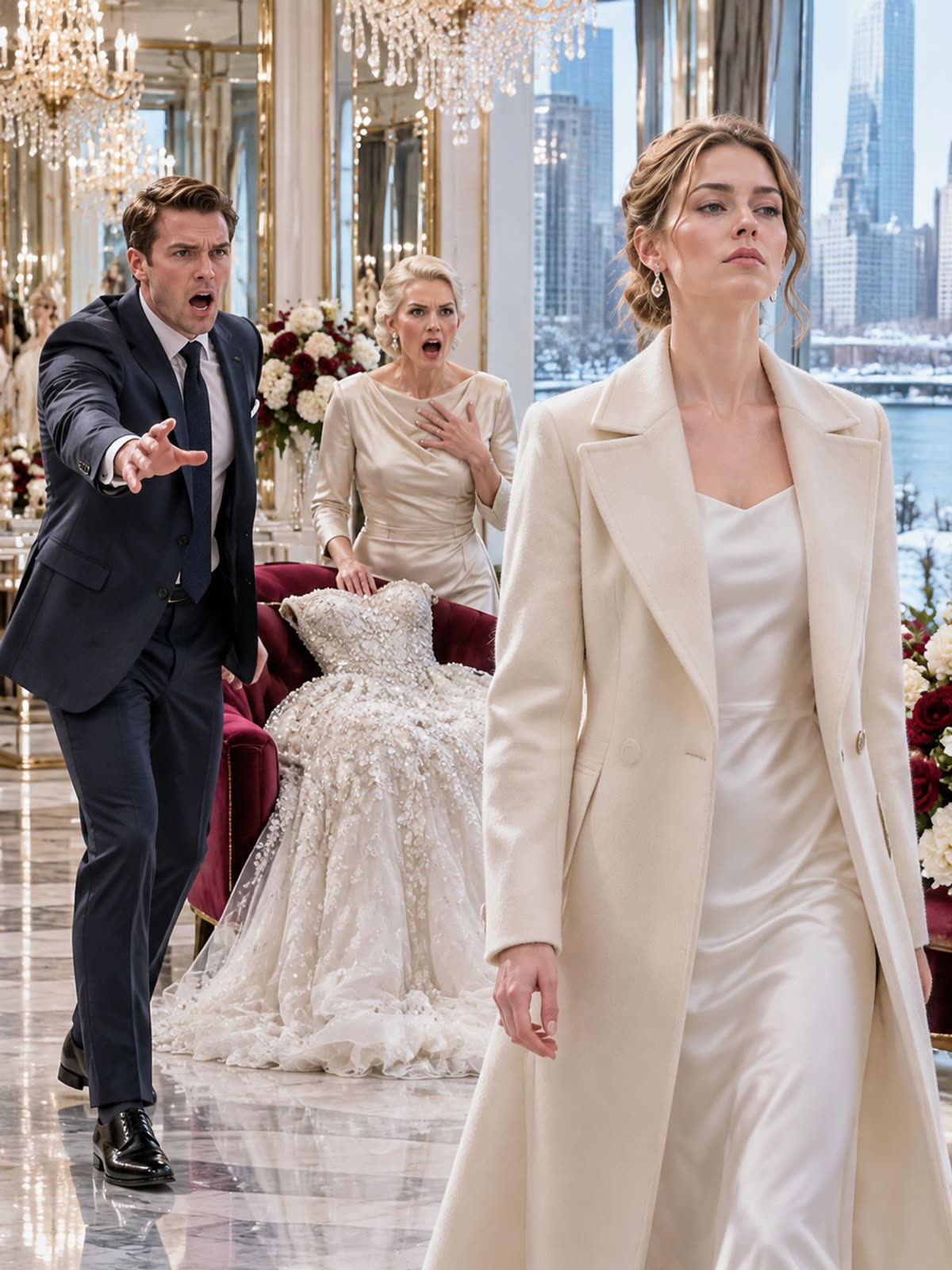
The bridal boutique stood thirty-eight floors above the Chicago River, high enough to make the city below appear immaculate and prosperous. Snow drifted past the windows like lovely ash. Under Italian chandeliers, surrounded by enormous mirrors, I stood inside a wedding gown worth more than the house where my mother had grown up. Its name was The Lake Star. Pearls had been sewn across the bodice by hand, and thousands of miniature crystals caught the light whenever I breathed. Behind me, the train spread like a sheet of frozen water. Everything about it was perfect, expensive, and unbearably heavy. This was supposed to be my final fitting. In twelve days, I would marry Alexander Whitmore.
Alexander sat opposite me in a burgundy velvet chair, one leg crossed over the other. His midnight-blue suit was the kind that made people lower their voices. A rare watch flashed at his wrist as he held his black coffee and studied me like something valuable he had purchased. There was no love in that look, only ownership. His mother, Evelyn, stood nearby in ivory silk, her silver-blond hair pinned into precise submission. Charles Whitmore faced the windows with his hands behind his back, apparently finding the whole appointment tedious. Their daughter, Brooke, kept scrolling on her phone and smiling to herself. I had spent three years learning how to exist among them: quietly, gracefully, gratefully, and without taking up too much space.
Our invitations had already reached senators, governors, judges, executives, and the old-money households of Lake Forest. The Palmer House ballroom had been booked for a year. White lilies were being flown in from California. Every name on the guest list had been weighed and negotiated as carefully as a diplomatic agreement. Society magazines had spent months anticipating the Whitmore wedding. Then Alexander lowered his coffee. “Emily, there’s been a change.” I found his reflection. “What kind of change?” His face remained perfectly composed. “The bride will be Vanessa.” A seamstress gasped and covered her mouth. I turned slowly, feeling the gown pull against my hips. Vanessa Hale. His childhood sweetheart. His first love. The woman who had left five years earlier while he fought his cousins for control of Whitmore Global.
She had gone to San Diego to “find herself,” then stayed away until he became chairman, until his face appeared on magazine covers, until defense and infrastructure contracts turned him into one of the most influential young executives in the country. “Say that again.” Brooke gave a little laugh. Evelyn looked annoyed, but not surprised. Alexander rose and slipped one hand into his pocket. “Vanessa was diagnosed last week with late-stage stomach cancer. The doctors say she may have six months. Maybe less.” The women attending my fitting looked away. One began trembling. I did not. “What does that have to do with our wedding?” His forehead creased, as though I were making him explain something embarrassingly simple. “It’s her final wish,” he said. “To walk down the aisle in a real wedding gown, in front of the people who matter, with me.”
I searched his expression for embarrassment, for the smallest acknowledgment of what he was asking. There was nothing. Evelyn moved forward. “Emily, be reasonable. You are healthy. You have time. Vanessa does not.” Charles turned from the window. “The Whitmore name cannot be dragged through gossip because of a sentimental adjustment.” “A sentimental adjustment?” Brooke finally looked up. “It’s not like you’re being dumped. Alex said he’ll marry you privately later. Somewhere discreet. After Vanessa passes.” Alexander nodded as if she had offered a generous compromise. “The invitations don’t need to change. Publicly, we’ll say you had a sudden medical issue and needed privacy. Vanessa will wear a veil. Most people won’t even know until the ceremony begins.” The room seemed to sway around me, but I stayed standing.
His voice softened into something almost affectionate. “You can attend if you want. Behind the scenes. The staff will arrange a uniform so no one bothers you.” A uniform. He wanted me hidden in staff clothing while another woman walked toward him wearing my gown, beneath my flowers, before the guests invited to the wedding I had spent a year arranging. My reflection glittered behind his shoulder like an offering. “For three years,” Alexander said, softening his voice, “my family has taken care of you. Your apartment, your clothes, your comfort, your reputation. You’ve never lacked anything. I’m asking you to be kind, Emily. Don’t become cruel over one ceremony.” Evelyn watched me with sharp eyes. “A woman’s grace is tested when she is asked to step aside.” I almost laughed. That was how their world worked: cruelty arrived dressed in manners, and humiliation was renamed grace.
I reached behind my back and began undoing the gown. The head seamstress straightened. “Miss Hart—” “It’s all right,” I said. Alexander’s expression hardened. “What are you doing?” I worked through the concealed buttons one at a time. The heavy dress slid from my shoulders, and I stepped clear of it in my plain white slip. I laid the most expensive bridal gown in Chicago across the velvet chair, where it collapsed like a wounded swan. Then I picked up my cream coat. “Send it to Vanessa’s hospital room,” I said. “If she wants my wedding, she may as well wear my dress.” His jaw tightened. “Don’t be dramatic.” I fastened my coat slowly, refusing to give him the spectacle he seemed to expect.
Alexander stepped toward me. “Emily, listen to me. This is temporary. You know your place in my life.” “No,” I said softly. “I finally know my place outside it.” Anger broke through his composure. “If you walk out of here, the Whitmore family’s protection ends today.” I lifted my handbag. Evelyn placed herself in my path. “Girls like you do not survive long after insulting families like ours.” I looked at the woman whose medicine I had organized, whose fever I had tended, whose fundraising speeches I had written. I had swallowed her insults because I believed love sometimes required endurance. Now I understood how easily endurance could become permission. I smiled at her. “Mrs. Whitmore,” I said, “you have mistaken silence for weakness.”
I walked out before any of them answered. Alexander called after me, his voice carrying through the boutique, but I did not turn. I should have understood that a quiet departure would never satisfy them. Losing a woman was not what frightened the Whitmores. Losing control of the explanation was. Three days later, they tried to destroy me without laying a hand on me. The first warning came from an old college friend: Emily, is this true? Attached was a medical report bearing my name, birth date, address, a physician’s signature, and the seal of a prestigious private hospital. The diagnosis claimed a congenital uterine abnormality and permanent infertility. Every detail looked official. None of it was true.
Within an hour, the document had spread through private society groups, anonymous accounts, gossip sites, business forums, and wedding pages. By noon, women who had smiled beside me at charity galas were calling me dishonest. By evening, the invented story had settled into place. Poor Alexander had supposedly discovered that his fiancée was barren just before the ceremony. He had tried to protect me, but a family requiring heirs could not accept such deception. Vanessa, fragile and dying, had become the innocent source of one last beautiful memory. I was the fraud who had hidden a defective body to secure a fortune. Alone in my downtown apartment, I read the accusations with a stillness that would have unsettled them. They did not know who I was. That was their first mistake. Assuming they could erase me was the next.

At three that afternoon, my doorbell camera showed Alexander standing outside with three glossy bags from an expensive Michigan Avenue bakery. He looked tired, not sorry. Men like him often mistook exhaustion for repentance. I opened the door and stayed in the entrance. “Emily,” he said, lifting the bags. “Your favorite lemon tarts.” I looked at his hands. “You forged a medical report.” His fingers tightened. Irritation crossed his face before he rearranged it into regret. “It was necessary.” “Necessary?” “You don’t understand the pressure I’m under. Canceling the wedding without an explanation would damage Whitmore Global. My parents were furious about Vanessa. I needed a reason people would accept.” “So you made me infertile.” He sighed as though I were determined to misunderstand him.
“It won’t matter forever. Gossip fades. I’ll tell people I chose to end it. You can live quietly. I bought you a house in Lake Forest. Three point eight million. It’s already in your name.” I stared at him, and he interpreted my silence as willingness. He moved closer. “You won’t be Mrs. Whitmore publicly, but I won’t abandon you. After Vanessa is gone, I’ll visit. I’ll take care of you. Anything you want, within reason.” The design of his cruelty was almost impressive. First he stole my wedding and destroyed my reputation; then he offered me a beautiful place to remain hidden. “Do you know falsifying medical documents is a crime?” His mouth curved. “Emily, don’t be naive. My legal team can bury anything.”
There was the man beneath the expensive suit. Not conflicted. Not noble. Simply certain that consequences belonged to other people. “You should take the house,” he said. “And leave Chicago before the wedding. Don’t force me to be harsher.” I smiled, quietly and without warmth. “Remember what you just said, Alexander.” His eyes narrowed. “Is that a threat?” “No,” I said. “It’s a timestamp.” I closed the door. For the first time in three years, his departure did not leave me crying. I went into my study, removed three engineering books from a low shelf, and pressed my thumb against a hidden biometric reader. A section of wall slid aside, revealing a steel safe. It held no jewels, photographs, or love letters. Nothing the Whitmores would have recognized as valuable.
I entered a thirty-two-character code. Inside were a matte-black encrypted satellite phone and a small alloy computer without a commercial logo. Before Alexander Whitmore’s quiet fiancée, there had been Dr. Emily Hart, chief materials scientist for a classified aerospace-defense initiative known within the Department of Defense and NASA joint command as Project Liberty Eagle. At twenty-nine, I had designed the essential framework of a heat-resistant superconductive composite capable of transforming American aerospace. Then a laboratory accident had nearly ended my life. Chemical exposure damaged my lungs and left neurological injuries. My doctors ordered an extended recovery. I stepped away from public science. Alexander met me during that recovery, when I was pale, worn down, and grateful for kindness. He mistook my reserve for a lack of ambition.
His family mistook my ordinary background for helplessness. Society women decided I was fortunate to have been chosen. Nobody asked why someone with no visible career possessed federal security clearance. I picked up the satellite phone and called a number I had not used for three years. The connection passed through layers of encryption. On the third ring, an older man answered. “Dr. Hart?” His voice shook slightly. “Professor Hayes,” I said. “It’s me.” There was silence, then the scrape of a chair. “Emily. My God. Are you safe?” “I’m safe.” “Are you recovered?” “Yes.” The next silence was heavier. “Then tell me you’re calling for the reason I hope you’re calling.” I looked at the false report on my desk and the separation agreement Alexander’s lawyers had sent beside it.
“My leave is over,” I said. “I’m ready to return to Project Liberty Eagle.” Professor Martin Hayes, my mentor and a former NASA legend, released a breath that seemed three years old. “You have no idea what this means,” he said. “The thermal shield calculations stalled without you. The country needs you back.” “I have some trash to clear first. I’ll be ready in three days.” “I’ll arrange extraction. Andrews Air Force Base can receive you.” “No,” I said. “Chicago first. Then Colorado Springs.” He paused. “Is someone threatening you?” Beyond my windows, the city lights surrounded the towers where Alexander believed his power reached everywhere. “Not anymore.” After the call, I signed the documents his attorneys had delivered, surrendering his money, houses, cars, and payment for my silence.
I placed the credit cards, jewelry, keys, and engagement ring into a courier box addressed to Whitmore Global headquarters. Then I packed one suitcase. No gowns or designer handbags. No carefully selected costume from the life they had arranged for me. Only my old clothes, my encrypted computer, and the person I had almost forgotten how to be. The following morning, Evelyn arrived with two private guards and entered before being invited. Her perfume spread through the apartment. “I heard you returned the ring,” she said. “Very theatrical.” I remained beside the kitchen island. “I returned everything.” She surveyed the room. “Do you think pretending you don’t want money makes you noble? My son was generous. A woman in your condition should be grateful anyone considered marrying her.”
“In my condition?” Her smile sharpened. “Infertile women have limited options, Emily. Especially ones whose reputations are already ruined.” I opened a folder and slid it across the counter. It listed every gift Alexander had given me, identifying what had been returned and what remained locked inside the family home. My signature appeared at the bottom. “You may inspect it,” I said. “I have taken nothing from your family.” Color rose in her face. “You dare speak to me like this?” “Yes.” Her eyes widened. Until then, she had only known the softened version of me. I stepped nearer. “Tell your son something for me,” I said. “He can keep the wedding, the dying sweetheart, the fake pity, and the family name he worships. But he does not get to keep my silence forever.”
Her laugh sounded thin. “Who do you think you are?” For a moment, I nearly answered. Instead, I smiled. “Someone your family should have researched before trying to erase.” She left with her guards and the jewelry. When the door closed, I washed my hands carefully. At sunset, a blocked number appeared on my phone. I answered, and a weak female voice whispered, “Emily? It’s Vanessa.” I said nothing. “I know you hate me,” she continued, coughing delicately. “But I’m going into treatment tomorrow. It may be my last chance to speak with you. I want to apologize. And there’s something of yours I want to return.” I closed my eyes. There was only one thing left.
Before she died, Alexander’s grandmother, Margaret Whitmore, had pressed an antique emerald ring into my palm. Of everyone in that family, she alone had understood me. “Never let them convince you you’re lucky to be tolerated.” I had left her ring in the mansion’s safe. If Vanessa now had it, Alexander had handed over the last sacred thing his family possessed. I had already returned everything he could claim. I had already arranged my departure. Still, that ring belonged to the memory of a woman who had seen what I was only beginning to admit. “I’ll come,” I said. Not for Vanessa. Not to make peace with Alexander. For the dead woman whose warning had reached me too late—and whose ring was now waiting in Vanessa’s hospital room.
PART 2 — The Wedding That Exposed Them
The Whitmore Medical Pavilion occupied the upper floors of a private hospital near Northwestern. Its cream-marble corridors were quiet, its nurses softer-spoken than the staff in any ordinary ward. Vanessa’s suite looked like an expensive hotel room arranged for someone who wanted an audience for her suffering. She rested against white pillows with her pale hair loose and her face powdered into an appearance of frailty. Near the window stood a mannequin wearing The Lake Star. Afternoon light caught the crystals of my wedding gown. Vanessa noticed my gaze and offered a tired smile. “Alexander wanted me to try it on,” she said. “He said it looked like it was made for me.” I stopped at the foot of the bed. “Where is the ring?”
Her eyes reddened with remarkable speed. “Emily, I’m so sorry.” “No audience here,” I said. “Save your strength.” For a second, something hard showed through her expression. She reached under a pillow and brought out a carved wooden box. The emerald shone against its black velvet lining. “Margaret wanted you to have it,” I said. “Alexander said I’m the future Mrs. Whitmore now.” Her voice stayed gentle, though her eyes were bright. “Still, I know I don’t have much time. I thought returning it might help you forgive him.” I took the box. For a moment, her fingers resisted before letting go. “You think you won,” I said. Her lips parted. “You took a man who could abandon a woman after three years, forge medical records, and hand another woman’s wedding to his ex. That is not winning, Vanessa. That is picking up a loaded gun because it shines.”
Tears ran down her cheeks. Almost immediately, the door burst open. Alexander came in. “Emily, what the hell are you doing?” He crossed to Vanessa and gathered her against him. “I only wanted to apologize,” she cried. “She said terrible things.” He glared at me. “She is dying.” I looked from the box to their carefully arranged embrace. “Of course she is.” His face twisted. “You are bitter because you lost.” “No,” I said. “I’m awake because I escaped.” Vanessa covered her mouth, her sobs growing louder. He pointed toward the door. “Leave. You have no place here.” I placed the emerald box on the bedside table. Surprise flickered across his face. “I came to see if there was anything in this family worth mourning,” I said. “There isn’t.”
“Emily,” he warned. I looked once more at the gown. “She can keep it. She can keep the ring. She can keep your name. I hope you both live long enough to understand each other.” Then I left. Vanessa’s crying faded before the door had finished closing. That night, Alexander’s secretary sent one million dollars to my account, accompanied by a request that I leave Chicago before the ceremony and avoid upsetting the important guests. I donated every dollar to a national scholarship fund for girls studying science and engineering. The sender’s name was Alexander Whitmore. My comment read: May this money help young women build futures no arrogant man can buy. I forwarded the receipt to his secretary, then blocked every Whitmore number. At nine, the satellite phone vibrated.
A military liaison spoke without hesitation. “Dr. Hart, extraction authorization confirmed. A secure motorcade will arrive at 0800. Aircraft departure from Midway restricted terminal at 0900. Destination: Peterson Space Force Base, Colorado Springs. Security classification: highest level.” “I’ll be ready.” Outside my window, Chicago glimmered in blue and gold. Across the city, florists were arranging the lilies I had selected. Chefs were preparing the seven courses I had approved. Musicians were rehearsing the song that had once belonged to my imagined future. Tomorrow, Alexander would stand before the country’s elite and marry his beautiful, dying lie. He thought I would disappear quietly enough to leave his story intact. By the time he believed the erasure complete, the country would know my name.
Morning arrived clear and brutally cold. I dressed in a white research uniform, secured my hair in a low knot, and picked up my alloy case. The apartment was spotless and empty. Nothing remained of the woman Alexander believed he had created. At precisely eight, three black armored SUVs entered the underground garage. They carried federal plates and no identifying logos. Four armed special operations escorts stepped out together. Their commander approached, stopped three feet away, and saluted. “Dr. Emily Hart. Special Security Unit Eagle assigned to escort you. Awaiting your instruction.” Nobody had addressed me that way in person for three years. Not Alexander’s fiancée. Not the poor girl his family had elevated. Not the subject of a fabricated diagnosis. Dr. Emily Hart. I lifted my chin. “Let’s go.” “Yes, ma’am.”
Our convoy passed through downtown beneath digital screens advertising the Whitmore ceremony. Alexander and Vanessa smiled from a polished portrait under the words LOVE BEYOND LIFE AND DEATH. I almost smiled. Love had nothing to do with what they were celebrating. At nine, the secure aircraft lifted away from Chicago, leaving the city beneath us in silver lines and winter haze. By 11:30, as we approached Colorado, the ballroom was filling with senators, governors, executives, lobbyists, media owners, and old-money heirs. The people who had laughed at my humiliation arrived in silk and diamonds to watch another woman wear my dress. Alexander waited beneath an arch of white lilies, handsome and composed. Vanessa came toward him under her veil, carrying fragility like another carefully chosen accessory.
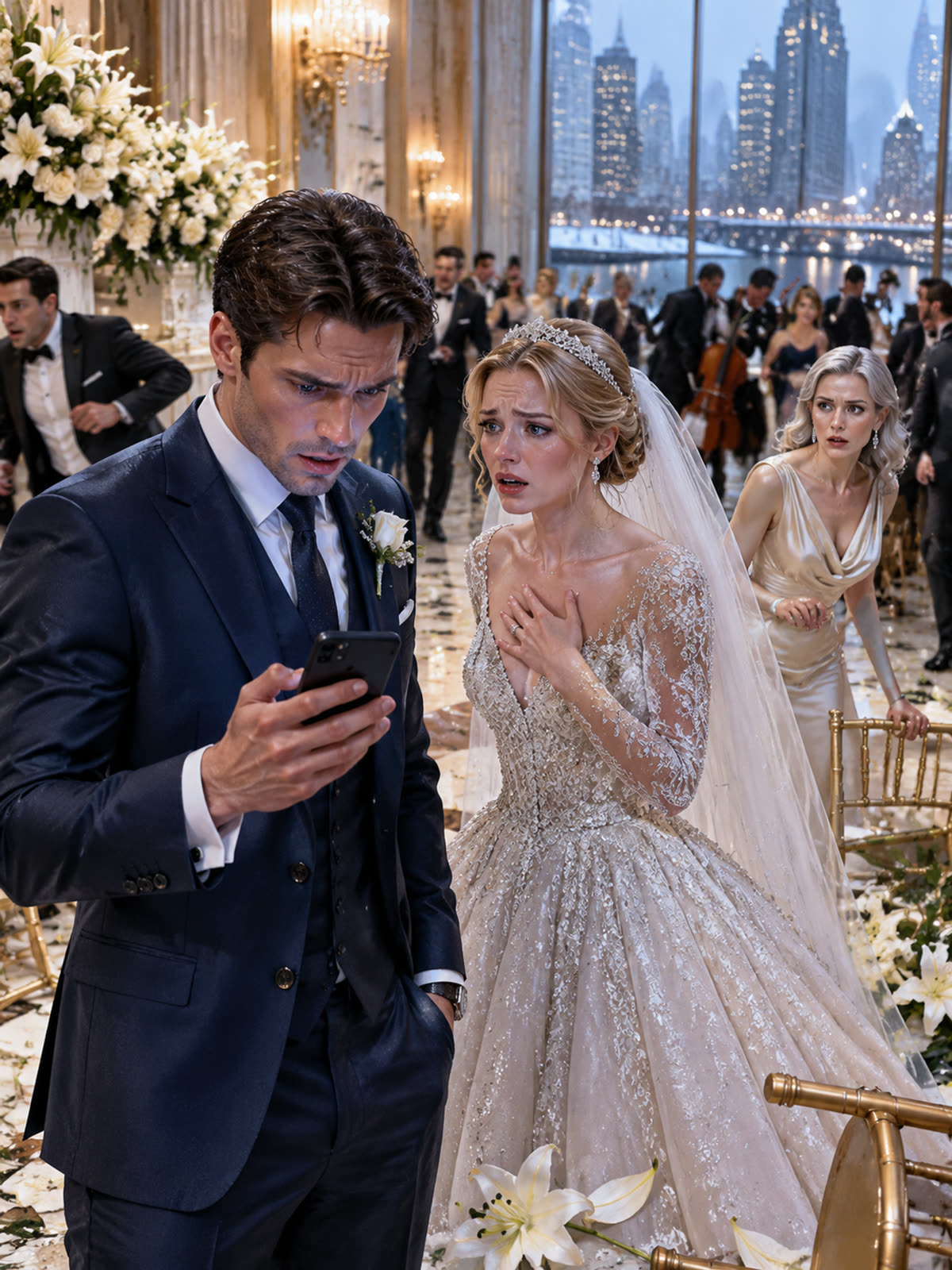
The officiant smiled. “Mr. Alexander Whitmore, do you take Vanessa Hale—” Every phone in the ballroom sounded at once. Not a handful. Hundreds. A federal-level urgent news alert had reached every device. The music stopped. The officiant fell silent. Guests looked down, and their expressions changed from confusion to shock, then fear. Alexander took his assistant’s phone. Across its screen was the official headline: NATIONAL SCIENCE HERO RETURNS: DR. EMILY HART, CHIEF SCIENTIST OF CLASSIFIED LIBERTY EAGLE AEROSPACE PROGRAM, DELIVERS BREAKTHROUGH MATERIALS RESEARCH TO U.S. DEFENSE COMMAND. Beneath it was my photograph. I was stepping from a secure aircraft in Colorado, white uniform bright against the waiting officials, my alloy case in my hand. Generals, NASA representatives, and federal security surrounded me. My head was high.
The assistant whispered, “Sir…” Alexander stood motionless. His face emptied of color. A guest in the front row dropped a champagne flute, and the breaking glass sounded like the first crack in something enormous. A retired senator rose, furious. “Whitmore, what have you done?” Charles got to his feet unsteadily. “There must be a misunderstanding.” The senator was already looking at the report. “You spread a forged medical record accusing a protected federal scientist of infertility? You let this room laugh at her?” Evelyn gripped her chair. “We didn’t know who she was.” He turned toward her. “That is not a defense. That is a confession of character.” All around them, the guests began calculating how quickly they could leave and how little evidence of their attendance they could carry away.
Nobody wanted a photograph beside the Whitmores. Nobody wanted to explain an association with the family that had publicly smeared a scientist working on classified national defense research. Phones kept vibrating. Aides whispered. Publicists scrambled. A defense contractor pulled Charles aside. “Our joint bid is suspended immediately.” A bank chairman said quietly, “We’ll need to review exposure.” A governor’s chief of staff left without a farewell. Within ten minutes, the season’s grandest wedding looked abandoned. Expensive shoes crushed white lilies. Chairs lay overturned, champagne soaked the carpet, and the string quartet packed with trembling hands. Vanessa remained at the altar in my gown, her veil shaking. “This can’t be real,” she whispered. “Alex, tell them it’s fake.” But Alexander could only stare at the photograph of the woman he had discarded.
For three years, I had shared his mornings, listened to his complaints, warmed soup when he worked late, and sat through his family’s dinners. I had let them think me simple because I believed keeping peace mattered more than defending pride. He had mistaken restraint for emptiness. Now the country could see what he had never bothered to recognize. Charles sank into a chair. Evelyn pressed a hand against her chest, her composure finally breaking. Brooke cried over her phone. “My friends are deleting pictures with us.” Alexander turned toward Vanessa. For the first time, he did not appear to see a tragic angel. He saw a woman wearing someone else’s gown in the wreckage of his reputation. “You said she was nobody,” he whispered.
Vanessa stared at him. “I—I didn’t know.” “You said she was just some quiet girl.” “You believed it too!” His laugh broke apart before it became a proper sound. Guests near the doors glanced back. He was beginning to understand that he had destroyed his home to warm himself beside a painted fire. By then, I had reached the secure research facility in Colorado Springs. Professor Martin Hayes waited outside the underground laboratory. Seventy-two years old, white-haired and sharp-eyed, he had always been too proud to cry in public. This time, he did. “Welcome home, Emily.” I shook his hand, and he pulled me into a brief, fierce embrace. Beyond him were supercomputers, containment chambers, and people who had never evaluated me by whether I was decorative enough to marry.
The researchers applauded. Some familiar faces had gone gray; some belonged to younger scientists who looked at me as though a missing equation had finally returned. I placed the alloy case on the central table. “The final lattice models,” I said. “Thermal tolerance projections, superconductive stabilization, and molecular repair simulations.” Hayes stared at me. “You kept working?” “Every day I could breathe.” He held my gaze. “And the people who hurt you?” On a wall display, muted footage showed the ruined wedding. “They have become irrelevant.” That was not entirely true yet. Soon it would be. Within two days, federal investigators began examining the false report, unlawful access to private records, coordinated digital defamation, and possible intimidation involving someone connected to classified defense work.
The hospital suspended two administrators. Whitmore Global’s stock plunged so sharply that analysts began describing the losses as a bloodbath. Three days after the wedding, Commander Reed brought a sealed report to my workstation. “Dr. Hart,” he said, “the investigation uncovered something you should know.” I removed my safety goggles and opened the file. Vanessa Hale did not have cancer. Not stomach cancer. Not another terminal condition. Her actual diagnosis was mild gastritis. A bribed hospital administrator had supplied the false oncology report. She had returned from San Diego carrying gambling debts and lawsuits, looking for money, status, and protection. Alexander’s old heartbreak and desire to play rescuer had made him an easy target. But the fraud extended beyond Vanessa’s invented illness.
The same administrator had arranged the infertility report after communicating with Vanessa and Alexander’s office. Alexander had wanted an explanation the public would accept. Vanessa had wanted me discredited. Their involvement was recorded in different forms, but both had left a trail. “What happens now?” I asked. Reed stood straight. “Vanessa Hale has been arrested for fraud, bribery, falsification of medical documents, and conspiracy. The hospital administrator is cooperating. Alexander Whitmore is under investigation for defamation, intimidation, and involvement in distribution of falsified medical records.” “And Whitmore Global?” “Audits. Contract freezes. Federal review of all defense-adjacent projects. Their partners are running.” I closed the folder. I felt no delight, only the clear finality of a door being shut. “Proceed according to law,” I said. “No favors. No private revenge. No mercy outside the legal process.” “Yes, ma’am.”
While my team ran simulations that night, Alexander left questioning and returned to a city that no longer bent around him. The next morning, his grandfather came back from Maine. Harrison Whitmore had built the company from inherited steel wealth and government contracts. Legacy mattered to him more than affection. At first, he showed no anger. He sat in his wheelchair at the Lake Forest mansion, breathing through oxygen tubes, and read every page the lawyers placed before him. Then he summoned Alexander. Attorneys lined the wall. Evelyn cried without making a sound. Charles looked as though he had aged twenty years. Alexander entered pale and unshaven, still wearing the suit from his destroyed wedding. “Grandfather,” he began.
Harrison hurled a stack of legal documents at his chest. “You stupid, arrogant child.” Alexander recoiled. “I gave you a corporation,” Harrison said, voice thin but lethal. “You gave me a federal scandal.” “I didn’t know who Emily was.” The old man’s eyes burned. “You didn’t need to know she was important to know she was human.” The room went silent. Harrison raised a shaking hand. “Effective immediately, Alexander Whitmore is removed as chairman and stripped of all executive authority. Trust access suspended. Corporate residence revoked. Personal accounts frozen pending legal review.” Alexander dropped to his knees. “Grandfather, please.” “You wanted to throw women away like furniture,” Harrison said. “Now learn what it is to be thrown out.” There was nobody in the room willing to contradict him.
By sunset, guards had escorted Alexander out of the mansion. His company car, credit cards, rare watch, security clearance, office, and apartment were gone. So was the protection that had always accompanied his surname. At the gates, icy rain fell over the man who had threatened to drive me from Chicago. He stood with a thin coat and a phone that no one seemed willing to answer. Finally, he called Vanessa. She picked up from house arrest. “Alex?” she said sharply. “Did you fix it?” His voice was barely audible. “I lost everything,” he whispered. “But we still have each other.” Silence followed. Then she laughed—not weakly, not painfully, and certainly not with love. “You idiot,” she said. “I came back for Whitmore. Not for you.”
PART 3 — The Life Beyond His Reach
Alexander found Vanessa in a cheap rental outside Joliet, where she was living under monitored release while awaiting trial. The building smelled of mildew and old cigarettes, and rain leaked through a crack in the stairwell ceiling. She opened the door because she thought he had money. Her expression changed at the sight of his hollow face. “You look awful.” “I need you,” he said. She folded her arms. “Need me for what? You’re useless now.” He stared. “You said you loved me.” “You wanted to hear that.” “You said you were dying.” “And you wanted to save me. It worked until you ruined it.” His voice cracked. “I ruined it?” Then he added, “You forged your diagnosis.” Her answer was immediate. “You forged hers.”
The words struck harder than a slap. Vanessa leaned toward him, her eyes bright with hatred. “Don’t pretend you were noble. You needed Emily humiliated so people wouldn’t ask why you replaced her. You wanted your perfect tragic romance and your clean reputation. You are not a victim, Alex. You are just stupid.” He caught her wrist. “I gave up everything for you.” She pulled away. “You gave up a national treasure for a lie because your ego liked being worshiped.” The argument became so vicious that neighbors called the police. By morning, the tabloids had both their names again, not as lovers defying death, but as disgraced opportunists fighting in a rental hallway. After investigators discovered Vanessa trying to move concealed funds through a cousin in Nevada, her bail was revoked. She was taken away in handcuffs, shouting that Alexander had promised to protect her. He watched from the curb. No driver arrived. No lawyer hurried over. His mother did not call.
In Colorado, Liberty Eagle had reached its most difficult phase. For months, I worked eighteen-hour days beside Professor Hayes, Commander Reed, and a young theoretical physicist named Dr. Nathan Cole. Nathan had come from Caltech without the arrogance people sometimes excused in prodigies. Tall, sandy-haired, and precise, he wore gold-rimmed glasses and had a habit of setting coffee beside my workstation before I noticed I needed it. He never brought up Alexander. He never treated what had happened to me as interesting gossip. One night at two, we sat over another failed molecular simulation. “You know, people always talk about betrayal like it breaks you. Sometimes I think it reveals the exact places where you were bending too far.” I looked over my mug. “That sounds personal.”
“It is,” he said. “But tonight it’s also mathematically relevant. Your lattice design is bending too far at the stress nodes.” For the first time in weeks, I laughed. We repaired the model before morning. Six months later, the heat-resistant superconductive shield passed its first full-scale simulation. The laboratory exploded into cheers, and Hayes no longer tried to conceal his tears. Official announcements were restrained, patriotic, and deliberately vague. Inside the program, we knew what the result meant. A field that had remained stalled for years had moved forward by decades. I had returned from a life spent disappearing into someone else’s shadow and completed the work I had been meant to do. The achievement did not erase what had happened. It made clear how much of my life remained beyond it.
Whitmore Global continued collapsing. Federal audits exposed inflated contracts, political favors, shell vendors, and compliance failures unrelated to me but rooted in the same certainty that wealth prevented accountability. Banks demanded repayment. Partners withdrew. Directors resigned. The company sold failing divisions, then its headquarters, then the Lake Forest estate. Harrison suffered a stroke during restructuring and retired permanently from public life. Charles and Evelyn moved quietly to a smaller home in Connecticut, accompanied by lawsuits and social exclusion. Brooke married into another family and stopped using Whitmore professionally. Alexander tried old friends, then consulting work, then interviews blaming Vanessa. Each attempt closed another door. A year later, he was doing temporary jobs under a shortened name: moving event equipment, driving delivery vans, and cleaning offices occupied by people who had once sought his approval.
One winter night, he appeared beyond the outer boundary of the Colorado facility. He had become gaunt. His hair was long and untidy, his shoes split from walking. The security cameras showed him kneeling in the snow near a checkpoint, hands lifted. “I need to see Dr. Hart,” he shouted. “Tell her Alexander is here. Tell her I’m sorry.” Reed showed me the footage in the control room. “Should we detain him?” Alexander lowered his forehead to the snow. “Emily! Please! I was wrong! I’ll do anything. I’ll be nothing. Just let me apologize.” There had been a time when seeing him suffer would have broken something in me. That woman belonged to another life. “I don’t know that man,” I said. Reed nodded. “This is a restricted federal facility,” I continued. “Remove him according to protocol. If he returns, turn him over to local authorities.” “Yes, ma’am.” I returned to the simulation display while security led him away.
Two years after the wedding that never became mine, Washington prepared for a ceremony under a pale November sky. Flags lined Constitution Avenue. Police barriers guarded the entrance to the National Academy Hall, news vehicles crowded the streets, and spectators gathered to see scientists whose work had become a source of national pride. I arrived in a black official sedan with a security escort. Instead of a research uniform, I wore a tailored navy suit and a small silver eagle pin. My hair was swept back, my makeup simple, my posture entirely my own. When the door opened, voices rose. “Dr. Hart!” “Emily!” “Liberty Eagle!” Nathan stepped out on the other side and offered his arm. “Ready?” he asked. “For the cameras or the medal?” “For whatever comes after both.” I took his arm, and we walked beneath the flags as colleagues who had faced impossible equations and trusted each other with the truth.
A journalist called, “Dr. Hart, what does this honor mean to you?” I stopped. “It means the work mattered. And it means no one should ever mistake quiet dedication for weakness.” By evening, those words would be national headlines. Beyond the barriers stood Alexander in a sanitation uniform, holding a plastic bag of empty bottles. His cheeks were hollow, his face weathered. He had come after seeing the ceremony announced on a shelter television, still mistaking nearness for a chance at forgiveness. Spectators whispered. “That’s Dr. Emily Hart.” “She was engaged to that Whitmore guy, right?” “The one who dumped her for the fake cancer woman?” “Imagine being stupid enough to throw her away.” Each remark made him flinch. Nathan leaned close and said something the microphones could not hear. I laughed freely. Alexander pushed forward. “Emily!” Officers stopped him. “Emily, please! Just look at me!”
I turned. Our eyes met, but my heart did not move. I saw a man who had mattered because I had given him meaning. Without that attachment, he was a stranger carrying part of my history. My gaze passed over him, and I turned back to Nathan. “Shall we?” His eyes searched mine, gentle and steady. “Yes.” We went inside together. Behind us, Alexander collapsed against the barrier, sobbing until police removed him. Inside, the President presented our team with the National Medal for Scientific Achievement. Hayes stood beside me with shaking hands while the audience applauded. At the reception, he brought me sparkling cider. “You know,” he said, “when you first called, I worried revenge would consume you.” “It didn’t.” “No.” He smiled. “Work did.” I watched the capital lights. “Not work,” I said. “Purpose.”
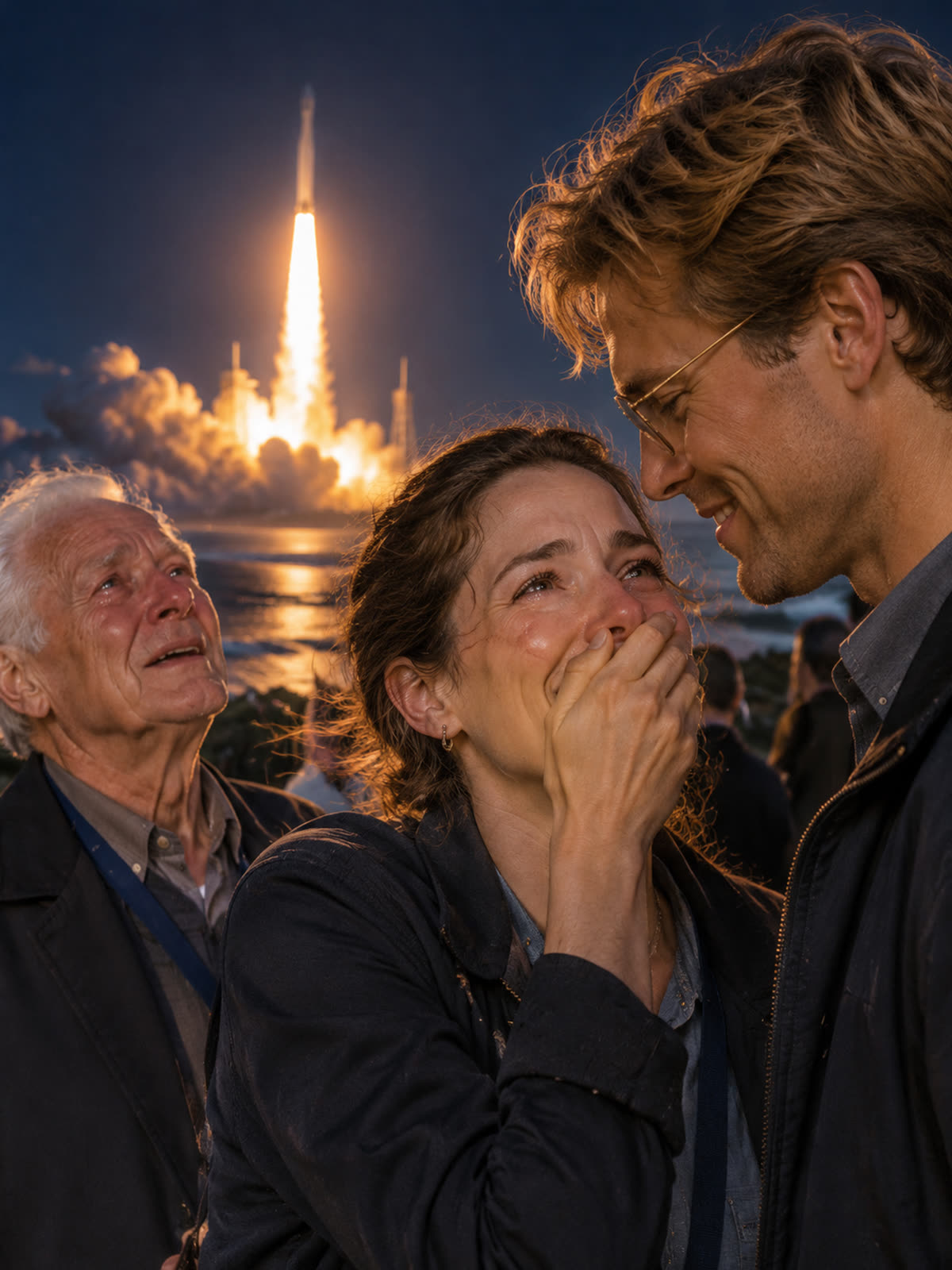
The following spring, Vanessa received ten years in federal prison for fraud, bribery, falsifying medical records, and related conspiracy charges. The administrator testified under a plea agreement. Alexander avoided prison on some charges but remained financially ruined, socially toxic, and permanently barred from executive leadership in regulated industries. Whitmore Global was dismantled and sold; its headquarters became ordinary leased office space. I stayed with Liberty Eagle until the first orbital systems using our material launched successfully. On launch night, Nathan and I stood at Cape Canaveral with Atlantic wind moving around us. The rocket lit the darkness like another sunrise. When the booster cleared the tower, Hayes cried again. Nathan leaned close. “That’s your wedding march.” I laughed through tears. Perhaps he was right. A woman’s future did not have to begin along an aisle. Sometimes it rose into the sky on fire.
Five years after leaving the bridal salon, I stood on the observation deck of a mountaintop research facility overlooking the San Diego coast. A satellite moved across the darkness above me. The sky looked endless. A soft wool coat lay around my shoulders, carrying the faint scent of cedar and coffee. Nathan came out with two mugs of tea. “You’ll freeze out here,” he said. “I wanted to see the orbit.” “It’s perfect.” I smiled. “The satellite or the night?” He looked up. “Both. But I meant you.” I rolled my eyes, even as warmth spread through me. Those five years had not made life effortless. They had made it honest.
I still worked too much. Nathan still left coffee where I would forget to look. Hayes had retired, though his weekly calls often included complaints that retirement wasted a perfectly functional brain. Reed sent a card every December, signed without any message, which somehow felt deeply affectionate. I had learned that peace was not a life without pain. It was a life without betraying myself. Once, I had believed love required becoming softer, smaller, and easier to keep. I had mistaken being selected by a powerful man for being safe. But velvet cannot turn a cage into freedom. Alexander had not destroyed me. He had shown me what self-erasure cost.
The woman who walked away from that fitting had not been heartless. She had not been cruel. She had finally stopped bowing before people who called humiliation grace. News of Alexander reached me occasionally and without invitation. Someone said he had been seen outside a Chicago shelter, muttering about the chairman he had been and the fate that had betrayed him. Someone else said he stood beneath public screens whenever aerospace coverage appeared, watching my face as though he could not stop returning to the same punishment. None of it stirred me. There was no pleasure, no sorrow, no wish to intervene. The absence of feeling was not another wound. It was the measure of how far I had traveled.
Vanessa remained in a federal women’s prison, where beauty, borrowed gowns, and an appearance of fragility could buy her nothing. The society publications forgot her. Their readers moved on to newer scandals. In her third year, she sent a letter requesting a statement of forgiveness that might help an appeal. I returned it without opening it. Some doors do not need to be slammed for their closure to be final. They simply stay closed. I had spent too long allowing other people’s demands to shape the limits of my life. I no longer believed that moving forward required offering access to everyone who regretted losing it.
The following spring, Nathan and I married quietly at a small vineyard near Santa Barbara. There were no senators, corporate heirs, or ballroom guests calculating bloodlines against bank balances. My ivory dress was simple and moved easily around me. My mother cried. Hayes delivered a speech that began with orbital mechanics and somehow arrived at love. Reed stood near the back in a dark suit, still watching the trees as if the habit could not be switched off. At dusk, beneath string lights and old oaks, Nathan and I exchanged our vows. He did not promise to protect me as if I were breakable. He promised to stand beside me when the work became difficult, tell the truth when it mattered, and never require me to dim myself so that he could appear brighter. That was enough.
Years later, young women sometimes asked how I had survived the betrayal, the public humiliation, and the loss of the life I had nearly chosen. I gave them the clearest answer I knew. “You survive by remembering that your value was never held in the hands of the person who betrayed you. They only made you forget where you placed it.” Then I repeated something Hayes had once told me after a failed experiment. “Pressure does not only break things. Sometimes it reveals what they are made of.” I knew what pressure had revealed in Alexander. More importantly, I finally understood what it had revealed in me.
The last time I saw Margaret Whitmore’s emerald ring, it was sealed inside an evidence container during the investigation. When proceedings ended, it passed to the estate’s creditors and was sold anonymously at auction. I did not bid. Once, I had believed recovering it would preserve the one decent thing that family had given me. Later, I understood that Margaret’s kindness had never lived inside the stone. Her warning had already done its work. I no longer needed to carry a dead woman’s protection on my hand. I had learned how to become my own.
For the fifth anniversary of Liberty Eagle’s public success, Nathan and I returned to the observatory above San Diego. At exactly 9:17 p.m., the satellite we had helped create crossed the sky, a moving point of brightness among thousands of stars. Nathan touched my hand. “Do you ever think about what would’ve happened if he hadn’t done it?” he asked. I watched the satellite approach the shadow. “Yes,” I said. “I would have married him.” The truth rested between us without reopening the wound. “I would have spent years trying to earn kindness from people who had none to give. I would have mistaken endurance for love. I might have forgotten my own name.”
His fingers closed around mine. “And now?” Beneath the mountain, San Diego shone along the coast. Above us, the universe stretched beyond ruined weddings, fallen heirs, old scandals, and rooms where women had once cried unheard. I breathed in the cold air. I was not Alexander Whitmore’s abandoned bride. I was not the diagnosis on a counterfeit report. I was not the disgrace they had invented to make themselves look merciful. I was Dr. Emily Hart: scientist, wife, daughter, and friend. A woman who had left a stolen wedding behind and found her way into the sky. “Now I know no one can steal a life from you once you decide to stop handing them the keys.” The satellite disappeared into shadow. This time, when the stars called, I never looked back.
Disclaimer: This story is a work of fiction inspired by real-life themes. Names, characters, places and events are fictionalized, and any resemblance to real persons is purely coincidental. Images are for illustration purposes only.
