

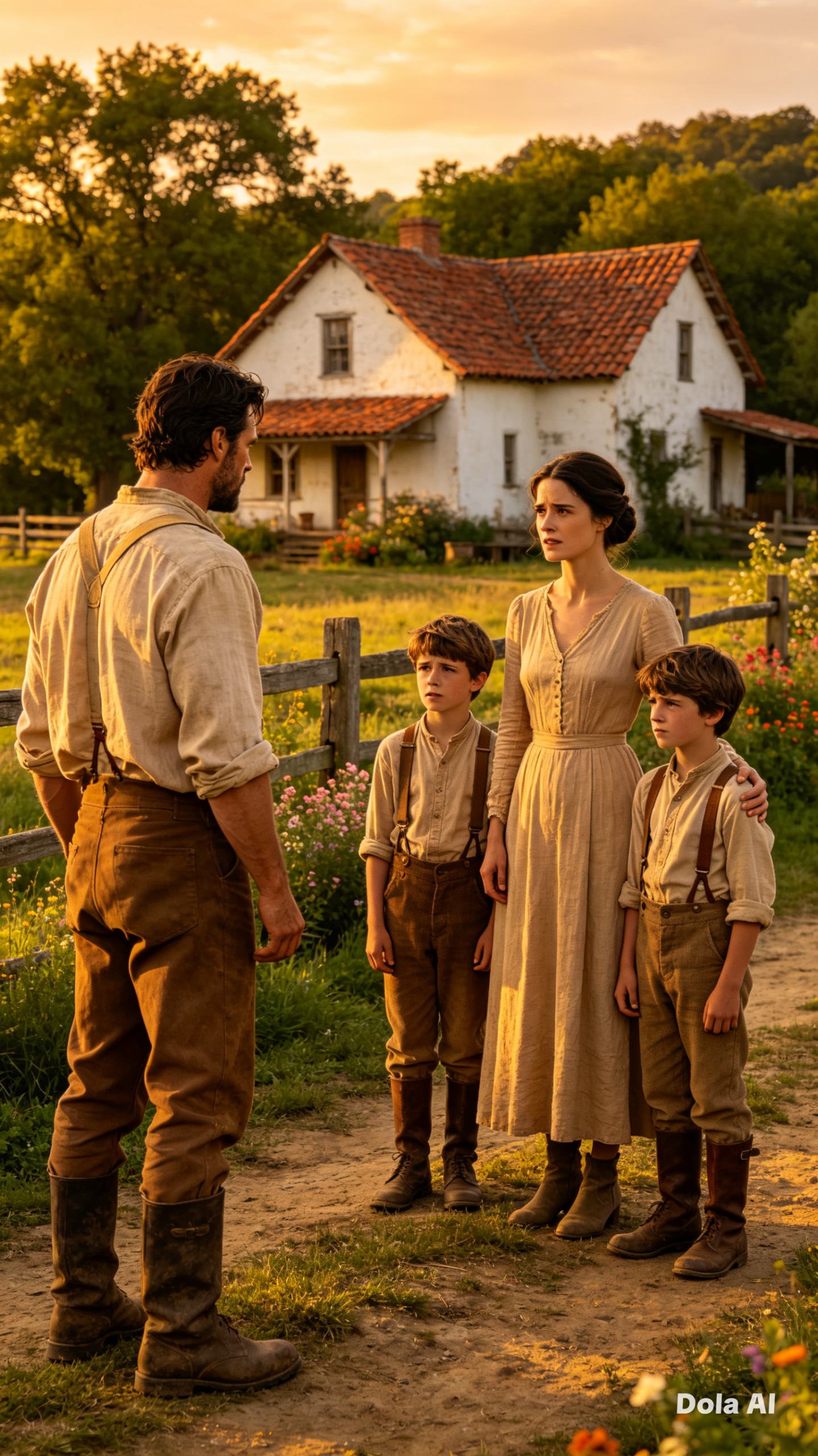
Clara Montoya arrived at El Encino Ranch with two hungry children, a bag of clothes slung over her shoulder, and the shame of asking for shelter in a house where no one was expecting her.
She had been walking from San Miguel del Río since before dawn. The dust from the road covered her skirt, her shoes had rubbed blisters onto her feet, and the Jalisco sun burned the back of her neck as though it, too, wanted to punish her for having been abandoned.
Her children walked behind her.
Tomás, 14, walked with his jaw clenched and his eyes hardened. Ever since his father disappeared, he had become a boy of few words and endless anger. In his pocket, he carried an old pocketknife that had once belonged to that cowardly man, and sometimes he squeezed it as though that piece of metal could answer the questions no one knew how to answer.
Mateo, 11, stayed close beside his mother. He still had the face of a little boy, although the past few months had filled his eyes with sadness. Every so often, he looked at Clara without saying a word, hoping she would promise that everything would turn out all right.
But Clara no longer dared to make promises.
Her husband, Julián Montoya, had left three months earlier, saying he was going to the village to sell a few mules and would be back before Sunday. He never returned. Instead, the store’s debt collectors showed up, followed by the landlord of the room they had been renting and a notice listing debts Clara had never signed for.
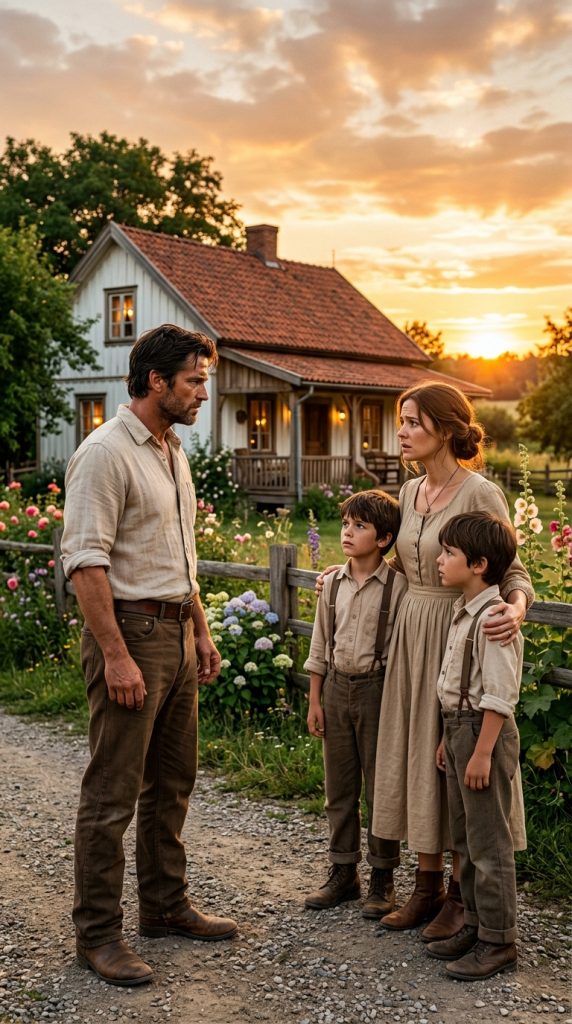
Julián had taken the little money they had left and abandoned his family with nothing but hunger, humiliation, and threats.
When the landlord gave them two days to move out, Clara sold her best rebozo, bundled their clothes into a blanket, and followed the only useful advice Doña Remedios, an elderly woman who knew everyone in the region, had given her.
“Go to El Encino,” she told her. “Don Esteban has lived alone ever since his wife passed away. He has land, livestock, and a house, but what he’s missing is someone who can bring that place back to life.”
Clara had no idea whether the man would welcome her or send her away before hearing her out. She only knew that no mother stands still while her children are hungry.
The ranch house appeared late that afternoon, its whitewashed walls gleaming beneath faded blue doors, with a stone porch and an old bougainvillea climbing one corner. Everything looked clean, orderly, and sturdy.
And yet, it seemed sad.
Like a house that had never fallen apart simply because no one had given it permission to collapse.
Don Esteban Rangel was in the corral when he saw them arrive. He was 45 years old, with a weathered face, several days’ worth of beard, and the hands of a man who had accomplished far more with them than with words. His wife had died eight years earlier, and ever since then, he had buried himself in work: waking before sunrise, tending the cattle, checking the crops, repairing fences, eating alone, and sleeping in a bed that felt far too large.
He wasn’t cruel.
He had simply grown emotionally distant.
When Clara stopped in front of him, he wiped his hands on his pants and looked at her without stepping too close.
“Good afternoon,” she said, forcing herself not to lower her eyes. “My name is Clara Montoya. Doña Remedios told me you needed someone to help with the house.”
Esteban looked at the boys.
Tomás met his gaze with open defiance.
Mateo hid slightly behind his mother.
“And their father?” Esteban asked.
Clara felt the question slice through her.
“He left. He left us with debts and never came back.”
She didn’t cry. She didn’t beg. She didn’t use dramatic words.
“I’m not asking for charity. I know how to cook, wash clothes, mend clothes, care for small animals, and keep household accounts. I’ll work in exchange for a roof over our heads and food for my children.”
Esteban remained silent.
He looked at the exhausted but unbroken woman. He looked at the older boy, as hard as freshly split stone. He looked at the younger one, frightened and quiet. Then he turned toward his own house, its windows closed and its stove long gone cold.
In that moment, two lonely souls recognized one another without saying a word.
“Just help me take care of the house,” Esteban finally said. “I’ll take care of your children.”
Tomás let out a bitter laugh.
“No one needs to take care of me.”
Esteban wasn’t offended.
“That’s what every young colt says before it learns not to break its own legs.”
Clara felt her eyes fill with tears, but she refused to let them fall.
“Thank you.”
“Don’t thank me just yet. Around here, everyone works.”
“That’s the only thing we have left.”
That night, Clara lit the stove that had been cold for days. She found beans, corn, a little dried chili, and some lard. She cleaned the table, opened the windows, dusted everything, and prepared a simple dinner.
When Esteban came inside, he stopped in the doorway.
The house smelled like food.
Not like stale smoke or silence.
Like real food.
Clara set four plates on the table.
“Everyone eats together here,” she said.
Tomás wanted to protest, but hunger won. Mateo sat down quietly. Esteban took his place at the head of the table as though the seat itself had become unfamiliar after so many years.
For several minutes, no one spoke.
Then Mateo tasted the beans and murmured,
“They taste just like the ones my grandmother used to make.”
Clara smiled faintly.
It was the first crack in the sadness that had settled over the house.
The days that followed were filled with hard work.
Clara got up before everyone else, swept the yard, kneaded tortillas, washed clothes, mended shirts, and hummed old songs as she opened the windows. Little by little, the house stopped looking abandoned. Clean curtains fluttered in the breeze. Wildflowers decorated the table. The stove stayed lit.
Meanwhile, Esteban took the boys out to the corral.
Mateo learned quickly. He fed milk to an orphaned calf that he named Lucero because of the white patch on its forehead. He brushed it, talked to it, and ran to see it every morning.
Tomás pretended not to care.
“That’s work for little kids,” he would say.
But he always watched from the corner of his eye.
One day, Esteban asked him to close the pasture gate. It was a simple task, but an important one, because the newly planted cornfield was nearby, and the cattle could ruin it.
Tomás, annoyed that no one had asked his opinion about living there, carelessly failed to latch the gate properly before walking away, kicking stones as he went.
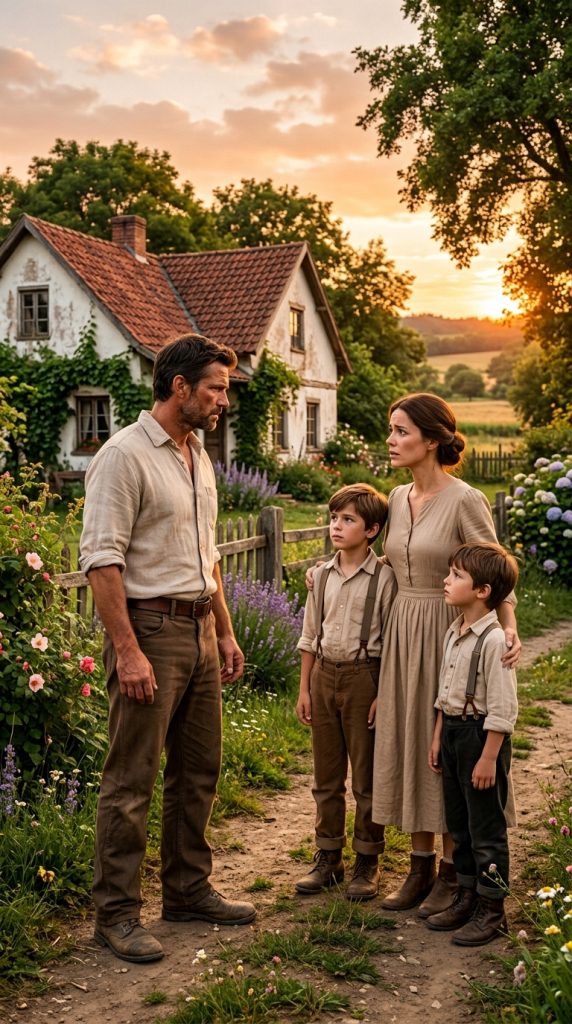
Before dawn, several head of cattle wandered into the young cornfield. They trampled the furrows, crushed the tender plants, and one pregnant heifer disappeared into the hills.
When Esteban discovered the damage, he called for Tomás.
“Did you latch the gate properly?”
The boy lifted his chin.
“Yes.”
Esteban walked over to the gate and pointed at the mud.
The evidence was unmistakable.
The latch had never been fully secured.
Tomás felt his face burning.
He waited for the shouting.
He waited for the blow.
He waited to be called useless, just as his father had done so many times.
But Esteban simply sat down on a tree stump.
“Come here.”
Tomás didn’t want to obey, but he did.
“A crop can be replanted,” Esteban said. “A gate can be repaired. A lost cow can be found. But when a man’s word is broken, it’s much harder to mend than any fence.”
Tomás clenched his fists.
“I’m not a man.”
“Then start becoming one today.”
The boy lowered his eyes.
“My dad used to make promises too.”
“And then he left.”
Tomás swallowed hard.
“Yeah.”
Esteban lowered his voice.
“That’s why you’ll have to make a choice. You can become like the man who ran away, or like the one who chooses to stay, even when it hurts.”
That night, Tomás took Julián’s pocketknife out and studied it in the candlelight. He had always seen it as a reminder of his father. That night, it looked more like a test.
The next day, without anyone asking him to, he went to the pasture gate. He adjusted the latch, reinforced the wire, and checked three times to make sure it couldn’t come open.
Esteban watched him from a distance without saying a word.
But Tomás knew he had seen him.
Weeks passed.
The ranch began to change. Mateo laughed again. Tomás no longer spent all day kicking stones. Clara paid off small portions of the debt with eggs, fresh cheese, and embroidered pieces she sold at the market. Esteban stopped eating alone. In the evenings, after dinner, he sat on the front porch drinking coffee while Clara mended clothes and the boys cleaned the tools.
A new kind of peace settled over them.
It wasn’t the kind of love found in novels or built on quick promises. It was something stronger: the trust that grows between people who work side by side, look at each other through exhaustion, and still choose to keep going.
But the past came back one market morning.
Clara was selling cheese in the town square when three men walked in, making a commotion. One of them was Julián.
He was thinner now, with an unkempt beard, a hat tilted to one side, and the same easy smile that had convinced Clara to marry him years earlier.
Tomás froze.
Mateo took a step backward.
Clara felt as though the ground had disappeared beneath her feet.
“Well, well,” Julián said, looking over her stand. “Looks like my wife has done pretty well without me.”
“I’m no longer your wife, so don’t speak to me like that,” Clara replied.
Julián burst into laughter.
“That’s for a judge to decide, not you. And those boys are mine.”
Tomás slipped his hand into his pocket.
The pocketknife was still there.
Julián noticed and smiled.
“Go ahead, son. Let’s see if they’ve turned you into a man over at that stranger’s ranch.”
The entire square fell silent.
Tomás felt his anger rise into his throat. He remembered the nights of hunger, his mother’s tears, the debts, the humiliation. He wanted to pull out the knife and wipe that smile off his father’s face once and for all.
But then he remembered Esteban.
“A man’s strength isn’t measured by what he destroys, but by what he can master within himself.”
Tomás let go of the pocketknife inside his pocket.
He straightened his back.
“My mother doesn’t owe you her fear. And neither do we.”
Julián’s expression changed.
“You ungrateful brat.”
“No. You’re the ungrateful one. You’re the one who left us hungry.”
People around the square began whispering. The owner of the general store came out carrying the black debt ledger.
“Julián Montoya,” he called out loudly. “Now that you’ve come back, you can finally answer for everything you signed.”
Julián took a step backward.
He hadn’t expected that.
Just then, Esteban arrived with the wagon to pick Clara up. He didn’t shout. He didn’t raise a hand. He simply stepped between Julián and the family.
“You’re not taking anyone away by force.”
Julián spat on the ground.
“And who do you think you are? Their father?”
Tomás stepped forward.
“A father is the one who stays.”
The words rang through the square like the toll of a church bell.
Julián looked at his oldest son, and for the first time, he no longer saw the wounded little boy he had abandoned. He saw a young man standing firm, his eyes clear and unwavering.
The men in the square moved closer. The town constable, alerted by the shopkeeper, arrived a few minutes later. It turned out Julián not only owed money at the store, but had also sold several mules that didn’t belong to him before running away.
That afternoon, they took him away under arrest.
Clara didn’t celebrate.
She simply hugged Mateo and took a deep breath, like someone finally setting down a heavy stone she had carried for far too long.
That night, the family returned to the ranch beneath a sky thick with storm clouds. Tomás remained quiet, but something about his silence had changed. It was no longer bitterness.
It was the exhaustion of someone who had won a battle within himself.
“You did the right thing,” Esteban said.
Tomás kept his eyes on the road.
“I wanted to pull out the knife.”
“But you didn’t.”
“Because I heard your voice.”
Esteban didn’t answer right away.
“Then it wasn’t just my voice anymore.”
The storm arrived before dawn.
First came the wind, lifting clouds of dust into the air. Then came the heavy, furious rain pounding against the tin roof. Within minutes, the creek overflowed, and the frightened cattle broke through toward the lower pasture.
Esteban grabbed his raincoat and a lantern and headed outside.
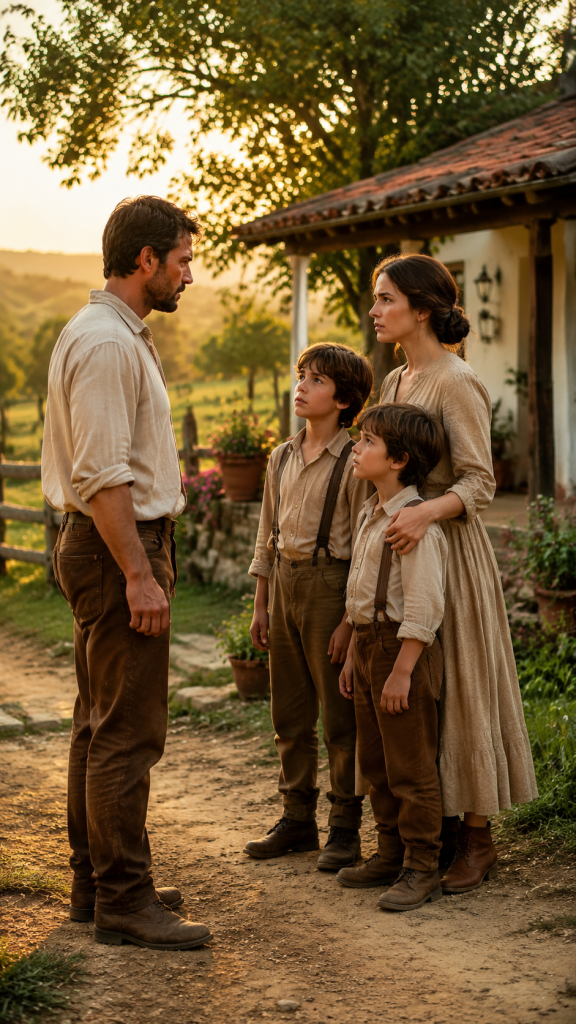
Clara followed him to the doorway.
“Be careful!”
The boys woke to the sound of thunder. From the window, they saw Esteban struggling through the mud, trying to drive the cattle toward higher ground.
Then a bolt of lightning lit up the scene.
Esteban fell.
He had twisted his leg near the creek, where the water was rising fast.
“Don Esteban!” Mateo shouted.
Clara tried to run outside, but Tomás stopped her.
“I’ll go.”
“No, son.”
“He came for us when we had nowhere else to go.”
Tomás and Mateo ran out into the rain.
The mud swallowed their boots. The wind lashed their faces. They reached Esteban, and he tried to order them back.
“It’s too dangerous!”
Tomás crouched beside him, slipped an arm over his shoulders, and lifted him with a strength he never knew he possessed.
“You said a man stays.”
Mateo supported him from the other side. Together, the two boys dragged him to the shelter.
But the cattle were still in danger.
Lying on the ground, Esteban began giving instructions. Tomás followed them with a precision that seemed almost miraculous. He didn’t shout at the animals. He didn’t strike them. He guided them one by one toward higher ground, using a steady voice and open hands, just as he had been taught.
Mateo ran to find Lucero, the calf, who was trembling beside a broken fence. He gathered the frightened animal into his arms, crying with both fear and love.
One pregnant heifer was trapped in the mud near the creek. Tomás waded in up to his waist, looped a rope around her neck, and shouted for Mateo to pull. The current pounded against them. For one terrifying moment, Mateo slipped and nearly fell into the rushing water.
Tomás let go of the rope and threw himself toward his brother.
He grabbed him by the arm.
“I’m not letting go of you!”
Mateo was crying.
“I’m scared!”
“So am I. But I’m not letting go.”
They managed to make it out safely.
Then they went back for the heifer.
When the worst of the storm had finally passed, the cattle were safe, the shelter was still standing, and although the crops had taken a beating, they had survived.
Clara welcomed them into the house with towels, hot broth, and tears she no longer tried to hide. She treated Esteban’s injured leg with bandages and medicinal herbs. The boys sat close to the stove, covered in mud, shivering, but alive.
Esteban looked at both of them.
“Today, you saved my life.”
Mateo shook his head.
“You saved us first.”
Tomás lowered his eyes.
“I didn’t know how to be anyone’s son.”
Esteban swallowed hard.
“And I didn’t know how to be a father again.”
Clara covered her mouth to keep herself from sobbing.
The next morning, the sky was perfectly clear. The fields smelled of freshly washed earth. The harvest hadn’t been lost. On the contrary, the final rain had given it new strength. Days later, they filled sack after sack with grain, sold corn, cheese, and livestock, and Clara was finally able to pay every last cent of the debt Julián had left behind.
The shopkeeper drew a line through her name in the black ledger.
“You don’t owe anything anymore.”
Clara closed her eyes.
For the first time in months, she was free.
The town’s opinion changed. The same people who had once whispered about the abandoned woman now spoke of her sons with admiration. They said Tomás was a young man whose word could be trusted. They said Mateo was hardworking. They said Esteban no longer looked like a ghost wandering through his own ranch.
One afternoon, several weeks later, Esteban gathered Clara and the boys on the front porch.
He was holding a document.
“I went to see the notary,” he said.
Clara tensed.
“Did something happen?”
“Yes. What happened is that this house isn’t empty anymore.”
Tomás stopped carving the piece of wood in his hands.
Esteban continued.
“I spent many years believing that people eventually get used to loneliness. It’s not true. You simply learn to speak more quietly so you don’t have to hear it. When you arrived, I thought I was giving you a roof over your heads. But you gave me a family.”
Clara already had tears in her eyes.
“Don Esteban…”
“Esteban,” he gently corrected. “If you want, this ranch will legally become your home. I’ve already signed the papers stating that Tomás and Mateo will be my heirs, along with any children God may—or may not—choose to send us. And Clara, I’d like to ask you something… with no debts, no pity, and no rush.”
She understood before he could finish.
“I don’t want a woman to take care of the house,” he said. “I want to spend whatever years I have left walking beside the woman who brought it back to life.”
Tomás stood perfectly still.
Mateo smiled as though he had been waiting for those words forever.
Clara looked at the man who hadn’t rescued her with sweet words, but with bread, shelter, work, respect, and patience.
“I didn’t come here looking for a husband,” she said.
“I know.”
“I came here looking for a way to save my children.”
“And you did.”
“Not by myself.”
Esteban held out his hand.
Clara took it.
There was no lavish wedding. There was a simple church service, a meal in the courtyard, bougainvillea flowers, and the entire town gathered to celebrate. Mateo led Lucero, wearing a ribbon around his neck. Tomás, dressed in a clean shirt, walked beside his mother—not as an abandoned boy, but as a proud young man.
When the priest asked who was giving the bride away, Tomás looked at Esteban, then at Clara.
“No one is giving her away,” he said. “She made it here on her own. We’re simply walking beside her.”
Everyone laughed through their tears.
Years later, in San Miguel del Río, people still told the story of the woman who had arrived with two children and a bundle of clothes, and of the widower who opened his door without realizing that God was giving him his life back.
El Encino Ranch once again became a home filled with laughter, hot coffee, honest work, and long Sunday family meals.
Tomás kept Julián’s pocketknife locked away in a box—not as a wound anymore, but as a reminder of everything he had chosen not to become. Mateo grew up caring for animals and never forgot Lucero. Clara planted flowers beside the front porch. Esteban learned how to laugh again without feeling the need to apologize for it.
And every afternoon, as the golden sun bathed the corrals in warm light, Clara looked at her family gathered together and thought that sometimes a door opens just when you believe you’ve reached the end of the road.
Because she had arrived with nowhere left to go.
And in the end, she found the place where everyone—even the man who opened the door—had been waiting to come home.
