


PART 1: THE MORNING MY HUSBAND THREW AWAY A $73 MILLION FUTURE
The morning I became $73 million richer was also the morning my husband decided I no longer mattered.
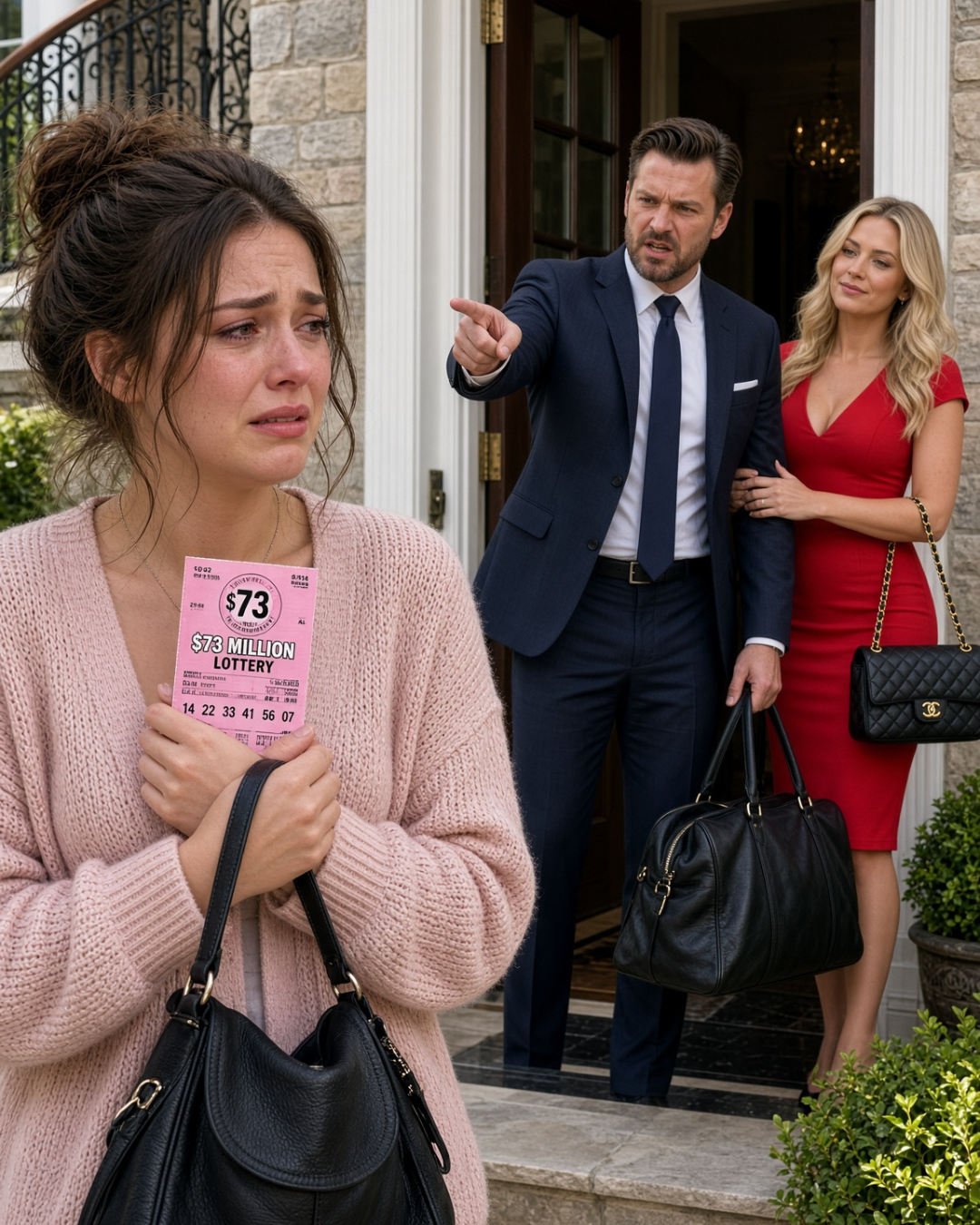
He walked through our front door with another woman beside him, smiled as though he were delivering perfectly ordinary news, and told me to pack my belongings.
What he didn’t know was that twelve hours earlier, I had purchased a two-dollar lottery ticket that would change my life forever.
And by the time he discovered the truth, he would have already destroyed everything he thought belonged to him.
It started with a cup of coffee.
The previous evening, I had stopped at a gas station on my way home. I was tired after another long day, thinking about bills, household expenses, and the design studio I had dreamed of opening for years.

As the cashier handed me my coffee, he jokingly suggested that I could use a little good fortune.
I laughed and purchased a two-dollar lottery ticket.
It was an impulsive decision.
I had never seriously expected to win anything.
After dinner, I stood at our kitchen counter and scratched the ticket.
At first, I thought I had misunderstood the numbers.
I checked them once.
Then again.
Then a third time.
My fingers trembled so badly that my phone slipped from my hand.
Seventy-three million dollars.
I stared at the ticket, barely breathing.
For several minutes, I couldn’t move.
Then I began laughing.
Not because I knew what to do with that much money, but because I suddenly understood how many things could change.
Our mortgage could disappear.
My mother would never have to worry about her house payments again.
Mark and I could finally take the vacation we had postponed year after year.
And perhaps, after six years of putting my own ambitions aside, I could open the small design studio I had always wanted.
For most of our marriage, Mark had insisted that his career needed to come first.
Whenever I mentioned my business plans, he reminded me that his professional opportunities were more important to our financial future.
So I waited.
I worked extra shifts.
I helped cover our expenses.
I told myself that one day, when Mark was established, there would finally be room for my dreams.
That night, I imagined telling him about the lottery ticket.
I pictured his surprise, his laughter, and the two of us celebrating together.
I barely slept.
At 6:14 the following morning, headlights appeared in our driveway.
Mark’s car.
He wasn’t supposed to return from his business trip until Friday.
I hurried downstairs, excited that I might get to surprise him sooner than expected.
The winning ticket was safely tucked inside a plastic sleeve in my purse.
I was already smiling when the front door opened.
Then I saw the woman standing beside him.
She was tall and blonde, carrying an overnight bag.
Mark walked inside as though nothing unusual had happened.
“Meet Vanessa,” he announced.
I looked from him to the woman.
Vanessa offered a restrained smile.
Mark loosened his tie.
“I’m tired of pretending our marriage is working. Take your belongings. I’m leaving you to be with her.”
For one moment, the room seemed to tilt.
Six years of marriage had been reduced to a single announcement.
I remembered our modest courthouse wedding.
Our first apartment.
The evenings when we ate inexpensive noodles because every spare dollar went toward Mark’s future.
I remembered supporting him through unemployment, financial problems, and two disappointing promotions.
I remembered the year I worked extra shifts because his income wasn’t enough to cover our expenses.
And now he was standing in our living room with another woman, speaking as though I were an inconvenience he had finally decided to remove.
“Are you certain?” I asked.
He chuckled.
“Don’t embarrass yourself, Claire.”
I had expected those words to hurt more than they did.
Instead, something inside me became remarkably clear.
I quietly fastened my purse.
Vanessa looked around our living room.
“Mark told me this house practically belongs to him anyway.”
Practically his.
I almost laughed.
The down payment had come from money my grandmother left me.
I had personally transferred those funds, and I had preserved every bank statement and supporting document.
Mark gestured toward the staircase.
“You have until Sunday to stay here. Then I expect your keys.”
I nodded.
“Certainly.”
His smile widened.
He seemed to interpret my calm response as surrender.
But I wasn’t surrendering.
I was thinking.
I went upstairs, entered our bedroom, and locked the door.
Then I removed the winning ticket from my purse and stared at it again.
Seventy-three million dollars.
Less than an hour earlier, I had imagined sharing that fortune with my husband.
Now I realized I needed to protect myself before making any decisions about it.
My first call went to the telephone number listed on the official state lottery website.
My second went to a divorce attorney.
My third went to an accountant.
By breakfast, Mark believed he had abandoned a financially struggling wife.
He had no idea that I had suddenly become wealthier than anyone he personally knew.
My attorney, Rachel Kim, listened carefully as I explained what had happened.
She did not celebrate the lottery win.
Instead, she asked detailed questions.
When had I purchased the ticket?
When had Mark announced the separation?
What state did we live in?
How had we acquired our home?
What records did I have concerning our savings, investments, and debts?
Then she gave me advice that would prove invaluable.
“Photograph the ticket, secure it inside a bank safe-deposit box, and don’t make any public announcements until we understand how the winnings will be treated under your state’s marital-property laws.”
I listened carefully.
“The dates matter,” Rachel continued. “And so does the origin of every dollar you already possess.”
She explained that sudden wealth did not automatically erase a spouse’s legal rights.
The prize might complicate the divorce rather than simplify it.
My responsibility was to make complete disclosures, document everything, and avoid any attempt to conceal assets.
I agreed immediately.
I didn’t want to cheat Mark.
I wanted a fair divorce.
And I wanted the truth about our finances to come out.
Throughout our marriage, Mark had mocked my habit of keeping old statements, receipts, and tax documents.
He called it unnecessary.
I called it being careful.
Now those records were about to become some of the most important things I owned.
Before noon, Rachel uncovered something disturbing.
Mark had apparently been preparing to divorce me for months.
He had opened a separate bank account.
He had redirected portions of his salary.
He had also used an undisclosed credit card to pay for hotel stays, expensive gifts, and trips involving Vanessa.
But one transaction troubled me more than the others.
Three weeks earlier, Mark had transferred $38,000 from our shared emergency savings into an account solely under his control.
I stared at the statement.
“He claimed our investments had performed badly.”
Rachel examined the records.
“They hadn’t.”
I felt a different kind of betrayal settle over me.
Mark hadn’t simply fallen in love with someone else.
He had been quietly rearranging our finances while allowing me to believe we were struggling together.
That evening, he returned home carrying champagne.
Vanessa accompanied him.
On her wrist was a bracelet I recognized from a transaction Mark had once described as a “client present.”
He placed a stack of documents on the kitchen island.
A proposed separation agreement.
“You take your vehicle and personal possessions,” he explained. “I retain the house, retirement savings, and investments. We separate without complications.”
I looked at the papers.
“You expect my signature tonight?”
“It’s a fair offer, Claire.”
According to his proposal, I would receive less than $20,000.
I had contributed more than $160,000 toward our household and property expenses.
Vanessa poured herself champagne.
“I’d accept it. Beginning again at your age won’t be simple.”
I was thirty-four.
I smiled politely.
“I’ll consider it.”
Mark’s expression tightened.
“Don’t prolong everything simply because you’re upset.”
“I’m not upset.”
And strangely enough, I meant it.
I had been hurt.
I had been shocked.
But the more Mark spoke, the more determined I became to handle everything carefully.
I would not sign away my rights because he demanded it.
And I would not allow his confidence to convince me that his version of our marriage was the truth.
The following morning, Rachel submitted preservation notices concerning our marital accounts and requested complete financial disclosures.
My forensic accountant began tracing the missing funds.
Then another discovery changed the entire situation.
Mark’s supposed business trip had never been legitimate.
He had charged his employer for Vanessa’s flights to Miami, hotel accommodations, and expensive restaurant meals.
Those expenses had been presented as client-development costs.
His employer’s policies classified such conduct as expense fraud.
I stared at the records in disbelief.
For months, Mark had been telling me that his work required sacrifice and understanding.
Meanwhile, he had been using his company’s money to finance trips with his mistress.
“Should we tell his employer?” I asked Rachel.
“Not yet,” she replied. “Let’s preserve the evidence and proceed carefully.”
I agreed.
There was no need to act impulsively.
Mark had already made enough careless decisions for both of us.
I leased a modest apartment and moved my belongings.
I took my grandmother’s furniture, my personal possessions, and the things I had purchased with my own money.
I left the rest untouched while the legal process continued.
On Sunday, Mark stood near the front door as I handed him my keys.
He looked extraordinarily pleased with himself.
“See? There was no reason for things to become unpleasant.”
I met his eyes.
“No,” I replied. “There really wasn’t.”
He closed the door behind me.
I walked to my car without looking back.
Three days later, I formally claimed my lottery winnings through the legal arrangement Rachel had recommended.
The claim was documented properly, with the necessary disclosures and professional guidance.
After mandatory tax withholding and financial planning, the funds were carefully managed while the divorce proceedings continued.
Mark knew nothing.
Lottery officials scheduled a public announcement for Friday.
Rachel scheduled our financial-disclosure conference for Thursday.
When she called to confirm the appointment, her voice was calm.
“Claire, we’re ready.”
I looked at the photograph of my grandmother on the table in my new apartment.
Then I thought about Mark’s smug expression as he took my keys.
He believed Thursday would be the day he convinced me to accept his unfair agreement.
But he had no idea what was waiting inside Rachel’s final folder.
And when he finally saw it, his entire expression would change.
PART 2: THE THREE FOLDERS THAT DESTROYED HIS CONFIDENCE
Thursday morning arrived with clear skies and a quiet sense of anticipation.
I woke early in my rented apartment.
For several minutes, I lay in bed staring at the ceiling.
The apartment was much smaller than the house Mark had insisted belonged to him.
There was no spacious kitchen island.
No carefully decorated living room.
No extra bedroom where I had once imagined setting up my design studio.
But the silence felt different here.
Nobody was criticizing my plans.
Nobody was reminding me that my career mattered less than his.
Nobody was telling me what I was allowed to want.
For the first time in years, the space around me felt entirely my own.
I made coffee, reviewed the documents Rachel had sent me, and dressed for the meeting.
The winning ticket had already been validated and claimed.
My financial team was handling the funds.
But I knew the divorce would still require careful legal decisions.
The lottery prize was enormous.
That did not mean I could ignore the laws governing marital property.
Rachel had been very clear about that.
We would disclose everything.
We would follow the legal process.
And we would insist that Mark do the same.
When I arrived at the conference room, Rachel was already waiting.
Three folders lay neatly arranged in front of her.
“Are you ready?” she asked.
I nodded.
“I think so.”
She studied my expression.
“You don’t have to prove anything today. Just let the documents speak.”
I sat beside her.
A few minutes later, Mark entered with Vanessa and his attorney.
He wore an expensive suit and the familiar expression of a man who believed every negotiation would end in his favor.
Vanessa walked beside him, carrying a designer handbag.
She glanced at my simple outfit, then at the conference room, and gave me a faint smile.
Mark settled into his chair.
“Are you finally prepared to be sensible?”
Rachel didn’t respond to the insult.
She opened the first folder.
“Mr. Bennett, your financial disclosures omitted two bank accounts.”
Mark’s smile weakened slightly.
Rachel continued.
“You also transferred $38,000 from marital savings, and approximately $27,000 was spent during your outside relationship.”
Vanessa’s expression changed.
Mark’s attorney leaned forward.
“Are those figures accurate?”
Mark gave an impatient shrug.
“They’re being exaggerated.”
Rachel calmly placed the supporting bank statements on the table.
There were account numbers, dates, transfers, and transaction records.
Each figure was supported by documentation.
Mark’s attorney examined the papers.
His expression grew increasingly serious.
I watched Mark shift in his chair.
He had always been comfortable making financial decisions without explaining them to me.
Now someone was asking him to account for those decisions in detail.
Rachel pointed toward the emergency savings transfer.
“This money was removed from a jointly held account three weeks before the separation announcement.”
Mark frowned.
“It was for investments.”
“Then we will need the investment records.”
He hesitated.
Rachel continued without raising her voice.
“The documents provided so far do not support that explanation.”
I remembered the evening Mark had told me our investments had performed poorly.
He had spoken with such certainty.
I had believed him.
I had even offered to take additional work if we needed to rebuild our savings.
Now I understood that the money hadn’t disappeared because of market conditions.
It had been moved without my knowledge.
Mark looked toward me.
“Claire, you know finances were never your strong point.”
I almost smiled.
For six years, I had maintained our household records.
I had tracked our expenses.
I had preserved the documents he dismissed as unnecessary.
And those records were now sitting directly in front of him.
Rachel opened the second folder.
“These documents suggest personal travel expenses were submitted to your employer as legitimate business costs.”
Mark froze.
She laid out the relevant records.
Flights to Miami.
Hotel accommodations.
Restaurant expenses.
Charges presented as business-related travel.
Vanessa stared at the papers.
Mark’s complexion faded.
“Did you contact my employer?”
“No,” I answered. “The evidence came from your own financial records.”
His attorney quietly removed his glasses.
The room fell silent.
For the first time since the meeting began, Mark looked directly at me without smiling.
He seemed to be trying to determine how much I knew.
I wondered whether he remembered all the evenings he had told me not to question his professional decisions.
He had insisted that I didn’t understand the demands of his career.
Now those demands were being examined one transaction at a time.
Mark cleared his throat.
“What exactly are you asking for?”
I answered before Rachel could.
“A fair and truthful divorce.”
He gave an uneasy laugh.
“You’re renting a one-bedroom apartment. Don’t pretend you’re holding all the cards.”
Rachel glanced toward me.
I gave a small nod.
She reached for the final folder.
Mark leaned back, apparently expecting another financial statement.
Instead, Rachel placed a photocopy of my officially validated lottery claim on the table.
For a moment, he didn’t react.
He glanced at the document.
Then he looked again.
His eyes moved toward the amount.
Seventy-three million dollars.
Vanessa leaned forward.
“Seventy-three million dollars?”
Complete silence filled the room.
Mark picked up the paper.
He studied it as though the numbers might rearrange themselves if he stared long enough.
“You actually won?”
I nodded.
“One night before your return.”
He looked at me.
Then at Rachel.
Then back at the document.
I could almost see him calculating.
The house.
The savings.
The retirement accounts.
The business opportunities he had once dismissed.
And now, the fortune he hadn’t known existed when he brought Vanessa into our home.
His expression changed.
The disbelief slowly disappeared.
Something more familiar took its place.
Calculation.
Then, astonishingly, affection.
“Claire, please listen. I made a terrible mistake. We can work things out.”
Vanessa turned sharply toward him.
“A mistake?”
Mark ignored her.
He leaned forward.
“Six years is a long time. We shouldn’t throw everything away because of one bad decision.”
I stared at him.
One bad decision.
That was how he described months of deception.
The secret accounts.
The missing savings.
The trips with Vanessa.
The unfair separation agreement.
The morning he stood in our living room and ordered me to leave.
I remembered supporting him when he was unemployed.
I remembered covering our expenses when his income wasn’t enough.
I remembered postponing my dream of opening a design studio because he insisted his ambitions mattered more.
And I remembered the moment he looked me in the eye and said, “Don’t embarrass yourself, Claire.”
Now he was asking me to reconsider.
Not because he had suddenly understood how deeply he hurt me.
But because he had discovered the amount of money I possessed.
“No,” I replied. “You already helped me find my answer.”
Mark’s expression hardened.
He looked toward his attorney.
“Can she even keep all of that?”
Rachel answered calmly.
“My client’s lottery claim has been fully and properly disclosed.”
She explained that no money had been concealed.
The court would apply the relevant state law to determine how the lottery winnings, property, accounts, debts, and other marital assets should be treated.
There were no promises that the prize would automatically belong entirely to me.
Nor would Mark automatically receive whatever he demanded.
The law would determine each person’s lawful entitlements.
And his undisclosed transfers would remain relevant regardless of the lottery winnings.
His questionable expense claims would also need to be addressed appropriately.
Mark’s attorney examined the documents again.
Then he requested a break.
As they left the room, Vanessa walked several steps ahead of Mark.
She didn’t look at him.
He tried speaking to her, but she continued toward the hallway.
Rachel waited until the door closed.
Then she turned toward me.
“How are you feeling?”
I thought about the question.
I had imagined this moment several times.
Part of me had expected to feel triumphant.
Another part had expected to cry.
But sitting there, surrounded by documents and legal folders, I felt something quieter.
Relief.
Mark finally knew the truth.
I no longer had to pretend that the money didn’t exist.
And I no longer had to listen to him describe our marriage as though my contributions had been meaningless.
“I’m all right,” I said.
Rachel nodded.
“Good. Remember, this is still a legal process. We need to stay focused.”
“I know.”
When Mark returned, his confidence had disappeared.
He barely spoke.
His attorney asked for additional time to review the disclosures and discuss the financial issues.
Rachel agreed to proceed through the appropriate channels.
There would be no rushed agreement.
No pressure to sign away property.
No private arrangement designed to benefit whichever spouse made the loudest demands.
Everything would be documented.
As the meeting ended, Mark approached me.
“Claire.”
I stopped.
He glanced toward Rachel, then lowered his voice.
“Can we talk privately?”
I shook my head.
“Anything important can go through our attorneys.”
He looked hurt.
For a moment, I wondered whether he understood how often I had felt dismissed during our marriage.
Then he spoke again.
“You know I loved you.”
I looked at him.
The words sounded strange now.
I had once wanted desperately to hear him say them.
But after everything that had happened, they no longer carried the meaning they once had.
“Mark, I wanted a marriage where we respected each other.”
He opened his mouth.
I continued.
“You made your decision before you knew about the lottery ticket.”
Then I walked away.
By evening, Mark’s employer had placed him on administrative leave while conducting an independent review of his expense claims.
The investigation was separate from our divorce.
I had not contacted his employer to demand punishment.
The company was responsible for reviewing its own records and determining whether its policies had been violated.
Within two weeks, Mark’s employment ended.
He was also instructed to reimburse improperly claimed expenses.
When I heard the news, I didn’t celebrate.
Losing a job was serious.
But I also understood that his professional consequences came from decisions he had made himself.
Meanwhile, the divorce proceedings continued.
Rachel and my accountant worked carefully to establish the origin of our assets, the nature of our debts, and the extent of the money Mark had moved or spent.
The $38,000 transfer remained a central issue.
So did the expenses associated with his relationship with Vanessa.
Mark’s proposed separation agreement, the one he had tried to make me sign over champagne, was no longer the basis for negotiations.
The court would determine a lawful division.
I was prepared to respect that decision.
Even if Mark was legally entitled to part of the lottery winnings, I would not try to conceal the prize or deny him what the law required.
I wanted fairness.
Not revenge.
One afternoon, Rachel called with another update.
“The court has reviewed the financial records concerning the disputed expenditures.”
I sat down.
“What does that mean?”
“It means the evidence of marital waste will be considered in determining the property division.”
I closed my eyes.
For months, Mark had behaved as though I had no right to question where our money went.
Now the transactions were being examined in a legal setting.
I thanked Rachel and ended the call.
Then I looked around my little apartment.
On the dining table lay sketches for a design studio.
For the first time in six years, I was seriously planning to open it.
I had spoken with financial professionals.
I had begun considering locations.
And I was learning how to manage sudden wealth without allowing it to become another source of chaos.
I was also thinking about my mother.
For years, she had worried about her mortgage.
I wanted to help her become financially secure.
But I was determined to make every decision carefully.
The lottery ticket had changed my circumstances overnight.
Building a meaningful life with that money would take more time.
Then another update reached me.
Vanessa had left Mark.
The woman who had stood in my living room and suggested that starting over at thirty-four would be difficult was no longer beside him.
I didn’t call him.
I didn’t ask for an explanation.
I simply returned to my work.
Because by then, I had begun to understand something important.
Winning the lottery had given me financial freedom.
But leaving a marriage in which my dreams were constantly dismissed was giving me something I had wanted for much longer.
The freedom to decide who I wanted to become.
And eight months after Mark walked into our home with Vanessa, I would finally stand inside the place I had spent six years imagining.
This time, no one would be there to tell me my dream wasn’t important.
PART 3: THE LIFE HE NEVER BELIEVED I COULD BUILD
Eight months after my husband brought his mistress into our home and demanded a divorce, I stood outside a beautiful brick building with my name displayed above the entrance.
For several seconds, I simply stared at the sign.
My design studio.
The dream I had postponed for six years was finally real.
Sunlight streamed through the large front windows.
Inside, employees were arranging materials, reviewing samples, and preparing for the day.
I could hear laughter coming from the worktables.
I smiled.
For years, I had imagined what it might feel like to walk into a business I had built around my own ideas.
I had pictured a bright workspace filled with talented people, creative projects, and opportunities to do work that mattered.
But every time I brought up the idea during my marriage, Mark found a reason to discourage me.

It wasn’t the right time.
We couldn’t afford the risk.
His career needed our attention.
My plans could wait.
And I had allowed them to wait.
I told myself that marriage required compromise.
That supporting my husband was part of building our future.
That one day, when his professional life was secure, he would support my ambitions too.
But that day never came.
Instead, Mark returned from a supposed business trip with Vanessa and told me to leave.
I remembered standing in our living room, the winning lottery ticket hidden inside my purse.
I had wanted to tell him about it.
I had wanted to celebrate with him.
And I had been only moments away from sharing the biggest financial surprise of our lives.
Then he introduced his mistress.
The memory no longer hurt in the same way.
It felt distant now, almost like something that had happened to another woman.
I walked into the studio.
Six talented designers worked with me.
They brought different skills, perspectives, and experiences to our projects.
I had been careful about hiring.
I wanted people who were talented, dependable, and excited about the work.
I also wanted to create the kind of professional environment I had once dreamed of finding.
A place where ideas could be discussed openly.
Where people were respected.
Where ambition wasn’t treated as something selfish or embarrassing.
One of the designers looked up from a table covered in sketches.
“Claire, can you take a look at these?”
“Of course.”
I moved beside her.
We spent several minutes discussing the designs.
Then another employee joined us with a suggestion.
Soon, the three of us were laughing and exchanging ideas.
It was an ordinary moment.
Yet I found myself appreciating it more than I could explain.
For so long, I had been told that my creative work was something I could pursue only after everyone else’s needs were satisfied.
Now it was part of my everyday life.
The lottery winnings had made it possible to invest in the studio without the financial pressures I had once faced.
But I had approached the business carefully.
I worked with professional advisers.
I developed a realistic budget.
I made sure the company had a sustainable plan rather than simply spending money because I could afford to.
I didn’t want to build a business that existed only because I had won the lottery.
I wanted to create something meaningful.
Something that could grow.
Something I would be proud of even if nobody knew how much money I had.
My financial advisers helped me manage the remaining winnings.
I had learned quickly that possessing a large fortune did not mean every financial decision became simple.
There were taxes, legal responsibilities, investments, and long-term considerations.
I wanted security, not extravagance for its own sake.
I also wanted to help my mother.
Once the necessary financial and legal arrangements were in place, I paid off her mortgage.
I still remembered telling her.
She had stared at me in disbelief.
“Claire, you don’t have to do that.”
“I know, Mom.”
“It’s too much.”
I took her hands.
“You’ve spent years worrying about those payments. I want you to enjoy your home without that burden.”
She began crying.
I hugged her.
For a moment, I remembered all the times she had helped me when I was struggling.
The meals she brought over.
The encouraging telephone calls.
The quiet reminders that I deserved to pursue my dreams.
Being able to offer her security felt more meaningful than anything expensive I could have purchased for myself.
I also established a grant initiative to support women recovering from financial mistreatment.
The idea came from my own experience.
During the divorce, I had discovered how easily one partner could hide transactions, redirect money, and pressure the other into accepting an unfair arrangement.
I had been fortunate.
I had records.
I had access to professional advice.
And, unexpectedly, I had won an enormous amount of money.
But I knew many women faced similar situations without those advantages.
Some were trying to rebuild their finances after years of control or deception.
Others needed assistance developing the skills or businesses that could help them become independent.
I wanted the initiative to provide practical support.
Not because money could erase everything they had experienced.
But because financial stability could give them more choices.
The same kind of choices I had once believed were beyond my reach.
Meanwhile, my divorce moved through the legal system.
Rachel continued representing me.
She remained careful and methodical throughout the proceedings.
She never promised that winning the lottery meant I could ignore Mark’s lawful rights.
Instead, she focused on ensuring that every relevant asset, account, liability, and transaction was properly disclosed.
The court considered the evidence of marital waste when determining the property division.
The unfair separation agreement Mark had tried to pressure me into signing was not enforced.
His undisclosed transfers and expenditures were examined.
And the final outcome reflected the applicable law rather than the demands he had made in our kitchen.
Mark received everything he was legally entitled to.
I accepted that.
Justice did not mean ensuring that he walked away with nothing.
It meant ensuring that neither of us could rewrite the financial truth of our marriage.
For years, Mark had acted as though his income, his ambitions, and his professional decisions were the only things that mattered.
The divorce required a more complete accounting.
It recognized that our marriage had involved contributions from both of us.
It also required the financial decisions he had concealed to be addressed.
When the proceedings finally ended, I expected to feel overwhelmed.
Instead, I felt quiet.
There was no dramatic celebration.
No desire to call Mark and remind him what he had lost.
I simply went home, made dinner, and sat in my living room.
For the first time in six years, I no longer had to wonder what mood my husband would be in when he came through the door.
I no longer had to defend every purchase or explain why my ambitions deserved attention.
I no longer had to make myself smaller to preserve someone else’s confidence.
I could simply exist.
And that was an extraordinary feeling.
A mutual acquaintance later mentioned that Mark was renting a condominium and attending job interviews.
His employer had terminated his employment following the independent review of his expense claims.
He had also been required to reimburse improperly claimed expenses.
Vanessa had left before our divorce became final.
I listened to the update without interrupting.
Then I changed the subject.
I felt no particular satisfaction.
No anger.
No longing.
That surprised me more than anything.
There had been a time when Mark’s opinion shaped almost every major decision I made.
I wanted him to approve of my work.
I wanted him to recognize my sacrifices.
I wanted him to believe that my dreams mattered.
Now I no longer needed him to understand any of it.
His life belonged to him.
Mine belonged to me.
One afternoon, I stayed late at the studio.
Most of the employees had already gone home.
The worktables were covered with sketches and samples from the day’s projects.
Outside, the evening light softened against the brick buildings.
I stood near the window and thought about the two-dollar lottery ticket.
Such a small thing.
A casual purchase at a gas station.
A joke from a cashier.
A few numbers scratched off at my kitchen counter.
And suddenly, seventy-three million dollars.
I had spent that first night imagining all the wonderful things Mark and I could do together.
I thought we would clear our mortgage.
Travel.
Help my mother.
Perhaps finally begin building the life we had spent years discussing.
But I hadn’t understood that Mark had already chosen a different future.
He had been preparing to leave.
Moving money.
Hiding accounts.
Spending on Vanessa.
Planning to pressure me into signing away property and savings.
The lottery win hadn’t caused our marriage to fall apart.
It had simply happened at the moment the truth about our marriage became impossible to ignore.
I thought about the morning Mark entered our home with Vanessa.
I could still remember the expression on his face.
The confidence.
The certainty that he controlled the situation.
He believed I would be frightened by the prospect of starting over.
He believed I would accept his agreement because I had no better options.
He believed the house, the savings, and our future were his to distribute.
And he had no idea what was inside my purse.
Sometimes I wondered what would have happened if I had told him about the lottery ticket before he announced the divorce.
Would he have stayed?
Would he have pretended that our marriage was still working?
Would he have suddenly encouraged my business plans?
I didn’t know.
And eventually, I realized that I didn’t need to know.
The most important thing was that Mark had made his decision without knowing about the money.
He had shown me how he intended to treat me when he believed I had little financial power.
That knowledge was worth remembering.
Not because it justified revenge.
But because it helped me understand why leaving had been the right decision.
I looked around the studio.
Six people had jobs because I had finally pursued the business I once kept postponing.
My mother no longer had to worry about her mortgage.
The grant initiative was beginning to help women rebuild their financial independence.
And I had created a life that reflected my own priorities.
The money had made those things possible.
But it hadn’t chosen them for me.
I had.
That distinction mattered.
I thought about the woman I had been on the morning Mark walked through our front door.
She had spent years believing that love required patience, sacrifice, and the willingness to wait for someone else’s ambitions to come first.
She had supported her husband through unemployment and financial difficulties.
She had worked extra shifts.
She had delayed her dreams.
And when he told her to leave, she had quietly asked one question.
“Are you certain?”
At the time, Mark thought the question was a desperate attempt to change his mind.
But now I understood that it had been something else.
It was the moment I began accepting that I could not build a future with someone who had already decided I didn’t belong in his.
I switched off the studio lights and stepped outside.
My name was still visible above the entrance.
For a moment, I stood beneath the sign.
Then I smiled.
I had once imagined that winning seventy-three million dollars would be the most extraordinary event of my life.
And financially, it certainly was.
But the greatest transformation hadn’t happened when I scratched the ticket.
It happened when I stopped allowing someone else’s opinion to determine what I believed I deserved.
Mark had walked away from our marriage believing he was leaving behind a woman with limited options.
He had no idea that I possessed a winning lottery ticket.
But more importantly, he had never understood the value of the woman standing in front of him.
I didn’t need him to regret his decision.
I didn’t need him to apologize.
And I didn’t need him to witness my success.
The future I had built was not a punishment for him.
It was a gift to myself.
I got into my car and drove home.
There were still decisions to make, responsibilities to manage, and new challenges waiting ahead.
But for the first time in years, those challenges belonged to a life I had chosen.
I remembered the two-dollar ticket that had transformed my financial circumstances.
Then I remembered the husband who had unintentionally revealed what my old life had truly been worth.
The lottery gave me wealth.
The divorce gave me clarity.
And choosing myself gave me freedom.
I finally felt free.
So I allowed Mark to keep the lesson he had taught me.
And I embraced the future.
THE END.
