

PART 1
Owen and I had been married for eleven years.
And for every one of those years, I had shared him with that hospital.
He was a gifted surgeon.
I was proud of him.
Proud that my husband spent his days helping people.
Proud that he saved lives.
But during the past year, something had changed.
I had started wrapping up his dinner before I even sat down to eat mine.
He missed Thanksgiving.
Our anniversary.
Our daughter’s eighth birthday.
Sometimes, he didn’t come home at all.
“We’re short-staffed, honey. Please don’t wait up.”
That was always the explanation.
Whenever Owen finally crawled into bed beside me, he looked so exhausted that I swallowed every complaint before it reached my mouth.
Once, I woke during the night and found him sitting on the edge of the mattress.
His shoulders were shaking.
“Owen?”
He quickly wiped his face before turning around.
“Rough night. Go back to sleep.”
I wanted to ask more.
But he looked so tired.
So I didn’t.
Then came Tuesday.
That morning, I watched him leave the house with his hospital badge clipped to his pocket.
And for some reason, I decided I was going to surprise him.
I packed his favorite lunch.
Added a slice of apple pie.
Then tucked a small note beneath the fork.
“You don’t have to take care of everyone. Let me have a turn.”
I smiled when I wrote it.
I imagined walking into the hospital.
Owen seeing me.
That tired expression disappearing from his face.
Maybe we’d eat together for twenty minutes.
Maybe he’d finally slow down.
Just for a little while.
I drove to the hospital feeling strangely excited.
But the moment I arrived, something felt wrong.
I walked toward the nurses’ station.
A woman who had known me for years looked up.
The second she saw me, her smile disappeared.
“Is Owen around?” I asked.
Then I grinned.
“And please don’t warn him. He’ll tell me I shouldn’t have bothered.”
She didn’t laugh.
Instead, she glanced at the nurse standing beside her.
My smile faded.
“Did something happen to him?”
Neither woman answered.
My stomach tightened.
“Where’s Owen?”
Still nothing.
I could feel myself getting angry.
Not because I thought they had done something wrong.
Because everyone was suddenly acting like I had walked into the middle of a conversation I was the only person not allowed to hear.
Then I saw Owen’s colleague Gideon walking toward me.
I had met Gideon dozens of times.
He was normally calm.
Professional.
The kind of person who never seemed rattled by anything.
But that afternoon, his face was as white as a sheet.
I lifted the lunch bag.
“I’m so glad you’re here,” I said brightly.
“Can you tell me where Owen is?”
Gideon stopped directly in front of me.
He looked at my face for several seconds.
Like he was trying to decide what to say.
Then something happened I had never seen before.
His eyes filled with tears.
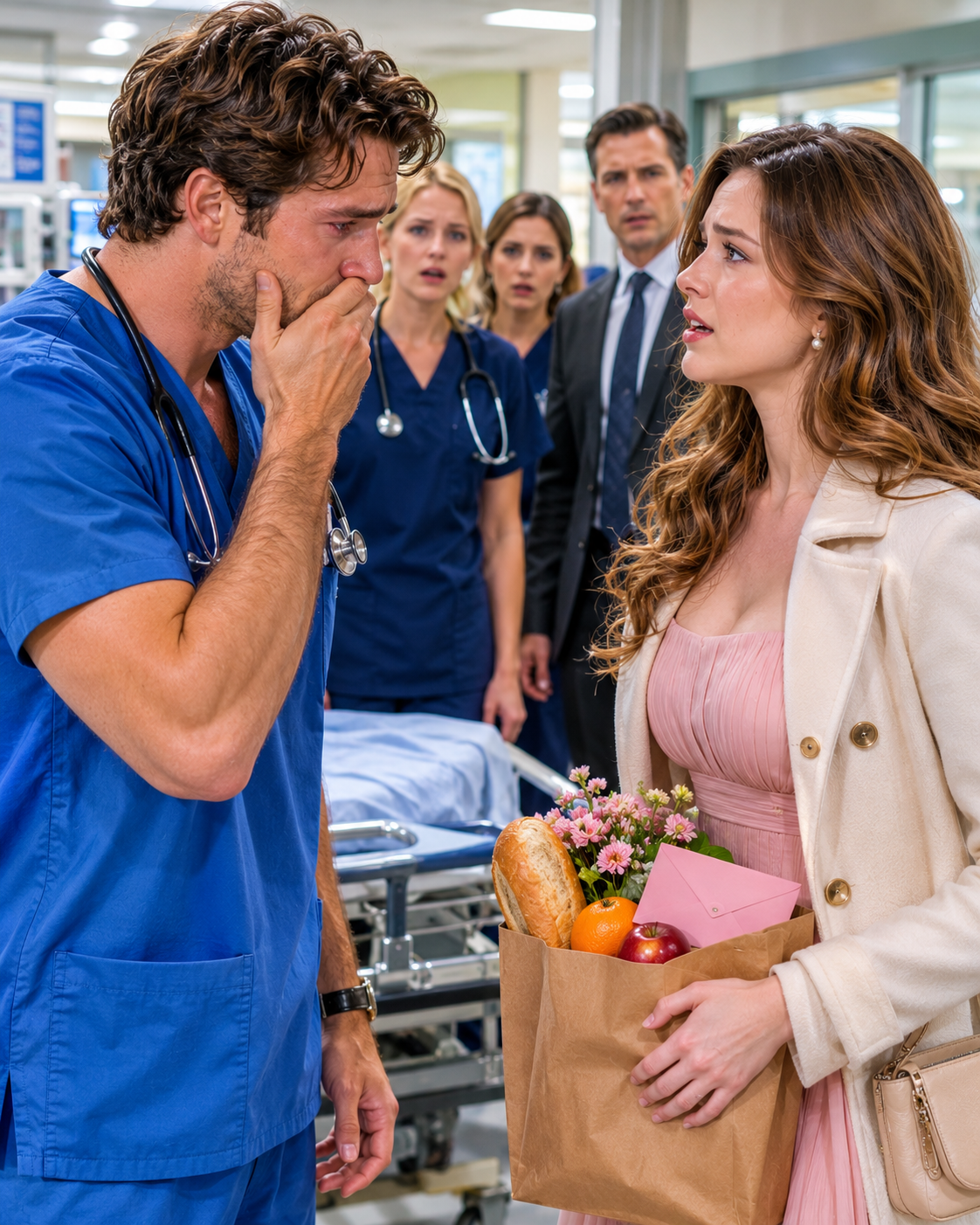
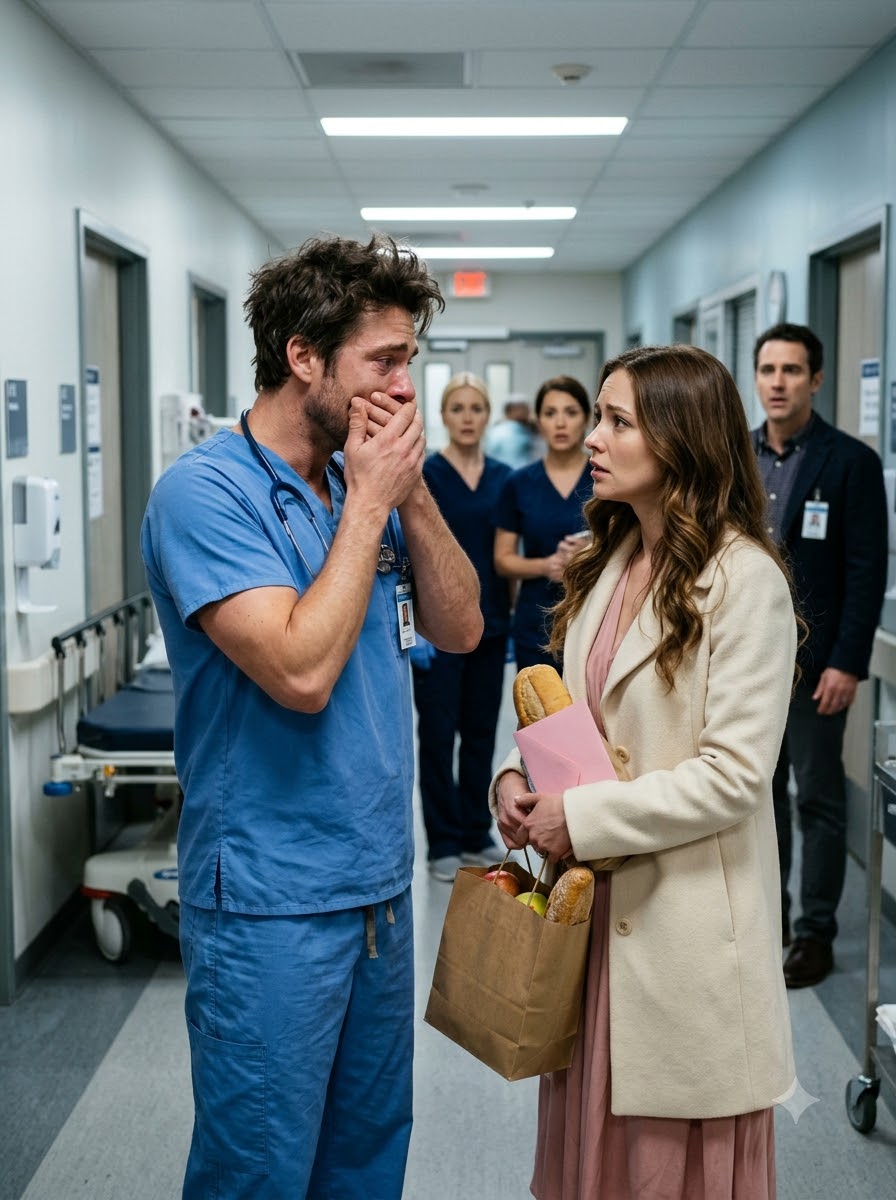
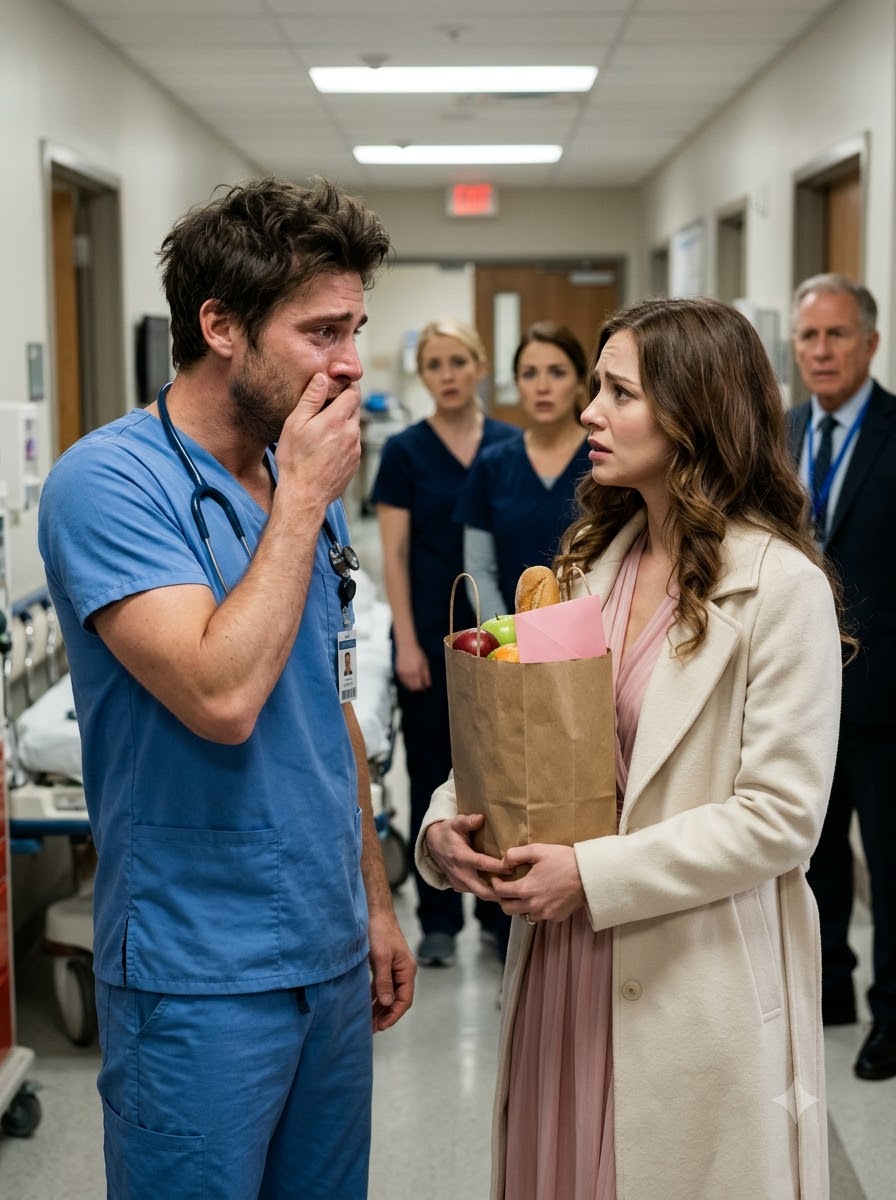
“He hasn’t told you anything, has he?”
My grip tightened around the lunch bag.
The apple pie shifted inside the container.
And suddenly, every missed dinner, every overnight shift, every tired excuse, and every moment Owen had looked away from me felt completely different.
Gideon looked at the lunch bag in my hands, then back at me.
“Eleven years, Maren. Eleven years, and he never found the courage to tell you.”
My heart began pounding.
“Tell me WHAT?”
Gideon took a shaky breath.
“Owen hasn’t been working extra shifts because we’re short-staffed. He’s been coming here every night for something else.”
I felt the floor disappear beneath my feet.
“Is he having an affair?”
Gideon’s expression crumpled.
“No. God, no. He’s been trying to save someone.”
“Who?”
He glanced toward the elevators before whispering, “Your daughter.”
My knees nearly buckled.
Our eight-year-old daughter, Hazel, was at home with my mother that afternoon.
“What are you talking about? Hazel is perfectly healthy!”
Gideon gently took the lunch bag from my trembling hands.
“Maren, three months ago, Owen received some devastating news. Hazel has a rare condition, and the treatment she needs is incredibly expensive.”
I couldn’t breathe.
“Why didn’t he tell me?”
“Because he made a promise to someone.”
“Who?”
Before Gideon could answer, the elevator doors opened.
Owen stepped out wearing surgical scrubs, his face pale and exhausted.
The moment he saw me, he froze.
Then he whispered five words that shattered my world.
“Maren, she’s not our biological daughter.”
I stared at him.
“What?”
Owen’s eyes filled with tears.
“There’s something about Hazel’s birth we’ve never told you.”
Then Gideon suddenly grabbed Owen’s arm.
“Tell her the truth before the transplant team arrives!”
And that’s when I realized this wasn’t just about a medical diagnosis.
It was about a secret buried for eight years.
“Not here,” Owen said, glancing at the nurses’ station, where every head had suddenly found something to read.
He took my elbow gently.
Gideon opened the door to a small family consultation room on the third floor of St. Brendan’s Medical Center.
It had a box of tissues on every surface, and I understood why.
I sat down because my legs gave me no choice.
“I carried her,” I said.
“I carried Hazel for nine months. I was in labor for twenty-one hours. I have the stretch marks to prove it.”
“I know,” Owen said.
He knelt in front of my chair, still in his scrubs.
“I know you did. Maren, please let me tell it in order. If I skip around, I’ll lose my nerve.”
I looked at the man I had married eleven years ago.
His hair had gone gray at the temples in the last twelve months, and I had blamed it on stress.
“Start,” I said.
“You remember the night she was born,” he began.
“The blizzard.”
I remembered.
Pittsburgh had been buried under two feet of snow that January.
Half the staff couldn’t make it in.
I had hemorrhaged after delivery, and the last thing I remembered was a nurse saying my name very loudly while the lights went white.
“I was a second-year attending then,” Owen said.
“I was in the OR with you for most of it. When you stabilized, they told me the baby was fine and had been taken to the nursery. I didn’t leave your side for two days.”
“I remember.”
“Another woman delivered that same night. Twelve minutes after you. Another girl, almost the same weight. The unit was overwhelmed. One nurse covering what should have been three. The bracelets…” His voice broke.
“They were swapped, Maren. Before anyone came back to check them.”
The room tilted.
“Swapped,” I repeated.
“Three months ago, Hazel got a fever that wouldn’t break. You remember the weekend I took her in for bloodwork, and I told you it was a routine check?”
“You said it was her tonsils.”
“It wasn’t her tonsils.”
He wiped his eyes with the back of his wrist.
“Her liver enzymes were wrong. Gideon ran a full panel. She has a rare inherited disorder, a metabolic condition that slowly destroys the liver. It’s been quiet for eight years. The bruising, the tiredness, the stomachaches I told you were growing pains, that was the beginning of it.”
I thought of Hazel dozing on the couch at four in the afternoon.
The blue marks on her shins that I’d blamed on the playground.
“She needs a partial liver transplant,” Gideon said quietly from the doorway.
“A living donor gives the best outcome. Owen was tested first, of course. He’s a surgeon. He assumed he’d be the donor.”
“I wasn’t a match,” Owen said.
“Not even close. So I asked them to test you. And in the process, the lab flagged something.”
“Flagged what?”
“The disorder is recessive. For Hazel to have it, both biological parents must carry the gene.”
He swallowed.
“Neither of us does.”
I pressed my hand over my mouth.
“I asked Gideon to rerun it,” Owen whispered.
“Twice. Then I ordered a full genetic comparison, and I told myself it was a lab error until the third result came back.”
“Why didn’t you tell me?”
My voice came out thin and cracked.
“Owen, I’m her mother. Why would you carry that alone?”
He looked at the floor.
“Because I was terrified that if I said it out loud, it would become true. And because I made a promise.”
“To whom?” I asked.
Owen drew a long breath.
“I didn’t stop at the test results. I pulled the records from that night. Every birth in the unit from January ninth to January tenth. There were four girls born that night. Only one was the right weight, the right time, the right blood type.”
He took out his phone and handed it to me with unsteady hands.
On the screen was a photograph of a girl about eight years old, standing on a dock with a fishing pole, grinning with a missing front tooth.
She had my mother’s chin.
She had the dark eyebrows that run through my father’s side of the family.
I knew her face the way you know your own handwriting.
“Her name is Ruby,” Owen said.
“She lives in Mt. Lebanon with a family named Kowalski. She’s healthy. She’s happy. She’s yours, Maren. She’s ours.”
I stared at that grinning, gap-toothed face for a very long time.
“And the mother?” I asked finally.
“The one who has Hazel?”
“Dana Kowalski. She’s a high school music teacher. Her husband, Walt, drives for UPS.”
Owen’s voice shook.
“I found them in October. I sat in my car outside their house for two hours before I could walk to the door.”
“You told them.”
“I told her. Alone, on the porch. I didn’t have the right words, so I just handed her the genetic report and said, ‘I think our daughters were switched at birth.’”
He closed his eyes.
“She didn’t speak for about a minute. Then she said, ‘Is the little girl sick?’”
My heart gave a painful lurch.
“That’s the first thing she asked. Not about Ruby. About Hazel.”
Gideon cleared his throat.
“She asked to be tested the next day. She’s a match, Maren. A very good one. She can give Hazel a part of her liver.”
I sat there with my hands over my face.
“And the promise?” I said through my fingers.
“Dana asked me for two things,” Owen said.
“That I not tell you until she’d told her husband and decided, with him, whether she could go through with the surgery. She said a mother deserves to hear the truth from a person who has made up her mind, not from one who’s still afraid. And she asked for time to sit with Ruby’s father and their own questions before anyone upended an eight-year-old’s world.”
“She asked you for weeks,” I said.
“She asked for three months. I gave her three months.”
He looked at me with raw, red-rimmed eyes.
“I thought I was protecting you from a lot of pain while we sorted out what to do. I was wrong to make that promise without you. I know it. I’ve known it every night I walked into that hospital and every morning I walked out of it.”
“Every night,” I said slowly.
“That’s what the late shifts were.”
“Some of them were real surgeries. The insurance company denied the transplant coverage twice, calling it ‘experimental,’ and I took every extra case I could to build a reserve. The rest of the time I was here with the transplant team, with Dana, with the lawyers.”
He gave a broken laugh.
“I’d sit in the parking garage afterward and cry. I didn’t want you to see.”
I remembered finding him on the edge of the bed with his shoulders shaking.
“I thought you were having an affair,” I said, almost as a confession.
“I know,” he whispered.
“I’m sorry. I’m so sorry.”
The door opened, and a woman stood there.
She was small, with sandy hair pulled back in a clip and the kind of tired, steady face that belongs to people who spend their days with teenagers.
PART 2
She wore a gray cardigan and held a paper cup in both hands, as if it were the only warm thing in the building.
“Dana,” Owen said, standing.
“Maren found out. I’m sorry, I didn’t have a chance to call you first.”
Dana looked at me.
I had imagined this meeting in the last ten minutes, a hundred different ways.
In none of them did I stand up and cross the room.
But my body did it for me.
“You’re Hazel’s mother,” I said stupidly.
“And you’re Ruby’s.”
Her voice was quiet.
“I’ve been trying to think of what to say to you for three months. I have nothing.”
“Me neither.”
We stood there, two women in a hospital room, each holding a piece of the other’s life.
“Is she okay?” I asked.
“Ruby?”
Dana’s eyes filled.
“She’s wonderful,” she said.
“She’s stubborn and funny, and she sings in the shower, and she has your eyebrows. I never knew where she got them.”
She laughed wetly.
“Walt used to say she must have gotten them from a mailman.”
A sound came out of me, half laugh, half sob.
“And Hazel?”
“Hazel,” I said.
“She hates mushrooms. She narrates her own life like a nature documentary. She asks a hundred questions a day, and she wanted to be a surgeon until she found out about the blood.”
Dana pressed her hand to her mouth.
“I’d like to know her,” she said.
“If you’ll let me. I’d like to give her a piece of me, whatever else happens.”
I didn’t think.
I just pulled her into my arms.
She was shaking.
So was I.
Over her shoulder, I saw Owen turn to the window and press his forehead against the glass.
“You’re going to save my daughter’s life,” I said into her cardigan.
“She’s our daughter,” Dana whispered.
“Both of them. I decided that in October. I just didn’t know how to say it.”
I didn’t forgive Owen that day.
I want to be honest about that.
I sat beside him in the cafeteria while the transplant team finished with Dana, and I did not take his hand.
I told him I was furious, and that I understood why he’d done it, and that both of these things were true and neither cancelled the other.
“You kept me out of my own child’s illness,” I said.
“For three months, Owen. I’m not a patient. I’m not a family member you manage. I’m her mother.”
“You are,” he said.
“You always have been.”
“Then you don’t decide what I can survive.”
“No.”
He nodded slowly.
“I don’t.”
“If it were reversed, would you want me to decide for you?”
He took a very long time to answer.
“No,” he said again.
“I’d have wanted to be there. Even if it hurt.”
“Then that’s what you owe me. Every time. Even if it hurts.”
He nodded.
His eyes were wet.
“Every time.”
I picked up the lunch bag Gideon had set on the table and opened it.
The apple pie had gone slightly lopsided.
My little note lay beneath the fork.
You don’t have to take care of everyone. Let me have a turn.
I slid it across the table to him.
He read it and put his hand over his eyes, and for a minute, the most gifted surgeon in the hospital sat in a plastic chair and wept like a boy.
I didn’t take his hand.
But I didn’t move away, either.
We told Hazel the next morning.
We did it together at the kitchen table, with my mother nearby in case we needed her, and with a plate of pancakes that no one touched.
Owen had practiced the words with the hospital’s child psychologist.
I’d spent half the night rewriting them in my head.
In the end, we told her the simplest version of the truth.
“Sweetheart,” I said, “your body has a sickness in your liver. Doctors can fix it, and Daddy’s been working very hard to make sure they do.”
“The tired thing?” Hazel asked.
“The tired thing.”
“Okay.”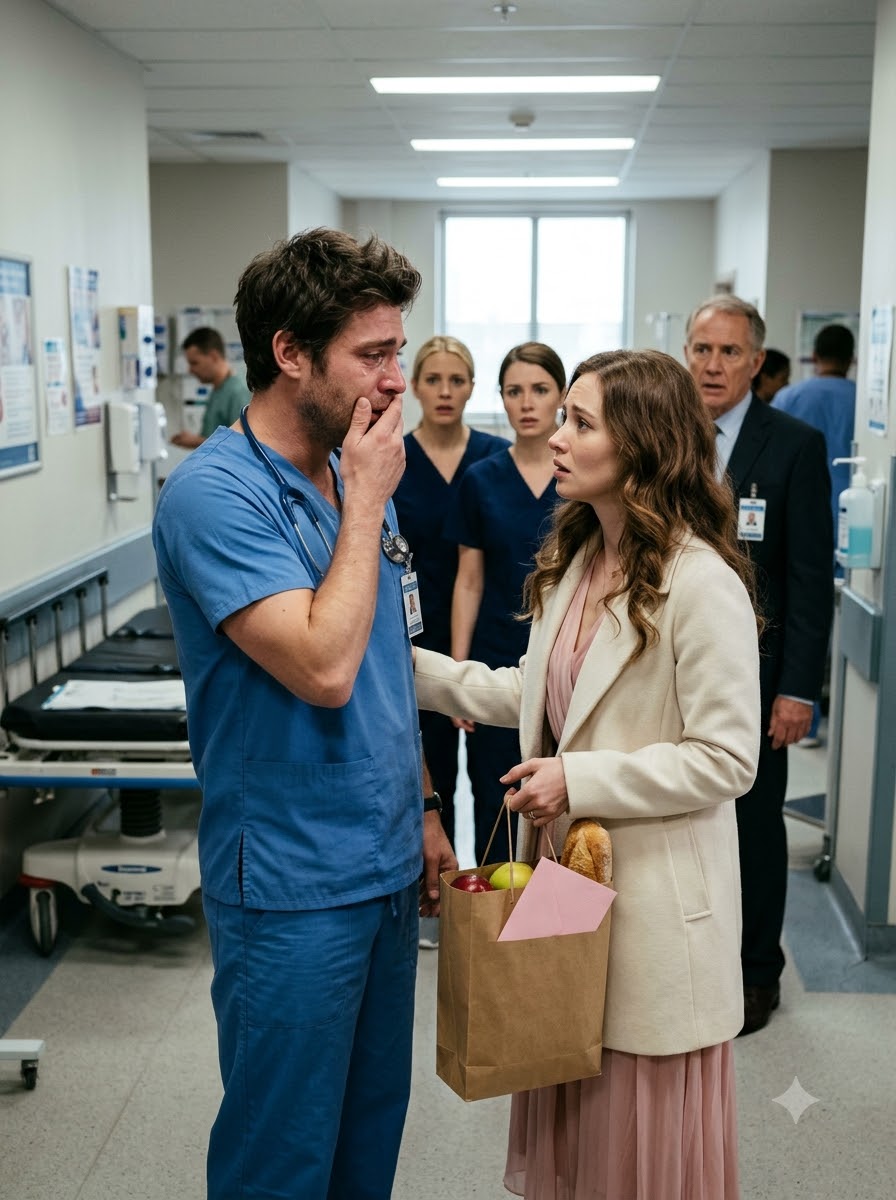
She chewed her lip.
“Does it hurt?”
“Not much. The operation will hurt a little, but we’ll be right there.”
“Is someone going to give me part of their liver?”
Owen and I exchanged a glance.
“Yes,” I said.
“A very kind person who wants to help you.”
“Do I know her?”
“Not yet. But you’re going to.”
Hazel considered this with the grave expression she wears when deciding between two flavors of ice cream.
“Is she nice?”
I thought of Dana in the gray cardigan, holding a paper cup like it was the last warm thing on earth.
“She’s very nice,” I said.
“She teaches music.”
“Can she teach me the violin?”
I laughed, and the laugh turned into tears, and Hazel climbed into my lap and patted my cheek with sticky fingers.
“Don’t cry, Mama. It’s just a liver.”
The surgery took eleven hours.
Owen was not allowed to operate on his own daughter, and he did not try.
He sat beside me in the surgical waiting room with a paper cup of coffee going cold between his hands.
Walt Kowalski sat across from us in a UPS jacket, big and silent, rubbing his knee.
Around hour six, he looked up and said, “I’m not great at this.”
“Neither are we,” I said.
“I keep thinking, what if I’d noticed? Eight years, and I never thought, ‘This kid doesn’t look like us.’ She looked like Dana. She looked like me when I squinted.”
His voice cracked.
“She’s my girl. I don’t care what a test says.”
“I know,” I said.
“Hazel’s mine for the same reason.”
He nodded and wiped his face with a rough palm.
Then Walt did something I wasn’t expecting.
He took a photograph from his wallet and passed it across the gap between our chairs.
It was Ruby, in a school photo with her hair in two uneven pigtails, her smile slightly crooked.
“She’s been asking questions,” he said.
“Dana and I told her last week. A little, anyway. That there’s another family. Another girl who needs help.”
“How did she take it?”
“She asked if she could send a card.”
He almost smiled.
“She’s making one now. It has a lot of glitter.”
I held the photograph for a long time.
At hour eleven, the surgeon came through the double doors with her mask pulled down and a tired smile.
“Both are doing well,” she said.
“The graft took beautifully. Hazel’s going to be sore, and she’ll need a long recovery, but she’s going to be fine.”
Owen made a sound I had never heard from a person, a low, cracked exhale, like a man who has been holding his breath for three months.
Walt put his face in his hands.
I held on to both of their sleeves, and the three of us sat there while the whole waiting room went blurry.
Recovery was slow and messy and full of small victories.
Hazel spent nineteen days in the hospital.
Her color came back first, the sallowness I’d mistaken for winter pallor melting into a healthy pink.
Then her appetite returned.
Then her questions.
“Is Dana going to be okay?” she asked one afternoon, propped up on pillows with a stuffed owl under her arm.
“She’s going to be fine. She’s recovering two floors down.”
“Can I see her?”
I hesitated.
“Do you want to?”
“She gave me part of herself,” Hazel said, in the matter-of-fact way only an eight-year-old can say something that profound.
“I’d like to say thank you.”
We rolled her down in a wheelchair, with the owl in her lap and a drawing she’d made on a hospital napkin.
Dana was sitting up in bed with a paperback, her face thin and pale.
When she saw Hazel, she set the book down very carefully.
“Hi,” Hazel said.
“I’m Hazel. You have my liver. Part of it.”
Dana laughed so hard she had to clutch her stomach, wincing.
“I do,” she said.
“It’s a good one. I’ve had it for thirty-nine years. I took care of it.”
“Thank you.”
Hazel held out the napkin.
“I drew you a violin.”
It was a lopsided violin with a very large bow.
Dana held it as if it were made of glass.
“It’s perfect,” she said.
“I’ll keep it forever.”
I stood in the doorway beside Owen, and neither of us said anything for a long time.
The glitter card arrived the following week.
It came in a lumpy red envelope, addressed in careful, wobbly letters: To Hazel, from Ruby.
Inside was a construction paper heart covered in so much glitter that it shed all over the bed.
Beneath it, in purple marker:
Hi. I’m Ruby. I like drawing and swimming and mac and cheese. Do you have a dog? I want one. Mom says maybe. I hope you feel better. I think we are kind of like sisters but weird. Write back!
Hazel read it three times.
Then she looked up at me.
“She spelled ‘weird’ right.”
“She did.”
“Can I meet her?”
“Yes,” I said.
“When you’re better. Slowly.”
“Slowly,” Hazel agreed gravely.
“Like with a new fish.”
We met on a Sunday in April, in the grassy field behind a park in Mt. Lebanon.
I stood at the edge with my arms wrapped around myself, in a spring jacket that was not warm enough.
Owen stood beside me.
The Kowalskis arrived five minutes early.
Walt carried a soccer ball.
Dana, thin but upright, held the hand of a small girl with my mother’s chin and my father’s eyebrows.
I had known her face from a photograph.
It was nothing like seeing her walk.
Ruby let go of Dana’s hand and stopped three feet from me.
“Hi,” she said.
“Are you Maren?”
“I am.”
“I’m Ruby.”
She studied me with frank, solemn interest.
“You look kind of like me.”
“I think it might be the other way around.”
She grinned, and I saw the same crooked tooth I’d once drawn on my own face in a mirror at that age.
Then Hazel, who had been hiding behind Owen’s legs, edged out.
The two girls looked at each other.
“You have a bandage,” Ruby said, pointing at the small dressing still visible under Hazel’s shirt.
“I have a scar,” Hazel said.
“It’s going to be a really good one.”
“Can I see it when it’s done?”
“Maybe.”
“Do you like mac and cheese?”
“Obviously.”
“Do you want to play soccer?”
“I’m not allowed to run yet.”
“Okay,” Ruby said.
“We’ll walk the ball.”
And just like that, they were off, two small girls dribbling a soccer ball at the pace of a very slow parade, arguing about the rules.
I stood there with my hand pressed against my mouth.
Dana came to stand beside me.
We watched them in silence for a while.
“Do you ever think about it?” she asked finally.
“All the years we missed?”
“Every day,” I said.
“I used to think I’d fall apart if I let myself.”
“And now?”
I looked at Hazel, kicking the ball in a slow, wobbly arc toward Ruby.
Then at Ruby, laughing in a way I recognized from the back of my own throat.
“Now I think we didn’t miss them,” I said.
“We just got to love them in two different places. And now we get to do it in one.”
Dana slipped her hand into mine.
“That’s a good way to say it,” she said.
Owen and I went to counseling that summer.
It wasn’t dramatic.
Mostly it was a small office with a beige couch and a woman who asked uncomfortable questions in a very kind voice.
We learned how to say I’m scared instead of I’m fine.
We learned how to disagree without disappearing.
Owen learned, painfully, that protecting me was not the same as including me.
I learned that my silence, all those times I swallowed my complaints, had not been generosity.
It had been another kind of hiding.
“You made it easy for me to leave you out,” Owen said one afternoon.
“You were so patient. I mistook it for permission.”
“And I mistook my patience for love,” I said.
“It was partly fear.”
We looked at each other for a long moment.
“I’d like to try again,” he said.
“Properly.”
“Me too.”
He took my hand.
This time, I let him.
On the first anniversary of the day I walked into St. Brendan’s with a lunch bag, I made Owen lunch again.
Turkey sandwich, a slice of apple pie, and a note beneath the fork.
I drove to the hospital in the early afternoon and walked through the sliding doors, past the nurses’ station where every smile was real.
Gideon waved from across the hall, a little teary even now.
Owen was in the doctors’ lounge.
He looked up from a stack of charts and saw me in the doorway.
His face did the thing it used to do before the secrets, a slow loosening, a tired man remembering how to be glad.
“Maren,” he said.
“What are you doing here?”
I held up the bag.
“Surprise,” I said.
He read the note, and I watched his mouth wobble the way it always did.
You don’t have to take care of everyone. But let us take care of you.
“Twenty minutes?” I asked.
“Take as long as you want,” he said.
“I’m all yours.”
We ate together at a small table by the window, with the Pittsburgh skyline spread out gray and gold beyond the glass.
My phone buzzed twice during lunch.
The first was a photograph from my mother: Hazel and Ruby on the back porch, sticky-faced, sharing a popsicle and a very large dog that belonged to neither of them.
The second was a message from Dana.
Girls want to know if they can have a sleepover. I said ask your mothers. Both of them. Together.
I showed it to Owen.
He laughed until his eyes were wet.
“Both mothers,” he said.
“Both mothers,” I agreed.
I finished the last bite of pie, and I thought about the strange, crooked road that had brought us here, a blizzard and a swapped bracelet, a liver and a glitter card and a field behind a park.
I thought of everything we had nearly lost, and everything we’d been given back in a shape none of us had expected.
My family was not the family I thought I had.
It was bigger.
It was messier.
And it was mine.
THE END.
