

PART 1 — The Morning I Discovered My Wife’s Secret
Gabriel Baeza was a man feared by half the Costa del Sol. In business, he had built his reputation on discipline, absolute control, and an unwillingness to tolerate disobedience. Employees who broke his rules rarely received second chances.
That morning, he was preparing to fire a young nanny for violating one of the strictest rules in his home.
But when he entered his daughters’ bedroom and discovered the woman sleeping with his six-year-old twins wrapped in her arms, he did something no one in his household would have expected.
He fell to his knees and cried.
It was 6:10 in the morning.
Gabriel had just returned from a business meeting in Algeciras. Rain still stained his expensive jacket, and exhaustion weighed heavily on his shoulders. His villa in Estepona stood silent beneath the pale morning light.
For years, he had controlled every detail of his businesses. Since his wife’s death, he had attempted to control every detail of his daughters’ lives as well.
The rules inside the villa were strict.
Employees were not permitted to enter the family’s beds. The children’s schedules were carefully monitored. Security cameras covered the property, guards controlled access, and caregivers followed written instructions.
Gabriel believed that if he eliminated uncertainty, he could prevent another tragedy.
Yet the one thing he could not control was his daughters’ grief.
Eleven months earlier, his wife, Nuria, had died after a long illness.
Their twin daughters, Alba and Candela, had not slept peacefully through an entire night since her death.
Some nights, Alba woke screaming.
Other nights, Candela sat upright in bed, asking questions no adult in the house seemed willing to answer.
Gabriel responded by tightening the rules.
No conversations about hospitals.
No entering the music room where Nuria had spent so much of her time.
No asking why Mommy was never coming home.
He believed silence would protect the girls from painful memories.
Instead, it made them afraid of their own feelings.
Alba flinched whenever a door slammed. Candela kept a photograph of her mother hidden beneath her pillow.
And Gabriel, surrounded by wealth and security, had no idea how to reach them.
The previous evening, both girls had developed fevers.
Their pediatrician had examined them, ruled out serious complications, and left instructions for their care.
But once the doctor departed, the worst part of the night began.
Alba screamed whenever someone turned off the bedside lamp.
Candela repeatedly asked whether Eva Moreno, their new nanny, was going to leave forever too.
Eva had worked at the villa for only four months.
She had studied Early Childhood Education and held a succession of temporary jobs before joining the household. She needed the income to help Isabel Moreno, the woman who had raised her.
Unlike the other caregivers, Eva did not insist that the twins stop crying.
She sat beside them.
She listened.
And when they spoke about their mother, she did not change the subject.
That night, the girls had asked her for something unusual.
They wanted her to lie between them, just as their mother used to do.
Eva knew the rule.
She also knew the girls were frightened and feverish.
So she climbed onto the bed, held them close, and stayed until they fell asleep.
Hours passed.
She never intended to fall asleep herself.
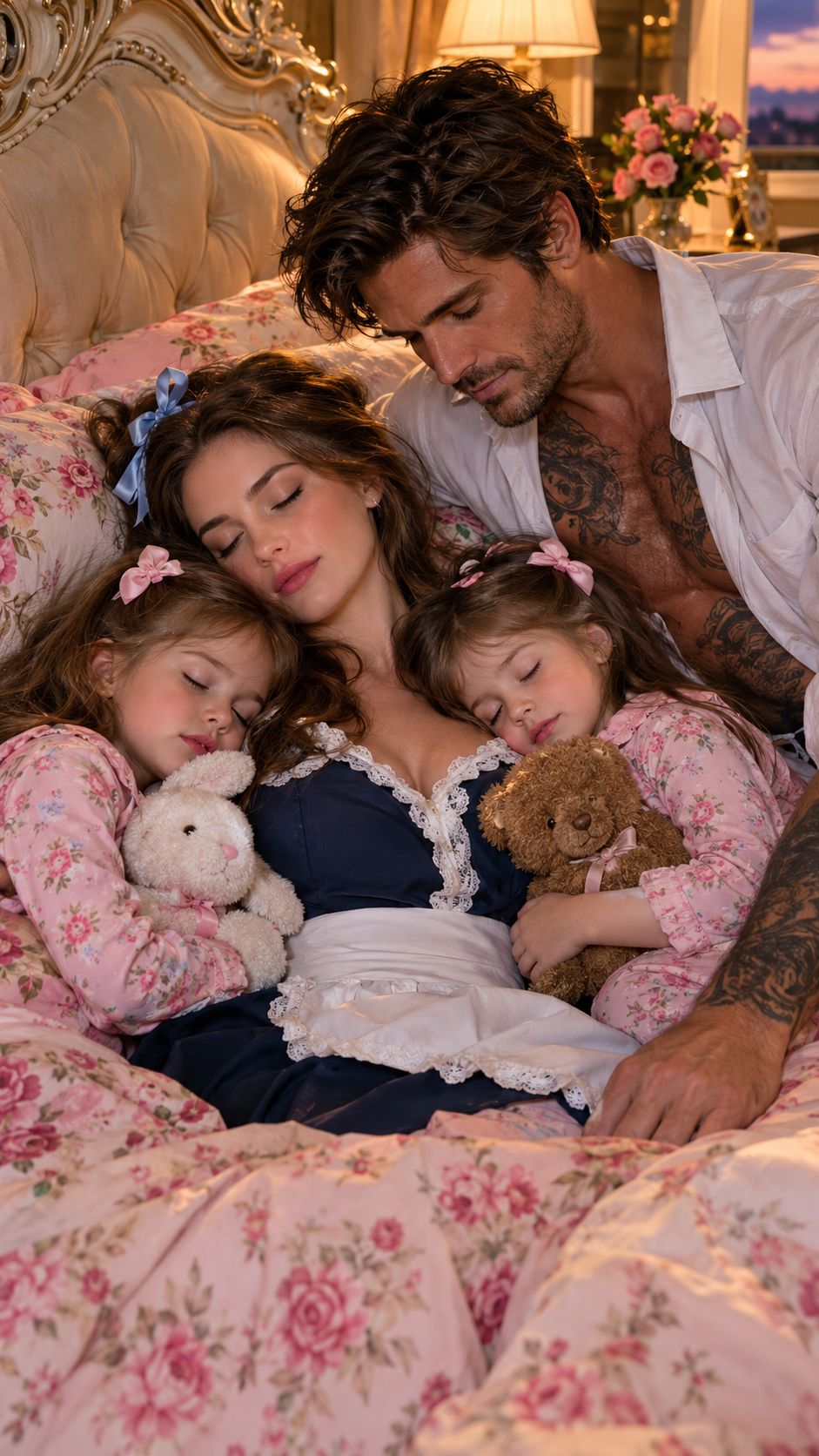
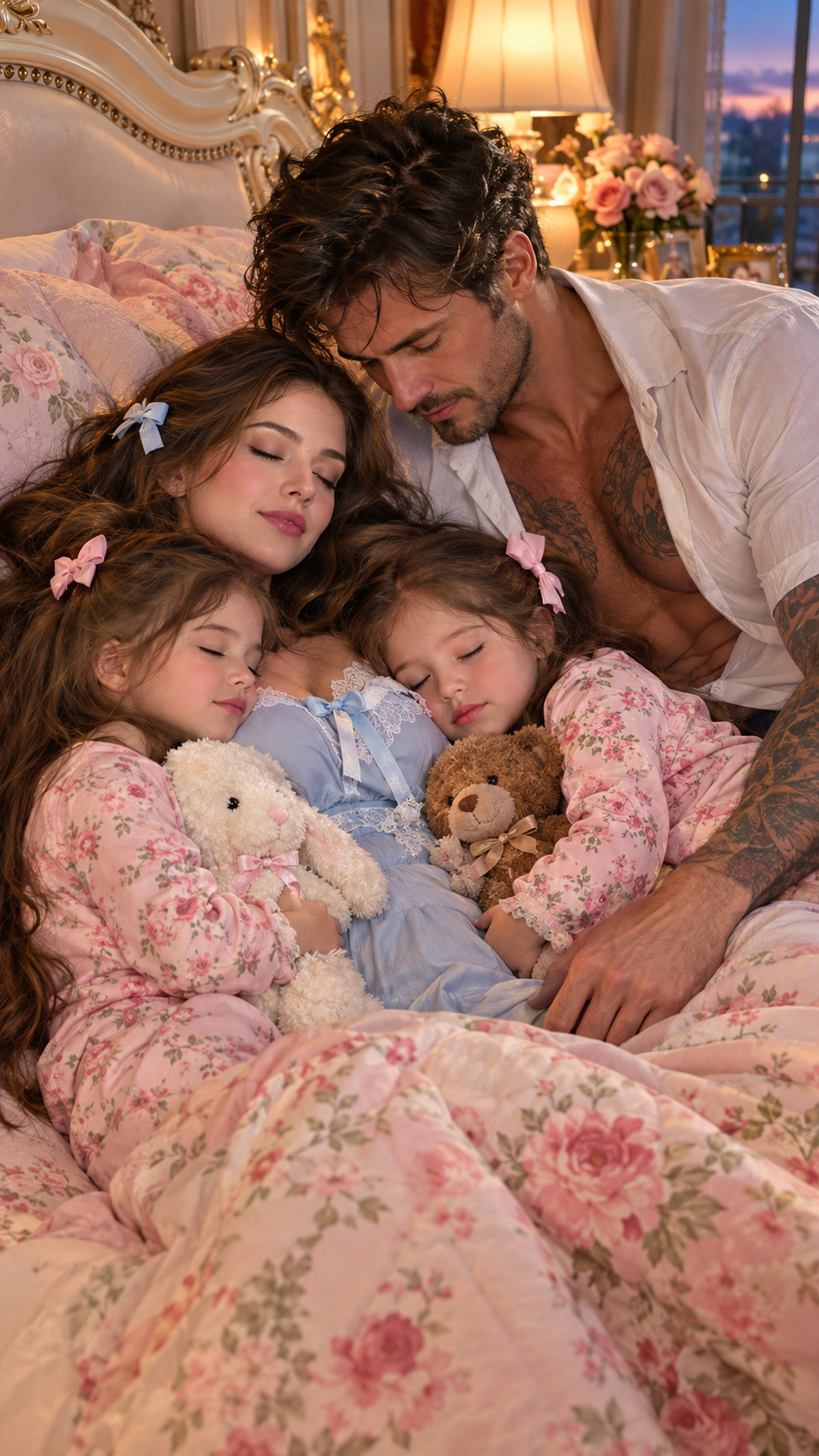
But when Gabriel opened the bedroom door at dawn, he found Eva lying between his daughters.
Alba’s cheek rested against the young woman’s shoulder.
Candela held tightly to Eva’s sleeve, as though afraid she might disappear if she loosened her grip.
Gabriel stopped in the doorway.
His first instinct was anger.
An employee had broken a rule.
He was about to demand an explanation when Eva stirred.
“Mr. Baeza…” Eva woke with a start. “I can explain.”
Gabriel raised one hand.
She fell silent.
He was looking at his daughters.
For the first time in eleven months, neither girl was crying.
Their breathing was steady.
Their faces were peaceful.
And for a moment, Gabriel could almost remember what the house had felt like before Nuria became ill.
Eva carefully lifted her head.
“They asked me to do what their mother used to do,” the young woman whispered. “To lie down between them until they could fall asleep.”
Gabriel remained motionless.
“Have you been holding them like this all night?” Gabriel asked.
“Until they fell asleep. After that, I didn’t want to wake them.”
He looked at the clock.
Seven hours had passed.
Seven hours in which his daughters had slept without fear.
Gabriel approached the bed and knelt beside it.
The sight of the girls resting peacefully against Eva brought back a memory he had spent almost a year trying to bury.
“Nuria asked me to let the girls sleep beside her on the last night she was conscious,” he confessed. “I took them to another room to make things easier for the doctors. I promised them they could come back in the morning.”
His voice broke.
He had believed he was making the responsible decision.
The doctors needed space.
Nuria needed rest.
The girls would return in the morning.
But morning had come too late.
His daughters never saw their mother conscious again.
And Gabriel had never forgiven himself.
Eva pressed her lips together.
She understood something then that Gabriel had not allowed himself to recognize.
The twins were still waiting for the promise their father had made.
They were waiting to return to a bedside that no longer existed.
Gabriel lowered his head.
For the first time in months, he allowed himself to cry openly.
Eva did not interrupt.
Neither did the sleeping children.
After a while, Gabriel stood.
“You’re not working today,” he said. “Get some rest. And never again think that comforting my daughters is something you’ve done wrong.”
Eva looked at him in surprise.
She had expected dismissal.
Instead, Gabriel was admitting that the rule itself had been wrong.
Before either of them could say anything more, Teresa appeared in the doorway.
The housekeeper had served the Baeza family for twenty-three years.
She had watched Gabriel build his fortune, witnessed Nuria’s illness, and seen the once affectionate father become a distant, controlling man.
Now she stood with an expression Gabriel recognized immediately.
She was carrying news he would not want to hear.
“Sir, there’s something we can no longer keep hidden.”
Gabriel straightened.
“Not now, Teresa.”
“Now is precisely the time. Your brother Sergio has demanded Nuria’s letters again. He says he needs them to file a petition with the court.”
Gabriel’s expression darkened.
His younger brother had been pressing him for access to family documents for weeks.
Sergio claimed he was concerned about the twins’ welfare.
Gabriel suspected something else.
Eva looked between them.
“What letters?”
Teresa hesitated.
Then she reached into her apron and removed an old photograph.
It showed a young woman standing at a railway station in Madrid.
Gabriel studied the picture.
He recognized the setting as Atocha station.
Then he looked at the woman’s face.
His eyes moved toward Eva.
She stepped closer.
The photograph showed her.
It had been taken two years earlier, long before she applied to work at the villa.
Eva stared at it in disbelief.
She remembered the day.
She remembered waiting for a train.
But she had never known someone was photographing her.
“Where did you get this?” she asked.
Teresa turned the picture over.
On the back, written in Nuria’s unmistakable handwriting, was a single sentence.
“I’ve found my sister. Her name is Eva Moreno.”
Eva stopped breathing for a moment.
Gabriel stared at the handwriting of his dead wife.
And Teresa, who had carried the secret for years, finally lowered her eyes.
The young woman sleeping beside his daughters had not simply arrived at the villa by chance.
She was connected to Nuria.
And Gabriel was beginning to realize that his wife had left behind secrets far more dangerous than he could have imagined.
PART 2 — The Letters Beneath the Piano
Eva Moreno stared at the photograph until the words on its back seemed to blur.
“I’ve found my sister. Her name is Eva Moreno.”
She read the sentence again.
Then again.
It made no sense.
She knew very little about her biological mother.
Her name had been Manuela.
Eva had spent part of her childhood in two foster homes before Isabel Moreno took her in and raised her.
Isabel had given her stability, affection, and a home.
But there were still questions about her earliest years that nobody had been able to answer.
She had never been told she had a sister.
And now she was standing inside the home of a dead woman who apparently knew more about her origins than she did.
“This has to be a mistake.”
Teresa shook her head.

She did not attempt to soften the truth with false reassurance.
“Nuria spent years investigating her family history. She found documents proving that you shared the same mother. There was a fourteen-year age difference between you. She traveled to Atocha to meet you, but she lost her nerve. She thought approaching you without warning might hurt you.”
Eva looked down at the photograph.
“So she decided to photograph me without my knowledge?” Eva shot back. “She thought that was better?”
Teresa lowered her head.
She understood the anger.
Nuria had wanted to meet her younger sister, but she had allowed fear to prevent the conversation.
Now Nuria was dead.
No explanation could give Eva back the opportunity to meet her.
“Before she became seriously ill, Nuria asked me to find a respectful way to bring you together. After that, it was too late.”
Gabriel turned toward the housekeeper.
“Did you know about this when we hired her?”
Teresa hesitated.
“I was the one who recommended her application,” Teresa admitted. “I knew she worked with children. I thought that if she met the twins, she would eventually feel that something here belonged to her. I was wrong to make that decision for her.”
Eva stepped backward.
For four months, she had believed she was working at the villa because she was qualified.
She had studied early childhood education.
She had experience caring for children.
She needed employment.
Now she wondered whether every kindness shown to her had been arranged around a secret she was never allowed to know.
“I’m not some gift someone left behind for this family.”
Gabriel looked at her.
“You’re right,” Gabriel replied.
There was nothing else he could honestly say.
Teresa had acted out of loyalty to Nuria.
But loyalty did not give her the right to decide how Eva should discover her own family history.
Before the conversation could continue, a sharp noise sounded from the hallway.
Sergio Baeza had arrived.
Gabriel’s younger brother entered accompanied by his lawyer.
He wore an expensive coat and carried himself with the confidence of a man accustomed to being welcomed into rooms where important decisions were made.
His expression changed when he noticed the photograph in Eva’s hand.
“I see Teresa has decided to put on a show.”
Gabriel moved toward him.
“What are you doing here?”
Sergio did not appear intimidated.
He explained that he had requested a judicial assessment of the twins’ living situation.
According to Sergio, Gabriel’s grief had left him incapable of caring for his daughters properly.
He also claimed that the presence of an emotionally involved employee created additional concerns.
His proposed solution was to seek greater authority over the girls’ welfare and temporary control over assets held for their benefit.
Gabriel stared at him.
“You didn’t care about them even when Candela spent three nights in the emergency room,” Gabriel snapped.
Sergio’s expression hardened.
“I’m the only one thinking about their future,” Sergio retorted. “All you know how to do is close doors and give orders.”
The words hurt.
Gabriel knew his brother was exploiting his failures as a father.
But he also knew that part of the accusation was true.
He had closed doors.
He had forbidden conversations.
He had mistaken control for protection.
Sergio noticed the effect of his words and smiled.
Eva stepped forward, holding the photograph.
“Did you know who I am?”
Sergio glanced at it.
For barely a second, he looked away.
“I know my sister-in-law had too many worries to distinguish an obsession from actual evidence.”
Eva watched him carefully.
His answer had avoided the question.
Teresa reached into her apron again.
This time, she removed a tiny key.
Nuria had given it to her during the final weeks of her illness.
For months, Teresa had been afraid to use it.
Sergio’s growing interest in Nuria’s documents had made that fear worse.
But now the secret was already exposed.
And Teresa understood that keeping the remaining evidence hidden would only protect the wrong people.
She led Gabriel and Eva down the hallway.
They stopped outside the music room.
The door had remained locked since Nuria’s funeral.
Gabriel had ordered it closed because everything inside reminded him of his wife.
Nuria’s piano.
Her sheet music.
The chair where she had sat practicing while the twins played nearby.
The room represented a life he could not bear to remember.
Teresa unlocked the door.
The familiar scent of polished wood greeted them.
Sheet music still rested on the piano.
Nothing had been moved.
For a moment, Gabriel stood in the doorway, overwhelmed by the memory of Nuria sitting at the keyboard.
Then Teresa approached the piano bench.
She opened a concealed compartment beneath it with the small key.
Inside was a metal box.
She placed it on the piano.
Gabriel opened it.
There were copies of three letters.
An accounting ledger.
And a digital storage device.
He examined the ledger first.
At the top of several pages were the names of companies connected to the Baeza family’s businesses.
Gabriel recognized the accounts.
He also recognized Sergio’s signature on several documents.
The payments had been described as renovation expenses for a children’s residential home in Málaga.
Eva leaned closer.
Then she froze.
She recognized the name of the institution.
She had lived there as a child.
She remembered the broken radiators.
The leaking ceilings.
The damp walls.
She remembered caregivers apologizing because the building could not be repaired.
“They said there wasn’t enough money,” she murmured.
Gabriel turned another page.
The ledger documented payments to companies linked to Sergio.
The total exceeded 1.8 million euros.
The supposed renovation work had been invoiced repeatedly.
But Eva’s memories suggested that much of it had never happened.
Gabriel’s hands tightened around the documents.
He had spent years believing his brother was managing the family’s secondary businesses responsibly.
Now he was looking at evidence that charitable funds may have been diverted through companies under Sergio’s control.
Then he found another document.
A notarized power of attorney.
Gabriel recognized his signature immediately.
Years earlier, he had granted Sergio extensive management authority.
He remembered signing the paperwork.
At the time, he had considered it an ordinary business arrangement.
Now he saw how much control he had surrendered.
Sergio had not needed to forge his signature to gain access to the accounts.
Gabriel had given him that access willingly.
He lowered himself onto the piano bench.
For years, he had been proud of his ability to command others.
Yet he had failed to examine the decisions being made under his own authority.
And the consequences may have reached children who had already suffered more than most adults could imagine.
Eva stood beside him, looking at the ledger.
She thought of the residential home.
She thought of the caregivers who had struggled to keep children warm during winter.
She thought of all the times she had been told there was no money for repairs.
Gabriel looked toward the closed door.
Sergio was still somewhere in the villa.
And now Gabriel understood why his brother had been so desperate to obtain Nuria’s letters.
But the accounting ledger was only part of what Nuria had left behind.
Eva reached for the envelope bearing her name.
Her fingers trembled as she opened it.
Inside was a letter written by the sister she had never met.
And what Nuria had written would force Eva to confront the most painful unanswered question of her childhood.
PART 3 — The Family We Chose to Become
Gabriel sat beside the piano, staring at the power of attorney he had signed years earlier.
He remembered the circumstances clearly.
Nuria had been pregnant.
His businesses were expanding.
He wanted to concentrate on creating more wealth, and Sergio had offered to oversee the secondary companies.
Gabriel had accepted.
He had signed the documents without carefully examining the extent of the authority he was granting.
“I gave him the authority to move money around while I focused on making more of it,” he said quietly.
Teresa stood beside the piano.
“And then you preferred not to ask questions,” Teresa added.
Gabriel did not defend himself.
He could have argued that Sergio had betrayed his trust.
That was true.
But it was also true that he had allowed his brother to manage large sums of money without adequate oversight.
The ledger in front of him was evidence not only of Sergio’s possible wrongdoing, but also of Gabriel’s own negligence.
Across the room, Eva unfolded the letter addressed to her.
It had been written months before Nuria’s death.
The handwriting was careful, though certain lines showed the uneven pressure of someone writing while ill.
Nuria did not begin by demanding affection.
She did not excuse their mother.
And she did not ask Eva to forgive her.
Instead, she explained what she had discovered.
Their mother, Manuela, had given birth to Eva fourteen years after Nuria.
Eva’s father was a different man, someone Manuela had become involved with after separating from Nuria’s father.
That relationship had deteriorated.
When the man began threatening Manuela over old debts, she sought help from social services.
Eva had still been very young.
What began as a separation intended to protect her became a prolonged process.
Eventually, she was placed in another family’s care.
Nuria had spent years trying to reconstruct the circumstances.
When she finally located Eva, she traveled to Madrid.
She saw her younger sister waiting at Atocha station.
But she could not bring herself to approach.
The letter contained the admission Eva needed to hear.
“I don’t know how much pain you’ve endured,” the letter said. “I know that watching you from a distance at a train station was an act of cowardice. I wanted to approach you, but I was afraid of becoming yet another person who came into your life asking something of you. If you ever read this, you can choose not to learn anything more about me. You also have every right to be angry.”
Eva read the passage more than once.
For years, she had imagined finding a sister.
Someone living.
Someone she could sit beside and question.
Someone who might remember their mother and explain why the family had broken apart.
Instead, she had found a photograph and a letter from a woman who was already gone.
Nuria had cared enough to search for her.
But she had been too afraid to make herself known.
Eva felt grief for a relationship she had never been given the chance to begin.
Gabriel watched her silently.
He knew what it meant to wish for one more conversation with Nuria.
He also understood that his grief did not give him the right to tell Eva how she should feel.
The second envelope was addressed to him.
He opened it.
Nuria had written about her growing concerns over Sergio’s business dealings.
She had noticed inconsistencies in contracts connected to the family’s companies.
Some had been certified by Tomás Cifuentes, the family’s lawyer.
Others involved expenses that appeared unusually high or difficult to verify.
Nuria explained where she had stored copies and asked Gabriel to arrange an independent examination.
Then the letter turned toward their daughters.
“Stop using the dangers outside this house as an excuse not to look at what’s happening inside it. Our daughters don’t need bodyguards outside their bedroom door. They need to be able to talk about their mother without being afraid of making you sad.”
Gabriel placed the letter on the piano.
For months, he had believed that surrounding his daughters with security would keep them safe.
But Nuria had understood what he refused to see.
The girls were not afraid only of losing someone else.
They were afraid of upsetting the parent they still had.
They had learned to hide their sadness because Gabriel could not bear to face his own.
He closed his eyes.
The third envelope was addressed to Alba and Candela.
Inside was the sheet music for the lullaby Nuria used to play for them.
Gabriel decided not to open everything at once.
The girls would have the chance to read their mother’s words when they were ready.
Teresa connected the digital storage device to the computer in the music room.
Several recordings appeared.
Nuria had left messages for her daughters.
One was a story about two little paper boats that faced the waves together.
Another reminded the girls that they were allowed to cry whenever they missed her.
They were allowed to ask questions.
They were allowed to ask for hugs.
As the recording played, two small figures appeared in the doorway.
Alba and Candela had awakened.
Candela looked toward the computer.
“Is that Mommy?” Candela asked.
Gabriel instinctively reached toward the controls.
For almost a year, he had prevented the girls from hearing their mother’s voice because he feared the sadness it would bring.
But Eva gently touched his arm.
“They have the right to hear her too.”
Gabriel stopped.
He looked at his daughters.
Then he sat down and opened his arms.
Both girls hurried toward him.
He held them while Nuria’s voice filled the room.
Alba listened carefully.
After a while, she looked up.
She wanted to know whether their mother had left because they had not been obedient.
Candela asked whether closing the bedroom door on that final night had somehow prevented Mommy from coming back.
Gabriel felt his chest tighten.
He remembered the promise he had made.
He remembered telling the girls they could see Nuria in the morning.
And he understood that their questions had been waiting for him ever since.
“No, sweetheart,” Gabriel replied. “Mommy was very sick. The doctors did everything they could. It wasn’t because of anything either of you did.”
Alba looked at him.
“Then why did you never let us ask about her?” Alba insisted.
Gabriel swallowed hard.
“Because every time we talked about her, I was afraid I would cry. And I mistakenly thought that if we didn’t talk about her, we would suffer less.”
Candela reached up and touched his face.
“Grown-ups can cry too.”
Gabriel pulled both daughters close.
He did not promise that their sadness would disappear.
He did not tell them that everything would soon be perfect.
Instead, he made a promise he could actually keep.
They would never again have to remain silent to protect him.
The discovery of Nuria’s letters also forced Gabriel to confront Sergio.
But he did not handle the matter through threats or favors from influential acquaintances.
He hired an independent lawyer with no connection to the family’s longtime legal advisers.
He provided the original documents still in his possession.
He requested a complete audit.
And he reported the suspicious financial transactions to the authorities.
The investigation uncovered companies with no employees, duplicate invoices, and private grants that had been diverted before reaching the children’s residential home in Málaga.
Some transactions had been authorized through the power of attorney Gabriel had given Sergio.
Others involved decisions Gabriel himself had expressly approved without verifying their purpose.
His lawyer made the situation clear.
“Reporting your brother doesn’t erase your own responsibilities.”
Gabriel understood.
He would have to provide records.
He would have to give statements.
And he would have to accept the possibility that the investigation could damage his reputation and cost him part of his fortune.
For the first time, he chose accountability over control.
Sergio did not surrender quietly.
He attempted to arrange a private negotiation.
During their meeting, he placed photographs of Alba and Candela on the table.
Then he tried to frighten Gabriel with the consequences of continuing the investigation.
“If you keep going, they’ll discover how we both started out. You’re going to ruin the family name over a nanny.”
Gabriel looked at the photographs.
His brother was still using the girls as leverage.
“Don’t ever use them to intimidate me again,” Gabriel said.
Sergio gave a bitter response.
“Now you care about their happiness? For an entire year, you didn’t even know what they were afraid of.”
Gabriel did not deny it.
“That’s true. And I’ll have to live with it. But you took advantage of their suffering to get access to their accounts.”
Sergio fell silent.
He had expected anger.
He had expected Gabriel to raise his voice and threaten him.
Instead, Gabriel admitted his failures without allowing those failures to excuse his brother’s conduct.
The legal proceedings continued for months.
Measures were taken to protect certain assets while investigators examined the suspicious payments.
Sergio’s attempt to interfere in the twins’ lives weakened when his financial interests became part of the review.
The girls’ circumstances were evaluated through professional reports rather than their uncle’s accusations.
Eva also became involved in the investigation.
When the payments connected to the residential home were examined, she provided evidence of the conditions she had experienced there.
She still possessed photographs of damp walls.
She remembered the broken radiators.
And she had letters written by caregivers requesting repairs that never arrived.
Gabriel proposed returning any money proven to have been diverted.
He wanted the children who had been deprived of those resources to receive what should have been available to them.
But Eva made one condition clear.
Those children deserved justice.
They did not deserve to become part of a publicity campaign designed to repair Gabriel Baeza’s reputation.
He accepted that.
Meanwhile, life inside the villa began changing.
The changes were not immediate.
The girls still struggled with grief.
Gabriel still made mistakes.
One evening, Alba became so angry that she smashed a family photograph.
Gabriel’s first instinct was to punish her.
He nearly ordered her to stop behaving that way.
Then he remembered Nuria’s letter.
Instead, he sat beside his daughter and helped her collect the broken pieces of the frame.
“I hate that Mommy isn’t here,” the little girl said.
“So do I,” he replied.
For once, neither of them had to pretend.
Candela stopped hiding her mother’s photograph beneath her pillow.
She began taking it to school.
Both girls resumed psychological counseling.
The music room was opened again.
Teresa pulled back the curtains and opened the windows.
Sunlight returned to a room that had been closed since the funeral.
But Eva had her own life to rebuild.
She had discovered that the woman whose children she cared for was her biological sister.
She had also learned that Teresa had deliberately brought her into the household without telling her the truth.
Eva cared deeply for Alba and Candela.
But she needed time away from the family to understand what those discoveries meant.
She requested several weeks off.
Gabriel offered her a raise.
She refused.
“I don’t need you to compensate me. I need to find out who I am without depending on this house.”
Teresa approached her before she left.
She apologized for arranging her employment without explaining Nuria’s connection to her.
“I thought I was fulfilling Nuria’s last wish.”
Eva looked at the older woman.
“Maybe you were,” Eva replied. “But fulfilling someone’s wish doesn’t give you the right to make decisions for someone else.”
Teresa accepted the criticism.
The following morning, Eva traveled to Cáceres.
She had located Manuela, her biological mother, who was living in an assisted care facility.
Manuela still kept a box filled with children’s drawings.
When Eva arrived, the older woman recognized her by a small scar beside her eyebrow.
“I looked for you,” Manuela said through tears.
Eva examined the photographs and drawings inside the box.
She wanted answers.
Not excuses.
“Finding me wasn’t impossible. Isabel never changed her address. Why didn’t you call?”
Manuela lowered her eyes.
“I was ashamed to come back after so many years.”
Eva felt the pain of all the years she had spent believing she had been forgotten.
“Your shame left me believing I didn’t deserve a mother.”
Manuela did not argue.
She did not claim that her fear made the abandonment acceptable.
Instead, she agreed to answer Eva’s questions.
Even when the answers were painful.
Even when they made her cry.
Eva returned several times.
She did not promise immediate forgiveness or reconciliation.
She needed to decide what kind of relationship, if any, she wanted with Manuela.
She also visited Isabel.
Learning the truth about her biological family did not diminish the love she felt for the woman who had raised her.
Isabel had been there through her childhood.
She had cared for her when she was frightened.
She had helped her become the woman she was.
And nothing Eva discovered about her origins could erase that history.
Seven months passed.
Eva returned to Estepona for Alba and Candela’s birthday.
She was no longer employed as their nanny.
She had accepted a position at a preschool in Málaga.
When she entered the villa, the atmosphere felt different.
The music room door was open.
No security guards stood outside it.
Nobody was instructed to avoid mentioning Nuria.
From inside, Eva heard laughter.
She followed the sound.
Gabriel was sitting at the piano with Candela, trying to teach her three notes.
Alba stood nearby, laughing because her father kept playing the final note incorrectly.
Eva stopped in the doorway.
For a moment, she watched them.
Gabriel was not wearing one of his dark business suits.
He was not giving orders.
He was simply a father spending time with his daughters.
Then the girls noticed her.
“Eva!” both girls shouted.
They ran toward her and wrapped their arms around her.
Eva knelt to embrace them.
Alba pointed toward a drawing on the wall.
It showed two little paper boats, a woman in a blue dress, and a star shining above them.
“Daddy told us you’re Mommy’s sister,” she said.
Eva crouched to their level.
“Yes. She was my big sister.”
Candela studied her seriously.
“Then you’re our aunt. Does that mean you’ll come visit even though you don’t work here anymore?”
Eva smiled.
“I’ll come because I want to see you, not because anyone pays me to.”
Gabriel watched them.
He had once believed that everything important could be secured through money, contracts, or rules.
Now he understood that affection could not be guaranteed by any of those things.
At dusk, the twins asked to hear one of Nuria’s recordings.
Gabriel sat beside them as he played their mother’s final message.
Her voice told the story of two little paper boats caught in a storm.
The boats could not stop the waves.
They could not control the sea.
But they could remain close to one another while the storm passed.
The girls listened quietly.
Gabriel held their hands.
Eva sat nearby.
Nothing about the recording changed the past.
Nuria would never return.
Sergio and Gabriel still had to answer for their decisions.
The missing money, the neglected children at the residential home, and the consequences of the investigation could not be erased by a family reunion.
Nor could Nuria’s letter restore the years Eva had lost with her sister.
Manuela’s explanations could not undo her absence.
But something important had changed.
Alba and Candela no longer had to pretend that their mother had never existed.
They could speak her name.
They could listen to her voice.
They could cry when they missed her.
And they could trust that their father would remain beside them.
That night, before leaving, Eva went upstairs to tuck the girls into bed.
Alba settled beneath her blanket.
Candela reached out and held Eva’s hand.
It was the same gesture she had made on the morning Gabriel found them sleeping together.
But this time, there was no fever.
No panic.
No desperate fear that the person beside her might disappear without explanation.
“Aunt Eva, can you leave the door open just a little?”
Eva turned toward the hallway.
Gabriel was standing there.
There was no threatening expression on his face.
No reminder about household rules.
He was simply waiting to hear what his daughters wanted.
Eva looked back at Candela.
“Of course,” she replied.
She adjusted the blanket, kissed the girls goodnight, and walked toward the door.
Then she left it slightly open.
Not because anyone expected Nuria to return.
Not because a locked door could change what had happened.
But because two little girls who had spent almost a year afraid of being abandoned were finally learning something they should never have had to doubt.
If they called out in the night, someone would hear them.
And someone would come.
THE END
