

PART 1
“If you’re not going to wash my daughter’s dishes, then get out of this house tonight.”
My mother-in-law, Brenda, said it in front of eleven people, as if she were throwing me out for committing some kind of crime.
That dinner at her house in Nashville was supposed to celebrate my sister-in-law Chloe’s promotion at an accounting firm. Since three in the afternoon, I had been the only one stuck in the kitchen.
My name is Hannah. I’m thirty-three years old, an interior designer in Memphis, and I’ve been married to Luke for four years. To his family, working from a laptop meant I “had plenty of time” to take care of everything around the house.
That day, I made roasted brisket, garlic mashed potatoes, seasoned green beans, gravy, fresh rolls, and strawberry shortcake. While taking a tray out of the oven, I burned my right wrist. I also had a cut on my left index finger. Even so, no one got up to help.
Luke was in the living room with his brother-in-law Oscar, drinking beer and talking about the game.
When dinner was over, Chloe left her plate on the table and looked at her freshly done nails.
“Hannah, wash mine too, okay? I just got gel nails.”
I took a deep breath.
“My hand is burned. You can rinse your own plate, and Luke can put the dishes in the dishwasher.”
Brenda slammed her coffee cup down.
“Since when does a man in this house have to wash dishes?”
I looked at my husband.
“Luke, will you help me?”
He didn’t even get up.
“Just deal with it for a minute, Hannah. We have guests. Don’t make a big deal out of this.”
“Just deal with it for a minute.”
The same phrase he used when Brenda took money from my drawer without asking. When she wore jewelry that had belonged to my late mother because it was “just for a party.” When she asked me to cancel projects so I could take care of my father-in-law after surgery, even though Chloe lived ten minutes away.
Brenda walked over to me.
“Just because you make your little money sitting in front of a computer doesn’t mean you’re better than us. You live under our roof.”
I had paid for a large part of that house’s renovation and covered my father-in-law’s medical expenses.
Then she added:
“And that apartment you own in Atlanta will belong to Chloe someday. She and Oscar need more space for their child.”
I felt the floor shift beneath me.
“That apartment?”
Chloe looked down.
“We’re family,” Brenda said. “Don’t keep score over everything.”
I turned toward Luke.
“You knew about this?”
His silence answered before he did.
I took off my apron.
“I’m not washing a single dish tonight.”
Brenda pointed toward the door.
“Then leave.”
Five minutes later, she started throwing my clothes out from the second floor. Luke didn’t stop her. My perfume bottle shattered on the stairs. The glass from our wedding photo broke right across his face.
Before I walked out, Brenda shouted:
“And leave the apartment keys! Luke already gave me a copy of the deed.”
I looked at my husband.
Three days earlier, he had asked me for those documents “for a bank procedure.”
I said nothing.
I went to stay with my friend Maya.
That night, I received a message from Luke:
“Give Chloe the keys and come apologize to my mother tomorrow.”
A minute later, another message arrived, this time from a bank representative.
“Ms. Hannah Ross: We need to verify your signature on a loan application for $2,200,000. The property being offered as collateral is your apartment in Atlanta.”
I had never applied for that loan.
And I still didn’t know that the forged bank signature was only the first of many things they had done using my name.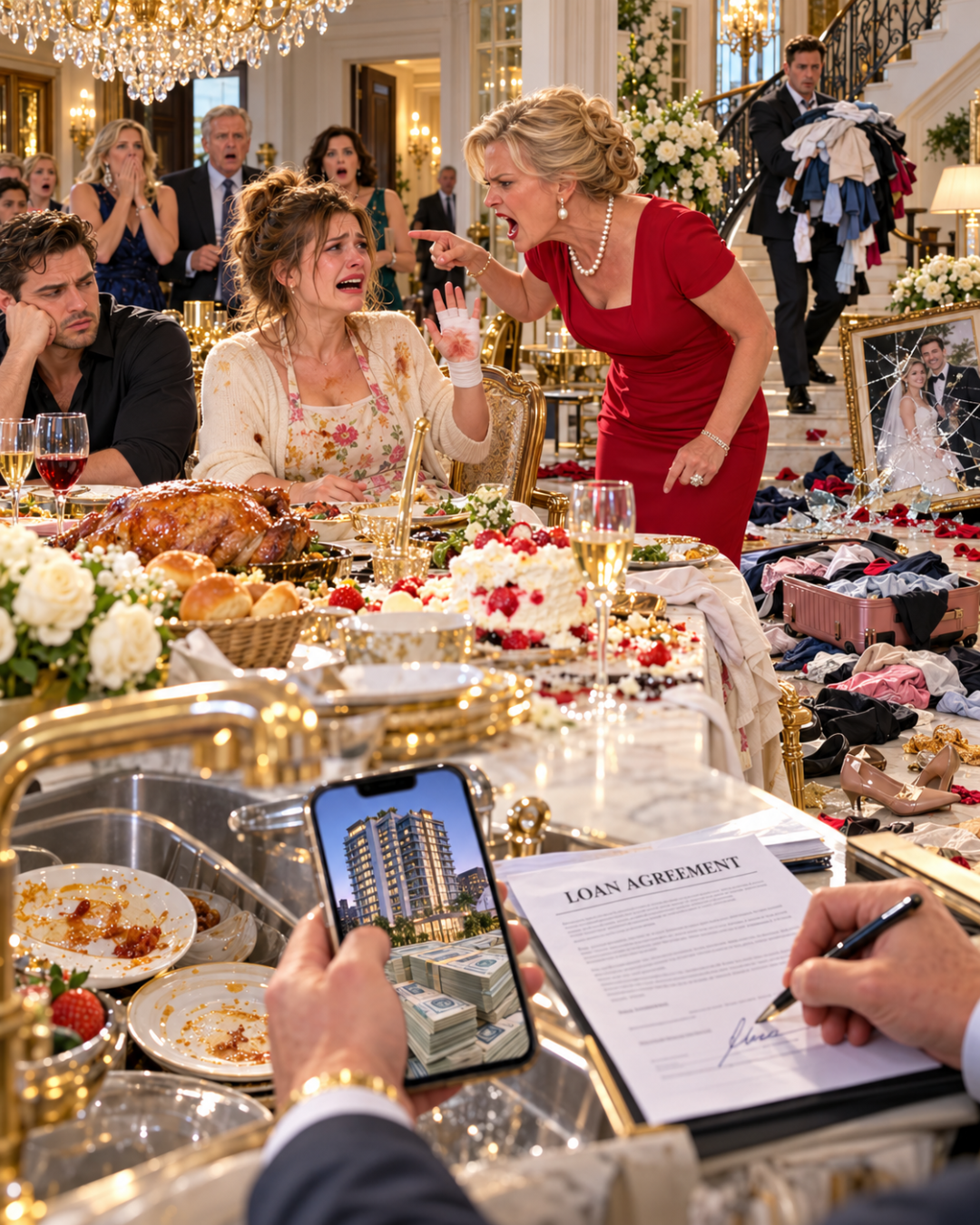
PART 2
I read the message three times, and every time, the number looked bigger.
Two million, two hundred thousand dollars.
Maya was standing in the doorway of her guest room holding a bag of frozen peas wrapped in a dish towel for my wrist. She took one look at my face and set the peas down on the dresser.
“What happened? Is it Luke?”
I turned the phone toward her. She read it, and I watched her expression go from confused to pale to something close to furious.
“Hannah. Don’t answer that number.”
“It says it’s the bank.”
“Anybody can say they’re the bank.” Maya sat down next to me on the bed. “If it’s real, the real bank will still be real when you call the number on their official website. If it’s fake, you don’t want to hand some stranger your information on the worst night of your life.”
She was right. That was the thing about Maya. We had been roommates in college, and for twelve years she had been the calmest person I knew in every crisis. I was the one who panicked quietly and smiled through it. She was the one who asked the next practical question.
I looked up the bank’s fraud line myself. First Harbor Bank. I had my business checking account there, the one I used for my design clients. My hands were shaking so badly that Maya had to dial for me.
It was almost eleven at night, but the fraud department was open. After I verified my identity, a woman with a warm Southern voice came on the line.
“Ms. Ross, my name is Grace Whitaker. I’m with our fraud prevention team. I’m the one who sent you that message. I’m very glad you called us directly.”
“I never applied for any loan,” I said. My voice cracked in the middle. “I don’t know what this is.”
There was a short pause, the kind of pause people make when they have just had a suspicion confirmed.
“I believe you,” Grace said gently. “Can I tell you why we reached out?”
The application had been submitted eleven days earlier at a First Harbor branch in Nashville. It was a commercial loan for two point two million dollars, secured by my apartment in Atlanta. The borrower listed on the paperwork was a company called Harrow Build Group, LLC.
My stomach dropped.
Harrow Build Group was Oscar’s company. Chloe’s husband. The construction business he always bragged about at family dinners, the one that was supposedly “about to take off” every single year.
“The application included a personal guarantee with your signature,” Grace went on, “and a durable power of attorney naming a Luke Ross as your agent, allowing him to act on your behalf for real estate transactions. The power of attorney was notarized.”
“I never signed a power of attorney.”
“Our loan officer compared the signature on the documents to the signature card on your business account with us,” Grace said. “They didn’t match. Not even close, honestly. That’s what flagged it. The closing was scheduled for next Thursday.”
Next Thursday.
If I had never opened a business account at that bank, if one careful loan officer had been in a hurry that day, my mother’s apartment would have been on the line for Oscar’s debts, and I wouldn’t have found out until the first missed payment.
“What happens now?” I asked.
“We’ve put a hold on the application. Nothing will close. I’m going to need you to fill out an affidavit of forgery, and I strongly recommend you file a police report and an identity theft report with the Federal Trade Commission. You should also freeze your credit with all three bureaus tonight if you can.” She hesitated. “Ms. Ross, I’ve been doing this for nineteen years. When the person named as the agent is a spouse, it’s rarely the only thing. Please check everything.”
After I hung up, I sat very still on Maya’s bed.
“Luke gave them the deed,” I said quietly. “Three days ago he asked me for the documents for a ‘bank procedure.’ I thought he meant our car refinance.”
Maya didn’t say anything. She just took my good hand and held it.
My phone buzzed again. Luke.
Mom says if you come by at noon tomorrow and apologize in front of Chloe, she’ll let this go. Bring the keys. Let’s not make this bigger than it is.
I stared at the words let this go until they blurred.
Then I did something I had never done in four years of marriage.
I didn’t answer him.
Maya’s older sister, Renee Coleman, was a real estate attorney in Memphis who had driven over to Nashville that weekend for a conference. By eight the next morning, she was sitting at Maya’s kitchen table in a crisp white blouse with a legal pad, a cup of black coffee, and the expression of a woman who had seen every kind of family disaster there was.
“Start from the beginning,” she said. “Don’t skip anything because you think it’s small. The small things are usually where the story is.”
So I told her everything.
The Atlanta apartment had belonged to my mother. After my father passed away when I was nine, Mom worked two jobs, went back to school at forty, and eventually built a small but successful staffing company. She bought that apartment in Midtown Atlanta when I was in college, a corner unit with tall windows and a view of the park. She used to say it was the first thing in her life that nobody could take away from her.
When she died of cancer three years ago, she left it to me. Only to me. It was paid off. I rented it out on short leases and used the income to support my business, and to help Luke’s family more times than I could count.
I told Renee about the renovation money. Sixty-two thousand dollars toward Brenda and Walter’s kitchen, roof, and bathroom, because Luke said his parents couldn’t manage and we would be living with them “just until the market calms down.” I told her about paying Walter’s hospital bills after his knee replacement when their insurance wouldn’t cover the rehab facility. I told her about the money that went missing from my desk drawer. I told her about my mother’s pearl necklace, the one Brenda borrowed “just for a party” six months ago and never returned.
Renee wrote steadily without looking up. When I finished, she tapped her pen twice on the legal pad.
“First,” she said, “the apartment is your separate property. You inherited it. It’s in your name alone. Luke has no right to pledge it, and a forged power of attorney doesn’t give anybody anything. That loan is dead.”
I let out a breath I didn’t know I had been holding.
“Second,” she said, and her voice got softer, “the bank lady is right. This is almost never a one-time thing. Let’s pull your credit reports. Right now.”
It took us twenty minutes.
When the first report loaded on Renee’s laptop, I felt like I was reading about a stranger.
A credit card I had never opened, issued eight months earlier. Balance: $18,400.
A second card, five months earlier. Balance: $9,750.
An auto lease for a white Lexus SUV, signed fourteen months ago with me listed as the primary lessee.
I covered my mouth with my hand.
“Chloe drives a white Lexus,” I whispered. “She told everyone Oscar surprised her with it for her birthday.”
Renee turned the laptop toward Maya, who read it and closed her eyes.
“And the mailing address on all three,” Renee said, “is Brenda’s house.”
Of course it was. For two years, I had lived in that house. Brenda always got the mail first. She always said she’d “sort it” and leave mine on the kitchen counter. Sometimes it took days. Sometimes I never got things I was expecting, and she told me the post office in their neighborhood was terrible.
I had believed her. I had believed all of them.
“Hannah,” Renee said. “Look at me.”
I looked up.
“This is not your fault. People who do this count on you being decent. They count on you not wanting to make a scene. They count on you being the kind of person who says ‘just deal with it for a minute.’ That’s not a weakness. It’s just something they used.”
Maya squeezed my shoulder. “And now you’re done dealing with it.”
I nodded, but my eyes were full.
We spent the rest of that Sunday doing things that felt both enormous and strangely ordinary. I froze my credit with Equifax, Experian, and TransUnion. I filed an identity theft report online with the FTC. I signed the bank’s affidavit of forgery. Renee called a detective she knew in Metro Nashville’s financial crimes unit, and he agreed to meet me Monday afternoon.
That night, Luke called four times. I let every call go to voicemail.
The last message he left was different from the others. He wasn’t angry anymore. He sounded nervous.
“Han, it’s me. Look, Mom’s calmed down. Just… call me back, okay? And don’t talk to anybody about the apartment stuff until we talk. It’s complicated. I can explain.”
Don’t talk to anybody.
It was the first time in four years I realized my husband was scared of me.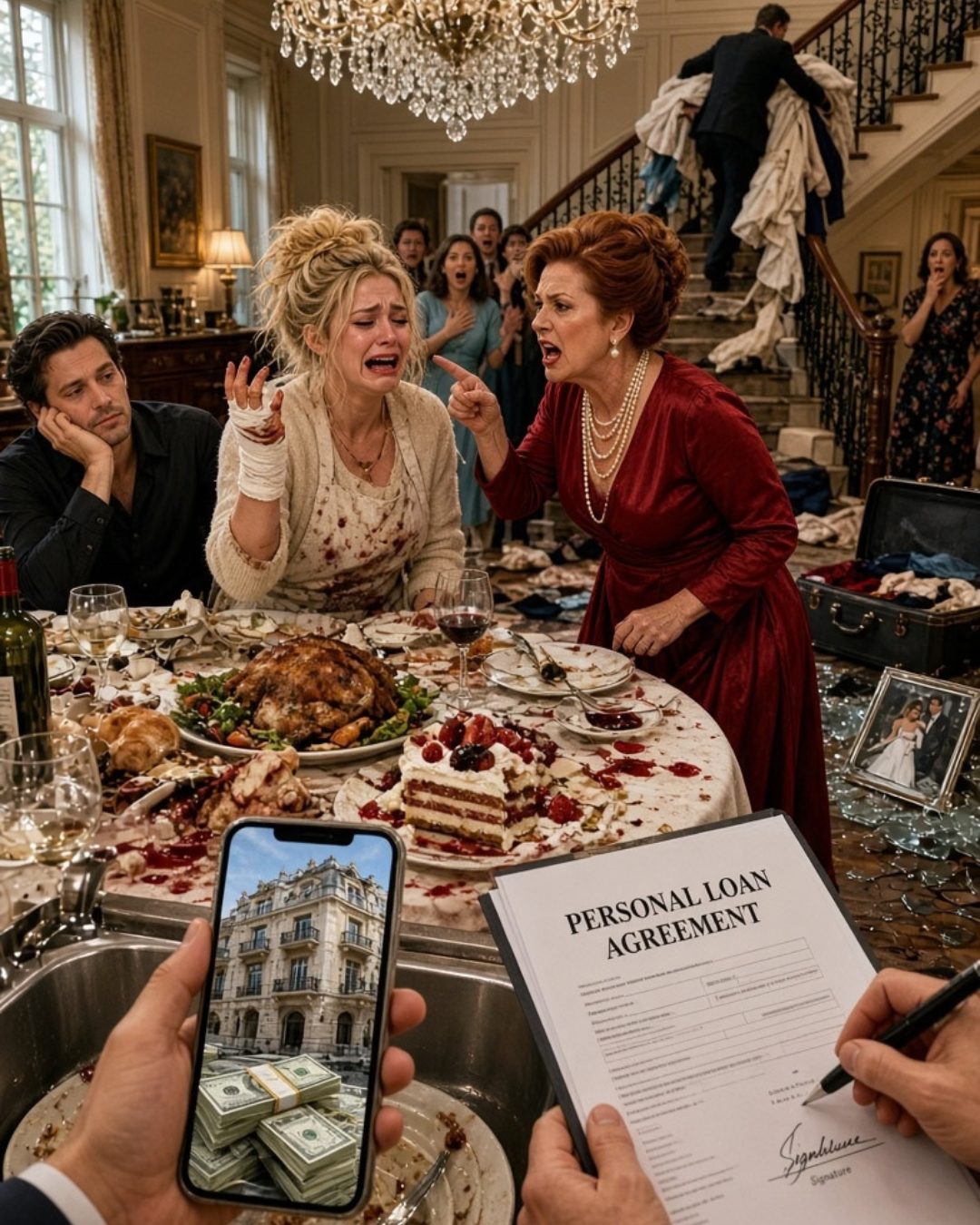
PART 3
Detective Marcus Hale was a tall man in his fifties with reading glasses on a cord around his neck and a desk covered in neatly labeled folders. He listened without interrupting, then asked me to go over one part again.
“The notary,” he said. “Whose stamp is on the power of attorney?”
I slid the copy Grace had emailed me across the desk. The notary seal read Tamara J. Pruitt, Davidson County.
I didn’t recognize the name. But the detective did something on his computer, and after a minute he looked up.
“Tamara Pruitt works as an office manager,” he said. “At Harrow Build Group.”
Oscar’s company.
“So the notary never saw me sign anything,” I said slowly, “because I was never there.”
“That’s my guess.” Detective Hale took off his glasses. “Ms. Ross, I want to be honest about how this usually goes. The bank has already filed its own report. With the forged documents, the credit card applications, the lease, and a notary connected to the borrower’s company, this is a serious case. People involved could face real consequences. Charges. Restitution. Maybe more.”
He let that settle.
“Some people in your position change their minds when it’s family. They drop out. They don’t want to be the reason someone gets in trouble. I understand that. But I want you to know, they’re not in trouble because of you. They’re in trouble because of what they did.”
I thought of Brenda at the top of the stairs, throwing my clothes into the yard. My perfume shattering. The broken glass across Luke’s face in our wedding photo. And Chloe, looking at her fresh nails, asking me to wash her plate with a burned hand while she drove a car I was paying for without knowing it.
“I’m not changing my mind,” I said.
He nodded once, like he had expected that answer.
“One more thing,” he said. “You mentioned some of your belongings are still at the house. You have every right to get them. I’d suggest you do it with a civil standby. An officer will come with you so it stays peaceful. And anything you find there that belongs to you, including any mail in your name, you take it.”
I went back to Brenda’s house on Tuesday morning at ten, with Maya beside me and a patrol officer named Officer Delgado parked at the curb.
I had chosen the time on purpose. Brenda had her Bible study group every Tuesday morning at church. Chloe would be at the accounting firm. Oscar was always at job sites. Luke worked in sales at a car dealership, and Tuesdays were his long days.
The only person home was my father-in-law, Walter.
Walter was seventy-one, a retired high school shop teacher with big quiet hands and a habit of fixing things that nobody asked him to fix. He opened the door slowly, leaning on his cane, and when he saw the officer behind me, something in his face collapsed.
“Hannah,” he said. “Honey. Come in.”
He didn’t ask why there was a police officer. He didn’t ask why I hadn’t come to apologize. He just stepped aside.
Brenda had put the rest of my things in black trash bags in the garage. My design books. My winter coat. My laptop stand. My sketchbooks from college. One of the bags had been left near the oil stain on the floor, and the bottom of it was soaked through.
I didn’t cry at that. I didn’t cry at the missing framed photo of my mother either, or at the fact that my good wool blazer had a footprint on it.
I cried when I opened my jewelry box upstairs and found the long velvet case where my mother’s pearls were supposed to be.
Empty.
I sat down on the edge of the bed that used to be mine and held the empty case in my lap. Maya stood quietly in the doorway. Officer Delgado waited in the hall and gave us space.
Then I heard Walter’s cane on the stairs.
He came in slowly, breathing hard from the climb. He had a manila folder in his hand, soft and worn at the edges, like it had been handled a lot.
“I need to give you something,” he said. “I should have given it to you months ago. I’m ashamed that I didn’t.”
He sat down in the old armchair by the window and held the folder out to me.
Inside were envelopes. Dozens of them. All addressed to Hannah Ross. Credit card statements. Collection notices. Two letters from the leasing company. A notice from a bank I had never heard of.
And at the very bottom, a small yellow slip of paper.
A pawn receipt from Belmont Jewelry & Loan, dated four months earlier.
One strand cultured pearls, 18k gold clasp, engraved.
Loan amount: $1,300.
The name on the receipt was Brenda Ross.
I looked up at Walter. His eyes were wet.
“I found the mail in the hall cabinet behind the old phone books,” he said. “Back in the spring. I asked Brenda about it, and she told me it was junk mail and that you’d said to throw it out. I wanted to believe her. Forty-four years, you want to believe your wife.”
He shook his head slowly.
“Then last month I found the pawn ticket in her purse when she asked me to get her reading glasses. I knew what that necklace meant to you. I’ve seen you touch the case when you’re sad, when you think no one’s looking.” His voice broke. “I told myself I’d fix it. I’d get the money together and get it back before you noticed. I’m an old man on a fixed income, Hannah. I didn’t get the money together fast enough. And I didn’t tell you. That’s on me.”
I didn’t know what to say. So I got up, walked over, and hugged him.
He held on to me like a father would. Like my own father might have, if he had lived long enough.
“You took care of me after my surgery,” he said into my hair. “You drove me to every appointment. You slept in that chair in the rehab center. My own daughter lived ten minutes away and came twice.” He pulled back and looked at me. “I don’t know everything they’ve done. But I know you didn’t deserve any of it.”
Before we left, Walter walked me to the car. Officer Delgado was already loading the last bag into Maya’s trunk.
“Is it true?” Walter asked quietly. “About the loan? Brenda’s been on the phone with Chloe every night this week. Whispering. I heard the word ‘bank’ about a hundred times.”
“It’s true,” I said.
He closed his eyes for a moment.
“Then whatever you do next,” he said, “you do it. Don’t protect them on my account.”
Belmont Jewelry & Loan was a small shop between a nail salon and a barbecue place, with a hand-painted sign and a bell over the door.
The owner was an older man named Frank Castellano who had run the store for thirty years. When I showed him the pawn receipt, the police report number, and a photo of my mother wearing the pearls at my college graduation, he studied the picture for a long time.
“The loan went into default two weeks ago,” he said. “I was going to put it in the case this Friday.”
My heart stopped.
He went into the back and returned with a small cardboard box. He opened it on the glass counter.
There they were. My mother’s pearls, a little dull under the fluorescent lights, but whole. Perfect.
I picked up the clasp with shaking fingers and turned it over.
The engraving was still there, small and delicate, in the handwriting-style script my mother had chosen the year I graduated.
For H. — you have always been enough.
I had to put my hand flat on the counter to steady myself.
Frank cleared his throat and looked away politely while I cried. Maya rubbed my back.
“Legally,” Frank finally said, “since it’s reported stolen, I’m supposed to hold it for the detective. But I’ll tell you what. I’ll call your detective right now. If he says it’s all right to release it to you as the owner, it’s yours. And I’ll go after the person who pawned it for my thirteen hundred. That’s my problem, not yours.”
Detective Hale said yes.
I walked out of Belmont Jewelry & Loan with my mother’s pearls around my neck, and for the first time in a week, I felt like I could breathe all the way down to the bottom of my lungs.
The call came on Saturday night. Exactly one week after Brenda threw me out.
I was sitting on Maya’s back porch with a cup of chamomile tea, the pearls warm against my collarbone, when Luke’s name lit up my phone.
This time, I answered.
“Hannah.” He sounded relieved, like he’d been holding his breath for days. “Thank God. I’ve been worried sick.”
I didn’t say anything.
“Listen,” he went on quickly. “I talked to Mom. She’s really calmed down. She wants to have everyone over for Sunday dinner tomorrow. Same people as last week. She says if you come and just say you’re sorry for the way you talked to her, everything goes back to normal. She even said you don’t have to do the dishes.”
He laughed a little, like that was a generous joke.
“And?” I said.
“And…” He hesitated. “There’s a small thing with the bank. It’s nothing, really. They need you to come in and confirm a couple of signatures. It’s just a formality. Oscar’s company needs some capital to finish a big project, and once it’s done, they’ll pay everything back in a year, tops. The apartment’s just sitting there as security. It’s not like anyone’s taking it.”
I set my tea down very carefully.
“Luke,” I said. “I’m holding the loan application in my hands right now.”
It was true. Grace had overnighted me a full copy. It was sitting on the patio table beside me in a clear plastic sleeve. Twenty-three pages. My name printed at the top. A signature at the bottom that looked like someone had traced my name from a birthday card.
The line went completely silent.
“Who signed my name?” I asked.
“Hannah…”
“Who signed my name, Luke?”
A long breath.
“Chloe,” he finally said. “Chloe signed it. She practiced from your old checks. Oscar’s office manager did the notary thing. I just… I just gave them the deed copy and your ID scan. That’s all I did. I swear.”
“That’s all you did,” I repeated.
“They were going to lose everything!” His voice rose. “Oscar owes money to suppliers, the bank was going to call his line of credit, Chloe was panicking, Mom was crying every night. You had this apartment just sitting there, and you’re always so careful and so calm, and I thought… I thought if it all worked out, you’d never even have to know. And if you found out later, you’d understand. It’s family, Han.”
“Did you know about the credit cards?”
Silence.
“Did you know about the Lexus?”
“Mom said you wouldn’t mind,” he said quietly. “She said you had good credit and it wasn’t hurting you.”
I closed my eyes.
I thought about four years. About every time I made myself smaller so there would be peace. About every holiday I spent in the kitchen while he watched football. About the way he said just deal with it for a minute like it was a love language.
“I’ll be there tomorrow,” I said.
“Really?” The relief in his voice was almost painful to hear. “Han, that’s great. That’s so great. Mom’s going to be so happy. Six o’clock, okay? And bring the keys, so we can just get it all over with.”
“I’ll bring everything,” I said.
And I hung up.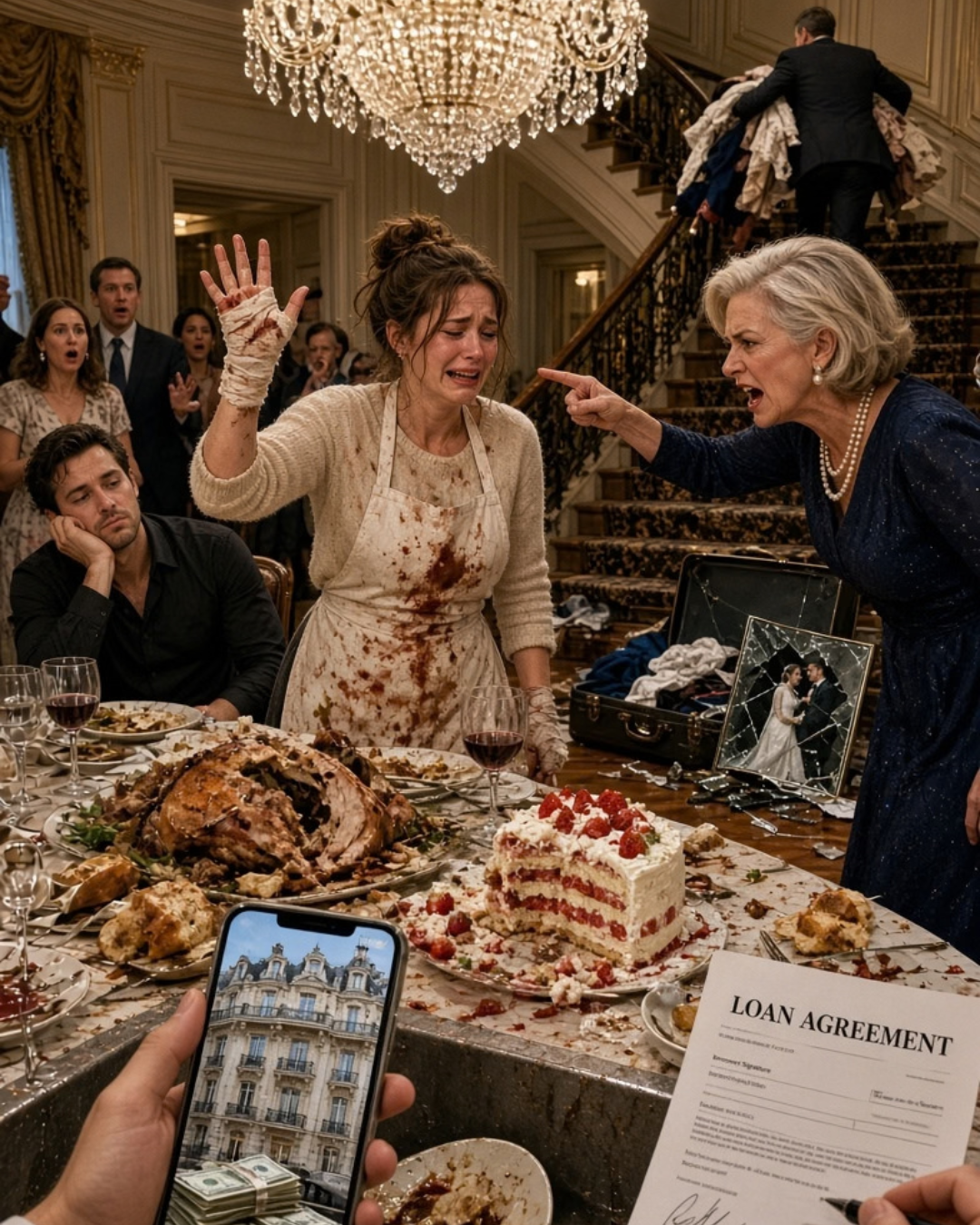
PART 4
Sunday dinner at Brenda’s house started at six o’clock sharp, the way it always did.
I arrived at 6:15.
I wore a navy dress my mother had helped me pick for a client presentation years ago. My hair was pulled back. My right wrist was still bandaged. And around my neck, clearly visible, were the pearls.
Renee walked in beside me carrying a leather briefcase.
The living room went quiet so fast it felt like someone had pulled a plug.
They were all there. The same eleven people from the week before. Brenda at the head of the dining table in a lavender blouse. Walter in his usual chair, his cane hooked on the armrest. Chloe and Oscar side by side, their toddler asleep in a portable crib in the corner of the den. Luke standing near the window, his face lighting up and then freezing when he saw Renee. Brenda’s sister, Aunt Patrice, and her husband, Uncle Ray. Cousin Tyler and his wife Jenna. And the next-door neighbors, Deb and Gary Fulton, who had been coming to Sunday dinners at that house for twenty years.
The table was set with Brenda’s good china. And in the kitchen, visible through the open doorway, the sink was already stacked high with pots and pans from cooking.
Of course it was.
Brenda’s eyes went straight to my neck. I watched the color drain out of her face.
Then she recovered, the way she always did, with a tight smile.
“Well,” she said. “Look who finally decided to show up. And she brought a friend. Hannah, this is a family dinner.”
“I know,” I said. “That’s why I’m here. This is Renee Coleman. She’s my attorney.”
Uncle Ray set his iced tea down. Deb Fulton glanced at Gary. Chloe’s hand went very still on her fork.
Luke stepped forward. “Han, what are you doing? I thought we agreed…”
“You asked me to come apologize,” I said. “And you asked me to bring everything. So I did.”
Renee set the briefcase on the side table and opened it.
“I’d like to start with the apartment keys,” I said, and I held them up. “Brenda, last week you told me these would belong to Chloe someday. You told me in front of everyone in this room. So I think everyone in this room deserves to know why.”
“Hannah, don’t,” Luke said.
“Sit down, Luke.”
I had never said anything to him in that tone before. He sat.
I took the loan application out of its plastic sleeve and laid it on the dining table, right on top of the lace tablecloth, between the green beans and the dinner rolls.
“Eleven days before you threw me out of this house,” I said, “someone walked into First Harbor Bank and applied for a two point two million dollar loan for Harrow Build Group. Oscar’s company. The collateral was my mother’s apartment. The one she left me when she died.”
Aunt Patrice gasped. Oscar’s jaw went tight.
“The application had my signature on it,” I went on. “It also had a power of attorney, supposedly signed by me, giving Luke the right to handle my property. It was notarized by Tamara Pruitt. Oscar, I believe Tamara is your office manager.”
Oscar pushed his chair back. “This is ridiculous. You don’t know what you’re talking about. That was a legitimate business transaction, and Luke said…”
“Luke said what?” Renee asked calmly.
Oscar stopped.
“I never signed any of it,” I said. “The bank compared the signature to my real one. It didn’t match. The loan is frozen. It will never close. The bank has already filed its own report.”
I looked at Chloe.
“Chloe, Luke told me last night that you practiced my signature from my old checks.”
Every head in the room turned toward her.
Chloe’s face went bright red and then white. She opened her mouth. Closed it. Looked at her mother.
“Chloe,” Brenda said sharply. “Don’t say a word.”
And that, more than anything, told everyone the truth.
“That’s not all,” I said, and my voice was steadier than I expected. Renee handed me the next folder. “There are two credit cards in my name that I never opened. Twenty-eight thousand dollars in charges. And there’s a lease on a white Lexus SUV with my name as the primary driver. Chloe, I believe you drove it here tonight.”
Cousin Jenna actually turned and looked out the window at the driveway, where the white SUV was parked under the streetlight.
“All the statements were mailed to this address,” I said. “And for over a year, somebody in this house hid them from me.”
“That’s a lie,” Brenda snapped. She stood up so fast her chair scraped the hardwood. “That’s a lie and you know it. You’ve always been jealous of this family. You come in here with your fancy lawyer and your fancy degree and you think you can…”
“It’s not a lie, Brenda.”
The voice came from the corner of the room.
Walter was pushing himself up out of his chair, one hand on his cane. It took him a moment. Nobody moved to help him. Nobody breathed.
He reached into his cardigan pocket and took out a folded sheet of paper. It was a photocopy of the pawn receipt.
“I found Hannah’s mail behind the phone books in March,” he said. “You told me it was junk. I found this in your purse in August. Belmont Jewelry and Loan. One strand of pearls. Engraved.” He looked straight at his wife. “You pawned her dead mother’s necklace for thirteen hundred dollars, Brenda. And I watched this girl cook for you, clean for you, pay for our roof, and sit up with me every night after my surgery. And I kept my mouth shut because I didn’t want a fight.”
His voice shook.
“I’m done keeping my mouth shut.”
Brenda stared at him like she had never seen him before.
“Walter,” she whispered. “We needed that money. Chloe was behind on the payments for the baby’s daycare. What was I supposed to do?”
“You were supposed to ask,” he said. “You were supposed to ask her. Or me. Or anybody. You weren’t supposed to take.”
The silence in the room was heavy enough to feel.
Then Deb Fulton, the neighbor, set her napkin down on the table very gently.
“Brenda,” she said softly, “I think Gary and I should go home.”
“Deb, no, sit down, this is just…”
“We’ve been coming here twenty years,” Deb said. “I held Chloe when she was a baby. But I’m not going to sit at this table and eat this food while that girl stands there with a bandage on her hand.” She stood, and Gary stood with her. On their way to the door, Deb stopped next to me and touched my arm. “Your mother would be very proud of you, honey. I only met her once, at your wedding. But I can tell.”
After the Fultons left, Aunt Patrice turned to her sister.
“Brenda,” she said. “The four thousand dollars you borrowed from me in January. For Walter’s ‘medication.’ Hannah paid for Walter’s medication. I know, because she told me at Easter.”
Brenda didn’t answer.
“Where did that money go?” Patrice asked.
Brenda’s eyes flicked to Chloe for just a second. That was enough.
Oscar suddenly stood up, grabbed his keys from the counter, and headed for the door.
“I don’t have to listen to this,” he said. “I’m not saying anything without my own lawyer.”
“That’s a good idea, Mr. Harrow,” Renee said evenly. “Because Detective Marcus Hale of the Metro Nashville financial crimes unit is going to want to talk to you. And to Ms. Pruitt. He already has copies of everything on this table.”
Oscar froze with his hand on the doorknob.
Chloe burst into tears.
It wasn’t a quiet, pretty cry. It was the kind of crying that comes from somewhere deep, from months of pretending everything is fine. She put her face in her hands and her whole body shook.
“I’m sorry,” she sobbed. “I’m sorry, I’m sorry. Oscar said we’d lose the house. He said the suppliers were going to sue us. Mom said Hannah had so much and we had nothing, and she’d never even notice, and it would all be paid back. I didn’t want to. I didn’t want to do the signature. I practiced it for two weeks and I felt sick every single time.”
“Chloe!” Oscar barked.
“No!” She lifted her head. Mascara ran down her face. “No, Oscar. I’m done. I’m not going to lose my son over your business. I’ll tell them everything.”
She turned to me.
“Hannah, I’m so sorry. The car, the cards, all of it. I told myself it wasn’t really stealing because you were family. But it was. I know it was.”
I looked at her for a long moment. My sister-in-law. The woman who asked me to wash her plate a week ago so she wouldn’t chip her nails.
“Then tell the detective the truth,” I said quietly. “All of it. That’s the only apology that matters right now.”
She nodded, wiping her face.
And then there was only one person left who hadn’t spoken.
Luke was still sitting where I had told him to sit. His elbows on his knees. His hands hanging between them. He looked like a man sitting in the waiting room of his own life.
“Luke,” I said.
He looked up. His eyes were red.
“I didn’t sign anything,” he said. “I want everybody to know that. I didn’t sign anything.”
“You gave them my deed,” I said. “You gave them a scan of my ID. You knew about the loan. You knew about the car. You watched your mother throw my clothes out a window and you didn’t stand up. You asked me to come here tonight and apologize, so I’d bring the keys and sign whatever they put in front of me.”
“I was trying to keep the peace.”
“You were keeping their peace,” I said. “Never mine. Not once in four years.”
He stood up and took a step toward me. “Han, please. We can fix this. We can move out, just the two of us. I’ll get a better job. I’ll go to counseling. I’ll do whatever you want. Just don’t do this. Don’t send my sister to jail. Don’t do this to my family.”
I felt something inside me go very quiet and very clear.
“Luke,” I said. “I didn’t do this to your family. Your family did this to me. The only thing I’m doing is refusing to carry it anymore.”
I twisted the wedding band off my finger. It came off more easily than I expected. Maybe I’d lost weight that week. Maybe it had never really fit.
I set it down on the table, right next to the loan application.
“Renee will be in touch about the divorce,” I said.
Brenda made a sound like a wounded animal. “You can’t just walk out on him! After everything we’ve done for you! We gave you a home! We gave you a family!”
I turned to face her.
For four years, I had been afraid of this woman. Afraid of her sighs, her comments, the way her smile could turn cold in the middle of a sentence. I had cooked her Thanksgiving turkey and ironed her tablecloths and listened to her tell me I was lucky to have married into this family.
I wasn’t afraid anymore.
“Brenda,” I said. “You didn’t give me a home. I paid for your roof. You didn’t give me a family. I paid for your husband’s rehab. You told me I lived under your roof, but you forgot who fixed it.”
I glanced toward the kitchen.
“And the dishes are in the sink.”
Walter walked me to the door.
On the porch, under the yellow light, he took both my hands in his.
“I’m going to stay with Patrice for a while,” he said. “I need some time to think. Forty-four years is a long time to not see something.”
“You saw it,” I said gently. “You’re the only one who did something about it.”
He smiled a little, sadly.
“Your mother raised you right,” he said. “I wish I’d been half as brave as you, thirty years ago.”
Then he leaned in and kissed my forehead the way my father used to. And I walked down the porch steps to Renee’s car without looking back.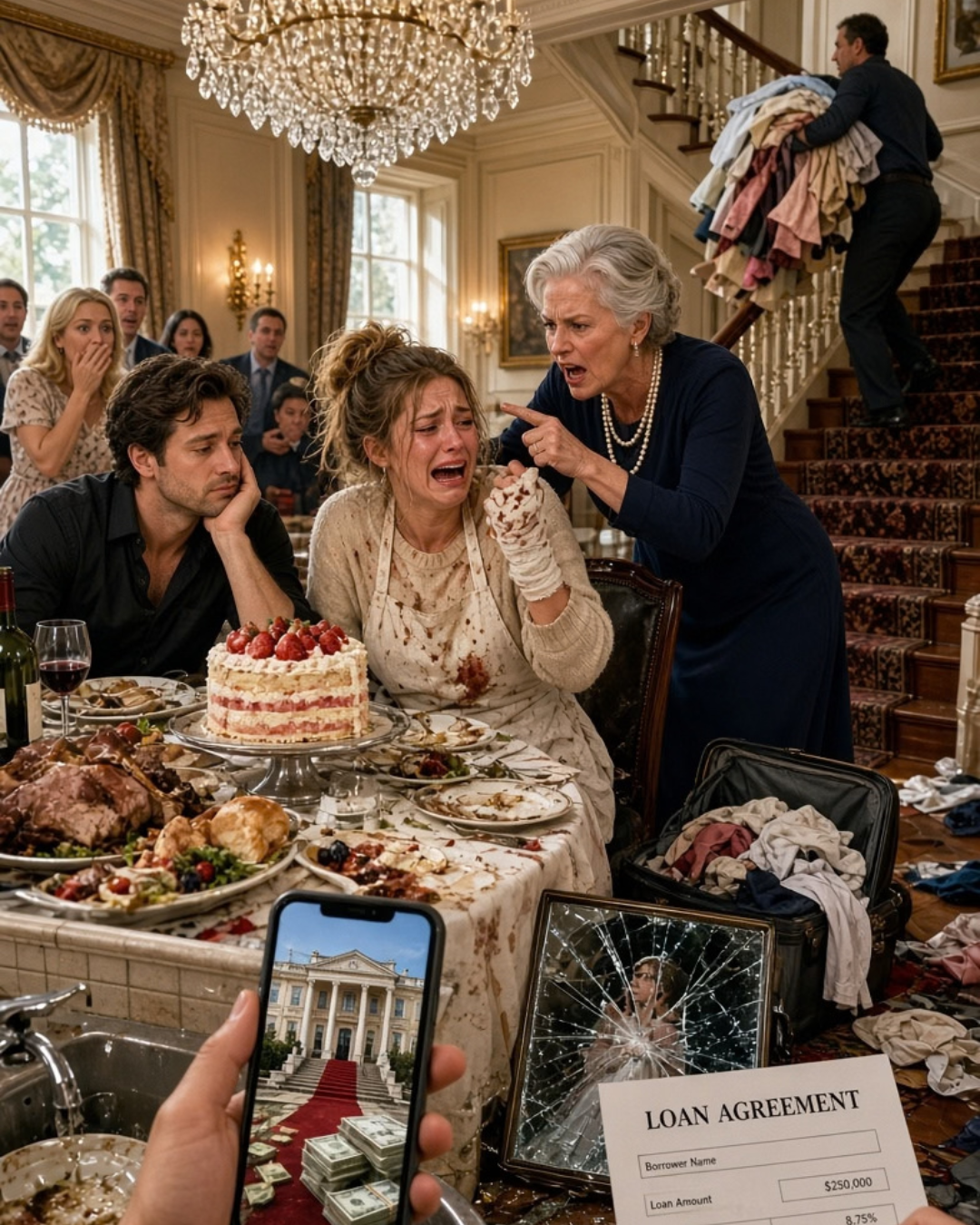
PART 5
The months that followed were not easy. But for the first time in a long time, they were honest.
Chloe kept her word. She met with Detective Hale three days after that dinner and told him everything. The forged signature. The practice sheets she had hidden in a kitchen drawer. The emails between Oscar and Tamara Pruitt about “getting the POA stamped.” Brenda’s role in hiding the mail and opening the accounts.
Because she cooperated fully and had no prior record, her attorney worked out an agreement with prosecutors. She would plead guilty to a lesser charge, pay full restitution, complete community service, and serve probation. The accounting firm let her go. The promotion that dinner had been celebrating was gone before her first paycheck at the new level.
The white Lexus went back to the leasing company. My name was removed from the lease, and the credit card companies closed the fraudulent accounts after reviewing the police report. My credit score, which had quietly dropped over the past year without my knowing, began to climb back up month by month.
Oscar tried to fight it. He hired a lawyer and told anyone who would listen that the whole thing was a misunderstanding. But the emails were the emails. And when Tamara Pruitt learned that her notary commission was being investigated, she came forward with her own statement. She said Oscar had told her it was “just family paperwork” and threatened her job if she didn’t stamp it.
Oscar was charged. His company’s line of credit was called. Harrow Build Group closed its doors that winter. The last I heard, he was working for another contractor while his case moved through court, and Chloe had filed for separation.
Tamara lost her notary commission, but because she cooperated, she wasn’t charged.
As for Brenda, the investigation found that she had personally filled out the applications for both credit cards using my information from documents in my desk. She also pawned my mother’s pearls without permission. She was charged with identity theft and theft of property. Her lawyer argued that she was a grandmother with no record who had “made poor choices under family pressure.” She received probation, a restitution order, and a judge who looked at her over his glasses and said, “Ma’am, the word ‘family’ is not a legal defense.”
She had to repay Frank Castellano at Belmont Jewelry & Loan the full thirteen hundred dollars. When I heard that, I sent Frank a thank-you card with a gift certificate to the barbecue place next door. He sent back a photo of himself holding it, grinning.
And Luke.
Luke was never charged. Detective Hale explained that handing over copies of documents, as bad as it was, was harder to prove as a crime than forging signatures. There was no question he knew. But knowing and signing are different things in court.
They weren’t different things in my heart, though.
The divorce was final in March. Tennessee is a state where property you inherit stays yours as long as you keep it separate, and I always had. The Atlanta apartment was never in question. Renee also made sure the sixty-two thousand dollars I had put into his parents’ house was documented. Luke agreed, without a fight, to pay back half of it over five years.
That was the only part of the divorce where he surprised me.
He didn’t contest anything. He didn’t ask for alimony, even though I earned more than he did. He signed every page Renee sent him. At the final hearing, when the judge asked if he understood what he was agreeing to, he said, “Yes, Your Honor. It’s the least I owe her.”
Outside the courthouse, he caught up to me on the steps.
“Han,” he said. “Can I say one thing? Then I’ll leave you alone.”
I waited.
“I’m seeing a counselor now,” he said. “Twice a month. She asked me why I always said ‘just deal with it for a minute’ to you. And I couldn’t answer. So she asked me who used to say it to me.” He looked down at the concrete. “It was my mom. Every time my dad tried to push back on something, every time I got upset as a kid. ‘Just deal with it for a minute, Luke.’ I didn’t even know I was repeating it. I thought it was just how families worked.”
He looked up.
“I’m not asking for anything. I know I don’t get to. I just wanted you to know I finally heard what I sounded like. I’m sorry it took losing you.”
It was the most honest thing he had ever said to me.
“I hope you keep going to the counselor,” I said. And I meant it. “I hope the next person you love never has to ask you to stand up.”
He nodded. His eyes were wet. Then he turned and walked down the steps, and I watched him go, and I felt sadness, but not regret.
There’s a difference. It took me a long time to learn it.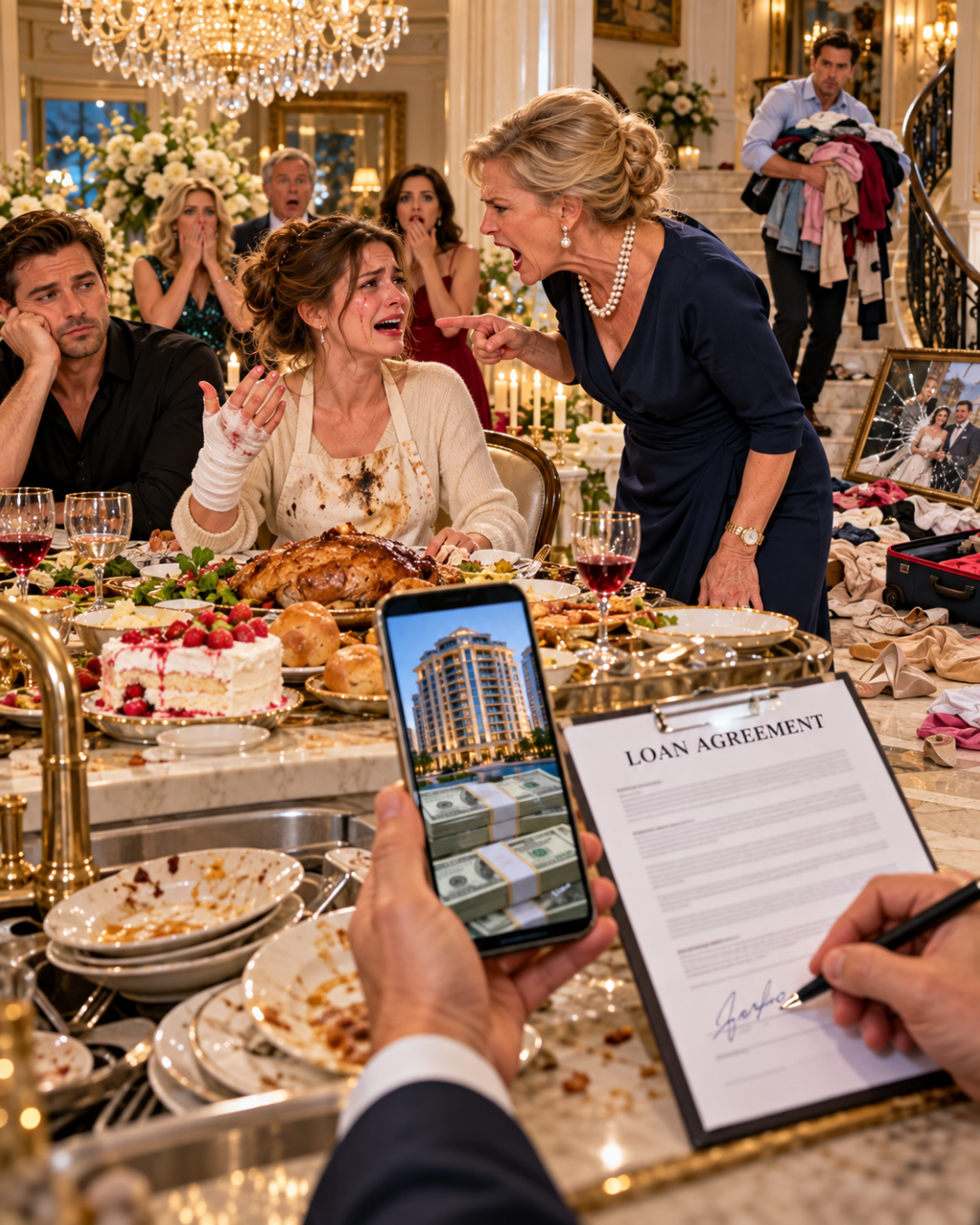
PART 6
In April, I moved to Atlanta.
The last tenants’ lease had ended in February, and I decided not to rent the apartment out again. For the first time since my mother died, I unlocked the front door not as a landlord, but as someone coming home.
The morning light came through the tall windows exactly the way I remembered. Mom’s reading chair was still in the corner where the tenants had pushed it. I sat in it for almost an hour that first day, just looking out at the treetops of the park, the pearls around my neck.
“I kept it, Mom,” I said out loud. “They tried. But I kept it.”
I rebuilt my design business from that apartment. It turned out the thing Brenda had always mocked, making “my little money sitting in front of a computer,” could be done from anywhere. Atlanta was full of people buying old homes and wanting them to feel warm again. By summer, I had more clients than I’d had in Memphis. By fall, I hired my first assistant, a bright young designer named Keisha who had just graduated from the Savannah College of Art and Design and who reminded me of myself at her age, except braver.
The project I was proudest of that year was for a nonprofit in southwest Atlanta. They ran a shelter and transitional housing program for women rebuilding their lives after financial abuse. Women who had lost their homes, their credit, their savings, sometimes their names, to people who said they loved them.
The director, a soft-spoken woman named Loretta, had read a short piece I wrote for a local design blog about starting over. She called and asked if I’d be willing to redesign their shared kitchen for free.
I said yes before she finished the question.
I designed that kitchen with a long table instead of an island, so everyone could sit together. Wide counters so two people could cook side by side. Two sinks, so no one ever stood alone washing up while everyone else relaxed in the other room. Above the door, Loretta let me paint a line in simple white letters:
In this kitchen, everybody helps.
When the kitchen was finished, the residents cooked a dinner to celebrate. A woman named Yolanda made the best cornbread I’ve ever eaten. A shy young mother named Brittany made banana pudding in a glass dish and blushed every time someone asked for seconds.
And when dinner was over, something happened that I will never forget.
Everyone stood up at once. Nobody was asked. Nobody was told. They just started clearing plates, rinsing glasses, laughing, bumping hips at the two sinks, handing towels down the line. Someone put on music. Someone started singing along.
I stood at the edge of it all with a dish towel in my hand and tears running down my face.
Loretta came and stood next to me.
“You okay?” she asked.
“I’m perfect,” I said. And I was.
That Thanksgiving, I hosted dinner in my mother’s apartment.
It wasn’t a big group. Maya flew down from Nashville. Renee came with her husband and their two teenage sons. Keisha brought her girlfriend. Detective Hale and his wife were visiting their daughter in Atlanta that week, and when I mentioned the dinner on the phone, he laughed and said he’d bring the sweet potato casserole.
And Walter came.
He had moved back home in the spring after a long talk with Brenda and a longer talk with a pastor. He told me on the phone, very plainly, that his marriage had changed. That he handled the mail now. That he’d put his own name on every account and every bill, and that Brenda was going to counseling as part of her probation. He said she had written me a letter, but he didn’t want to send it until I was ready.
“There’s no rush,” I told him.
“I know,” he said. “That’s why I’m not rushing.”
Walter took the train down from Nashville by himself. He arrived with his cane, a small overnight bag, and a homemade pecan pie in a plastic carrier that he’d guarded on his lap for six hours.
“Made it myself,” he said proudly when I opened the door. “Your mother-in-law never let me in the kitchen. Turns out I’m pretty good at it.”
I laughed so hard I had to lean on the doorframe.
We ate at my mother’s old dining table, which I had refinished myself that summer. Renee’s boys fought over the last roll. Detective Hale told stories about the strangest fraud cases he’d ever worked, carefully leaving out anybody’s name. Maya made a toast that made everyone cry, and then she made another toast to make everyone stop crying.
When the pie was gone and the coffee was poured, I stood up to start clearing plates out of habit.
Walter put his hand on my arm.
“Sit down, honey,” he said. “You cooked.”
Then he stood up, hooked his cane on the back of his chair, and carried the first stack of plates to the sink.
One by one, everyone followed him. Renee’s sons argued over who got to dry. Detective Hale rolled up his sleeves. Maya handed out dish towels like she was passing out medals.
I sat alone at my mother’s table for the first time that night, listening to the water running and the plates clinking and the people I loved laughing in my kitchen.
My wrist had long since healed. There was only a faint pale mark left from the oven burn, the size of a thumbprint. Some days I didn’t even notice it. Some days I looked at it on purpose.
It reminded me of the night I finally said no.
Two weeks later, I opened Brenda’s letter.
It was short. Her handwriting was shakier than I remembered.
Hannah,
My counselor says I have to write this without explaining myself, so I will try.
I took things that were yours. Your money, your name, your mother’s pearls, and your peace. I told myself it was for my children. It was for my pride. I was ashamed that my family needed so much, and I was angry that you had what we didn’t. I made you the servant in my house so I wouldn’t have to feel small.
I am sorry. I don’t expect you to answer.
Walter says you taught him to stand up. I think you taught me that too, even though I didn’t want to learn it.
Brenda
I read it twice. Then I folded it and put it in the drawer of my mother’s desk.
I didn’t write back. Not yet. Maybe someday. Forgiveness, I’ve learned, isn’t a door you’re forced to walk through the moment someone knocks. It’s a room in your own house, and you get to decide when to open it.
People sometimes ask me, when they hear the story, what the lowest moment was.
They expect me to say the night Brenda threw my clothes out the window. Or the moment I read the bank message. Or the day I saw my own name on a car lease I never signed.
But it wasn’t any of those.
The lowest moment was years earlier, on some ordinary Sunday, when I stood at that sink with my hands in the hot water while everyone else laughed in the next room, and I thought, This is just what love costs.
It isn’t.
Love doesn’t ask you to burn your hand and keep scrubbing. Love doesn’t take your mother’s necklace and call it borrowing. Love doesn’t practice your signature at the kitchen table. And love never, ever says just deal with it for a minute when what it means is stay small so the rest of us stay comfortable.
Real love rolls up its sleeves and stands next to you at the sink.
I found that out the hard way. I lost a husband, a house I helped pay for, and a family I thought was mine.
But I kept my mother’s apartment. I kept my name. I kept her pearls, with that small engraving on the clasp that I finally believe.
You have always been enough.
And every Sunday now, in a sunny apartment in Atlanta with tall windows over the park, I cook dinner for people who love me.
And when it’s over, everybody helps with the dishes.
THE END
