


PART 2
The officers separated us so they could continue taking statements.
Javier was informed that the reported assault and threats would be documented and investigated.
The financial documents would need a separate examination.
There was no instant judgment.
No dramatic declaration that every accusation had been proven.
There were witnesses.
Security recordings.
Banking records.
Documents.
And a formal process that Javier couldn’t simply dismiss with an angry command.
That was enough for me.
As I prepared to leave, Mercedes called after me.
“Clara, please. Don’t ruin my son’s life.”
I turned toward her.
Her eyes were wet.
For three years, I would have rushed to comfort her.
But now I noticed something.
She hadn’t asked whether I was hurt.
Not once.
“Mercedes,” I said softly, “your son made his choices.”
She shook her head.
“He’s your husband.”
I looked down at my wedding ring.
Then I slowly removed it.
The gold caught the light from the chandelier.
“Not for much longer.”
I placed the ring beside the unpaid bill.
And walked away.
Outside, a fine autumn rain was falling over Madrid.
Cars moved across the shining pavement.
A bus stopped at the curb.
Farther down the street, a couple laughed beneath a shared umbrella.
I stood under the restaurant awning, holding my stained scarf.
Then my chest tightened.
My knees felt weak.
I leaned against the stone wall and struggled to breathe.
Inspector Salazar, who had accompanied me outside, asked whether I needed medical attention.
I nodded.
Not because I believed I was seriously injured.
But because I was tired of pretending I was fine.
A medical team examined me, treated the irritation on my face, and explained what further care might be necessary.
Afterward, I sat on a bench beneath the awning.
Then I called my sister, Lucía.
She answered almost immediately.
“Clara? It’s late. What’s wrong?”
The warmth in her voice broke something inside me.
“Can you come get me?”
She paused.
“Where are you?”
I gave her the restaurant’s address.
“I’m coming.”
She didn’t demand an explanation.
She didn’t tell me to stop crying.
She simply came.
Twenty-five minutes later, her small blue car pulled up beside the curb.
Lucía stepped out wearing an oversized sweater and mismatched shoes.
She took one look at me.
“Oh, Clara.”
I tried to smile.
But I couldn’t.
She crossed the pavement and wrapped her arms around me.
The moment she held me, the strength I’d forced myself to maintain all evening disappeared.
I cried against her shoulder while rain tapped against the restaurant windows.
“I’m sorry,” I whispered.
Lucía pulled back.
“For what?”
“For not listening to you.”
Her eyes filled with tears.
“Don’t apologize for coming home.”
That night, I stayed in her spare bedroom.
I tried to sleep.
But every time I closed my eyes, I saw Javier lifting the wineglass.
I heard Mercedes laughing.
I remembered the entire restaurant falling silent.
At four in the morning, I found Lucía sitting at her kitchen table with two mugs of tea.
She looked up.
“Couldn’t sleep?”
I shook my head.
She pushed a mug toward me.
We sat quietly while the refrigerator hummed and the first hints of daylight appeared beyond the windows.
Eventually, I asked the question that had been tormenting me.
“How did I let it get this bad?”
Lucía looked down at her hands.
“Do you remember when you first introduced Javier to us?”
I nodded.
“He brought flowers for Mamá,” she continued. “He asked about everyone’s work. He made you laugh so hard you spilled coffee.”
A painful smile touched my lips.
“He was wonderful.”
“He knew how to be wonderful,” she said. “That doesn’t mean you imagined the good parts.”
I lowered my eyes.
“He changed.”
“Maybe. Or maybe he gradually showed you more of himself.”
Her words settled heavily between us.
Lucía reached across the table.
“You kept trying to save the man you remembered. But the man hurting you was the one standing in front of you.”
I pressed my lips together.
“I still love parts of him.”
“I know.”
“Does that make me weak?”
“No. It makes leaving complicated.”
I stared into my tea.
Then I admitted something I’d been afraid to say.
“I’m scared he’ll convince me to go back.”
Lucía remained silent for a moment.
Then she reached for a notebook.
She placed it in front of me.
“Then write down what happened tonight. Every detail. Not for the police. For yourself.”
I looked at the blank page.
She handed me a pen.
“So if you ever start remembering only the good days, you can remember why you left.”
I began writing.
The restaurant.
The bill.
The wine.
The threat.
The envelope.
By sunrise, I’d filled seven pages.
And for the first time in years, I felt that my own words mattered.
The following week was exhausting.
There was nothing glamorous about beginning a divorce or investigating financial wrongdoing.
I contacted Isabel Ortega, a lawyer experienced in family and financial disputes.
Together, we reviewed my bank accounts, company records, property documents, and the proposed ownership agreement.
The more we examined, the more troubling the situation became.
Some payments Javier had described as household expenses appeared connected to Mercedes’s company.
There were invoices for services my business had never received.
And messages suggesting Javier had discussed accessing my financial information without my knowledge.
Isabel was careful not to jump to conclusions.
“Suspicions aren’t findings,” she reminded me. “We need evidence, proper documentation, and patience.”
So we collected evidence.
I contacted my bank about the disputed transfer.
The pending payment was stopped while its authorization was reviewed.
I secured my business accounts.
Changed passwords.
And hired an independent accountant to examine the financial records.
Her name was Teresa.
She was quiet, meticulous, and extraordinarily patient.
One afternoon, she asked me to come into her office.
“Clara, I want to show you something.”
She turned her monitor toward me.
A list of transactions filled the screen.
They stretched across eighteen months.
At first, the amounts were relatively small.
Then they became larger.
The total exceeded thirty thousand euros.
I gripped the edge of her desk.
“Where did it go?”
“Mostly to entities associated with the Rivas family company. We still need to determine who authorized each transaction and on what basis.”
Thirty thousand euros.
Money I’d earned by working weekends.
Money I’d saved instead of taking vacations.
Money intended to help me hire another employee.
My eyes burned.
Teresa pushed a box of tissues toward me.
I couldn’t take one.
Not yet.
“Can we prove it?”
“We can establish the money trail,” she said. “Your lawyer can advise what it means legally.”
I nodded.
Then I went into the restroom, locked the door, and cried.
I wasn’t crying only because of the money.
I was remembering Javier kissing my forehead after I’d worked late.
Bringing me coffee while I prepared client reports.
Telling me how proud he was.
I’d believed we were building something together.
And all that time, he had been quietly taking pieces of it away.
Two weeks later, Javier requested a meeting through our lawyers.
Isabel reminded me that I wasn’t obligated to attend.
But I wanted to hear what he would say.
We met in a neutral conference room with legal representatives present.
Javier looked thinner.
His expensive jacket seemed too large for him.
When I entered, he stood.
“Clara.”
I sat opposite him.
Neither of us spoke for several seconds.
Then he said, “I miss you.”
My fingers tightened beneath the table.
He looked down.
“I know I behaved terribly.”
I waited.
“I was under pressure. My mother’s business was struggling. I thought if we combined our resources, everything would work out.”
“Why didn’t you ask me?”
He rubbed his forehead.
“Because I knew you’d say no.”
I stared at him.
There it was.
The truth.
He’d known I wouldn’t agree.
So he’d tried to remove my ability to refuse.
“You knew I’d say no,” I repeated, “so you tried to take away my choice.”
He looked miserable.
“I never wanted to hurt you.”
“You threw wine in my face.”
His eyes filled.
“I lost control.”
“And before that? The transfers? The paperwork?”
He said nothing.
I leaned forward.
“Javier, I spent three years wondering what I needed to change to make you treat me kindly. I thought if I earned more, cooked better, visited your mother more often, stopped disagreeing in public, you’d become the man I married.”
His mouth trembled.
“I can be that man again.”
I shook my head.
“That man only appeared when I was doing what you wanted.”
He reached across the table.
I moved my hands into my lap.
His fingers stopped halfway.
“Please,” he whispered.
For one terrible moment, I wanted to take his hand.
I wanted the familiar laughter.
The warmth.
The future I’d once imagined.
Then I remembered standing in that restaurant, soaked in wine, while Mercedes smiled.
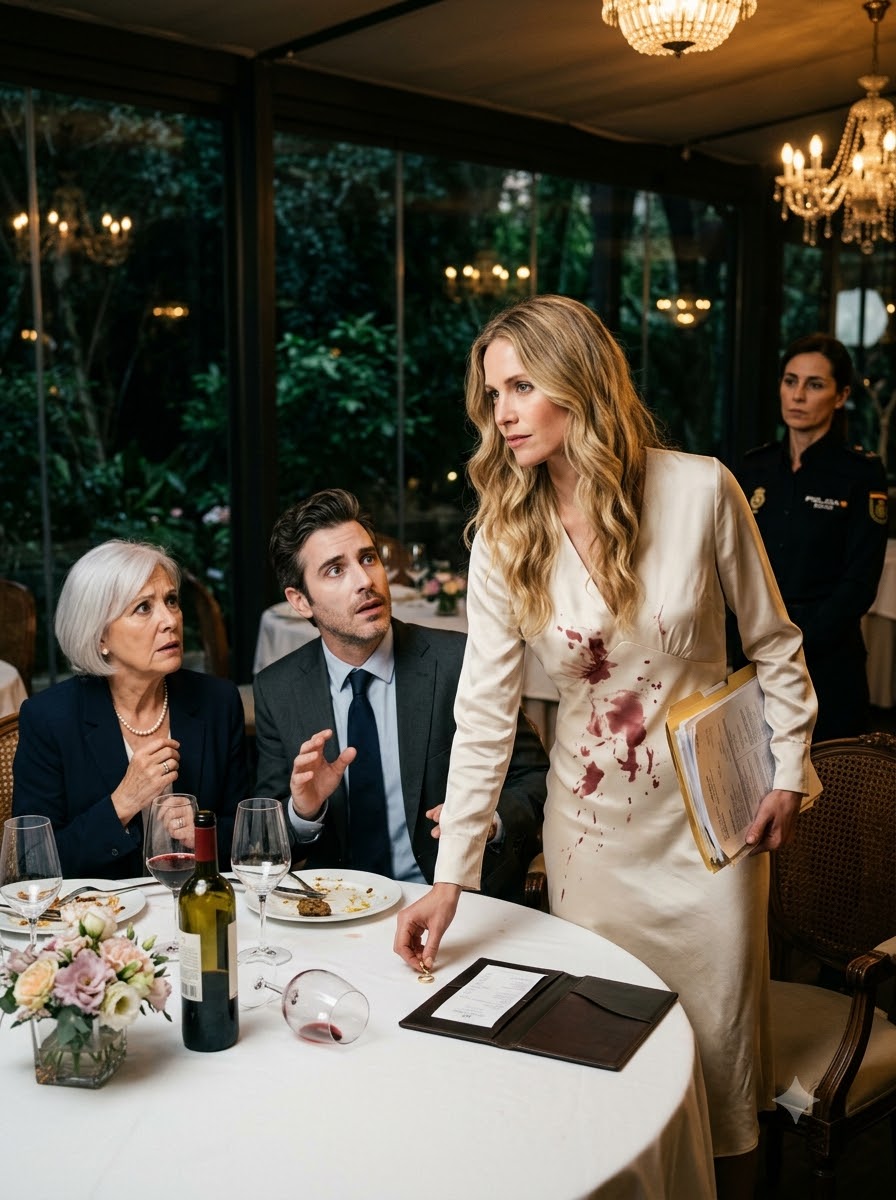
And I realized that missing someone didn’t mean I should return to them.
“I want a divorce,” I said.
Javier closed his eyes.
A tear slipped down his cheek.
I felt the familiar urge to comfort him.
But I stayed where I was.
When the meeting ended, Isabel accompanied me outside.
My hands were shaking.
She noticed.
“Are you all right?”
I took a slow breath.
“No.”
Then I looked up at the bright Madrid sky.
“But I will be.”
The legal process continued for months.
The police investigation into the restaurant incident proceeded with the preserved footage, witness statements, and my account.
The suspected financial wrongdoing was examined separately.
Investigators reviewed banking records and documents connected to the proposed transfer of my business.
Eventually, the evidence established that Javier had authorized improper transfers from funds he wasn’t entitled to use.
It also established his involvement in preparing misleading documents concerning my company.
Mercedes’s role came under scrutiny as well.
Her family business was already struggling with significant debt.
As its financial practices were examined, lenders and business partners began withdrawing their confidence.
The consequences arrived gradually.
Transactions were frozen or challenged.
Legal notices were delivered.
Questions were asked.
Professional expenses mounted.
And the carefully maintained image of the Rivas family began to crumble.
Eventually, Javier admitted responsibility for the unauthorized financial activity during the legal proceedings.
He was ordered to make restitution and faced additional penalties under the resulting judgment.
Mercedes’s company entered insolvency proceedings.
Her involvement in the disputed transactions also resulted in separate legal consequences.
There was no single spectacular moment when everything collapsed.
Instead, there were records that couldn’t be erased.
Money that had to be accounted for.
Legal obligations that couldn’t be avoided with threats.
And a woman they’d expected to remain silent who refused to disappear.
When the financial judgment was finalized, Isabel called me.
“It’s done, Clara.”
I was standing inside my office.
A new desk had just been installed for our first additional consultant.
I slowly sat down.
“Really?”
“Yes. The restitution arrangements are enforceable. Your ownership remains yours.”
I looked around.
The shelves I’d assembled myself.
The photographs from my first team celebration.
The small plant Lucía had given me when I opened the business.
Javier had spent years talking about my company as though it existed because he’d allowed it to.
Now the legal record confirmed what had always been true.
It belonged to me.
“Thank you,” I whispered.
After ending the call, I expected to feel victorious.
Instead, I sat quietly.
Because legal accountability could help restore money.
It could establish responsibility.
It could protect my future.
But it couldn’t return the years I’d spent questioning my own judgment.
That evening, I visited my mother.
She was preparing tortilla española in her small kitchen, humming while turning potatoes in a pan.
When she saw me, she wiped her hands on a towel.
“Clara, cariño.”
I hugged her.
She held me longer than usual.
Then she stepped back.
“There’s something I need to tell you.”
We sat at the kitchen table.
She placed an old photograph between us.
It showed me at twenty-three, standing outside my first office.
I was holding a cardboard sign with my company’s name.
My hair was blowing in the wind.
My smile was enormous.
“I remember this day,” I said.
“Your father took that photograph.”
I touched the edge of the picture.
My father had died five years earlier, before I married Javier.
He’d been a quiet man who repaired electrical equipment and believed that patience could solve most problems.
Mamá opened a drawer and removed a small envelope.
“He gave me this before he became ill. He said to give it to you when you needed reminding of something.”
I stared at her.
“Why didn’t you give it to me before?”
“Because I thought you were happy. Then, when things became difficult, I was afraid you would think I was interfering.”
Her voice cracked.
“I should have asked more questions.”
I reached for her hand.
“Mamá.”
She shook her head.
“Read it.”
Inside was a letter written in my father’s familiar handwriting.
My Clara,
You have always been braver than you believe.
When you were little, you used to take broken things apart because you wanted to understand how they worked. Sometimes you could repair them. Sometimes you couldn’t. But you never believed that something was your responsibility simply because it was broken.
Remember that when you grow older.
Love people generously, but never confuse love with surrender.
Build a life where your voice is welcome.
And if you ever find yourself in a room where someone makes you feel small, remember that you are allowed to leave.
You do not have to earn the right to be respected.
You already have it.
Papa.
My vision blurred.
I pressed the letter against my chest.
My mother covered her mouth.
We sat together in silence for a long time.
Then I laughed through my tears.
“He knew.”
Mamá smiled sadly.
“He knew you.”
I looked again at the photograph.
The young woman outside her first office hadn’t known what her future would bring.
But she’d been smiling.
Standing tall.
Believing her life belonged to her.
I wanted to find that woman again.
And slowly, I began to.
I started seeing a therapist who helped me recognize behaviors I’d once dismissed as ordinary marital disagreements.
I learned how easily affection could become mixed with control.
How repeated criticism could weaken someone’s confidence.
And how fear could remain long after the person who caused it was gone.
Some days, I felt strong.
Other days, a stranger raising his voice in a supermarket made my stomach tighten.
Once, at a friend’s birthday dinner, I accidentally spilled red wine.
I froze.
My friend Elena noticed immediately.
She quietly took the glass from my hand.
“Hey,” she said. “You’re here with us.”
I nodded.
She handed me a napkin.
“No one’s angry.”
I stared at the red liquid spreading across the tablecloth.
Then I looked at her.
And I began to cry.
Elena didn’t tell me to stop.
She simply sat beside me until I could breathe normally again.
Recovery wasn’t simple.
But for the first time, I could move through it without someone demanding that I hurry.
Several months after the restaurant incident, Luis contacted me through Andrés.
He wanted to know how I was doing.
We arranged to meet for coffee.
He arrived looking nervous, twisting the strap of his backpack.
“I wasn’t sure whether you’d remember me,” he said.
I smiled.
“Of course I remember you.”
He looked down.
“I should have said something sooner that night.”
“You did say something.”
“After the police arrived.”
I leaned forward.
“Luis, you were working. You didn’t know what was going to happen.”
He nodded.
But he still looked troubled.
Then he told me about his older sister.
She had once been in a controlling relationship.
“When I saw him throw that wine,” he said, “I recognized her expression on your face.”
I swallowed.
“What expression?”
He hesitated.
“Like you were trying to decide whether you were allowed to be upset.”
I looked away.
Sunlight reflected through the café windows.
Luis continued.
“My sister got out. She’s doing well now.”
“I’m glad.”
He smiled.
“She works with a support organization. I told her about you—not your name or anything private. Just what happened.”
I nodded.
“She said that sometimes one person standing up can help someone else believe they can.”
We sat quietly for a moment.
Then I looked at him.
“You helped me that night.”
His eyes widened.
“I just told the truth.”
“Exactly.”
One year after the incident, my divorce was finalized.
I walked out of the courthouse wearing a navy-blue coat and carrying a thin folder.
Lucía was waiting on the steps with two cups of coffee.
She handed one to me.
“How does freedom taste?” she asked.
I took a sip.
“Like very expensive legal fees.”
She burst into laughter.
So did I.
We laughed until tears ran down our cheeks and strangers began looking at us.
Then Lucía linked her arm through mine.
“Come on. Mamá’s making lunch.”
We walked through Madrid beneath the pale winter sunlight.
For the first time in years, I wasn’t worried about getting home before Javier.
I wasn’t rehearsing explanations.
I wasn’t wondering whether something I’d said or bought would lead to an argument.
I was simply walking beside my sister.
And that ordinary freedom felt extraordinary.
That spring, I expanded Morales Financial Consulting.
We hired two additional consultants and moved into a brighter office overlooking a tree-lined street.
I insisted on placing a round table in the meeting room.
Teresa asked why.
I smiled.
“Because nobody should feel like they’re sitting at the wrong end.”
We focused on helping small businesses understand their finances and make decisions with confidence.
Eventually, I began offering free workshops through a local women’s support organization.
I spoke about financial independence.
Secure banking.
Understanding contracts.
And the importance of obtaining independent advice before signing important documents.
At my first workshop, seven women attended.
One sat near the exit, clutching her handbag.
Another kept her phone face down, glancing at it whenever it vibrated.
I recognized those small gestures.
After the session, the woman near the door approached me.
“My husband says I’m terrible with money,” she whispered. “But I used to manage the accounts at my father’s shop.”
I smiled gently.
“Then you already know more than he wants you to remember.”
Her eyes filled.
She took the information sheet I’d prepared.
“Thank you.”
I watched her leave.
And something inside me settled.
What had happened to me would always be part of my past.
But it no longer had to define everything that came afterward.
One warm evening in early summer, Andrés invited me back to the restaurant.
He explained that the staff wanted to thank me and acknowledge Luis’s decision to speak honestly about what he’d witnessed.
At first, I hesitated.
The thought of returning made my palms damp.
Lucía offered to come with me.
I accepted.
When we entered, the restaurant looked almost exactly as I remembered.
Golden lighting.
White tablecloths.
Crystal glasses.
Soft music drifting above quiet conversations.
My stomach tightened when we passed the table where I’d sat with Javier and Mercedes.
An elderly couple occupied it now.
They were sharing dessert.
The woman laughed.
Her husband reached across the table and brushed a crumb from her sleeve.
I stopped walking.
Lucía touched my elbow.
“Are you okay?”
I looked at the couple.
Then at the table.
For months, I’d imagined that corner of the restaurant as permanently marked by what happened to me.
But life had continued there.
People had celebrated birthdays.
Shared meals.
Reunited with friends.
And laughed together.
My humiliation hadn’t become the restaurant’s entire story.
And it didn’t have to remain mine.
Andrés greeted us warmly.
Luis was there, along with several other staff members.
They’d arranged a small dinner in a private room.
Nothing extravagant.
Just good food and kind company.
Halfway through the meal, Andrés stood.
“I’d like to say something.”
My cheeks grew warm.
He smiled.
“When we work in hospitality, we’re trained to make guests comfortable. But that night reminded us that sometimes our responsibility is to make someone safe.”
He glanced toward Luis.
“And sometimes courage is simply refusing to look away.”
Luis lowered his head with an embarrassed smile.
Andrés raised his glass.
“To Clara.”
Everyone lifted their glasses.
I looked around the table.
At Lucía.
At Luis.
At Andrés.
At the people who’d witnessed one of the worst moments of my life and chosen to help rather than look away.
I stood.
“Thank you,” I said.
My voice trembled.
“I spent a long time believing that keeping the peace meant staying quiet.”
I paused.
“Sometimes peace begins when you finally say no.”
We raised our glasses together.
And for the first time since that terrible evening, the sound of glass touching glass didn’t make me flinch.
As Lucía and I prepared to leave, Andrés handed me a small envelope.
“There’s one more thing.”
I opened it.
Inside was a copy of the restaurant’s original incident report.
Attached was a handwritten note from Luis.
You told me to call security. I was afraid of losing my job, but you looked at me like you believed I would do the right thing. Thank you for that. I hope you know that you helped me find my courage too.
I read the message twice.
Then I looked toward Luis.
He shrugged shyly.
“I thought you should know.”
I folded the note carefully.
“I’ll keep it.”
Outside, the evening air smelled of rain and flowering trees.
Lucía and I walked toward her car.
She glanced at me.
“What are you thinking?”
I considered the question.
A year earlier, I would have answered automatically.
Nothing.
Or I’m fine.
Instead, I told her the truth.
“I’m thinking about how much time I spent waiting for Javier to become kind.”
Lucía listened.
“And how many kind people were around me all along.”
She squeezed my hand.
We reached her car, but I paused before getting inside.
Across the street, a little girl was helping her father carry groceries.
He pretended the bag was impossibly heavy, making her giggle.
I watched them for a moment.
Then I remembered my father’s letter.
You are allowed to leave.
For years, I’d believed leaving meant failure.
Now I understood that sometimes leaving was the first real act of faith in yourself.
The following Sunday, my family gathered at my apartment.
Mamá brought tortilla española.
Lucía arrived with flowers.
Elena brought a chocolate cake that leaned dramatically to one side.
Teresa appeared with sparkling lemonade and announced that nobody was allowed to discuss accounting.
We opened the windows.
Music drifted through the rooms.
Someone spilled water on the kitchen counter.
Nobody shouted.
Nobody demanded an apology.
We simply wiped it up.
At sunset, I stepped onto the balcony.
Madrid stretched before me, its rooftops glowing amber beneath the evening sky.
Inside, I could hear my mother laughing.
Lucía and Elena were arguing playfully about the correct way to cut cake.
The scent of fresh coffee floated through the open door.
I rested my hands on the railing.
Then my phone vibrated.
For a brief moment, my body tensed.
I looked at the screen.
It was a message from a woman who’d attended one of my workshops.
I opened my own bank account today. I was scared, but I did it. Thank you.
I read it slowly.
Then I smiled.
Behind me, Lucía appeared in the doorway.
“Clara! Are you coming? Mamá says we’re not starting dessert without you.”
I turned.
The apartment glowed with warm light.
The people I loved were waiting inside.
Not because they needed me to pay for something.
Not because they wanted to control my choices.
But because they wanted to spend time with me.
I slipped my phone into my pocket.
“Coming.”
As I walked inside, my eyes fell on the framed photograph standing on the hallway shelf.
The young woman outside her first office.
Beside it was my father’s letter.
And beneath both was a small silver frame containing a sentence I’d written myself.
I didn’t lose my family when I said no. I found the people who knew how to love me.
I stepped into the kitchen.
Lucía handed me a plate.
Mamá kissed my cheek.
Someone turned up the music.
And when laughter filled the room, I joined in.
There was no dramatic announcement.
No final confrontation.
Nobody left to convince.
Just a warm evening.
An open window.
And a life that belonged to me.
For the first time in years, I wasn’t waiting for the next moment of cruelty.
I was simply happy.
And that was enough.
