

PART 3
Rebecca lived in a small white house at the end of a quiet country road.
When we arrived, I noticed a flower garden beside the porch and a wooden bench beneath an old maple tree. The place looked peaceful, ordinary, and entirely unlike the world of wealth and influence I had imagined after hearing about Richard Hayes.
Lucas parked the car.
For a moment, none of us moved.
Then Ethan turned toward me.
“You don’t have to do this if you’re not ready.”
I looked at him.
“I raised two boys who once thought a broken toy was the end of the world. I can manage a difficult conversation with a grown woman.”
He laughed softly, and the tension in the car eased.
We walked to the front door together.
Before Lucas could knock, the door opened.
Rebecca stood in the doorway.
She was older than in the photograph, of course. Her hair was streaked with gray, and fine lines framed her eyes. But the resemblance to my sons was unmistakable. She had Lucas’s eyes and Ethan’s smile.
For a few seconds, she simply stared at them.
Then her gaze moved to me.
“Eleanor?”
I nodded.
“Rebecca.”
Her hands trembled.
“I don’t know what to say.”
“Neither do I.”
She stepped aside and invited us in.
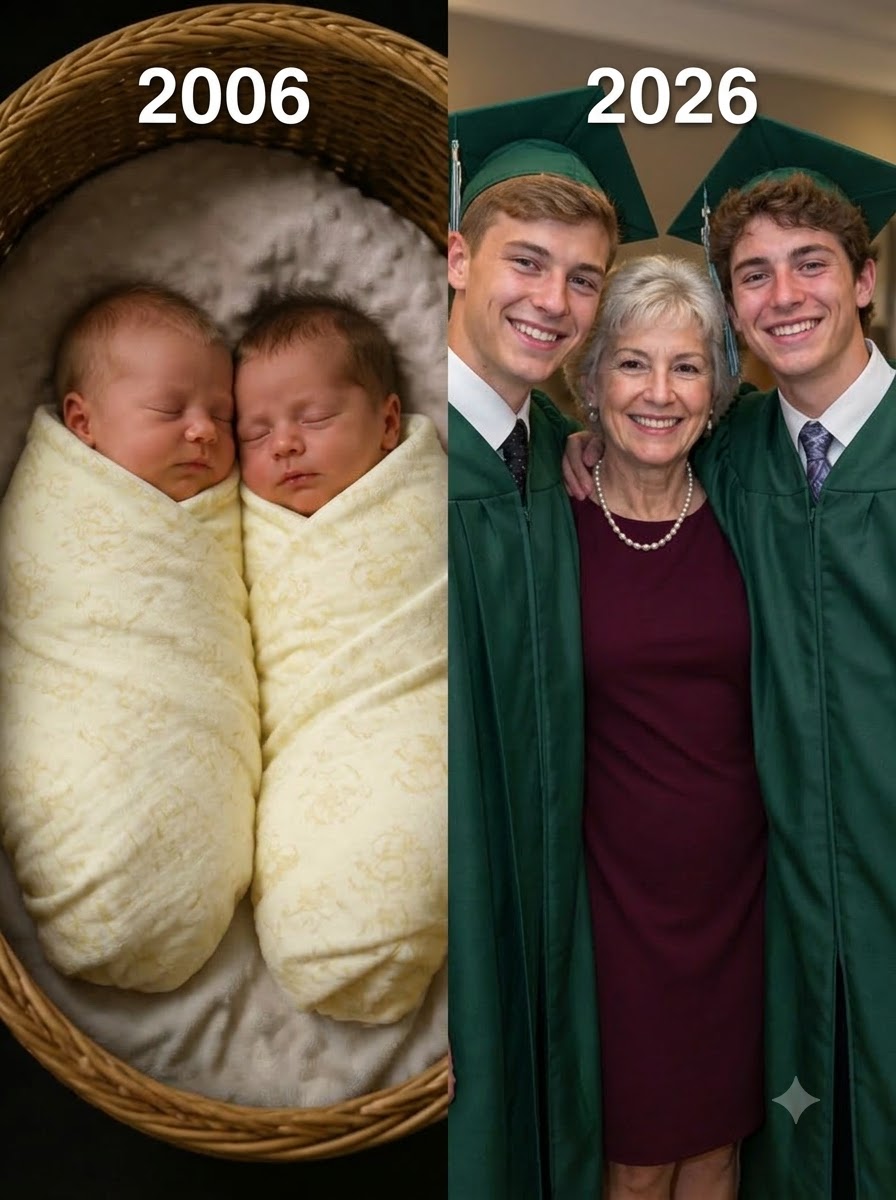
The living room was modest and tidy. A bookshelf stood against one wall, filled with novels and family photographs. On the mantelpiece was a picture of two newborn boys lying side by side.
I recognized the basket beneath them.
Rebecca followed my gaze.
“That was taken the day before I left them with you,” she whispered.
I turned toward her.
“Why did you take that photograph?”
“Because I was afraid I would forget how small they were.”
Her voice cracked.
“I knew I might never see them again. I wanted something to remember.”
She sat down, covering her face with both hands.
“I have rehearsed what I would say to you for twenty years. Every apology. Every explanation. Every reason I thought I was doing the right thing. But now that you’re here, none of it sounds good enough.”
I sat opposite her.
“Then don’t rehearse. Just tell me the truth.”
Rebecca nodded slowly.
She explained that after she left Lucas and Ethan at my doorstep, she watched from a distance until she saw me return with the police.
She hadn’t intended to frighten me. She had simply needed to know that the babies were safe.
When the authorities took them into care, she left the area and sought help from a lawyer Margaret had recommended. She eventually secured a job in another state and began rebuilding her life.
But Richard Hayes had not given up.
He had continued searching for her, using private investigators and legal threats to pressure her into returning. He had also discovered that the boys were in foster care.
For months, Rebecca feared he would find a way to gain custody of them.
Then she learned that I had begun visiting the boys.
At first, she watched from a distance, trying to determine whether I was kind to them. She saw me carrying a blanket into the foster home one cold afternoon. She saw me sitting beside their cribs, singing softly when one of them cried.
She watched me leave the building with tears in my eyes.
And she realized that I loved them.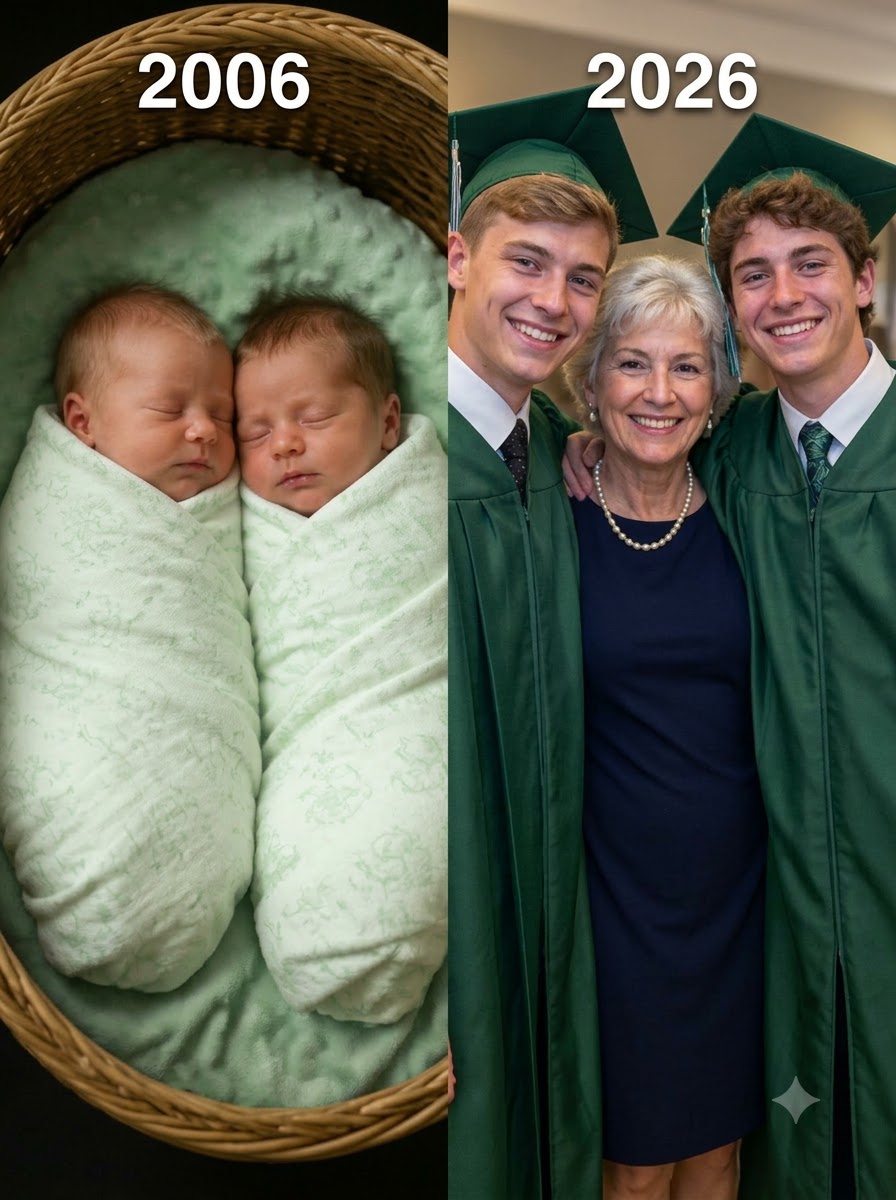
“I thought you would give them a chance,” she said. “I hoped you might become their foster mother. I never imagined you would adopt them.”
“Why didn’t you come forward when the adoption became final?”
Rebecca looked down.
“Because by then, I understood that you were giving them something I couldn’t. Stability. A home. A mother who could love them without fear of someone taking them away.”
I felt anger rising inside me.
“You could have told me the truth. You could have explained the danger. I might have helped you.”
“I know.”
“Did you ever consider what it would do to me if I found out twenty years later that my sons had been left at my door because someone else had decided I needed them?”
Rebecca flinched.
“I did. And I was selfish enough to convince myself that your happiness was worth my silence.”
Her honesty silenced me.
She wasn’t asking me to approve of what she had done.
She was finally admitting that her decision had hurt people, even though she had made it out of fear and love.
I looked at my sons.
“Did you know she had watched us?”
“No,” Lucas answered. “She told us yesterday.”
Rebecca wiped her eyes.
“I saw them grow up in photographs whenever I could find them. I learned about their school achievements, their college acceptances, and the lives they were building. I kept telling myself that as long as they were happy, I had no right to interfere.”
“But you wanted to meet them,” I said.
“Every day.”
The room fell silent.
Then Rebecca rose and walked to the bookshelf. She returned with a thick folder tied with a ribbon.
“I brought these for you.”
Inside were letters, photographs, and copies of documents relating to Margaret’s efforts to protect her.
There were also several letters Rebecca had written to my sons over the years.
One was dated when they turned five.
Another had been written on their tenth birthday.
There were letters for their high school graduation, their eighteenth birthday, and the day they left for college.
None had been sent.
I read the first one.
My beautiful boys,
Today you are five years old. I wonder whether you like chocolate cake or vanilla, whether you run faster than other children, and whether you still hold each other’s hands when you fall asleep.
I hope you know that you were never unwanted. You were wanted so desperately that I was willing to break my own heart to keep you safe.
I couldn’t continue.
I placed the letter down and wiped my cheeks.
Rebecca sat beside the folder.
“I know words can’t make up for what I did. I know they can’t give you back the years I missed.”
“No,” I said quietly. “They can’t.”
She nodded, accepting the answer.
“But I also know,” I continued, “that my sons were loved before they ever came to me. I can see that in everything you’ve kept.”
Rebecca looked up.
“Do you hate me?”
I thought carefully before answering.
“No. But I am angry with you.”
She closed her eyes.
“I understand.”
“I wish you had trusted me. I wish you had given me the chance to help. And I wish you hadn’t allowed fear to keep you away for so long.”
“So do I.”
I took a breath.
“But I won’t pretend I understand what it was like to be in your position. I wasn’t there. I didn’t face your father. I didn’t have to make the choices you made.”
Rebecca began to cry again.
“I don’t expect you to forgive me today.”
“Good,” I replied. “Because forgiveness isn’t a switch I can turn on and off.”
For the first time, a faint, grateful smile appeared on her face.
“I wouldn’t ask you to.”
We spent the next several hours talking.
Rebecca told us about Margaret, about the years she had spent hiding from Richard, and about the legal battles that had followed his death. She described how she had tried to convince herself that staying away was an act of sacrifice rather than fear.
My sons asked questions I had never thought to ask.
What were their first words?
Did Rebecca have any other children?
Did she remember the day they were born?
She answered everything she could, sometimes laughing through her tears.
Eventually, Ethan asked the question none of us had wanted to raise.
“What about Grandpa’s estate?”
Rebecca’s expression changed.
She looked at the folder, then at Lucas and Ethan.
“That is the other reason I asked you to come.”
She explained that Richard had left behind a complicated estate, including shares in Hayes Industrial Holdings and a family trust that had never been fully settled.
Because of the circumstances surrounding her estrangement, she had challenged parts of his will. The case had dragged on for years, and several relatives had argued over the distribution of the assets.
Recently, the estate’s lawyers had located documents confirming that Lucas and Ethan were Richard’s biological grandchildren.
The discovery had changed everything.
Under the terms of a separate trust, the twins were entitled to a substantial inheritance.
But there was a condition.
To claim it, they had to establish their identities and provide evidence that their relationship to Richard had not been concealed through fraud.
I stared at Rebecca.
“Are you saying someone could accuse them of fraud because they were adopted?”
“Not because they were adopted,” she replied. “Because my father believed the adoption had been arranged to hide his heirs from him. His lawyers are questioning whether the circumstances surrounding their placement were properly documented.”
Lucas frowned.
“But the adoption was legal. We have the records.”
“Yes. And those records are valid. The problem is that my father’s estate has challenged the history behind them.”
I felt the old instinct rise inside me—the instinct that had carried me through every school meeting, every medical appointment, and every difficult moment of motherhood.
Someone was threatening my sons.
I wasn’t going to sit quietly and watch.
“Then we show them the truth,” I said.
Rebecca stared at me.
“You would help us?”
I almost laughed.
“They are my sons. Of course I would.”
Ethan reached for my hand beneath the table.
Rebecca looked as though she might cry again, but this time, she smiled.
For the first time since we had arrived, I felt that we were no longer four people separated by a secret.
We were four people trying to put the pieces of a broken history back together.
And we were going to do it as a family.
