

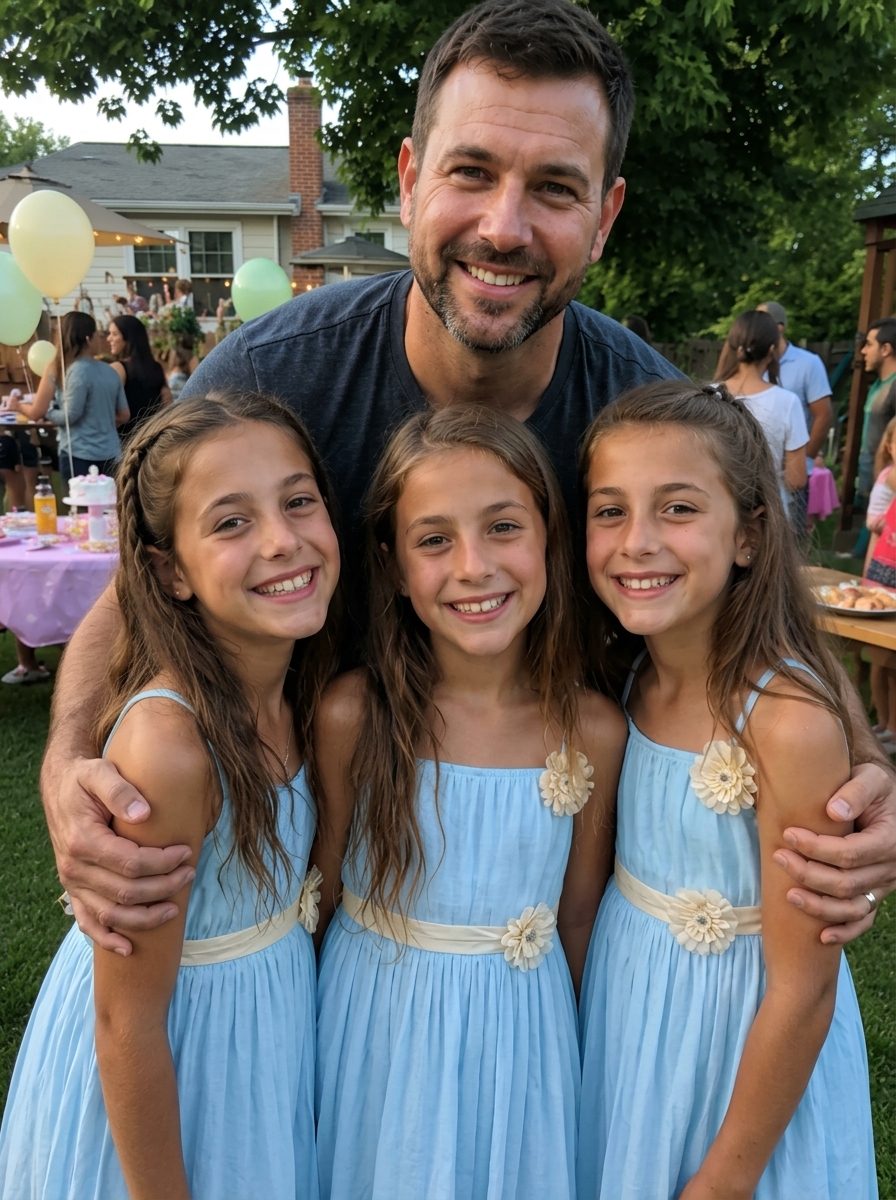
Ten years after my wife died giving birth to our triplets, I discovered a maple box waiting on our porch after their birthday celebration. The tag was written in her handwriting. Inside were three sealed letters and a single line that made me realize Cleo had been present in our daughters’ childhood in ways I had never understood.
The box had been left there after everyone had gone home.
I almost didn’t notice it.
The backyard still looked like the aftermath of a celebration.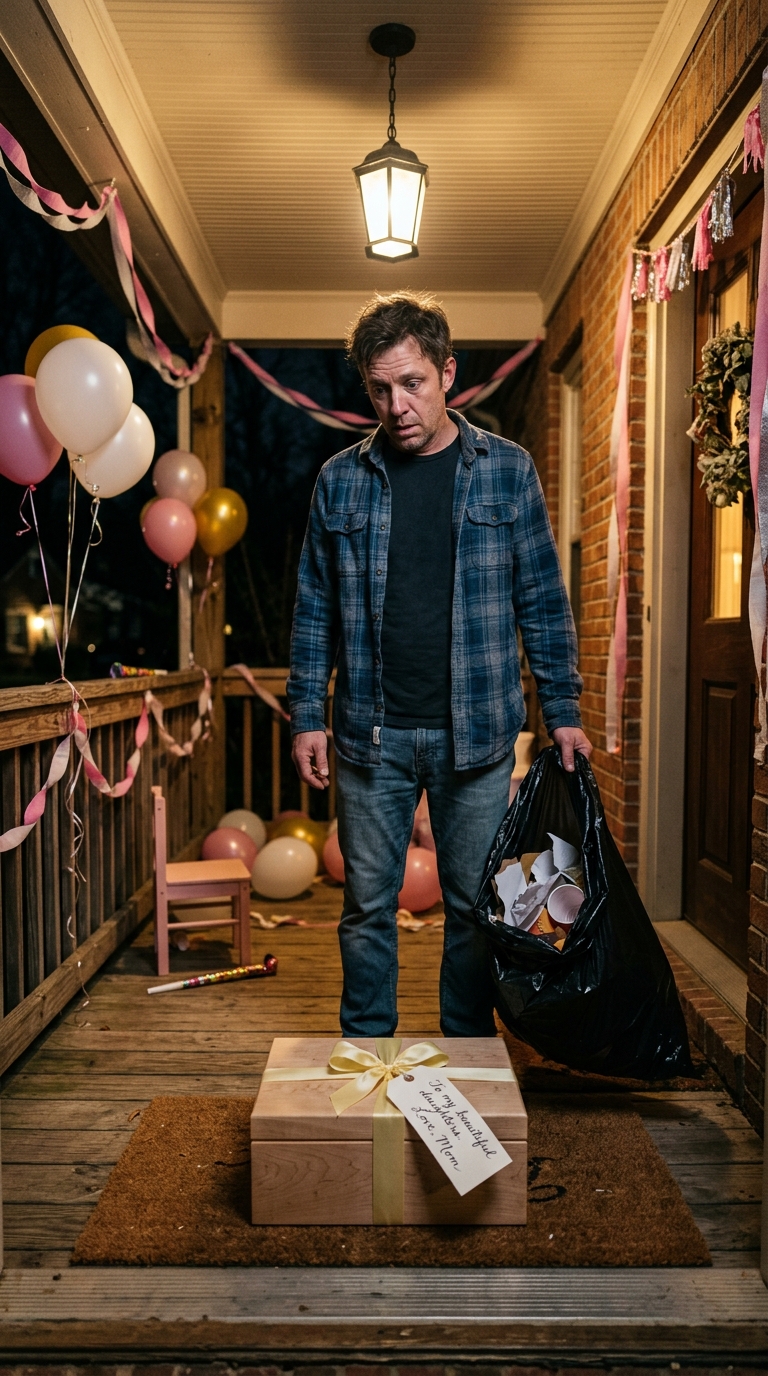
Pink streamers hung unevenly from the fence.
Paper plates drooped beside half-eaten slices of cake.
Three balloons tapped softly against the porch railing whenever the night breeze passed through.
Inside, my daughters were upstairs brushing frosting from their teeth, arguing over who had the biggest birthday candle.
Ten years old.
Chloe, Linzie, and Ivy.
I stood in the doorway with a trash bag in my hand, tired in that content way parents feel when the day has gone well enough to ache. Then I saw it.
A small maple box rested on the porch mat, tied with a pale yellow ribbon. No delivery label.
No return address.
Only a tag carefully tied to the handle.
I bent down.
The handwriting struck me before the words even registered.
I knew the curve of the L.
The soft loop of the M. My knees nearly gave way on the porch.
“To my beautiful daughters. Love, Mom.”
For a moment, I couldn’t hear the crickets. I couldn’t hear my daughters upstairs.
All I could hear was a hospital monitor from ten years ago, and a doctor saying my name like it was something fragile about to break.
Cleo died the day our daughters were born. One moment, nurses told me I had three healthy baby girls.
The next, a curtain was drawn, voices lowered, and the happiest day of my life split into two lives I would spend a decade trying to hold together.
Fatherhood.
Grief.
Both screaming at once.
Those first months were made of bottles, casseroles, sympathy cards, and sleep so thin it barely counted. My mother moved into our guest room.
My sister came before work to help with feedings.
I learned to tell the girls apart by the sound of their cries before I could recognize them by sight.
Chloe cried like she was filing a formal complaint.
Linzie cried like her heart had been personally offended.
Ivy barely cried at all. She watched everything with wide, searching eyes, as if she had arrived already knowing more than the rest of us. People told me Cleo would want me to be strong.
I hated that sentence.
Cleo would have wanted to be there.
Still, years passed the way they always do when children are involved—without asking permission.
Teeth came in.
First steps happened. Kindergarten swallowed them whole in matching backpacks.
Birthday candles multiplied.
And every milestone carried the same quiet shadow beneath it.
Cleo should have seen this.
Now her handwriting was sitting on my porch.
“Dad?”
I turned.
Chloe stood halfway down the stairs in pajamas covered with moons. “What is it?”
I tried to answer, but nothing came out.
Linzie appeared behind her. Ivy followed last, slower, already reading my face. “Dad?” Ivy whispered.
I lifted the box.
“It’s from your mom.”
The three of them froze completely.
We sat at the kitchen table under the party lights I had forgotten to turn off.
For a long moment, no one touched the ribbon. “Is it really from her?” Linzie asked.
“I think so.” That was the only honest answer.
I untied it carefully.
Inside were three sealed envelopes, each labeled in her handwriting.
Chloe.
Linzie.
Ivy.
Beneath them lay a small notebook with a worn green cover.
I opened it first, because I was afraid of the letters.
The first page contained only one sentence.
“If this reached them, kindness kept its promise.”
Nothing else.
Just that. Chloe leaned in closer.
“What does it mean?”
“I don’t know, baby.”
But my hands had started to tremble again.
I turned the page. Four names were listed.
June. Books.
Arthur. Music.
Nina. Birthdays.
Samuel. The box.
I stared at the names until they stopped being words and started becoming people.
June, the librarian who always slipped the girls extra bookmarks and never charged late fees when our house was in chaos.
Arthur, the retired music teacher down the street who repaired Chloe’s violin when the bridge snapped and refused any payment.
Nina, the bakery owner who remembered every birthday and always added three small frosting flowers to our order. Samuel, the carpenter from church who used to hand the girls carved wooden animals at the town fair. None of them were strangers.
That made it worse.
Or maybe better.
I couldn’t tell yet.
“Can we open our letters?” Chloe asked. I looked down at Cleo’s handwriting on the envelopes.
Every part of me wanted to say yes.
Every part of me wanted to say no.
“Tomorrow,” I said at last.
Linzie frowned. “Why?”
“Because your mom waited ten years to give them to you.” I touched the notebook gently.
“We can wait one night to understand how.”
The next morning, I took the notebook with me while the girls stayed with my mother.
I went to the library first.
June stood behind the desk, stamping due dates into children’s books. She looked smaller than I remembered, silver hair pinned behind one ear, a cardigan stitched with tiny embroidered birds. When she saw the notebook in my hand, her expression shifted immediately.
“Oh,” she said softly. “It arrived.”
For a moment, the rows of books felt farther away, like the room itself had stepped back.
“I knew part of this, Alan.”
“What part?”
June closed the book in front of her and walked around the desk.
“Cleo came here about two months before the girls were born. She was huge and laughing about it, saying the babies had taken over her body and probably half her thoughts.”
I almost smiled.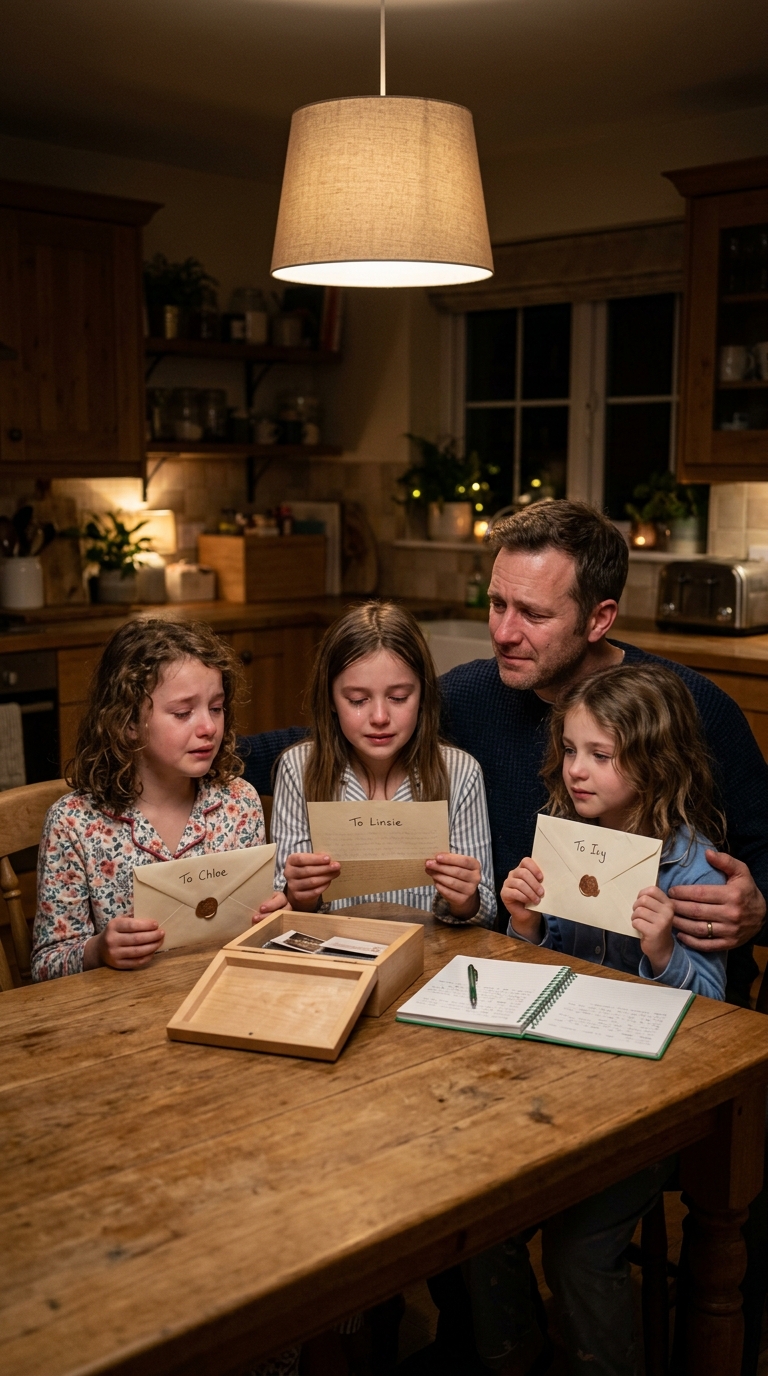
That sounded exactly like her.
“She asked me something unusual,” June continued. “She said, ‘If one of my girls ever needs a reason to love books, will you help her find it?’”
I glanced toward the children’s corner where my daughters had spent so many rainy afternoons.
“She knew?”
“No.” June shook her head. “Not like that. She hoped she would be there herself. But she said mothers prepare for everything—diapers, fevers, school forms. She said this was just another kind of preparing.”
A cold weight settled behind my ribs.
June reached under the desk and placed a faded bookmark into my hand. Three pressed wildflowers were sealed inside.
“She left this with me,” she said. “I was meant to give it to whichever girl needed it first.”
“Why didn’t you?”
June gave a soft, knowing smile.
“I did. Ivy was six. She was upset because the others had friends over and she wanted somewhere quiet. I gave her this when she got her first library card. She returned it inside a book later.”
I remembered that card.
Ivy used to keep it in her nightstand drawer.
I had thought June was simply kind.
Now I understood it had never been that simple.
The second name led me to Arthur’s small brick house.
He opened the door with a cane in one hand and a music stand tucked under the other.
When I showed him the notebook, he exhaled slowly and glanced past me toward the yard.
“Cleo always knew how to make a promise sound simple.”
“What did she ask you?” He smiled, but his eyes were bright with memory. “If one of them ever wants to give up on music too quickly, ask her to try just one more lesson.”
Chloe had nearly quit violin at eight after a recital where she forgot the ending and cried behind the stage curtain.
The following week, Arthur had shown up with rosin, sheet music, and two cookies wrapped in a napkin. He told her every musician owed the world at least one bad performance.
Chloe kept playing.
I had always thought Arthur was just patient.
At Nina’s bakery, the bell above the door rang as I stepped inside.
Nina looked up from icing cupcakes.
Then she saw the notebook. Her hand went to her chest.
“Birthdays,” I said.
Her eyes filled instantly.
Cleo had come every Saturday during her pregnancy, Nina told me. She bought cinnamon rolls and sat by the window with one hand resting on her stomach, talking about names she liked and names I had rejected. “One morning she said,” Nina recalled, “‘If any birthday ever feels smaller than it should, don’t let it.’”
She wiped her hands on her apron.
“So every year, I made sure there were three frosting flowers.”
“I thought you just remembered.”
“I did remember,” she said softly through tears. “That was the promise.”
Samuel’s workshop was the final stop.
Except Samuel was gone.
His daughter answered the door, holding a ring of keys and looking like someone who had spent weeks sorting through a life piece by piece.
“My father passed away last month,” she said gently. “I’m sorry… I didn’t know.”
“Quietly,” she added. “In his sleep.”
I looked down at the notebook.
“He made the box?”
She nodded. “And he kept it.”
The workshop smelled of cedar and sawdust. Half-finished birdhouses lined one wall. A rocking chair sat by the window with a folded blanket draped over it.
She led me to a workbench and opened a folder.
“My dad left instructions. If anything happened before the triplets turned ten, I was to deliver the box. I was a few hours late because I couldn’t find the ribbon.”
A laugh escaped me and broke halfway into something heavier.
She handed me a small note.
Cleo’s handwriting again.
“Ten is old enough to hold sadness in both hands and still leave room for wonder.”
I sat down slowly on Samuel’s stool.
The box had not arrived by chance.
It had moved through ten years of ordinary people keeping ordinary promises.
That evening, the girls and I sat on Cleo’s quilt in the living room.
The maple box rested between us.
“Can we open them now?” Linzie asked.
I nodded. They opened their envelopes carefully.
Chloe read first.
“Helping usually looks much smaller than people imagine,” she whispered. Her eyes lifted to mine.
“That’s why Arthur fixed my violin.”
“Maybe,” I said.
Linzie’s letter came next.
“Flowers don’t bloom at the same time. Neither do people. If your sisters reach something before you, don’t mistake their season for yours.”
Linzie pressed the letter against her chest.
She was the one who measured herself against Chloe’s courage and Ivy’s quiet, steady certainty. Ivy waited the longest.
Then she read in a voice barely above a whisper.
“Notice lonely people before they ask to be noticed. Most of them won’t ask.”
She cried silently, the way she had even as a baby. I opened the notebook again and read the final page.
“Alan, if you’re reading this, please don’t think I expected to leave you. The doctors told us my pregnancy was complicated. But I wasn’t afraid. I expected gray hair, arguments about bedtime, and three girls rolling their eyes when we kissed in the kitchen. But love makes room for fear without letting fear take over the house. I didn’t ask June, Arthur, Nina, and Samuel to raise our daughters. I only asked them to keep one small light on in case mine went out too soon. — Cleo.”
I covered my mouth.
The girls were watching me. “Did she love us?” Linzie asked.
The question broke something in me.
“More than anything, sweetheart.”
“How do you know?” Ivy whispered.
I looked at the box. At the letters.
At the notebook.
At ten years of quiet kindness I had once mistaken for coincidence.
“Because she found ways to love you before she ever met you.”
The girls sat quietly with Cleo’s letters resting in their laps.
Then Ivy glanced toward the birthday cake still on the kitchen counter.
“Dad?” she asked softly. “Can we take some to Mrs. Hargrove next door?”
I blinked. “Why?”
Ivy shrugged.
“Mom said lonely people shouldn’t always have to ask first.”
The silence in the room felt suddenly heavy enough to swallow.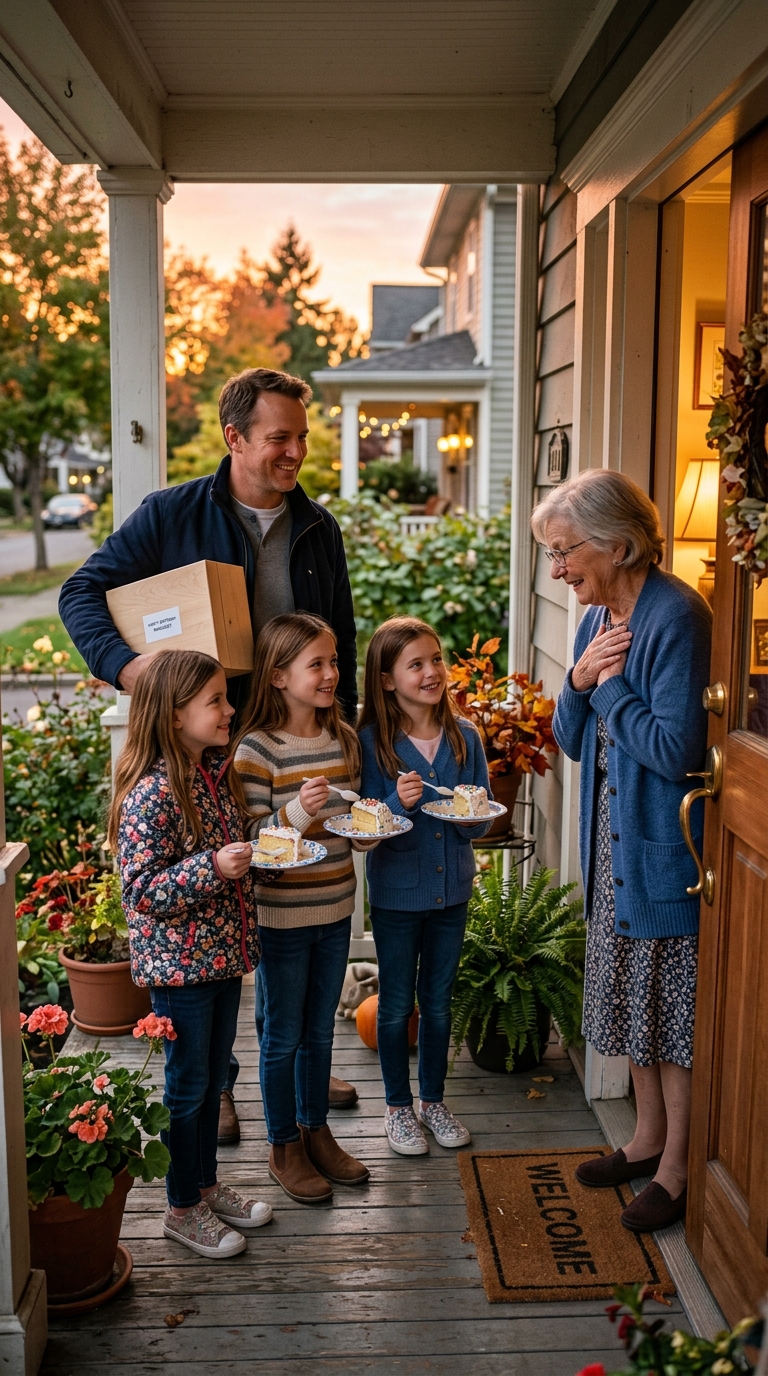
Without another word, Chloe grabbed paper plates. Linzie wrapped slices carefully in napkins. Ivy carried the container in both hands as if it mattered more than anything else.
I picked up the maple box.
Mrs. Hargrove opened the door looking surprised.
“We had birthday cake yesterday,” Ivy said with a shy smile. “We thought you might like some.”
Her expression softened immediately.
As we walked home a few minutes later, the maple box rested quietly beneath my arm. For ten years, I had told myself my daughters had grown up without their mother.
Watching them notice someone before she even had to ask, I finally understood.
They hadn’t grown up without Cleo.
They had grown up speaking her language.
