

The wind that night swept down from the sierra like a knife. It cut through coats, gloves, and even bones. By the time darkness had completely swallowed the hills of Chihuahua, any sensible man was already sitting by a stove with a hot plate in his hands. But no one had ever called Elías Barragán sensible.
His horse advanced slowly through the snow, its hooves sinking with a dull crunch. Frost clung to its mane like white dust. Elías adjusted his wool coat and clenched his jaw as the cold bit into his ribs.
— Easy, Colorado — he murmured, stroking the animal’s neck. — Hondonada Gris can’t be much farther.
That was what he hoped.
The trail had almost disappeared under the storm. The wooden posts were buried, and all the hills looked the same in the gloom. Elías had ridden through worse skies, but now he was an older man, and winter no longer stayed on his skin—it sank all the way into his memory.
Then he saw it.
At first he thought it was a trick of the eye: a thin, gray line trembling above a cluster of trees. Then he saw it again. Smoke.
Elías frowned.
No one camped out here by choice, so far from town in the middle of winter. Not unless they had no other option.
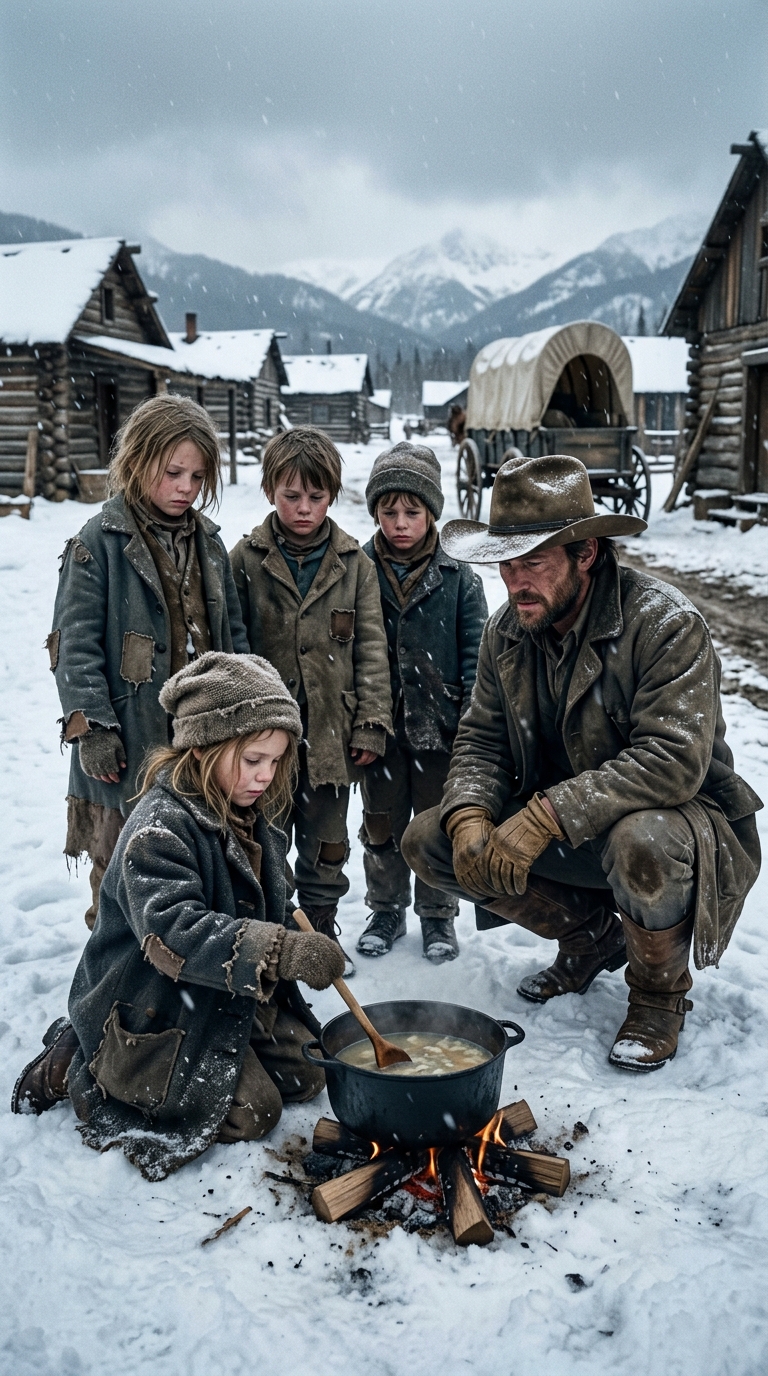
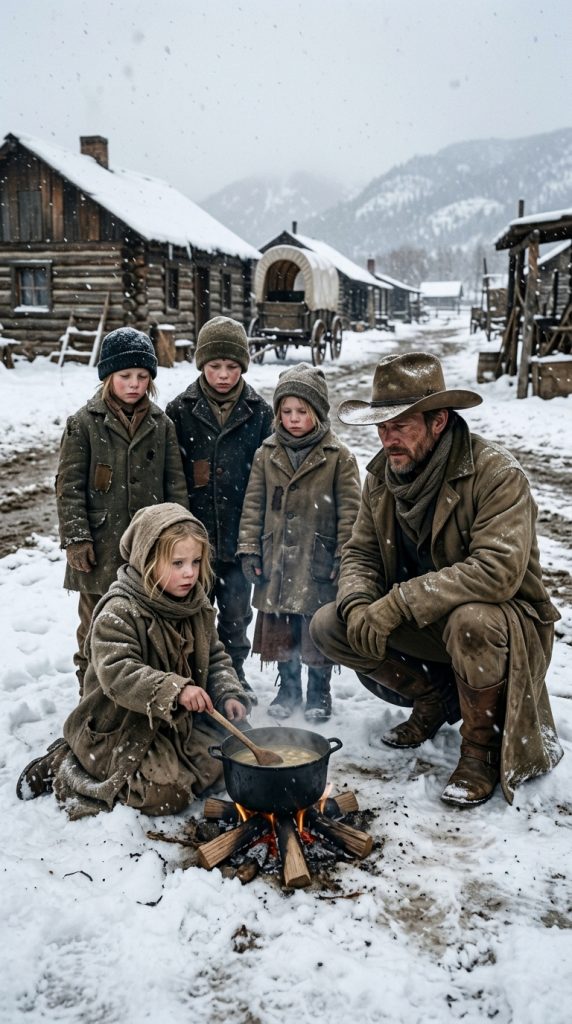
He signaled the horse and headed down toward a small hollow between two low hills. There, half-buried in snow, stood an old wagon. The canvas cover hung limp, hardened by ice. One wheel was crooked, as if it had given out suddenly and no one had had the strength to fix it.
The place felt unsettling.
Too much silence.
There were no horses tied up. No adult voices. Only the whistle of the wind through the dry pines.
And then he heard a child’s cough.
Elías froze for a second. Then he dismounted. His boots crunched on the snow.
— Hello? — he called.
There was no answer.
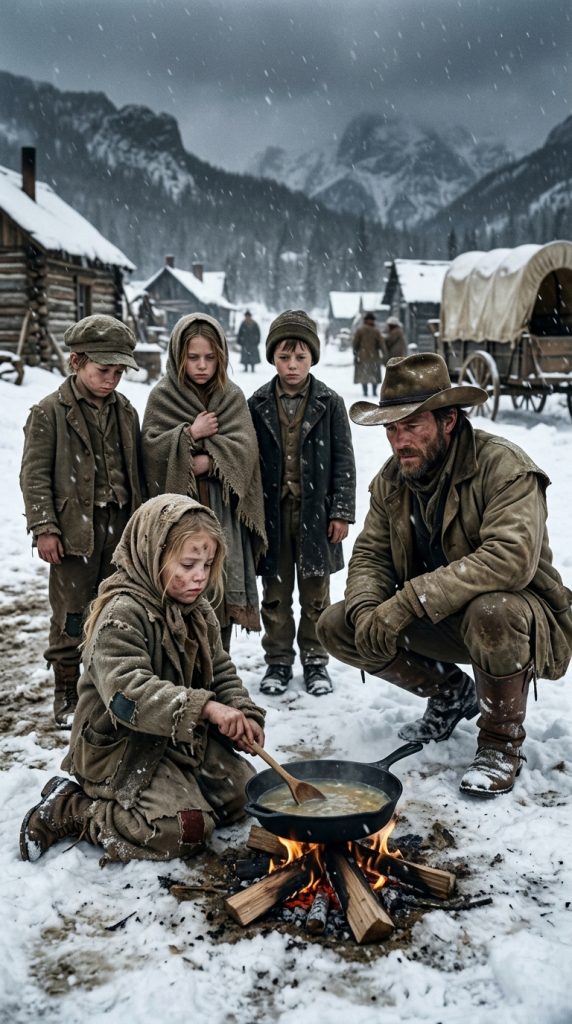
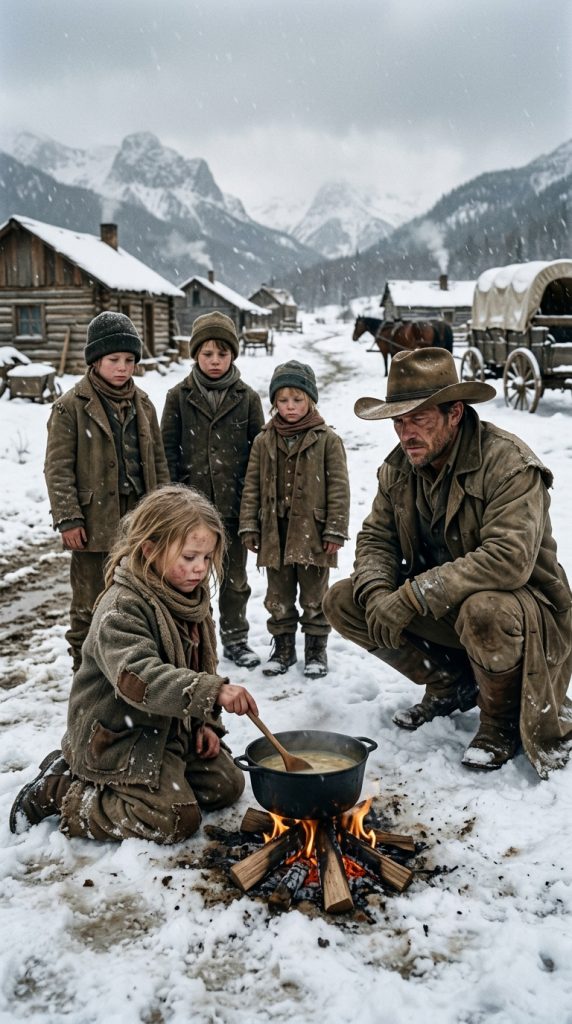
He approached the back of the wagon. The smoke came from a miserable fire, just a few thin branches holding up a blackened pan. Standing beside the fire was a girl no more than five years old. Her dark blond hair was tangled, her face smudged with dirt, and she wore a coat so large it swallowed her hands. She was stirring something in the pan with a wooden spoon.
Behind her were four other children, thin, silent, watching him with an alertness that did not belong to childhood.
The oldest, a boy of about twelve, stepped forward.
— Don’t come any closer — he said.
Elías stopped.
He looked at them calmly. Their cheekbones were sunken, their skin cracked from the cold, and they carried the kind of hunger that no longer complained because it had learned to resign itself.
— How long have you been here? — he asked slowly.
The boy studied him as if he were a man his own age.
— We’re fine.
Elías nodded slowly, as if accepting the answer. But he had lived too long to confuse pride with truth.
— What’s your name, son?
— Mateo.
— And the others?
Mateo pointed without taking his eyes off the stranger.
— Jacobo. Marisol. Tomás… and she’s Clarita.
The little girl didn’t turn around. She kept stirring the pan with solemn concentration, as if something sacred were happening there.
Elías crouched beside the fire.
— What are you cooking, Clarita?
The girl lifted her face. She had such serious blue eyes that it hurt Elías to look at them.
— Soup — she whispered.
— What kind?
Clarita looked at the grayish mixture and answered with complete naturalness:
— Snow soup.
Elías felt something tighten in his chest.
Inside the pan there was water, a bit of poorly dissolved flour, and perhaps some mashed bean remnants. Nothing. And yet the other children watched her as if they were expecting a miracle.
— We found a little flour in the wagon — Marisol explained softly. — And some dry beans.
— We’re making it last — Jacobo added.
Tomás, the youngest boy, coughed again. It was a weak, hollow cough. Clarita stopped stirring, blew on a little broth in the wooden spoon, and walked over to him.
— Here — she said.
Tomás drank slowly.
None of the others protested. There was no jealousy. Only a silent rule: the weakest first.
Elías looked at the wagon.
— Where are your parents?
This time no one answered.
The wind slapped the canvas with a sharp crack.
Mateo swallowed.
— Dad went for help.
— And your mom?
The boy lowered his gaze but didn’t answer. It was Marisol who spoke, her eyes filled with a fear that had already grown tired.
— She’s resting in the wagon.
Something in the girl’s tone chilled Elías’s spine more than the weather.
He stood up slowly.
— I’m going to see her.
Mateo took another step.
— Don’t touch her.
— I won’t hurt her.
He carefully pulled back the canvas and looked inside. The woman was wrapped in blankets, rigid, too still. Elías knew the truth instantly. He had seen that silence before, too many times. The fever had taken her many hours earlier.
He closed his eyes for a moment. Fifteen years ago, another winter had taken his wife and young son in a remote cabin. Since then he had made only one promise: never to belong to anyone again.
He stepped out of the wagon without saying a word.
Mateo looked at him as if searching his face for an answer he already knew.
— Don’t tell them — the boy murmured. — Not yet.
Clarita approached with a dented cup.
— For you — she said, offering him her portion.
Elías looked at her, unable to speak.
It was the only thing they had. And yet this little girl was sharing it with him.
— You need it more, little one.
Clarita shook her head.
— My mom used to say that sharing takes away a little of the cold.
Elías took the cup but set it down beside the fire without drinking.
He looked at the sky. Black clouds were rolling down from the sierra. Another storm. Worse than the last one.
If he left, these five children would not see morning.
And if he stayed… well, staying meant something he wasn’t sure he was still made for.
— We have a problem — he said at last.
Mateo set his jaw.
— What kind of problem?
— One that can’t be fixed with snow soup.
He took out some jerky, two hard biscuits, and a small sack of beans from his saddlebags. The children’s eyes widened as if he had pulled out gold.
— Cut the meat into small pieces — he told Mateo. — Make it last.
While the children ate with a mixture of desperation and old-fashioned manners, Elías watched the snow grow thicker. The wind was now blowing sideways.
— Listen to me carefully — he said firmly. — This hollow is going to fill with snow before midnight. You can’t stay here.
— We can’t leave Mom — Marisol whispered.
Mateo lowered his head.
— Or Dad.
Elías looked at him.
— What’s your father’s name?
— Rafael Ortega.
— How long ago did he leave?
— Three days.
Three days.
Elías pressed his lips together. If the man hadn’t returned, the most likely thing was that he had fallen on the way… or perhaps he had reached the town but couldn’t explain where they were.
Then Clarita spoke with a calmness that didn’t match her age:
— Mom told me that if she slept too long… we should look for good people.
The wind roared louder.
There was no time for long prayers.
They buried Soledad Ortega at the foot of a pine where the snow was less hard. Elías and Mateo dug together while the others waited huddled, shivering. When they finished, Clarita left a small piece of biscuit on the grave.
— In case she wakes up hungry — she murmured.
Elías removed his hat.
Afterward, he mounted the children as best he could. Mateo in front with him, Jacobo behind, Marisol and Clarita settled with their arms wrapped tightly around the horse, and Tomás inside his own coat, pressed against his chest to share what warmth he had left.
— We’re going to Hondonada Gris — he announced. — And we’re going now.
The storm hit them before they crossed the first hill.
The snow began as powder and became a white wall. The horse snorted, sinking up to its knees. The children pressed against one another. Elías could barely make out the trees.
— Are you still with me? — he shouted every so often.
— Yes — Mateo answered, though his voice sounded weaker each time.
Tomás stopped shivering, and that frightened Elías more than anything else.
— Don’t you fall asleep on me, son — he murmured, shaking him gently.
— I’m cold…
— I know. Hold on.
When the horse refused to take another step in front of a snowdrift, Elías felt real fear for the first time. Then he remembered an old trapper’s cabin hidden among the pines on the ridge. He hadn’t thought about it in years.
— There’s a cabin around here — he said. — If it’s still standing, it’ll save us for the night.
— And if it’s not? — Jacobo asked.
Elías looked at the storm.
— Then we keep walking until we find one that is.
They entered the forest. There the wind eased a little, enough to hear their own breathing. They moved among the trees like ghosts until a dark silhouette appeared in the whiteness.
Low roof. Crooked walls. But standing.
The cabin.
Elías almost laughed with relief.
He brought the children inside, broke up an old chair, lit a fire, and warmed them one by one by the hearth. Tomás was pale but breathing. Clarita fell asleep with her head in Marisol’s lap. Mateo sat upright, still keeping watch as if he didn’t know how to do anything else.
At dawn, the sky was clear.
Elías went out first and saw the valley lit up. Behind him, the door creaked. Mateo appeared, rubbing his arms.
— What’s going to happen now? — the boy asked.
Elías looked at him for a long time. He had spent fifteen years running from anything that might need him. And now life had placed five children in front of him and asked him, plainly, what kind of man he wanted to be.
— Now we go to town — he answered. — And then… I guess we’ll see how six people live under the same roof.
Mateo opened his eyes wide.
— Six?
— Yes. Because you’re not alone anymore.
The town received them with ringing bells and running feet. As soon as they entered, the doctor from the dispensary came running out.
— Finally! — he shouted. — We’ve been looking for you!
Elías frowned.
It turned out that Rafael Ortega had managed to reach Hondonada Gris the night before the storm, but he arrived with a broken leg, the beginning of frostbite, and half dead from exhaustion. He collapsed before he could guide anyone back. By the time he could speak, it was impossible to go out and search for them.
— He asked about his children all night — the doctor said.
No more needed to be said.
Mateo was the first to run. Jacobo behind him, then Marisol, Clarita, and Tomás, stumbling over one another. Rafael was in a bed at the dispensary, pale, with his leg immobilized and his beard hardened by old frost. When he saw his children come in, he cried without shame.
Clarita climbed as best she could onto the edge of the bed.
— I managed to cook, Papa — she told him. — I made soup.
Rafael hugged her with trembling hands.
Elías remained at the door, still.
He felt a hand on his elbow. It was the pharmacist’s widow, a good woman who had known him since he was young.
— You saved their lives.
Elías shook his head.
— No. I just got there in time.
But something inside him already knew that wasn’t true. He hadn’t arrived “in time.” He had arrived to stay.
Rafael took weeks to recover. His leg never fully healed, and the doctor was clear: for months he wouldn’t be able to work hard. Elías, who until then had lived alone on a small ranch on the outskirts of town, made the decision without a speech.
— Come with me until you can stand on your own — he said.
And that “until” became months. Then a year. Then a habit.
In spring, Mateo helped with the corrals. Jacobo learned to mend fences. Marisol filled the house with dried flowers and soft songs while she swept. Tomás regained the color in his cheeks and strength in his legs. Rafael became Elías’s right hand when he could move again. And Clarita…
Well, Clarita settled into the kitchen as if she had been born owner of the stove.
One afternoon, while the sun gilded the hills and the smell of beans cooking filled the house, Elías came in and found her standing on a bench, stirring a huge pot with a spoon almost as long as her arm.
— What’s that? — he asked.
Clarita smiled, her eyes sparkling.
— Soup, Mr. Elías.
He pretended to be alarmed.
— Don’t tell me it’s snow soup again.
The girl burst out laughing.
— No. Now it has beans, potatoes, and meat. We don’t make snow soup anymore.
Elías rested a hand on the doorframe and looked at her for a long moment, feeling the warmth of the kitchen, the sound of the other children laughing in the yard, Rafael’s voice in the corral… and finally understanding what the winter had not been able to take from him completely.
The fire was not always in the hearth.
Sometimes it was at a full table, in small footsteps running through the house, in a girl who had offered her last cup of soup to a stranger.
And for the first time in many years, Elías Barragán stopped feeling like a man lost in the snow.
At last, he had come home.
