

PART 1: THE BABY IN THE FORBIDDEN OFFICE
The most terrifying moment of my life wasn’t realizing my seven-month-old daughter had vanished from the storage room where I’d briefly left her.
It was discovering her fast asleep in the arms of Vincent Moretti, the formidable Chicago businessman whose reputation made everyone tread carefully around him.
Then he asked a question that stole my voice.
“Who left this child alone?”
His tone was strangely soft, which somehow made the moment far more unnerving.
I stood frozen in the doorway of his private office, my waitress uniform clinging to me with sweat, my hands shaking.
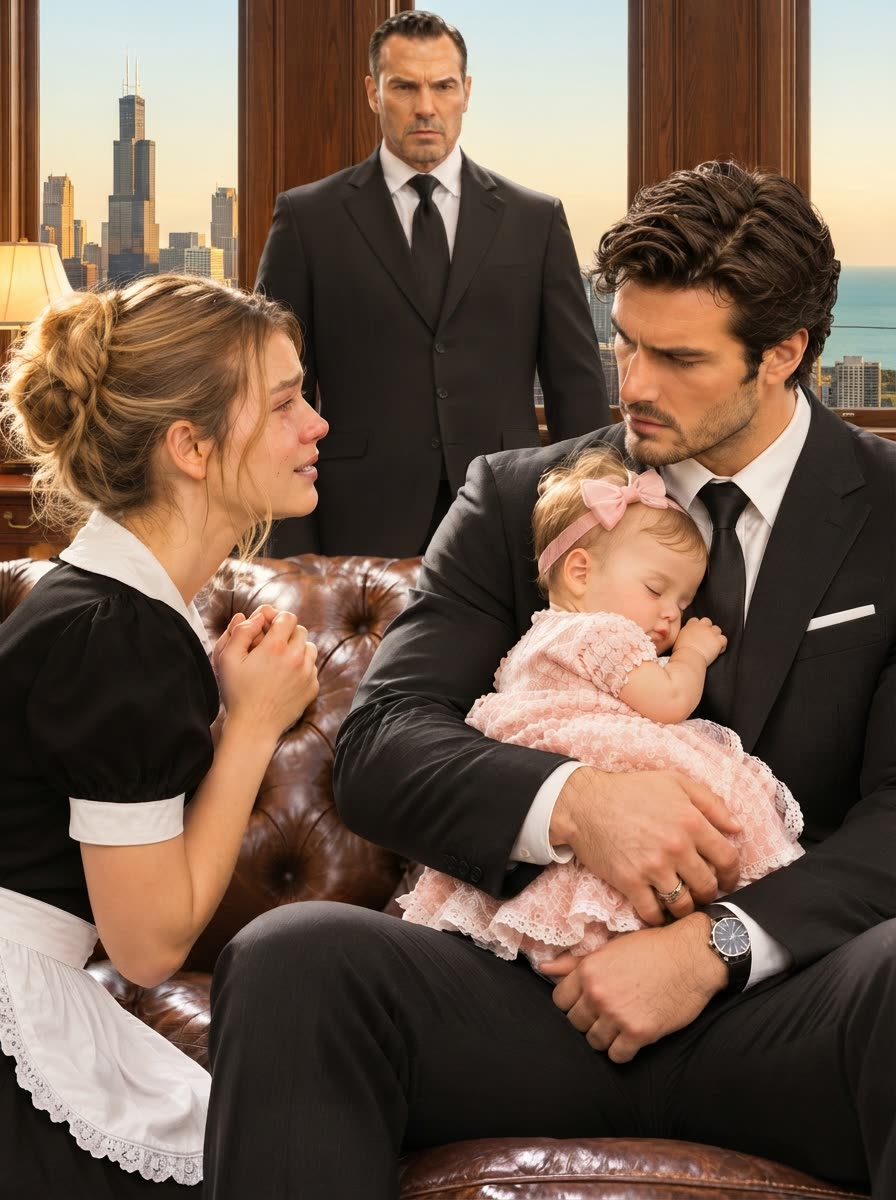
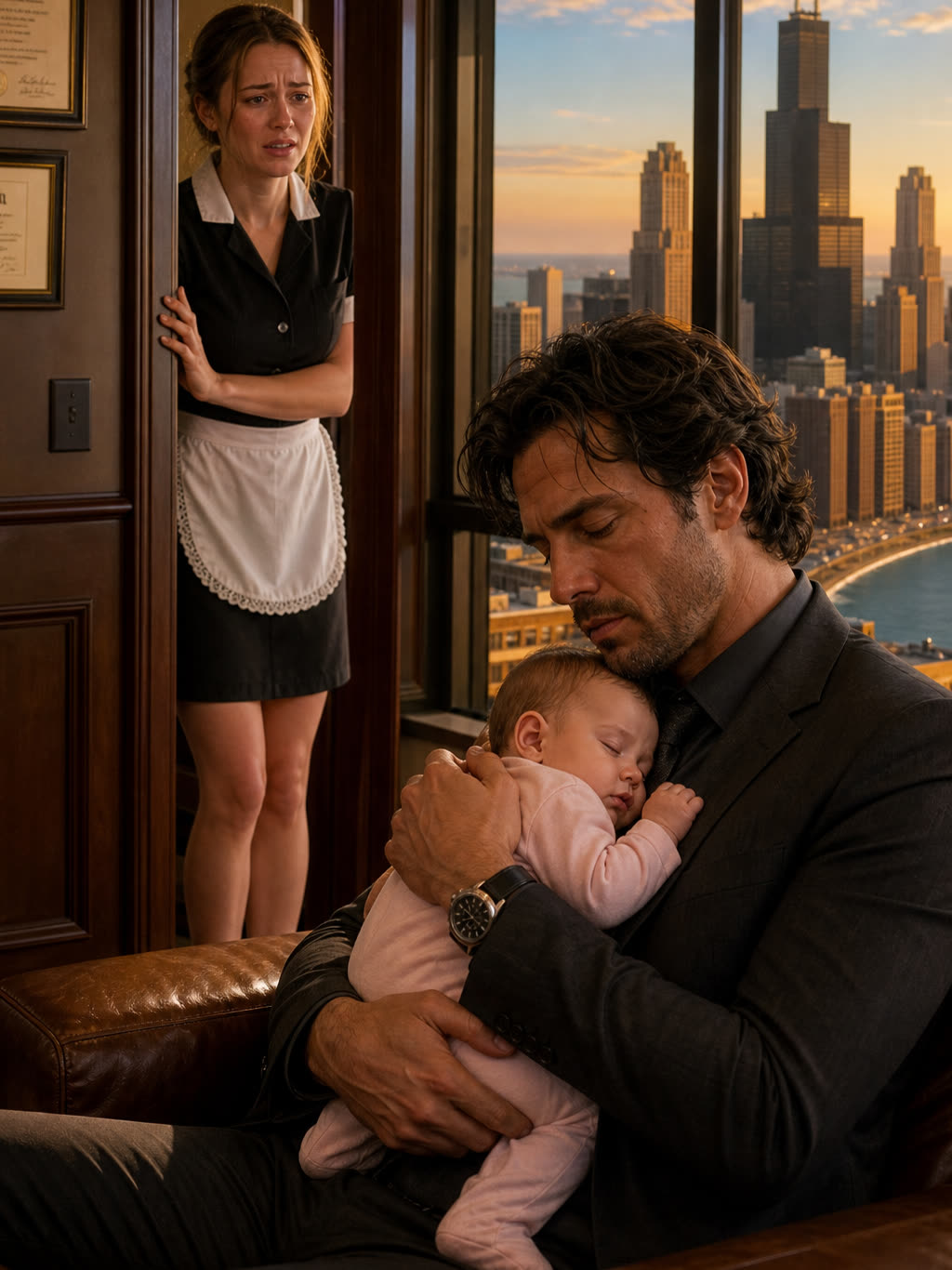
Vincent sat on an expensive brown leather couch, wearing a charcoal suit that cost more than several months of my rent. His dark hair was slightly disheveled, and one arm cradled my sleeping daughter.
Ellie. My precious little Ellie. Her cheek was pressed against his chest, her tiny fingers curled around his jacket as though she had found the safest spot in the world. And he seemed perfectly happy to let her sleep. That was what baffled me.
Everyone at the restaurant knew how fiercely Vincent Moretti guarded his privacy. Employees avoided interrupting him, especially inside his personal office, and three rules were understood by all: never go downstairs without permission, never enter his office uninvited, never disturb the owner. Yet there I stood, facing him while he held the person I loved most.
“Please,” I whispered. “Please don’t fire me.”
His eyes narrowed slightly.
“I didn’t ask about your job.”
“I know. I’m sorry.”
“Then answer my question.”
I glanced at Ellie. She shifted against his chest, sighed softly, and drifted back into sleep. For twenty minutes I had been frantic about where she might be. Now she was right in front of me, safe and warm, and I could hardly make my legs move.
“I did,” I admitted. “I left her alone.”
Vincent studied me.
“Where?”
“In the storage room upstairs.”
“The storage room?”
I nodded.
“Behind the pantry.”
His expression turned grave. For a moment I was certain he would call security. Instead, he looked down at Ellie.
“How old is she?”
“Seven months.”
“And you thought a storage closet was a safe place for a seven-month-old baby?”
His question filled me with shame, because I already knew the answer. I’d known it when I spread Ellie’s pink blanket on that hard floor. But when every option had seemed impossible, I had convinced myself I could manage.
“No,” I whispered. “I didn’t think it was safe.”
“Then why?”
My eyes filled with tears.
“Because I didn’t have anywhere else to take her.”
He said nothing. Standing in front of one of Chicago’s most powerful men, I suddenly felt all the exhaustion I had spent months hiding. I was tired of pretending everything was under control. Tired of serving wealthy customers while worrying about overdue bills. Tired of apologizing for needing extra shifts, for struggling with childcare, for never having enough money. Most of all, I was tired of dreading tomorrow.
“My babysitter canceled thirty minutes before my shift,” I explained. “I called everyone I knew. The daycare required payment upfront, and my manager said another absence could cost me my job.”
Vincent listened without interrupting.
“My rent is overdue. I have bills I can’t cover. If I lose this job, Ellie and I might lose our apartment.”
I fought to steady my voice.
“I know leaving her there was a mistake. I thought I could check on her between tables, and at first, I did. But then dinner service became overwhelming.”
A tear slid down my cheek.
“When I returned, she wasn’t there.”
My voice cracked.
“I didn’t know where she’d gone.”
Vincent watched me in silence, then glanced toward the entrance.
“Close it.”
“Sir?”
“The door, Emily.”
It startled me to hear him say my name. I had never introduced myself to him, yet apparently he knew exactly who worked in his restaurant. I pushed the heavy mahogany door shut.
Vincent carefully shifted Ellie in his arm.
“Come here.”
I hesitated.
“She’s your daughter. I’m not going to keep her from you.”
Relief swept through me. I crossed the room and he gently placed Ellie into my waiting arms. She stirred, wrinkled her tiny nose, and opened her eyes.
Then she smiled.
That familiar smile had carried me through seven hard months. I kissed her forehead.
“Oh, sweetheart. I’m so sorry.”
Ellie made a cheerful sound and grabbed my collar. She had no idea how frightened I’d been.
“Sit down,” Vincent said.
He gestured to the other end of the couch.
“You’re shaking.”
I wanted to flee, but my legs felt unsteady, so I sat. The office was larger than my whole apartment, with tall bookshelves, a polished desk, and windows overlooking the Chicago skyline. Everything in it looked impossibly expensive.
Vincent leaned forward.
“Do you know how I found her?”
I shook my head.
“I was coming upstairs when I heard a baby crying.”
My stomach clenched.
“She was crying?”
“Yes.”
He went on calmly.
“I followed the sound. The door wasn’t completely closed. She was lying beside some boxes.”
I looked down at Ellie, who was now tangling her fingers in my hair.
“I picked her up because she was upset,” he explained. “Then I tried to find whoever was responsible for her.”
“Why didn’t you tell anyone?”
“Because I wanted to understand the situation before the entire restaurant became involved.”
I stared at him.
“Then she stopped crying,” he added. “She fell asleep while I was bringing her downstairs.”
The image of the fearsome Vincent Moretti carrying my daughter through his restaurant was almost impossible to believe.
“She doesn’t usually like strangers,” I murmured.
One corner of his mouth lifted.
“Apparently, she made an exception.”
As if she had understood, Ellie turned toward Vincent and smiled. His expression softened, just for a moment.
Then someone knocked.
“Come in.”
Richard, my manager, stepped inside. He was a thin, sharply dressed man who rarely seemed satisfied with anyone on the staff.
“Mr. Moretti, I’m sorry to interrupt, but there’s a situation upstairs.”
He noticed me.
“Emily?”
I pulled Ellie a little closer. Richard looked from me to Vincent and back again.
“What is this? Emily, what are you doing down here?”
“Richard,” Vincent interrupted.
My manager stopped at once.
“Did you know Emily has a seven-month-old daughter?”
Richard blinked.
“No, sir.”
“Did you know her childcare arrangement fell through yesterday?”
“No, sir.”
“Did you tell her another missed shift could cost her employment?”
Richard hesitated.
“I explained our attendance expectations.”
“That wasn’t my question.”
“Yes, sir.”
My heart pounded. Richard turned toward me.
“Emily, bringing a child here without authorization violates our workplace—”
“Enough.”
That single word from Vincent ended the conversation. He rose, and his height and calm made the room feel suddenly smaller.
“She made an unsafe decision,” Vincent said. “We agree on that.”
Richard nodded.
“Absolutely, sir.”
“But she believed asking for help would cost her livelihood.”
Richard shifted uneasily.
“Mr. Moretti, I wasn’t aware—”
“That’s becoming clear.”
Vincent turned to me.
“Emily, how long have you worked here?”
“Four months.”
“Have you missed shifts?”
“Two.”
“Why?”
“Ellie wasn’t feeling well the first time. The second time, my babysitter didn’t arrive.”
“And you informed Richard?”
“Yes.”
Vincent looked back at my manager. Richard straightened.
“Sir, we have standards to maintain.”
“Of course.”
Vincent’s voice stayed controlled.
“One of those standards should be allowing employees to report emergencies without fearing they’ll immediately lose their income.”
Richard said nothing.
“Return to the dining room. We’ll discuss this later.”
“Yes, Mr. Moretti.”
Richard hurried out. I stared at Vincent.
“Why did you do that?”
“Do what?”
“Defend me.”
“I didn’t defend your decision,” he replied. “Leaving your daughter without appropriate supervision was unsafe. It cannot happen again.”
I lowered my eyes.
“I know.”
“But firing you won’t make her safer.”
I looked up.
“And threatening someone already struggling won’t solve their problems.”
His words took me by surprise. For months, people had told me to work harder, organize better, stop making excuses. Few had asked what had led me here.
“Are you going to fire me?” I asked.
“No.”
I blinked.
“No?”
“No.”
My eyes filled again.
“Thank you.”
“Don’t thank me yet.”
He grew serious.
“Tomorrow, you’ll meet with our administrative office to discuss reliable childcare arrangements. Until that’s resolved, we won’t schedule you when your daughter has no supervision.”
“But I can’t afford to miss work.”
“I didn’t say you’d lose your wages.”
I stared at him.
“Why would you do that?”
Vincent glanced at Ellie, who had begun to yawn.
“Because I don’t want another child left in a storage closet.”
Something in his wording caught me. Another child. There was an unexpected sadness in his voice. Before I could ask, he turned away.
“Go home, Emily.”
I stood.
“Sir?”
“Yes?”
I wanted to ask why he had carried Ellie downstairs himself, why he had comforted her, why he seemed to care so much about us. Instead I asked the question that mattered most.
“Can I really come back tomorrow?”
“Yes.”
I nodded, holding Ellie securely as I approached the door.
“Emily.”
I turned.
“Your daughter deserves a safe place to sleep.”
My throat tightened.
“I know.”
“And you deserve to ask for help without constantly fearing the consequences.”
For a moment, I couldn’t speak.
“Thank you, Mr. Moretti.”
I opened the door. Behind me, Vincent murmured almost to himself.
“Seven months old.”
I glanced back. He was staring at the empty spot where Ellie had slept. For the first time, the powerful businessman looked strangely vulnerable, as if some deeply personal memory had caught him. I didn’t understand what it meant.
I had walked into that office expecting to lose my job. Instead I was leaving with Ellie safe in my arms and an unexpected promise of support.
That evening, after putting her to bed, I sat at my kitchen table surrounded by overdue bills. The apartment was cold, the refrigerator nearly empty, and the electricity notice lay beside my rent reminder. Nothing had suddenly become easy.
But for the first time in months, I felt something I had almost forgotten.
Hope.
The next morning I arrived at the restaurant expecting an ordinary shift. Instead, Richard was waiting near the employee entrance, looking unusually pale.
“Emily,” he said. “Mr. Moretti wants to see you.”
My stomach tightened.
“Did I do something wrong?”
Richard glanced toward the staircase. Then he said something that stunned me all over again.
“He specifically asked you to bring the baby.”
PART 2: THE MAN BEHIND THE FEARED NAME
For several seconds, I could only stare at Richard.
“Mr. Moretti asked for Ellie?”
He looked uncomfortable.
“He wants you and your daughter in his office before your shift.”
“Why?”
“I don’t ask Mr. Moretti why he does things.”
It was probably the most honest answer Richard had ever given me. Ellie rested against my shoulder, happily chewing the corner of her pink blanket. I had barely slept the night before, haunted by the image of Vincent holding her so gently against his chest.
At the bottom of the staircase, Richard stopped and walked away, leaving me alone with Ellie. “Well, sweetheart,” I whispered, “apparently we’re doing this again.” I knocked on the mahogany door.
“Come in.”
Vincent sat behind his desk studying a folder, a black suit with an open-collared white shirt replacing yesterday’s charcoal. His serious expression eased when he noticed Ellie.

“Good morning.”
“Good morning, sir.”
He stood.
“How is she?”
“She’s fine.”
“Did she sleep?”
“Yes.”
“And you?”
The question startled me, because nobody had asked about my well-being in months.
“Not much.”
He studied my tired face.
“Sit down.”
I settled into the chair across from him while Ellie reached eagerly for a silver pen. I caught her hand.
“Sorry.”
Vincent slid the pen closer.
“She can have it if you hold it for her.”
“It’s expensive.”
“It’s a pen, Emily.”
Ellie touched it and squealed. Vincent watched her for a moment before returning to his chair.
“I’ve arranged a meeting with our administrative coordinator.”
“About yesterday?”
“About childcare.”
He explained that the restaurant already offered employee benefits and emergency assistance, but its childcare support needed improvement.
“You changed company policy?”
“I’m reviewing it.”
“Because of me?”
“Because an employee felt she had no choice but to hide her infant in a storage closet.”
His voice was firm without being unkind.
“I own this building, Emily. That means I have some responsibility for what happens inside it.”
I lowered my eyes.
“I shouldn’t have done it.”
“No. You shouldn’t have.”
He paused.
“But I don’t believe shame is going to help you make a better decision next time.”
I looked up, surprised by his understanding. I had expected another warning, not a practical discussion about solutions. Vincent opened my employment file.
“You started here four months ago.”
“Yes.”
“Before that, you worked at a diner.”
I nodded.
“And before that?”
“I stayed home with Ellie for a while.”
“Your husband?”
My fingers found my wedding ring. I still wore it, although Daniel had been gone for seven months.
“He died.”
Vincent’s expression changed.
“I’m sorry.”
“It was sudden.”
He waited, giving me time.
“Daniel worked long hours. We thought he was healthy. Ellie had just been born, and we were exhausted but happy.”
I remembered him holding our newborn in the hospital, promising we would face whatever came together. Then one morning he collapsed and never came home.
“The doctors discovered a heart condition nobody knew he had.”
Vincent listened without a word.
“After the funeral, the bills kept arriving. I used our savings, sold his car, and eventually sold most of our furniture.”
I tried to smile.
“Now I have a baby, an apartment I can barely afford, and a kitchen table covered in bills.”
His gaze briefly touched my ring.
“Do you have family?”
“Nobody who can help regularly.”
“Friends?”
“A few, but they have responsibilities of their own.”
“And your babysitter?”
“She’s kind, but she isn’t always available.”
Vincent leaned back.
“Then you need something dependable.”
“I know.”
“Not something that disappears thirty minutes before your shift.”
Ellie dropped the pen. Before I could retrieve it, Vincent came around his desk and picked it up. As he handed it back, Ellie wrapped her tiny fingers around his index finger. He went completely still. Then she laughed, and his face softened, revealing the same sadness I had noticed the day before.
“She likes you,” I whispered.
“She’s friendly.”
“Not usually with strangers.”
He glanced at her.
“Then perhaps she has poor judgment.”
I laughed before I could stop myself. For a brief moment the office felt almost ordinary: a tired mother, a cheerful baby, and a serious man struggling not to smile.
Then someone knocked. Vincent gently freed his hand.
“Come in.”
A tall man in a dark suit entered.
“Vincent, we need to discuss the meeting.”
“Later, Marco.”
“It’s important.”
“So is this.”
Marco hesitated, nodded, and left.
“You don’t need to delay your work because of us,” I said.
“I decide what requires my attention.”
“Of course.”
He studied me.
“Emily, you don’t need to apologize every time you speak.”
I looked up.
“And you don’t need to behave as though I’m going to punish you for asking a question.”
I almost smiled.
“People say you’re frightening.”
His eyebrows rose.
“Do they?”
Realizing what I’d said, I blushed.
“I’m sorry.”
Vincent actually smiled.
“That is exactly what I mean.”
Later that morning I met Margaret, the administrative coordinator, who explained that the restaurant would help arrange licensed childcare near my apartment, with financial assistance while I regained my footing. We went through schedules and paperwork that had felt impossible a day earlier. When she finished, I asked what had been troubling me.
“Why is Mr. Moretti doing all this?”
Margaret smiled gently.
“Perhaps he understands more than people think.”
That afternoon I went back to work feeling different. Ellie was with a qualified caregiver, and I knew exactly when I could collect her. For the first time in months I could concentrate without checking my phone every few minutes. Richard barely spoke to me, but he had become more careful about how he addressed the other employees.
A week passed, then another. My problems hadn’t vanished. Rent was still due, bills remained unpaid, and grief appeared when I least expected it. Sometimes I reached for my phone to tell Daniel something funny Ellie had done, and then I remembered. But slowly, I was beginning to feel hopeful again.
One evening, passing the lower staircase, I noticed Vincent’s door was slightly open. His voice drifted into the hallway.
“I don’t want excuses. I want the problem corrected.”
Another man answered.
“Understood.”
Then Vincent continued.
“No employee should have to choose between protecting a child and keeping a paycheck.”
I recognized Marco’s voice.
“You’re changing a lot for one waitress.”
After a pause, Vincent replied.
“It isn’t about one waitress.”
I walked on quietly, but his words stayed with me.
Three days later, Richard approached as I finished wiping a table.
“Mr. Moretti wants to speak with you.”
Despite everything, those words still made me nervous. Downstairs, Vincent stood beside the windows overlooking Chicago.
“Emily.”
“Yes, sir?”
“How is the childcare arrangement working?”
“Very well.”
“And your daughter?”
“She’s happy.”
“Good.”
I hesitated.
“Mr. Moretti, why do you keep asking about her?”
He was silent, then looked toward the leather couch where Ellie had slept.
“Because I remember what it feels like to hear a child crying and not know whether anyone is coming.”
His answer startled me. Before I could respond, his expression turned guarded.
“That’s all, Emily. You can go.”
I should have left, but something made me ask one more question.
“Did something happen to someone you loved?”
Vincent looked at me for a long moment. Then he answered quietly.
“Yes.”
That single word carried unmistakable sadness.
“I’m sorry.”
He turned toward the window.
“So am I.”
I left without asking anything more. That night, settling Ellie into bed, I thought about how gently he had let her hold his finger, and about his words concerning a crying child. For the first time I wondered whether the man everyone feared carried a private loss nobody understood. I knew what grief looked like. I had lived with it since Daniel died.
The next morning Margaret invited me into her office. She looked unusually serious.
“Emily, Mr. Moretti has asked whether you’d be interested in a different position.”
I blinked.
“What kind of position?”
“Administrative support. Better hours. Better pay. No evening shifts.”
My heart raced.
“Why me?”
Margaret placed a folder before me.
“He reviewed your employment history and discovered you previously handled schedules, accounts, and customer records.”
That was true. Before Ellie was born I had worked as an office assistant, though I had never mentioned it to Vincent.
“He thinks you’ve been underemployed.”
I read the offer: a reliable salary, predictable hours, benefits, and evenings at home with Ellie. It was nearly everything I had hoped for. Yet I hesitated.
“Would I be working directly for him?”
Margaret nodded.
“Part of the time.”
I glanced toward the staircase leading to his private office. Accepting meant stepping deeper into Vincent Moretti’s world, one I understood very little. Daniel used to tell me that when an opportunity seemed unusually generous, I should understand every condition before agreeing.
“What exactly does Vincent Moretti expect from me?” I asked.
“Mr. Moretti expects you to do your job, Emily.”
“That’s all?”
“That’s all.”
“Then why does everyone seem so frightened of him?”
She sighed.
“Because Vincent Moretti is a complicated man.”
It wasn’t much of an explanation. I had heard stories about his restaurants, warehouses, and businesses across Chicago, about the influential people he knew and the connections that made employees so cautious. Nobody spoke openly of his private affairs.
“I have a daughter,” I said. “I can’t afford another bad decision.”
“Then speak with him before accepting.”
That afternoon I knocked on his door.
“Come in.”
“Can we talk?”
“Of course.”
I sat opposite him, clutching the folder.
“I appreciate everything you’ve done, but I need to understand why you’re offering me this position.”
“Because you’re qualified.”
“That can’t be the only reason.”
“Why not?”
“Because you barely know me.”
Vincent closed his folder.
“I know you’ve worked consistently under difficult circumstances. You have administrative experience, and you admitted a serious mistake rather than blaming someone else.”
I swallowed.
“That still doesn’t explain why you keep helping us.”
He looked toward the window.
“I don’t like seeing children suffer because adults have failed them.”
There was something personal behind those words.
“Is that what happened to you?”
He met my eyes.
“Something like that.”
He offered nothing more, so I asked what mattered most.
“If I take this job, will I be expected to do anything illegal?”
The room fell silent. For a moment I feared I had ruined everything. Then Vincent gave a faint, almost approving smile.
“That’s a reasonable question.”
I exhaled.
“And the answer?”
“No. You’ll handle legitimate restaurant administration. Payroll records, schedules, supplier correspondence, and employee support.”
“Nothing else?”
“Nothing else.”
“Even if I hear something I shouldn’t?”
His expression sharpened.
“Then you walk away from the conversation.”
I nodded.
“Emily, I’m not offering you a place in my private affairs. I’m offering you a better job.”
I looked down at the papers. For months I had struggled just to hold our lives together, and now someone was offering a chance to rebuild. But accepting help still felt unfamiliar.
“Can I think about it?”
“Take the weekend.”
“And if I say no?”
“Then you keep your current position.”
“You won’t be angry?”
“No.”
His answer reassured me more than the salary did.
That evening, after Ellie fell asleep, I spread the papers across my kitchen table beside the overdue bills. I thought of Daniel, who before Ellie was born had urged me to study accounting.
“You’ve got a good head for numbers,” he’d said.
I’d laughed.
“That’s romantic.”
He’d kissed my forehead.
“I’m serious. You’re smart, Em. Don’t forget that.”
After losing him, I had stopped thinking about my ambitions. Everything had become surviving another month, paying another bill. I had almost forgotten the capable woman Daniel believed in. I looked toward Ellie’s crib, where she slept with one little hand beside her cheek, and wanted her to grow up knowing her mother had tried to build something better, not merely endured.
On Monday I accepted. Vincent listened quietly and nodded.
“Good.”
That was all. No grand speech, only one quiet word that somehow felt more genuine than anything else.
The following week I began in a small office near the restaurant’s private floor, with predictable hours and a better salary. For the first time since Daniel died I could review my monthly expenses without panic. Each payday I chipped away at my debts, arranged a payment schedule with the utility company, and planned how to catch up on rent. The progress was modest, but it was real.
Vincent never expected gratitude and never mentioned the storage room. I saw him more often, yet he remained hard to read. Some mornings he looked exhausted. Other days, well-dressed visitors entered his office, sometimes followed by tense conversations, yet he always emerged composed. I learned to respect the boundaries around his private affairs. But I also learned that he noticed nearly everything: excessive schedules, incorrect supplier charges, employees who needed emergency help. He could be demanding, impatient, and intimidating, but he paid attention to the people who worked for him. That challenged many of my assumptions.
One afternoon, as I organized payroll records, he appeared.
“Emily.”
“Yes?”
“Is Ellie here?”
“No. She’s at daycare.”
“How is she?”
“She’s trying to crawl.”
“Trying?”
“Mostly she pushes herself backward and gets frustrated when her toys get farther away.”
His mouth twitched.
“Sounds frustrating.”
“Very.”
I laughed, noticing his faint smile.
“Would you like to see a picture?”
I immediately wondered if the question was inappropriate, but Vincent held out his hand.
“Of course.”
I showed him a photograph of Ellie on our carpet in a yellow sweater, smiling widely.
“Does she always smile like that?”
“Almost always.”
He looked at me.
“Even after everything?”
I understood. Despite losing her father and living through months of uncertainty, Ellie stayed cheerful.
“She doesn’t know what we’ve lost.”
Vincent returned my phone.
“Maybe that’s a blessing.”
“Sometimes I think she’s the reason I survived it.”
He paused.
“Children can give people a reason to keep going.”
Again I noticed that familiar sadness. Every conversation about Ellie seemed to touch something personal in him. I wanted to ask, but I respected his silence.
Another month went by. Ellie began crawling, my rent was finally current, and grocery shopping no longer required calculating every purchase. One evening I realized I hadn’t worried about money so intensely in weeks. I cried, but this time from relief.
The following Friday, a powerful storm swept across Chicago. Heavy rain slowed traffic, and Ellie’s daycare called about flooding near its building. I needed to collect her early, and my old anxiety flared at once. I approached Vincent’s office while he was speaking with Marco.
“Come in.”
“I’m sorry to interrupt.”
He looked up.
“What’s wrong?”
“The daycare called. I need to pick up Ellie before the roads get worse.”
He glanced outside.
“Then go.”
“I still have two reports to finish.”
“They can wait.”
“Are you sure?”
“Emily.”
I looked at him.
“Your daughter is more important than two reports.”
I nodded gratefully. As I turned, Marco reminded him about an upcoming meeting and unfinished documents. Vincent reached for his coat.
“Where are you going?” Marco asked.
“To make sure she gets there safely.”
I turned around.
“Mr. Moretti, you don’t have to—”
“The roads are flooding.”
“I can take a taxi.”
“Then I’ll have a driver take you.”
With Ellie waiting and the weather worsening, I accepted. Twenty minutes later I sat in a black car watching rain blur the Chicago streets. To my surprise, Vincent sat beside me. For several minutes neither of us spoke.
“Why did you come?” I finally asked.
“Because the weather is bad.”
“You could have sent the driver.”
“I could have.”
He offered no more.
“People are going to talk.”
“People already talk.”
“About you.”
“They always have.”
I smiled slightly.
“Does that bother you?” he asked.
“Sometimes.”
“Why?”
“Because I don’t know which stories are true.”
Vincent studied me.
“Some are.”
My smile faded.
“Some aren’t.”
“That’s not very comforting.”
“No,” he admitted. “I suppose it isn’t.”
Rain streamed across the windows as the car stopped at a light. Then he spoke quietly.
“You should never mistake kindness for innocence, Emily.”
I turned toward him.
“I’ve made choices I’m not proud of.”
I stayed silent.
“But helping you and Ellie isn’t one of them.”
His words affected me more than I expected.
“Then why does it feel like you’re trying to make up for something?”
Vincent looked toward the rain. For a long moment he didn’t answer.
“Because sometimes you don’t get another chance to do the right thing.”
I studied his face.
“What happened?”
His jaw tightened. Then, with unmistakable regret, he answered.
“There was a time when someone needed me, and I wasn’t there.”
I waited.
“And I’ve spent years wishing I could change that.”
Before I could reply, the driver announced we had reached the daycare. Vincent opened the door, ending our conversation, but his words followed me inside: someone needed me, and I wasn’t there.
I collected Ellie, bundled her in her coat, and carried her back to the car. The moment she saw Vincent she squealed. He looked surprised, then smiled warmly, and Ellie reached for him.
“Apparently, she remembers you,” I said.
Vincent extended his arms. After a brief hesitation, I let him hold her. She settled against his chest and grabbed his jacket. Once again I watched Chicago’s most intimidating businessman cradle my daughter with extraordinary gentleness, only this time I wasn’t afraid. As he brushed a damp curl from her forehead, I realized something unexpected. I trusted him. Not with every question or every secret, but I trusted him to care for her. That unsettled me, because I had struggled to trust anyone since Daniel’s death.
When we reached my apartment, Vincent carried Ellie beneath the entrance awning while I gathered her things. Rain fell all around us.
“Emily.”
“Yes?”
He looked at Ellie before meeting my eyes.
“Don’t ever think you have to face everything alone.”
My throat tightened. I had managed everything myself for so long that accepting support still felt foreign.
“I’m trying,” I whispered.
He nodded.
“I know.”
He gently returned Ellie to my arms and walked toward the car. Then he stopped.
“There’s something about my past you should know.”
My heart quickened.
“What?”
Vincent glanced at Ellie.
“Not tonight.”
And he climbed into the car.
PART 3: THE TRUTH BEHIND HIS SILENCE
For three days, Vincent’s words stayed in my thoughts.
There’s something about my past you should know.
He had spoken so seriously that I couldn’t dismiss them.
I tried to focus on Ellie’s meals, the laundry, work, and the toys scattered around our apartment.
But every phone call made me wonder whether it was Vincent, and every time I passed the restaurant staircase I remembered his expression in the rain.
On Monday afternoon, he finally invited me into his office.
“Come in.”
Vincent stood beside the window, Chicago and the glittering lake spread out behind him. For once his desk was clear and no visitors waited outside.
“Sit down, Emily.”
I obeyed. He remained standing, gazing over the city.

“When I was younger, I believed that being powerful meant never needing anyone.”
I listened.
“I built my life around that belief.”
He paused.
“But I learned too late that power doesn’t protect you from losing the people you love.”
My chest tightened. He turned toward me.
“Years ago, someone in my family needed help.”
I stayed quiet.
“They were frightened. Alone. And they believed coming to me would only make their situation worse.”
I immediately remembered Ellie on that storage room floor, and my terror of losing my job.
“I didn’t understand how desperate they were until it was too late.”
His expression strained.
“I had spent so much time making people afraid of me that someone who should have trusted me was afraid to ask for help.”
His words settled heavily between us.
“What happened?” I whispered.
Vincent lowered his eyes.
“A child was involved.”
Sadness washed over me. He offered no names or details, and I understood how hard it was for him to speak of it.
“Was the child hurt?”
He looked away.
“There was a loss I couldn’t undo.”
My eyes filled.
“I’m sorry.”
He nodded.
“For years, I told myself there was nothing I could have done.”
Then he looked directly at me.
“But when I found Ellie in that storage room, I realized something.”
I waited.
“People don’t always ask for help when they need it most.”
My throat tightened.
“Sometimes they’re too frightened.”
“Yes.”
He sat opposite me.
“And sometimes the people who could help are the very people they’ve been taught to fear.”
I looked down, remembering how I’d begged him not to fire me while Ellie slept safe in his arms. For the first time I understood his reaction differently.
“You reminded me of something I’d forgotten,” he said.
“What?”
“That being feared isn’t the same as being respected.”
I stared at him.
“And being powerful doesn’t mean much if people are afraid to tell you the truth.”
We sat quietly for several moments.
“Is that why you’ve been helping me?” I asked.
“Partly.”
“Partly?”
Vincent met my eyes.
“Because you needed help.”
I swallowed.
“And because Ellie made me remember that some things are more important than reputation.”
I didn’t know how to answer. Vincent Moretti was still a powerful, intimidating man with a complicated life I didn’t fully understand. But he was also someone carrying a painful regret, someone who had comforted my crying daughter because he couldn’t ignore her. And that mattered to me.
“I don’t know what happened in your past,” I said gently.
He listened.
“And I won’t pretend I understand everything you’ve been through.”
I paused.
“But you helped us when you didn’t have to.”
His expression stayed serious.
“And I won’t forget that.”
For a moment his eyes softened. Then he looked away.
“Thank you, Emily.”
It was the first time I had ever heard him thank me.
Over the following weeks our conversations grew easier. Nothing changed dramatically, with no grand declarations or extraordinary promises, only ordinary moments: Vincent asking whether Ellie had finally learned to crawl forward, me explaining that she had and now nothing in our apartment was safe from her curiosity. He listened so gravely that I couldn’t help laughing. Beneath his reserve, I discovered, Vincent Moretti had a surprisingly dry sense of humor. Without realizing it, I stopped feeling nervous whenever he entered a room.
One evening I stayed late to finish a report. He appeared in my doorway.
“You’re still here.”
“Almost finished.”
“What time does the daycare close?”
“In an hour.”
He checked the clock.
“Then you should leave.”
“I only need ten more minutes.”
“Emily.”
I sighed.
“Yes?”
“Do you remember what I told you about your daughter being more important than paperwork?”
I smiled.
“Yes.”
“Good. I’d hate to repeat myself.”
We both laughed. For a brief moment our eyes met and I felt something unexpected. Not fear, not gratitude, but something warmer that I hadn’t allowed myself to feel since Daniel died. I looked away, instantly guilty. I still wore my wedding ring, kept Daniel’s photograph beside my bed, and missed him every day.
Vincent noticed.
“What’s wrong?”
“Nothing.”
He clearly didn’t believe me but respected my silence.
“Go home, Emily.”
That night, after Ellie fell asleep, I sat beside Daniel’s photograph.
“I don’t know what I’m doing,” I whispered.
I remembered our plans for a small house, a backyard, perhaps another child someday. For months I had believed honoring Daniel meant keeping my heart exactly as it was. But perhaps loving him didn’t mean I could never be happy again.
The next afternoon I asked Vincent something personal.
“Do you ever feel guilty when something good happens?”
He looked up.
“Sometimes.”
“Even when you haven’t done anything wrong?”
“Especially then.”
He closed his folder.
“Why do you ask?”
I took a breath.
“Sometimes I laugh, and then I remember Daniel isn’t here.”
Vincent listened.
“Ellie does something funny, and for a few seconds, I’m happy. Then I feel terrible.”
“Because you think being happy means you’ve forgotten him.”
I nodded. He leaned back.
“Emily, grief isn’t a debt you have to keep paying forever.”
His words stayed with me.
“Missing someone doesn’t mean you have to stop living.”
My eyes filled.
“I don’t know how to move forward.”
“Then don’t rush.”
His voice softened.
“Take one day at a time.”
For months people had urged me to be strong and move on. Vincent was the first to tell me there was no deadline for healing.
A few weeks later Ellie turned nine months old, and I bought a small cake. When I mentioned it at lunch, Vincent seemed genuinely interested.
“Nine months?”
“Nine months.”
“She’s growing quickly.”
“Too quickly.”
“Does she still have the yellow rattle?”
I stared at him.
“You remember that?”
“She was holding it when I found her.”
I hadn’t realized he’d noticed such a small detail.
That evening I found a small package on my desk. Inside was a beautifully crafted wooden toy, simple and perfect for Ellie’s age, along with a little card.
For Ellie. May she always have something to smile about.
There was no signature, but I knew who had sent it. At home I placed it beside her yellow rattle, and she reached for it at once. Tears filled my eyes, not because the gift was valuable, but because someone had remembered my daughter, someone with no obligation to do so.
The next morning I visited Vincent’s office.
“Emily.”
“Thank you.”
I showed him a photograph of Ellie smiling beside her new toy.
“She likes it.”
“She loves it.”
“I’m glad.”
I hesitated before asking something that surprised even me.
“Would you like to come to her first birthday?”
Vincent went still, and his smile vanished. I instantly feared I had overstepped.
“I’m sorry. You don’t have to. I just thought—”
“Emily.”
I stopped.
“Are you inviting me because you feel obligated?”
“No.”
“Because I helped you?”
“No.”
“Then why?”
I swallowed.
“Because Ellie likes you.”
He waited.
“And because I do, too.”
The silence seemed endless. For once, Vincent looked uncertain. Then he answered quietly.
“I’d like that.”
My heart lifted.
“Really?”
“Really.”
I left his office feeling unexpectedly happy. But that evening I overheard something that reminded me how complicated his life remained. Near the private staircase, Marco was speaking with a stranger.
“You know this can’t continue,” the stranger said.
Marco answered calmly.
“Vincent knows what he’s doing.”
“Does he? He’s getting attached.”
I stopped walking.
“That woman and her child are becoming important to him.”
Marco said nothing.
“And important things have a way of becoming weaknesses.”
I slipped away quietly. Suddenly the rumors about Vincent’s business connections came rushing back. I had focused for weeks on the man who treated Ellie so tenderly and had almost forgotten how little I knew of the people around him.
I barely slept that night. I watched Ellie breathing softly, her yellow rattle beside her, unaware how uncertain her mother had become. I had promised myself never to repeat the mistake of the storage room, yet here I was growing close to a man whose private world I hardly understood. Gratitude couldn’t replace careful judgment.
The next morning I went straight to his office.
“Emily.”
“We need to talk.”
His expression turned serious. He closed his folder.
“Sit down.”
I stayed standing.
“Yesterday, I overheard two men speaking near the staircase.”
Vincent grew still.
“What did they say?”
I swallowed.
“That Ellie and I were becoming important to you.”
He listened without interrupting.
“And that important things become weaknesses.”
His jaw tightened.
“Who said it?”
“Marco was there, but I didn’t recognize the other man.”
Vincent glanced at the door.
“Did either of them threaten you?”
“No.”
“Did they approach you?”
“No.”
He nodded.
“Then tell me what you’re afraid of.”
My eyes filled.
“I’m afraid of making another mistake.”
He waited patiently.
“I’ve spent months trying to protect Ellie. When I left her in that storage room, I thought losing my job was the worst thing that could happen.”
My voice trembled.
“Then I realized how wrong I was.”
His expression softened.
“I know.”
“And now I’m worried that becoming close to you might bring complications into her life.”
I had finally said it. Vincent watched me for several moments, then walked to the window. When he spoke, his voice was quiet.
“You’re right to ask that question.”
My heart sank. I had hoped he would simply reassure me. Instead he took my concerns seriously.
“My life isn’t simple, Emily.”
“I know.”
“And my reputation isn’t entirely undeserved.”
I lowered my eyes.
“There are people who dislike me. People who might use my personal relationships to create problems.”
My throat tightened.
“Then perhaps I should stay away.”
Vincent turned.
“If that’s what you decide, I’ll respect it.”
I stared at him.
“You would?”
“Yes.”
“And my job?”
“Your job is yours because you’ve earned it.”
“And the childcare assistance?”
“That’s an employee benefit. It doesn’t depend on whether you speak to me outside work.”
“You’re not going to punish me?”
His expression changed.
“Emily, have I done something to make you believe I would?”
“No.”
“Then why are you afraid?”
I swallowed.
“Because I’ve spent so long feeling one mistake away from losing everything.”
He was silent a moment, then nodded.
“I understand.”
As I looked at him, something became clear. Vincent wasn’t demanding unquestioning trust or using his position to sway me. He was letting me choose, a genuine choice, something I hadn’t felt I possessed in months.
“I need to know Ellie will be safe,” I whispered.
“Then that has to come first.”
He paused.
“Always.”
“Even if it means we don’t see each other anymore?”
Sadness briefly crossed his face, but he answered immediately.
“Even then.”
My heart tightened. He meant it, even though the possibility clearly hurt him. And suddenly I recognized my own feelings. I didn’t want to disappear from his life, not because of the salary or the childcare or the opportunities, but because somewhere between finding Ellie asleep in his arms and hearing him say grief wasn’t a lifelong debt, Vincent Moretti had become important to me.
I took a breath.
“I don’t want to stop seeing you.”
He looked at me.
“But I need honesty.”
“You have it.”
“And I need boundaries.”
“Then we’ll have them.”
I nodded.
“Ellie comes first.”
His expression softened.
“She always should.”
Then he said something I knew I would remember.
“Emily, I don’t want you to need me.”
I stared at him.
“I want you to be able to stand on your own. And if you still choose to have me in your life, I want it to be because you want me there.”
Tears gathered in my eyes. He wasn’t asking me to depend on him. He was asking me to decide for myself, and I already knew my answer.
“I do want you there,” I whispered.
He looked at me for a long moment. Then he smiled. Not the reserved smile he wore at work, not the faint one Ellie coaxed from him, but a genuine smile, warm and almost relieved.
“Then we’ll take things slowly.”
“Slowly.”
And we kept that promise. Vincent remained a busy, influential man with responsibilities I didn’t fully understand, but he respected every boundary we set. Our relationship grew outside the workplace, through quiet dinners, walks in the park, and afternoons when Ellie crawled happily toward him. Sometimes he seemed unsure how to enjoy such ordinary moments, being accustomed to responsibility and control rather than simple happiness. Ellie never noticed. She adored him with the uncomplicated affection of a child. And gradually, I began falling in love with him, too.
It frightened me. I still missed Daniel and visited his grave to tell him about Ellie. But I was beginning to understand that moving forward didn’t mean forgetting him. Love didn’t always replace what we’d lost. Sometimes it simply found room beside the grief.
Months passed. Ellie learned to pull herself upright and began taking small, wobbly steps along the furniture. Through it all Vincent was consistently there. He never tried to replace Daniel or expected Ellie to call him anything special. He simply kept showing up. And one day I realized that was what I had needed most. Not wealth or luxury, but someone dependable who chose to stay.
When Ellie’s first birthday came, I planned a small celebration at home. Our apartment was modest, with mismatched furniture and a scratched kitchen table, but the overdue bills were settled, the electricity worked, and the refrigerator was full. I decorated with pink balloons, bought a small cake, and invited a few friends. I also saved a place for Vincent.
He arrived carrying a modest gift bag. No entourage, no grand entrance, just Vincent Moretti in my doorway wearing a dark sweater. Ellie spotted him and reached out with both arms, squealing.
“Hello, sweetheart.”
He lifted her carefully, and she pressed both little hands against his face, making everyone laugh. I watched from the kitchen, overwhelmed. The scene felt strangely familiar: Vincent holding Ellie, her tiny hands against him, his face softening. But everything around them had changed. The first time I saw them together, I was terrified of losing my job. Now I stood in my own home among people who cared about us, and I felt safe.
Later, after the guests had gone, Ellie fell asleep against Vincent’s chest. He sat on the couch, one arm gently supporting her. I paused in the doorway and remembered the brown leather couch in his office, the charcoal suit, the question that had changed everything.
Vincent looked up.
“What?”
I smiled through unexpected tears.
“Nothing.”
“Emily.”
I sat beside him.
“I was remembering the first time I saw you holding her.”
“The storage room.”
I nodded.
“I thought you were going to fire me.”
“I remember.”
“I thought my life was over.”
He looked down at Ellie.
“Mine changed that day, too.”
I turned to him.
“How?”
“I spent years believing that caring about people only made life more complicated.”
I listened.
“Then I heard a baby crying in a storage closet.”
His hand rested lightly on Ellie’s back.
“When I picked her up, she stopped crying.”
I smiled.
“She does that.”
“I remember wondering how frightened someone must be, searching for her.”
My throat tightened.
“Then you came through the door.”
He paused.
“You looked at her as though the entire world had been returned to you.”
Tears rolled down my cheeks.
“She is my world.”
“I know.”
He glanced at Ellie.
“That was when I realized I’d spent too much of my life protecting things that weren’t truly important.”
I studied him.
“Power. Reputation. Control.”
His voice softened.
“None of them mattered as much as knowing that little girl felt safe in my arms.”
I reached for his hand. He held mine, and for a while we sat quietly together.
“You saved us,” I whispered.
Vincent shook his head.
“No, Emily.”
I looked at him.
“You saved yourself.”
I wanted to disagree, but he continued.
“You asked questions, worked hard, made plans, paid your debts, and built a better life for your daughter.”
He gently squeezed my hand.
“I gave you an opportunity. You did the hard part.”
His words brought fresh tears. For so long I had believed I was failing: Daniel, because I couldn’t change what happened to him; Ellie, because I couldn’t give her everything she deserved; myself, because I had needed help. But Vincent saw a woman who had kept trying through grief and uncertainty, who had made mistakes, learned from them, and found the courage to begin again.
“I don’t know what I did to deserve you,” I whispered.
“Maybe that’s the wrong question.”
“What should I ask?”
He smiled.
“Whether we’re willing to keep choosing each other.”
I looked at Ellie, then back at him.
“Are we?”
His answer came immediately.
“I am.”
My heart filled with warmth.
“So am I.”
He leaned forward and gently kissed my forehead, a small, unhurried gesture that meant more than any elaborate declaration. Ellie stirred between us, opened her eyes, looked at Vincent, then at me, and smiled. We both laughed.
“Apparently, she approves,” Vincent said, adjusting her blanket.
I rested my head on his shoulder. For the first time in months I let myself imagine a future without immediately fearing its loss. Not a perfect future, not one free of grief or uncertainty, but one built on honesty, trust, and the courage to love again.
A year earlier I had been a grieving widow beside a kitchen table buried in overdue bills, certain that losing my job would take the little stability Ellie and I had left. That fear drove me to bring my daughter to work and leave her in an unsuitable storage room. It was a serious mistake, one I would never justify or repeat. But it forced me to admit what I had resisted: I couldn’t manage everything alone, and asking for help didn’t make me weak. It made me human. Vincent hadn’t erased my past or replaced Daniel, and he hadn’t magically solved every problem. He had simply recognized a frightened mother who needed support and chosen to respond with understanding.
That night, after he left and Ellie was asleep, I opened a kitchen drawer and found the final electricity warning I had received months earlier. I had kept it without knowing why. I unfolded it and looked around: the lights glowing softly, the refrigerator humming, Ellie’s toys across the carpet. Beside Daniel’s photograph hung a new picture of Ellie on Vincent’s lap at her birthday, both of them smiling. I folded the warning and put it back, not to forget those difficult months, but to remember how far we had come.
The next morning Ellie woke me with her cheerful babbling. I lifted her from the crib and she wrapped her little arms around my neck.
“Good morning, sweetheart.”
She smiled. I carried her to the window, where Chicago stretched beneath the morning sun. Somewhere across the city, Vincent Moretti was probably already at work, still influential, still the man whose reputation made strangers speak cautiously. But to me he would always be something different: the man who heard my daughter crying when nobody else noticed, who carried her from a storage room into safety, who reminded me that asking for help wasn’t the same as surrendering, and who showed me that even people with intimidating reputations can carry private grief.
Ellie reached toward the sunlight and laughed, and I laughed with her. Because for the first time since Daniel’s death, I wasn’t simply trying to get through another day. I was beginning to enjoy living again. And I finally understood something I hadn’t known when I stood trembling in Vincent’s private office: the moment I believed I might lose everything had quietly become the beginning of a new chapter for my daughter and me.
Disclaimer: This story is a work of fiction inspired by real-life themes. Names, characters, places and events are fictionalized, and any resemblance to real persons is purely coincidental. Images are for illustration purposes only.
