

I gave my late husband’s jacket to a freezing veteran outside the grocery store beneath my apartment. A week later, an email appeared in my inbox with the subject line: “Regarding the incident outside the grocery store.”
I stared at those words for nearly an hour before opening it.
My first thought was that the man had done something wrong.
My second thought was worse.
What if helping him had put my children in danger?
It was early December, the kind of cold that seeped through your clothes and refused to leave. I lived in a small apartment above a grocery store with my ten-year-old son, Beckett, and my eight-year-old daughter, Piper.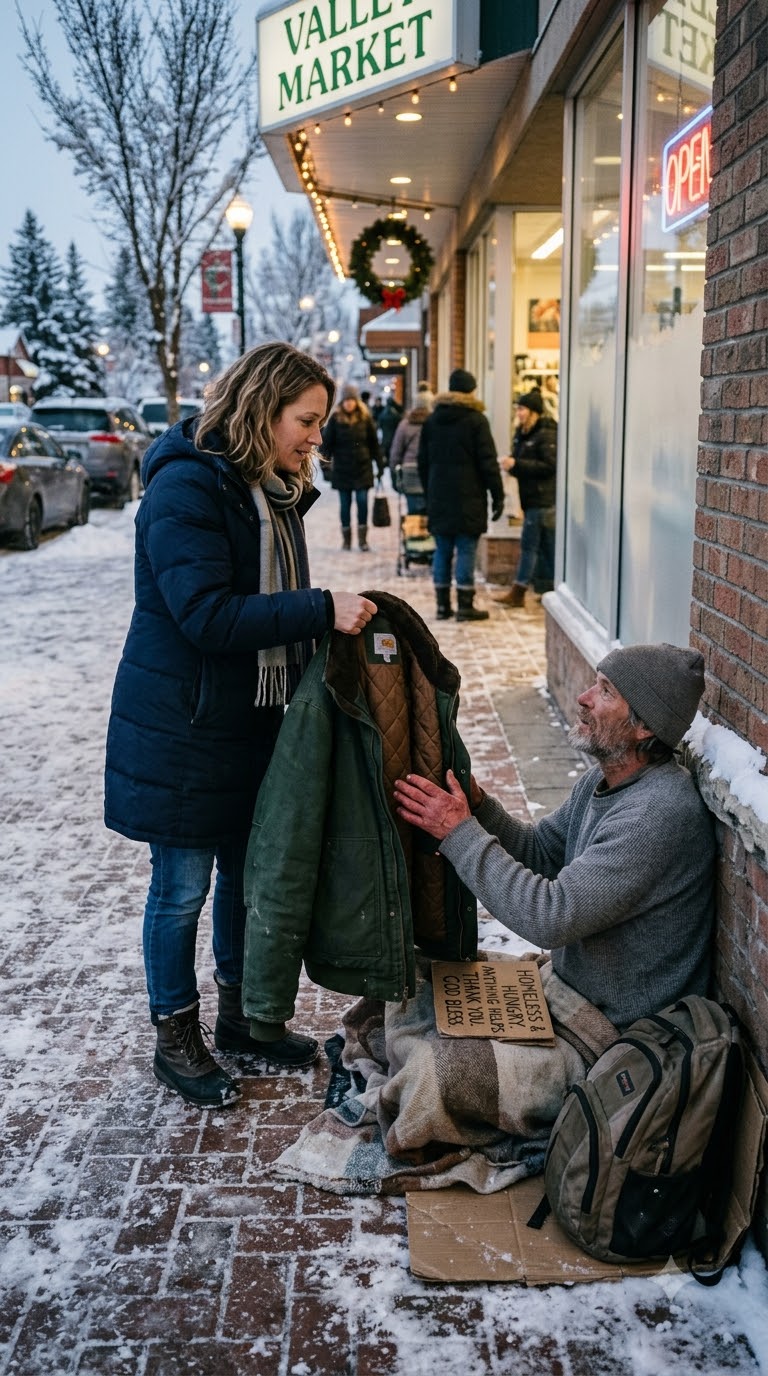
The apartment was not the place I had pictured raising my children.
The kitchen was narrow, the pipes banged whenever someone upstairs showered, and the smell of fresh bread from the store below sometimes mixed oddly with the cleaning products in our hallway.
But it was close to the children’s school and just fifteen minutes from my job at a dental office. After my husband, Dane, died, those things mattered more than space or peace.
My mother called the apartment temporary.
“You need somewhere peaceful,” she often told me. “Somewhere with a yard for the children.”
I always gave her the same response.
“This is what we can manage right now.”
Dane had been gone for eighteen months.
Some days, saying that still felt impossible.
He had survived two overseas deployments and several years of military life, only to die from a heart condition no one knew he had. He collapsed one Saturday morning while fixing a loose kitchen cabinet.
By the time the ambulance arrived, he was already gone.
There had been no warning and no final conversation. One moment, he was complaining that I had handed him the wrong screwdriver. The next, I was kneeling beside him on the floor, begging him to breathe.
Afterward, I learned that grief was not always loud.
Sometimes it was a lunch box I packed automatically before remembering Dane no longer needed one.
Sometimes it was Beckett standing in the doorway wearing his father’s shoes.
Sometimes it was Piper asking whether people could still feel cold after they died.
And sometimes it was the dark green jacket hanging beside our front door.
Dane had worn it for years. It was heavy, lined with soft brown fabric, and warm enough for the harshest winter. One pocket held an old receipt and two cough drops that had gone hard.
I knew because I had checked.
I had searched every pocket after he died, hoping to find something I had missed. A note. A shopping list. Anything in his handwriting.
There was only the receipt, the cough drops, and his name stitched onto a small cloth label inside the lining.
Beckett sometimes slipped into the jacket when he thought I wasn’t watching. The sleeves covered his hands, and the bottom nearly reached his ankles.
Once, I found him sitting on the couch with the collar pressed against his face.
“Does it still smell like Dad?” he asked.
“A little,” I said.
He nodded and stayed there for another ten minutes.
Piper did something similar. On difficult nights, she would stand beside the coat rack and rub one sleeve between her fingers.
I never told either child to stop.
The afternoon I gave the jacket away started like any other weekday.
My mother had picked Piper up from school for a dentist appointment, and Beckett was at a friend’s house working on a science project. I finished work early and stopped at the grocery store for milk, oranges, and something simple for dinner.
The man was sitting against the brick wall near the entrance.
He had placed himself away from the automatic doors so he wouldn’t block anyone. His shoulders were hunched, and his bare hands were tucked beneath his arms.
A piece of cardboard rested against one knee.
Veteran. Anything helps.
People walked past without looking.
I nearly did the same.
I was tired. I still had laundry in the dryer, messages from Beckett’s teacher to answer, and a sink full of breakfast dishes upstairs.
Then the man raised his head.
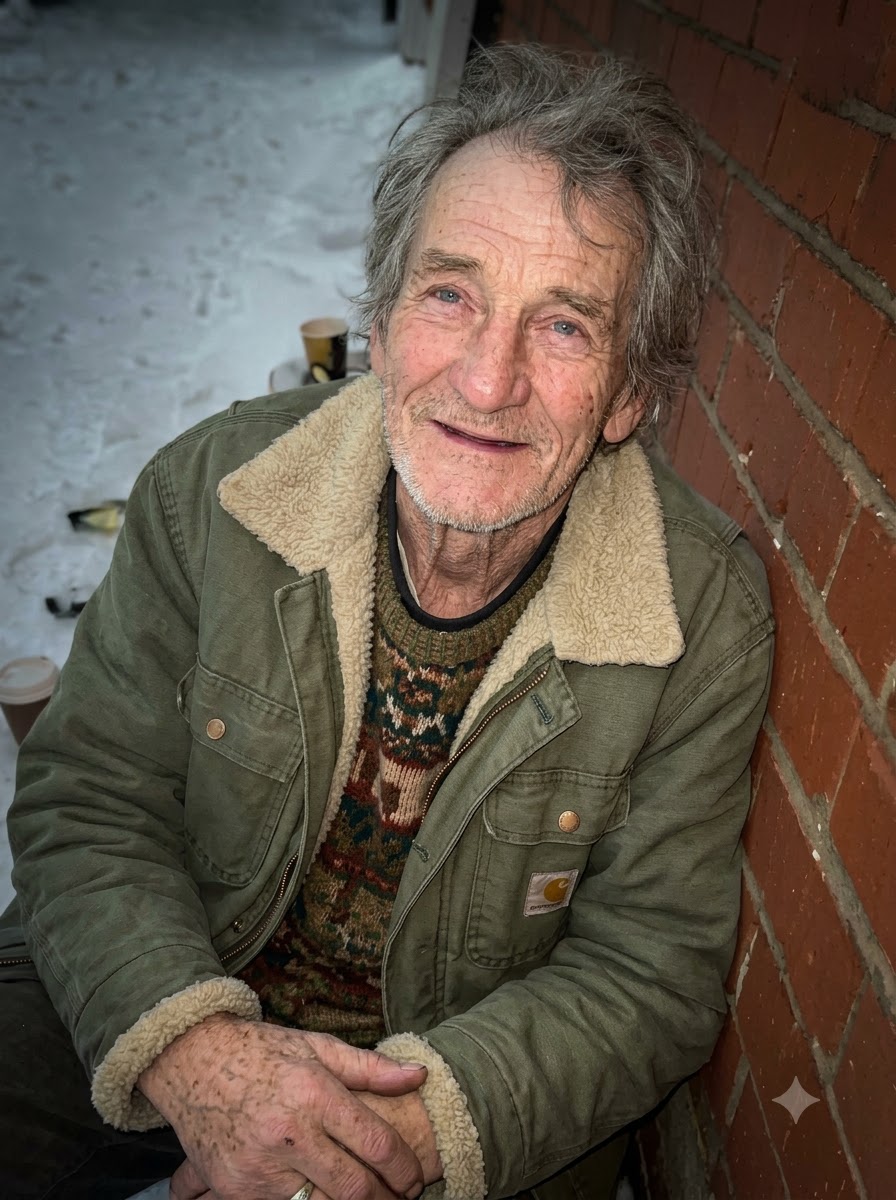
He looked to be somewhere in his fifties. His beard was untidy, and deep lines surrounded his eyes. He wore a thin gray sweater that looked completely unsuitable for December.
“Ma’am,” he said. “Sorry to bother you. It’s colder than I expected today.”
I stopped.
His voice was polite, but exhausted.
“I’m a veteran,” he added, touching the edge of his sign. “I’m just trying to get through the week.”
I had a few dollars in my purse. I could have given them to him and gone inside.
Instead, I looked at his hands.
They were red and trembling.
“Where’s your coat?” I asked.
He gave a small, embarrassed laugh.
“Long story.”
“You can’t sit out here dressed like that.”
“I know.”
He said it without defensiveness. Somehow, that made it worse.
Dane used to tell me that the cold felt different after his deployments. Old injuries ached. His fingers sometimes became stiff even when the rest of us were comfortable.
I thought about that as I looked at the man.
“Wait here,” I said.
He frowned.
“What?”
“Just wait.”
I hurried through the entrance and climbed the stairs to our apartment.
The hallway was quiet when I opened the door.
My eyes went straight to the coat rack.
Dane’s jacket hung there between Beckett’s raincoat and one of Piper’s pink scarves.
I stood before it for a long time.
There were other coats in the apartment. An old one of mine, a thin jacket Beckett had outgrown, and a puffy coat that belonged to my mother.
But none would fit the man properly.
Dane’s would.
I reached for it, then stopped.
I pictured Beckett coming home and seeing the empty hook.
I pictured Piper pressing her face against the sleeve and finding nothing.
The jacket was one of the few things we had never packed away.
Giving it to a stranger felt different from giving away an ordinary coat. It felt as though I was choosing to lose another piece of my husband.
I could buy the man a blanket, I told myself.
I could give him money.
I could call a shelter and leave.
Then I thought of Dane.
He had never been good at walking away.
Once, on our way to my sister’s wedding, he stopped in formal clothes to help a man whose car had broken down. We arrived twenty minutes late, with grease on Dane’s shirt cuff.
I had been furious.
“The man was standing there with two children,” Dane told me. “What was I supposed to do?”
“You could have called someone.”
“I was someone.”
I could almost hear him saying it as I stood beside the coat rack.
I took down the jacket.
The man was still outside when I returned.
His eyes shifted from my face to the coat in my hands.
“It’s clean,” I said. “And it’s warm.”
He didn’t reach for it.
“That looks expensive.”
“It isn’t.”
“It looks like it belongs to someone.”
“It used to.”
He studied me for a moment.
“What’s your name?” I asked.
“Harlan.”
“I’m Mallory.”
“I can’t take someone’s good coat, Mallory.”
“Yes, you can.”
His eyes dropped.
“I don’t want to cause trouble.”
“You’re not causing trouble. Put it on before your hands freeze.”
He slowly accepted the jacket.
When he slid his arms into the sleeves, his expression changed. The coat fit him almost perfectly.
He pulled it closed and touched the collar.
“This is very warm.”
“I told you.”
“Thank you.”
His voice caught on the final word.
I went inside the store and bought a container of hot soup, a small loaf of bread, and a cup of tea. When I brought them outside, Harlan was still sitting beneath the awning.
He looked at the bag, then back at me.
“You didn’t have to do this.”
“I know.”
That was something Dane often said too.
I left before the man could thank me again.
When Beckett came home that evening, he immediately noticed the empty hook.
“Where’s Dad’s jacket?”
I had spent the previous hour preparing an explanation, but suddenly none of the words sounded right.
“There was a man outside,” I said. “He didn’t have a coat, and it was freezing.”
Beckett stared at the hook.
“So you gave him Dad’s?”
“Yes.”
His face tightened.
I waited for him to get angry.
Instead, he asked, “Was he really cold?”
“Yes.”
Beckett looked down for a moment.
“Dad would’ve given it to him.”
“I think so.”
“But I liked wearing it.”
“I know.”
“Is he going to bring it back?”
“I don’t know.”
Beckett nodded, though disappointment remained on his face.
Piper said nothing when she heard. She walked to the coat rack, touched the empty hook, and then wrapped both arms around my waist.
That night, after the children were asleep, I wondered if I had done the right thing.
I knew someone had needed warmth.
I also knew the jacket had belonged to my children in a way I had not fully considered.
Grief made ordinary choices difficult. A coat was no longer simply a coat. Every object carried a memory, and every memory felt as though it might vanish if I stopped protecting it.
For the next week, I watched for Harlan whenever I passed through the grocery store entrance.
He was never there.
Then the email arrived.
Regarding the incident outside the grocery store.
It came from the property management office.
I opened it, read the first few lines, and immediately closed my laptop.
The message mentioned an “unauthorized interaction” near the building entrance. It said an individual had been questioned during a welfare check and had mentioned receiving personal property from a resident.
I read the email three times.
Had Harlan caused a disturbance?
Had someone complained?
Had he told people which apartment I lived in?
I thought about Beckett and Piper walking through that entrance every day.
For the first time, my decision did not feel kind. It felt reckless.
I called the number at the bottom of the email.
A woman named Renee answered.
“I received a message about an incident outside the grocery store,” I said. “I think it concerns a man named Harlan.”
“Yes, ma’am. We only need to confirm what happened.”
“Is he in trouble?”
“No. A store employee called an outreach team because he appeared confused and was struggling to stand. Security spoke with him while they waited.”
My grip on the phone loosened slightly.
“Is he all right?”
“He was taken to a veterans’ support center.”
I closed my eyes.
“Then why did you email me?”
“He told security a resident gave him the jacket he was wearing. Since he had also mentioned that you lived above the store, management needed to make sure he had not entered the residential area.”
“He didn’t. I brought it to him.”
“All right. That is all we needed.”
I should have ended the call.
Instead, I asked, “Did he say anything else?”
Renee paused.
“He mentioned your husband.”
I sat straighter.
“My husband is dead.”
“I’m sorry. Harlan said he recognized the name inside the jacket. Dane Mercer?”
The room went completely still.
“Yes.”
“He said they served together.”
Harlan returned two days later.
I saw him through the grocery store window while paying for bread. He stood near the entrance holding Dane’s jacket folded across his arms.
He looked cleaner. His beard had been trimmed, and he wore a brown coat that was slightly too large for him.
I hurried outside.
“Harlan?”
He turned.
“I hoped I’d see you.”
“You didn’t have to return that.”
“I know.”
He held out the jacket.
“I wanted to.”
I accepted it carefully.
For several seconds, neither of us spoke.
“The building manager told me you knew my husband.”
Harlan looked toward the street.
“Dane and I were in the same unit for almost a year.”
“You recognized his name?”
“It was stitched inside the lining. He used to put his name on everything.”
I laughed before I could stop myself.
“Yes. He did.”
Harlan’s expression softened.
“He said people borrowed things and never brought them back.”
“That also sounds like him.”
He looked down at his hands.
“After we came home, I had a rough time. Dane checked on me more than I wanted him to. He’d show up with coffee, make me go to appointments, ask whether I had eaten.”
I pressed the jacket against my chest.
“He never told me.”
“He probably didn’t think it was a story worth telling.”
That sounded like Dane too.
Harlan explained that after leaving the military, he had struggled for years. He managed for a while, then lost his job and apartment within a few months. By the time I met him outside the store, he had been sleeping in temporary shelters and sometimes on buses.
When the outreach workers arrived, he resisted going with them.
Then one of the workers noticed Dane’s name inside the jacket.
“She knew him,” Harlan said. “Your husband volunteered with their veterans’ program before he died.”
I stared at him.
“He did?”
“Apparently, he helped drive people to appointments.”
Dane had told me he sometimes stayed late at work.
I had never asked many questions.
The outreach worker used Dane’s name to calm Harlan down. She reminded him that accepting help was not the same as failing. Eventually, he agreed to go with them.
“They found me a bed,” he said. “They’re helping me replace my identification and apply for work.”
“I’m glad.”
Harlan handed me a small envelope.
Inside was the grocery receipt from the pocket and the two old cough drops.
“I thought your children might want everything back.”
My throat tightened.
“You found these?”
“They were still in the coat.”
I smiled through the tears gathering in my eyes.
“My daughter will probably try to save the cough drops forever.”
Harlan looked at the jacket.
“Your husband helped me when I didn’t want help. Then you did the same thing without knowing who I was.”
“I almost kept walking.”
“But you didn’t.”
He held my gaze.
“Dane would have been proud of you.”
I had been told many times that Dane would be proud of the children.
No one had said it to me.
The words hurt in a place I had kept carefully closed.
“Thank you,” I whispered.
When I returned upstairs, Beckett saw the jacket in my arms.
“It came back.”
He rushed across the room before I could answer.
Piper followed and pressed her face into the sleeve.
“Does it still smell like Dad?” Beckett asked.
I lifted the collar and breathed in.
The jacket smelled faintly of cold air, laundry soap, and someone else’s life.
“A little,” I said.
That evening, I hung it back on the coat rack.
It looked the same as before, but it no longer felt like something we needed to shield from the world.
Dane had worn it.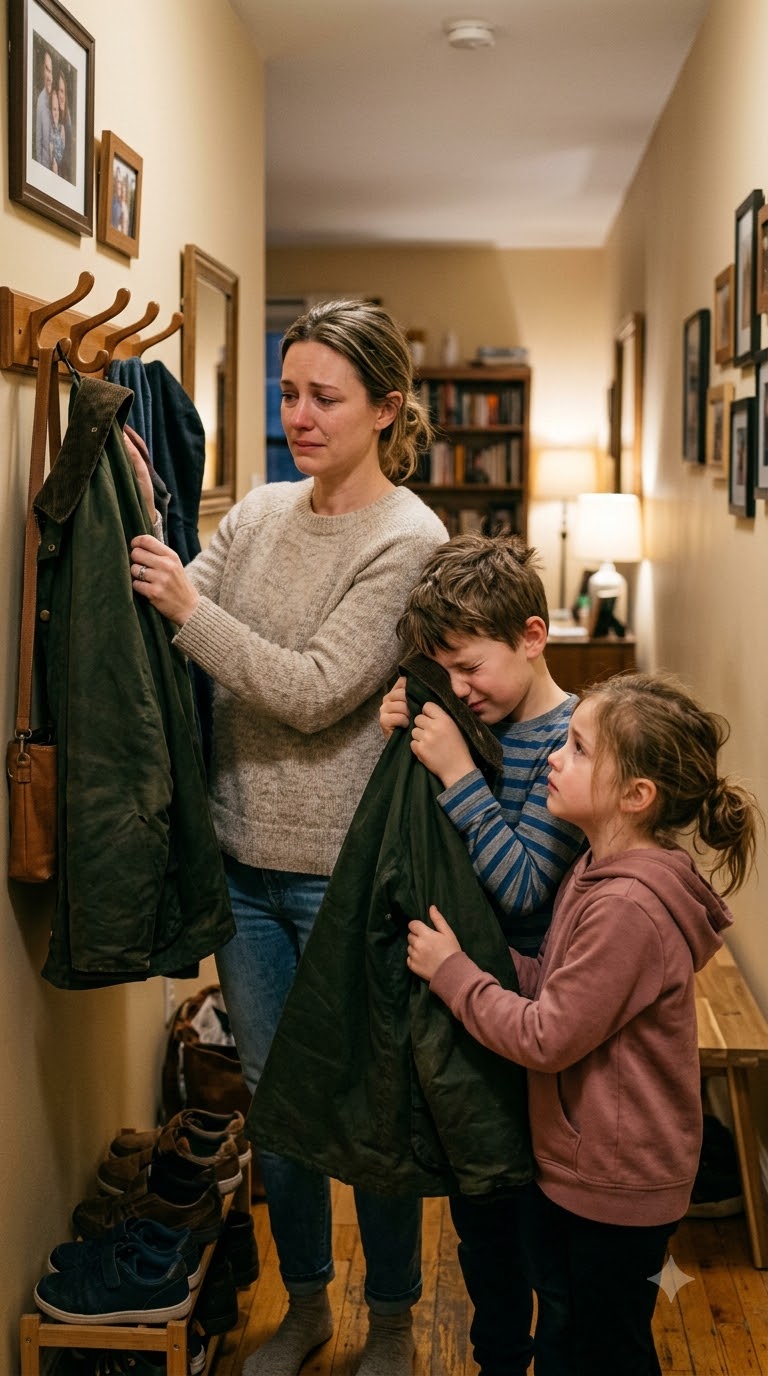
Harlan had needed it.
And now it had returned carrying a part of my husband’s life that none of us had known existed.
A few weeks later, Beckett asked if we could donate some of Dane’s other winter clothes to the veterans’ center.
“Not everything,” he added quickly. “Just the things nobody wears.”
Piper chose two sweaters but changed her mind about one at the last minute.
I let her keep it.
We packed the rest into a box together.
The jacket remained on its hook.
Sometimes Beckett still wears it. Sometimes Piper still holds the sleeve when she misses her father.
I no longer see that as keeping Dane trapped in our hallway.
The jacket can stay.
And when the day comes that someone else needs it again, perhaps we will be ready to let it leave.
