

I thought I was following a memory when I recognized something that had once belonged to my missing daughter. I never imagined it would expose a truth my husband had kept from me for ten years.
Our kitchen smelled of cinnamon toast that morning, while sunlight filtering through the curtains made everything feel warm and peaceful. Hannah, my 11-year-old daughter, sat at the table swinging her feet as she waited for her father to bring out the small velvet box he had hidden all week.
Rick set it in front of her with a grin I hadn’t seen in years.
“Happy birthday, sweetheart! I made the design myself!”
Hannah lifted the lid and gasped.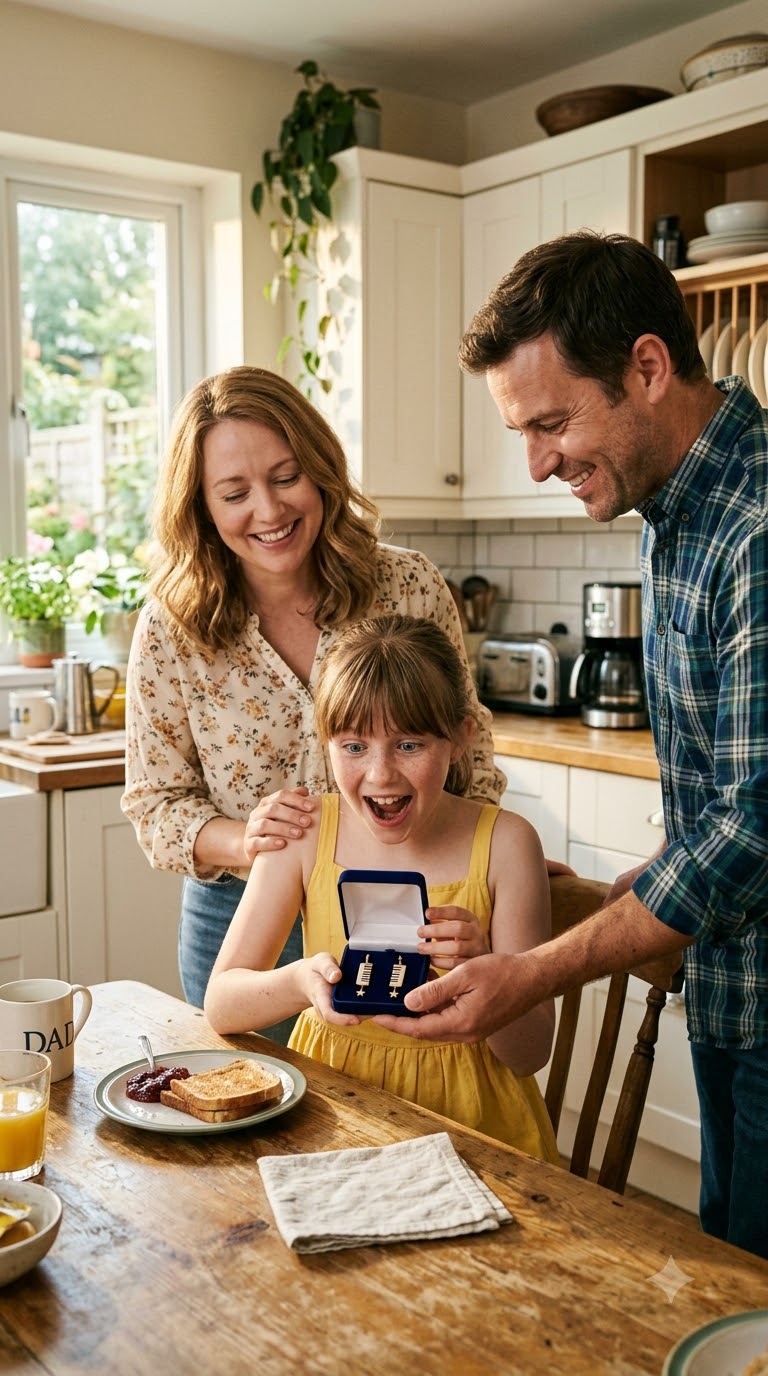
Inside were two gold earrings shaped like piano keys, each ending in a tiny star. They were completely one-of-a-kind. Her father had sketched the design over and over before sending it to a jeweler.
“They’re beautiful,” our daughter whispered. She looked up at me, her eyes shining. “I’ll never take them off, Mom.”
I brushed her bangs away and kissed the crown of her head.
“You don’t have to. They’re yours forever.”
That spring felt untouchable.
Hannah practiced piano every afternoon, filling the house with clumsy scales that gradually turned into real songs. Rick sat beside her on the bench, tapping the rhythm against her knee.
At night, my husband helped her with math at the kitchen table while I braided her hair and she chewed on her pencil.
“Mom, do you think I’ll be good enough for the recital?” She asked one evening.
“Baby, you’re already good enough. You just have to trust your hands.”
Hannah smiled.
She had a way of keeping the things I told her, storing them somewhere deep inside like tiny treasures.
Rick seemed different in those days.
Or perhaps I was simply convinced he was.
He often stayed late in the garage, which he called his workshop, and hated anyone opening the door without knocking. I told myself every man deserved a private place.
Sometimes he went on long Sunday drives and came home without saying where he had been. Other times, his phone rang and he stepped onto the porch, lowering his voice while his shoulders grew tense.
“Who was that?” I’d ask when he returned inside.
“Just work stuff, Marlene. Nothing to worry about.”
So I didn’t worry.
I trusted him.
That version of myself is the one I miss most.
Three weeks after her birthday, Hannah left for piano practice with her sheet music tucked under one arm and those gold earrings shining in the sunlight.
“Straight home after, okay?” I called from the porch.
“I know, Mom!” She turned and waved.
The earrings flashed once before she vanished around the corner.
Six o’clock came.
Then seven.
My friend Denise called about our dinner plans, and I told her I’d call her back. Rick paced through the living room, checking his phone again and again.
I called the piano studio while Rick drove around searching for her. They told us Hannah had finished practice and headed home.
By eight, I was standing at the front door in my slippers, staring down our silent street as police cars pulled up.
And just like that, my life ended on an ordinary Tuesday evening.
THE POLICE SEARCHED FOR YEARS.
Ten years went by.
Eventually, Hannah’s case went cold. Detectives stopped calling, searches disappeared, and the world continued as though my daughter had never existed.
Everyone had a theory.
K:idnapping.
Memory loss.
A little girl who became lost somewhere in the city and never found her way back.
I read every theory until my hands went numb from gripping my phone.
Rick wanted me to stop.
Every year on Hannah’s birthday, at Christmas, or whenever he caught me looking at her school photo on the mantel, he repeated the same thing.
“Enough living in the past, Marlene,” he’d say. “Let our child rest.”
Denise was kinder.
One Thursday, she came over with two coffees and a grief counselor’s pamphlet.
“Honey, you’ve been carrying this alone for a decade,” she said. “Nobody’s asking you to forget her, just to breathe.”
I accepted the pamphlet.
But I never called.
Something inside me refused to release her.
Maybe it was instinct. Maybe stubbornness. Maybe it was simply a mother refusing to bury a child she had never been given the chance to say goodbye to.
Then that Saturday, everything changed.
I was walking through the local flea market when I saw them.
My knees almost gave way.
Hannah’s earrings.
The ones Rick had designed himself.
The middle-aged woman behind the table was sorting through a chipped china set when I walked up.
“Where did you get these?” I asked.
My voice barely sounded like my own.
She looked up and shrugged.
“Those came in a box of estate things a couple of weeks ago. Don’t know whose exactly. My son does the pickups.”
“Please,” I whispered. “I need them.”
She named a price.
I handed her the money without even counting it.
My hands were shaking so badly that I almost dropped the earrings.
I drove home clutching them so tightly in my palm that they left marks.
Rick was pouring coffee when I entered the kitchen.
The instant he saw them, his face went pale, then red. He slowly set his mug on the counter, but I could see his hand trembling.
“Why would you bring those into this house?!” he shouted.
I froze.
“Because they were Hannah’s!”
He stared at them for a long moment before shaking his head.
“Those aren’t hers, Marlene,” he said, his voice flat. “Lots of jewelers make piano earrings. It’s a common design.”
“Common?” I said. “You designed them yourself!”
Rick gripped the edge of the counter so tightly that his knuckles turned white.
“Throw them away! Hannah is dead!”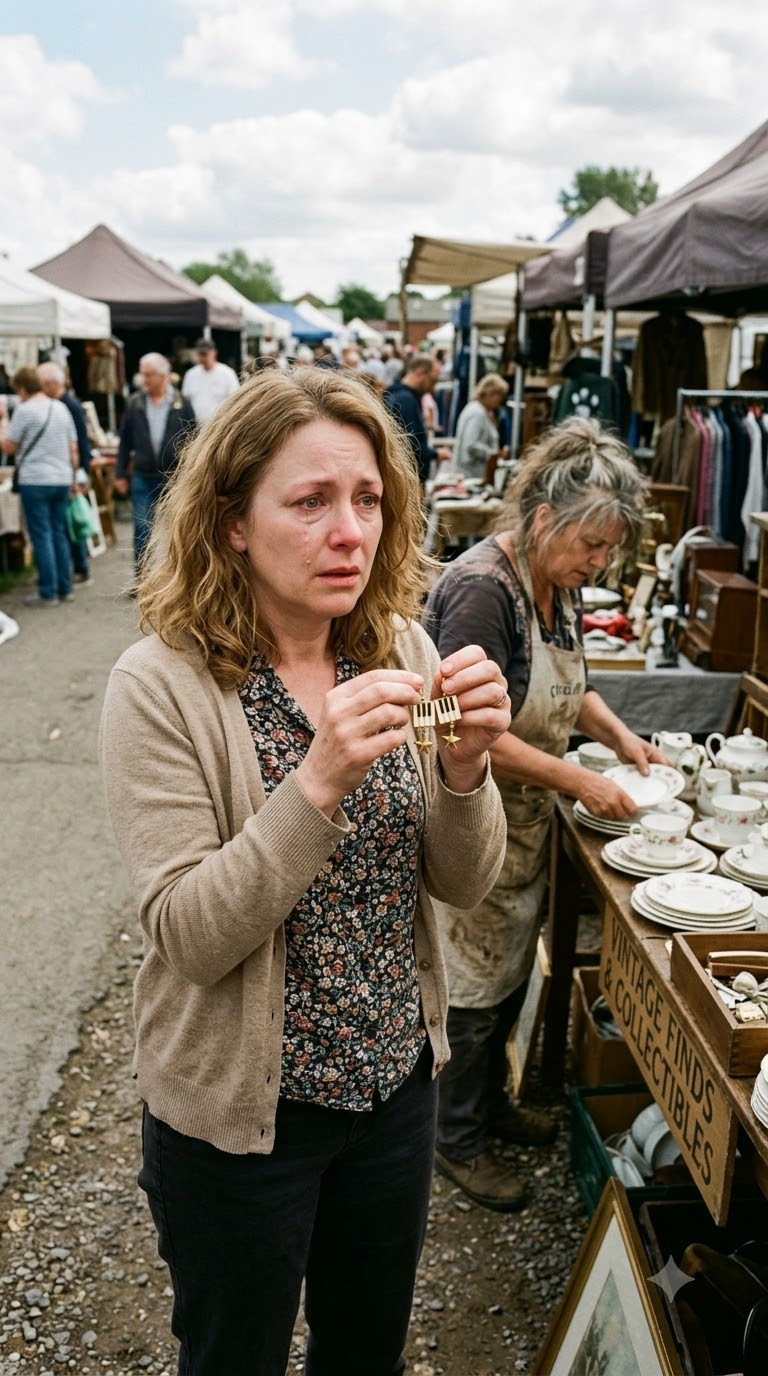
The words made no sense.
Hannah wasn’t dead.
She was missing.
And Rick refused to look me in the eyes.
I spent that night in the guest room, crying until morning with the earrings pressed against my collarbone, just as I used to hold Hannah when she was little.
Sometime before dawn, exhaustion finally carried me into sleep.
A knock woke me.
I pulled on my robe and opened the front door.
Two officers stood on the porch, their badges visible and their expressions cautious.
“Mrs. Rhodes?” one asked.
My heart climbed into my throat.
“Yes?”
The officer looked past me.
I turned.
Rick stood barefoot in the hallway, still dressed in his old robe.
“Ma’am, we need to speak with both of you,” the officer said. “We have significant new information about Hannah. This is about the earrings you found yesterday.”
My breath caught.
“You found Hannah?” He didn’t respond.
His attention remained fixed on Rick.
Then he said quietly, “Ma’am, it’s time you heard what your husband has really been hiding for the past ten years.”
Rick remained silent.
My knees grew weak, so Detective Palmer helped me over to the couch while Detective Gomez stayed by the door.
Rick still hadn’t moved.
“Mrs. Rhodes,” Palmer said, “the woman at the flea market, Cheryl, called our tip line yesterday. She’d seen Hannah’s photo on one of those old cold-case segments, and something about the way you reacted to those earrings stayed with her. Her son told her where that estate box had come from. It belonged to a woman named Judith, who passed away two months ago.”
The name barely registered.
I had probably heard it only twice in twenty years.
“Judith,” I whispered. “Rick’s sister?”
Palmer slowly nodded.
“She was his older sister. They lost contact years before you two met. She lived in rural Ohio, pretty isolated, with no close neighbors or family. We’ve been quietly working the tip ever since Cheryl called, gathering Judith’s records, coordinating with Ohio authorities, and confirming that a young woman had been living with her.”
She paused.
“We only came to your door once we were sure. Judith had been raising the teenage girl for the last decade. Different name. The same age as Hannah. Same description.”
I turned toward Rick.
Tears were silently running down his face.
“Rick,” I said. “What did you do?”
He shook his head like a child who had been caught lying.
“Marlene, please…”
“What did you do?!”
Rick slid down the wall until he was seated on the floor.
Palmer waited.
FINALLY, HE SPOKE.
“I was in debt,” Rick said. “Gambling. I owed people I couldn’t pay. And I’d already taken the money, Marlene. Your mother’s inheritance, the account she left for Hannah’s college, I drained it. All of it.”
I couldn’t breathe.
“Hannah heard me,” he said. “On the phone. She came through the back door from piano practice. She heard me telling the guy where the money came from. She heard the account, the amounts, and heard me say your name.”
“She was 11,” I said.
“Hannah started asking questions. She wondered whether the money wasn’t supposed to be hers and wanted to tell you.” He wiped his face with his robe sleeve. “I panicked, Marlene! I drove her to Judith’s. We hadn’t spoken in years, but she wouldn’t turn away a child.”
He drew in a trembling breath.
“I told her you’d abandoned Hannah and me. I brought papers with me, a custody letter I’d forged with a court seal. Judith had never met you, so she had no reason not to believe me. I gave her a different last name for you, too.”
“You left our daughter there and never went back?!”
“I couldn’t! If Hannah had come home, she’d tell you everything. And then it wasn’t just the debt, it was the theft.” His shoulders shook. “Every year became harder. If I came clean, I’d lose everything.”
I was crying now.
Palmer gently placed a hand on my arm, but I pulled away and rose to my feet.
“Ten years of me begging you to help me look! You told me to let her rest while watching me fall apart every single night! And you knew!”
“I’m sorry,” my so-called husband whispered.
“Sorry?”
“Marlene, I loved her too.”
The words turned my stomach.
“Don’t you dare use that word in this house!”
Palmer moved between us.
“Mr. Rhodes, we’re going to need you to come with us.”
Rick offered no resistance.
He simply nodded.
I turned toward Palmer, barely able to remain standing.
“Judith,” I said. “What happened to her? Where’s my daughter?”
“Judith passed away two months ago,” Palmer said softly. “Cancer. She’d been sick for a while. She left a letter behind, ma’am. We’ve made a copy for our file, and the original is with a foster caregiver named Beverly because it was addressed to Hannah.”
Gomez spoke from the doorway.
“It’s clear Judith had started to doubt Rick’s story. Hannah’s memories didn’t match what he’d told her. In the letter, she mentions taking the earrings off your daughter the night she arrived before locking them in a drawer for safekeeping.”
“Over the years, your sister-in-law (SIL) forgot they were there. When the house was cleared out, they were mistaken for Judith’s own jewelry and placed in the estate box with everything else.”
Only one question mattered.
“And Hannah?”
Palmer answered.
“Your daughter is alive. She’s 21 and living with Beverly just outside Columbus. She’s safe and healthy. Hannah has been searching for you, ma’am, but with the wrong last name, every lead went cold. She was saving up to hire someone.”
My knees finally gave way.
Palmer caught me before I hit the floor.
“I knew,” I sobbed into her shoulder. “I always knew!”
DETECTIVE PALMER DROVE ME ACROSS TWO STATE LINES THE NEXT MORNING.
Rick was already behind bars.
My hands continued trembling as I held the small velvet pouch containing Hannah’s earrings.
As we turned onto a quiet street, Palmer said, “Beverly is your SIL’s neighbor who took Hannah in after the funeral. Nothing official, just a kind woman who didn’t want the teenager to be alone in that house.”
Beverly met us at the door of a pale yellow house with a porch swing. She had kind eyes and flour dusted across her apron.
“She’s in the living room,” Beverly said gently. “I told her that someone who loves her very much was coming.”
Hannah was standing beside the window when I entered.
She was taller than I had ever imagined.
“Sweetheart,” I whispered.
Her head slowly turned.
Her eyes filled with tears.
“I know that voice,” she said. “I’ve been trying to remember it my whole life!”
I walked across the room.
She came toward me halfway.
For a long moment, neither of us said anything.
Later, Beverly brought out the letter Judith had left behind.
Hannah read it aloud with trembling hands.
“She wrote that she suspected Dad lied,” my daughter said. “That she was sorry she didn’t dig deeper.”
“She loved you,” I told her. “That much is clear.”
“But you never stopped looking?” Hannah asked.
“No, baby. I couldn’t.”
I opened the pouch and set the earrings in her palm.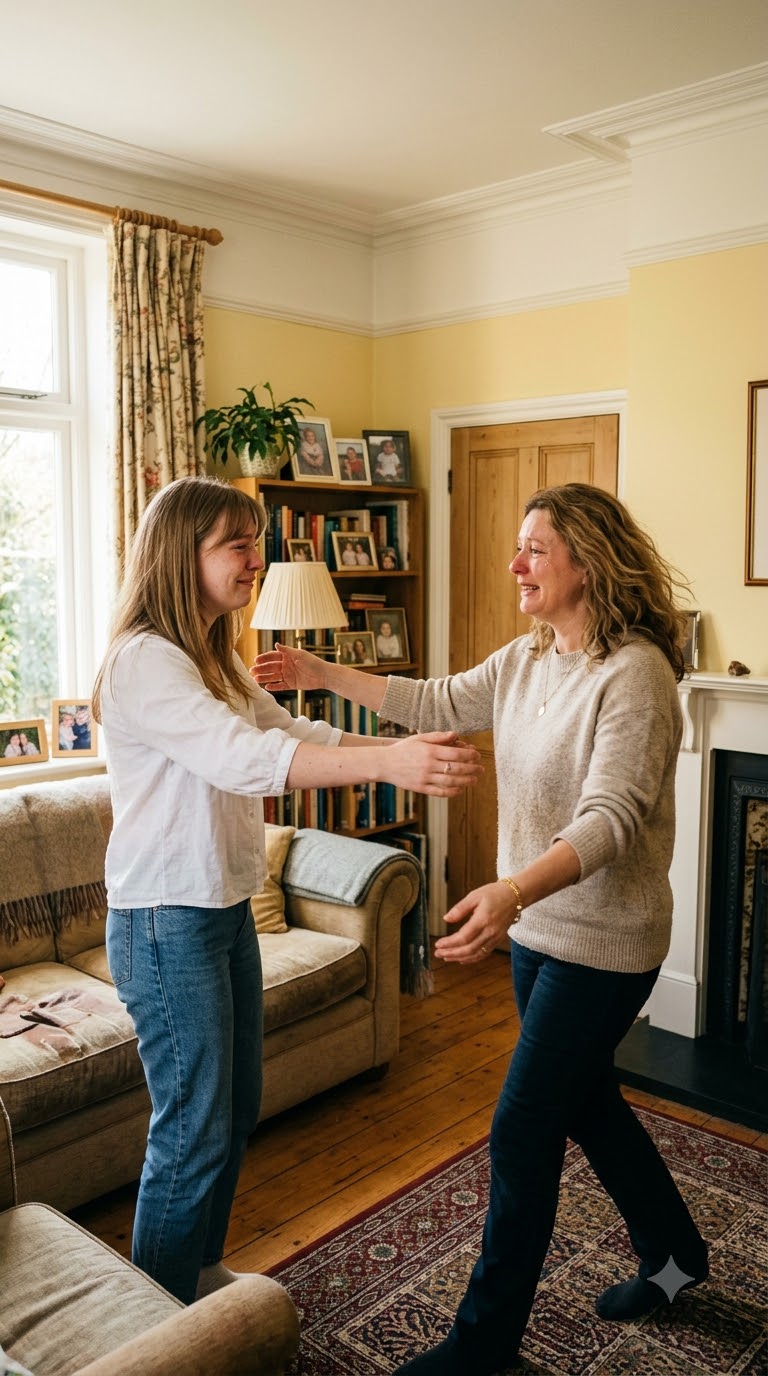
“You said you’d never take them off,” I said. “Do you remember?”
Hannah nodded as tears streamed down her cheeks.
Then she put them back in.
Right where they belonged.
I FILED FOR DIVORCE THE FOLLOWING WEEK.
The law could handle Rick.
My energy belonged to Hannah now.
We began with simple things.
Sunday breakfasts.
Long walks.
Piano lessons started again, almost as though the missing years hadn’t taken so much from us.
Every mother I’ve ever known has been told that her instincts are too loud, too stubborn, or too much.
Mine refused to be silenced.
And in the end, that instinct brought my daughter home.
That’s a story I’ll tell for the rest of my life.
