


PART 1
“Mr. Rivas, don’t be alarmed. The children are fine.”
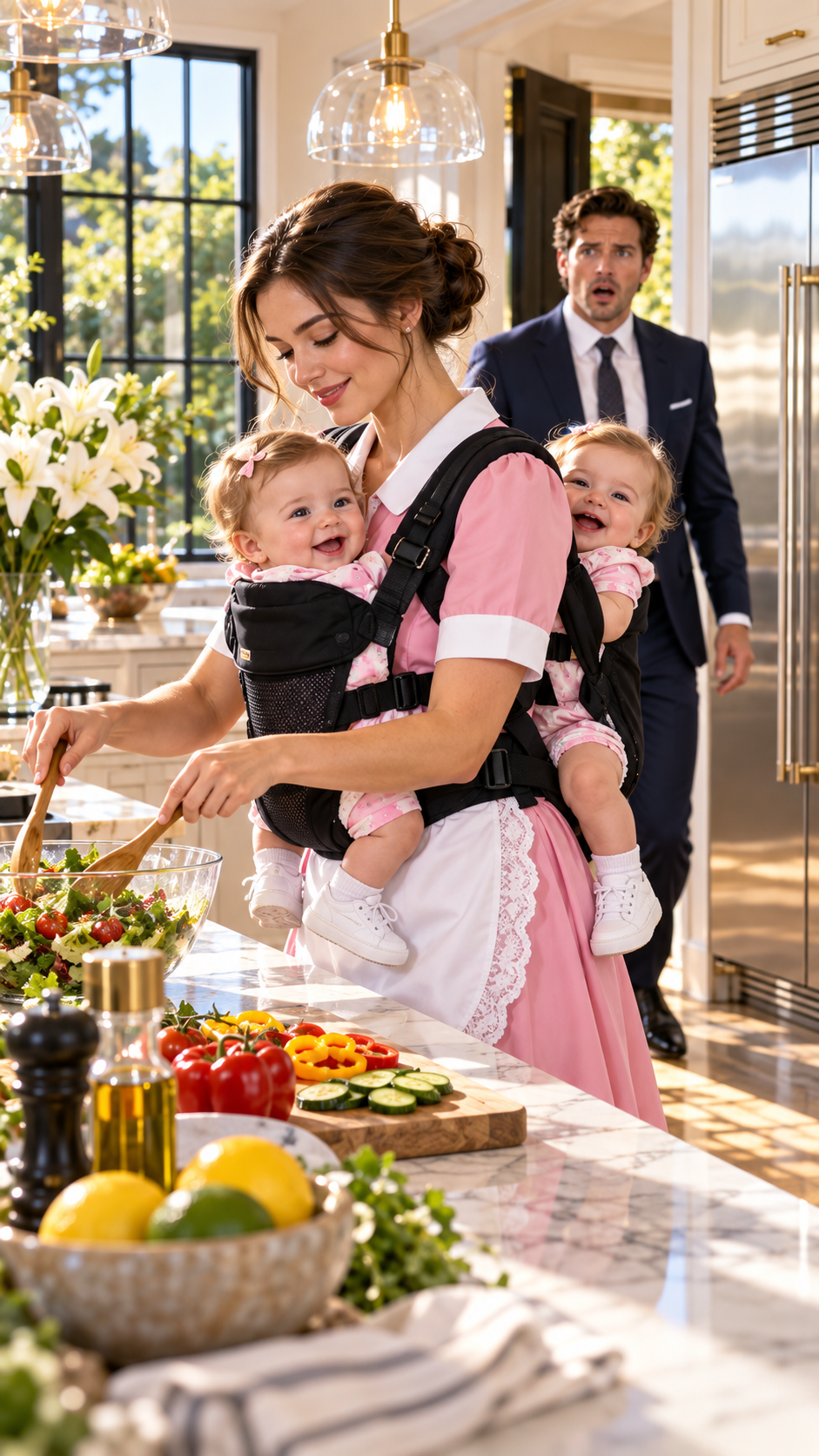
That was the first sentence I heard when I walked into my kitchen and found a woman I had never seen before with my 2 sons pressed against her body, one at her chest and the other on her back.
I froze with my briefcase still in my hand. Mateo and Emiliano were 5 months old and, from the day they were born, they had cried as if the entire world hurt them. In less than 3 months, 4 nannies and 1 night nurse had quit. I bought smart cribs, white-noise machines, imported formula, and even switched pediatricians. Nothing worked.
That afternoon I came back early from a meeting in Polanco because I couldn’t concentrate. I expected to hear the screaming from the elevator. Instead, the apartment was so deeply silent that I felt afraid.
The woman was wearing a simple blue uniform. She was cutting zucchini while humming a song. Mateo, held in a rebozo adapted as a baby carrier, was looking at her hands. Emiliano was sleeping on her back with his cheek resting on her shoulder.
“Who are you?” I asked.
She set the knife on the cutting board.
“My name is Lucía Hernández. Doña Teresa sent me.”
My mother-in-law’s name hardened my chest. Teresa was the mother of Daniela, my wife, who 4 months earlier had packed clothes into a suitcase and left, saying she could no longer handle the babies, the house, or me. Since then, Teresa and I had barely spoken. She blamed me for working too much and for leaving her daughter alone when she needed support the most.
“I didn’t hire anyone.”
“I know. But the nurse had to leave for an emergency. She left me instructions. When she left, the children were crying very hard.”
Lucía explained that she had found 2 baby carriers in a closet. She tied Mateo to her front, Emiliano to her back, walked slowly down the hallway, and sang for almost 20 minutes.
“It wasn’t magic,” she said. “They needed warmth, movement, and to feel someone close.”
It hurt to hear her, because I had spent money on everything except what seemed most obvious.
Then Lucía untied Mateo and placed him in my arms.
“Don’t hold him as if he’s going to break. Press him to your chest.”
I did. My son settled his face against my shirt and did not cry.
I almost did.
“Why do you know how to do this?” I asked.
Lucía looked down at Emiliano.
“Because from the time I was 12 I raised my 3 brothers. And because I know what it feels like to grow up believing you are in the way.”
Before I could answer, she added something that completely changed what I thought I knew about Teresa:
“Last night she cried when she called me. She told me she couldn’t sleep thinking her grandsons were suffering… and that maybe you were too.”

PART 2
The next day I called Teresa. I wasn’t expecting an apology, and I didn’t get one.
“I still think you were wrong with Daniela,” she told me. “But one thing doesn’t erase the other. Those boys need you alive, not destroyed.”
Lucía started working with us that week, with a schedule, a contract, and a formal salary. She arrived at 7 in the morning from Iztapalapa and, before anything else, she picked up the twins. She didn’t “silence” them; she watched them. She taught me to tell the cry of hunger from the cry of tiredness, to feed them without looking at my phone, and to sit on the floor even if I had 20 emails waiting.
She also told me her story. Her mother cleaned houses, and her father disappeared when she was 5. By 12, Lucía was already preparing bottles, taking children to school, and getting up before dawn with the youngest. She had just finished a course as a childcare assistant and was looking for a dignified opportunity.
Over the weeks, my sons changed. First they stopped crying for hours. Then they started to smile. After that, to babble.
One afternoon I came home early and Lucía showed me a video: Mateo burst into laughter and Emiliano imitated him.
The joy hit me so hard I had to sit down.
“I knew you’d want to see it,” she said.
That “you’d want” reminded me of something uncomfortable: she was my employee, and I was starting to look forward to her arrival for reasons that no longer had to do with the children.
The next day I told her I couldn’t pretend I felt nothing, but that I also was not going to put her in a position where she had to return my feelings in order to keep her job.
Lucía was silent.
“Then let’s settle that first,” she answered. “Because I feel something too… and I don’t want this to start crooked.”

PART 3
Her answer made me feel relief and shame at the same time. Relief because I had not imagined what was happening between us; shame because Lucía had seen the problem more clearly than I had.
That same day we agreed we would not make any romantic decision while she depended directly on me. I spoke with a serious childcare agency that Teresa knew. Lucía agreed to join them, keeping a stable schedule and a better income. For 6 weeks another caregiver came to the house in the mornings. Lucía still saw the children some weekends, but now as a guest.
That distance was the first test.
I expected to discover that I missed her only because she solved my chaos. That was not what happened. I missed her questions, her laugh when I burned the tortillas, the direct way she told me to put my phone face down during dinner. And when we talked at night, she no longer had to measure her words in front of her employer.
I also changed things that could not depend on her. I cut back on travel, delegated 2 major accounts at the company, and reserved Tuesday and Thursday afternoons for my sons. I learned to bathe them without turning the bathroom into a flood. I discovered that Emiliano fell asleep if I stroked his left eyebrow and that Mateo hated socks. Most of all, I learned to stay.
It did not always work. There were nights when both of them cried for hours and I ended up sitting on the kitchen floor. But I no longer heard their crying as an accusation. It was a need, not a judgment.
Our first formal date was in a small café in Coyoacán. Lucía arrived in a green dress with an amused expression.
“I’ve never seen you this nervous,” she said.
“I’ve never gone out with someone who knows I don’t know how to fold a stroller.”
We laughed. We talked about debts, family, fear, and what each of us wanted to keep of our own lives. Lucía wanted to keep working and study early childhood education. I told her I was not looking for a substitute mother for my sons.
“That matters,” she answered. “I love them very much, but I don’t want my place to exist because another woman left.”
Months later, Daniela called.
I had not seen her since she left. Her voice was shaking. She had started therapy and was living with a cousin in Querétaro. She did not ask to come back to me. She asked to see the children.
My first reaction was anger. I remembered the sleepless nights, the suitcase by the door, and the 3-line message she left afterward. But I also understood that the children could not become a form of punishment.
We spoke with a family psychologist and organized short, supervised visits. Daniela cried the first time Mateo touched her face. Emiliano took longer to come close. I did not try to make her pain easier or make it worse. She had to build her place through actions.
Teresa did not defend her blindly either.
“She is my daughter,” she told me, “but they are also my grandsons. If she wants to recover trust, she will have to earn it.”
Daniela started to follow through. She arrived at the agreed time, asked about their meals, learned their routines. Some weeks were good; others were hard. We did not become a couple again. What had broken no longer had the shape of a marriage, but we were able to turn it into a civil relationship for the children.
Lucía never competed with her. That was one of the reasons I ended up loving her more.
When the twins turned 1, we had a small party in Teresa’s yard in Tlalpan. There was papel picado, mole, rice, and gelatin. Mateo plunged both hands into the cake. Emiliano smeared cream in his hair. Daniela stayed for a while and left early. Before she went, she walked over to Lucía.
I only managed to hear:
“Thank you for taking care of them when I couldn’t.”
Lucía nodded.
That night, after putting the children to bed, she and I sat in the empty yard. Balloons were still moving in the air.
“A year ago I thought my life was over,” I told her.
“It wasn’t over. It was disordered.”
“You helped put it in order.”
“No, Alejandro. I walked into a house where people were tired. You decided to stay.”
That was Lucía: she never let me turn her into a miracle so I could avoid recognizing my responsibilities.
A year later we moved into a smaller house with a garden. I worked from home 2 days a week. Lucía started her bachelor’s degree in preschool education in the afternoons. The twins waited for her by the door on Wednesdays, when she came back with a backpack full of notes and crayons.
That was when I knew I wanted to ask her to marry me.
I did not do it at an elegant dinner. I did it on an ordinary night, after picking plastic blocks up off the floor. Mateo and Emiliano were asleep. On the table was the same gray baby carrier Lucía had used the day I met her. Teresa had found it in a box and sent it to us.
I set it in front of us.
“Do you remember?”
Lucía laughed.
“How could I forget. I thought you were going to throw me out before you even knew my last name.”
I took out a small box.
She stopped laughing.
“I don’t want to ask you to be the person who came to save us,” I told her. “I want to ask you to keep building a life where neither of us has to save the other alone.”
I got down on one knee.
“Will you marry me?”
Lucía covered her mouth.
“Yes,” she said. “But don’t say again that you didn’t prepare a speech. That was far too well prepared.”
We got married 7 months later, also in Teresa’s yard. It was a simple ceremony. The twins, already 2 years old, had one job: carry the rings. Mateo arrived with one. Emiliano arrived with a little stone and insisted it was “prettier.” No one argued.
Daniela attended. She did not stay for the whole party, but she hugged the children and wished me luck. That did not erase the past. It did not have to.
The years that followed were less cinematic and more important.
There were bills, colds, school meetings, arguments about schedules, exhausted nights, and Sundays when no one wanted to cook. Lucía finished her degree and started working at a children’s center in the borough. I sold part of the company and stopped measuring my worth by how many hours I could spend away from home.
Daniela kept contact with the children, not perfect, but consistent. Teresa came on Sundays with containers of food enough to feed a soccer team.
When Mateo and Emiliano turned 5, one afternoon they were playing in the garden kicking a ball. I was leaning on the fence when Lucía came up behind me and wrapped her arms around my waist.
“Do you remember the silence of that day?” she asked.
Of course I remembered.
For months I had believed silence was a threat, because in my house it had always meant something was wrong.
I looked at our sons arguing over who would be goalkeeper. On a chair sat the old gray baby carrier, now turned into a bag for small balls and toys.
“Yes,” I told her. “It was the first time I understood that stopping crying was not the same as being all right.”
Mateo shouted:
“Dad, come on!”
Emiliano raised his arms toward Lucía.
“Mom, you too!”
She took my hand and we ran toward them.
As I crossed the grass I thought about everything I had tried to buy when I was desperate: machines, specialists, quick solutions. None of it had been useless, but I had wanted to fix my sons without stopping to know them.
That stranger in the blue uniform did not walk into my kitchen to teach me a technique.
She taught me to stay.
And years later, every time one of my sons reached for my chest to hug me, I still remembered that first afternoon when Mateo rested his face against my shirt, breathed slowly, and decided, at last, not to cry.
