


PART 1
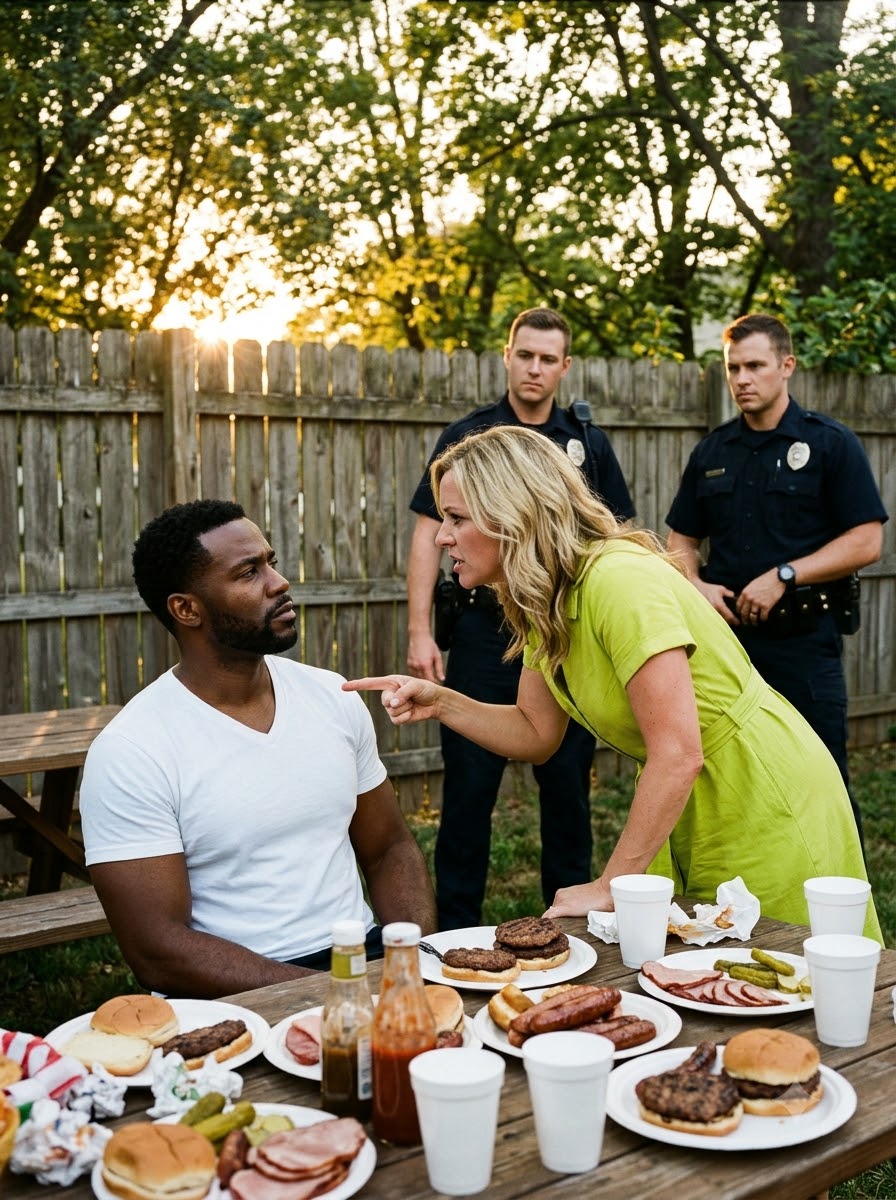
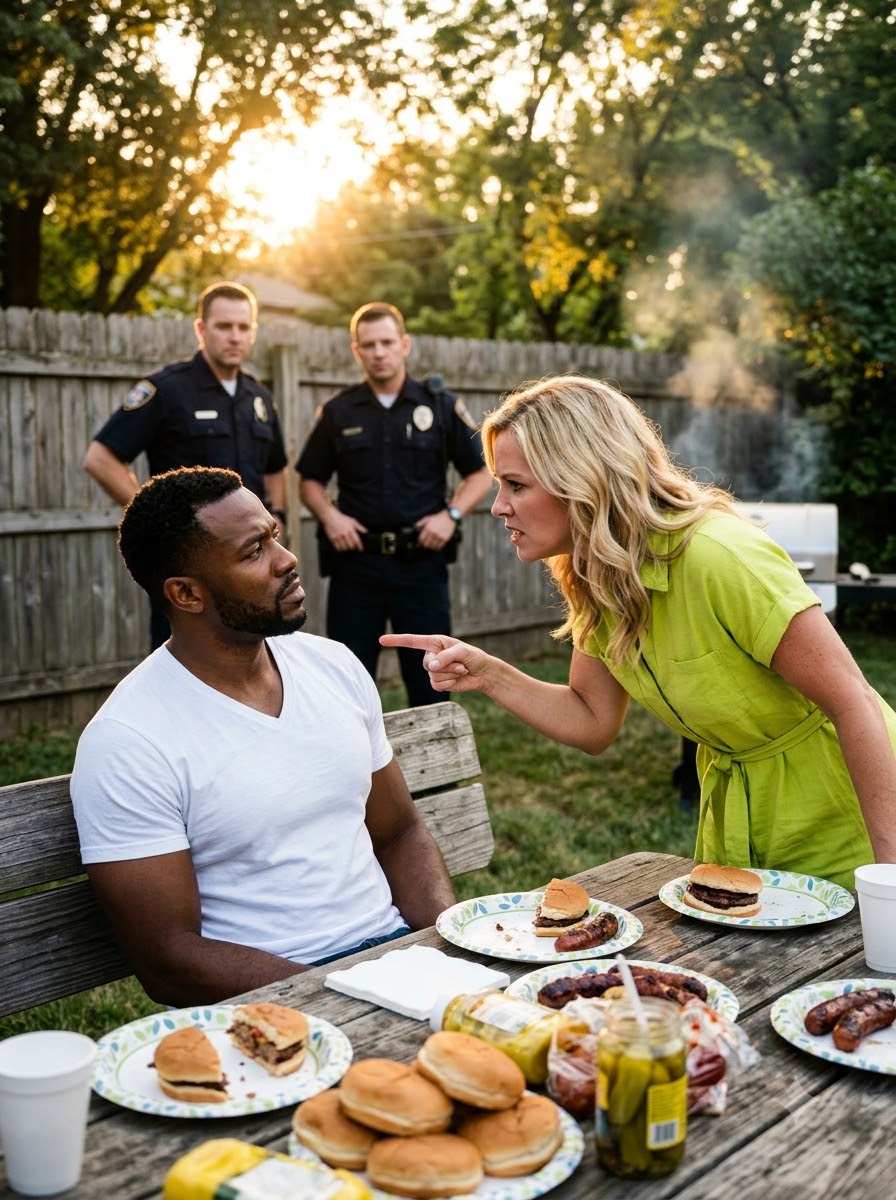
The first thing Patricia Langford told the 911 dispatcher was that four suspicious men had occupied a backyard in Stonebridge Glen. According to her, alcohol was involved, the men were making excessive noise, and one had behaved aggressively when she attempted to question them.
Twice, she suggested drugs might be involved.
She had not seen any drugs.
She also neglected to mention one particularly important detail.
She was standing inside my fenced backyard while making that call.
My name is Marcus Holloway. I was forty-three years old, and I had purchased the house at 742 Meadow Creek Drive just over four months earlier.
That Saturday, I was standing beside my smoker checking a rack of ribs while three of my closest friends argued about Baltimore’s chances of surviving the playoffs.
Terrence Cole was sitting at the patio table, eating potato chips directly from the bag. Darius Bennett was wrestling with a folding chair that refused to lock into place. Nolan Price had appointed himself director of beverages.

Until Patricia walked through my gate, the greatest threat to public safety was Terrence’s opinion about quarterbacks.
“Yes, they’re still here,” Patricia murmured into her phone.
She looked directly at us.
“They keep looking at me.”
Nolan raised an eyebrow.
“You’re standing in his backyard.”
I pointed my barbecue tongs toward him.
“Not one more word.”
Patricia continued speaking as though we weren’t there.
She wore tan slacks, spotless sneakers, and a turquoise polo shirt embroidered with Stonebridge Glen Homeowners Association. Her blond hair was pulled tightly back, and one hand rested on her hip.
Everything about her posture suggested she believed she was supervising employees who had disappointed her.
She acted as though the property belonged to her.
It didn’t.
I had bought that house because I wanted peace.
Most of my adult life had been spent moving between apartments, condominiums, and temporary rentals. There was always somebody stomping overhead, arguing through a wall, or making enough noise to remind me that my home wasn’t entirely mine.
By forty-three, I had finally saved enough for a modest brick house with a garage, a wooden fence, and a maple tree that shaded the patio after three in the afternoon.
It wasn’t extravagant.
The kitchen counters needed replacing. The dishwasher sounded like a helicopter preparing for takeoff.
But every mortgage payment came from my bank account.
And every square foot behind that fence was mine.
My mother had cried when she first visited.
She wandered through the kitchen opening cabinets, looking around as though I had purchased a magnificent estate instead of an ordinary three-bedroom house.
She knew how long I had worked for something permanent.
For me, ownership wasn’t about showing off.
It meant finally having somewhere I could relax.
The barbecue was supposed to be my first proper Saturday enjoying the backyard.
Terrence brought ribs despite knowing I had already purchased ribs, then spent twenty minutes explaining why his were superior.
Darius arrived carrying macaroni salad that obviously came from a grocery store, although he insisted his cousin had prepared it that morning.
Nolan brought a case of beer and announced that providing beverages was an essential form of emotional support.
There was no music.
Nobody was screaming.
No cars blocked the street.
Nobody had parked in front of a neighbor’s driveway.
We were four grown men cooking food and spending time together.
I first noticed Patricia approximately thirty minutes before she entered.
Her house stood two lots behind mine, beyond a drainage path. From my patio, I could see part of her upstairs window over the fence.
The curtain shifted several times.
Then her face appeared briefly behind the glass.
Darius noticed.
“Somebody’s watching us.”
Terrence turned.
“Where?”
“Back house.”
Nolan lifted his bottle.
“Maybe she wants a rib.”
Five minutes later, my side gate opened.
Patricia walked in without knocking, calling out, or asking permission.
She stepped onto the patio, examined the four of us, and focused on the cooler beside Nolan.
“I knew something was going on.”
Those were the first words Patricia Langford ever spoke to me.
I placed my tongs on the grill.
“What exactly did you know?”
She pointed at the cooler.
“I could hear all of you from inside my house.”
Terrence looked toward the fence.
“You can hear us through two fences and almost an acre?”
She snapped toward him.
“I wasn’t speaking to you.”
Terrence looked at me.
I shook my head.
Patricia faced me again.
“Who lives here?”
“I do.”
Her expression changed.
“You?”
“Yes.”
She looked at the house.
“You’re the owner?”
“I’m the person paying the mortgage.”
For several seconds, she stared.
At the time, I assumed she was simply surprised.
Later, I understood something else.
She wasn’t discovering who I was.
She was confirming it.
“You recently moved in.”
“Four months ago.”
She nodded.
“I thought I recognized the name.”
I barely registered that remark.
Instead, Patricia launched into a lecture about HOA regulations.
She discussed guest limits, parking restrictions, noise ordinances, outdoor furniture, and alcohol-related complaints.
She sounded like a prosecutor reading an indictment.
Yet she never asked whether anyone had actually complained.
She simply declared that our gathering violated neighborhood standards.
“I read the bylaws before buying this house,” I told her.
“Then you should know parties require approval.”
“There are three guests.”
“You have alcohol.”
“Yes.”
“Visible from another property.”
“That isn’t prohibited.”
Her lips tightened.
“You’re already being argumentative.”
Darius stood to retrieve his phone from beneath the table.
Patricia immediately stepped backward.
“There.”
Darius froze.
“There what?”
“That behavior.”
He looked at himself.
“I stood up.”
I pointed toward his chair.
“Sit back down, man.”
He sat.
I turned toward Patricia.
“You need to leave.”
Her expression hardened.
“Excuse me?”
“This is private property.”
“I am the president of this association.”
“That doesn’t give you permission to enter my backyard.”
“I’m investigating complaints.”
“Whose complaints?”
“I’m not required to tell you.”
“Then investigate from outside my gate.”
She stared.
“You clearly don’t understand how Stonebridge Glen operates.”
“I understand what private property means.”
That was the end of our conversation.
Patricia pulled out her phone.
“Fine.”
I knew what she intended.
“You’re calling the police?”
“If that’s what I have to do.”
Nolan looked toward the sky.
“Please do.”
I pointed at him.
“Nolan.”
He raised both hands.
“I said nothing.”
Patricia dialed 911.
Within several minutes, sirens approached.
A relaxed barbecue changes very quickly when you realize somebody has described you to the police as dangerous.
The beers went onto the table.
Darius placed his phone where his hands remained visible.
Nobody approached the gate.
Terrence looked at me.
“You handle this.”
“That was already the plan.”
Nolan had stopped smiling.
“What if she says somebody threatened her?”
“Then we tell the truth once.”
Darius nodded.
“And don’t give anybody extra material.”
Exactly.
Two patrol cars stopped in front of my house.
A third arrived shortly afterward.
Officer Walker entered through the side gate first. He looked young enough to be asked for identification at restaurants.
Sergeant Victor Shaw followed him.
Shaw had considerably more experience, and he took a moment to examine the scene before speaking.
Patricia hurried forward.
“Thank God you’re here.”
Shaw lifted a hand.
“Ma’am, stay right there.”
“They threatened me.”
He stopped inside the yard.
His gaze moved over the patio.
Four men.
A smoker.
Food.
A cooler.
Folding chairs.
No weapons.
No broken furniture.
No confrontation.
Then he looked at me.
Recognition crossed his face.
Officer Walker missed it.
Patricia didn’t.
Shaw spoke calmly.
“Sir, is this your home?”
“Yes.”
“You the legal owner?”
“Yes.”
He turned toward Patricia.
“Did you invite Ms. Langford back here?”
“No.”
Patricia interrupted.
“I am HOA president.”
“I understand that,” Shaw replied.
“There was a disturbance.”
“What disturbance?”
“They were yelling.”
Terrence whispered, “Football discussion.”
I glanced at him.
He stopped.
Shaw continued.
“Did anybody threaten you before you entered the yard?”
“The entire situation felt threatening.”
“That isn’t what I asked.”
Patricia folded her arms.
“They were drinking.”
“Adults are allowed to drink alcohol on private property.”
“They were using foul language.”
Shaw looked toward me.
I shrugged.
“Nolan called Pittsburgh trash.”
Nolan pointed at me.
“I said their secondary was trash.”
Walker turned his head, apparently trying not to smile.
Patricia threw her hands upward.
“You see this?”
Shaw inhaled slowly.
“Mr. Holloway, did you ask her to leave?”
“Yes.”
Patricia interrupted again.
“He doesn’t have the authority to remove an HOA representative while she’s investigating a complaint.”
Shaw looked directly at her.
“He owns the property.”
“I represent the community.”
“This backyard is not community property.”
She stared.
Then her eyes narrowed.
“You know him.”
The yard became very quiet.
Shaw remained composed.
“I’ve met Mr. Holloway.”
“There.”
Patricia pointed at me.
“That explains everything.”
“What does it explain?” Shaw asked.
“Why you’re protecting them.”
“I am asking you to leave another person’s fenced property.”
“You’re taking his side.”
“I’m enforcing property rights.”
“They’re intimidating me.”
“What threat did anybody make?”
“They stood up.”
“One man stood up.”
“He moved toward me.”
Darius shook his head.
“I was getting my phone.”
Shaw turned back to Patricia.
“Ma’am, leave the yard.”
Her face flushed.
“You people always cover for one another.”
Nobody answered.
She marched toward the gate.
Before leaving, she looked back at me.
“This isn’t finished.”
Then she slammed it shut.
The officers remained for almost thirty minutes.
They interviewed us separately and documented the scene.
Walker recorded the food, bottles, and furniture, apparently determined to make his report thorough.
Shaw handed me an incident number.
Before leaving, he lowered his voice.
“Save everything.”
I looked at him.
“You think she’s going to keep going?”
He glanced toward the fence.
“She just told you she would.”
He was right.
That evening, I discovered Patricia administered the private Stonebridge Glen Residents Forum.
At 7:48 p.m., she published a post titled:
URGENT COMMUNITY SAFETY WARNING — MEADOW CREEK DRIVE
She included my house number.
According to Patricia, multiple intoxicated men had behaved aggressively.
She mentioned possible gang activity.
Possible narcotics.
Police favoritism.
She claimed she had entered the property in her official capacity and had been surrounded and intimidated.
Reading it, you would have thought she had barely escaped a hostage situation.
The comments appeared immediately.
Thank you for looking out for us, Patricia.
This neighborhood has really changed.
Why were police unwilling to act?
We should demand answers.
One woman commented that she had walked past my property and seen nothing more alarming than men cooking.
Patricia replied:
You were not present during the escalation.
Technically, that was true.
It was also deeply dishonest.
That night, I understood something important about Patricia.
She didn’t necessarily invent entire events.
She rearranged ordinary facts until they appeared sinister.
Standing became aggression.
Beer became intoxication.
Friendship became gang affiliation.
An officer recognizing me became corruption.
I took screenshots.
Every post.
Every response.
Every timestamp.
The following morning, an envelope was taped to my front door.
NOTICE OF COMMUNITY VIOLATION
Three alleged offenses:
Unregistered social event.
Noise disturbance.
Unauthorized recreational items visible from adjacent property.
The recreational items were folding chairs, a cooler, and grilling equipment.
The total fine was three hundred dollars.
Additional penalties would accumulate if the violations continued.
I called Darius.
He arrived an hour later with coffee and a printed copy of the HOA bylaws.
Darius loved paperwork in the disturbing way some people enjoy crossword puzzles.
He sat at my kitchen table and began turning pages.
“First violation is invalid.”
“Why?”
“Registration applies only when outside guests exceed ten.”
“We had three.”
“Exactly.”
He continued.
“Noise enforcement requires either two resident complaints or independent verification after nine p.m.”
“It was before four.”
“Exactly.”
Another page.
“Temporary outdoor furniture in active use is exempt.”
I leaned backward.
“So the whole thing is garbage.”
“Yes.”
Then he stopped smiling.
“But that’s not the point.”
“What is?”
Darius tapped the envelope.
“She’s creating a record.”
“Of false violations.”
“Doesn’t matter at first.”
He leaned forward.
“If enough notices exist, people stop examining each one.”
He tapped the papers again.
“They just see a stack.”
That bothered me because he was right.
I filed a written appeal.
No online argument.
No angry telephone call.
I cited the bylaws, attached photographs, supplied the police incident number, and identified witnesses.
The board acknowledged receiving it.
Four days later, Patricia issued another violation.
Trash container visible from the street.
It had been placed outside during approved collection hours.
Two days afterward came another.
Unauthorized overnight parking.
Terrence’s vehicle had left before midnight.
Parking restrictions didn’t begin until two.
Then she complained about my lawn.
According to Patricia, the grass exceeded the permitted height.
I hired a landscaping company to measure it.
Compliant.
Every allegation eventually fell apart.
But the envelopes kept arriving.
Soon, I felt my shoulders tighten whenever I opened the mailbox.
Cars slowed in front of my house.
Neighbors who had welcomed me became cautious.
A father across the street stopped chatting when I took out the trash.
Then a grocery delivery driver handed me my bags and asked, “Is this the place everybody was talking about online?”
That was when I understood the damage.
Patricia wasn’t merely inconveniencing me.
She was deciding who I was in the minds of people who had never met me.
Then she contacted my employer.
Deputy Chief Renee Dawson called me into her office on a Wednesday afternoon.
She closed the door.
“We received a formal complaint.”
I already knew.
“Patricia Langford?”
Renee looked surprised.
“You expected it?”
“I expected something.”
She handed me the complaint.
Patricia claimed I had used professional connections to avoid arrest during a neighborhood disturbance.
She alleged that I intimidated responding officers by implying there would be consequences if they acted against me.
None of it had happened.
But the department still had to investigate.
I understood the obligation.
I hated it anyway.
I gave Renee everything.
The police report.
Screenshots.
Violation notices.
Appeals.
Witness information.
She studied the documents for several minutes.
“This looks weak.”
“It is.”
“Then why do you look worried?”
I pointed at Patricia’s complaint.
“Because she doesn’t need one accusation to work.”
Renee waited.
“She only needs enough accusations that people stop asking which ones were true.”
Renee nodded.
“Then be better at records than she is.”
That became my plan.
I installed security cameras.
One at the front door.
One covering the driveway.
One at the side gate.
Another overlooking the patio.
None pointed into neighboring windows or beyond my property.
For nearly a week, the recordings showed nothing unusual.
Squirrels.
Delivery trucks.
Wind.
A teenager cutting across the driveway.
Then, on Thursday at 11:37 p.m., my phone vibrated.
BACKYARD MOTION
I opened the live feed.
A man wearing a dark jacket stood beside my new HVAC unit.
He was holding a metal bar.
He swung it.
The first blow dented the housing.
The second cracked a panel.
The third tore something loose.
I ran downstairs.
By coincidence, Terrence, Darius, and Nolan were at my house again. We had been organizing documents for the upcoming HOA hearing.
All four of us reached the patio door.
I opened it.
“Hey!”
The man turned.
The floodlight illuminated part of his face.
Then he ran.
Terrence stepped forward.
I grabbed his arm.
“No.”
“He’s getting away.”
“Let him.”
The intruder reached the fence.
Before climbing over, he pulled a spray can from his jacket.
He painted one word across my siding.
SNITCH
Then he disappeared into the darkness.
Nolan stared at the wall.
For once, nobody made a joke.
Darius called the police.
Terrence paced beside the fence.
I stood near the damaged unit, fighting the urge to touch it.
Nolan looked at me.
“Hands off.”
I turned.
“You telling me how to handle evidence?”
“You currently look like somebody who might punch the air conditioner.”
He had a point.
The damage was serious enough to warrant a felony investigation.
Officers photographed the HVAC unit, spray paint, footprints, tool marks, fence damage, and security footage.
Then our neighbor Joan Mercer supplied something even more useful.
Her doorbell camera had captured a dark SUV entering our street minutes before the vandalism.
The same vehicle departed shortly afterward.
Part of its license plate was visible.
Detective Lena Park took over the investigation.
She asked the obvious question.
“Anybody have a reason to target you?”
“I’ve been fighting with the HOA president.”
“Patricia Langford?”
“You know her?”
“Only by reputation.”
I explained the barbecue, the complaints, the false violations, and Patricia’s warning that the matter wasn’t finished.
Lena took careful notes.
“Do you have evidence she arranged this?”
“No.”
“Then we keep that separate.”
“I know.”
That distinction mattered.
Suspicion wasn’t proof.
Even when suspicion made perfect sense.
Three days later, Nolan called.
“Remember that SUV?”
“Yes.”
“Registered to GreenShield Community Patrol.”
I sat down.
GreenShield was a private neighborhood-security contractor.
“Who was driving?”
“Police are looking at a former employee.”
“Name?”
“Cody Mercer.”
The name stirred a memory.
Then Nolan added something that brought the past rushing back.
“He used to know Eric Langford.”
Patricia’s son.
And suddenly I remembered why Patricia had recognized my name.
Six years earlier, I had worked on a narcotics task force investigating counterfeit prescription pills being distributed throughout the county.
The tablets were sold as oxycodone.
They contained fentanyl.
Several people overdosed.
One of the defendants was Eric Langford.
Patricia’s twenty-eight-year-old son.
He was intelligent, educated, and came from a comfortable family.
He hadn’t organized the operation, but he handled distribution and money.
We built the case through surveillance, messages, controlled purchases, and financial records.
Eric eventually pleaded guilty.
Less than three years into his sentence, he died following complications from a medical condition.
I remembered the sentencing hearing.
A blond woman sitting behind the defense table.
Crying.
Then shouting at prosecutors afterward.
Calling the investigators murderers.
Patricia.
Her first conversation in my backyard suddenly sounded different.
“You’re the owner?”
“I thought I recognized the name.”
She had known who I was.
Perhaps not immediately.
But soon enough.
I sat at my kitchen table, staring at nothing.
Nolan was still on the phone.
“You still there?”
“Yeah.”
“You remember Cody?”
“Not well.”
“He was connected to Eric’s crowd.”
“That sounds right.”
“He cooperated in the old case.”
I closed my eyes.
Of course.
Cody had provided information and received a shorter sentence.
Patricia probably knew that too.
The harassment suddenly had a recognizable motive.
But motive wasn’t evidence.
And the more clearly I understood why Patricia might hate me, the more important it became not to make an accusation I couldn’t prove.
Because I had a feeling the worst part of this wasn’t over.
PART 2
Terrence reacted exactly as I expected when I told him what I remembered.
He stood so abruptly that his chair nearly tipped over.
“She knew exactly who you were.”
“I think so.”
“She targeted you because of Eric.”
“Probably.”
“Stop saying probably.”
Darius interrupted.
“He has to.”
Terrence turned toward him.
“Why?”
“Because belief is not evidence.”
Terrence pointed toward the damaged siding.
“She paid somebody connected to her son to attack Marcus’s house.”
“We don’t know that yet,” Darius replied.
“You honestly think this is coincidence?”
“No.”
Darius leaned back.
“But if Marcus walks across the street and accuses her without proof, what happens?”
Terrence said nothing.
Darius answered.
“She gets exactly the video she needs.”
I nodded.
“That’s why we wait.”
Waiting was miserable.
But waiting didn’t mean doing nothing.
Sometimes patience means refusing to destroy your own case.
The HOA meeting was scheduled two weeks later.
Patricia had encouraged unusually high attendance, claiming she intended to discuss “ongoing threats to neighborhood stability.”
Fifty-six homeowners arrived.
She sat at the front beside four board members.
Pearl earrings.
Navy blazer.
Perfectly arranged documents.
Nothing about her appearance suggested that the situation she had created was beginning to collapse.
The meeting opened with ordinary neighborhood business.
Pool repairs.
Tree trimming.
Security lighting.
Then Patricia reached my address.
“We have experienced repeated disturbances associated with one residence.”
Several heads turned toward me.
I sat in the second row.
Terrence stood beside a wall.
Darius sat near the back.
Nolan remained near the entrance.
Patricia continued.
“Unauthorized gatherings.”
“Police involvement.”
“Repeated confrontations.”
“Possible misuse of professional influence.”
Joan Mercer raised her hand.
“Were any of those HOA violations upheld?”
Patricia paused.
“They remain under review.”
The treasurer looked toward her.
“No.”
Patricia turned.
Three violations had already been dismissed.
Another homeowner asked whether police had issued any citations during the barbecue.
Patricia changed direction.
“I have serious concerns about the responding officers’ neutrality.”
“Why?”
“One of them knew the homeowner.”
There it was again.
I stood.
“My name is Marcus Holloway.”
The room quieted.
“I purchased 742 Meadow Creek Drive this spring.”
I looked around.
“Most of you have heard Patricia’s account of what happened.”
Nobody interrupted.
“She described gang activity.”
I paused.
“Drugs.”
Another pause.
“Threats.”
I placed my laptop on a side table.
“With the board’s permission, I’d like everyone to hear what was actually reported.”
The secretary nodded.
Patricia stood.
“That call should not be played publicly.”
Joan spoke immediately.
“I want to hear it.”
Several homeowners agreed.
The 911 recording began.
Patricia’s voice filled the clubhouse.
Dangerous men.
Possible narcotics.
Alcohol.
Intimidation.
The dispatcher repeatedly asked whether anyone had threatened her.
No.
Weapons?
No.
Physical contact?
No.
Then came the question that changed the room.
Where was Patricia standing?
A long pause.
Finally, her recorded voice answered.
“I entered the backyard because I am association president.”
People turned toward her.
The recording ended.
I placed the responding officers’ report on the table.
“No disturbance observed.”
“No threats reported by independent witnesses.”
“No criminal violation.”
“Caller remained on private property after being asked to leave.”
Silence settled over the clubhouse.
A man near the back asked Patricia, “Why did you tell us you barely got away?”
She folded her arms.
“You were not there.”
Joan answered.
“We just heard you.”
Patricia raised her voice.
“You’re all focusing on technicalities.”
Another homeowner asked, “Entering somebody’s fenced yard is a technicality?”
“I had legitimate safety concerns.”
“Based on what?”
Patricia turned toward me.
“This is bigger than one barbecue.”
I knew where she was going.
“The police already knew him.”
She pointed at me.
“Ask yourselves why.”
At that moment, the clubhouse door opened.
Sergeant Victor Shaw entered.
Behind him were Deputy Chief Renee Dawson and Lieutenant Heather Lewis from Internal Affairs.
Patricia’s expression changed.
Terrence straightened.
Darius glanced toward me.
Nolan closed the door behind them.
Renee addressed the homeowners.
“Ms. Langford filed a formal misconduct complaint alleging that Mr. Holloway used police connections to interfere with neighborhood enforcement.”
Someone whispered, “Police?”
Renee continued.
“Because Detective Holloway authorized limited disclosure after the investigation concluded, I can clarify the relevant facts.”
She looked toward me.
“Marcus Holloway has served with the Redmont Police Department for eighteen years.”
The atmosphere shifted immediately.
Patricia went pale.
Renee gestured toward Terrence.
“Sergeant Terrence Cole.”
Then Darius.
“Detective Darius Bennett, Robbery-Homicide.”
Then Nolan.
“Officer Nolan Price, Cyber Investigations Unit.”
The four supposedly dangerous men from Patricia’s neighborhood warning.
Four Black men enjoying a barbecue.
Four police officers.
Nobody applauded.
Nobody laughed.
Except Patricia.
A sharp, nervous laugh escaped her.
“I knew it.”
She stood.
“I told everyone they were connected.”
She faced the homeowners.
“This proves everything.”
Sergeant Shaw stepped forward.
“No, ma’am.”
“You knew him.”
“I did.”
“You protected him.”
“I told you to leave property that didn’t belong to you.”
“You treated him differently because he was police.”
Shaw’s answer was immediate.
“If Mr. Holloway had worked at a grocery store, the law would still give him the right to remove an uninvited person from his yard.”
Patricia shook her head.
Lieutenant Lewis opened a folder.
“Your complaint stated Detective Holloway identified himself as law enforcement and intimidated responding officers.”
“Yes.”
“He did not.”
Patricia froze.
“The body-camera footage shows Detective Holloway never displayed credentials.”
“He never referenced his rank.”
“He never asked officers for preferential treatment.”
“He never instructed Sergeant Shaw.”
“He never contacted dispatch.”
“He remained on his own patio while patrol officers investigated your complaint.”
Lewis closed the folder.
“Your allegation was unfounded.”
A murmur moved through the room.
Patricia gripped the table.
Then the door opened again.
Detective Lena Park entered.
My stomach tightened.
I hadn’t expected her.
“Mrs. Langford.”
Patricia turned.
Lena stopped several feet away.
“I need to speak with you after this meeting.”
Patricia swallowed.
“About what?”
“The property damage at Mr. Holloway’s home.”
“I had nothing to do with that.”
Nobody spoke.
Lena tilted her head.
“I didn’t say you did.”
Patricia seemed to realize what she’d just revealed.
Too late.
Before anyone could speak, the treasurer stood.
Her name was Carol Atwood.
She carried a thick binder.
“Before we adjourn, there is another issue.”
Patricia turned sharply.
“No.”
Carol addressed the board.
“I reviewed association spending after Patricia requested additional private security authority.”
“This is not on the agenda,” Patricia snapped.
“It concerns association funds.”
Carol opened the binder.
“Two payments were made to GreenShield Community Patrol.”
Detective Park remained motionless.
“The first covered authorized weekend patrols.”
Carol looked toward Patricia.
“The second was eighteen hundred dollars.”
A homeowner asked, “For what?”
Carol lifted a document.
“Emergency community threat assessment.”
Patricia crossed her arms.
“Yes.”
“Where’s the assessment?”
“I haven’t received the final report.”
“Where’s the agreement?”
“Verbal.”
“Board approval?”
“I used executive authority.”
Carol shook her head.
“Anything above seven hundred fifty dollars requires a second board signature.”
Patricia’s face tightened.
“You signed it alone.”
Detective Park stepped forward.
“GreenShield did not conduct an emergency assessment.”
For a moment, Patricia appeared unable to breathe.
Lena continued.
“We identified the individual who damaged Mr. Holloway’s property.”
Nobody moved.
“His name is Cody Mercer.”
Patricia looked down.
“Mr. Mercer previously worked for GreenShield.”
“That proves nothing,” Patricia said.
“Neighborhood cameras place the company vehicle near the residence.”
Lena continued steadily.
“A search warrant recovered clothing consistent with the surveillance footage.”
“Tools consistent with damage to the HVAC housing.”
“Red industrial marking paint consistent with material recovered from the exterior wall.”
Patricia held the table so tightly that her knuckles whitened.
Then Lena said something that silenced the entire room.
“Mr. Mercer is cooperating.”
Patricia whispered, “No.”
Lena opened her folder.
“He preserved messages.”
Patricia began shaking her head.
Lena read several lines.
Only a few.
But they were enough.
He bought a place in your neighborhood.
Another message.
I want him nervous every time he comes home.
Then another.
Make him understand that somebody remembers what he did.
And one sent after the barbecue.
The police are protecting him. We’ll do it another way.
Cody had replied:
You paying extra?
Part of the eighteen hundred dollars had come from the HOA account.
Another payment came directly from Patricia.
Carol looked sick.
“You used association money?”
Patricia said nothing.
The clubhouse erupted.
Homeowners shouted.
Board members argued.
Someone demanded Patricia resign immediately.
Lena raised a hand.
“Everyone stop.”
Gradually, the noise faded.
“No one is being convicted in this room.”
She looked toward Patricia.
“This is an active investigation.”
Even then, that distinction mattered to me.
Even when everything seemed to point in one direction.
Evidence mattered.
Procedure mattered.
A homeowner near the front finally asked the question nobody had raised.
“Why Marcus?”
Patricia looked at me.
For the first time, her expression wasn’t merely that of an angry neighborhood official.
The anger looked older.
Deeper.
Personal.
Lena answered carefully.
“Mrs. Langford had previous knowledge of Detective Holloway.”
Patricia laughed bitterly.
“Tell them.”
I stood.
“Her son was Eric Langford.”
Several residents looked confused.
I continued.
“Six years ago, I worked on a regional narcotics investigation involving counterfeit prescription medication containing fentanyl.”
Patricia’s eyes filled with tears.
“Eric was one of the defendants.”
“You arrested him.”
“Yes.”
“You testified against him.”
“Yes.”
“You sent him to prison.”
“I testified about evidence.”
“He died there.”
My voice softened.
“I know.”
“You didn’t care.”
I looked at her.
And for a moment, I didn’t see the HOA president.
I remembered the mother sitting outside a courtroom six years earlier.
Crying.
Angry.
Looking for someone still alive to blame.
“I was sorry Eric died.”
Her expression twisted.
“You don’t get to say his name.”
“I wish he had made different choices.”
“You destroyed him.”
“No.”
My voice remained quiet.
“Eric made decisions that brought him into that investigation.”
“He called me every week.”
Patricia’s voice trembled.
“He told me prison was killing him.”
Nobody moved.
“He told me you ruined everything.”
I didn’t attempt to retry the old case in front of the neighborhood.
There had been surveillance.
Photographs.
Messages.
Controlled purchases.
Bank transfers.
A guilty plea.
Those facts remained true.
But they didn’t make her son any less dead.
So I said the only thing I could honestly say.
“I wish he were still alive.”
Patricia stared at me.
“You don’t mean that.”
“I do.”
Detective Park intervened.
“Grief does not authorize harassment.”
Patricia turned toward her.
“It does not authorize false reporting.”
“Property damage.”
“Misuse of community funds.”
“Or retaliation.”
Patricia slowly sat down.
Something changed in Stonebridge Glen that evening.
There was no applause.
No dramatic moment when everyone suddenly turned against her.
Instead, people stopped looking toward Patricia for direction.
For seven years, she had controlled the association through absolute certainty.
Which lawn was unacceptable.
Which car didn’t belong.
Which family was disruptive.
Which homeowner deserved another warning.
Her position had allowed behavior many residents privately disliked.
That night, the position stopped protecting her.
Carol Atwood made a motion.
“Effective immediately, Patricia Langford is suspended from all board authority pending independent investigation.”
Another board member seconded.
The vote passed.
Five to one.
Patricia cast the only opposing vote.
The board froze every enforcement action Patricia had initiated without proper approval.
My noise violation.
Parking.
Lawn maintenance.
Outdoor furniture.
Trash containers.
Social gathering.
All withdrawn.
Patricia left before the meeting officially ended.
Detective Park followed her outside.
She wasn’t dragged away in handcuffs.
Later, the internet seemed disappointed by that.
Real investigations are usually less theatrical than people imagine.
Cody Mercer was charged first.
Property damage.
Trespass.
Conspiracy-related offenses.
His attorney negotiated cooperation.
Investigators recovered messages, bank records, and transaction histories.
Then the HOA audit began.
Most of the spending was completely ordinary.
Pool chemicals.
Landscaping.
Insurance.
Clubhouse repairs.
Streetlights.
But the GreenShield payment stood out.
No second signature.
No written work product.
No independent board approval.
Prosecutors eventually charged Patricia with offenses connected to soliciting the vandalism and misusing association funds.
Other allegations remained civil matters.
Her Facebook accusations were not automatically criminal.
Many of her HOA violations represented abuses of authority rather than crimes.
The final plea agreement included probation, restitution, repayment to the association, mandatory counseling, and a no-contact order.
It wasn’t dramatic.
It was proportionate.
Internal Affairs closed my case.
No misconduct.
Terrence, Darius, and Nolan were also reviewed because Patricia continued insisting that our barbecue proved officers had improperly protected one another.
The review established what had actually happened.
Four off-duty men.
Private property.
Lawful alcohol consumption.
No displayed weapons.
No threats.
No use of police authority.
After everything concluded, Renee Dawson called me into her office.
“Shaw told me something funny.”
“What?”
“He said part of him wished you’d just told him you were police.”
I looked at her.
“Why?”
“Might have made the scene faster.”
I shook my head.
“If somebody has to tell responding officers he’s a detective before his property rights matter, that’s a bigger problem.”
Renee smiled slightly.
“That’s exactly what I told him you’d say.”
Then she became serious.
“There’s something else.”
“What?”
“Patricia knew who you were.”
“Yes.”
“But she didn’t know Terrence, Darius, and Nolan were officers.”
“No.”
Renee leaned back.
“So when she told dispatch there was a gang…”
I understood.
“That wasn’t about the old investigation.”
“Not entirely.”
I nodded.
Patricia’s hatred of me explained why she had entered my backyard.
It didn’t fully explain the story she immediately invented about my friends.
Gang members.
Drug users.
Aggressive men.
Four Black men standing beside a barbecue.
Her desire for revenge gave her a motive.
Her assumptions supplied the language.
And that distinction mattered.
Because the more I thought about it, the clearer something became.
The public was fascinated by the fact that Patricia had falsely accused four police officers.
But I was beginning to realize that was the least important part of what had happened.
PART 3
After the HOA meeting, apologies began arriving.
Some neighbors sent letters.
Others knocked on my door.
An astonishing number claimed they had “always had doubts” about Patricia’s accusations.
Their earlier online comments suggested otherwise.
I didn’t argue.
People often become braver after they know who won.
One apology, however, stayed with me.
A neighbor named Frank Wallace visited on a Sunday afternoon.
He had commented beneath Patricia’s original warning:
If people can’t respect Stonebridge standards, maybe they should live somewhere else.
Now he stood on my porch holding his baseball cap in both hands.
“I was wrong.”
I waited.
“I believed her because she sounded confident.”
“That happens.”
Frank shook his head.
“No.”
He looked directly at me.
“That explains it.”
“It doesn’t excuse it.”
I respected that.
“I never met you.”
“No.”
“I didn’t see the barbecue.”
“No.”
“I just decided I knew what happened.”
“Yes.”
He nodded.
“I’m sorry.”
“Thank you.”
That was enough.
Carol Atwood became interim HOA president.
Several weeks later, she arrived carrying a thick folder.
I looked at it suspiciously.
“If this is another lawn citation, I’m selling the house.”
She laughed.
“No citations.”
Inside was a formal apology from the board.
The association reimbursed my appeal costs.
It also adopted new procedures.
Fines required documented support.
No president could issue penalties alone.
Expenditures above seven hundred fifty dollars required two signatures.
Appeals would be reviewed by board members who hadn’t participated in the original complaint.
Carol watched me read.
“Exciting?”
“Painfully boring.”
“That’s what Darius said.”
“He’s right.”
“I hate when lawyers and detectives say governance should be boring.”
“Because they’ve seen what happens when it isn’t.”
She stood.
“You planning another cookout?”
“Eventually.”
“How many guests?”
I pretended to consider it.
“Possibly four.”
Carol shook her head.
“Living dangerously.”
A month later, Terrence, Darius, and Nolan returned.
Same patio.
New HVAC unit.
Fresh paint covering the word SNITCH.
The cameras remained.
The gate had a new lock.
Terrence glanced toward Patricia’s empty house.
“She’s staying with family now?”
“That’s what I heard.”
“Feels strange.”
Nolan opened a beer.
“What does?”
“No curtain moving.”
“You miss having an audience?”
“No.”
Terrence looked around.
“I miss knowing where the crazy is.”
Darius handed me a plate.
“You good?”
I looked toward the maple tree.
Children were riding bicycles beyond the fence.
Somebody was mowing a lawn.
A dog barked twice.
Ordinary suburban sounds.
“Yeah.”
Terrence raised his drink.
“To HOA presidents staying on their side of the fence.”
Nolan lifted his bottle.
“To security cameras.”
Darius groaned.
“You people are terrible at toasts.”
I raised mine.
“To boring Saturdays.”
They stopped.
Terrence nodded.
“That’s the one.”
We drank.
For the first time in months, laughter in my backyard felt harmless again.
I hadn’t realized how much I missed that feeling.
Eventually, the story reached the internet.
Its most popular version was simple:
HOA PRESIDENT CALLS POLICE ON FOUR BLACK “GANG MEMBERS” — FINDS OUT THEY’RE ALL COPS.
People loved the twist.
I hated it.
Not because the headline was inaccurate.
Because it encouraged the wrong conclusion.
Our professions weren’t what made Patricia wrong.
Terrence could have worked construction.
Darius could have been a high school teacher.
Nolan could have driven a city bus.
I could have stocked shelves overnight.
The backyard still would have belonged to me.
The barbecue still would have been lawful.
Patricia still would have entered without permission.
Her accusations still would have been dishonest.
During a television interview, a reporter asked about the moment Patricia learned we were all law enforcement officers.
“What went through your mind?”
I considered the question.
“That people were going to think she just picked the wrong four Black men.”
The reporter paused.
“What do you mean?”
“There wasn’t a correct group of men for her to falsely describe that way.”
I looked toward the camera.
“You don’t earn the right to be treated truthfully because your résumé is impressive.”
The reporter fell silent.
I continued.
“A plumber deserves the same truth.”
“So does a teacher.”
“An unemployed man.”
“A former inmate who already served his sentence.”
“Facts don’t become optional because somebody decides they don’t respect you.”
That interview clip spread even farther than the original story.
Nolan shared it in our group chat.
MARCUS IS A PHILOSOPHER NOW.
Terrence replied:
HE PRACTICED THAT SPEECH FOR THREE DAYS.
Darius added:
IMPOSSIBLE. IT WAS TOO SHORT.
I responded:
ALL THREE OF YOU ARE BANNED FROM MY HOUSE.
Nolan immediately wrote:
DO WE NEED HOA APPROVAL TO APPEAL?
I laughed alone in my kitchen.
And that was when I noticed something.
The house finally felt like mine again.
Still, the fear took longer to disappear than Patricia did.
For months, I monitored myself.
Was the television too loud?
Were we laughing too much?
Had Terrence’s truck stayed too late?
Would somebody see Nolan walking through the gate and invent a story?
Would beer bottles become proof of intoxication?
Would four friends become a gang again?
That’s what harassment does.
Even after the person enforcing unreasonable rules disappears, part of you continues enforcing those rules against yourself.
I had to unlearn that.
One Saturday at a time.
Eventually, I removed the backyard camera.
Terrence noticed immediately.
“Getting reckless?”
“I’m tired of recording myself overcooking chicken.”
“You need documentation.”
“Of what?”
“Culinary misconduct.”
I threw a napkin at him.
The HOA audit concluded several months later.
There was no enormous theft operation.
No secret bank account.
No decades-long corruption scheme.
Patricia had made one major unauthorized payment because she had convinced herself that frightening me was somehow protecting the neighborhood.
That disturbed me more than ordinary theft might have.
She hadn’t believed she was stealing.
She believed she was justified.
And that’s one of the most dangerous things about authority.
Sometimes people violate rules knowing they’re acting dishonestly.
Other times, they become so certain of their own righteousness that rules begin to look like obstacles meant for lesser people.
Patricia had always operated from certainty.
If she believed a lawn was too high, measurements became excuses.
If she believed a teenager looked suspicious, an explanation became attitude.
If she decided I was dangerous, police reports became cover-ups.
If she believed I had destroyed her family, hurting me became justice.
Every contradictory fact became evidence that the conspiracy was larger.
Police found no crime.
Favoritism.
Violations dismissed.
Board corruption.
Internal Affairs cleared me.
Cover-up.
Cameras captured Cody.
Setup.
Cody cooperated.
Betrayal.
There was no information she could accept if accepting it required admitting that her original conclusion might have been wrong.
That was why her first words in my backyard stayed with me.
“I knew something was going on.”
She had barely arrived.
She hadn’t asked a question.
She hadn’t learned anything.
But she already knew.
That was the problem.
Almost a year later, a younger officer named Eric Sloan asked about the incident during a training lunch.
“Would you have handled the backyard differently if you weren’t police?”
I looked at him.
“How?”
“More angry.”
“I was furious.”
“You didn’t look furious on body camera.”
“That isn’t the same thing.”
He waited.
“I knew the worst thing I could do was give Patricia one real moment to attach to a hundred fake ones.”
Eric nodded.
“That sucks.”
“Yes.”
I smiled.
“Outstanding police vocabulary.”
He laughed.
Then I became serious.
“The bigger issue is that ordinary people shouldn’t need eighteen years of experience to understand how to survive a false accusation.”
He looked at me.
“What do you mean?”
“I knew to save the original post.”
“I knew to preserve the 911 call.”
“I knew not to touch the vandalism evidence.”
“I knew how to appeal records.”
“I knew when not to talk.”
I pushed my lunch aside.
“Most people don’t.”
That stayed with him.
And with me.
I had advantages once the system became involved.
Not because the call hadn’t hurt me.
It had.
Not because the rumors disappeared.
They didn’t.
But I understood procedures.
Many people enter bureaucratic systems without that knowledge.
They throw away ridiculous letters.
Delete messages.
Miss appeal deadlines.
Don’t realize they can request records.
Don’t know they should preserve video footage.
Their inability to navigate paperwork doesn’t make them wrong.
It makes proving they’re right more difficult.
Eventually, Stonebridge Glen returned to normal.
Residents argued about trees.
Mailbox colors.
Parking.
Pool hours.
Somebody accused Carol of wasting association funds on mulch.
I loved every ridiculous minute of it.
Ordinary neighborhood disagreements felt luxurious after Patricia had transformed the association into a personal weapon.
Meetings became slow.
Boring.
Occasionally irritating.
Exactly what homeowner meetings should be.
One year after the original barbecue, the four of us gathered on my patio again.
Almost the same weekend.
Terrence brought ribs.
Darius arrived with food he once again claimed somebody’s aunt had prepared.
Nolan opened a beer.
Then he looked at me.
“You know what today is?”
I shook my head.
He smiled.
“One year.”
I looked around.
Then remembered.
Terrence raised his spatula.
“To the gang.”
Darius pointed at him.
“Absolutely not.”
Nolan burst out laughing.
I said, “If that ends up online, I’m denying I know you.”
Terrence lowered the spatula.
“Fine.”
Darius lifted his drink.
“To everybody staying in their own backyard.”
I raised mine.
“That works.”
Nobody photographed the moment.
Nobody recorded it.
Nobody needed to.
Patricia eventually sold her house.
A retired couple named Ray and Susan Dalton bought it.
When I first met them, Ray looked uncomfortable.
“We heard a little about the previous owner.”
“I figured.”
“I hope there aren’t hard feelings about us moving into her place.”
I laughed.
“You didn’t call the police on my barbecue.”
Susan smiled.
“We’re very quiet.”
“Be as loud as you want.”
She looked toward my patio.
“We heard you cook.”
“That rumor is true.”
A month later, they came over for ribs.
No emergency calls.
No neighborhood alerts.
No police.
Just neighbors sharing dinner.
That ordinary evening meant more to me than anything that ever went viral.
Years later, I still occasionally thought about Eric Langford.
Not because I doubted the investigation.
I didn’t.
The evidence had been strong.
He had pleaded guilty with legal representation.
But Patricia reminded me that the consequences of prosecution don’t stop with defendants.
Parents live with them.
Children.
Spouses.
Brothers.
People who never touched the drugs.
Police work requires us to distinguish responsibility from suffering.
Eric committed crimes.
Patricia lost a son.
Her grief was real.
Her revenge was wrong.
Both things could be true.
Understanding how somebody became cruel doesn’t mean accepting the cruelty.
Patricia wasn’t a cartoon villain.
She was a grieving mother who made terrible decisions.
A neighborhood leader who confused authority with ownership.
A woman who convinced herself that because her pain was legitimate, everything she did in its name must also be legitimate.
That made the story more uncomfortable.
And more useful.
Monsters don’t teach us much.
Ordinary people who convince themselves they’re entitled to hurt others can teach us considerably more.
Patricia’s worst decision wasn’t paying Cody.
That happened later.
Her first terrible decision was concluding that facts about me no longer mattered.
Once she reached that point, everything else became easy.
I was dangerous.
Therefore my barbecue must be dangerous.
My friends looked threatening.
Therefore their movements were aggression.
Police disagreed.
Therefore police were corrupt.
The HOA rejected her violations.
Therefore the association had been compromised.
Her reasoning always began with the conclusion.
Evidence came afterward.
Several years after buying the house, I replaced my original smoker.
Terrence objected.
“That grill is historic.”
“That grill is rust.”
“It survived Patricia.”
“It also burned six racks of ribs.”
Darius examined the bottom.
“This thing is structurally unsafe.”
Nolan looked at me.
“Call the HOA.”
I laughed so loudly that somebody three houses away probably heard me.
Nobody complained.
That sound became one of my favorite things about the house.
Four grown men laughing too loudly in a backyard.
Because once, I had learned to fear that sound.
Now I refused to.
One evening, I sat alone beneath the maple tree.
No friends.
No barbecue.
No case files.
Just a cup of coffee.
The siding Cody had spray-painted had been completely replaced.
For a while, I considered leaving a faint mark.
Something to remember what had happened.
Eventually, I decided against it.
Not every wound needs a monument.
Sometimes repair is allowed to look like repair.
The neighborhood was quiet.
A sprinkler clicked nearby.
Somebody’s dog barked.
A car door closed.
I thought about Patricia’s original emergency call.
She had stood inside my backyard and described me as the threat.
Over time, that detail became more significant than anything else.
A person had crossed somebody else’s boundary and then convinced herself that the rightful owner was the intruder.
That pattern extends far beyond homeowners associations.
Managers.
Supervisors.
Police officers.
Executives.
Board presidents.
Anybody with authority can begin confusing the power to make decisions with the power to define reality.
Those aren’t the same thing.
A title can give your decisions weight.
It cannot make your assumptions true.
That was the lesson Stonebridge Glen eventually learned.
Perhaps my department learned something too.
The next time I saw Sergeant Victor Shaw outside work, we were attending a retirement dinner.
He shook my hand.
“Still having those dangerous cookouts?”
“Every chance I get.”
He smiled.
“You keep the cameras?”
“Front and side.”
“Good.”
I looked at him.
“You were right.”
“About what?”
“Saving everything.”
Victor nodded.
“That lesson cost me a few headaches too.”
I waited.
He smiled.
“Another story.”
Fair enough.
Stonebridge Glen eventually became exactly what I had wanted when I bought my house.
Boring.
Children rode bicycles through the cul-de-sac.
Ray gave away tomatoes every summer.
Susan baked too much bread.
Carol complained about association dues even though she helped establish them.
Terrence continued believing he was a barbecue expert.
Darius still brought supermarket food and lied about its origins.
Nolan continued making jokes at precisely the wrong moments.
Life moved forward.
The dramatic events became smaller with every passing year.
That was the real victory.
Not Patricia’s plea agreement.
Not the board vote.
Not Internal Affairs clearing my name.
Not even discovering why she had hated me.
The victory was reaching a Saturday when my friends could walk through my gate carrying food and nobody thought about the police.
We didn’t watch the fence.
Nobody lowered his voice.
Nobody wondered how a beer bottle might appear from another window.
Nobody worried that standing too quickly could become somebody else’s evidence.
We simply sat together.
Four Black men in a backyard.
Not suspects.
Not detectives.
Not gang members.
Not a viral headline.
Friends.
And one of us happened to own the house.
That should have been enough from the very beginning.
