

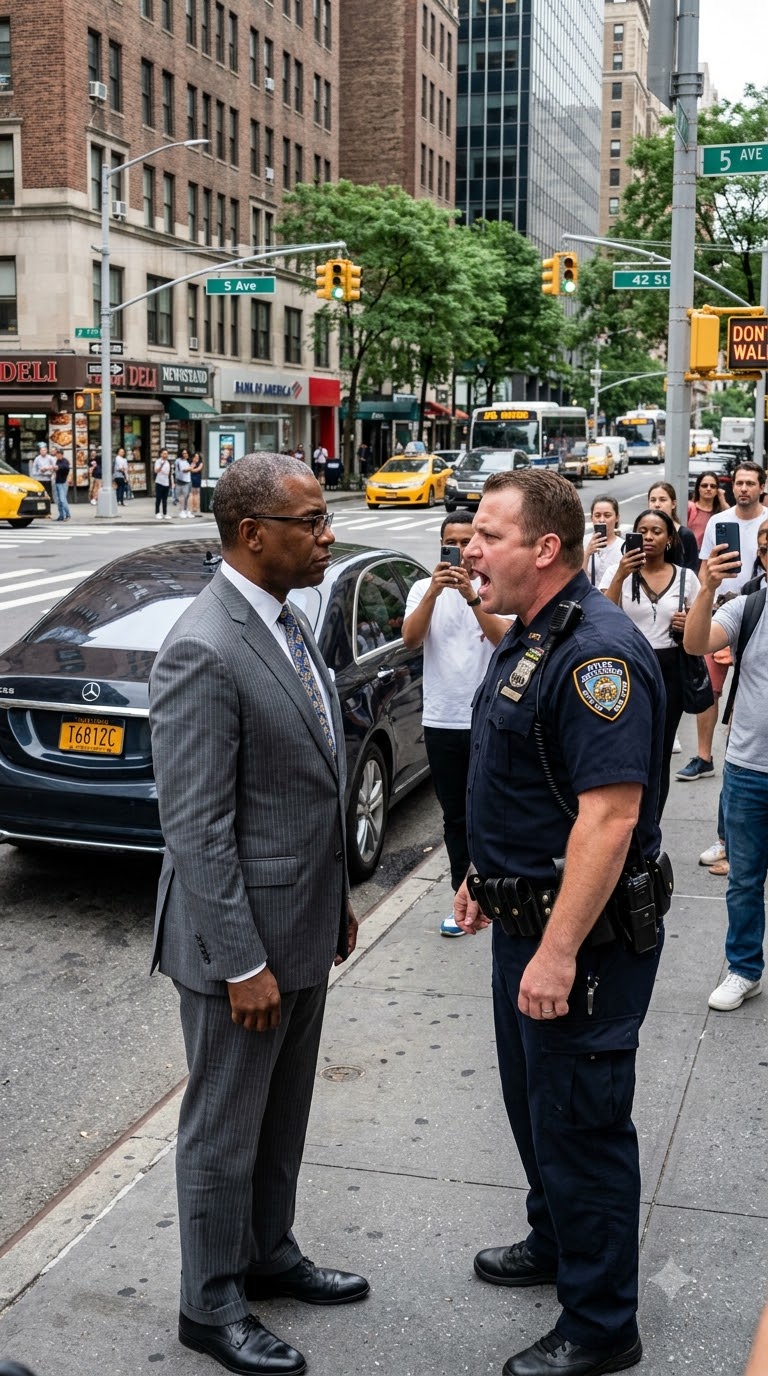
Officer Travis Harlan had worn a Brookhaven police badge for sixteen years, long enough to forget there had once been a difference between authority and ownership. On Jefferson Avenue, people recognized his cruiser before they recognized him. Store clerks lowered their voices when Unit 22 slowed outside their windows, teenagers suddenly remembered somewhere else they needed to be, and delivery drivers checked their paperwork twice if his headlights appeared behind them.
Harlan called that respect.
The neighborhood had another word for it.
On one bright Tuesday morning, Harlan finally stopped the one man who would make that difference impossible to ignore.
The sound of the slap traveled farther than anyone expected.
It cracked against the brick storefronts at Jefferson and Sixth, sharp enough that a woman pushing a stroller froze beside the curb and a city bus braked too early. A pair of eyeglasses skidded across the sidewalk, one lens breaking near a storm drain while a paper coffee cup rolled into the gutter.
The man Harlan had struck stood beside a black Mercedes sedan.
He wore a charcoal suit, crisp white shirt, muted navy tie, and polished brown shoes. A line of blood appeared at the corner of his mouth while a red handprint slowly formed across his dark brown cheek. He did not raise his fists, shout, or give Harlan the reaction the officer seemed to be waiting for.
Instead, the man pulled a folded handkerchief from his pocket.
He touched it to his lip.
Then looked directly at Harlan’s nameplate.
“Officer Travis Harlan,” he said calmly. “Badge 2741.”
Harlan smiled.
He thought the man was trying to intimidate him.
Over the years, Harlan had stopped plenty of Black men wearing expensive watches and tailored suits. Attorneys. Executives. College professors. Consultants who believed careful language and professional clothes could protect them from the fact that Harlan controlled what happened next.
He liked teaching those men otherwise.
What Travis Harlan did not know was that the man standing in front of him was Dr. Isaiah Bennett.
And in less than twenty minutes, Isaiah Bennett was scheduled to walk into Brookhaven Police Headquarters and be introduced as the city’s new chief of police.
Forty minutes earlier, Isaiah had been standing in front of the bathroom mirror in room 1218 of the Wellington Hotel.
He adjusted his tie once.
Then again.
The second adjustment had nothing to do with the tie.
From the window behind him, downtown Brookhaven was waking beneath clear morning light. Old churches sat between glass towers, construction cranes hung over new condominiums, and the streets below carried the familiar mix of buses, delivery trucks, office workers, and people who had been here long before developers decided their neighborhoods were valuable.
Brookhaven liked to talk about renewal.
Isaiah had been hired because the city needed something deeper than that.
On the hotel desk sat a leather transition binder, a new credential wallet, and a framed photograph of Isaiah’s father outside a small barbershop in Augusta. His father was smiling in the picture, wearing a white short-sleeve shirt with one hand wrapped around a broom handle.
Isaiah picked up the photograph.
His father had died eight years earlier.
He had never worn a badge.
But he understood authority.
“Son,” he used to say, “the minute a man enjoys making people afraid of him, he has already lost control of himself.”
Isaiah remembered that sentence often.
That morning, it would matter more than he knew.
Isaiah Bennett was fifty-two years old and had spent almost three decades in law enforcement. He began as a patrol officer, completed a master’s degree at night, moved into command, and eventually earned a doctorate in criminal justice administration after twenty years of work.
He had helped rebuild departments damaged by corruption scandals.
He had worked under federal consent decrees.
He had fired officers everyone said were untouchable.
Brookhaven had not recruited him because its department was healthy.
The city had reached the point where denial had become more expensive than reform.
Civil lawsuits were stacking up.
Body-camera failures had become regular news stories.
Community meetings ended with residents shouting questions that department leaders answered with phrases like ongoing review and personnel matter.
The same stories kept appearing.
Different residents.
Different streets.
Same patterns.
Isaiah had spent most of the previous night reading complaint files.
One name appeared more often than any other.
Travis Harlan.
Thirteen civilian complaints in less than a year.
Thirty uses of force over three years.
Three civil settlements.
Two teenagers injured during stops that began as minor encounters and somehow ended with reports accusing them of sudden aggression.
Supervisors described Harlan as old school.
Firm.
Proactive.
Fearless.
Isaiah knew institutional language well enough to translate.
Old school often meant resistant to oversight.
Firm sometimes meant unnecessarily aggressive.
Proactive could mean looking for reasons.
Fearless sometimes meant enjoying power.
Isaiah closed the personnel file at 1:13 that morning.
Less than eight hours later, he would meet the man behind it.
He just had no idea it would happen on a sidewalk.
At 8:05, Isaiah left the hotel.
The city had arranged a driver.
The driver had called in sick.
Isaiah could have requested another vehicle, but instead he took the Mercedes assigned to him during the transition period.
He wanted fifteen quiet minutes before the official introduction.
No mayor.
No television cameras.
No union president smiling through obvious suspicion.
Just Brookhaven before Brookhaven knew who was looking.
Soft jazz played from the speakers as Isaiah turned onto Jefferson Avenue.
At the same time, Officer Harlan sat inside Unit 22 outside Delaney’s Bakery, drinking coffee and staring at morning traffic.
He was bored.
Bored officers did not always create problems.
Harlan did.
Dispatch crackled through the radio.
“Unit 22, reminder. New chief arrival scheduled this morning. Central units maintain standard visibility.”
Harlan rolled his eyes.
“Copy.”
He had heard enough about the new chief.
Outside hire.
Doctor.
Reform guy.
Another polished administrator with a binder full of buzzwords like transparency, trust, and culture.
Harlan had survived chiefs before.
He had survived task forces.
Community review boards.
Mandatory training.
One mayor who announced accountability in front of cameras and then privately told command staff to keep officers happy.
Men like Harlan became confident because institutions taught them that storms passed.
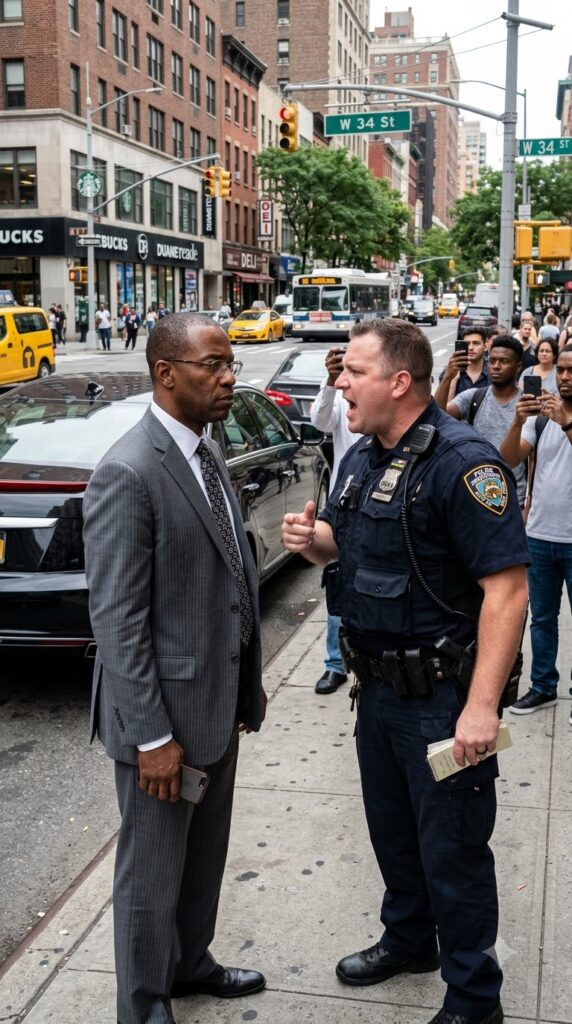
Then Harlan saw the black Mercedes move slightly left of center to avoid a pothole.
For maybe two seconds.
No danger.
No traffic nearby.
No real reason to stop the vehicle.
But Harlan was already reaching for the lights.
Isaiah saw the patrol cruiser behind him.
Red and blue filled the mirror.
He breathed slowly once.
Then looked ahead for a safe place to pull over.
He knew traffic-stop procedure better than almost anyone in the department he was about to lead.
Hands visible.
Window down.
Announce movements.
Do not surprise the officer.
But Isaiah also knew something no training manual could fully capture.
He had spent fifty-two years being Black in America.
He understood that knowing the law did not guarantee surviving someone else’s ego long enough to use it.
Isaiah pulled over beside Torres Floral & Repair because the storefront had cameras facing the street.
That choice was intentional.
Visible place.
Public sidewalk.
Businesses nearby.
Witnesses.
Inside the flower shop, Rosa Delgado looked through the front window.
Her stomach tightened the moment she recognized Harlan’s cruiser.
Six months earlier, Harlan had stopped her seventeen-year-old nephew, Mateo, on the same block. He claimed Mateo matched the description of someone who had stolen electronics.
No description ever appeared in the report.
Mateo had been carrying new phone chargers from a supplier.
Harlan shoved him face-first against the brick wall before checking the receipt.
Rosa had filed a complaint.
She provided photographs of the bruises.
The receipt.
Two witnesses.
The complaint came back unfounded.
Mateo still crossed Jefferson Avenue whenever he saw Unit 22.
Across the street, a neighborhood livestreamer named Jordan Ellis was recording his morning walk.
Jordan’s channel mostly covered ordinary Brookhaven life.
Food trucks.
Street musicians.
Potholes.
Community meetings.
Local arguments that became funny three days later.
His camera had been pointed toward a mural when he noticed Harlan approaching the Mercedes.
Jordan turned.
“Officer Harlan,” he murmured to his viewers.
Then added, “Let’s stay here a minute.”
Harlan reached the driver’s window.
“License and registration.”
Isaiah kept both hands on the steering wheel.
“Good morning, Officer. May I ask why I was stopped?”
“I said license and registration.”
“I heard you.”
Isaiah kept his tone even.
“I’m asking for the reason for the stop.”
Harlan leaned closer.
“You crossed the center line.”
“I moved around a pothole.”
“Step out.”
Isaiah paused.
He could have argued.
Instead, he opened the door slowly.
“I’m exiting the vehicle now.”
He said it clearly.
Not dramatically.
For the record.
Harlan noticed.
People who narrated their own movements usually knew something about procedure.
He did not like that.
Isaiah stood beside the Mercedes.
Hands visible.
Harlan looked at the car.
Then Isaiah’s watch.
Then his suit.
Then his face.
“Nice ride.”
“Thank you.”
“What do you do?”
“I work in public safety.”
Harlan laughed.
“That what they call it now?”
Isaiah said nothing.
Harlan looked around and noticed Rosa standing outside the flower shop with her phone raised.
Jordan remained across the street recording.
A few commuters had slowed.
An elderly bookstore owner named Evelyn Grant stepped into her doorway.
Evelyn was seventy-six and had owned Grant Books since the late 1980s.
She had seen Harlan stop delivery workers.
Teenagers.
Homeless men.
Church members.
Professionals coming home late.
Once she watched him force a retired teacher against a wall because the man asked why his grandson was being questioned.
She complained twice.
Nobody returned either call.
Now she folded her arms and watched.
Harlan pointed toward the Mercedes.
“License.”
Isaiah spoke carefully.
“My wallet is inside my left jacket pocket.”
“Hands on the hood.”
“Am I being detained for anything beyond the traffic stop?”
“You nervous?”
“No.”
“You’re talking a lot.”
“I’m asking questions.”
Harlan’s jaw tightened.
There it was.
The moment Isaiah recognized immediately.
The investigation had ended.
The power contest had begun.
Harlan grabbed Isaiah’s shoulder.
He shoved him toward the brick wall.
Phones rose.
Jordan spoke into his livestream.
“He just pushed the driver into the wall. Driver has not threatened him. Driver is complying.”
Harlan began patting Isaiah down roughly.
Isaiah did not move.
“Officer Harlan, I do not consent to a search of my person beyond a lawful weapons frisk.”
“Didn’t ask.”
Harlan moved toward the Mercedes.
He opened the driver’s door.
Isaiah’s voice sharpened slightly.
“I do not consent to a vehicle search.”
Harlan reached across the seat.
“Then you’ve got nothing to worry about.”
“That is not how consent works.”
Harlan grabbed the leather briefcase resting on the passenger seat.
He pulled it out.
Opened it.
Then dumped the contents across the sidewalk.
Documents slid over the concrete.
Transition memos.
A folder labeled First 100 Days.
A sealed letter from the mayor.
Personnel charts.
A small framed photograph of Isaiah’s father.
The credential wallet remained inside Isaiah’s jacket.
Harlan looked down at the documents.
Then nudged the binder with his shoe.
“Big important man, huh?”
Isaiah stared at him.
Rosa stepped closer.
“Leave his stuff alone.”
Harlan pointed.
“Back up.”
“You can’t just dump somebody’s property on the sidewalk.”
“Stay out of police business.”
Evelyn lifted her phone higher.
“What police business?”
Harlan turned.
She continued.
“He moved around a hole in the street.”
“Ma’am—”
“You people still haven’t fixed the hole.”
A few bystanders laughed.
Harlan’s face reddened.
Jordan called from across the street.
“It’s live, Officer.”
That changed the air.
Harlan looked toward him.
“How many times do I have to tell people to back up?”
Jordan remained where he was.
“I’m on a public sidewalk.”
Harlan turned back toward Isaiah.
He finally removed the driver’s license from Isaiah’s wallet.
“Isaiah Bennett.”
He looked at the card.
“Doctor?”
“Yes.”
“What kind?”
“Criminal justice leadership.”
Harlan smirked.
“So not a real doctor.”
A murmur moved through the crowd.
Isaiah gave him nothing.
“Officer Harlan, badge 2741, I am requesting a supervisor.”
Harlan’s eyes narrowed.
“Don’t say my badge number like you know me.”
“I am identifying the officer conducting the stop.”
“You think that suit makes you important?”
“No.”
“The Mercedes?”
“No.”
“You think talking like some lawyer keeps me from putting you in your place?”
Silence.
Several people heard exactly what he had said.
Rosa whispered, “There it is.”
Isaiah turned slightly so Jordan’s camera had a clear angle.
“I am unarmed. I have complied. Officer Harlan has searched my vehicle without consent and is refusing my request for supervisory review.”
Harlan took one step forward.
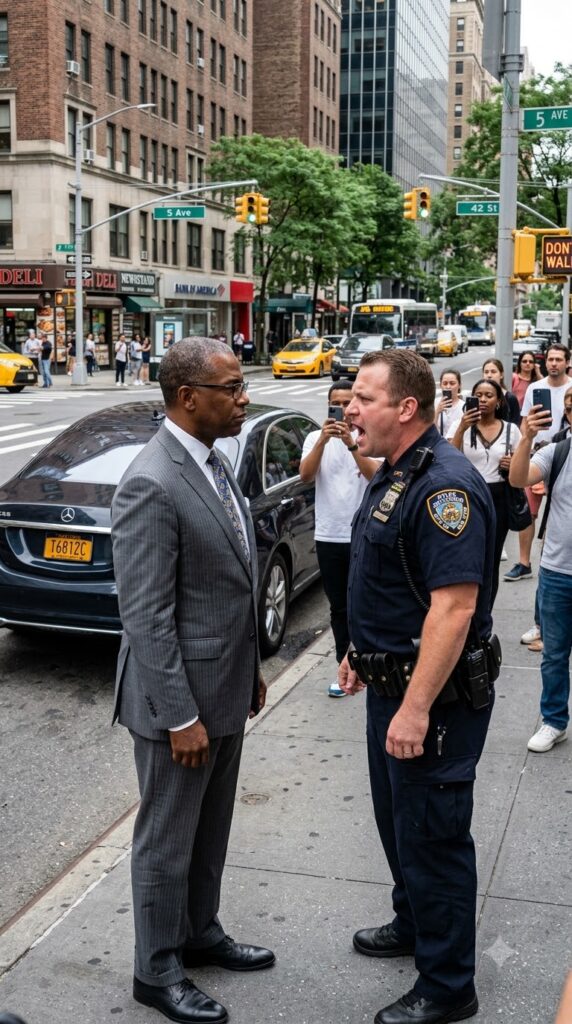
Then slapped him.
Isaiah’s glasses flew from his face.
The left temple piece snapped when they hit the pavement.
For a second, nobody on Jefferson Avenue moved.
Blood appeared near Isaiah’s mouth.
The shape of Harlan’s hand began rising on his cheek.
Harlan stepped backward.
“Maybe now you understand respect.”
Isaiah picked up his handkerchief.
Pressed it to his lip.
Then looked directly toward the phones.
“Officer Travis Harlan struck me without provocation at approximately 8:39 a.m.”
Harlan’s expression changed.
Not much.
But enough.
Isaiah continued.
“Multiple independent witnesses are recording.”
Jordan looked at his screen.
His livestream had jumped from fewer than three thousand viewers to nearly twenty thousand.
Comments raced past.
HE HIT HIM.
DRIVER DID NOTHING.
BADGE 2741.
CALL A SUPERVISOR.
Rosa shouted, “I got the whole thing.”
Evelyn stepped from the bookstore doorway.
She walked toward Harlan slowly.
“I’ve watched you do this for years.”
“Ma’am, back up.”
“No.”
People murmured.
Evelyn raised her phone.
“You shoved Rosa’s nephew into that wall.”
Harlan pointed toward her.
“Back away.”
“You threw Mr. Park’s delivery boxes into the street.”
“Last warning.”
“You put Reverend Daniels against a patrol car because he asked why you were questioning his grandson.”
“Ma’am.”
Evelyn lifted her chin.
“No, Travis.”
The street went still.
“You step back.”
Something moved through the crowd.
Not cheering.
Recognition.
For years, everyone had been separating their experiences.
Their complaint.
Their stop.
Their bruise.
Their humiliation.
Now an old woman had connected them out loud.
Harlan reached for his handcuffs.
“Turn around,” he told Isaiah.
“For what offense?”
“Disorderly conduct.”
“I have not been disorderly.”
“Obstruction.”
“I have not obstructed.”
“Resisting.”
“I have not resisted.”
Harlan stepped closer.
“You want another lesson?”
Isaiah looked at him for a long moment.
Then slowly lifted his left hand.
Harlan’s hand moved toward his weapon.
“Don’t reach.”
Isaiah stopped immediately.
“My official credentials are inside my jacket pocket.”
Harlan frowned.
“What credentials?”
Isaiah looked directly into his eyes.
“The ones for the job I am supposed to begin in approximately seventeen minutes.”
The crowd quieted.
Isaiah removed the wallet with two fingers.
He opened it.
The gold shield caught the morning sunlight.
Dr. Isaiah Bennett
Chief of Police
Brookhaven Police Department
Travis Harlan stopped breathing normally.
The change in his face was immediate.
His eyes went from the badge to Isaiah’s bleeding lip.
Then to the red handprint.
Then to the phones.
Then back to the badge.
Jordan stared at his screen.
“Wait.”
He stepped closer.
“The guy Harlan just hit is Brookhaven’s new police chief.”
Rosa covered her mouth.
Evelyn looked at Harlan.
There was no satisfaction in her expression.
Only exhaustion.
Harlan stepped backward.
“Chief, I—”
Isaiah closed the credential wallet.
“Do not call me Chief as though the word changes what happened thirty seconds ago.”
“Sir, I didn’t know.”
“That is the problem.”
“No, I mean if I knew you were—”
“A person with authority?”
Harlan swallowed.
“That’s not what I meant.”
Isaiah stepped closer.
His voice stayed quiet.
“If knowing my title would have changed how you treated me, then you already understood your behavior was wrong before you knew who I was.”
Harlan opened his mouth.
Nothing came out.
There was no answer that could help him.
Isaiah reached toward Harlan’s shoulder radio.
The officer did not stop him.
“Dispatch, this is Chief Isaiah Bennett at Jefferson and Sixth.”
Silence crackled back.
Then a woman’s voice.
“Repeat?”
“Chief Isaiah Bennett. I need a patrol supervisor, Internal Affairs representative, and medical unit to Jefferson and Sixth immediately.”
Another pause.
Isaiah looked toward Harlan.
“Officer Travis Harlan, badge 2741, is relieved from field duty pending investigation for excessive force, unlawful search, and possible civil-rights violations.”
The dispatcher sounded stunned.
“Chief Bennett, confirming Officer Harlan?”
“Confirmed.”
A murmur moved through the crowd.
Isaiah handed the radio back.
“My first command briefing will be delayed.”
Harlan looked around.
The corner he had controlled for years no longer belonged to him.
His report would not be the only record.
His body camera would not be the only evidence.
His memory would not outrank Rosa’s phone, Jordan’s livestream, Evelyn’s notes, and twenty strangers recording from different angles.
Within minutes, Lieutenant Natalie Park arrived.
She stepped from her cruiser.
Saw Isaiah.
Saw his face.
Saw Harlan.
Saw the documents scattered on the sidewalk.
Her expression changed.
“Chief Bennett.”
“Lieutenant.”
“What happened?”
“You will preserve the scene first.”
She nodded.
“Understood.”
“Officer Harlan’s body camera appears inactive.”
Park looked sharply toward Harlan.
Isaiah continued.
“Secure his weapon, radio, cuffs, badge, body camera, cruiser camera, and duty phone.”
Harlan looked at her.
“Natalie.”
She did not answer.
“Come on.”
Park stepped toward him.
“Remove your duty belt.”
His face hardened.
“You know me.”
“Yes.”
“Then you know this is getting blown out of proportion.”
Park looked at Isaiah’s cheek.
Then at the broken glasses.
Then at the documents on the ground.
“Remove the belt.”
That sentence told the block more than any speech could have.
Harlan no longer controlled what another officer was allowed to see.
Slowly, he removed his equipment.
Gun.
Radio.
Cuffs.
Taser.
Badge.
Each item went into an evidence container.
No one applauded.
Isaiah noticed that.
He appreciated it.
This was not entertainment.
It was accountability.
Rosa approached after Harlan was placed in the back seat of another cruiser.
“My nephew filed a complaint about him.”
Isaiah looked at her.
“Name?”
“Mateo Delgado.”
“When?”
“Six months ago.”
“Do you have the complaint number?”
“I have everything.”
“Good.”
Rosa looked at him uncertainly.
“They told us they reviewed it.”
Isaiah picked up his broken glasses.
“I didn’t ask what they told you.”
Her eyes filled.
“I’m going to read it.”
Evelyn came next.
She carried an old notebook.
Isaiah looked at it.
“What’s that?”
“Dates.”
She held it toward him.
“Stops I saw. Names when I knew them. Times. What Harlan said.”
Isaiah opened the first page.
Years of handwritten entries.
“You kept all this?”
“I got tired of calling people who never called back.”
He looked at her.
“So you wrote it down.”
“I figured one day somebody might decide it mattered.”
Isaiah closed the notebook carefully.
“It matters.”
Evelyn nodded once.
“Good.”
She placed it in his hands.
“I’m tired of carrying it.”
By noon, Jordan’s livestream had spread across Brookhaven.
By three, regional news stations were running the footage.
By evening, national outlets had picked it up.
Someone online called the incident The Jefferson Avenue Slap.
Isaiah hated the phrase immediately.
It made everything sound like one outrageous moment.
He knew better.
The slap was only the moment the camera caught clearly.
The story began years earlier.
That evening, Isaiah held his first press conference as Brookhaven police chief.
There was a small bandage near his mouth.
His cheek was still swollen.
Behind him stood Mayor Caroline Webb, Lieutenant Park, Rosa Delgado, Evelyn Grant, Jordan Ellis, and several Jefferson Avenue residents.
That lineup was deliberate.
Isaiah did not want police brass filling the background.
The department had spent too long speaking only to itself.
He stepped to the microphone.
“This morning, before I entered Brookhaven Police Headquarters as chief, I experienced conduct that residents of this city have described for years.”
Cameras clicked.
“I was stopped on weak grounds.”
Pause.
“Searched without consent.”
Another.
“Verbally degraded.”
His jaw tightened.
“Struck while compliant.”
The room became quiet.
“The difference between my experience and many before mine is not that I deserved better.”
Rosa looked down.
Isaiah continued.
“The difference is that I had credentials in my pocket Officer Harlan did not expect.”
He looked directly into the cameras.
“That should disturb every person in Brookhaven.”
A reporter raised his hand.
Isaiah continued before taking questions.
“Rights do not become stronger when the citizen has an important title.”
The mayor shifted behind him.
Isaiah did not look back.
“Effective immediately, every complaint involving Officer Travis Harlan will be reopened.”
A murmur moved across the press room.
“Every use-of-force report associated with Officer Harlan over the past six years will receive external review.”
He continued.
“Every unexplained body-camera deactivation in the department will be audited.”
Another pause.
“And no complaint will be classified as unfounded without documented contact with available civilian witnesses.”
The police union president watching from the back folded his arms.
Isaiah saw him.
“Officers who serve honestly have nothing to fear from accurate records.”
His eyes moved across the room.
“Anyone who fears accurate records should ask why.”
Three weeks later, federal civil-rights investigators arrived in Brookhaven.
Special Agent Tasha Reynolds walked into Isaiah’s office carrying three boxes.
She placed the first on his conference table.
“We have thirty-four potential victims.”
Isaiah looked at her.
“Thirty-four?”
“Connected directly to Harlan.”
She opened a folder.
“Twenty-four Black.”
Another.
“Six Latino.”
Another.
“Three Asian.”
She paused.
“One white homeless veteran.”
Isaiah turned pages.
Photographs.
Bruised wrists.
Split lips.
Scraped knees.
Broken glasses.
A teenage boy with swelling around one eye.
A delivery driver with bloody palms.
A sixty-three-year-old pastor standing beside a dented car.
His own face had become national news because he was the chief.
These people had disappeared into complaint files.
That fact troubled Isaiah more deeply than being slapped.
Tasha pointed toward several reports.
“Same sequence repeats.”
“Explain.”
“Minor stop.”
She counted on her fingers.
“Citizen questions basis.”
“Harlan describes attitude change.”
“Body camera unavailable or deactivated.”
“Force used.”
“Report describes sudden noncompliance.”
Isaiah closed one file.
“Supervisory review?”
“Approved almost every time.”
“Same supervisors?”
“Mostly two.”
Isaiah already knew their names before she said them.
That mattered.
Bad officers rarely survive sixteen years on personality alone.
Somebody signs the forms.
Somebody ignores the timestamps.
Somebody calls the bruises unfortunate.
The federal investigation widened.
Internal Affairs reopened files residents had been told were closed forever.
Witnesses listed in old complaints said nobody had ever contacted them.
Body-camera logs showed gaps beginning seconds before several uses of force.
Supervisors had copied identical language between reports.
In one case, the same grammatical error appeared in three separate investigations two years apart.
Isaiah stared at those pages.
The department had not simply failed to catch Harlan.
Parts of it had learned how to protect him.
Mateo Delgado testified before federal investigators.
He was eighteen now.
Tall.
Quiet.
He sat beside his aunt Rosa.
“When he stopped me, I kept telling him I had a receipt.”
Tasha asked, “Did he review the receipt before using force?”
“No.”
“What happened?”
Mateo rubbed his palms together.
“He told me boys like me only learn once.”
Isaiah remained still.
“Then?”
“He put my face against the wall.”
Rosa looked away.
Mateo continued.
“My aunt filed the complaint.”
“What happened with it?”
“They said there wasn’t enough evidence.”
His voice tightened.
“There were two witnesses.”
Tasha nodded.
“Were either interviewed?”
“No.”
Mateo looked toward Isaiah.
“Nothing happened until he hit you.”
The room became quiet.
Isaiah would remember that sentence longer than he remembered Harlan’s hand.
Nothing happened until he hit you.
There was the indictment of the entire old system.
Justice had arrived.
But only after harm accidentally reached somebody with enough power to make ignoring it expensive.
Evelyn Grant became one of the investigation’s strongest witnesses.
Her notebook covered almost five years.
Dates.
Times.
Weather.
Names.
Vehicle descriptions.
Statements.
The defense attorney later tried to suggest she might be confused because of her age.
Evelyn looked at him over her glasses.
“You think I forgot Officer Harlan because I’m seventy-six?”
The lawyer shifted.
“I am simply asking about reliability.”
“Son, I remember every bully I’ve ever met.”
A few people in the courtroom smiled.
Evelyn continued.
“Officer Harlan made himself easy to remember.”
The judge hid a smile behind one hand.
Harlan’s attorney argued that the Jefferson Avenue slap represented a single lapse in judgment.
Federal prosecutors disagreed.
Assistant U.S. Attorney Marissa Cole stood before the jury.
“One recorded strike did not create this case.”
She looked toward Harlan.
“It exposed it.”
The screen behind her showed complaint numbers.
Years.
Names.
“Officer Harlan repeatedly used public authority against citizens he believed would not be believed.”
She paused.
“The tragedy is not that he eventually struck the police chief.”
Isaiah listened from the gallery.
“The tragedy is how many people he harmed before that happened.”
Harlan eventually accepted a plea agreement after two former supervisors agreed to cooperate with prosecutors.
He pleaded guilty to federal civil-rights violations, falsification of reports, and obstruction tied to prior complaints.
He received prison time.
Permanent law-enforcement decertification.
Restitution requirements.
Loss of a significant portion of his pension under state disciplinary proceedings.
When the sentence was announced, reporters asked Isaiah whether he felt vindicated.
“No.”
The answer surprised them.
One reporter asked why.
Isaiah said, “Prison tells us what happened to one officer.”
He paused.
“Reform tells us whether we learned anything.”
Brookhaven adopted new accountability rules within four months.
Every use of force required review by someone outside the officer’s immediate chain of command.
Unexplained body-camera shutdowns triggered automatic investigation.
Civilian complaints went first to an independent office instead of disappearing directly into department hierarchy.
Repeat complaints generated mandatory intervention even when individual allegations remained disputed.
Supervisors could be disciplined for knowingly approving incomplete investigations.
Some officers hated it.
A handful resigned.
Others complained anonymously that Isaiah was destroying morale.
He saved the messages.
Not because they hurt him.
Because private complaints revealed culture more honestly than official statements.
One officer wrote that Brookhaven was becoming “a department where criminals have more rights than cops.”
Isaiah printed that message.
He used it in supervisor training.
“Every person has rights,” he told them.
“If that sentence threatens your understanding of policing, we found the training need.”
Body-camera compliance climbed.
Civilian complaints initially increased.
The mayor worried.
Isaiah did not.
“People complain when they think somebody might listen.”
Six months later, complaints began decreasing.
Not because reporting became harder.
Because stops changed.
Isaiah returned to Jefferson and Sixth one Saturday morning.
The corner looked ordinary.
That was the best part.
A bus hissed beside the curb.
People carried coffee.
Delaney’s Bakery had a line stretching almost to the door.
Rosa arranged tulips inside her shop.
Near the spot where Isaiah’s glasses had broken, the city installed a small bronze marker.
He had opposed the idea.
The neighborhood insisted.
The marker read:
JEFFERSON & SIXTH
Where Witness Became Accountability
Rosa came outside.
“Mateo got accepted.”
Isaiah smiled.
“To college?”
“Justice studies.”
“Good.”
“He wants to become a public defender.”
Isaiah nodded.
Rosa laughed.
“I thought the police chief would try recruiting him.”
“I want him wherever his conscience tells him he belongs.”
Rosa looked toward the marker.
“For months after Harlan hurt him, Mateo wouldn’t walk this block.”
Isaiah watched a teenager pass them carrying headphones.
“What changed?”
“He saw Harlan lose the badge.”
Rosa paused.
“Then he saw somebody finally believe us.”
Evelyn arrived carrying a paper bag.
“I brought blueberry muffins.”
Isaiah smiled.
“Good morning.”
She pointed at him.
“If this turns into one of those emotional community moments, I’m taking my muffins home.”
Jordan arrived a few minutes later.
He carried a camera but kept it lowered.
His livestream had changed his career.
He now produced documentary pieces on neighborhood policing.
People often called him brave.
Jordan always corrected them.
“I held a phone.”
He said it again that morning.
“Rosa carried this for six months. Evelyn carried it for years. Mateo carried it on his face.”
Lieutenant Park joined them in uniform.
She now commanded Professional Standards.
She held a printed report.
“Quarterly numbers.”
Isaiah sighed.
“Today?”
“You hired me.”
“Unfortunately.”
She smiled.
“Civilian complaints down twenty-eight percent.”
Isaiah nodded.
“Body-camera compliance?”
“Ninety-eight.”
“Use of force?”
“Down nineteen.”
Evelyn opened the muffin bag.
“What were y’all doing before?”
Natalie Park looked at her.
“Protecting ourselves too much.”
Evelyn nodded.
“See? That wasn’t hard to say.”
No one argued.
Later that month, Isaiah spoke to a class at the Brookhaven Police Academy.
Rows of recruits sat in pressed uniforms.
New badges.
Clean boots.
Confident faces.
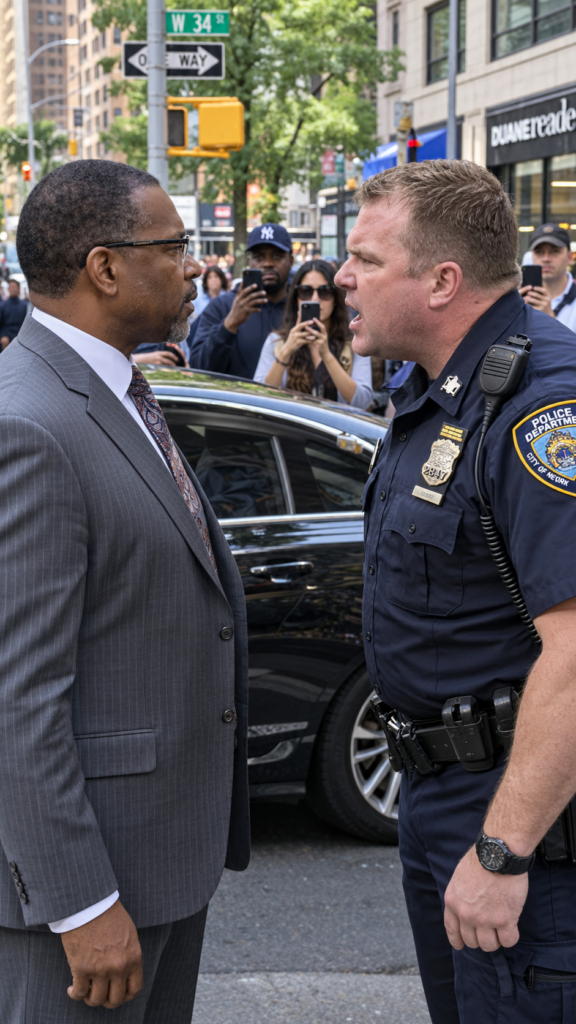
On the screen behind Isaiah was a frozen image from Jordan’s livestream.
Harlan’s hand was halfway through the slap.
Isaiah’s glasses were already leaving his face.
The crowd watched from behind them.
Isaiah said nothing for ten seconds.
Let them look.
Then he spoke.
“This image is not here to embarrass your department.”
He walked slowly across the classroom.
“It is here because departments sometimes need embarrassment before they become honest.”
Nobody moved.
“Officer Harlan believed he was alone with his authority.”
Isaiah pointed toward the screen.
“He was not.”
He looked at the recruits.
“Witnesses were there.”
“History was there.”
“Every complaint nobody bothered to take seriously was there.”
Isaiah stopped.
“Some of you will be given obedience before you earn wisdom.”
A few recruits shifted.
“You will carry weapons before you fully understand restraint.”
He continued.
“People will insult you.”
“Question you.”
“Lie to you.”
“Challenge you.”
“Sometimes they will make you afraid.”
Isaiah looked at the screen again.
“What you do with that feeling is the difference between public service and personal power.”
A recruit raised her hand.
“What happened to Harlan?”
“He went to prison.”
Another recruit asked, “Do you forgive him?”
Isaiah paused.
People asked him that constantly.
“I don’t build policy around forgiveness.”
The recruit waited.
“I build it around preventing the next person from needing mine.”
The room stayed quiet.
Good.
Years later, people still told the story as if it were perfect instant karma.
A racist officer stopped a Black man in an expensive car.
The officer humiliated him.
Slapped him.
Then discovered the man was his new police chief.
The officer lost everything.
People loved that version.
It had irony.
Justice.
A clean reversal of power.
Isaiah always thought it missed the most important part.
He told people about Rosa.
About Mateo.
About Evelyn’s notebook.
About Jordan leaving the camera running.
About Natalie Park choosing the investigation over protecting an officer simply because they wore the same uniform.
He told them about thirty-four names inside federal evidence boxes.
The slap became famous because Isaiah had a chief’s credential in his pocket.
The hidden pattern mattered more.
Cruelty almost never begins on the day everybody notices it.
It begins smaller.
A search someone cannot justify.
A complaint nobody returns.
A camera that happens to be off.
A report written so confidently that witnesses begin questioning their own memory.
A supervisor signing at the bottom.
Again.
Again.
Again.
Until the institution stops treating repetition as evidence and starts calling every new case isolated.
Harlan’s mistake was not that he hit the wrong man.
There is no correct citizen to slap for asking a lawful question.
His mistake was believing the people he had hurt before were too ordinary to matter.
Isaiah kept his broken glasses in a small cardboard box inside his office.
He never framed them.
Never displayed them.
Most employees did not know they were there.
But occasionally a policy meeting would drift into vague language.
Unfortunate event.
Perception problem.
Breakdown in communication.
Isolated incident.
Isaiah would open the drawer.
Take out the glasses.
Place them on the table.
Conversations became more accurate after that.
Objects have a way of defeating euphemisms.
On the third anniversary of Jefferson and Sixth, Mateo Delgado stood beside the bronze marker wearing a suit of his own.
He was leaving for law school the following week.
Rosa cried openly.
Then denied crying.
Evelyn complained that everybody was getting sentimental and hugged Mateo longer than anyone else.
Jordan recorded a short video for the family.
No livestream.
No audience.
Isaiah stood nearby.
Older now.
A little more gray around the temples.
Mateo looked toward the marker.
“I still hate that it took him hitting you.”
Isaiah nodded.
“So do I.”
“But something changed.”
“Yes.”
Mateo looked toward him.
“How do we keep it from changing back?”
Isaiah glanced across Jefferson Avenue.
A patrol officer was talking with a delivery driver beside the bakery.
No hands near weapons.
No raised voices.
Just a conversation.
“We keep records,” Isaiah said.
Mateo listened.
“We believe patterns before they become scandals.”
He looked toward Evelyn.
“We listen to people before they become evidence.”
Then toward Rosa.
“And we stop teaching citizens that dignity is something they have to prove.”
Traffic continued behind them.
A bus stopped.
The bakery door opened.
Somebody laughed near the flower shop.
Brookhaven moved around the place where history had once stopped for the sound of one open hand striking a man’s face.
The city remembered the slap.
But Isaiah made sure the department remembered what came before it.
The complaints.
The silence.
The fear.
The years when Harlan believed the street belonged to him because nobody had successfully told him otherwise.
That was the truth Isaiah carried into every graduation class and command meeting that followed.
A badge gives an officer legal authority.
It does not give ownership.
It does not make humiliation a police tactic.
It does not turn prejudice into probable cause.
And it does not make fear the same thing as respect.
Because one day, Isaiah told every recruit, you may find yourself standing in front of someone you believe has no influence, no title, no lawyer, and nobody important watching.
That is the moment your character matters most.
Not after cameras arrive.
Not after the chief arrives.
Not after consequences appear.
Before.
When all you know is that another human being is standing in front of you and trusting the badge on your chest to mean something better than power.
That trust, Isaiah told them, is the job.
Everything else is equipment.
