

PART 2
Dad pulled out his pocketknife, cut through the strap, and freed the child.
“He was trembling,” Dad recalled. “He wrapped his arms around my neck and wouldn’t let go.”
Dad took off his uniform jacket, wrapped Michael in it, and carried him through the snow.
A farmer’s son photographed them.
By the following morning, their picture had appeared in newspapers across America.
People called Dad a hero.
He despised the attention.
“Every photograph of me reminded me that Ruth wasn’t there to see another morning,” he explained.
Unfortunately, the rescue wasn’t the end of the story.
Two weeks later, investigators and airline representatives began questioning his decisions.
Why had he chosen that particular field?
Why hadn’t he reached Toledo?
Could the crash have been prevented?
Some newspapers that had praised him suddenly began suggesting pilot error.
Dad became the target of harsh speculation.
“The fuel supplier was powerful,” he said. “I was just a young first officer. Blaming me was easier.”
What hurt him most was Ruth’s mother.
She attended the investigation hearings and sat in the front row, staring at him without saying a word.
Dad believed she blamed him for her daughter’s death.
Fourteen months passed before investigators established the full cause.
Fuel contamination had affected multiple aircraft.
Their final report completely cleared Dad and confirmed that he had made the right decisions under the circumstances.
Northline offered him his position back.
They even offered him a promotion to captain.
“But I couldn’t return,” Dad admitted.
He tried.
He put on his uniform, walked through the airport, and sat inside the cockpit.
Then his hands began trembling.
He couldn’t breathe.
Every time he closed his eyes, he saw Ruth.
So he left aviation behind forever.
He returned to school and became a teacher.
The following year, he met Mom, who taught English at the same high school.
She was the only person who knew the whole story.
“She told me I didn’t have to carry it alone,” he said.
“Then why didn’t you tell Beth and me?”
Dad’s eyes filled with tears.
“Because I didn’t want you growing up with a newspaper headline for a father. I wanted to be the man who helped with homework, took you camping, and made pancakes on Sundays.”
He reached for my hand.
“I just wanted to be your dad.”
“You were,” I whispered. “You always were.”
He explained that a year after the investigation, the survivors organized a gathering.
They commissioned a pair of silver wings engraved with the number 417.
Michael, who was ten at the time, presented them to Dad.
“He said something I’ve never forgotten,” Dad recalled. “He told me that because I’d carried him out of the plane, he wanted to carry the wings to me.”
Dad had treasured them ever since.
Michael continued writing for years.
Christmas cards. School reports. News about flight training.
Eventually, he became a professional pilot himself.
Dad even attended his graduation, although he sat at the back and left before Michael could see him.
“I wasn’t brave enough to face those memories,” Dad admitted.
Eventually, he stopped responding.
After several more years, Michael’s letters stopped arriving.
I was still trying to process everything when the captain’s voice came through the aircraft speakers.
“Good afternoon, everyone. We’re about forty minutes from Columbus. The weather looks excellent, and we expect a smooth arrival.”
There was a pause.
“Before we begin our descent, I’d like to share something personal.”
Dad stiffened.
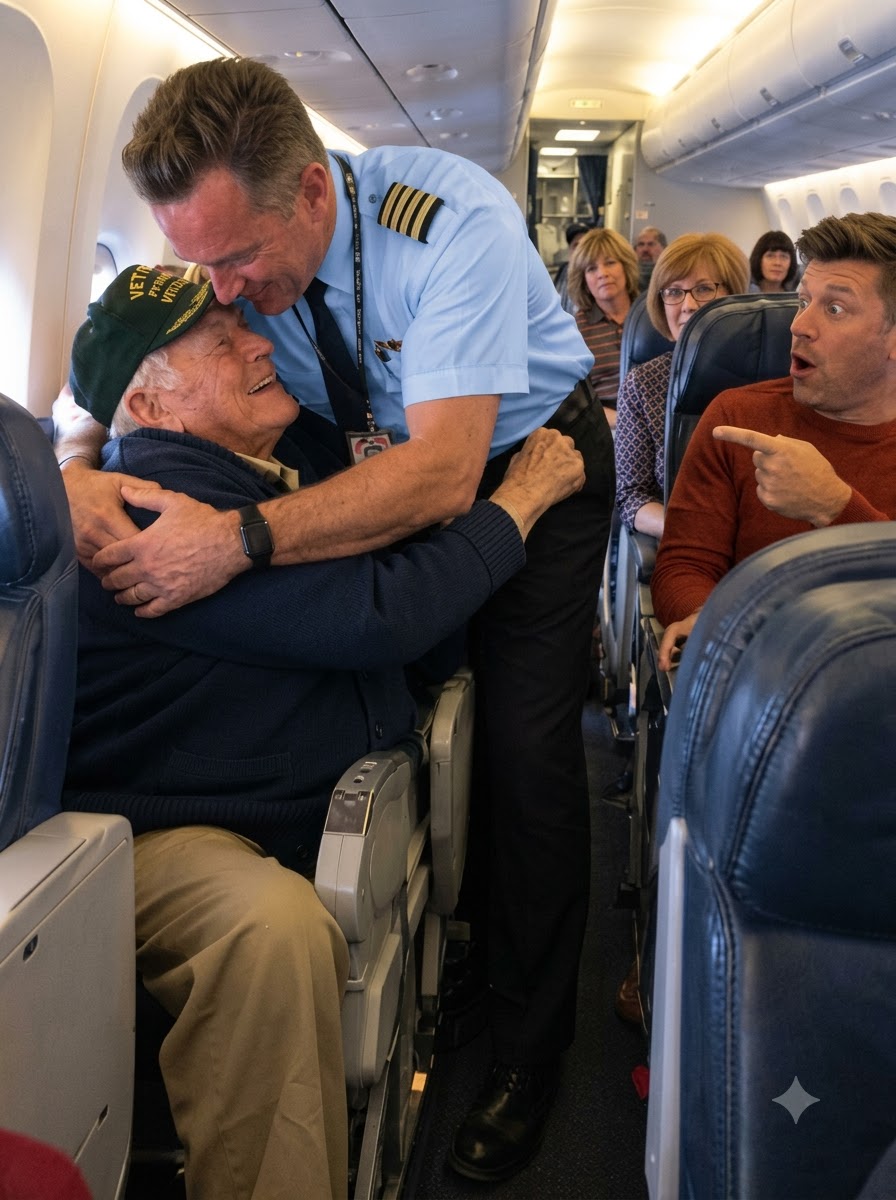
“Nearly fifty years ago, I was a nine-year-old boy aboard an aircraft that crashed during a snowstorm. Both engines failed, and the captain suffered a fatal heart attack.”
The cabin fell silent.
“A young first officer managed to bring that aircraft down in a snowy field. Fifty-two people survived. I was one of them.”
Dad tightened his grip on my hand.
“Two remarkable people didn’t survive that night: Captain Frank Dorsey and flight attendant Ruth Ellison. I want to honor them today.”
Dad closed his eyes.
Tears trickled down his cheeks.
“That first officer carried me out of the smoke. Because of him, I grew up. Because of him, I became a pilot. He’s aboard this flight today, but I won’t identify him. He never wanted recognition.”
Michael paused.
“He simply wanted people to get home safely. Today, I’ll do everything I can to bring you home, just as he once brought me home.”
The announcement ended.
For several seconds, nobody moved.
Then applause filled the cabin.
Dad’s lips trembled.
I leaned closer and heard him whispering two names.
“Frank. Ruth. Frank. Ruth.”
About ten minutes later, someone approached our row.
It was the businessman in the gray suit.
His expression had completely changed.
His tie was loosened, and his eyes were red.
“Sir,” he said quietly. “Could I speak to you?”
I wanted to tell him to go away.
But Dad nodded.
The man crouched beside our seats.
“My name is Grant Whitaker. And I owe you an apology.”
He struggled to continue.
“My mother is Carol Whitaker. In January 1977, she was seven months pregnant. She was on Flight 417.”
Dad froze.
“She was sitting in seat 6C,” Grant continued. “She told me that story my entire life.”
He explained that when the aircraft crashed, Carol struggled to stand because of her pregnancy.
Smoke surrounded her.
She believed she and her unborn baby were going to die.
Then a young pilot appeared.
He helped her escape and promised they were going home.
Dad whispered, “Blue coat.”
Grant stared at him.
“What?”
“Your mother. She was wearing a blue coat. She kept saying she was worried about her baby.”
Grant covered his mouth.
“Yes,” he whispered. “That was her.”
He explained that he had been born six weeks after the crash.
Throughout his childhood, his mother kept the famous newspaper photograph hanging in their hallway.
She often told him that the pilot in the picture had saved both their lives.
“She tried finding you,” Grant said. “She contacted the airline and newspapers. Nobody could tell her where you’d gone.”
“I didn’t want anyone to find me,” Dad replied.
Grant nodded.
“When I saw your silver wings and recognized the number, I searched for the photograph. Then I realized who you were.”
He took a shaky breath.
“And I remembered what I did this morning.”
He looked Dad directly in the eyes.
“I shoved the man who saved my mother’s life. The man who made my life possible. I mocked you because I was impatient about a business meeting.”
Tears streamed down his face.
“I don’t know how to apologize for something like that.”
Dad waited until Grant had finished speaking.
Then he gently placed a hand on the man’s shoulder.
“You didn’t know who I was, son.”
“But that’s no excuse.”
“No,” Dad agreed. “It isn’t.”
He paused.
“That’s exactly the lesson.”
Grant looked confused.
“You didn’t know my story. And you don’t know the story of anyone else around you. That mother holding her baby, the exhausted traveler at the back, the young woman checking tickets. Every one of them has experienced things you cannot imagine.”
Grant lowered his head.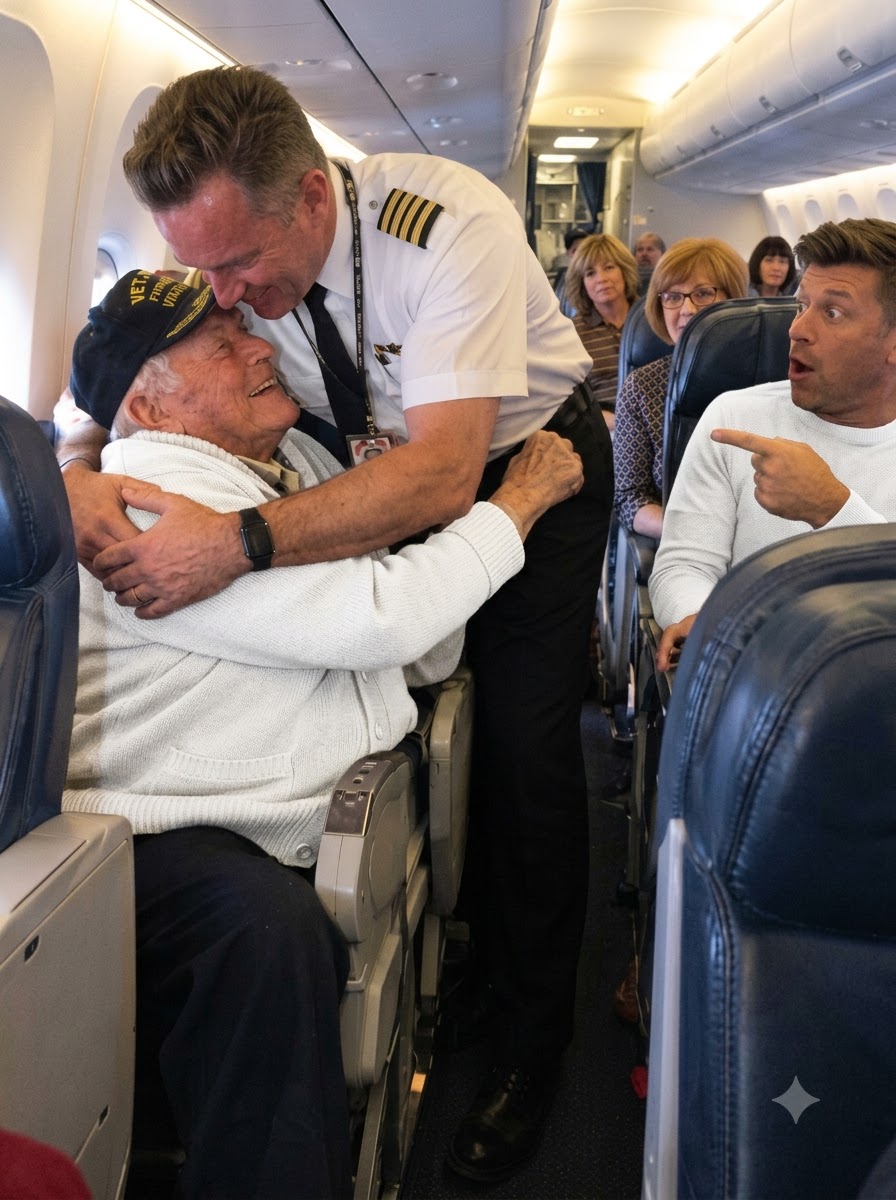
Dad continued.
“You shouldn’t treat people kindly because they might turn out to be important. You should treat them kindly because they already are important. Every person matters.”
Grant nodded through his tears.
“I won’t forget that.”
“I believe you,” Dad replied.
Then Grant asked if he could contact his mother.
“She never stopped hoping she’d find you.”
Dad looked at me. I squeezed his hand.
“Tell her I’m glad she and her little boy made it home.”
Grant immediately sent a message.
A reply arrived moments later.
He read it, then turned his phone toward Dad.
Is it really him? Please tell him I named you after him.
Dad blinked.
“Named you after me?”
Grant smiled through his tears.
“My middle name is Walter. I never liked it growing up. Mom only told me it belonged to someone special.”
Dad covered his face.
I held him as he cried.
Shortly afterward, a flight attendant asked Grant to return to his seat for landing.
Before leaving, he thanked Dad once more.
“For my mother’s life,” he whispered. “And for mine.”
The aircraft landed smoothly.
Dad watched the runway through the window, paying attention to every movement like someone who still understood them all.
“Beautiful landing,” he murmured.
“That boy has become quite a pilot.”
When the passengers began disembarking, Dad remained in his seat.
Michael had invited us into the cockpit.
But Dad looked frightened.
“I don’t know whether I can do it, Lauren.”
“Why?”
“The last time I entered a cockpit, I couldn’t stay.”
I took his hand.
“Then this time, I won’t let you go alone.”
We waited until the cabin had emptied.
At the front, Michael stood beside the open cockpit door.
His first officer greeted Dad respectfully.
“Captain Reyes has told me about you many times, Mr. Hayes.”
Dad blushed.
Michael offered him the copilot’s seat.
Dad stared at it.
The controls were modern, nothing like the ones he’d operated decades earlier.
Still, his eyes moved across the instruments with familiar understanding.
His hands trembled as he approached.
Finally, he lowered himself into the seat.
I stood in the doorway.
For almost a minute, he remained silent.
Then he gently touched the controls.
“I always thought sitting here again would bring everything back,” he whispered.
Michael sat beside him.
“Does it?”
Dad closed his eyes.
For several seconds, the only sound was his breathing.
Then he opened them.
“No,” he said softly. “This time, I see a field full of people walking home.”
Michael reached into his pocket.
He pulled out a tiny pair of plastic wings.
They were faded, chipped, and almost completely worn away.
“Ruth gave me these when I boarded Flight 417,” he explained. “I was holding them when you found me trapped under the seat.”
He placed them beside Dad’s silver wings.
“I’ve carried them on every flight I’ve flown for thirty-one years.”
Dad stared at them.
Michael’s voice trembled.
“I wanted you to have them. Because Ruth was part of your crew. And because I think she’d want you to know you finished what she started.”
He swallowed.
“You brought her passengers home, Walt.”
Dad couldn’t speak.
He sat in that cockpit, holding both pairs of wings in his palm, and cried.
Michael placed a hand on his shoulder.
I stood beside them, crying too.
For the first time, I understood that my father hadn’t spent nearly fifty years concealing a heroic achievement.
He’d spent those years trying to forgive himself for surviving.
When we finally left the plane, Grant was waiting near the end of the jet bridge.
I was surprised.
Hadn’t he been desperate to get to his meeting?
“I called my boss,” he explained. “Asked him to move it until tomorrow.”
“Could you afford to do that?”
He shrugged.
“Maybe not. But I’ve realized some things matter more than business.”
Then he offered to carry Dad’s bag.
Dad smiled and handed it to him.
Grant walked beside us through the airport, matching Dad’s slower pace.
Whenever crowds rushed past, he positioned himself protectively between them and Dad.
At baggage claim, he collected our suitcase.
Then he held up his phone.
“My mother’s asking if she can see you.”
A silver-haired woman appeared on the screen.
She began crying the moment Dad came into view.
“Mr. Hayes? It’s Carol. Do you remember me?”
Dad held the phone with both hands.
“You wore a blue coat.”
Carol laughed through her tears.
“I still have that coat. I’ve kept it all these years.”
They talked for several minutes.
I stepped aside with Grant, allowing them some privacy.
Then he apologized to me.
I admitted that although Dad had forgiven him, I was still struggling to move past what had happened.
Grant nodded.
“I understand.”
“But you stayed,” I said. “Even though you didn’t have to.”
He looked toward Dad.
“I think I’ve spent too many years being someone who never slows down for anybody. I’d like to change that.”
Later, from the airport parking garage, I called Beth.
“Did you land safely?” she asked immediately.
“Yes. Dad’s fine. But Beth, there’s something you need to know.”
“What happened?”
“Did you know Dad used to be an airline pilot?”
Silence.
Then Dad reached for the phone.
“Put me on speaker, Lauren.”
And there, sitting inside our parked car, he told my sister everything.
About Frank, Ruth, Michael, the crash, the investigation, and the silver wings.
When he finished, Beth was crying.
“Why didn’t you tell us, Dad?”
“I wanted you to have an ordinary father.”
“You were never ordinary,” she answered. “We just didn’t know your whole story.”
Something changed after that day.
Not immediately, but gradually.
Michael visited two weeks later with his wife and grown daughters.
They spent hours looking through photographs and exchanging stories.
One of Michael’s daughters had become a pilot herself.
Dad started answering letters again.
In November, Carol visited with Grant and his family.
She brought the blue coat she’d preserved for nearly fifty years.
Grant brought his wife and two young sons.
I watched Dad stand beneath the maple tree in his backyard while the boys played.
He looked happier than I’d seen him since Mom died.
Grant hadn’t lost his job, either.
His boss rescheduled the presentation, and he eventually secured the important account.
But he told me something remarkable.
“A month ago, winning that deal would’ve been the best thing that ever happened to me.”
“And now?”
He looked across the yard at Dad.
“Now I think the best thing was being forced to recognize the man I’d pushed aside.”
The following January 14, Dad asked me to drive him to northern Ohio.
We traveled for five hours through snow-covered fields.
He said very little along the way.
Eventually, we stopped at a small cemetery.
Dad walked slowly between the headstones until he reached one beneath an old oak tree.
It read:
RUTH ANNE ELLISON
1952–1977
SHE STAYED.
Fresh red carnations rested beside the stone.
“Her sister still visits,” Dad explained. “Michael told me.”
He lowered his eyes.
“I’ve never been here before. I was too ashamed.” I took his arm.
“You have nothing to be ashamed of.”
He nodded.
“I think I finally understand that.”
He carefully knelt in the snow.
Then he pulled the worn plastic wings from his pocket.
The ones Ruth had given Michael.
The ones Michael had carried throughout his career.
Dad placed them beside the flowers.
“You got them home, Ruth,” he whispered. “You helped get them home.”
He stayed there quietly for several minutes.
When he finally rose, tears glistened on his cheeks.
But he was smiling.
“Come on, sweetheart. Let’s go home.”
During the drive back, Dad took out his silver wings.
He studied them thoughtfully.
Then he reached toward my car keys in the cupholder.
“Dad, what are you doing?”
“Keep driving.”
I heard a faint metallic click.
When I glanced over, he had attached the wings to my keyring.
“Dad, those belong to you.”
“They’ve belonged to me for forty-nine years. Now I want you to have them.”
“Why?”
He watched the snow-covered fields glide past the window.
“Because someone needs to remember what they mean.”
“The crash?”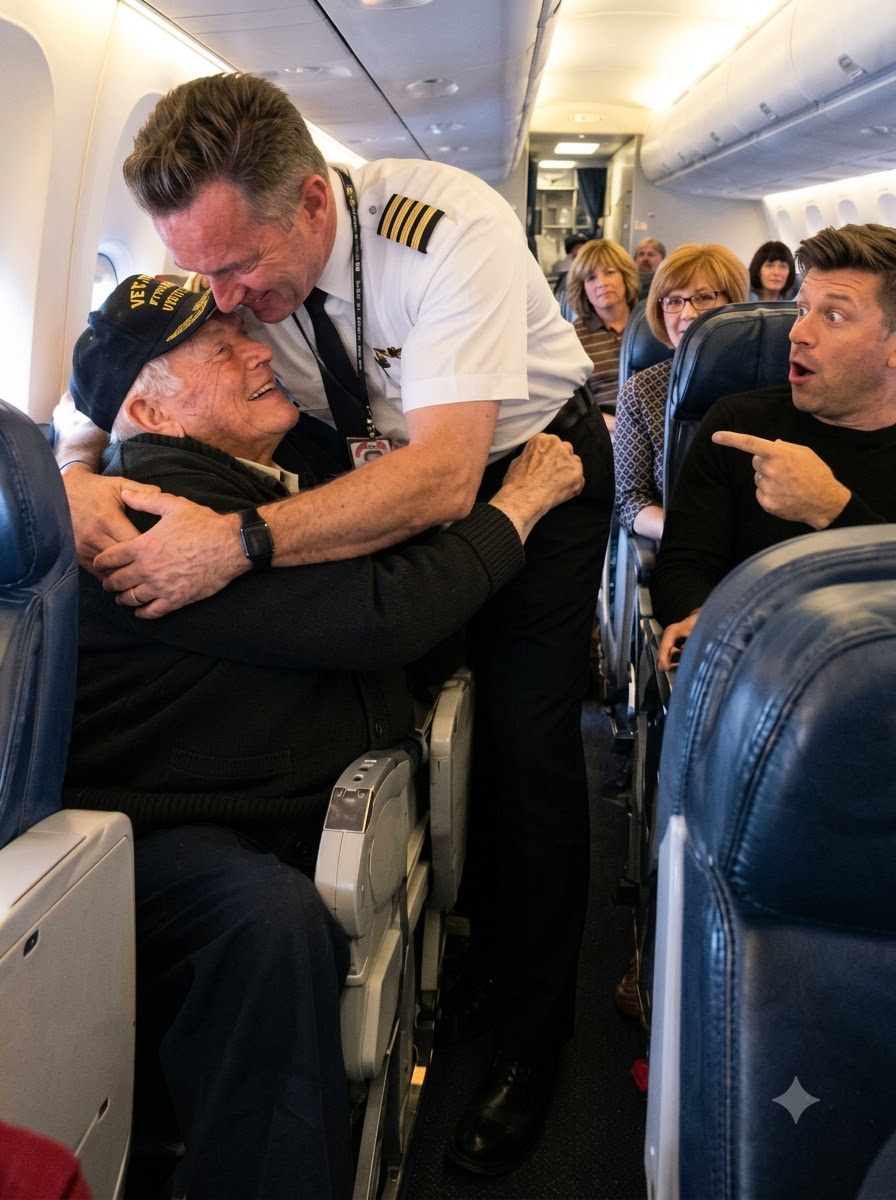
“No,” he answered. “Something much more important.”
He touched the wings.
“You never know who’s standing beside you in a line. The old man who’s taking too long. The woman struggling with her luggage. The frightened child on an airplane.”
He turned toward me.
“You don’t know what they’ve survived. What they’ve lost. Or whose life they may have saved.”
My eyes filled with tears.
“So when somebody slows you down,” Dad continued, “be patient. Especially when you’re in a hurry.”
I promised him I would remember.
Dad is eighty-two now.
He still completes crosswords in pen, still wins at cribbage, and still checks the front door twice before going to bed.
But airports no longer frighten him the way they once did.
Last spring, he flew alone to visit Michael.
He called me from the gate, proud that he’d made it through security without any trouble.
“Did you tell anyone who you were?” I teased.
“No need,” he replied. “I let the young fellow behind me go first. He seemed to be in a hurry.”
I laughed.
Of course he did.
The silver wings remain attached to my keys.
I carry them everywhere.
Sometimes, when I’m standing in a long grocery store line behind someone counting coins, or waiting while an elderly person struggles with a payment machine, I feel my old impatience beginning to rise.
Then I touch those wings.
And I remember.
Nearly fifty years earlier, a young pilot carried a frightened boy out of a smoking airplane.
He helped a pregnant woman in a blue coat reach safety.
He brought dozens of strangers home through a terrible winter storm.
Yet half a century later, that same man was simply an elderly passenger struggling with his passport.
Nobody standing behind him knew what he had done.
And that was the lesson Dad had been teaching me all along.
You shouldn’t be kind to someone because they might be a hero, wealthy, powerful, or important.
You should be kind because every human being has a story you cannot see.
Sometimes the person slowing you down has spent a lifetime carrying memories heavier than you could ever imagine.
Sometimes the person you dismiss is the reason somebody you love is still alive.
And sometimes the quiet old man standing beside you once carried an entire future out of the darkness.
So now, when the line moves slowly, I don’t complain.
I touch the little silver wings.
And I wait.
