

Part 1
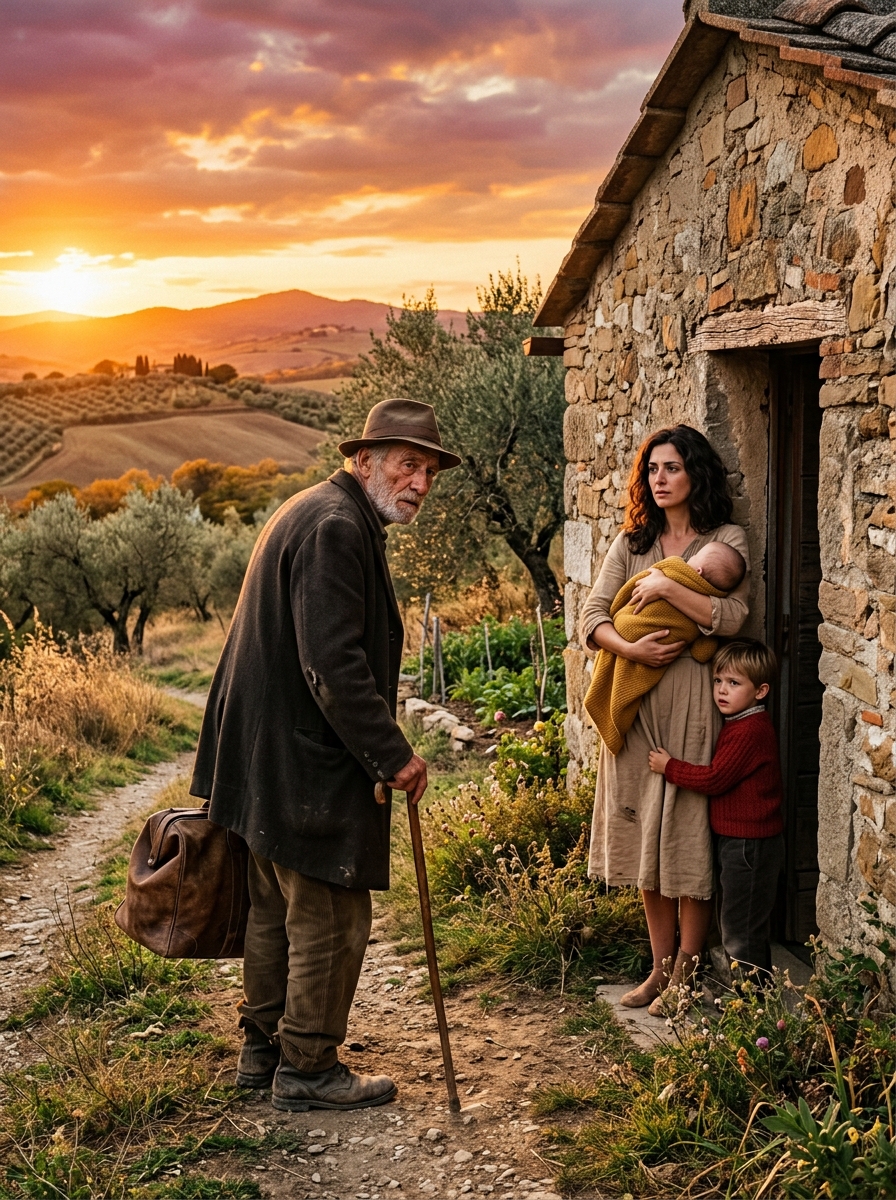
Don Julián Herrera bought that abandoned house on the outskirts of Pátzcuaro so he could die slowly, without witnesses and without anyone asking him again if he had already gotten over his wife’s death.
The house stood on a damp hill, surrounded by pine trees, forgotten cornfields, and a dirt road that turned into pure mud during the rainy season. It had cracked adobe walls, a warped wooden door, and a patio where bougainvillea grew as if no one had told them that joy could also leave a place.
Julián was 58 years old and carried an old sadness deep in his bones. Since Teresa, his lifelong wife, had died, he stopped going to the town festivals, sold part of his land, and gradually distanced himself from everyone. People said he had become bitter. He didn’t argue. Sometimes, when pain stays too long, you end up looking like it.
That November afternoon, he arrived in an old pickup truck loaded with tools, blankets, and a box of photographs he didn’t dare open. The sky was gray, the wind smelled of wet firewood, and the church bells rang in the distance as if calling to another life—one that was no longer his.
When he pushed the front door, he stopped.
It was open.
Julián frowned. He clearly remembered closing it the week before when he signed the purchase papers. He took a flashlight from the truck and entered slowly.
The inside smelled of dampness, dust, and old ash. Dry leaves covered the floor, a broken chair leaned against the wall, and there was a cold fireplace where someone had tried to light a fire with wet branches.
Then he heard a noise.
It wasn’t a rat. It wasn’t the wind.
It was breathing.
Julián raised the flashlight and the beam fell on a young woman huddled by the fireplace, hugging two small children under a torn blanket.
The woman stood up suddenly, pale, with black hair stuck to her face and eyes full of fear.
“Please, sir… don’t throw us out.”
Julián stood motionless.
The children hid behind her. One was a thin boy about six years old, with eyes too alert for his age. The other was a smaller girl with undone braids, clutching a rag doll to her chest.
“Who are you?” Julián asked in a dry voice.
The young woman swallowed.
“My name is Marisol. These are Emiliano and Lupita. We arrived last night. We didn’t want to steal anything. We just needed to get through the storm.”
Julián looked around. There was a bag of clothes, an empty pot, and some children’s shoes drying near the fireplace. He didn’t need more explanations to understand that this woman wasn’t just passing through for comfort. She was running from something.
“We’ll leave tomorrow,” Marisol said quickly. “I promise.”
Emiliano, the boy, looked up.
“My mom said no one lived here.”
Julián wanted to answer harshly. He wanted to tell them the house was his, that it wasn’t a shelter for anyone, that he had bought this place precisely so he wouldn’t have to hear voices, footsteps, or crying.
But then he saw Lupita’s feet. They were purple with cold.
Without saying a word, he went out into the drizzle and returned with bread, cheese, milk, a thick blanket, and some cans of beans.
Marisol looked at him as if she didn’t know whether to thank him or cry.
“Eat first,” he said.
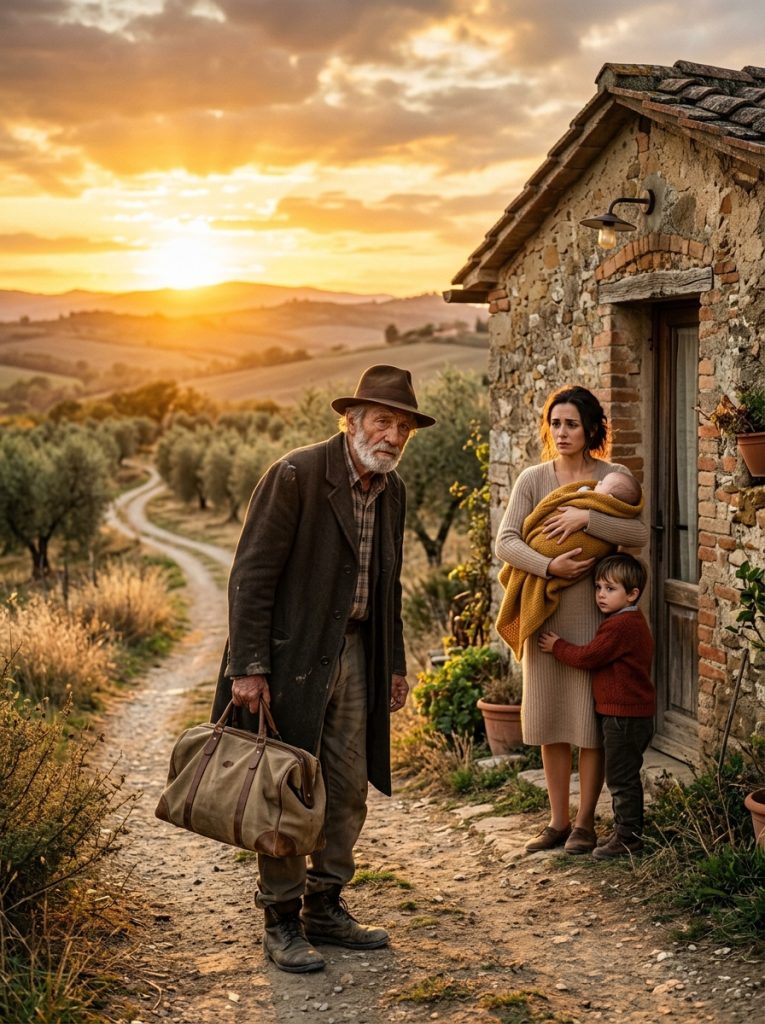
At first the children obeyed in silence, but Emiliano soon began watching Julián with clean curiosity.
“Do you live here alone?”
Julián took a moment to answer.
“Yes.”
“Aren’t you scared?”
“No.”
The boy tilted his head.
“My mom is scared of being alone.”
Marisol looked down, ashamed. Julián pretended not to notice the tears gathering in her eyes.
That night, while the rain beat against the broken tile roof, Julián let them stay by the fireplace. He sat in an old chair on the other side of the room, arms crossed, watching the small fire he had finally managed to light.
It had been months since he had heard someone breathing inside a house.
It had been months since he had felt that a closed door could protect someone and not just lock them in with their ghosts.
Before going to sleep, Emiliano left a drawing on the table. It was a crooked house, a woman, two children, and a tall man without a face standing next to them.
Julián picked up the paper.
“Who is this?”
The boy yawned.
“I don’t know yet. But I think someone is missing there.”
Julián didn’t answer.
That night he barely slept. The drawing remained on the table like a question he didn’t want to answer.
The next morning, the smell of coffee woke Julián before the light. Marisol had cleaned the kitchen, swept the dust, and put water on to heat. Lupita was sitting by the window with her doll, and Emiliano was trying to gather twigs in the patio.
When Marisol saw Julián, she tensed.
“I didn’t want to touch your things. I just thought I could help a little.”
“I didn’t say anything.”
“It’s just… we’re used to leaving before we become a bother.”
That phrase stayed with Julián longer than he would have liked.
The days began to pass in a strange way. Marisol repaired curtains, cleaned corners, and cooked with what little there was. Emiliano followed Julián around the property like a loyal dog, asking about the trees, the tools, the rain, the stars. Lupita spoke little, but every afternoon she left a flower beside the bench where Julián sharpened his machetes.
And little by little, without asking permission, the house stopped feeling dead.
One afternoon, while checking for leaks, Emiliano found a box of photographs under a table. Julián tried to take it away, but the boy had already pulled out a picture of Teresa smiling at a town festival, wearing a blue shawl and eyes full of life.
“She was pretty,” Emiliano said.
Julián clenched his jaw.
“She was my wife.”
“Did she go to heaven?”
Julián looked at the photo.
“That’s what they say.”
“Then she must be happy that the house isn’t so quiet anymore.”
Julián felt something break inside him. He didn’t shout, he didn’t cry. He simply took the photo and went out to the patio so no one would see his hands trembling.
Part 2
The peace lasted until the town started talking.
One Sunday, Julián went down to Pátzcuaro to buy flour, oil, medicine for Lupita’s cough, and a pair of used shoes for Emiliano. Marisol didn’t want to go with him, but the children had been locked inside the house for weeks and Julián insisted.
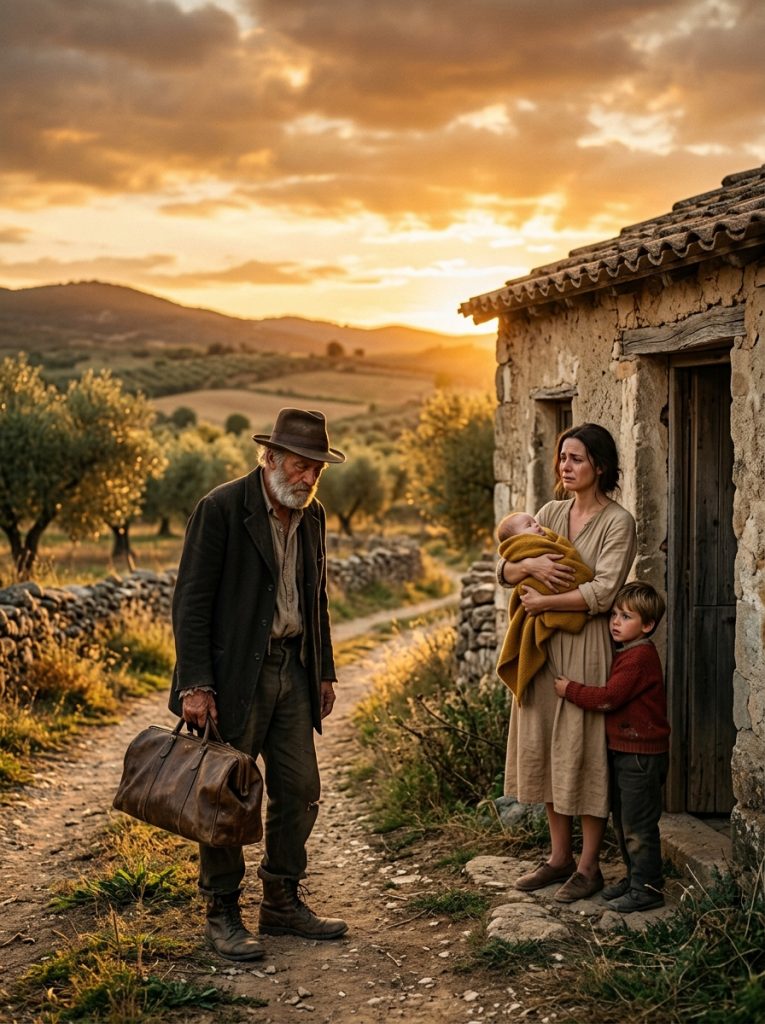
As soon as they reached the square, the stares fell on them like stones. Doña Refugio, the owner of the store, stopped arranging candles when she saw Marisol get out of the truck. Two men on the bench by the porch murmured something. A woman crossed herself openly.
“Just look at that,” someone whispered. “Don Julián has found himself some young company.”
Marisol heard it.
So did Julián.
He pretended not to, but the comment hardened his face.
Inside the store, when Emiliano took his hand to ask for a sweet bread, the silence grew even heavier.
A man said in a low voice:
“Poor Teresa. Not even a year dead and he’s already brought a woman with children into her house.”
Marisol let go of Lupita’s hand as if it had burned her.
On the way back, no one spoke. The truck climbed the dirt road between pines and mist, but something had broken.
That night, Marisol packed the clothes into a bag. Julián watched her from the doorway.
“What are you doing?”
“We’re leaving tomorrow.”
“Why?”
“Because I know how this ends. People talk, then accuse, then destroy. You were good to us, Don Julián. I won’t let them tarnish your wife’s memory because of me.”
Julián wanted to tell her he didn’t care about the town, but he couldn’t.
Because part of him was also afraid.
Afraid of betraying Teresa.
Afraid of wanting Marisol and the children to stay.
Afraid of accepting that, for the first time in months, he no longer wanted to die.
Close to midnight, while everyone was sleeping, a strong storm hit the house. The wind rattled the windows and rain seeped through the cracks. Julián got up to check the fireplace, but when he reached the kitchen he felt a brutal dizziness.
He grabbed the table.
His chest burned as if an invisible hand were squeezing him from inside.
He tried to call Marisol, but no voice came out.
He fell to his knees.
The flashlight went out.
Emiliano was the one who found him. He had woken up because of the noise and saw Julián lying there, pale, breathing with difficulty.
“Mom!” he shouted. “Mom, Don Julián is dying!”
Marisol ran barefoot. When she saw him, the color drained from her face.
“Emiliano, bring the blanket. Lupita, don’t cry, my love. Stay by the door.”
The rain made it impossible to walk for help, and the truck was stuck in the mud. Marisol didn’t know how to drive well, but she didn’t hesitate.
Between her and Emiliano, they managed to lift Julián into the back seat. Lupita, with trembling hands, held the flashlight. Marisol started the truck three times before the engine responded.
They drove down toward the town through lightning, mud, and dangerous curves.
Emiliano sat in the back, holding Julián’s hand.
“Don’t fall asleep,” he kept repeating. “You promised to teach me how to prune the trees. Don’t fall asleep.”
They reached the small hospital when Julián could barely breathe.
The doctor later said that if they had taken twenty minutes longer, he wouldn’t have survived.
At dawn, Marisol sat in a plastic chair with the sleeping children on her lap. Her dress was wet, her eyes red, and her hands covered in dried mud.
Father Gabriel, who had come to visit another patient, found her there.
“Are you the woman living with Don Julián?”
Marisol looked down.
“We were only passing through.”
The priest watched her in silence.
“Last night you saved his life. That doesn’t sound like ‘passing through.’”
When Julián woke up, the first thing he saw was Emiliano sleeping beside the bed, his head resting on his arm. Lupita was curled up in a chair, hugging her doll. Marisol was looking out the window, exhausted.
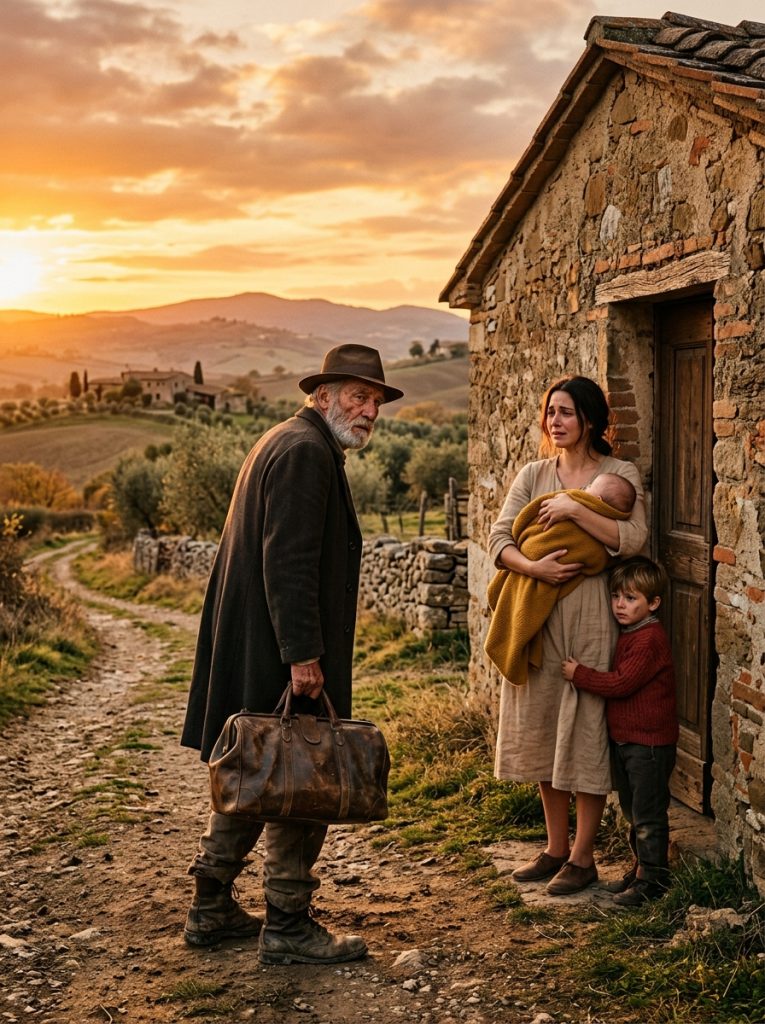
Julián tried to speak.
“You didn’t leave.”
She turned.
“I couldn’t leave you.”
“But you were going to.”
Marisol swallowed.
“Yes. Because I thought staying would hurt you.”
Julián closed his eyes.
“What was hurting me was being alone.”
Before she could answer, a nurse entered with a bag of belongings. Among Julián’s wet clothes was the old letter from Teresa that he had never wanted to read. It had fallen out of the box of photographs and Emiliano had kept it in his pocket the night before, thinking it was important.
Julián opened it with weak hands.
Teresa’s delicate, living handwriting was still there, impossible:
“Julián, if one day I go before you, don’t turn your heart into a closed house. We never had children, but you were born to take care of others. If life puts a family in front of you, don’t leave them outside just to mourn me. Love them. I will be in that light.”
Julián began to cry.
Not with shame.
Not in silence.
He cried like someone finally letting go of a heavy stone carried for too long.
Emiliano woke up and squeezed his hand.
“Did your wife write that?”
Julián nodded.
“Yes.”
“Then she wanted us to stay.”
Marisol covered her mouth to keep from sobbing.
Julián looked at her with wet eyes.
“Don’t go. Not out of pity. Not out of fear. Stay because this house was already waiting for you.”
Marisol wanted to respond, but at that moment the door to the room burst open violently.
A tall, well-dressed man with a black hat and eyes full of rage appeared in the entrance.
Marisol stood up as if she had seen a ghost.
“Did you think you could hide forever?” he said. “Let’s go, Marisol. My children are coming back with me today.”
Part 3
The man’s name was Esteban Arriaga, and only then did Julián understand what Marisol had been running from.
It wasn’t just poverty.
It wasn’t shame.
It was fear.
Esteban was a cattle rancher, friends with municipal police, and carried a violence he knew how to disguise with clean boots and a pressed shirt.
“Those children are mine,” he said, pointing at Emiliano and Lupita. “And this woman also knows who she belongs to.”
Marisol trembled but didn’t back down.
“I don’t belong to anyone.”
Esteban let out a dry laugh.
“Without me you are nothing.”
Julián tried to sit up in bed, still weak.
“We don’t speak like that here.”
Esteban looked at him with contempt.
“Shut up, old man. You look quite ridiculous defending a woman who moved into your house to take your money.”
Emiliano stepped in front of his mother.
“Don’t talk to her like that!”
Esteban raised his hand, but before he could touch the boy, Father Gabriel entered the room accompanied by two state police officers.
They were not the town police. They were agents called by the doctor after seeing the old bruises on Marisol’s arms and hearing Lupita cry when she heard her father’s name.
The surprise wiped the smile from Esteban’s face.
“This is a family matter.”
“No,” Marisol said, with a strength she didn’t know she had. “This is a complaint. And this time I’m going to speak.”
She spoke.
She told of years of beatings, confinement, and threats. She told how Esteban took her money, how he frightened the children, how one stormy night she fled with only the clothes on her back because he swore he would take her children away forever.
Emiliano also spoke.
In a small but clear voice.
Lupita didn’t say much; she only showed the broken doll her father had stepped on that last night.
Esteban was detained before he could leave the hospital.
For the first time, Marisol saw him leave without feeling that the world was ending.
She felt fear, yes.
But behind the fear there was something new: freedom.
In the following weeks, the whole town learned the truth. The same people who had whispered in the square began to look down when they saw Marisol.
Doña Refugio came to the house one day with sweet bread and chocolate.
“I’m sorry, child,” she said. “Sometimes the mouth runs faster than the heart.”
Marisol accepted the bread but didn’t humble herself. She had learned that surviving was also a form of dignity.
Julián returned to the house more slowly, with medicines and strict orders from the doctor. He could no longer carry sacks or climb onto the roof, but he had Emiliano watching over him like a foreman.
“No pretending to be strong,” the boy would tell him. “The doctor said rest.”
Lupita filled the house with drawings. In one of them, the family appeared again in front of the house. This time the tall man had a face.
It was Julián, with a crooked mustache and a huge smile.
A year later, in spring, the adobe house no longer looked abandoned. There were flowers in the patio, chickens near the corral, clean curtains, and the smell of freshly made tortillas.
Julián and Marisol got married in a simple ceremony at the town church. Not out of obligation or appearances. They married because affection, when it is born from respect and care, can also be a second chance.
Emiliano and Lupita walked in front of them carrying bougainvillea branches.
Father Gabriel, in front of the altar, said:
“Sometimes God does not return what was lost in the same form. Sometimes He sends something new to teach us that the heart can still open.”
Julián squeezed Marisol’s hand.
On a small bench, next to a candle, was Teresa’s photograph. Marisol had placed it there without anyone asking. Because she understood that loving Julián did not mean erasing his past, but honoring it with a new life.
Months later, Julián began the process of giving Emiliano and Lupita his last name. When the judge asked the boy if he was sure, Emiliano replied:
“I already was his son from the day he taught me how to light the fireplace.”
Everyone laughed.
Julián didn’t.
Julián cried quietly.
The years passed.
The house he had bought to wait for death filled with birthdays, school homework, illnesses cured with broth, small arguments, big hugs, and mornings of coffee with bread.
Emiliano grew up and studied agronomy to revive Julián’s lands. Lupita became a teacher because she said every child deserved a house where they didn’t have to be afraid.
Marisol stopped walking with her eyes on the ground. She learned to laugh loudly, to plant flowers, to sleep without startling awake.
And Julián, who once believed his heart had been buried with Teresa, discovered that love does not end when someone dies.
It only moves to another room inside the soul.
Twenty years later, on a November afternoon, Julián sat in the patio with white hair and a blanket over his legs. Several children ran among the bougainvillea. They were his grandchildren.
Emiliano arrived from the fields with his boots covered in dirt. Lupita was making coffee in the kitchen. Marisol sat beside Julián and took his hand.
The old house smelled of bread, firewood, and life.
Julián looked at the wooden door he had once found open by accident.
Then he smiled.
“I thought I had bought this house to die in peace.”
Marisol rested her head on his shoulder.
“And you ended up living with family.”
Julián watched the children run, listened to their laughter mix with the church bells, and closed his eyes for a moment.
Somewhere in his memory, Teresa was smiling.
Then he understood that no house is truly abandoned when someone dares to light a light inside.
And that sometimes, when you open the door to save others, they are the ones who end up saving you.
