

For 8 years, my parents made me leave the house whenever my brother brought his fiance over. Mom would say, “She comes from a good family, don’t embarrass us”; Dad would add, “Just disappear for the weekend”; and I did. Then, one weekend, I never returned. It took them four years to discover where I had gone.
My mother referred to what happened as “your situation,” as though it were a stain she wanted to keep hidden.
Two days before the first Easter visit, I walked into the hallway and noticed six family photographs had disappeared from the wall.
Mom said the frames were being updated.
The only picture of me that remained was my junior-year portrait, positioned in the center of the living-room shelf beside a white candle.
“It’s for Easter,” she said.
As she spoke, she quietly moved my seven-day pill organizer from beside the toaster into the silverware drawer.
“Mitch is bringing someone home this weekend. Her name is Avery Lockheart. Her people are Mountain Brook.”
Mountain Brook was twenty minutes from Hoover, but to Mom, it might as well have been another country.
“That family has been through a terrible loss,” she continued. “They don’t need to walk into ours.”
I thought she meant me.
She did.
Mitch came home from Tuscaloosa Friday night. He was twenty, studying engineering at Alabama, and still the only person who called me Stace.
He stood in my doorway while I packed a duffel bag.
“I’m sorry about all this, Stace.”
I assumed he meant our parents.
“Sorry for what?”
But he had already left.
The following morning, Dad placed my keys beside the sink. At 10:59, I backed out of the driveway.
In the mirror, I watched Mitch’s Jeep turn onto our street with a laughing girl beside him.
She never saw me.
That was the point.
I drove forty-five minutes south to Ruth Tidwell’s peach farm in Chilton County.
Her granddaughter Casey had been my best friend since high school. Ruth took one look at my bag and didn’t ask about February.
“Hands first,” she said. “Questions can wait till supper.”
She put me to work thinning peaches.
A tree produces more fruit than it can carry. If you don’t remove enough, the branches strain beneath small, hard peaches until something breaks.
By noon, green fruit covered the ground.
Later that afternoon, Ruth showed me a tree everyone believed had died during the January freeze.
She scraped a twig with her thumbnail.
Bright green appeared beneath the gray bark.
“Scratch test,” she said. “Brown means dead. Green means she’s living.”
Then she released the twig.
“Green underneath. She’s just been through a winter.”
I carried that image home with me Sunday night.
The house smelled like ham and lilies. The candle beside my portrait had burned halfway down.
That summer, Mom started calling Avery Mitch’s fiance, even though he wouldn’t propose for years.
And our house developed rules.
In May, Mom installed a keyed lock on the outside of my bedroom door.
She claimed it was so Avery wouldn’t accidentally walk into my messy room.
My room was the neatest in the house.
The key remained on Mom’s ring. Whenever she wasn’t home, I couldn’t enter my own bedroom.
My toothbrush was moved into a zip-top bag in my car.
My mail disappeared before visits.
I wasn’t allowed to park my car outside because someone might ask who owned it.
The texts came before every visit.
“Every weekend be gone by 11.”
Sometimes noon.
For one Fourth of July, 9 a.m.
I started documenting every forced departure in a yellow notebook.
Easter became number one.
When I turned twenty, Mom started charging me $400 a month for room and board.
I was paying rent for a house I was repeatedly forbidden to occupy.
After two years, I finally asked what Avery believed about me.
Mom answered immediately.
“She thinks you live in Atlanta. You work there. You’re very busy.”
Then she handed me a dish.
“Don’t make me a liar.”
I believed her because it seemed to explain everything.
Years later, I discovered that wasn’t the lie at all.
Mom never asked where I spent those weekends.
Usually, I went south.
Eventually, Ruth kept a cot for me beside her kitchen and two of my shirts in the closet.
During winter, she taught me grafting.
A graft connects living wood. The green layer beneath the bark has to meet cleanly on both pieces, or the graft won’t heal.
My first winter, nine of ten apple grafts took.
Ruth said almost nothing, which, coming from her, was high praise.
I remembered something my horticulture teacher, Mr. Witcom, had once told me.
“You’ve got grafter’s hands.”
Ruth’s eyesight was getting worse, so I helped her write letters to her old friend Ingred Zberg, who owned an orchard in Washington.
One response arrived addressed to Ruth.
“Ruth tells me nine out of 10 took. Whoever did those graphs has good hands. April up here is worth seeing.”
Ruth placed her late husband’s grafting knife beside my plate.
I slipped Ingred’s letter into my yellow notebook behind the tally marks.
It was the first invitation I had received in two years.
During the week, I worked at a garden center in Hoover. I had started by bagging mulch at nineteen and eventually became the manager of the woody plant lot.
Contractors asked for me by name.
My family knew none of it.
One night Dad asked:
“You still at that feed store?”
“It was not a feed store,” I said. “Yes.”
After the hospital, Mom had also convinced me to delete my social-media accounts “for your own good.”
I thought she was protecting me.
Later, I understood whose privacy she had really been protecting.
By the end of 2017, my notebook contained one hundred tally marks.
One hundred weekends gone.
Nobody had ever asked where.
The first crack appeared after my grandmother June died in March 2018.
Avery was coming to the funeral with Mitch, so I wasn’t allowed at the church service.
“You can come to the graveside,” my mother told me. “Family only. After Avery leaves, stand in the back.”
After the service, someone handed me an obituary.
It listed June as survived by one daughter, Lynette, and one grandson, Mitchell.
Not me.
If my family truly believed I lived in Atlanta, I should have been there.
Another woman stood away from everyone that day, beside a group-home van.
She stared at Mom throughout the entire service.
As we walked toward the cars, she whispered:
“Linny?”
Mom kept walking.
“Who is that?” I asked once we were in the car.
“Nobody. Somebody from mama’s old church. Get in the car.”
We were already inside.
Dad suddenly claimed he had forgotten his sunglasses and walked back toward the grave.
He returned four minutes later without sunglasses.
During the drive home, Mom repeatedly hummed Blessed Assurance.
She only hummed when she was frightened.
A year and a half later, Avery walked into my garden center.
I recognized her immediately from years of family photographs.
She had never seen me.
“I need a dogwood,” she said. “A really good one. It’s for our church’s memorial garden. My boyfriend’s family lost someone. Every Easter, my mom reads the names at sunrise, and I want this to be something she’s proud of.”
I assumed she meant Grandma.
I helped her choose a Cherokee Princess dogwood with a clean graft union.
On the tag, I wrote what I wrote on every tree.
“Graft is good. Water deep the first summer. She’ll bloom.”
At the gate, Avery looked at me strangely.
“You look like someone I should know,” she said.
It was the closest I came to telling her.
Instead, I sold her a tree.
That Christmas, Mitch proposed.
Mom texted me:
“Wedding is June 13th. Keep that weekend free.”
It took me a day to understand that “keep that weekend free” meant I wasn’t invited.
I confronted her.
“It’s not the right time for you to be there.”
I still didn’t know why.
Then the pandemic arrived, and for eight weeks in 2020, everyone was required to stay home.
For the first time in years, so was I.
One Sunday, Avery called on FaceTime while I was making lunch.
Mom saw me behind her and covered the phone.
“Out of frame,” she mouthed.
I carried my plate to the one corner the camera couldn’t see and ate standing up while Mom talked to a woman who believed I lived in Atlanta.
The wedding was postponed twice before finally being set for October 8th, 2022. Mom texted:
“New date, October 8th, 2022. Keep it free.”
By Easter 2021, my parents had started attending the Lockhearts’ sunrise service.
“Sunrise service with the Lockheart Sunday, be gone Friday.”
People often ask why I didn’t leave sooner.
The answer was insurance.
My medication and therapist were covered through Dad’s employer plan. The garden center offered no coverage.
Mom reminded me whenever I pushed back.
“You’re on our insurance until you’re 26. Our house, our rules.”
When I turned twenty-six, I finally purchased my own marketplace insurance.
The card had only my name on it.
Even then, I stayed.
That Thanksgiving, I came back from Ruth’s and discovered all my medication had been moved into my locked bedroom.
“Keep your medicine in your room,” she said. “People use that bathroom.”
People had been using that bathroom for seven years.
My newest bottle, dated that October, was now hidden behind a door only Mom could open.
I assumed she was afraid of the medication.
I couldn’t imagine what else she could possibly be afraid of.
In January 2022, another box of cuttings arrived from Ingred.
Ruth wrote Ingred’s number on a paper towel.
“You call her,” she said. “I’m tired of being the middleman.”
I called.
Ingred skipped the pleasantries.
“So you’re the hands,” she said. “The offer stands. April, bring gloves.”
I told her I’d think about it.
Three months later, the Easter text arrived.
“Lock hearts for supper Saturday. Sunrise service Sunday, be gone by 10:00.”
By then, the visits included Avery’s parents too.
Mom referred to them as:
“Our church friends now.”
On Saturday morning, I left at 9:40.
Tally mark 211.
April 16th, 2022.
That evening at Ruth’s, I opened my pill organizer.
Saturday was empty.
The bottles were still inside my locked bedroom.
Ruth watched me.
“Go get what’s yours,” she said. “Then come straight back.”
I drove home shortly before ten.
The Lockhearts’ Suburban was still sitting in the driveway.
I parked down the block and approached the house from the dark side yard.
The hallway window beside my bedroom was slightly open.
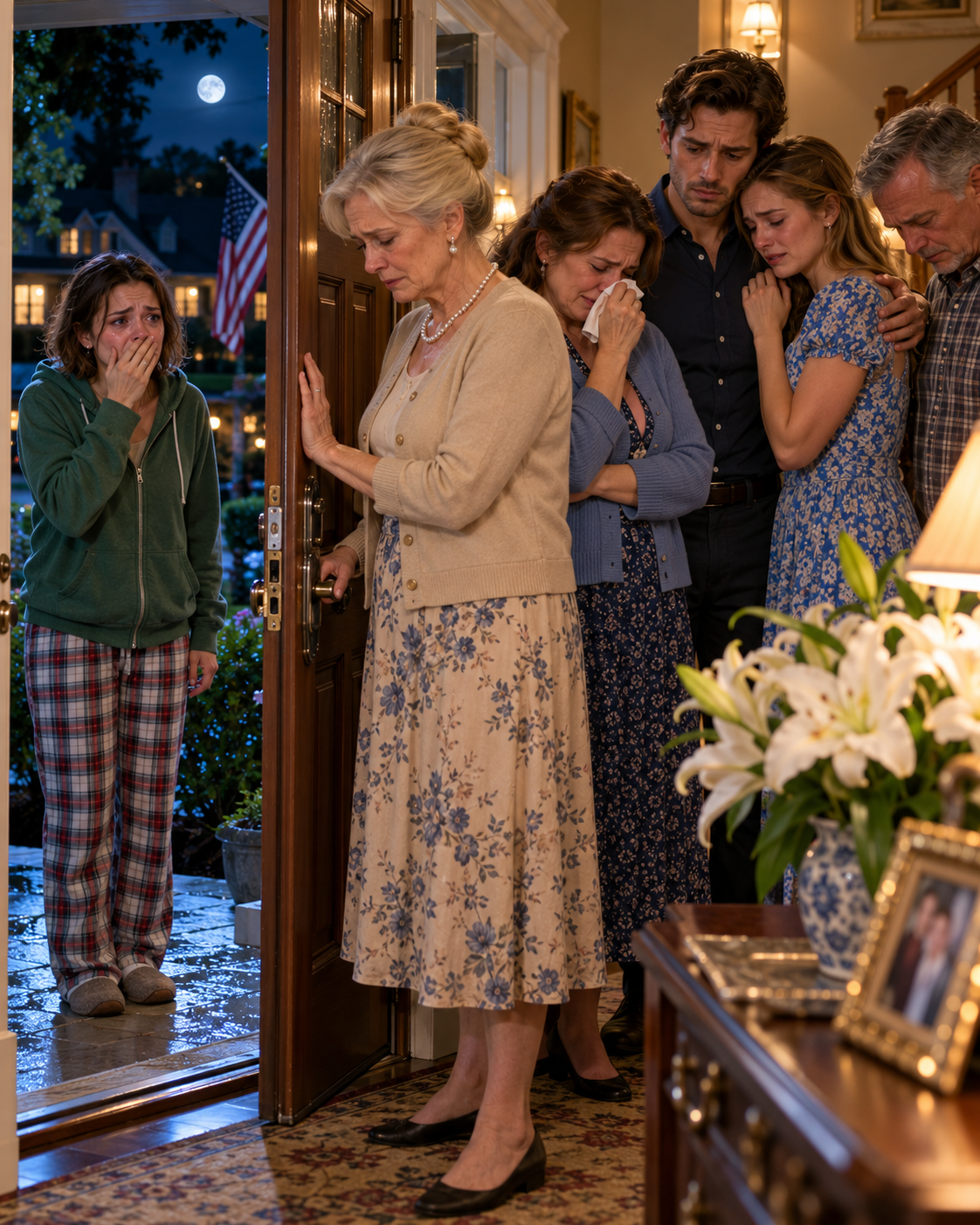
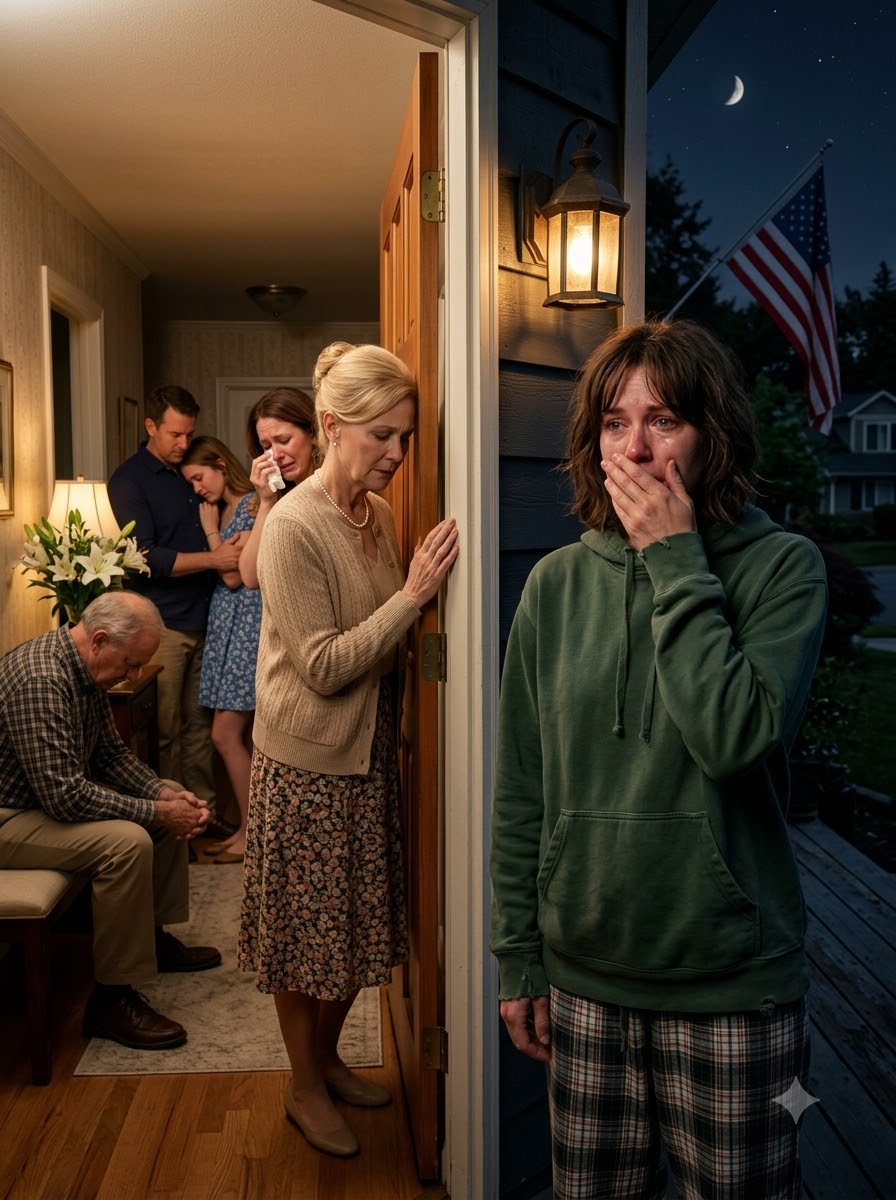
Suzanne Lockheart stood outside my door.
Mom was beside her, holding a tissue.
Avery clung to Mitch.
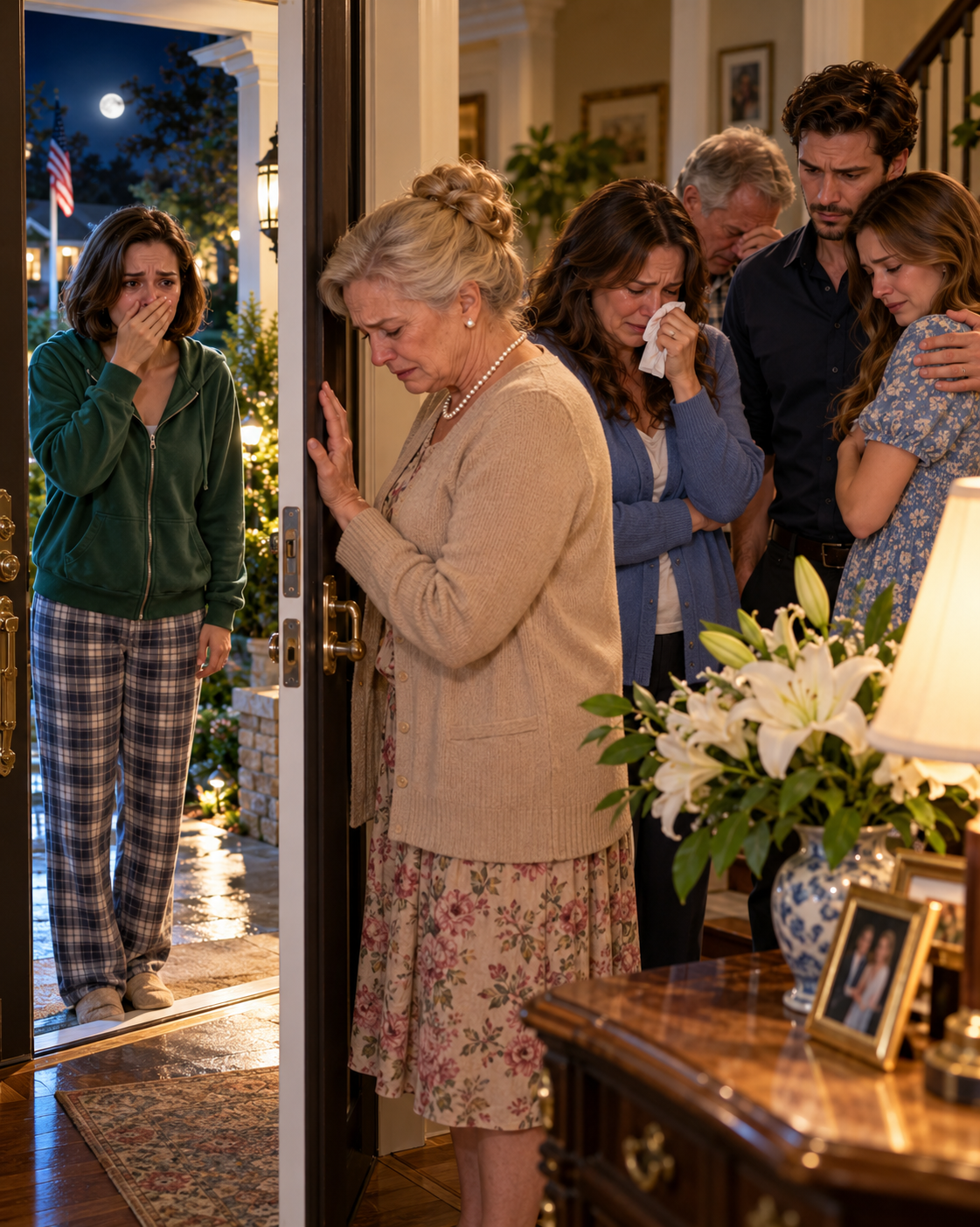
Dad stood near the kitchen, staring at the floor.
Suzanne touched my door.
“May I?”
Mom nodded.
Suzanne placed her palm against the wood and lowered her head.
Mom dabbed her eyes.
“I still can’t bring myself to open it.”
I stood outside, watching a stranger pray over my bedroom door.
You don’t touch a door that way unless you believe the person who belongs behind it will never return.
After they left, I waited until the house was dark.
Near midnight, I slipped inside through the back.
On the dining table was a framed photograph of a blooming dogwood.
At the bottom was a granite memorial stone.
In loving memory of Anastasia Dunaway, 1995 2014.
She is not dead but sleepeth.
A card beside it read:
8 We’ll read her name at sunrise. S.
Then I noticed the white nursery tag hanging from the tree.
My handwriting.
The exact tree I had sold Avery.
Everything suddenly fell into place.
The burned candles.
The obituary that left me out.
“My boyfriend’s family lost someone.”
“It’s not the right time for you to be there.”
The locked bedroom nobody supposedly had the courage to open.
Mom had never told Avery that I lived in Atlanta.
She had allowed Avery’s entire family to believe I was dead.
And I had personally chosen my own memorial tree.
I sat in Mom’s chair until the refrigerator had cycled twice.
Then I stood.
Her keys were beside the coffee maker.
I opened my bedroom and packed one bag.
Medication.
Birth certificate.
Ruth’s grafting knife.
The yellow notebook.
Everything else belonged to the girl they had created.
I left the bedroom door standing wide open, the lamp burning, the key still in the lock.
They claimed they couldn’t bear to open it.
I made certain they would have to look inside.
Then I called Ruth.
“Then go see April,” she said.
I drove northwest.
Near Memphis, with dawn beginning to break, I sent my parents the only message they would receive from me for years.
“I’m alive. Don’t look for me.”
It was the first truthful sentence my family had spoken about me in eight years.
I drew a line beneath tally mark 211.
As I crossed the Mississippi, my mother was attending sunrise service and listening to my name among the dead.
I wouldn’t discover that until years later.
It took four days to drive roughly 2,500 miles.
I finally called Ingred from Oregon.
“Come straight to the packing shed,” she said. “I’ll put the coffee on.”
I arrived at Soulberg Orchards on April 20th, 2022.
One hundred forty acres stretched above the Columbia River.
Ingred examined my hands before she studied my face.
Within a week, I had a new bank account, a new phone number, and a bunk with the seasonal crew.
When I closed my old bank account, one thought remained with me:
Nobody in Washington had ever been told I was dead.
The apples were blooming.
I started at around $17 an hour.
“I’ve seen pictures of your grafts,” Ingred told me on my first morning in the Rose. “I haven’t seen your thinning. Show me.”
Ruth called that week.
“Your mother called me,” she said. “She didn’t ask where you were. She asked if you’d said anything to anybody.”
That was the entire search.
I finally understood why.
You can’t ask people to help locate a daughter you’ve spent years telling everyone is dead.
One man on my crew bet twenty dollars that I wouldn’t make it until August.
At least he said it directly to me.
By June, Ingred moved me into an old trailer overlooking the Honey Crisp block.
On October 8th, 2022, I was picking Golden Delicious from a ladder.
My brother was getting married in Alabama.
The old text was still on my phone.
“Keep October 8th free.”
That night, I checked an old email account.
Mitch had written:
“Thank you for staying away today.”
My absence had become my wedding gift.
A month later, Ingred offered me a year-round position with health insurance.
I found a therapist.
Then Ingred showed me nine acres of old Red Delicious trees that were no longer producing enough to justify keeping.
“Next spring, we cut these down to stumps and graft cosmic crisp onto them,” she said. “Top working. The roots are good. The variety is done.”
She kicked one of the trunks.
“Rootstock decides how big. Scion decides what.”
Then she handed me a twelve-person crew and told me the block was mine.
It was the first time anyone had trusted me with something because of what I could actually do.
In spring 2023, we cut the old trees down and grafted Cosmic Crisp onto the surviving roots.
One day, a lift jammed while I was ten feet above the ground.
The mechanic was Callum Reed.
He fixed it in six minutes, then watched me finish the row. “You check everything twice,” he said.
“Once for the tree, once for me.”
By June, 94% of our grafts had taken.
I recorded that number at the front of my yellow notebook.
For once, a number represented something I had created instead of something I had endured.
That fall, I enrolled in a tree-certification program and needed a recommendation.
I emailed Mr. Witcom.
He responded within an hour.
“Anastasia. I always figured those hands would end up somewhere. Letters attached. Proud of you.”
He became the only connection I still had to Alabama.
In January 2024, a severe freeze swept through the valley.
Afterward, I examined a hundred young grafts.
Thirty-eight were brown.
That night, I almost called Mom.
Instead, I called Ruth.
“Well, you know what to do in April.”
The following morning, Ingred walked the block with me.
“Frost doesn’t care who grafted it,” she said. “It’s not a report card.”
That spring, I grafted the damaged trees again.
Thirty-eight had died.
I kept scratching until I found green.
In spring 2025, Ingred promoted me to assistant orchard manager.
Crew schedules.
Spray records.
Budgets.
Frost alarms at three in the morning.
It also meant my photograph was posted on the orchard website.
I hadn’t put my face online since I was eighteen.
“People should know who runs my trees,” Ingred said.
By then, Callum and I had started having dinner together after my Thursday therapy appointments.
Neither of us gave it a name.
It was the first genuine thing in my life that didn’t need a label.
My photograph remained online for almost a year before my family discovered me.
They found me because of a scholarship.
In February 2026, Suzanne Lockheart decided to establish a $2,000 annual horticulture scholarship at Hoover High in memory of the girl she believed had died.
Mom tried to stop it.
“I’d rather keep it quiet,” she said.
Suzanne answered: “She deserves to be said out loud.”
The school foundation sent the application to the horticulture teacher.
Mr. Witcom saw my name.
Then the dates.
Then he remembered the recommendation he had written for me in Washington in 2023.
He called Dad.
“Mr. Done away. I wrote your daughter a recommendation letter in 2023. Is there some kind of mistake?”
After a long silence, Dad replied:
“Give us until Easter.”
Mr. Witcom agreed to postpone the scholarship.
That night, Mitch searched for my name online.
Four years after I had left.
It took him twenty minutes to find me once he finally made the decision to look.
I knew nothing about any of it until an email arrived from Mr. Witcom.
“I may have told your father something you didn’t want him to know. I’m sorry. Are you all right?”
At seven that morning, the orchard office phone rang.
Ingred answered and handed me the receiver.
“Your mother,” she said.
I took it.
“Anastasia.”
Her voice was exactly the same.
No hello.
No question about the past four years.
“I need you to call Suzanne Lockheart.”
Mom already had another version prepared.
According to her story, I had left in 2014 after “your situation.” They hadn’t known whether I was alive. Suzanne had misunderstood because everyone had been too heartbroken to correct her.
All I had to do was confirm it.
“Tell her you left in 2014 and we didn’t know if you were alive. That’s all,” she said. “Then come home for Christmas.”
Christmas.
She presented it like a reward.
“You are always so good at disappearing,” she said. “I just need you to do it one more time.”
My yellow notebook was inside my jacket.
Two hundred eleven dated tally marks beginning in 2014 and ending in 2022.
“I’ll think about it,” I said.
Mom needed a daughter who had disappeared in 2014.
My notebook told a different story.
Let me ask you something before I tell you what I did.
If the people who erased you suddenly needed you to confirm their version, would you do it to keep the piece?
Tell me in the comments.
Two days later, a message came through the orchard website.
“It’s Mitch. Please call me. Not mom’s number. Mine.”
I called that night.
For a while, neither of us knew what to say.
Then his voice broke.
“It was me, Stace,” he said. “I said it first.”
In March 2014, he had been dating Avery for six weeks.
One night, she told him about her brother Trip, who had died in a car accident before graduation.
She explained how people treated her afterward.
And Mitch, whose sister had recently been hospitalized, told her:
“We lost my sister in February.”
“I meant the hospital,” he told me. “I meant we lost you the way you were.”
“She started crying and held on to me, and she said it was the first time anybody understood. I couldn’t take that away from her.”
He never corrected Avery the following morning.
By Easter, Mom knew.
She chose to protect the lie.
Mitch said she told him:
“People understand grief.”
Then he asked me to support the new version.
“Mom’s version would work,” he said finally. “You left. Nobody knew. Avery would be hurt, but she’d forgive something like that. Please, Stace.”
His marriage depended on it.
So did his job with Avery’s father.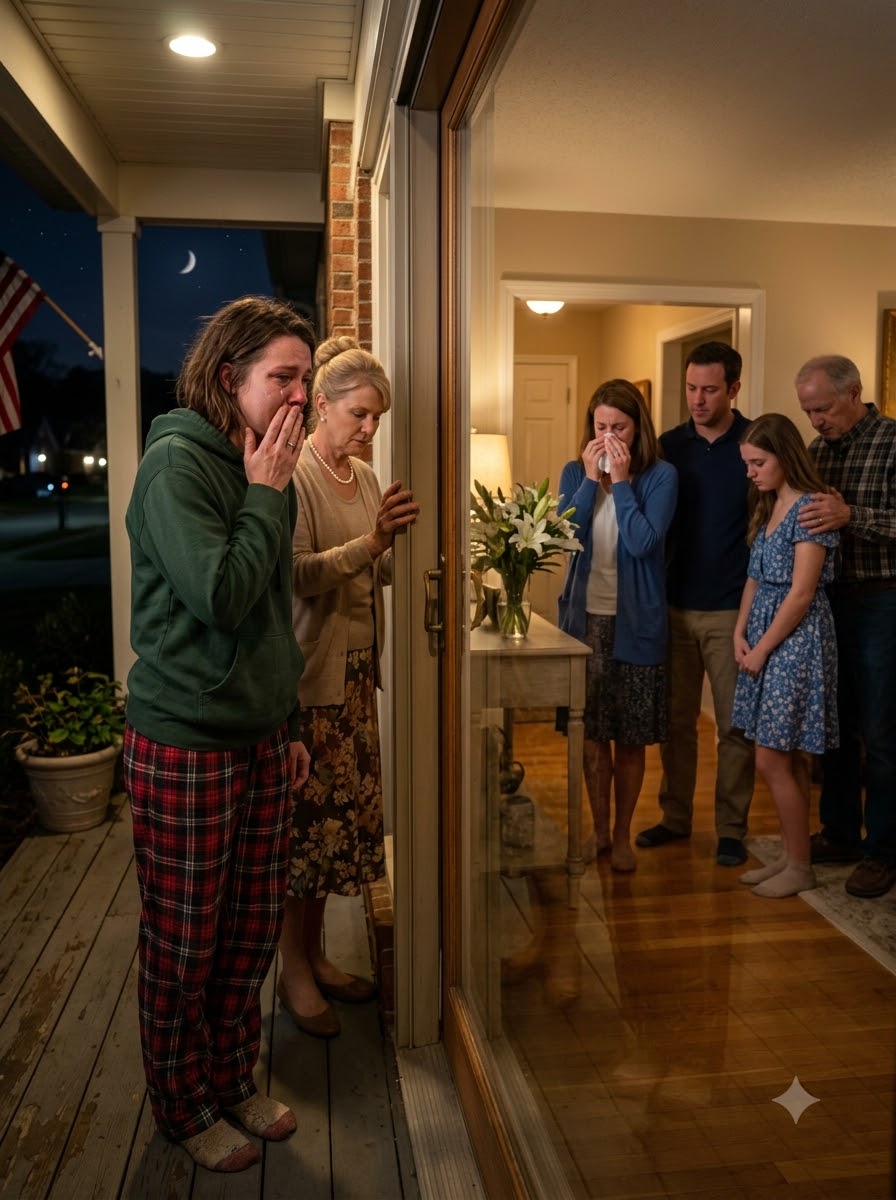
Then he told me what had happened the morning I left.
Mom discovered my bedroom door standing wide open and read my text.
She stood there.
Then she got dressed for sunrise service.
“She went?” I asked.
“We all went,” Mitch said.
Afterward, she told Suzanne that she had finally found the courage to open my room.
Suzanne cried with her while the church watched.
I had left the door open to expose the lie.
Mom turned it into another performance.
Dad called Saturday.
He didn’t start with an apology.
Instead:
“Your mother had a sister,” he said. “Her name was Rosalind.”
Rosalind was four years older than Mom.
At twenty, she developed schizophrenia and entered the state psychiatric hospital.
My grandparents moved to Hoover and told their new church that Rosalind had “gone home to the Lord.”
Mom was sixteen. “In your grandmother’s house, grief was something people brought casseroles for,” my father said. “Sickness was something they whispered about.”
I immediately thought of the woman standing beside the van at Grandma’s funeral.
Dad continued.
“Lenny, I didn’t forget my sunglasses that day,” he said. “I went back to give her my phone number. I’ve been visiting her once a month ever since. Your mother thinks I have branch meetings in Tuscaloosa.”
Then he added:
“Your mother learned it from hers. That’s not an excuse. It’s just where it came from.”
For the first time, I understood Mom.
Understanding wasn’t forgiveness.
It was recognition.
Dad continued.
“There’s one more thing,” he said.
“After you left, I checked your account. The last transaction was a gas station in Cheyenne.”
I waited.
“I saw Cheyenne,” he said. “I didn’t look after that.”
My father was a bank manager.
He could have found me.
He chose not to.
Before we ended the call, he added:
“Rosalyn’s visiting hours on Fridays are 10 to noon.”
That Monday, I asked Ingred for Easter week off.
Bloom was approaching, and orchard managers were expected to stay nearby.
Ingred looked at the calendar.
“Go,” she said. “The trees will wait 11 days, not 12.”
I booked the flight.
Then I texted Mitch.
“You have until Saturday night to tell Avery yourself.”
He didn’t answer.
Mom wanted me to call Suzanne.
I decided to meet her instead.
Casey picked me up from Birmingham airport.
At the farm, eighty-year-old Ruth was waiting on the porch.
She looked at me and repeated the first words she had spoken to me years earlier.
“Hands first. Questions can wait.”
On Good Friday morning, I visited Rosalind.
She was sixty-three, with Mom’s cheekbones and an easier laugh.
Beside her bed was a photograph of Mom as a teenager.
“That’s Linny,” she said, following my eyes. “Before.”
Dad had told her I was coming.
She had prepared a folder.
Inside was an old church bulletin announcing that the Hadley family had given thanks for the life of their daughter Rosalind, who had gone home to the Lord.
“They told the new church, ‘I went home to the Lord,’” she said. “Mama kept the bulletin in her Bible. Your daddy found it when he cleaned out her house, and he brought it to me because it’s mine.”
She studied me.
“You look like Linny before she got scared. She used to hum when she was scared. Blessed Assurance. Every time Daddy’s truck came up the drive.”
I told her about my memorial stone and the tree.
She listened.
When I finished, she asked:
“Is Lenny coming?”
I didn’t answer.
That afternoon, I drove to Mountain Brook.
Suzanne was behind the church preparing the memorial garden.
The dogwood I had sold Avery was blooming above the stone bearing my name.
Suzanne looked up.
Recognition came slowly.
“Anastia,” she said.
“Yes, ma’am.”
We walked to her house.
I told her everything.
The hospital.
The first weekend.
The locked room.
The notebook.
Then I placed the yellow notebook on her kitchen table.
She read every dated tally mark.
“That was a birthday supper,” she said.
“That was the 4th of July.”
She turned another page.
“That was the weekend we brought the tree photos over.”
Eventually, she reached number 211.
April 16th, 2022.
“That was the night I touched your door.”
“I know,” I said. “I was outside the hall window.”
Suzanne covered her mouth.
Then she asked about the tag still hanging from the memorial tree.
“‘She’ll bloom,’” Suzanne said. “It was the last thing anyone had written for her.”
“I wrote it,” I said. “I wrote it on every tree.”
My phone buzzed.
Mom.
“Don’t do this to your brother.”
I turned the phone facedown.
Suzanne asked:
“What do you want, Anastasia?”
I knew the price of every choice.
If I stayed silent, the scholarship would disappear quietly.
Mitch’s marriage might survive.
Mom’s story would remain intact.
Maybe I would even receive a Christmas invitation.
All I had to do was never tell the truth.
If I spoke, I might lose my family permanently.
Suzanne looked toward the memorial programs.
“Every Easter I read the names of people who can’t be here,” Suzanne said. “None of them has ever shown up.”
I thought about the stone and the eight years I had spent disappearing.
“Then don’t read mine,” I said.
She nodded.
Saturday night, Mitch finally texted.
“I told her.”
Thirty minutes later, Avery contacted me.
“This is Avery. I saw a bottle in your parents’ bathroom at Thanksgiving in 2021. It had your name on it and a date from that October. I let him tell me it was old. Come to sunrise.”
I read it three times.
Now I understood what Mom had been afraid of that Thanksgiving.
Not my medicine.
The date on the bottle.
Easter morning, the church garden was cold and blue before sunrise.
Around eighty chairs faced the brick wall.
The dogwood was covered in white blossoms.
My memorial stone remained beneath it.
The nursery tag was still hanging from a branch.
Ruth, Casey, and Mr. Witcom sat in the back.
I remained standing beside the tree.
My parents entered.
Dad saw me first and stopped.
Mom took two more steps before noticing me.
I watched her calculate who was present and what version of the story might still survive.
She crossed the grass.
“What are you doing here?” she whispered.
“Standing where you can see me.”
Avery sat in the front row beside her father.
Mitch sat nearby, with one empty seat separating him from his wife.
At 6:30, Suzanne stepped to the lectern.
She read each memorial name slowly.
Somewhere among the chairs, Mom began humming Blessed Assurance.
Suzanne reached the end and folded her paper.
“This tree was planted for a young woman we believed we had lost,” she said. “She is here this morning, and I’ve asked her to read one name for me.”
I walked forward.
Suzanne handed me an index card.
I hadn’t prepared a speech.
I wasn’t there to accuse anyone.
I was there to read the name of the eighteen-year-old boy whose mother had unknowingly grieved me alongside him for eight years.
“Thomas Lockheart III,” I read. “Trip.”
Then I stepped back.
Suzanne finished the service.
She didn’t need to explain anything else.
People began putting the pieces together.
A woman beside Mom quietly moved her chair away.
Others looked between me and the memorial stone.
After the service, Mom approached Suzanne.
“Suzanne, I never said she died.”
Suzanne’s expression was worse than anger.
It was accuracy.
“No,” she said. “You just let me grieve her.”
Mom looked at me.
I knew what she wanted me to say.
That I left in 2014.
One sentence could preserve the story.
I didn’t say it.
Instead, I reached for the dogwood branch and scratched the bark.
Green.
Avery appeared beside me.
She looked at the nursery tag, then at my hands.
Recognition finally settled into place.
“You sold me this tree,” she said.
“I checked the graft.”
Behind us, an older man approached Dad.
“Glenn,” he said, “who is this young lady?”
Dad looked at Mom.
Then at me.
It took him eight years and four more.
“That’s my daughter,” he said.
Mom picked up her purse and left through the side gate.
Dad eventually followed.
For eight years, Mom had decided when I was allowed to be visible.
That morning, she was the one who disappeared first.
Two weeks later, the church removed my memorial stone.
Suzanne asked what I wanted done with it.
“Send it to my mother,” I said. She did.
Dad later texted:
“It’s in the garage, face to the wall. The tree stayed.”
Suzanne also asked whether I wanted the dogwood removed.
I told her no.
It was a good tree.
I had chosen it myself.
I returned to Washington on the twelfth day, exactly as promised.
The orchard bloomed three days later.
The king blossoms opened first.
I stood with Callum among the Cosmic Crisp trees we had grafted onto old roots.
Mitch and Avery separated briefly after Easter, then began marriage counseling.
I don’t know what will happen between them.
Neither do they.
Avery sometimes texts me about plants.
It feels like the possibility of a beginning.
Mitch calls every Sunday.
I answer about one call in three.
The first time I answered, he didn’t offer another polished apology.
Instead, he said:
“I don’t know how to be your brother yet. I’d like to learn.”
Mom still hasn’t apologized.
I no longer organize my life around waiting for one.
But in May, Dad drove her to Tuscaloosa.
She spent forty minutes with Rosalind.
That night, Mom texted me.
“Roz says, ‘You came to see her. Thank you.’”
It was the first time she had ever thanked me for something other than leaving.
Suzanne calls occasionally.
She asks about the orchard, frost, and whether I’m eating.
She is one of the few people from Alabama who asks questions and actually waits for my answer.
The scholarship survived.
Suzanne renamed it for Trip and expanded it to seniors who work with their hands—in soil, wood, or engines.
At Mr. Witcom’s final awards night, it went to a girl who had grafted her first apple tree that spring.
He emailed me a photo.
“Good hands,” he wrote.
Nothing more was necessary.
At the end of May, I was thinning Honey Crisp apples when Casey sent me a photograph.
Rows of small pots sat beneath a mist bench in Ruth’s greenhouse.
Each contained a cutting.
With Suzanne’s permission, Casey had taken softwood cuttings from the memorial dogwood.
My tree.
The one planted for my supposed death.
It was too early to know if they would root.
But Casey wrote:
“Every one of them is still green.”
That night, I opened the yellow notebook.
Two hundred eleven tally marks.
One date beside each.
A straight line beneath the last.
I haven’t added another number.
I don’t count that way anymore.
Below the line, I wrote one word.
Green.
I spent eight years learning how to leave rooms quietly, on time, without being asked twice.
I thought disappearing was simply what I was good at.
It turned out I had only never found the right ground.
For eight years, they decided when I disappeared.
Now I decide where I grow.
