

Part One: Whose Hands Cooked the Feast
Every fall, the threshing dinner came straight out of my garden and my canning jars. And every fall, my mother-in-law informed a crew of eighteen men that she had done it all herself.
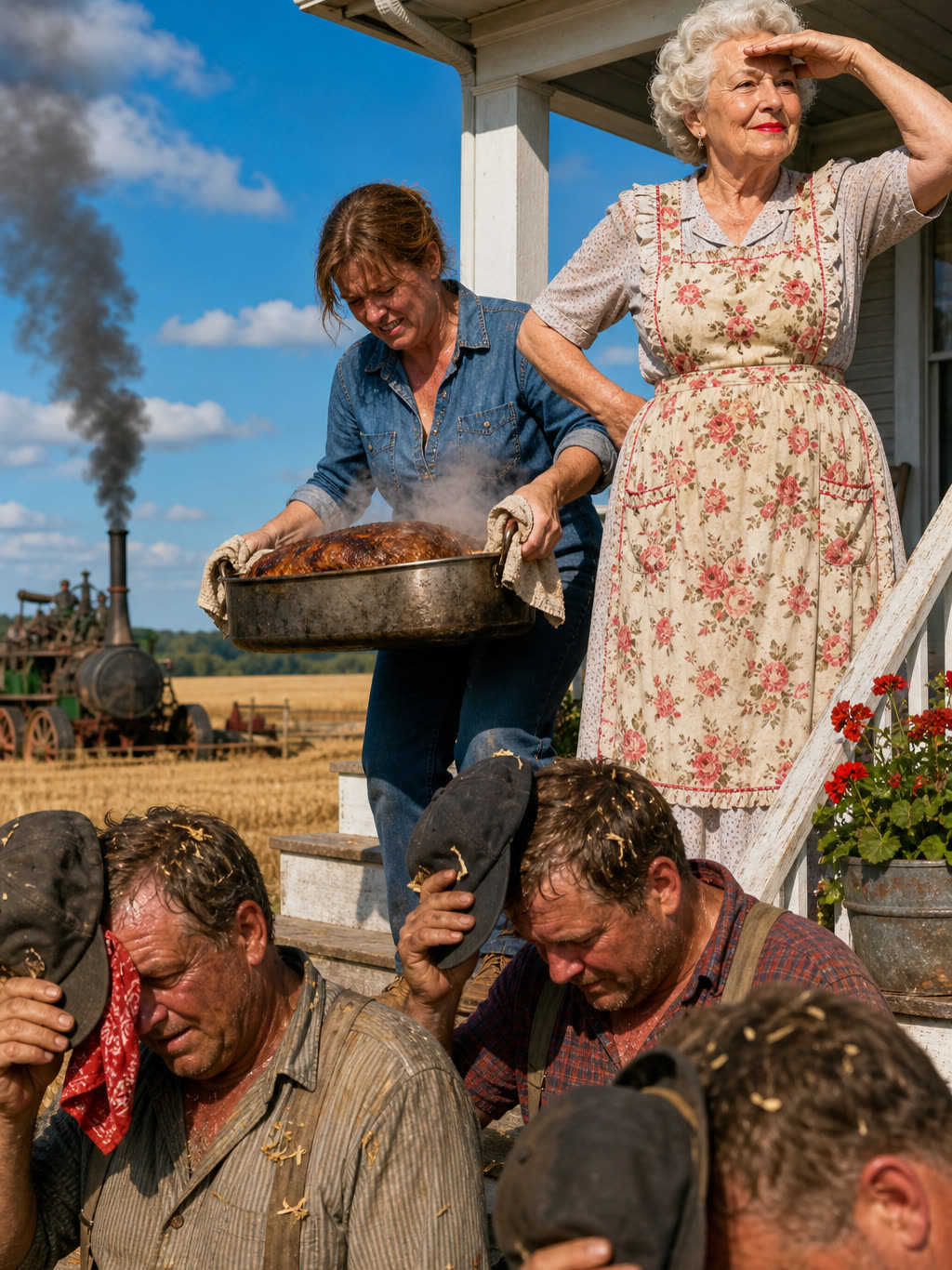
She greeted them on the farmhouse steps, just as she did each year. It was the second Saturday in August, at noon, when the whistle on the old steam engine sounded and the men trudged up from the oat field with chaff in their hair and sweat darkening their shirts.
Faye stood at the top of the porch steps in her flowered apron. Her white hair was set in curls from the beauty shop in Eldora. She had put on lipstick.
She lifted one hand to shade her eyes against the sun.
“I have been cooking since four,” she told them.
I was right behind her, holding the roaster.
Forty pounds of beef. Chuck roast, braised since five that morning with onions and carrots and a pint of my own canned tomatoes. It was so heavy my arms trembled, and the handles were so hot they were burning straight through the dish towel I had wound around my wrists.
I stood on that porch behind her, holding it, and not one man glanced my way. They looked at Faye. They took off their caps and wiped their foreheads with red handkerchiefs.
“Smells wonderful, Faye,” said Dale Kruse, who has farmed the section to the east for fifty years.
“You outdid yourself again,” said one of the Vogel boys. “You’re a saint, Faye,” said Harold Mertz. “A living saint.”
Faye smiled and patted her curls. “Oh, go on,” she said. “Wash up. It’s getting cold.”
The men headed for the pump by the windmill to wash their hands.
I carried the roaster past Faye, through the screen door, down the hall and into her dining room. I set it on the trivet at the long table, beside my green beans and my sweet corn and my bread-and-butter pickles and my dinner rolls.
I said nothing. I had been saying nothing for eleven years.
My name is Sheila Hemmingsen, and I am forty-three years old. I married Roy Hemmingsen when I was thirty-two, a little late by the standards out here in Hardin County, Iowa, where most girls marry the boy from the next farm over before they turn twenty-two.
I was not from the next farm over. I came from Des Moines. I had taught home economics in Ames for nine years when I met Roy at a church supper in Iowa Falls. He was quiet and shy, with big hands and a sunburned neck. He asked me what was in my potato salad, and I told him. He asked me again the following week at a different church supper, even though I knew he remembered.
We married in June, and I moved out to the farm in July. Two farms, really. Roy and I live in a little white house on the east eighty. A quarter mile up the gravel lane sits the home place, the big farmhouse where Roy grew up and where his parents, Earl and Faye, still live.
Behind our little white house lies a half acre. When I arrived it was weeds and a rusted hog feeder. Roy dragged the feeder out with the tractor that first fall, and I tilled the ground the next spring. I have gardened it every year since.
I grow everything. Green beans, three kinds. Sweet corn in two plantings three weeks apart, so it doesn’t all ripen at once. Forty tomato plants. Cucumbers for pickles. Beets, carrots, onions, potatoes, peppers, squash, and pumpkins in the corner by the fence.
I put up two hundred quarts every summer, and I mean that number. I count them. Sixty quarts of green beans, fifty of tomatoes, thirty of pickles, twenty of beets. Corn cut off the cob and frozen, another forty bags. Applesauce from the old trees by the grove. Peach jam, strawberry jam, rhubarb sauce.
I stand at my stove in August with the windows open and the canner boiling and sweat running down my back, and I do it every day for six weeks. My jars fill the basement shelves from floor to ceiling, each one labeled with masking tape in my own handwriting.
Every August, the Hemmingsens host the threshing bee. They have done it since 1948.
Most farmers around here gave up threshing oats the old way sixty years ago, once combines arrived and nobody wanted to shock bundles by hand and feed them into a separator. But Earl’s father, Arnold, kept a 1928 Case threshing machine in the big barn, along with a 1916 Avery steam engine to run it. Every August he brought them out for the neighbors, to thresh a few acres of oats the old way, for the memory of it.
When Arnold died, Earl kept it going. It has grown into a real occasion. People come from all over the county, bringing lawn chairs to set along the fence line, and the kids climb on the old tractors.
Eighteen men work the crew. There are pitchers and bundle haulers, a man to feed the separator, a man to run the engine, a man on the grain wagon, and a man on the straw stack getting chaff down his collar. Some are old men who have done it since they were boys, and some are young men who never have.
They work from seven in the morning until the oats are done, usually four or five in the afternoon. And at noon they stop for dinner.
Out here, dinner means the noon meal, the big one. Meat and potatoes and vegetables and bread and pie, enough to keep eighteen men going through a hot August afternoon of pitching bundles. For thirty years, Faye made it. Then, eleven years ago, I married Roy.
The first August after our wedding, Faye called me on the phone.
“You’ll help with the threshing dinner,” she said. It wasn’t a question.
“Of course,” I said.
That first year, I helped. I made the green beans and the rolls and peeled potatoes in her kitchen while she made the roast, the gravy and the pies. The second year, Faye’s arthritis was worse, so I made the green beans, the rolls, the potatoes and the gravy. By the third year, I was making all of it.
After that, Faye stopped cooking for the threshing dinner entirely. She never announced it. She simply stopped.
The week before, she would phone and say, “You’ll do the beef again, won’t you, Sheila? My hands are so bad this year.” The next day she would call again. “And the beans. You know how the men love your beans.” Then the potatoes. Then the gravy. Then the corn and the rolls and the pickles and the pies.
By the fifth year, I was making everything, in my own kitchen, in the little white house on the east eighty. Every bean on that table was mine. I grew them on the half acre, picked them in the morning dew, snapped them on my back step and canned them in July.
The corn came off my second planting, timed every year so it would be ripe the week of the bee. The tomatoes in the beef came out of my jars, and so did the pickles, the beets and the applesauce.
Even the beef was ours. Roy and I raise four steers a year on the pasture behind the barn, and in the spring we send two to the locker plant in Iowa Falls, one for us and one for the threshing dinner. The locker bill alone ran two hundred dollars for the cutting and wrapping and freezing. I paid it out of our grocery money.
The pies were mine, too. Six of them. Apple from the trees by the grove, cherry from the jars I put up in June, and sour cream raisin because Dale Kruse asks for it every year. The rolls were mine, six dozen, and I was up at two in the morning to get them rising.
On the morning of the bee, I started at four. I loaded everything into the back of Roy’s pickup: the roaster of beef, the kettles of potatoes and beans and corn, the pans of rolls under dish towels, the pies in their tins. Then I drove it all a quarter mile up the gravel lane to the home place and carried it into Faye’s kitchen. The beef went into Faye’s oven to keep warm, the potatoes onto Faye’s stove, the pies onto Faye’s counter.
And at noon, when the whistle blew, Faye would take the roaster out of her oven.
Faye’s part was to carry one pan, forty feet, from her oven to her porch steps. That was all. She would wait until the whistle sounded and the men began walking up from the field. Then she would put on her oven mitts, lift out the roaster, and carry it through her kitchen, down the hall, out the front door and onto the porch.
She would stand at the top of the steps holding it while the men came up the lawn. Then she would hand it to me, and she would say, “I have been cooking since four.”
The first year she said it, I thought I had misheard. The second year, I figured she meant it as a joke. By the fifth year, I understood.
And there was the standing. That was the rest of Faye’s part: to stand on the steps when the men came up from the field, to stand at the head of the table when they sat down, to stand by the pie when they asked who made it. To be standing there when they washed up and said, Thank you, Faye. You’re a saint.
You want to know why I never said a word. I have asked myself that for eleven years, at my stove in August with the canner boiling, in the dark at two in the morning punching down roll dough, on the porch behind Faye with forty pounds of beef burning my wrists. Why don’t you just say something?
Here is the answer. There is no clean way to correct your mother-in-law. Not in a place like this, in Hardin County, Iowa, where everybody has known everybody for four generations and the Hemmingsens have hosted the threshing bee since 1948. Not in front of eighteen hungry men.
Say one word and I become the hard one. I could see it as plain as day. Actually, Faye, I made that. Eighteen men looking at me, then at Faye, then down at their boots.
And then the story would travel, from the threshing bee to the co-op to the café in Eldora to the Lutheran church and onto every kitchen table in the county by Sunday. Roy’s wife made a scene at the bee.
That is the story that would have traveled. Not Faye’s been taking credit for Sheila’s cooking for eleven years. Just Roy’s wife made a scene. The city girl from Des Moines. The one who married late. The one who doesn’t know how things are done out here.
So I kept quiet, and I kept cooking.
Roy knew. He is not stupid. He watched me rise at four every August, he carried the roaster out to the pickup, and he saw the jars on the basement shelves. But Roy is Earl’s son, and Earl is the quietest man I have ever known. In eleven years I have heard him say maybe a hundred words that weren’t about the weather or the price of beans. Roy learned quiet from his father.
“Mom’s had a hard life,” Roy said once. It was the fourth year, in bed after the threshing dinner, when I was crying into my pillow so he wouldn’t hear. He heard anyway.
“Her mother-in-law was terrible to her,” he said. “Grandma Hemmingsen. Mom doesn’t talk about it. But Dad told me once.”
“Told you what?”
Roy was quiet for a long time.
“That Grandma made Mom’s life miserable,” he said. “For twenty years. Until she died.”
“That doesn’t mean Faye gets to do it to me,” I said.
“I know,” Roy said. “I know it doesn’t.” He put his arm around me in the dark. “I’m sorry, Sheila,” he said. “I don’t know how to fix it.”
Our daughter, Megan, was born the second year we were married. She is nine now, with Roy’s sunburned nose and my stubborn streak, and she has helped me in the garden since she could walk. She was the one who noticed first.
She was seven, at the threshing bee. She had come with me at four that morning to help load the pickup, carrying the pickles and the rolls. At noon she stood beside me on the porch while Faye met the crew on the steps.
“I have been cooking since four,” Faye told them.
Megan looked up at me. She said nothing. She just looked, with a little frown.
That night at bedtime, she asked. “Mom,” she said. “Why did Grandma say she cooked?”
I didn’t know what to tell her. “Grandma’s hands hurt,” I said. “She can’t cook like she used to.”
“But she said she did,” Megan said.
“I know.”
Megan thought about it. “That’s a lie,” she said.
“It’s complicated, honey,” I said.
“It’s not complicated,” Megan said. “You cooked. She said she cooked. That’s a lie.”
I had no answer. I tucked her in, turned off the light, and stood in her doorway for a long time. My seven-year-old daughter had seen in a single afternoon what I had been pretending not to see for nine years.
Then, one winter, I quit keeping quiet. It was January, the eleventh winter, with the fields frozen white and the wind howling across the section. I was down in the basement counting jars. Two hundred and four quarts, floor to ceiling.
I stood before the shelves and studied my handwriting on the masking tape. Green beans, July 14. Tomatoes, August 3. Beets. Pickles. Applesauce. And I thought about the threshing bee, about standing on that porch behind Faye with forty pounds of beef burning my wrists, about Harold Mertz calling her a saint.
I thought about Megan at seven saying that’s a lie, and about Megan at nine, watching me do it all over again. Learning from me that when somebody takes credit for your work, you stand behind them and say nothing. I did not want her to learn that.
I did not fight Faye. I want to be clear about that. I didn’t call her or confront her or say a word to anyone. I did something else instead.
Our machine shed sits out back, past the half acre behind the little white house. It is a big gray steel building, forty by eighty, with two sliding doors across the front and a concrete floor. Roy keeps the tractor there in winter, along with the planter, the hay rake, and about thirty years of junk his father handed down.
That spring, I asked Roy to clean it out. He looked at me as though I had lost my mind.
“Clean out the shed?” he said. “Sheila, what for?”
“I’ll tell you,” I said. “But you have to promise not to tell anyone. Not your mother. Not your dad. Not the Vogel boys. Not anybody.”
So I told him, sitting at our kitchen table on a cold March night with the wind rattling the windows. He listened without a word. When I finished, he sat back and stared at me.
“You want to move the threshing dinner,” he said slowly.
“Yes.”
“Out of my mother’s house.”
“Yes.”
“To our machine shed.”
“Yes.”
Roy was silent for a long time. “Mom’s going to have a fit,” he said.
“Probably,” I said.
He looked at the window, at the dark, at the yard light shining on the machine shed. “The bee still runs at the home place,” he said. “The threshing. The engine’s in Dad’s barn. The oats are on Dad’s ground.”
“I know,” I said. “The bee stays where it is.” I took his hand across the table. “But the dinner doesn’t have to,” I said.
Roy looked at me.
“Dinner’s served where the cook says it is,” I said. “And I’m the cook. I’ve been the cook for eleven years.”
He thought about it a long while. Then he smiled, a slow smile, the one I fell in love with at the church supper in Iowa Falls. “Okay,” he said. “Let’s clean out the shed.”
We swept that shed out all summer, on the sly, like a couple of kids. We worked in the evenings after chores, after supper, after Megan was in bed, with the big doors closed so nobody driving by on the gravel road could see.
We hauled out thirty years of junk. An old cultivator. A broken hay rake. A pile of rusted fence posts. Seventeen coffee cans of bent nails. A 1974 Chevy pickup with no engine that Roy’s uncle had left there in 1991. Roy pulled it out with the tractor and we sold it for scrap, two hundred and forty dollars. That paid for the plywood.
Roy and I knelt on the concrete and screwed down sheets of three-quarter-inch plywood over sleepers, so the floor would be smooth and warm and wouldn’t sweat. We painted it gray with porch paint. Roy ran a new electric line from the house, and we hung strings of white café lights back and forth across the rafters, twenty strands.
The first night we switched them on, we stood in the middle of the shed and looked up for a long time. “Sheila,” Roy said quietly. “It looks like a wedding.”
We borrowed tables, eight long folding ones from the Lutheran church in Eldora, the kind with metal legs and fake wood tops. We asked Pastor Lindgren in June and told him it was for a family reunion. He asked no questions. He only said, “Bring them back clean.”
I sewed tablecloths, red gingham. I bought forty yards at the fabric store in Iowa Falls and told the lady it was for curtains. I sewed them at my kitchen table over three nights in July, after Megan was asleep and the canning was done. Eight tablecloths, hemmed by hand on all four sides.
Nobody knew but Roy and Megan. We told Megan in June. She was nine, and so excited she couldn’t sleep. She helped paint the floor and string the lights, and at night she sat on the kitchen floor while I sewed and handed me pins.
“Grandma’s going to be so surprised,” she said.
“Yes,” I said. “She is.”
“Are you going to tell her?” Megan asked.
“No,” I said.
Megan thought about that. “Is that a lie?” she asked.
I put down my sewing. “No, honey,” I said. “It’s a secret. A lie is when you say something that isn’t true. A secret is when you don’t say anything at all.”
She considered that for a long time. “Grandma’s been doing a lie,” she said. “And you’ve been doing a secret.”
“Yes,” I said.
“And now we’re doing a secret back.”
I laughed. “Something like that,” I said.
The bee still ran at the home place. That August, on the second Saturday, everything began the way it always has, the way it has since 1948. At six in the morning Earl fired up the old Avery steam engine in front of the big barn, black smoke rolled from the stack, and the whistle screamed across the section.
By seven the crew had arrived, eighteen men in work clothes and seed caps with pitchforks over their shoulders. The bundle wagons rolled out to the oat field. The men pitched bundles onto the wagons, the wagons rolled back to the machine, and the men pitched bundles into the separator.
The old Case machine roared. Chaff flew, straw blew out onto the stack, and oats poured from the spout into the grain wagon. The spectators sat along the fence line in their lawn chairs while the kids climbed on the old tractors.
Faye stood on her porch in her flowered apron, her hair set in curls, waving to the spectators. Waiting for me to bring the food.
At eight-thirty, Roy walked the crew. He did it one man at a time. He went out to the oat field where the bundle haulers worked, over to the threshing machine where the feeders worked, and up onto the straw stack. He spoke to every one of the eighteen, and he said it plain.
“Dinner’s at our place this year,” Roy said. “The machine shed. Down the lane. Noon.”
Each man looked at him, confused. Then Roy said the rest. “Sheila’s been cooking.”
He said my name, once to each of them. Eighteen times, in the oat field, at the separator, on the straw stack, by the steam engine. Sheila’s been cooking. It was the first time my name had ever been spoken aloud at the threshing bee, in eleven years.
Some of the men said nothing and simply nodded and went back to pitching bundles. Some glanced up the lane at Faye on her porch, then at Roy, then at their boots.
Dale Kruse looked at Roy for a long time. “Your place,” Dale said slowly. “Not your mother’s.”
“Our place,” Roy said.
Dale was silent a moment. Then he nodded once. “Noon,” he said.
And from the porch of the home place, a quarter mile away, I saw Faye drop her wave and slowly lower her hand.
Part Two: The Trucks on the Lane
I was up at four. For once, that was true.
I had been up at four for every threshing bee in eleven years, but nobody ever knew it except Roy, and Faye always claimed it. This year I said it to myself, standing at my stove in the dark with the oven light on and the radio playing KWMT out of Fort Dodge. I have been cooking since four.
Forty pounds of beef, braising since five in the big blue roaster, with onions and carrots and two pints of my own tomatoes. Twenty pounds of potatoes, peeled the night before and soaking in cold water in the refrigerator. Six quarts of green beans from my jars, with bacon and onions.
Sweet corn off my second planting, fifty ears, picked that morning in the dark with a flashlight. Six dozen rolls, which meant rising at two. Six pies: apple, cherry and sour cream raisin. Bread-and-butter pickles, pickled beets, applesauce, and ten gallons of iced tea.
At eight o’clock, Megan came downstairs in her pajamas. “Mom,” she said. “Are you scared?”
I was stirring the gravy and didn’t turn around. “Yes,” I said.
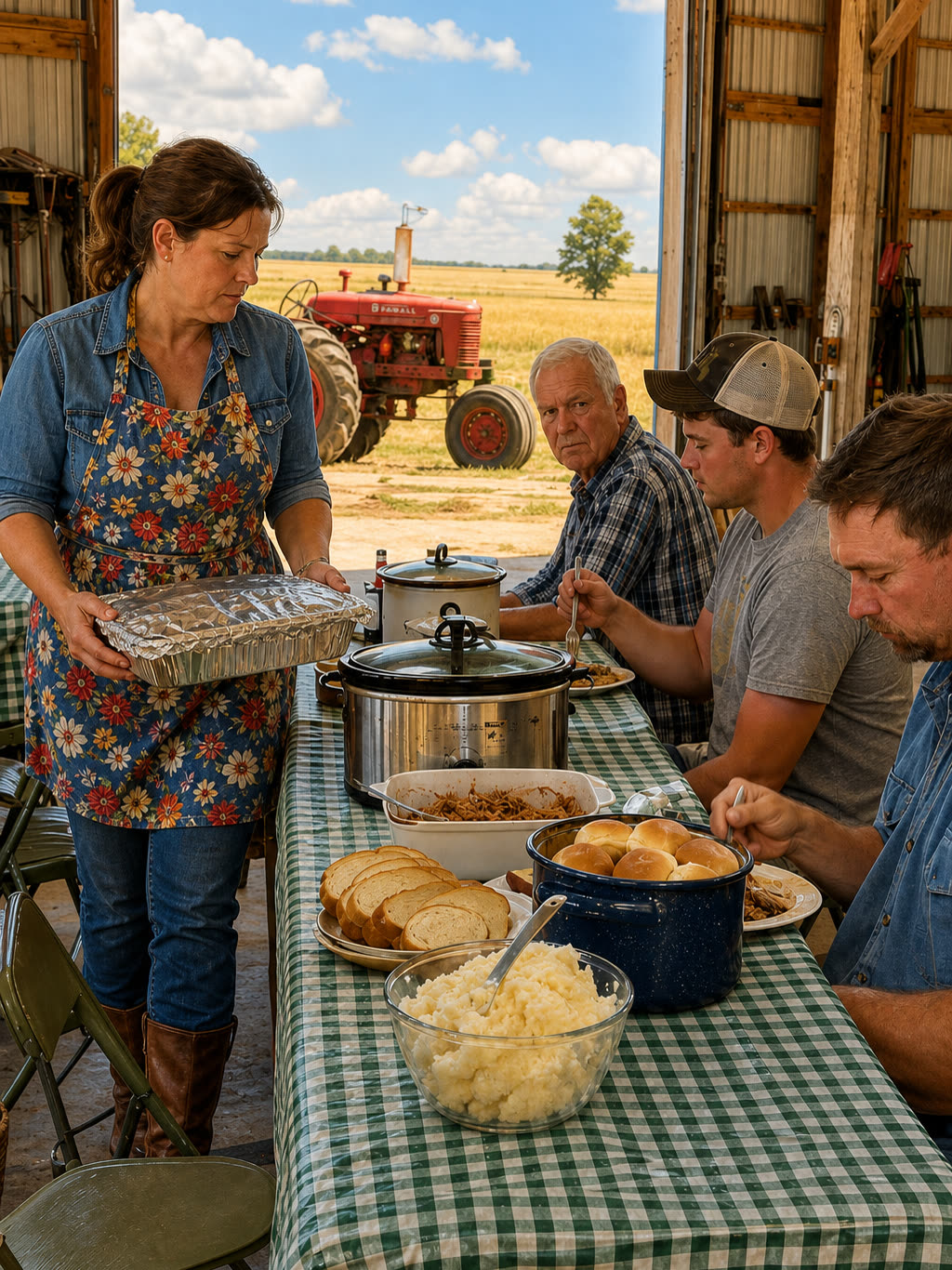
At eleven, I stood in the open doors of the machine shed. Roy had slid them all the way back, both sides, forty feet of open door. Inside, eight long tables ran in two rows down the middle of the shed, covered in red gingham and set with plates and silverware borrowed from the church.
The white café lights glowed in the rafters even in the daylight. At the far end stood a long serving table holding my blue roaster, my kettles, and my pies in a row.
Past the doors, out the other end of the shed, lay the gold field, Roy’s oats, ripe and waving in the August sun. Beyond them, a quarter mile up the lane, sat the home place, the big barn, the black smoke from the steam engine. I could hear the threshing machine roaring.
And I was scared sick. I stood in those doors in my apron with my hands shaking. I was afraid they would drive up to Faye’s out of habit.
Eighteen men, hungry and tired, done at noon and walking to their trucks, starting their engines, turning right up the lane to the home place the way they had for thirty-four years. I was afraid I would stand in a full shed, empty. Eight tables. Red cloths. White lights. Forty pounds of beef. And no one. Eleven years of cooking, riding on a single lane.
Roy came and stood beside me. He had come down from the bee at eleven, covered in chaff, his face sunburned. He took my hand. “They’ll come,” he said.
“You don’t know that.”
“No,” Roy said. “But I told every one of them. And I looked every one of them in the eye.”
Megan came out of the house in a clean blue dress with little white flowers. She had braided her own hair. She stood on my other side and took my other hand, and the three of us waited in the open doors of the machine shed.
Noon came. The whistle on the steam engine blew. I heard it from a quarter mile off, that long, high scream, the signal that the crew was breaking for dinner. The threshing machine went quiet, and I held my breath.
For a long time nothing happened. Thirty seconds. A minute. I could hear the men’s voices far off up at the home place, laughing and talking. I could see Faye on her porch, tiny from here, standing at the top of her steps in her flowered apron. Waiting.
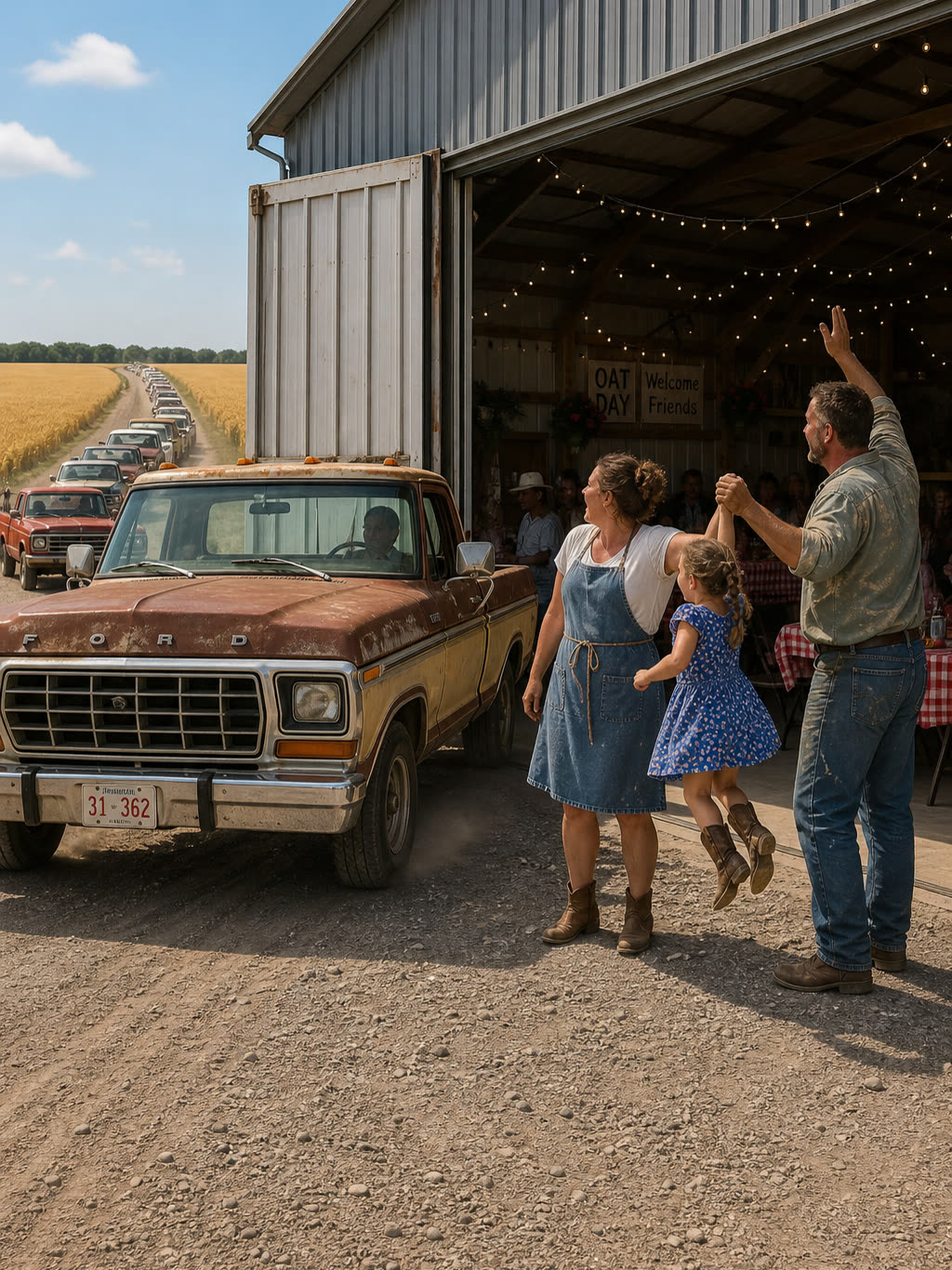
Then I heard an engine start. A truck turned down our lane. Old Dale’s rusted Ford, a 1979 F-150, brown and tan, more rust than paint, with a cracked windshield and a Hardin County Farm Bureau sticker on the bumper.
It came down the gravel lane slowly, raising a little cloud of dust, and it turned in at our place. Then another followed behind it. The Vogel boys’ blue Chevy. Then Harold Mertz’s white Dodge. Then another, and another, a whole string of them raising dust, rolling down the lane one after the other the way cars come in a funeral procession.
Every one of them turned in at our place. Not one went on up to Faye’s. I stood in the open doors of the machine shed and watched them come. Eleven trucks. Eighteen men. Roy squeezed my hand so hard it hurt, and Megan was jumping up and down.
Dale Kruse pulled his rusted Ford up beside the shed and shut off the engine. He climbed out. He is seventy-eight, he has been on the threshing crew since 1958, and he has had both knees replaced. He stood in front of the open doors and took off his seed cap.
He looked at the eight tables, the red gingham, the white lights in the rafters, the blue roaster at the far end. He looked at me. “Well now,” Dale said. He shook his head slowly. “Well now, Sheila,” he said.
They sat. I carried. Megan poured the tea. Eighteen men at eight long tables, in a machine shed with red gingham and white lights and the gold oat field showing through the open doors.
I carried the beef first, the blue roaster, forty pounds. This time I didn’t wrap my wrists in a towel. I used oven mitts, good ones. I set it on the table in front of Dale, and he looked up at me.
Then the potatoes, the gravy, the green beans with bacon, the corn, the rolls in their baskets under dish towels, the pickles, the beets, the applesauce. Megan went down the rows with a big glass pitcher of iced tea, pouring every glass and not spilling a drop.
Then Harold Mertz picked up an ear of corn. He looked at it. He looked at me. “This your corn, Sheila?” he asked.
The whole table went quiet.
“It is,” I said. “Off the half acre out back.”
Harold studied the corn for a long time. Then he nodded. “It’s good corn,” he said.
One of the Vogel boys picked up a green bean. “These your beans, Sheila?”
“Mine,” I said. “Put up in July.”
Ed Larson held up a pickle. “Your pickles?”
“Mine.”
Then a young man I didn’t know, a nephew of the Kruses perhaps, from Ames, held up a roll. “Ma’am,” he said. “Did you make these?”
“Up at two to get them rising,” I said.
He looked at the roll in his hand. “These are the best rolls I’ve ever had in my life,” he said.
Down two long tables it went, one by one, each man asking whose food it was. The beef, from our own steer, off the pasture behind the barn. The beets, off the half acre. The applesauce, from the old trees by the grove. The gravy, mine.
And each one thanked me. By name. Thank you, Sheila. Thank you, Sheila. This is wonderful, Sheila. Sheila, you outdid yourself. Eighteen men. Eighteen times.
I stood at the end of the serving table with my oven mitts in my hands and tears running down my face, and I didn’t wipe them away. Megan came and stood beside me and put her arm around my waist.
“Mom,” she whispered. “They know.”
Then I turned around with a pan of corn, the second batch, fresh off the stove. I turned from the serving table.
And there in the doorway stood Faye.
She was standing in the open doors of the machine shed in her flowered apron, her hair set in curls, her lipstick on. She had walked down the lane, a quarter mile, on her bad hip, in the August heat. She held nothing. Her own stove sat a quarter mile off, going cold.
The shed went quiet. Not all at once. The men at the near tables saw her first and stopped talking, then the men behind them, then the whole shed. Eighteen men with forks halfway to their mouths, looking at Faye in the doorway, and then at me with my pan of corn.
Nobody said anything. I didn’t know what to do. I stood there with the corn, and Faye stood in the doorway, thirty feet between us. Eleven years between us.
Then Earl stepped up beside her.
Part Three: The Spoon, the Crust, and the Sign
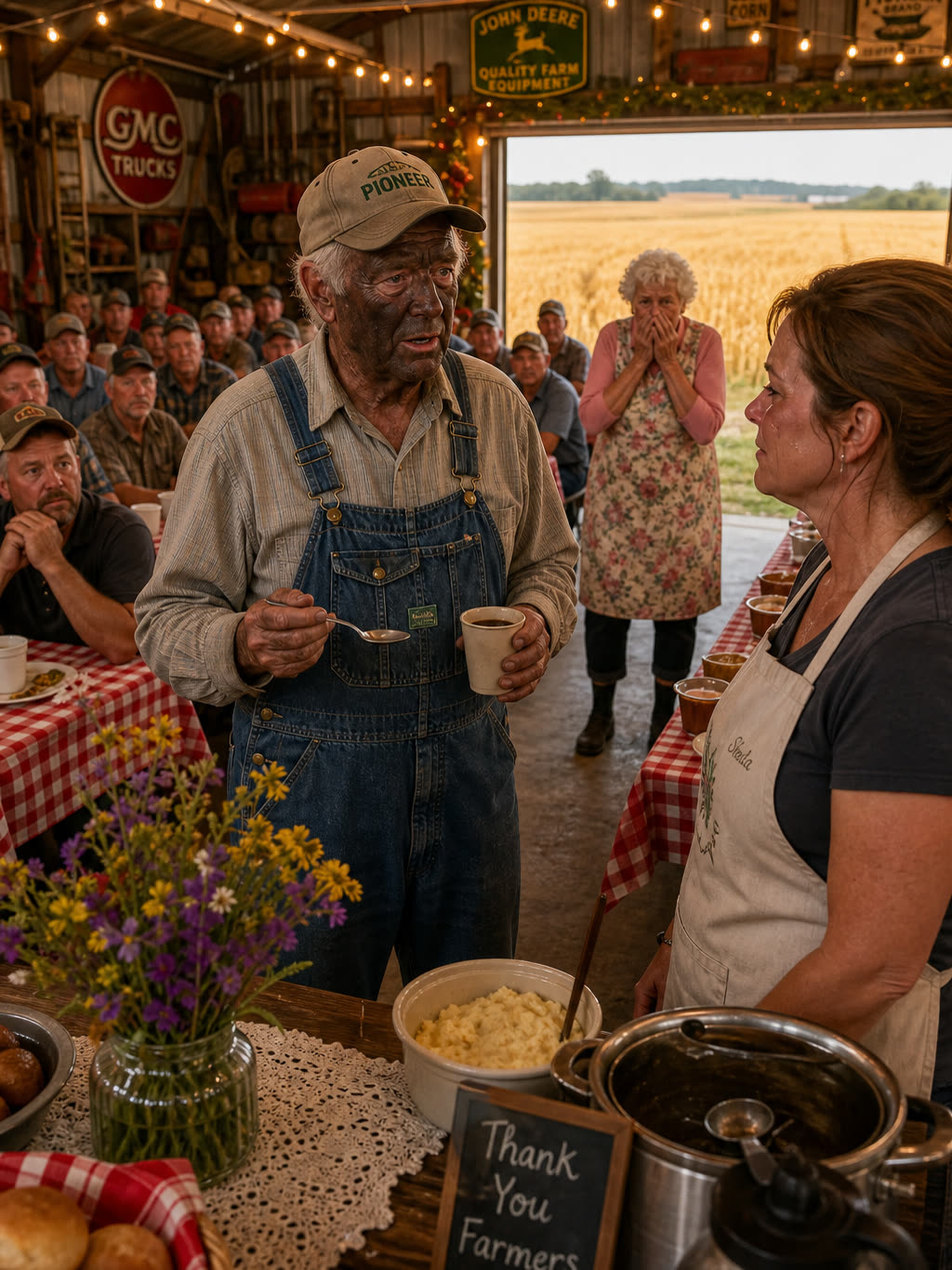
My father-in-law, Earl Hemmingsen, is seventy-six years old. He is tall and thin and a little bent at the shoulders. He has big hands like Roy’s and a face like a dried creek bed, and he has worn the same pair of bib overalls to the threshing bee since 1971.
He has run the steam engine every year since his father died, and he was still covered in coal soot, black on his hands, black on his face, black in the creases around his eyes.
In thirty years, I had never heard that man make a speech. Not at Roy’s wedding. Not at Megan’s baptism. Not at his own fiftieth anniversary party in the church basement, when the whole congregation chanted speech, speech, speech and he only shook his head and sat back down.
Earl doesn’t make speeches. Earl talks about the weather and the price of beans, and sometimes, if you are lucky, the engine.
He walked into the shed, past Faye and past the first row of tables. He walked down the aisle between them in his sooty overalls with eighteen men watching.
He stopped at the head of the second table, right in the middle of the shed, under the white lights. He picked up a spoon, a plain steel spoon from the church silverware, and tapped it twice on a coffee cup. Clink. Clink.
The whole shed went still. The men set down their forks. Megan set down her pitcher. Faye stood frozen in the doorway.
Earl looked right at me, past his own wife.
He said nothing for a long moment. He just stood in the middle of the machine shed with a spoon in one hand and a coffee cup in the other, looking at me with his coal-black face and his tired eyes. Then he set down the cup and cleared his throat.
“I’m not much for talking,” Earl said. His voice was low and rough, like a gate that hasn’t been opened in years. “Most of you know that.”
A few of the old men smiled.
“But I’ve got something to say,” Earl said. “And I’ve waited eleven years to say it.” He looked at me. “Thirty-four years, really,” he said.
Nobody moved.
“I’ve eaten this dinner every August since I was a boy,” Earl said. “My mother made it. Then my wife made it. Then my son’s wife made it.” He looked around the shed. “And not once,” Earl said, “in all those years, did anybody thank the right woman.”
The shed was dead silent.
“My mother,” Earl said, “told this crew for twenty years that she cooked the threshing dinner.” He looked at the doorway, at Faye. “She didn’t,” Earl said quietly. “Faye did. My wife. From the time we married in 1972 until my mother died in 1992. Faye was up at four every August. Faye canned the beans. Faye made the rolls.”
He swallowed. “And my mother stood on those porch steps,” Earl said, “and told every man in this county it was all her own doing.”
I turned and looked at Faye. She stood in the doorway with her hand over her mouth.
“I never said a word,” Earl said. “Not once. Twenty years. I let my mother take that from my wife. Because I didn’t know how to correct my own mother. Not in front of eighteen hungry men.” He looked at his boots. “I told myself it didn’t matter,” he said. “I told myself Faye didn’t mind.”
He looked up. “She minded,” Earl said.
“When my mother died,” Earl said, “Faye finally got her turn. Her turn on the porch. Her turn to be thanked. And she’d waited twenty years for it.” He looked at me. “And then her hands got bad,” he said. “And she couldn’t cook anymore. And Sheila came along and started doing it all.”
He shook his head slowly. “And Faye couldn’t let go,” Earl said. “Couldn’t give up the only thanks she ever got.” He looked back at his wife in the doorway. “So she did to Sheila,” Earl said, “exactly what my mother did to her.”
Faye made a sound, a small, broken sound.
“And I let that happen too,” Earl said. “Eleven more years. I stood by that steam engine every August and watched my son’s wife carry forty pounds of beef up the porch steps behind my wife, and I never said a word.” His voice cracked. “That’s thirty-one years I kept quiet,” he said. “Thirty-one years of watching the wrong woman get thanked. Twice.”
He turned to face me and took off his seed cap, his gray hair matted with sweat and soot. “Sheila,” he said. “Thank you,” Earl said. “For eleven years of threshing dinners. For your beef and your beans and your corn and your rolls.”
He looked at the eight tables, the red gingham, the white lights. “For this,” he said. Then he looked at the men. “This dinner,” Earl said, “was cooked by Sheila Hemmingsen. Every bite of it. For eleven years.”
He paused. “Before that,” he said, “it was cooked by Faye Hemmingsen. For twenty years. While my mother took the credit.” He looked at the doorway. “I’m sorry, Faye,” he said quietly. “I should’ve said it in 1972.”
Then he looked back at me. “And I’m sorry, Sheila,” Earl said. “I should’ve said it the first year.”
He put his cap back on, sat down, and picked up his fork.
Nobody moved for a long time. Then Faye walked into the shed. She walked slowly, on her bad hip, between the tables, past eighteen men who wouldn’t look at her. She walked the whole length of the aisle to the far end, to the serving table.
To me.
She stopped in front of me. I was still holding the pan of corn, and she looked at it. “That’s the second planting,” she said quietly. Her voice was shaking. “The one you put in three weeks after the first. So it’d be ripe the week of the bee.”
I stared at her. “You noticed that?” I said.
“I noticed everything,” Faye said. “Every year. The tomatoes in the beef. The bacon in the beans. The sour cream raisin pie for Dale.” She looked at the jars of pickles on the serving table, at my handwriting on the masking tape. “I noticed,” she said. “I just couldn’t say it.”
Her eyes filled with tears. “Earl’s mother stood on those steps for twenty years,” Faye said. “And every year, I stood behind her holding the roaster. And every year, the men thanked her.” Her voice broke. “I was twenty-two the first year,” she said. “I cried in the bathroom. Earl’s mother found me and told me to wash my face and stop making a scene.”
“And then she died,” Faye said. “And I finally got to stand on the porch. And the men finally thanked me. And it was the best day of my life.”
She looked down at her hands, gnarled and swollen with arthritis. “And then these started,” she said. “And I couldn’t hold a paring knife. And I couldn’t punch down bread. And you came along. Young and strong. With your garden and your jars and your home economics degree.”
She looked up at me. “And I thought, She’s going to take it,” Faye said. “The only thing I ever got thanked for.”
“So I took it first,” Faye said.
I couldn’t say anything.
“It was wrong,” Faye said. “I knew it was wrong. Every single year. I’d stand on those steps and say I have been cooking since four, and I’d hear Earl’s mother’s voice coming out of my mouth.” She wiped her eyes. “And I couldn’t stop,” she said. “I’m sorry, Sheila,” she said. “I’m sorry for eleven years.”
I set the pan of corn down on the serving table and took off my oven mitts. I looked at my mother-in-law, standing in my machine shed in her flowered apron, her hair set in curls, her lipstick smudged now from crying. At her hands, gnarled and swollen. At twenty years of standing behind somebody else on the porch steps, holding a roaster that burned her wrists.
“Faye,” I said. “Who made the pie crust?”
She stared at me. “What?”
“The pie crust,” I said. “On the sour cream raisin. The one Dale asks for every year.”
Faye didn’t answer.
“It’s yours,” I said. “Your recipe. You gave it to me the first year. On a recipe card. In your handwriting. With lard, not shortening. And a splash of vinegar. I’ve made it every year since,” I said. “Exactly the way you wrote it. I never changed a thing.”
Faye put her hand over her mouth.
“And the beef,” I said. “Braised with tomatoes. That’s yours too. You told me that first August. Always put a pint of tomatoes in with the chuck roast, Sheila. Earl’s mother never did. It’s what makes the gravy.”
Faye was crying openly now. “I didn’t think you remembered that,” she whispered.
“I remember everything,” I said.
I turned around and picked up a pie, the sour cream raisin, the one with Faye’s crust. I turned back to the room, to the eighteen men at the eight long tables. “This pie,” I said, loud enough for the whole shed to hear, “is made with Faye Hemmingsen’s crust recipe. She’s been making it since 1972.”
I held it up. “Nobody ever thanked her for it,” I said.
The shed was silent. Then Dale Kruse stood up, seventy-eight years old, two new knees, chaff still in his hair. He took off his cap. “Faye,” he said. “I’ve eaten that pie every August for fifty years.” He looked at her. “Thank you,” he said.
Then Harold Mertz stood. “Thank you, Faye.” Then the Vogel boys. Then Ed Larson. Then the young man from Ames, who had never been to a threshing bee before and knew nothing about any of it.
“Thank you, ma’am,” he said.
One by one, eighteen men. Thank you, Faye. Thank you, Faye. Thank you, Faye. Faye stood in the middle of my machine shed and cried.
There were eighteen men at eight tables, and two empty chairs at the end of the second table, right under the white lights. I had set them out that morning without knowing why. Megan pulled one out and looked at her grandmother.
“Grandma,” she said. “Sit down. You walked all the way here.”
Faye looked at the chair. Then she looked at me. Megan pulled out the second chair and looked at me. “Mom,” she said. “You sit too. You’ve been standing since four.”
I had not sat down at a threshing dinner in eleven years. Not once. Faye and I sat, side by side, at the end of the second table under the white lights. Megan put a plate in front of each of us and piled them with beef and potatoes and beans and corn. She poured us each a glass of iced tea, and she didn’t spill a drop.
Earl sat across from us. He looked at his wife, then at me. He said nothing. He had said enough for one day. He simply passed the rolls.
After dinner the men went back to the bee. The whistle blew at one, and they threshed until four-thirty, every bundle, the best oat crop in ten years, Earl said.
When they came down the lane at five to collect their trucks, Dale Kruse stopped at the shed door. I was inside washing dishes in a big tub of hot water on the serving table, and Faye stood beside me drying. She had stayed all afternoon.
“Sheila,” Dale said. “Faye.” We both turned. “Same time next year?” he asked. “Here?”
Faye and I looked at each other. “Here,” Faye said.
Dale nodded. “I’ll bring my wife’s rhubarb dream bars,” he said. “She’s been wanting to bring something for twenty years. Nobody ever asked.”
That was three years ago. The threshing bee still runs at the home place. Earl still fires up the old Avery steam engine at six in the morning, the black smoke still rolls from the stack, the whistle still screams across the section, and the eighteen men still pitch bundles into the 1928 Case separator.
But the dinner is in our machine shed now. Eight long tables from the Lutheran church, red gingham tablecloths, white lights strung across the rafters. And a sign. Roy made it the second year, out of an old barn board, and burned the letters in with a wood-burning tool from the hardware store in Iowa Falls. It hangs over the big sliding doors.
THRESHING DINNER. Cooked by Sheila & Faye. Since 1972.
Faye comes down to our house at four in the morning now, every second Saturday in August. She can’t cook much, and her hands grow worse every year. She can’t hold a paring knife or punch down bread. But she can sit at my kitchen table and tell me when the gravy’s right, and she can roll a pie crust, slowly, with her knuckles, the way she has since 1972.
I make the beef, the beans, the corn, the rolls, the pickles and the beets. Faye makes the crust for the sour cream raisin. At noon, when the whistle blows and the trucks come down the lane, we stand together in the open doors of the machine shed, side by side.
The men come in and sit. Megan pours the tea. She is twelve now, and she doesn’t spill a drop. I carry the beef, Faye carries the pie, and every year, before the men pick up their forks, Earl stands, takes up a spoon, and taps it twice on a coffee cup. Clink. Clink. The shed goes still. He doesn’t make a speech. He says two sentences.
“This dinner was cooked by Sheila,” he says. “The pie crust is Faye’s.”
Then he sits down, and the men say thank you. To both of us. By name.
Last August, after the dinner, after the dishes, after the trucks went home, I found Faye standing alone in the open doors of the machine shed, looking out at the gold oat field and, past it, up the lane at the home place. Her own porch steps. The sun was going down, and the white lights glowed in the rafters behind her.
“Faye?” I said. “You okay?”
She didn’t turn around. “I was thinking about Earl’s mother,” she said quietly. “Standing on those steps.” She was quiet for a long time. “I wish somebody had built me a shed,” she said. “In 1972.”
I stood beside her and said nothing for a while. Then I took her hand, her gnarled, swollen hand, the hand that rolled out pie crust with its knuckles because it couldn’t hold a rolling pin anymore.
“Somebody did,” I said. “It just took fifty years.”
Faye laughed. Then she cried. Then she did both, standing in the open doors of my machine shed in her flowered apron, with the gold field going dark in front of us.
A few minutes later Megan came out of the house carrying a recipe card, an old one, stained with lard and splashed with vinegar, in Faye’s handwriting from 1972. Pie Crust. For Sour Cream Raisin. Lard, not shortening. A splash of vinegar. Don’t overwork it.
“Grandma,” Megan said. “Will you teach me this? Next year?”
Faye looked at the card for a long time. Then she looked at me. Then she looked at her granddaughter.
“Only if you put your name on it,” she said. “When you make it. Every time.”
Megan thought about that. “Grandma’s crust,” she said slowly. “Mom’s filling. My pie.” She looked up. “Is that a lie?” she asked.
Faye smiled. “No, honey,” she said. “That’s a family.”
Disclaimer: This story is a work of fiction inspired by real-life themes. Names, characters, places and events are fictionalized, and any resemblance to real persons is purely coincidental. Images are for illustration purposes only.
