

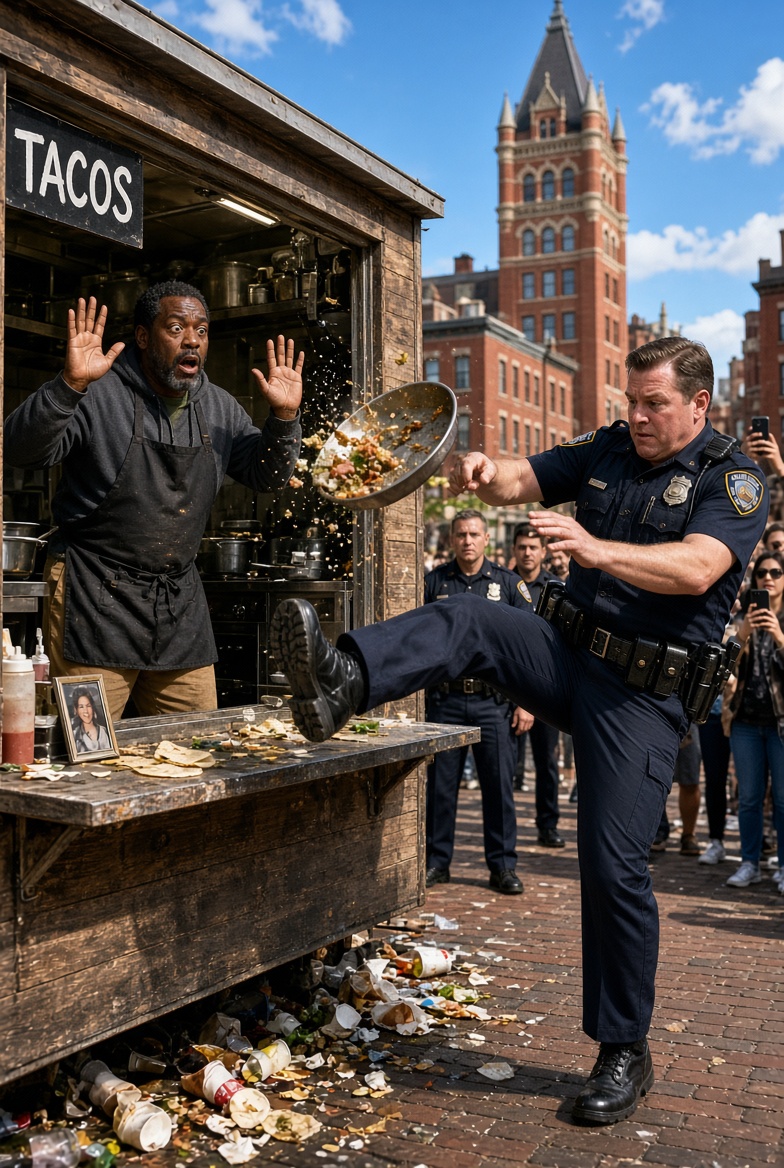
Officer Derek Brennan slammed his hand against the metal counter of Valor Bites, the sound cracking down 16th Street like a warning shot.
“Look at this. Another welfare case pretending to run a business,” he said, then kicked the food truck’s tire twice.
“You steal this truck? Bet you did.
Your kind always does.”
Elijah Thompson stepped back with both hands open and visible. “Officer, I own this truck legally.
I have all my permits right here.”
“Permits?” Brennan snatched the dog tags hanging near the service window, yanked them free, and threw them onto the pavement.
“Fake military garbage. You buy this junk online to scam people?”
He spat near Elijah’s foot. “I’ve seen a hundred people like you.”
The morning crowd froze.
Phones rose.
Cameras began recording.
Elijah’s voice stayed quiet, almost a whisper. “Sir, please.
I’m just trying to work.”
Brennan smirked. “Work?
This is my street, and you’re leaving one way or another.”
Thirty minutes earlier, the sky over Denver had glowed soft orange.
At 6:47 a.m., Elijah unlocked his food truck as his keys jingled in the cool October air.
He was forty-two, but he moved like someone younger, shoulders straight and steps precise.
Eighteen years of military service had trained his body to follow routines even when his mind was tired.
The truck’s name stretched across the side in bold letters: Valor Bites.
Beneath it, smaller text read, “Veteran-Owned and Operated.”
A faded military insignia decorated one corner.
Everything about the truck looked clean, cared for, and loved.
Inside, Elijah wiped down the grill until the metal gleamed under the overhead lights.
He arranged eggs, cheese, peppers, and tortillas in neat rows, each item exactly where he wanted it.
His hands worked fast but never rushed.
Eighteen years in the Army had taught him efficiency without chaos.
Marvin Gaye played softly on the radio while Denver woke outside.
Joggers passed, a homeless man pushed a cart, and the first sunlight turned the skyscraper windows gold.
Elijah parked in his usual spot on 16th Street, a designated zone for veteran-owned small businesses.
A green city sign marked the area clearly, and his laminated permit hung in the truck window with an expiration date of March 2026.
Everything was legal.
Everything was current.
By seven, the first customers arrived.
Sarah Carter, a defense attorney in her mid-thirties, ordered the same thing she ordered every morning.
“Breakfast burrito, extra salsa, black coffee,” she said, tapping her card on the reader. “Morning, Elijah.
How’s business?”
“Can’t complain. God’s been good.”
He handed her the burrito wrapped in foil, still warm from the grill.
“You going to the VA meeting this weekend?” Sarah asked.
“Wouldn’t miss it. We’re talking about the homeless-veteran outreach program.”
Sarah nodded. “You’re doing good work.
Keep it up.”
Next in line was James Rodriguez, a construction worker who had been coming to the truck for four months. “My man, give me two of everything.
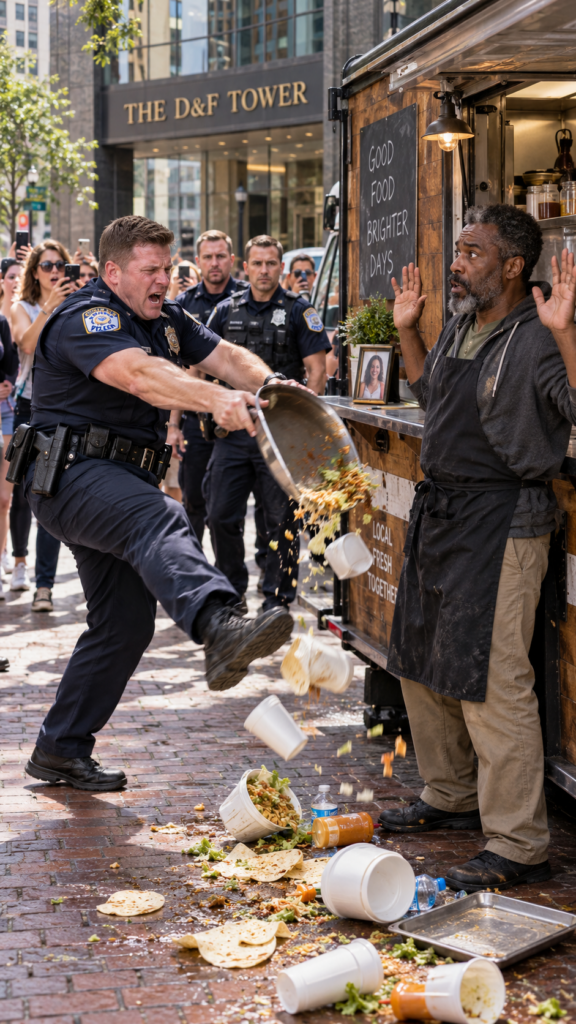
The crew’s hungry today.”
Elijah laughed and started cracking eggs. “You got it, brother.”
An elderly Vietnamese woman, Mrs. Nguyen, shuffled toward the window and pointed at the menu.
Elijah already knew what she wanted.
He handed her a vegetarian burrito and waved away her cash. “On the house today, Mrs. Nguyen.”
She tried to protest, but he shook his head gently. “You remind me of my late wife.
She’d want me to take care of you.”
Mrs. Nguyen’s eyes watered.
She bowed slightly, whispered “thank you” three times, and walked away clutching the warm foil package.
A man in torn fatigues approached next.
His name was Marcus, and he never offered a last name.
He was homeless, a Gulf War veteran with a weathered face, dirty hands, and eyes that still held something sharp and alert.
“Elijah.” Marcus nodded.
“Marcus. You eating today?”
“Not yet.”
Elijah poured him a strong black coffee and handed over a breakfast sandwich. “It’s Thursday.
You know what that means.”
Marcus managed a small smile. “You spoil me, man.”
“We take care of our own. You know that.”
Marcus lingered. “You hear about Jenkins?
They found him under the overpass. Froze to death.”
Elijah’s jaw tightened.
He knew Jenkins, another veteran and another brother lost.
“I’ll make some calls,” Elijah said. “See if we can get more blankets out there before winter hits hard.”
“You’re a good man, Elijah.”
“Just doing what’s right.”
The morning rhythm continued.
Orders came steadily, and Elijah worked the grill, called out names, joked with regulars, and filled the truck with the smell of bacon, coffee, and fresh tortillas.
The radio switched to Al Green, and people began humming along without realizing it.
Everything felt normal.
Elijah glanced at a photograph taped to the wall.
His late wife, Angela, smiled back at him.
She had died three years earlier after cancer took her quickly.
The truck had been her dream, built around her recipes and the simple idea that feeding people could be a kind of love.
Every burrito, every smile, every free meal for a struggling veteran was still for her.
Valor Bites was how Elijah kept part of Angela in the world.
He checked the clock.
7:13 a.m.
Another good morning in a string of good mornings.
Another day of purpose.
Then he saw the patrol lights.
A police car rolled toward the curb with its red-and-blue lights spinning silently.
No siren, just the lights turning across the pavement.
Officer Derek Brennan stepped out first.
He was thirty-eight, thickly built, with a buzz cut going gray at the temples and a uniform stretched tight across his chest.
He adjusted his duty belt and let one hand rest near his weapon, not on it, just near enough to send a message.
His partner followed.
Officer Kyle Hayes was nearly a decade younger, thinner, and visibly uncomfortable.
Hayes had been on the force for three years.
He had seen Brennan work before, and his nervous eyes suggested he already knew what kind of stop this might become.
Brennan walked straight to Valor Bites.
He did not look at the city permit displayed in the window or at the veteran-owned parking sign beside the curb.
“Morning,” Elijah said evenly.
He had survived enough dangerous situations to recognize a person who wanted control more than answers.
Brennan was already broadcasting that danger.
Brennan said nothing at first.
He circled the truck slowly, dragging his fingers across the side panel before stopping at the permit.
He leaned close and squinted at it as if studying a forgery. “This your truck?”
“Yes, sir. Everything’s registered and legal.”
“I didn’t ask if it was legal. I asked if it’s yours.”
Elijah took a slow breath. “Yes, sir.
I’m the owner. Elijah Thompson.”
Brennan finally looked directly at him, sweeping his eyes from Elijah’s face to his shoes and back again. “Thompson.
Is that your real name?”
“Yes, sir.”
“License, registration, permit, insurance. Everything.”
Elijah reached slowly for his wallet, keeping his hands visible.
He passed over his driver’s license, truck registration, business permit, and insurance card.
Everything was current.
Everything was official.
Sarah Carter was still standing nearby with her coffee.
She watched Brennan take the papers without properly examining them.
“Officer, is there a problem?” she asked. “Mr. Thompson has been parking here legally for six months.”
Brennan turned his head slowly. “Ma’am, step back.
This doesn’t concern you.”
“I’m a witness to whatever this is.”
“Step back or I’ll cite you for obstruction.”
Sarah’s jaw tightened, but she moved three steps away.
Her phone was already recording.
She was not the only one.
At least a dozen people had raised cameras.
Brennan studied Elijah’s documents for far too long.
Two minutes became five, and five became ten.
Customers shifted their weight and checked their watches while food cooled on the grill.
“These look photocopied to me,” Brennan said, holding the business permit toward the light.
“Sir, that’s the original document from the city. It has the official seal.”
“Are you telling me how to do my job?”
“No, sir. Just explaining.”
“I can see what it is.”
Brennan lifted his radio. “Dispatch, Unit 47.
I need a records check on a business permit and a background on Elijah Thompson.”
A female dispatcher responded. “Copy, 47.
Stand by.”
Hayes shifted behind Brennan.
He looked toward the growing crowd, opened his mouth once, then said nothing.
Elijah stood perfectly still, his hands resting on the counter where everyone could see them.
Inside, his heart pounded.
His therapist’s voice echoed in his memory: Breathe. Count.
Don’t let them trigger you.
The radio crackled again. “Unit 47, records show business permit valid through March 2026.
Driver’s license active. No warrants, no priors.
Vehicle registration current.”
Brennan’s jaw shifted from side to side.
He clipped the radio back to his belt but did not return Elijah’s documents.
“Doesn’t matter what the computer says. I’m looking at this with my own eyes, and something’s not right.”
“Officer, I don’t understand. Everything checks out.”
“You understand just fine. This street’s been having problems.
Illegal vendors, health-code violations, suspicious activity.”
“I’m not illegal. I have every permit the city requires.”
Brennan stepped closer to the service window until Elijah could smell coffee and cigarettes on his breath. “Are you arguing with me?”
“No, sir. I’m just trying to understand what the issue is.”
“The issue is I say there’s an issue. That’s how this works.”
Brennan finally handed the documents back, but his fingers lingered just long enough to make Elijah pull them free.
Hayes cleared his throat. “Derek, maybe we should—”
“Maybe you should secure the perimeter. Keep these people back.”
Hayes moved toward the crowd. “Folks, please step back.
Give the officer room to work.”
No one moved.
Sarah kept filming, as did a young Black man in a hoodie and an older white woman holding a dog leash.
Brennan circled the truck again, this time searching for something he could use.
He checked the tires, license plate, rear door, and finally tried the locked back entrance.
“Open up the back.”
It was not a request.
“Sir, may I ask why?”
“Health inspection.”
“You’re not a health inspector.”
Brennan’s face hardened. “I have authority to investigate potential health-code violations.
Open it now.”
Elijah forced his hands to stay still.
Angela’s voice seemed to whisper from somewhere in his memory: Choose your battles, baby.
Come home to me.
But Angela was gone.
There was only this truck, this street, and this moment.
“Officer, I’m happy to comply, but I’d like to understand the specific concern. Is there a complaint filed against me?”
“The specific concern is I smell something suspicious coming from your truck.”
“Suspicious? It’s breakfast food.
Eggs, bacon, tortillas.”
“Don’t tell me what I’m smelling. Open the truck or I’ll open it myself.”
The crowd murmured.
Someone said, “This is wrong.”
Another voice added, “He isn’t doing anything illegal.”
Brennan spun around. “Anyone else want to chime in?
Because I’ve got all day and plenty of citation books in my car.”
The crowd went quiet, but the phones stayed up.
Cameras kept recording.
Elijah unlocked the back door.
His keys jingled loudly in the sudden quiet.
“Everything inside is food-grade, inspected, and certified,” he said. “I passed my health inspection two months ago.
The certificate is posted inside.”
Brennan pushed past him into the truck.
His boots tracked dirt across the clean floor Elijah had mopped that morning.
He opened containers, lifted lids, moved supplies, and made a mess because he could.
Hayes watched from the door with the expression of someone who wanted to be anywhere else.
Elijah stood outside his own truck, hands at his sides, watching a stranger tear through his late wife’s dream.
His jaw ached from clenching.
Breathe.
Count.
Don’t react.
Don’t give him a reason.
Brennan emerged five minutes later empty-handed.
He had found nothing because there was nothing to find.
That only seemed to make him angrier. “You got a smart mouth, Thompson.
Real smart.”
He stepped close again. “I’m going to figure out what you’re hiding here.
And when I do, that permit won’t mean anything.”
“I’m not hiding anything, sir. I’m just trying to make a living.”
Brennan laughed sharply. “A living?
Tell me, where’d you really get the money for this truck? Family?
Friends? Something else?”
The implication hung in the air.
Elijah kept his voice controlled.
“I saved for three years. Used my military pension and savings.
Built this truck with my own hands to honor my late wife.”
“Late wife. Military pension.
You’ve got an answer for everything, don’t you?”
“Just the truth, sir.”
Brennan stared at him for a long beat, then looked at Hayes. “Call for backup.
I want another unit here. Something’s not right about this setup.”
Hayes raised his radio reluctantly. “Unit 47 requesting backup at 16th and Blake.”
The dispatcher confirmed another unit was on the way.
A normal morning became something else entirely.
Brennan climbed into the truck again before backup arrived.
Cabinet doors banged open and metal clanged against metal.
Elijah’s instincts screamed at him to intervene, but he knew what could happen if a Black man physically interfered with a police search, even an unlawful one.
So he stood outside with visible hands and controlled breathing.
Inside, Brennan opened the commercial cooler and pulled out containers of prepared vegetables.
Lettuce scattered across the counter and tomatoes rolled onto the floor.
He opened a sealed container of cooked bacon, smelled it, and made a face as if it were spoiled even though it had been prepared that morning. “This looks questionable.”
Hayes did not respond.
He was watching the crowd instead.
More people had gathered, perhaps thirty now.
A woman in medical scrubs stood with her arms crossed, her expression openly disapproving.
Brennan searched the dry storage next, opening bags of flour, sugar, and spices as if expecting contraband.
He found only food.
At the prep station, he picked up a ten-inch chef’s knife and held it under the light. “You’ve got a lot of knives in here.”
“It’s a commercial kitchen, sir. Those are standard cooking tools.”
“Standard, right?”
Brennan set the knife down but kept one hand near it, allowing the suggestion to linger.
The backup unit arrived.
Sergeant Maria Rodriguez stepped out.
She had been on the force for twenty-three years, wore a crisp uniform, and had the tired eyes of someone who had seen bad decisions made by good and bad officers alike.
She walked to Hayes first. “What’s the situation, Officer Hayes?”
Hayes shifted. “Brennan’s conducting an investigation.
Possible health-code violation.”
Rodriguez looked at the permit in the window, the veteran-owned parking sign, and the crowd filming everything.
Her eyes narrowed.
“Health code? Since when do patrol officers handle health inspections?”
Hayes said nothing.
Rodriguez walked to the service window. “Sir, I’m Sergeant Rodriguez.
May I ask your name?”
“Elijah Thompson. Ma’am, I own this truck.”
“Mr. Thompson, what’s going on here?”
Before Elijah could answer, Brennan emerged from the truck, sweating despite the cool morning.
He had searched for fifteen minutes and found nothing.
“Sarge, this individual was parked illegally, refused to provide documentation, and got hostile when questioned.”
Sarah stepped forward immediately. “That’s a lie.
I watched the whole thing. He provided every document requested.
He’s been nothing but respectful.”
“Ma’am, I told you to step back,” Brennan snapped.
“I’m an attorney and a witness. I’m not stepping anywhere.”
Sarah held up her phone, still recording.
Rodriguez raised one hand.
“Everybody calm down. Hayes, what did you observe?”
Hayes looked between Brennan and Rodriguez.
His mouth opened and closed before he finally answered.
“The parking appears legal, Sarge. Documentation was provided.
I didn’t observe any hostility.”
Brennan’s head snapped toward him. “What?”
“I’m just stating what I saw.”
Hayes would not meet Brennan’s eyes.
Rodriguez nodded slowly. “Mr. Thompson, do you consent to a search of your vehicle?”
Elijah knew his rights. “Ma’am, with respect, I’d like to know what probable cause exists for a search.”
Rodriguez almost smiled. “Brennan, what’s your probable cause?”
“I smell marijuana coming from the vehicle.”
Elijah’s stomach dropped.
It was a blatant lie.
“Officer, that’s false. I don’t use drugs.
Never have. You can test me right now.”
Brennan raised his radio again. “Dispatch, I need a K-9 unit at 16th and Blake.
Possible drug activity.”
The crowd erupted. “This is harassment.”
“He didn’t do anything.” “Someone call the news.”
Rodriguez raised both hands. “Everybody quiet.
Brennan, stand down for a second. Let me handle this.”
Brennan ignored her.
He reached inside the truck, grabbed the chef’s knife again, and held it up where everyone could see it.
“Concealed weapon right here in plain view.”
“That’s a cooking knife,” someone shouted.
“Blade longer than five inches. Illegal concealment in a commercial vehicle.”
Rodriguez briefly closed her eyes.
When she opened them, her voice was sharp.
“Brennan, that’s not how the statute works, and you know it.”
But Brennan had committed himself to the confrontation. “Sir, put your hands where I can see them.”
“They are visible, officer. They haven’t moved.”
“Hands up now.”
Elijah raised his hands slowly, palms open.
A Purple Heart keychain dangled from one finger and caught the sunlight.
Brennan saw it and curled his lip. “What’s that?
Some kind of gang jewelry?”
“It’s my Purple Heart keychain, sir. From my military service.”
“Sure it is. Turn around.
Face the truck. Hands on the vehicle.”
Rodriguez stepped forward. “Derek, this is—”
“He’s got a weapon and he’s refusing lawful orders. I’m detaining him for officer safety.”
“He’s complying with everything you’ve asked,” Sarah called out.
“Last warning, ma’am. Back up or you’re under arrest for obstruction.”
Elijah turned slowly and placed his palms flat against Valor Bites.
The metal felt cool beneath his skin.
His own truck.
Angela’s dream.
Now it felt like a cage.
Brennan kicked his feet apart wider than necessary and searched him roughly.
He found only Elijah’s wallet, keys, and phone.
Then the phone rang.
Brennan pulled it from Elijah’s pocket and looked at the screen.
The caller ID read: DoD Pentagon Liaison.
The crowd went silent.
Even Brennan paused.
Then he declined the call and tossed the phone onto the truck counter. “Probably a scammer.
They always try to sound official.”
Elijah’s voice stayed soft. “Sir, that’s really my work contact.
They’ll call back. It’s important.”
“Nothing about you is important.”
Brennan pulled out handcuffs. “You’re under arrest for obstruction, possession of a concealed weapon, and operating without proper permits.”
“All his permits are valid,” Sarah shouted.
Rodriguez moved between them. “Derek, I’m ordering you to stand down.
There is no probable cause for arrest here.”
“I have plenty of cause. I witnessed the whole thing.”
“So did I,” Rodriguez said. “And so did thirty people with cameras.
Think about what you’re doing.”
Brennan grabbed Elijah’s right arm and pulled it behind his back.
The cuff clicked shut too tightly.
Elijah winced but did not resist.
A veterans’ rights workshop six months earlier had taught him the same rule he had lived by in dangerous places: if the arrest is wrong, fight it in court, not on the street.
The second cuff closed around his other wrist.
Brennan pushed him toward the ground.
“On your knees.”
Elijah lowered himself carefully.
His knees hit the concrete, waking old injuries with a flare of pain.
“Face down.”
He lowered his body until his cheek pressed against the sidewalk.
Grit and dirt dug into his skin.
Brennan placed a knee against his back, not enough to injure him, but enough to make the point.
Power was the point.
Hayes finally spoke. “Derek, this is too much.
He’s compliant.”
“Shut up, Hayes. Call it in.”
Hayes hesitated with his hand over the radio.
His eyes met Rodriguez’s.
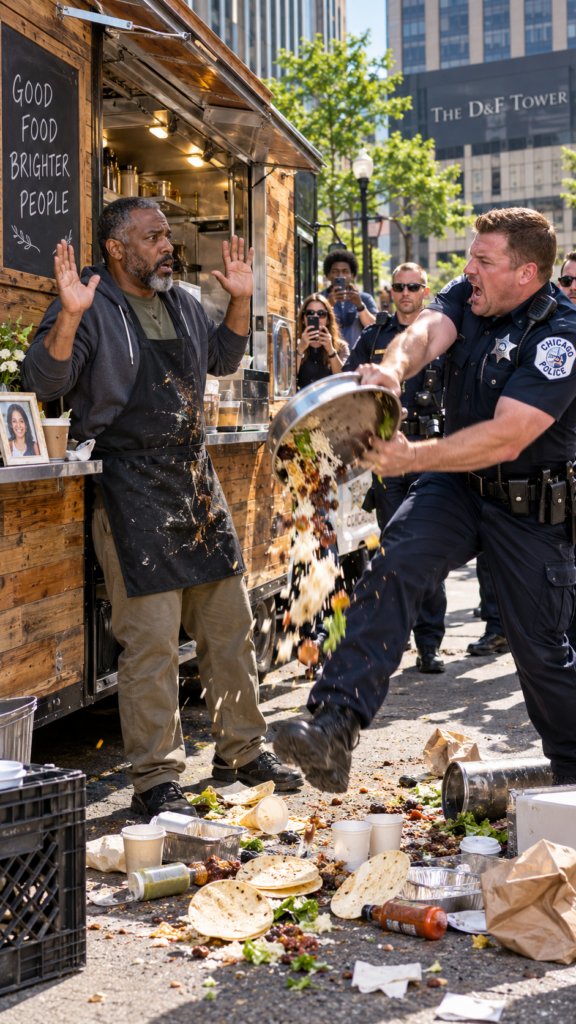
She nodded once. “Do it.
Document everything.”
Hayes keyed the radio. “Dispatch, Unit 47.
One in custody. Male approximately forty.”
Brennan added, “Resisting arrest. Weapon recovered.”
“I didn’t resist,” Elijah said against the pavement. “I’m a veteran.
I’m complying fully. This is unlawful.”
Brennan leaned slightly more weight into him. “Yeah, and I’m a five-star general.
Save it for booking.”
Elijah’s phone rang again on the counter.
DoD Pentagon Liaison.
Second attempt.
Brennan looked toward it, then away. “Persistent scammers.”
Rodriguez walked to the counter and picked up the phone.
Her face changed when she saw the screen.
“Derek, you need to see this.”
“I’m busy.”
“Look at this screen now.”
Brennan refused to move.
He had gone too far to admit a mistake in front of the crowd.
“Doesn’t matter who’s calling. This individual broke the law.
He’s under arrest. End of story.”
The ringing stopped.
Thirty seconds later, it began again.
Third attempt.
Urgent.
Rodriguez answered and placed the call on speaker.
A woman’s voice filled the morning air, cold and authoritative.
“Denver Police Department, this is Colonel Patricia Morrison with the Department of Defense. I need to speak with Lieutenant Colonel Elijah Thompson immediately regarding an urgent national-security matter.
Authentication code Tango Seven-Niner Victor Alpha Two.”
The street went completely still.
Rodriguez looked at Elijah lying face down in handcuffs, then at Brennan, whose face had gone pale.
“Colonel Morrison, this is Sergeant Rodriguez. We’re on scene with Mr. Thompson.
There’s a situation here.”
“What kind of situation requires my consultant to be unavailable during a national-security matter?”
“Your consultant?”
“Lieutenant Colonel Thompson is a senior adviser to the Joint Chiefs. He is scheduled for a classified briefing in fourteen hours.
Why isn’t he answering his phone?”
The moment seemed to freeze.
Brennan’s knee was still against Elijah’s back.
His hand still held the handcuff chain, but all confidence had disappeared from his face.
Rodriguez swallowed. “Colonel Morrison, can you verify your identity?”
“Sergeant, I don’t have time for games. Put Thompson on immediately.”
“Ma’am, he’s currently detained.”
Silence followed, the kind that seemed to lower the temperature of the whole street.
“Detained?” Morrison’s voice dropped.
“You detained a senior Pentagon consultant? On what grounds?”
Rodriguez looked at Brennan.
He was frozen.
She looked at Hayes.
He would not meet her eyes.
Thirty phones recorded everything.
“Ma’am, hold while I assess this.”
“Sixty seconds, Sergeant. Then I call your chief.
After that, the FBI.”
Rodriguez muted the phone and turned on Brennan. “Get him up now.”
Brennan could barely move.
“Derek, remove those handcuffs now.”
Hayes moved first.
He knelt and unlocked the cuffs.
Red marks circled Elijah’s wrists.
Hayes helped him stand.
“Sir, I’m sorry.”
Elijah stopped him with a look.
Not angry, just tired.
He brushed dirt from his shirt and tested his shoulders.
His knees ached and his wrists throbbed, but he was standing.
Rodriguez handed him the phone. “Sir, the colonel is waiting.”
Elijah took it.
His voice changed immediately.
“Colonel Morrison, Thompson here.”
The command authority in his tone made several people look at him differently.
“Elijah, what is happening in Denver?”
“Minor misunderstanding, ma’am. Local officers mistook me for someone else.”
“You hold TS/SCI clearance and advise the Joint Chiefs. How do you get mistaken?”
“I was off duty running my food truck, my therapy project.”
Morrison’s voice softened slightly. “I remember.
But this sounds like more than a misunderstanding.”
“Yes, ma’am. It does.”
“Do you need the Inspector General?”
“Not yet. Let local jurisdiction handle it first.”
“Twenty-four hours, Elijah. If this isn’t resolved, I make calls.”
“Understood, Colonel.”
“I still need you for tomorrow’s briefing.”
“I’ll be there.”
“Put the sergeant back on.”
Elijah handed the phone to Rodriguez.
She took it like a fragile device that might explode.
“Sergeant Rodriguez, I’m sending you a Department of Defense contact. Call within the hour with a full report.
If Lieutenant Colonel Thompson was mistreated, expect federal consequences. Clear?”
“Crystal clear, ma’am.”
The line ended.
Rodriguez looked at Elijah with a new level of attention. “Sir, may I see credentials?”
Elijah reached into his wallet and produced Department of Defense identification.
The photograph showed him in uniform, and the clearance information confirmed top-secret access.
Rodriguez studied the card, then handed it back carefully. “Lieutenant Colonel, I had no idea.”
“You weren’t supposed to know. I separate work and personal life.”
He produced more documentation, including a Pentagon consultant badge and a letter on Department of Defense letterhead commending his advisory work on veteran programs.
Hayes stared at the documents. “Sir, if I’d known—”
“If you’d known, you’d have treated me differently,” Elijah said. “That’s the problem.
You shouldn’t need to know my credentials. Everyone deserves dignity.”
Hayes nodded, looking sick.
Brennan stood frozen, staring at nothing.
The swagger was gone.
Sarah pushed forward. “Lieutenant Colonel Thompson, I’m Sarah Carter.
Attorney. I witnessed everything, and I have video.”
“Thank you, Ms. Carter.”
“I’ll represent you pro bono if needed.”
“Let’s see how this plays out first.”
Other voices joined in.
The nurse, the construction worker, and several customers offered testimony and recordings.
Marcus, the homeless veteran, stood at the edge of the crowd with tears in his eyes.
Rodriguez called Chief Maria Diaz. “Chief, you need to come to 16th Street immediately.”
She listened, then continued. “We just detained a Pentagon consultant and decorated veteran.
It’s all on camera. Multiple witnesses, multiple videos.
The Pentagon is already involved.”
Her eyes moved to Brennan. “I’m recommending immediate suspension.”
Brennan’s voice came out hoarse. “Sarge, I didn’t know.
How could I know? He didn’t identify himself.”
“You found nothing illegal and nothing wrong. You escalated anyway,” Rodriguez said.
“You risked all of us because you couldn’t let it go.”
“He looked suspicious.”
“He looked Black. That’s not suspicious.”
The truth landed without euphemism.
Elijah watched without satisfaction.
His expression held only sadness, as if he already knew the same thing would happen tomorrow to someone who had no Pentagon credentials.
He walked to his truck and surveyed the mess inside.
Food had been scattered, supplies disrupted, and the frame holding Angela’s photograph and his Bronze Star had been cracked.
He picked it up carefully and brushed away loose glass. “This was my wife’s dream.
She died three years ago from cancer. She wanted to feed people.
This truck kept her alive for me.”
Brennan flinched.
“You destroyed it because I looked suspicious,” Elijah continued. “I’m lucky.
I have credentials. The Pentagon calls for me.
But the next veteran, the next Black owner, what happens to them?”
No one answered because everyone already knew.
Chief Maria Diaz arrived in an unmarked car.
She was fifty-two, Latina, with silver threaded through dark hair and twenty-five years on the force.
She stepped out with the expression of someone who knew she had arrived at a disaster already too public to contain.
Rodriguez met her at the perimeter and showed her the phone recordings.
Diaz’s jaw tightened with every second.
She looked at the crowd, at the cameras, and finally at Elijah standing beside his damaged truck.
Recognition flashed across her face.
“Lieutenant Colonel Thompson. From the VA board.”
“Chief Diaz. I wish this were different circumstances.”
She surveyed the truck. “What happened?”
“Your officers happened, ma’am.”
Diaz turned to Rodriguez. “Full report.”
Rodriguez walked her through the baseless stop, valid documents, search, false marijuana claim, cooking knife labeled as a weapon, arrest, and ignored Pentagon calls.
Diaz listened without interrupting.
Her face hardened.
“Body-camera footage?”
“Mine is active,” Rodriguez said. “Brennan’s was off.”
Diaz turned sharply. “Off during a civilian interaction?”
“Yes, Chief.”
“That’s a policy violation.”
She walked toward Brennan.
He was sitting on the curb with his head in his hands.
“Stand up.”
He rose slowly and refused to meet her eyes.
“Your body camera was off. Why?”
“I forgot to activate it.”
“You forgot during a stop that became an arrest.”
She held out her hand. “Incident notes.”
Brennan handed them over.
Diaz read aloud. “Subject parked illegally.
Refused compliance. Displayed aggression.
Concealed weapon discovered.”
She looked up. “Is this accurate?”
“That’s what I observed.”
Diaz faced the crowd. “Does anyone here agree with that description?”
Silence held for a moment before Sarah stepped forward.
“I observed the opposite. Mr. Thompson was polite and legal.
Officer Brennan was aggressive from the start.”
“Anyone else?”
Hands rose across the sidewalk.
Dozens of witnesses contradicted Brennan.
Diaz handed the notes to Rodriguez. “Potential false official statement.
Add it to the investigation.”
Then she faced Brennan. “Badge and weapon.
Now.”
“Chief, let me explain.”
“Nothing to explain. I have thirty videos, Pentagon records, and a veteran with marked wrists.
Badge. Weapon.
Now.”
Brennan’s hands shook as he unpinned the badge he had worn for twelve years.
Then he removed his duty weapon and holster and surrendered both.
Diaz handed them to Rodriguez. “Suspended without pay, effective immediately.
Report to Internal Affairs tomorrow at 0800.”
“What about my union rep?”
“Call whoever you want. You’re still suspended.”
Brennan looked at Hayes for support.
Hayes turned away.
Diaz addressed him next. “You witnessed misconduct and stayed silent until Rodriguez arrived.
Correct?”
“Ma’am, I tried telling him to stop.”
“Tried isn’t enough. Policy requires intervention.
You’re reassigned to desk duty for a minimum of two weeks pending review.”
Hayes nodded.
He had expected worse and knew he deserved worse.
Diaz approached Elijah. “Lieutenant Colonel, I apologize on behalf of Denver Police.
This should never have happened.”
“Apologies are a start,” Elijah said. “They’re not enough.”
“Agreed. What do you want?”
“Real consequences. Real reform.
Protection for the next person without Pentagon credentials.”
“You have my word on a thorough investigation. Internal Affairs is involved, and FBI Civil Rights will be notified within the hour.”
“FBI?” Brennan asked weakly.
“For what?”
Diaz did not look at him. “Potential deprivation of rights under color of law.
Federal offense.”
Sarah handed Diaz her card. “Chief, I’m representing Lieutenant Colonel Thompson.
All communication through me.”
“Understood. We need his statement downtown after medical attention and after the property damage is documented.”
“Fair.”
Diaz signaled Rodriguez. “Photograph everything.
Truck damage, injuries, all of it. Complete evidence package before end of shift.”
“Yes, ma’am.”
A Channel 7 news van pulled up, followed soon by Channel 9.
Reporters moved toward the scene with cameras and microphones.
Diaz muttered under her breath, then turned to Elijah. “Sir, you’re not required to speak to press.”
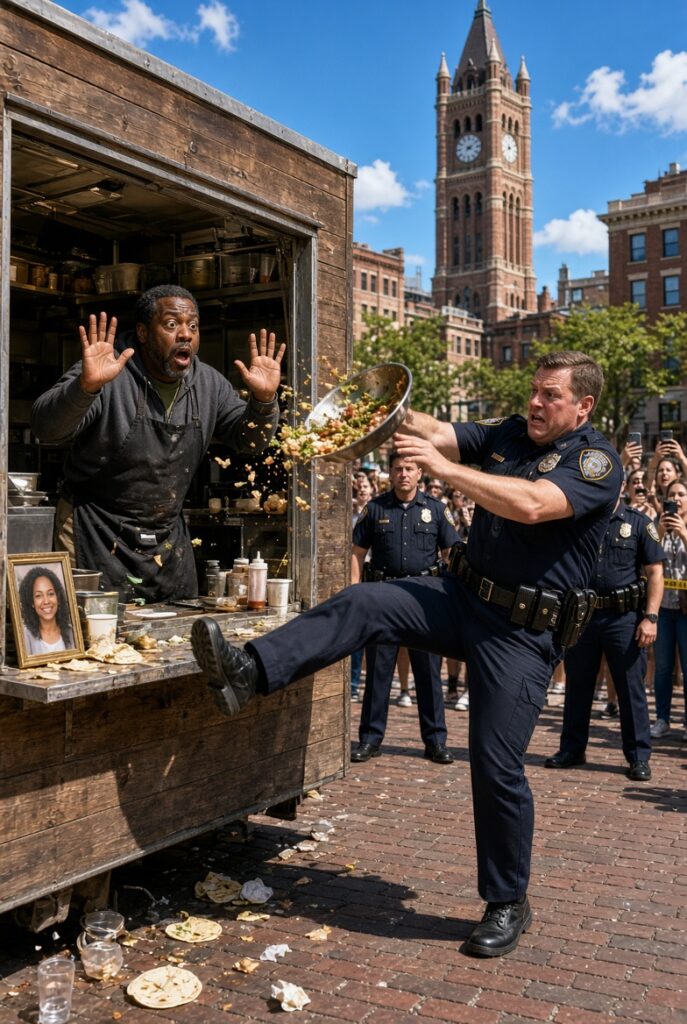
“I know my rights, Chief. I’ll make a brief statement.”
The reporters crowded around him. “Mr. Thompson, what happened here?
Were you assaulted? Is the Pentagon involved?”
Elijah raised one hand and the questions quieted.
“My name is Elijah Thompson. I’m a retired Army Lieutenant Colonel and Pentagon consultant.
This morning, while legally operating my veteran-owned food truck, I was detained without cause, searched without lawful basis, and arrested on false allegations.”
His voice was calm and factual.
“I’m fortunate. I have credentials.
I have people who will take my calls. Most people don’t.
That’s the real problem.”
“Will you press charges?” a reporter asked.
“I’ll let the system work. We’ll see if it does.”
Brennan stood alone on the curb without his badge or weapon, wearing the same uniform that had carried authority only an hour earlier.
Elijah walked past him to secure the truck.
Their eyes met briefly.
Brennan opened his mouth, perhaps to apologize, but no words came.
The investigation began within hours.
By noon, Internal Affairs had opened a formal case.
By evening, FBI Civil Rights had assigned two agents.
By the following morning, the Department of Defense Inspector General had contacted Denver Police directly.
Three agencies were now asking questions about Derek Brennan.
The videos went viral first.
Sarah’s recording reached social media before noon.
By afternoon it had millions of views, and by midnight it had spread across the country.
Hashtags about veteran dignity and police accountability trended nationally.
News networks replayed the same images: Brennan kicking the truck, throwing the dog tags onto the pavement, ignoring Pentagon calls, and kneeling over a compliant Elijah.
Within twenty-four hours, the Department of Defense released a statement condemning Elijah’s detention and calling for full accountability.
The statement summarized his service record, including eighteen years in uniform, four combat deployments, a Purple Heart, a Bronze Star with Valor, and dozens of commendations.
Denver responded with organized protest rather than violence.
Veterans led the demonstrations.
Two hundred gathered the first day, five hundred the next, and roughly a thousand by the weekend.
Many stood in quiet formation carrying flags and handmade signs.
Marcus, the homeless veteran Elijah had fed for months, stood near the front in a clean borrowed uniform.
His sign read, “This could have been me.”
Mayor Carter called an emergency press conference and promised reform and accountability.
The crowd listened without applause.
Internal Affairs moved quickly.
Hayes entered his interview with a union representative prepared to protect himself, but the evidence forced a different choice.
Investigators showed him the videos and explained the federal exposure he might face for enabling misconduct.
His resolve broke.
He told them about seventeen previous complaints against Brennan, how supervisors had minimized them, how union pressure discouraged accountability, and how everyone knew Brennan had a pattern.
“How many of those complaints involved people of color?” an investigator asked.
Hayes looked down at his hands. “Fourteen.”
The investigator underlined the number twice.
They pulled Brennan’s public social-media history.
It made the case worse.
Investigators found racist memes, demeaning posts about urban neighborhoods, comments defending unnecessary force, and a shooting-range photograph captioned with language comparing city patrol to a combat zone.
Thirty-seven other officers had reacted positively to the post.
Internal Affairs forwarded the material to the FBI.
Federal investigators now had evidence relevant to motive, intent, and a broader departmental culture.
The case expanded beyond a single unlawful stop.
District Attorney Rachel Morrison convened a grand jury.
The proceedings took two weeks.
Twenty-two witnesses testified.
Sarah described the stop, customers described the search, Rodriguez described the body-camera failure and escalation, and Hayes described the years of ignored complaints.
Elijah testified last.
He wore a formal suit rather than military dress and carried himself with the same disciplined posture the crowd had seen on 16th Street.
The prosecutor asked him to describe the incident.
He did so calmly, without exaggeration.
“How did it feel to be forced face down on concrete while serving your community?”
Elijah paused before answering. “Like being in a place where I had to survive first and argue later.”
“Do you believe Officer Brennan’s actions were racially motivated?”
Elijah chose his words carefully. “I believe he saw a Black man with a business and decided something had to be wrong.
He saw my service as fake because it didn’t fit the story he had already written about me.”
He looked toward the jurors. “If I had looked different, I believe he would have driven past.”
The grand jury returned indictments on every major count submitted, including state charges for official misconduct, false imprisonment, and falsifying reports, along with federal civil-rights charges.
The criminal case moved quickly because so much of the evidence existed on video.
Brennan’s lawyers attempted several delays, but the judge rejected motions that lacked legal basis.
Opening statements began on a Monday.
Prosecutors presented the videos early.
The jury watched Brennan strike the truck, throw the dog tags, ignore the Pentagon calls, and press Elijah to the pavement after records had already confirmed every permit was valid.
Several jurors reacted visibly.
One older man shook his head in disbelief.
The defense argued reasonable suspicion.
Prosecutors answered with the permit, legal parking designation, valid records check, spotless health inspection, and testimony from officers on scene.
“What was suspicious, Officer Brennan?” the prosecutor asked during cross-examination. “The food truck, the veteran designation, or Mr. Thompson’s skin color?”
Brennan had no convincing answer.
Hayes testified for the prosecution after receiving limited immunity for truthful cooperation.
He described the pattern, the complaints, the fear of confronting Brennan, and the culture that encouraged silence.
“Why didn’t you stop him?” the prosecutor asked.
Hayes’s voice broke. “I was afraid of being labeled disloyal.
Afraid of losing my career. I chose my career over what was right, and I’ll regret that for the rest of my life.”
The trial lasted eight days.
The jury deliberated for four hours before returning guilty verdicts on the principal charges.
The courtroom erupted briefly before the judge restored order.
Elijah remained seated and closed his eyes for a moment.
Sentencing came two weeks later.
The courtroom was packed.
The judge addressed Brennan directly. “You were given authority to protect and serve.
You used it to persecute and humiliate a citizen who had done nothing unlawful.”
The judge continued, “You manufactured violations, filed false statements, and allowed racial prejudice to override both law and judgment. This was not legitimate policing.”
Brennan received eight years in federal prison, with related state sentences ordered to run concurrently.
He was permanently barred from law-enforcement employment and ordered to pay restitution and fines.
His pension rights were substantially affected by the criminal findings and administrative process.
Twelve years on the force ended in disgrace.
The consequences reached beyond one man.
Denver Police announced a broad package of reforms.
Mandatory bias and constitutional-policing training became part of annual certification.
An independent oversight board gained expanded authority, and complaint procedures were redesigned so supervisors and union representatives could no longer quietly bury patterns of misconduct.
Body-camera compliance became mandatory, with automatic administrative consequences for unjustified failures to activate.
The department also adopted clearer intervention rules requiring officers to step in when colleagues violated policy.
The city settled Elijah’s civil case for $1.2 million.
He donated half of the settlement to homeless-veteran programs in Angela’s name.
Three other officers resigned after their own public social-media activity and disciplinary histories surfaced during the investigation.
Hayes kept his job but was demoted and made ineligible for promotion for five years.
He accepted the punishment and began volunteering with Elijah at veteran-outreach events, trying slowly to make amends.
The Colorado legislature introduced a police-accountability bill inspired by the case.
It passed with bipartisan support after months of hearings.
The Department of Justice later incorporated elements of the investigation into civil-rights training materials.
Veterans’ organizations also used Elijah’s experience to emphasize knowing one’s rights, documenting encounters, and seeking legal help rather than escalating on the street.
Other cities watched Denver’s response.
Some adopted similar reforms immediately, while others resisted.
Change came slowly, but it came.
One unlawful stop had exposed a pattern that paperwork and silence had protected for years.
Six months later, morning sun caught the side of Valor Bites as it pulled into the same parking space on 16th Street.
The veteran-owned sign was still there.
The truck had been completely restored.
The paint was brighter, the damaged panels repaired, and a mural of Angela now covered one side, surrounded by images of food and community.
A local artist had donated the mural.
Elijah cried the first time he saw it.
Inside, the kitchen gleamed with new equipment, a better grill, and upgraded refrigeration.
Part of the settlement made those improvements possible.
At first, Elijah had resisted using the money on the truck.
Sarah convinced him otherwise.
“Use it to build something better,” she told him. “That’s how you honor what happened.”
The frame containing Angela’s photograph and his Bronze Star hung on the wall again with new glass.
Beside it was a letter from the Secretary of Defense praising Elijah’s restraint, reform work, and continued service to veterans.
The morning crowd returned quickly.
Most of the regulars had never really left.
Even while Valor Bites was closed for repairs, customers asked when Elijah would return.
They had supported him, testified for him, and waited for the truck to come home.
Sarah was first in line, as always. “The usual.”
“You know it.”
She smiled. “How does it feel to be back?”
Elijah handed her the burrito. “Like coming home.
Like finishing what Angela started.”
Marcus appeared next, looking different from six months earlier.
He was cleaner, healthier, and standing straighter.
A housing program had found him an apartment, and he had a part-time job at the VA.
They were small steps, but they were forward.
“Morning, brother,” Marcus said.
“Marcus. Good to see you standing tall.”
“Learned from the best.”
Elijah handed him coffee. “This one’s on me today.”
Marcus pulled out crumpled bills. “Your money’s no good here, you know that.”
“Elijah, you can’t keep giving forever. Let me contribute.”
They compromised.
Marcus paid half.
The day moved smoothly.
Orders came steadily, laughter filled the air, and Al Green sang through the speakers.
At noon, a police car pulled up.
Elijah’s hands paused for half a second.
Old instinct.
Old memory.
The person who stepped out was Rodriguez, dressed in street clothes and off duty.
“Sergeant, what can I get you?”
“Just Rodriguez now. Or Maria, if you prefer.”
She ordered a lunch burrito. “I wanted to check on you.
See how you’re doing.”
“I’m good. Better than good, actually.”
Rodriguez hesitated. “What you went through, I’m sorry it happened.
Sorry I didn’t arrive sooner.”
“You arrived when you arrived. You did the right thing when it mattered.
That’s what counts.”
They talked while she waited for her food, mostly about reforms and how slowly the department was changing.
“Hayes asks about you sometimes,” Rodriguez said. “He wants to apologize in person but doesn’t think he has the right.”
“Tell him I’m here every morning. Door’s open.”
Rodriguez took her burrito and left a twenty-dollar bill for a twelve-dollar order. “Keep the change.
Consider it an investment in the community.”
Reporters still appeared occasionally, following the national story that had become a local lesson in accountability.
Elijah gave them nearly the same answer every time.
“I’m not special. I’m a man who was treated wrong and happened to have resources to fight back.
The real story is everybody who doesn’t have those resources.”
He always added, “The real story is making sure this doesn’t happen to them.”
At closing time, Elijah cleaned the grill, wiped the counters, and organized supplies for the next morning.
The routine comforted him.
He lifted Angela’s photograph and traced her face with one finger. “We did it, baby.
We’re still serving. Still feeding people.
Still making them happy.”
A Black teenager walking past stopped and stared at the truck, the mural, and the veteran-owned sign.
“You run this yourself?” the boy asked.
“Every day.”
“That’s cool. Really cool.”
The teenager hesitated. “You think someone like me could do something like this someday?”
Elijah stepped to the window and looked him in the eye. “You can do anything you set your mind to.
Don’t let anybody tell you differently.”
“Work hard. Stay legal.
Stand up for yourself. The world will try to make you small.
Don’t let it.”
The boy nodded slowly and walked away with his head a little higher.
Elijah locked the truck and looked down the same stretch of street where he had been forced to the ground six months earlier.
There was no celebration in his face and no desire for revenge.
Only resolve.
People often asked why he came back to the same spot.
Why not choose somewhere safer or easier?
But leaving would have meant accepting the idea that he did not belong there.
Elijah refused to give anyone that victory.
This was his street.
His community.
His purpose.
Justice was not revenge to him.
Justice was accountability, reform, and making sure the next person did not need Pentagon credentials to be treated with dignity.
Derek Brennan was serving his sentence.
Some people thought it was too harsh, while others believed it was not harsh enough.
Elijah chose a simpler position.
The law had spoken, and his responsibility now was to keep working so that the system functioned better for people who had less power than he did.
He had been lucky in ways many victims were not.
He had credentials, connections, witnesses, video, legal support, and institutions willing to answer his calls.
The question that stayed with him was what happened to the people who had none of those things.
That was the work still unfinished.
The next morning, Valor Bites opened at sunrise again.
The grill warmed, coffee brewed, and the first customer laughed with Elijah through the service window.
The truck was still serving.
