


My father’s funeral was underway when my husband told everyone, “Her inheritance will finally pay off my family’s debts.” My MIL had already picked a $600,000 house. I said nothing. At the will reading, the lawyer placed Dad’s old phone on the table and pressed play. Six seconds later, my husband sprang up, yelling, “Turn that off!”
My husband stood up in the middle of my father’s funeral reception and announced that my inheritance would finally erase his family’s debts.
For three seconds, nobody moved.
Then his mother, Patricia, squeezed his arm and said, almost proudly, “And once probate clears, we can finally close on the house.”
The house.
The $600,000 four-bedroom place she had toured two days after my father died.
I stared at Ethan across the crowded church hall. My father’s coworkers, neighbors, cousins, and old friends were still holding paper cups of coffee. His photograph, surrounded by white lilies, was ten feet behind my husband.
“You told them?” I asked.
Ethan smiled as if I were being difficult. “Claire, everyone knows your dad left you everything. There’s no reason to pretend we’re struggling anymore.”
I felt something inside me turn cold.
Ethan had spent the last year telling me his consulting firm was “temporarily tight.” He had borrowed from our joint savings twice. He had insisted that his mother’s debts were not our responsibility. Now, before my father was even buried, he was speaking as though my inheritance belonged to him.
I said nothing.
That frightened him more than anger would have.
Three days later, we sat in my father’s attorney’s conference room for the will reading. Patricia came too, wearing pearls and carrying a folder from a luxury real-estate agency. Ethan kept checking his phone. His knee bounced beneath the table.
My father’s attorney, Martin Hale, did not open the will immediately.
Instead, he locked the conference-room door.
Ethan stopped bouncing his knee.
Martin placed a sealed evidence bag on the table. Inside was my father’s old black phone, the one I had seen beside his hospital bed during his final week.
“What is that?” Ethan asked.
Martin looked at me, not him.
“Your father left specific instructions,” he said. “Before I discuss the estate, Claire needs to hear something.”
Patricia leaned forward. “This is highly inappropriate.”
Martin removed the phone, connected it to a small speaker, and tapped a recording dated eleven days before my father died.
There was static.
A chair scraped.
Then my father’s voice.
“You understand that money is Claire’s, Ethan. Not yours.”
My husband’s face drained of color.
A second voice answered.
His.
“She’s my wife. What belongs to her belongs to me.”
I looked at Ethan.
He would not look back.
The recording continued.
My father said, “Not if she knows what you did.”
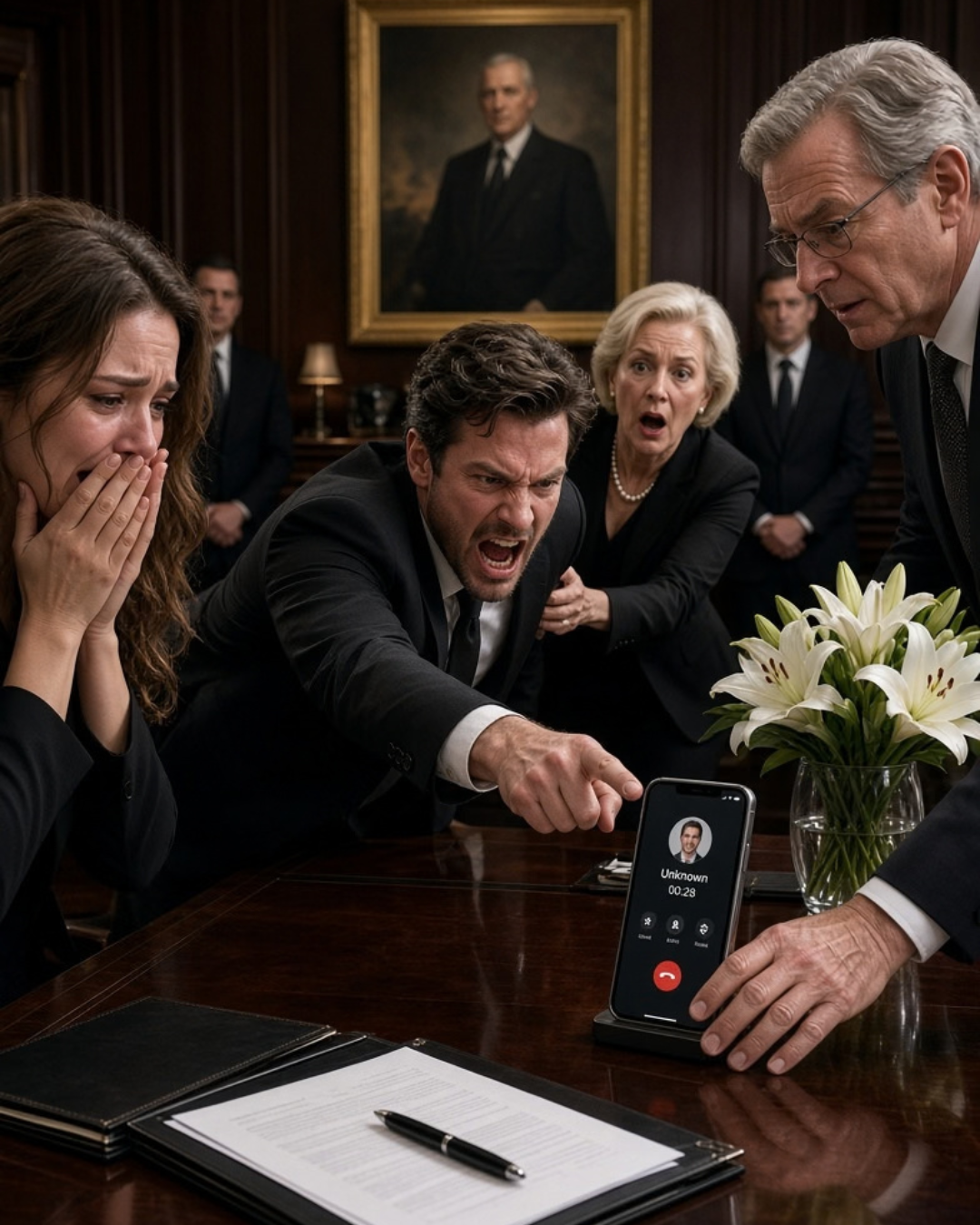
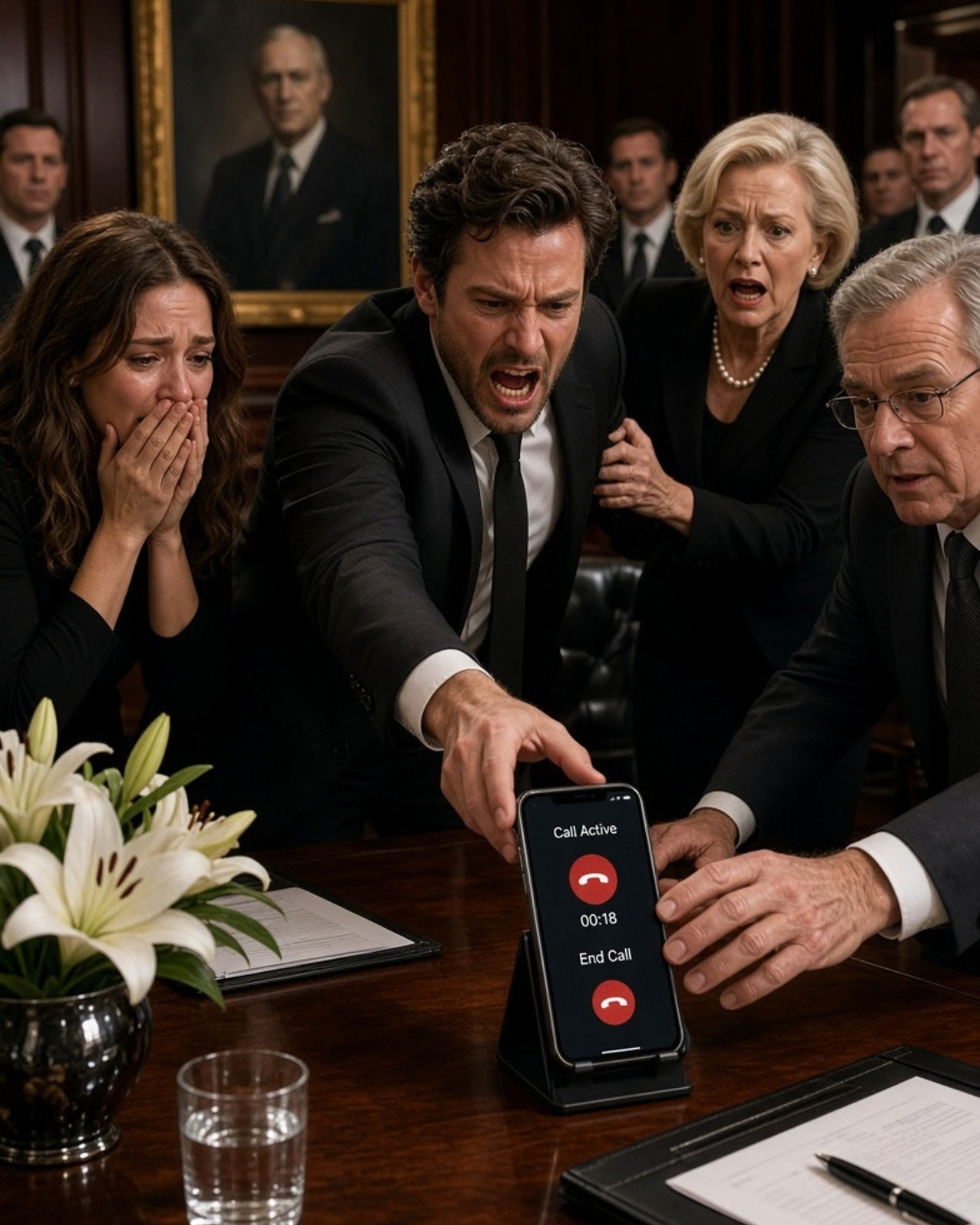
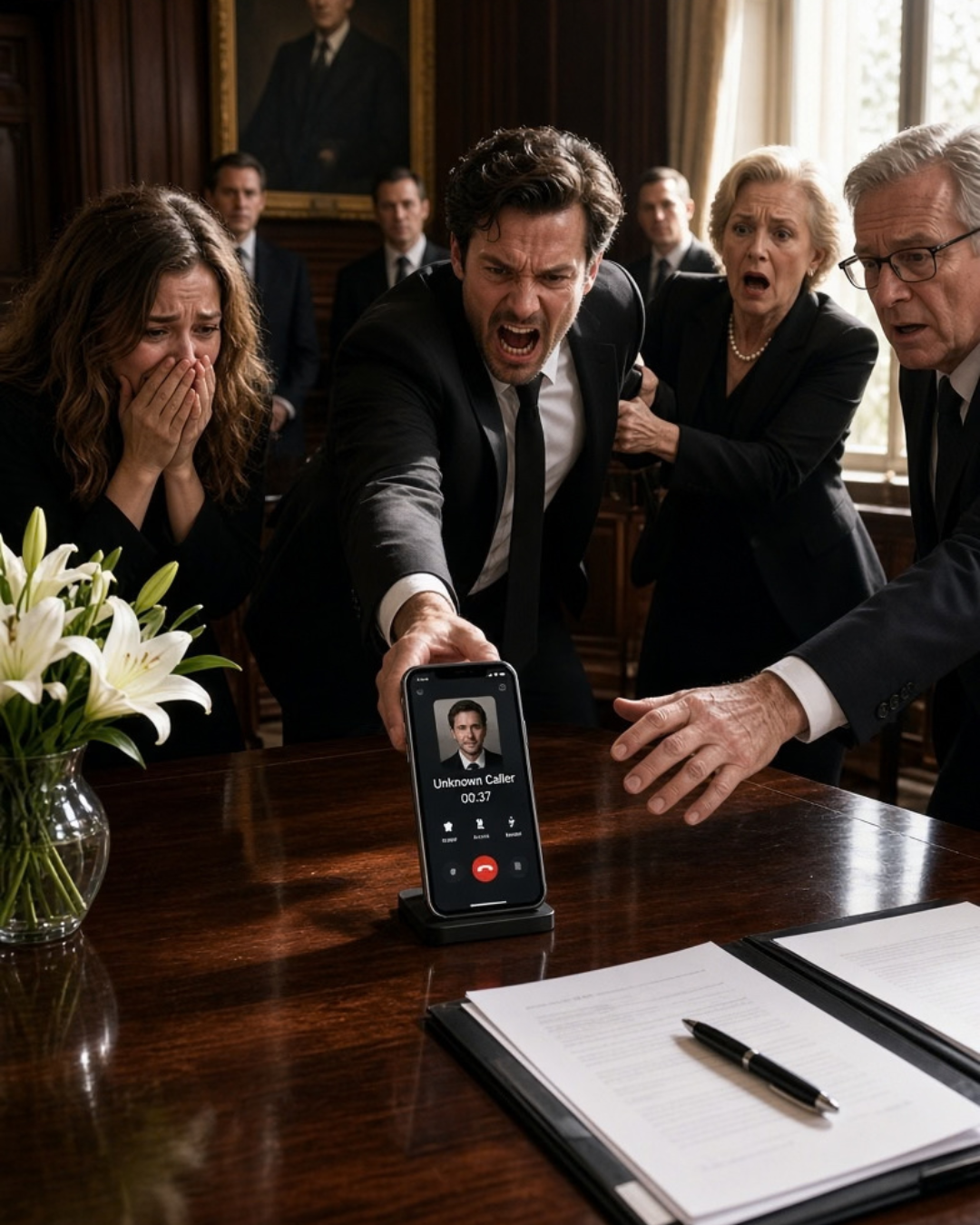
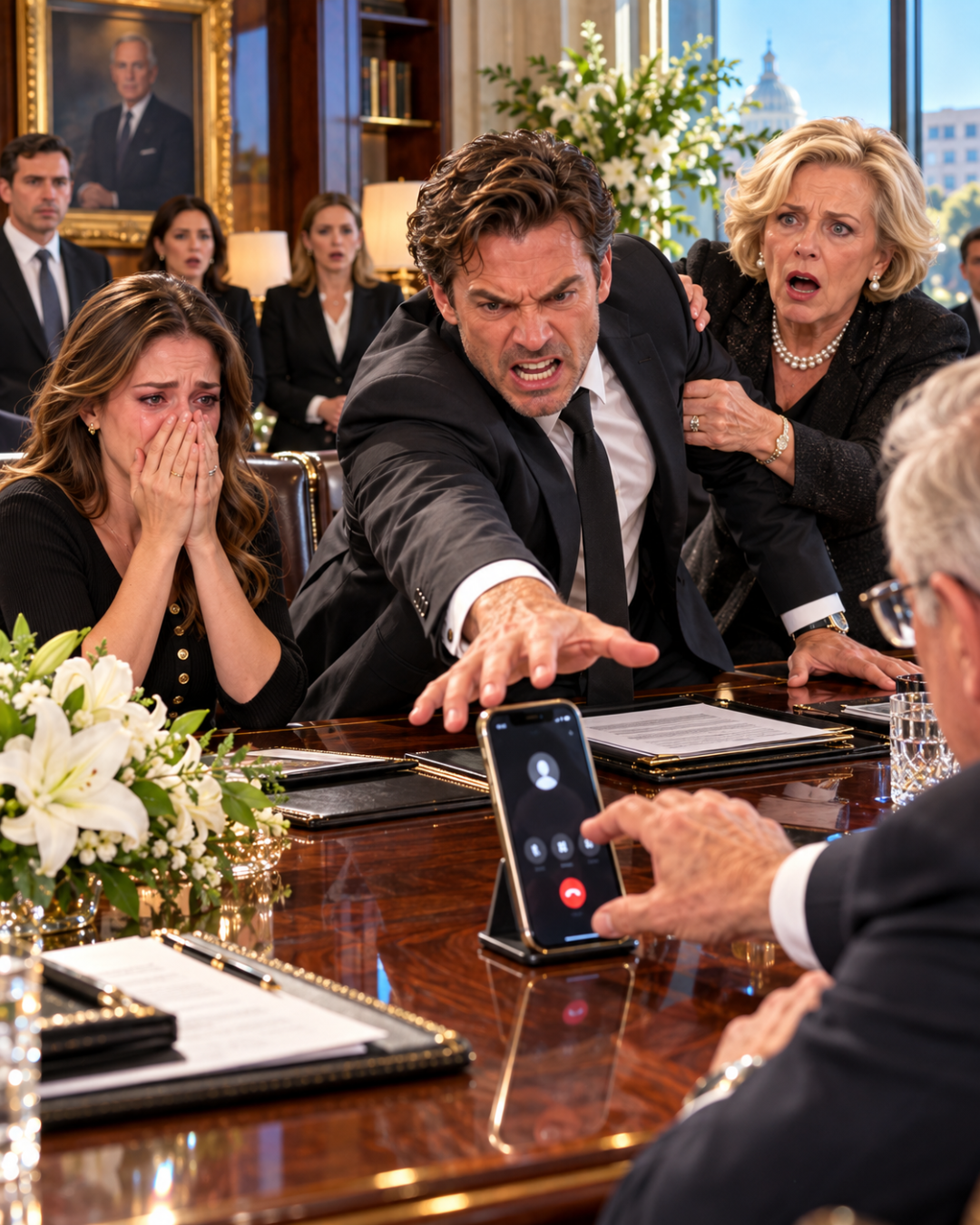
Six seconds later, Ethan shot to his feet so violently that his chair crashed backward.
“Turn that off!”
Martin did not move.
Patricia grabbed Ethan’s sleeve.
I heard my own voice come out thin and unfamiliar.
“What did you do?”
Ethan reached across the table for the phone.
Martin pulled it away.
Patricia whispered, “Ethan, don’t.” Her voice was no longer smug. It was terrified. That was when I realized she already knew.
And from the speaker, my father said one final sentence that made Ethan freeze with his hand still in the air.
“I have the documents proving you forged Claire’s signature.”
Part 2
Ethan’s hand dropped.
For the first time in twelve years of marriage, I saw fear on his face that had nothing to do with losing money. It was the fear of being caught.
“That recording proves nothing,” he said.
Martin calmly turned the volume higher.
My father’s voice returned. “I compared the signature on the home-equity application with Claire’s passport records. You copied it.”
I turned toward Ethan. “Home-equity application?”
He said nothing.
Martin opened a second folder and slid three pages toward me. The first carried my name. The second showed a $185,000 credit line secured against our house. The third showed a transfer to a company I had never heard of: Mercer Ridge Consulting LLC.
Ethan owned Mercer Ridge.
I had never signed any of it.
My stomach tightened.
Patricia suddenly stood. “This is a family misunderstanding. Richard hated Ethan. Everyone knows that.”
“No,” Martin said. “Richard hired a forensic accountant.”
That silenced her.
The accountant had traced more than $260,000 in hidden business losses, personal loans, and credit-card debt connected to Ethan. Worse, several accounts had been opened using my information. According to Martin, my father discovered everything after a bank verification letter was accidentally mailed to his house, where I had lived before marriage.
Ethan finally spoke.
“I was fixing it.”
“With my inheritance?” I asked.
“With our future.”
Martin pushed another document across the table.
It was a purchase agreement for Patricia’s $600,000 house.
The buyer was not Patricia.
It was me. My name appeared on the contract.
So did a signature that looked almost perfect.
I had never seen the document before.
Patricia’s face changed.
“I thought Claire agreed,” she said quickly.
Ethan stared at her with such fury that I knew she had just betrayed him.
Then Martin revealed the first twist.
My father had known about the house before he died.
The real-estate agent had called him because Ethan listed my father as the source of funds and claimed a large inheritance distribution was “imminent.” My father became suspicious and arranged the recorded meeting with Ethan.
But Martin still had not played the most important part.
He tapped the phone again.
My father asked, “What happens if Claire refuses to sign after I’m gone?”
Ethan laughed softly on the recording.
“She won’t refuse. If she does, I have enough to make her look unstable.”
My skin went cold.
Ethan lunged for the speaker.
Martin stood and blocked him.
Patricia shouted for Ethan to stop, but he shoved the chair aside and knocked a glass of water onto the floor.
I backed toward the wall.
“What does that mean?” I asked.
Martin reached into his briefcase and removed a sealed envelope with my name on it.
“Your father believed Ethan was preparing more than forged financial documents,” he said.
Ethan stopped moving.
Martin looked directly at me.
“He believed your husband had been building a file to convince a court that you were mentally incapable of controlling your own money.”
I remembered the therapist Ethan had insisted I see after my father’s diagnosis. The sleeping pills he kept asking whether I had taken. The nights he photographed me crying.
Then Patricia whispered something I was not supposed to hear.
“You said those records were already enough.”
The room went silent.
Martin slowly turned toward her.
Ethan’s face hardened.
And I realized the conspiracy had never been only about stealing my inheritance after my father died.
They had been preparing to take control of me while he was still alive.
Martin did not open the envelope. He placed it beside the phone and told me my father had required two witnesses before its contents could be disclosed. One was already in the room. The other, he said, was waiting outside.
Ethan looked toward the locked door.
Then someone knocked three times.
Patricia went pale.
“Claire,” Martin said, “whatever happens next, do not leave with your husband.”
What do you think will happen next? I’d love to hear your honest guess or reaction.
Part 3
What do you think will happen next? I’d love to hear your honest guess or reaction.
The knocking came again.
Martin walked to the door, unlocked it, and let in a woman I recognized from my father’s funeral. Her name was Sophia Grant. I had assumed she was one of his former business clients. She introduced herself now as the forensic accountant my father had hired six weeks before his death.
Behind her stood Detective Lena Morales.
Ethan stepped backward.
“This is insane,” he said. “Claire, tell them this is a family matter.”
I looked at the forged purchase agreement with my name on it.
“No,” I said. “It stopped being a family matter when you signed my name.”
Detective Morales explained that Martin had already given police copies of the suspected forged credit application, the house contract, and the accountant’s preliminary report. She was not there because of whatever Ethan might say in that room. She was there because investigators had obtained a warrant to seize specific financial records and electronic devices connected to Mercer Ridge.
Ethan immediately reached for his phone.
Morales told him to put it on the table.
He did not.
Instead, he turned toward the door.
Sophia moved out of the way. Martin did too. Morales blocked the exit and repeated the instruction. For several seconds Ethan stared at her, breathing hard, then slammed his phone onto the table so violently that the screen cracked.
Patricia began crying.
“Ethan handled the paperwork,” she said. “I never signed Claire’s name.”
Ethan spun toward her.
“You knew exactly what we were doing.”
That sentence destroyed the last possibility that I had misunderstood anything.
Part 4
Detective Morales did not raise her voice, and that was the first thing I noticed.
In the movies, a moment like this always came with shouting. Instead, the conference room went so quiet that I could hear the air conditioner humming in the ceiling and the slow drip of spilled water running off the edge of the table onto the carpet.
“Mr. Hale,” she said calmly, “you mentioned an envelope.”
“I did.” Martin straightened his jacket, and for the first time since I had known him, he looked less like my father’s lawyer and more like my father’s friend. “Richard’s instructions were very specific. The envelope may be opened only in the presence of two witnesses, and only after the recording has been played, and only with Claire’s permission. Ms. Grant and I are the two witnesses.”
He turned to me.
“Claire, this is your decision. You can walk out of this room right now and never hear what is inside. Nobody here would think less of you.”
I looked at Ethan.
He was standing with his back against the window, one hand pressed flat against the glass as though the building might tip over. His cracked phone lay face-up on the table between us, a spider web of lines spreading across the screen. He looked smaller than he had at the funeral. Smaller than he had that morning over breakfast, when he had kissed my forehead and said, “Today’s going to be a good day for us.”
Twelve years. I had married him when I was twenty-eight. He had cried during his own vows. He had driven four hours through a snowstorm once because I had a fever and my car would not start. I had believed, all the way down to the bottom of my bones, that I knew what kind of man he was.
“Open it,” I said.
Ethan took one step toward the table. “Claire, wait. Before you do this, think about what you’re—”
“Mr. Whitaker’s daughter has given her consent,” Detective Morales said. “Please stay where you are, sir.”
Ethan stayed where he was.
Martin picked up a silver letter opener and slit the top of the envelope with one slow, careful stroke. He tipped it, and four items slid onto the table. A folded letter in my father’s handwriting, three pages thick. A small silver flash drive. A stapled document with a notary seal pressed into the corner. And a thin blue folder with a label I recognized because it was written in my father’s blocky engineer’s print: WHITAKER FAMILY TRUST.
Ethan’s eyes went straight to the blue folder.
“That trust is not valid,” he said quickly. “Richard was sick. He was on medication. Any court would—”
“The trust was signed eighteen months ago,” Martin said, “and reaffirmed three weeks before his death. Two attorneys reviewed it. Two independent witnesses signed it. And on the day he reaffirmed it, Richard also completed a cognitive evaluation with his physician, because he suspected someone might eventually question his judgment.”
Martin’s voice did not change, but something in his face sharpened.
“He was right about that, wasn’t he?”
Ethan said nothing.
Martin opened the blue folder and turned it toward me. “Claire, I want you to hear this part clearly, because I suspect you have been told otherwise. Your father’s estate passes to you, and only to you, through this trust. Every dollar, every account, the house on Alder Street, the retirement funds. Under the law, and under the specific language your father wrote, it is your separate property. It cannot be pledged, borrowed against, or redirected by any spouse, any relative, or any business partner. Not one cent can be released to anyone but you.”
I heard a small, strangled sound from across the table.
Patricia had pressed her hand over her mouth.
“There is no probate delay to wait out,” Martin continued, looking at her now. “There is no distribution that will ‘clear’ on any schedule you have been promised. Mrs. Reyes, I understand a deposit of forty thousand dollars was wired to the real-estate agency for a house on Marlowe Court.”
Patricia’s voice came out cracked. “Ethan said it was a temporary hold. He said the funds would be replaced the moment the estate—”
“The deposit came from the Mercer Ridge account,” Sophia Grant said quietly. “Which means it came from a home-equity line that Claire never authorized.”
Patricia sank into her chair like someone had cut a string.
I could not stop staring at the letter. I picked it up. The paper felt thin and warm, as if my father had only just set it down. My hands were shaking so badly that the pages rattled.
“Would you like me to read it?” Martin asked gently.
“No,” I said. “I’ll do it.”
I unfolded the first page. My father’s handwriting slanted hard to the right, the way it always had, as though every word were leaning into a strong wind.
I began to read out loud.
Claire-bear,
If Martin is handing you this letter, then two things have happened. First, I am gone, and I am so sorry to have left you before I was ready. Second, I was right about something I very much hoped I was wrong about. I have never hated being right as much as I hate it now.
My voice caught. I swallowed and kept going.
I spent thirty-one years working on the water systems for this county. Do you know what I learned? A pipe does not break all at once. It weeps. A small dark patch in the soil, a faint dampness in the wall, and most people walk right past it. By the time the flood arrives, the leak has been there for years.
I noticed the leak in your marriage a long time ago, and I said nothing, because you were happy, and because you loved him, and because a father who criticizes his daughter’s husband usually loses his daughter. That was my mistake. I will carry it to the end.
I stopped. I pressed my lips together until I could breathe again.
Nobody in the room moved.
Here is what I need you to know, and I want you to read this next part twice.
What Ethan did is not a measure of your intelligence. Being deceived says something about the deceiver, never about the person who trusted him. You did not fail. You were generous with someone who was not, and that is not a flaw. Please do not let anyone, including yourself, convince you otherwise.
In March, I asked you to see Dr. Okafor for a checkup. I told you it was for my peace of mind while I was sick. You rolled your eyes and went anyway. I am sorry I could not explain why. Her sworn letter is in this envelope. It says you are healthy, sharp, and entirely capable of running your own life, which I could have told any judge in one sentence. But some people only believe paper.
I laughed, and it came out as a sob. I remembered that appointment. I had complained the entire drive home. Dad had called that evening just to ask, “Did she say you were okay?” and I had said, “Dad, I’m fine,” and he had said, “Good,” in a voice so relieved that I had thought it was strange.
The money in this trust is the least important thing I am leaving you. Do not let it become the biggest thing in your life. Do not let it make you afraid, and do not let anyone teach you to hide. If you decide to spend it, spend it on something that makes you free.
One more thing. Patricia will be frightened when this comes out. Frightened people follow strong voices, and she has been following Ethan’s for years. I do not think she is a wicked woman. I think she is a scared one. If she does the right thing at the end, Claire, let her. Whatever you decide about the rest, decide it with your eyes open and your heart intact.
Call Dana. She has been worried about you longer than you know.
I love you, kiddo. I was so proud to be your father. I would do all of it again.
Dad.
The last page slipped from my fingers and drifted onto the table.
For a while, no one said anything. I heard Sophia sniff quietly behind me. Detective Morales looked at the floor with the stillness of someone who had learned to let people have their moment. Even Martin took off his glasses and pressed the bridge of his nose.
Then Ethan spoke, and the sound of his voice was like a stone dropped into a pool.
“That’s a beautiful letter,” he said, and there was something almost pleading in it. “It really is. But nothing in it proves I did anything. Your father was sick. He was suspicious of me from the day we met. You’re going to let his paranoia destroy our marriage?”
I looked up at him.
“You forged my name on a credit application,” I said.
“I helped with the paperwork—”
“You put my name on a house contract.”
“I was going to tell you—”
“You told a room full of my father’s friends that my inheritance would pay your family’s debts while his photograph was ten feet away from you.”
Ethan opened his mouth. Nothing came out.
Sophia Grant stepped forward. She was small and quiet and carried herself with the calm of someone who had read a thousand records more carefully than anyone else ever would. She opened a slim laptop on the table.
“Mr. Reyes, let me save everyone some time,” she said. “The online application for the home-equity line was submitted from the IP address at your office. The signature was traced from Claire’s passport application. We compared them side by side. The tremor pattern in the capital C is identical, which is how we know it was traced instead of signed. A real signature never lands exactly the same way twice.”
She tapped a key.
“The house contract was notarized by a mobile notary named Dale Purcell. Mr. Purcell keeps a careful journal. The identification number he logged does not belong to Claire. He told us a man brought the documents to him already signed and said his wife was too overcome with grief to attend. He remembers the man wore a gray suit and looked nervous.”
She looked at Ethan.
“He also remembers that the man tipped him twenty dollars for being quick.”
Ethan’s face went pale in patches, the way skin goes when the blood runs out of it.
“And this,” Sophia said, tapping a second key, “was recovered from a cloud backup connected to your business email.”
A document filled the screen. The heading read: Petition for Temporary Conservatorship. My name was typed beneath it, followed by a date three weeks in the future. A blank line waited at the bottom for a signature and a court seal.
The room seemed to tilt.
I read the first paragraph, though I could barely make the words hold still. It described me as “increasingly forgetful, emotionally unstable, and unable to responsibly manage complex financial matters following the loss of a parent.”
“That’s not finished,” Ethan said hoarsely. “That was only a draft. It was a contingency.”
“A contingency,” I repeated.
“In case you fell apart, Claire! You were crying every night. I was scared for you.”
“You photographed me crying,” I said. “You told me it was to remember how much I’d been through.”
“I—”
“You asked me every single evening whether I had taken the sleeping aids. You kept the bottle in your nightstand. You asked Dr. Bell to write that I was forgetful. I remember now. You asked her twice.”
That was when Patricia finally broke.
“I told you it would only be temporary,” she cried, looking at her son with a face I had never seen on her. She had always been so composed, so polished. Now her mascara was running and her voice was raw. “You said she would rest. You said she would be looked after. You said it was for her own good and we would just be managing things until she was feeling better!”
“Mom.” Ethan’s voice was a warning. “Stop talking.”
“She was going to be—” Patricia turned to me. “Claire, I swear I did not understand what he meant. I thought—”
“Mrs. Reyes,” Detective Morales said, not unkindly. “You are not under arrest right now. But I need you to understand that anything you say may be used later, and you may want an attorney before you say any more.”
Patricia stopped. She stared at her folded hands. Then in a small, cracked voice she said, “I only wanted to keep my home. That’s all I wanted. We owed so much. He said this was the only way.”
“How much did you owe?” I asked her, and I was surprised by how steady my voice was.
She glanced at Sophia.
“One hundred and forty thousand dollars,” Sophia said quietly. “Between a refinance, a failed condo investment, and a private lender who had been calling. Ethan promised to fix it. He took out the credit line, opened cards in Claire’s name, and drained the joint savings account of seventy-one thousand dollars over eleven months. Some of that went to his mother’s creditors. Most of it went to hide losses at Mercer Ridge, which had been failing for two years.”
Two years.
I thought of every dinner where he had said, “Business is good, just slow this quarter.” Every evening he had come home late. Every time he had squeezed my hand and told me not to worry.
Detective Morales stepped forward and pulled a folded paper from inside her jacket.
“Ethan Reyes,” she said, “a judge signed this arrest warrant at nine o’clock this morning. It charges you with forgery, identity theft, and financial fraud in connection with the home-equity application and the purchase agreement. Please put your hands where I can see them.”
Ethan did not move.
“This is a mistake,” he whispered. Then louder, turning to me, his whole body suddenly softening with a desperate tenderness that I had once mistaken for love: “Claire. Claire, please. We can fix this. Tell them you signed. Tell them you forgot. You were grieving. Nobody would blame you. We can clear everything up, and we’ll go home, and I promise I will make this right.”
I stared at him. I truly stared at him, the way you stare at a house you have lived in for years after you have learned the foundation is cracked.
“You told my father that if I refused to sign, you’d make me look unstable,” I said.
His mouth trembled.
“You don’t have to do that anymore,” I said. “I’m standing right here. And I have never been clearer in my life.”
The handcuffs clicked with a small, ordinary sound, like a car door closing. Ethan flinched at it. Detective Morales spoke his rights in a low, even voice, and he did not fight her. He simply looked at me, hollow and stunned, as she guided him toward the door.
“Twelve years, Claire,” he said.
“I remember every one of them,” I told him. “That is exactly why this hurts. But remembering someone is not the same as staying.”
The door closed behind him.
I did not cry until we reached the hallway. My knees gave out as if someone had cut my strings, and Sophia’s hand was suddenly under my elbow, small and strong and steady. Martin appeared at my other side. I had not asked him to, but he stood there like a wall, and that was what I needed.
“Do not leave with your husband,” he had said, hours earlier.
I hadn’t. I walked out of that building with my father’s lawyer on one side and his forensic accountant on the other, into a parking lot flooded with plain afternoon sunlight. A little boy was riding a scooter along the far sidewalk. Somewhere a dog barked. The world was ridiculous in its ordinariness.
And I stood there in the light and finally let myself weep, out loud, for my father, and for the marriage I thought I’d had, and for the woman who had walked into that room that morning believing she only had one loss to grieve.
Part 5
My father’s house smelled like coffee and pine cleaner.
I had not been back since the funeral. Everything was exactly where he had left it: his reading glasses folded on the arm of the recliner, the crossword still open on the side table with three squares left blank, the old wool cardigan hanging on the hook by the kitchen door. It looked like a house waiting for someone to come home.
I stood in the doorway for a long time. Then I sat down in his chair, pulled the cardigan over my shoulders, and sat there until the sun went down.
That was where Dana found me.
She did not knock. She had a key, because my father had given her one years ago, back when we were in college and she practically lived at our kitchen table. She came in with a grocery bag on each arm, took one look at me, dropped both bags on the floor, and wrapped me in a hug so fierce that it knocked the breath out of me.
“Martin called me,” she said into my hair. “He said you shouldn’t be alone.”
“Dana.” My voice cracked. “I’m so sorry.”
“Don’t you dare.”
“I stopped calling you. I let it just—”
“Claire.” She pulled back and held my face in both hands. Her eyes were red. “I know exactly why you stopped calling me. And it was not your fault. It was never your fault.”
That was the sentence that undid me. I had been holding it together all day, and I lost it completely. She sat on the arm of the recliner and held on to me while I shook.
Later, we sat at the kitchen table with tomato soup she had made from her mother’s recipe. I told her everything, and she listened without interrupting, without flinching, without telling me what I should have seen.
When I finished, she was quiet for a while.
“You know what I remember?” she said finally. “The year you and Ethan got engaged, he told you that I was ‘a little jealous.’ He said it kindly, like he was protecting you.”
I stared at her. “He did say that.”
“And then it was that your father was ‘too critical.’ And then that your work friends ‘talked too much.’ And then that your cousin Marie ‘stirred up drama.'” Dana shook her head slowly. “It was never one big thing. It was a hundred little ones. Every time someone who loved you got close, there was a reason to step back. That’s how it works. The walls go up quietly, one brick at a time.”
I thought about my father’s letter. A pipe does not break all at once. It weeps.
“Why didn’t I see it?” I asked.
“Because you weren’t looking for it. You were trusting someone. That’s not a flaw, Claire.” She said it firmly, just the way my father would have. “Someone who wants to be trusted and someone who deserves to be trusted can look exactly the same from the outside. Right up until the day they don’t.”
I didn’t say anything. I reached across the table and held her hand, and we sat there in my father’s kitchen, and it was the first time in two years I had felt like I could breathe all the way to the bottom of my lungs.
Sophia Grant arrived at nine the next morning with a laptop, a box of pastries, and a stack of neatly labeled folders. She set everything on the kitchen table like a general arranging a map.
“I’m going to walk you through all of it,” she said. “Every account, every debt, every transfer. Some of it will be hard to hear. But I’ve found that people cope better with the whole picture than with a hundred rumors.”
“Show me everything,” I said.
She did. It took four hours.
The credit line was the largest piece: $185,000 secured against our house. But the bank’s fraud unit had already opened a review, and after the police report was filed, they froze the account and confirmed in writing that I would not be held responsible for any of it. “The signature was forged,” Sophia said. “The application was fraudulent. The debt belongs to the person who created it, and that person is not you.”
There were three credit cards opened in my name. Those would be closed and cleared. There was a personal loan Ethan had taken out using my Social Security number, which would take a few months of paperwork to remove. There was the joint savings account, drained down to eleven dollars.
“Some of that may be recoverable,” Sophia said. “Detective Morales’s team has frozen the Mercer Ridge accounts. Everything traceable will be seized and applied toward restitution.”
“Everything traceable,” I repeated.
“Everything,” she said, and gave me a small smile. “I’m very good at tracing.”
I looked at the columns of numbers, dates, and account names, and I felt something I could not quite name. It wasn’t anger anymore. It was something quieter and steadier. It felt like standing on the floor of a house that had finally been swept clean, even though the furniture was gone.
“Why did my father hire you?” I asked. “How did he even find you?”
Sophia glanced at the window before she answered. “Your father called me on a Tuesday in April. He said he had a problem he didn’t want to be right about. He asked me to look into a man named Ethan Reyes, and he asked me to be thorough, and he asked me to be kind about it, if it turned out to be nothing.” She paused. “It was not nothing.”
“He was worried about me.”
“He was terrified for you,” she said. “And he spent his last weeks making sure you would never have to go through this alone. Do you know what he said to me on the phone, the last time we spoke? He said, ‘If something happens to me, make sure my daughter knows she wasn’t foolish. She was loved. That’s a very different thing.'”
I put my hand over my mouth.
That afternoon, the phone rang. It was a number I didn’t recognize.
“Claire? This is Dr. Naomi Bell.”
The therapist. The woman I had seen four times in the weeks after my father’s diagnosis, sitting in a soft green armchair, twisting a tissue in my fingers. Ethan had insisted on the appointments. I had been so grateful, then, that he cared.
“I’ve been waiting to hear from you,” she said carefully. “And I couldn’t call you first. I’m bound by confidentiality, and it wasn’t appropriate for me to contact you until you or an authorized person reached out. But I read the news this morning, and I want you to know that I have already spoken with Detective Morales.”
I sat down slowly. “About what?”
“About the fact that your husband asked me, on two separate occasions, to put in writing that you were confused, forgetful, and unable to manage your affairs.” Her voice was gentle but steady. “I refused both times. I told him that everything I had observed was a woman in grief, and that grief is not incapacity. He became quite insistent. He called the clinic four times. I documented all of it.”
I closed my eyes.
“Claire, I want you to hear me. You were the clearest person in that room every time. Sad, yes. Exhausted, yes. But clear. Someone trying to manipulate you into doubting yourself would have wanted you to think otherwise.”
I breathed out slowly. It was the second time in two days someone had told me I was not broken, and it was beginning to work.
“Thank you,” I said. “For refusing.”
“It was the easiest decision I’ve ever made,” she said. “If you’d like to talk sometime, my door is open. No charge. Not for this.”
On Sunday afternoon, a taxi stopped in front of my father’s house.
I was on the porch, sorting through a box of his old photographs, when I saw it. The back door opened. A woman stepped out slowly, holding a shoebox against her chest with both hands.
It was Patricia.
She wore no pearls. No lipstick. Just a plain gray cardigan and a face that looked ten years older than it had three days before. She stood at the bottom of the porch steps and did not come any closer.
“I know I shouldn’t be here,” she said. “My attorney told me not to come. But I could not sit in that house another hour.”
I rose slowly. I did not invite her up. I did not send her away, either.
“I toured that house two days after your father died,” she said. Her voice was thin and shaky. “I stood in the kitchen and imagined my furniture in it. And I will never forgive myself for that, Claire. Never.”
“I know,” I said.
“I’m not asking you to forgive me.”
“Good,” I said. “Because I’m not ready to.”
She nodded, taking that in. Then she held out the shoebox.
“Inside are printouts of every message Ethan sent me in the last year. I saved them because I was afraid he would blame everything on me someday. That’s the truth. I wasn’t being brave. I was protecting myself.” She swallowed. “But I’m giving them to you anyway. Because they show exactly what he told me, and exactly what he told you, and they are not the same.”
I took the box. It was heavier than it looked.
“I loved my son more than I loved what was right,” Patricia said. She was crying now, quietly, without any performance at all. “That’s the whole ugly truth of it. I wanted so badly to believe he would fix everything that I stopped asking how.”
I thought about my father’s line. If she does the right thing at the end, let her.
I was not ready to say it was all right. It wasn’t all right. There was a house on Marlowe Court and a forged contract and a woman who had stood with her arms folded while her son planned to have me declared unfit.
But I looked at her, an old and frightened woman on my father’s front walk holding out the only piece of courage she had left, and I said the only true thing I could.
“It’s not okay, Patricia. But you brought the box. That matters.”
She pressed her lips together and nodded. Then she turned and walked back to the taxi, one careful step at a time.
I watched it drive away. Then I sat down on the porch swing and opened the shoebox, and for the next two hours I read every page.
On Wednesday, Ethan’s attorney sent a letter.
It was three pages long and written in the kind of language that sounds polite until you read it twice. It said that “in the interest of family harmony,” my husband was “prepared to overlook certain misunderstandings,” and that if I would sign a brief statement affirming that I had “consented to and authorized” the credit line, “all parties could move forward without unnecessary legal expense.”
I read it standing at Martin’s desk. Then I handed it to him.
He read it in about twenty seconds. He took off his glasses. And then he laughed, a real, delighted, unguarded laugh that filled the whole office.
“I’m sorry,” he said, wiping his eye. “I’m sorry, Claire. In forty years of practice I have rarely seen something so shameless.”
“He wants me to lie to help him.”
“He wants you to sign a statement that contradicts a forensic report, a notary’s journal, a bank’s fraud review, and your father’s sworn evidence. Which would be perjury.” Martin set the letter down as though it might be sticky. “Do you want me to reply?”
“Send him two words,” I said.
Martin raised his eyebrows.
“‘Absolutely not.'”
“That’s three,” Martin said. But he was smiling, and he wrote it down.
Two days later, on a bright Friday afternoon, Ethan came to the house.
He had been released on bond the day before, with the condition that he stay away from me. I found out later that his attorney had warned him twice. But some part of him must have believed, right up until the end, that if he could just stand in front of me and say the right words, the last twelve years would come flooding back and wash everything clean.
I was in the front yard, kneeling in my father’s flower bed, pulling out weeds around the lilies. I heard the car door first. Then his voice.
“Claire!”
I stood up. My heart did not race. It simply went very still.
He stood at the end of the walkway with his tie loose and his eyes red. He looked like he had not slept in days, and in some strange way, that only made me more certain.
“Claire, I just need five minutes. Five minutes to explain—”
“You’re not supposed to be here,” I said.
“I know. I know that. But you have to understand, none of this was meant to hurt you. I was drowning, and I panicked, and everything just spiraled.” He took a step forward. “Please. I’m your husband.”
I reached into my pocket and pressed the emergency button that Detective Morales had shown me. I did not say anything. I just held my ground.
“Claire, tell them I’m your husband!” His voice rose. “You can’t just throw away twelve years!”
That was when I noticed the front door of the house across the street opening.
Mr. Alvarez stepped onto his porch. He was seventy-eight years old and had lived on Alder Street for forty years. He had taught my father to play chess and had shoveled our driveway for us every winter. He wore a faded flannel shirt and slippers, and he was holding a garden hose in one hand.
He didn’t spray anyone. He just stood there and looked at Ethan.
A moment later, the door next to him opened, and Mrs. Delgado from number 214 came out, followed by the Thompsons from the corner house, and then two teenagers I had once babysat, and then a woman I did not recognize at all, carrying a baby on her hip. One by one, the neighbors filed onto their front lawns and stood there in a loose, silent line along the sidewalk.
Nobody shouted. Nobody threatened. They simply stood between Ethan and my father’s house like a row of old, unmovable trees.
“Sir,” Mr. Alvarez said, in a voice as mild as tea, “I believe the lady asked you to leave.”
“She didn’t ask anything!”
“She didn’t have to,” said Mrs. Delgado. “We know exactly who you are.”
Ethan looked at the line of faces. He looked at me. He looked, I think, for the first time in his life, at a wall he could not talk his way through.
The patrol car turned the corner two minutes later, with no siren, just a quiet flash of blue. Detective Morales stepped out of the passenger side. She did not need to say much.
“Mr. Reyes. You are in violation of your release conditions.”
His shoulders sagged. It was the final, small collapse of a man who had run out of doors.
The bond was revoked that same afternoon.
That evening, the neighbors gathered on my father’s porch with casseroles and folding chairs and stories about him that I had never heard. Mr. Alvarez told me about the winter my father had stayed up all night with a broken pipe on his street so that seventeen families would have water by morning. Mrs. Delgado told me my father used to drop off tomatoes on her step without ever saying a word.
I sat in the swing, wrapped in his cardigan, listening to a whole neighborhood tell me who my father had been.
It was not the evening I had expected. But somewhere in the middle of it, I realized that I was no longer only grieving.
I was being held.
Part 6
The sentencing was scheduled for a gray Tuesday morning in late January.
By then, five months had passed. Ethan’s attorney had made every possible attempt to negotiate, delay, and reframe. But the evidence was a wall. There were the forged documents, the traced signature, the notary’s journal, the bank’s report, the recovered email, Patricia’s shoebox of messages, Dr. Bell’s careful notes, and my father’s recording. In the end, Ethan pleaded guilty to forgery, identity theft, and fraud.
I had told Martin I wanted to speak at the hearing.
“You don’t have to,” he said. “Many victims choose to submit a written statement.”
“I know.” I looked down at the pages in my hands. “But I spent a long time being quiet. I think I need to say it out loud.”
The courtroom was smaller than I had imagined. Rows of wooden benches, pale walls, a seal above the judge’s chair. Dana sat behind me on the left. Sophia sat on the right. Martin was beside me, and behind him, in the back row, I noticed Mr. Alvarez in his good gray suit and Mrs. Delgado holding a tiny bouquet of white lilies. My father’s neighbors had come.
Ethan sat at the defense table in a plain jacket, thinner than I remembered. He did not look at me until the judge called my name.
I walked to the podium and set down my pages. I looked at them for a moment. Then I set them aside, folded my hands, and looked up.
“Your Honor,” I said, “my name is Claire Whitaker. For twelve years, I was married to the defendant.”
My voice shook slightly on the word married. I steadied it.
“I want to tell you what it feels like to learn that the person who slept beside you for twelve years had been planning to take your life apart. It does not feel like a single blow. It feels like every memory you have gets quietly rewritten. Every birthday dinner, every trip, every night he held my hand, I now have to look at again and ask, Was any of it real?”
The courtroom was silent.
“He forged my name. He borrowed against the home we shared. He opened accounts in my name that I did not know existed. And when my father was dying, and I was crying myself to sleep, he was collecting evidence to persuade a court that I was too unstable to make my own choices.
“I want to be very clear about something. The money is the smaller part of this. Money can be traced and recovered and replaced. What cannot be replaced is the time I spent doubting myself. I spent weeks wondering whether I really was falling apart. I spent evenings asking whether the sadness I felt was proof that something was wrong with me.”
I took a slow breath.
“Nothing was wrong with me. I was grieving. That is what loving someone looks like when they are leaving.”
I saw Dana wipe her eyes.
“I am not here to ask for revenge. I don’t think revenge would help me sleep. I am here to ask that the sentence you choose will protect the next person. Someone else is out there, right now, sitting in a kitchen, being told that their doubts are a sign of weakness. I hope they hear about this day. I hope they find the courage to ask questions, and I hope someone believes them the first time.”
I glanced at Ethan.
He was staring at his hands. His shoulders were shaking.
“Ethan,” I said, and his head came up. “You asked me once, in front of my father’s friends, to be quiet so you could take what you wanted. I was quiet. But I want you to know that my silence was never weakness. It was a woman learning exactly what she was standing next to.”
I folded my pages.
“That’s all, Your Honor. Thank you.”
I walked back to my seat. Martin squeezed my arm without a word. Behind me, someone in the gallery was crying softly, and I realized it was Mrs. Delgado.
The judge took a long moment before speaking. She was an older woman with silver hair and a careful, unhurried voice.
“Mr. Reyes,” she said, “you have pleaded guilty to serious crimes that were carried out over an extended period and with deliberate planning. I have read the reports. I have read the messages. I have listened to the victim. And I have to tell you that what strikes me most is not the amount of money. It is the way you used a person’s trust as a tool, and used her grief as an opportunity.”
Ethan did not lift his eyes.
“The court sentences you to six years in state custody, followed by five years of supervised release. You will pay full restitution, including the amounts recovered from the Mercer Ridge accounts and any remaining balance owed to the victim and the financial institutions involved. You will have no contact with Ms. Whitaker. And you will be required to complete a course of counseling and financial ethics while incarcerated.”
She set down her pen.
“I hope you use the time to become a more honest man than the one who stood before me today.”
Ethan swallowed. When the bailiff stepped forward, he rose slowly. At the door, he stopped and turned. His eyes found mine across the room, and his lips shaped two words without any sound.
I’m sorry.
I did not nod. I did not smile. I simply met his eyes for a long, quiet moment, and let him see that I had heard it. Whether he meant it, or would someday mean it, was no longer mine to carry.
Then he was gone.
I sat there while the courtroom emptied around me. I had expected to feel triumphant, or relieved, or furious. Instead I felt light. Not happy, exactly. Just lighter, as though a heavy coat I had been wearing for years had finally slid off my shoulders and I was noticing the air.
Patricia’s case was resolved a few weeks later.
Because she had cooperated fully, providing the shoebox of messages, testifying about what she knew, and agreeing to repay every dollar she was legally responsible for, the prosecutor recommended leniency. She received a sentence of probation, two hundred hours of community service, and a repayment order. She sold her condominium to cover what she owed. She moved into her sister’s spare room in another state.
She wrote me a letter. It was two pages long, in shaky blue ink. I read it once, standing at the mailbox, and then I put it in my father’s desk drawer, beneath the crossword puzzle he never finished.
I have not answered it yet. Maybe someday I will. Maybe I won’t. My father wrote that I should let her do the right thing at the end, and she did. But letting someone do the right thing is not the same as pretending they never did the wrong one. I think both things can be true at the same time. I am learning that many things can.
The divorce was finalized in March.
I signed my name at the bottom of the last page, slowly, in my own handwriting. When the clerk handed me the certified copy, I noticed that my signature looked different than it had in years. The C was bigger. The loops were steady. It looked like a woman who knew exactly who she was.
I went back to being Claire Whitaker that afternoon. It felt like putting on a coat I had left at a friend’s house years ago, one that still fit perfectly.
In April, Martin called and asked me to come to his office.
“There’s something I’ve been holding for you,” he said. “I wanted to wait until everything was settled.”
When I arrived, he was standing at his desk with a small cardboard box. He lifted the lid. Inside, wrapped in soft tissue paper, was my father’s old black phone.
“The court released it from evidence last week,” he said. “Claire, there’s one more file on it. I found it the day before the will reading, and I did not open it. It’s labeled in his handwriting, on a sticker stuck to the back of the phone: For Claire only. After it’s over.”
I looked at him. My throat felt tight. “You haven’t listened to it?”
“It isn’t mine to hear.” He set the box in my hands. “I’ll be in the next room. Take as long as you need.”
He closed the door softly behind him.
I sat down in a leather chair by the window and held the phone in both hands. It was lighter than I remembered. The screen was scratched in one corner where my father had once dropped it on the garage floor. I remembered how he had grumbled about it, how he had refused for years to upgrade, saying, “If it still makes calls, it’s not broken.”
I found the file. It was labeled with a single word: Claire.
I pressed play.
There was a pause, a small rustle of blankets, and then the sound of my father clearing his throat. His voice was thinner than it used to be, but it was unmistakably his: warm and gruff, with that faint hitch at the end of a sentence that meant he was about to say something he’d rehearsed.
“Hi, kiddo. It’s Dad.”
I pressed my hand over my mouth.
“I don’t know exactly when you’ll be hearing this. Martin says it’ll be after everything’s over, and I hope that means it’s all over the right way. I’m recording this in the hospital, and the nurse just left, so I’ve got about ten minutes before she comes back and tells me I need to rest.” He gave a soft, wheezy chuckle. “I am terrible at resting. You know that.”
I laughed through my tears.
“I want to tell you a story. Do you remember when you were six, and I took the training wheels off your bike? You were so nervous. You said, ‘Dad, don’t let go.’ And I said, ‘I’ve got you.’ And I ran behind you, holding the back of the seat, all the way down Alder Street.”
I closed my eyes.
“Somewhere around the Alvarezes’ house, I let go. I didn’t tell you. You kept going. You rode the whole rest of the block by yourself, and when you reached the corner, you turned around, and you saw I was way back by the mailbox, and your face…” His voice caught. “Claire, I will never forget that face. You weren’t scared. You were so proud. You yelled, ‘I did it!’ as if you had invented the bicycle.”
He was quiet for a moment.
“That’s what parenting is, kiddo. You hold on as long as you need to, and then you let go, and you pray the whole time that they’ve got enough balance to make it. I let go of you a long time ago. But I want you to know I’ve been running behind you this whole time. Right up until I couldn’t anymore.”
Tears were running down my face now, freely, without shame.
“You’re going to think about everything you missed. You’re going to replay it. You’re going to ask yourself why you didn’t see it, and you’re going to be hard on yourself. Please don’t. You loved someone. That’s all you did. If loving someone is a mistake, then it’s the best mistake a person can make, and I’d make it a thousand times.”
He coughed, softly, and paused.
“About the money. I don’t care what you do with it. But if I could ask for one thing, it’s this. Don’t use it to feel safe. Use it to feel free. Those are different, and you’ll know the difference when you feel it.”
I could hear a smile creep into his voice.
“And I understand that Patricia has her eye on a house with four bedrooms. Kiddo, please. Nobody needs four bedrooms. Buy a porch swing. Plant something. Invite the neighbors over. I promise you’ll sleep better.”
I burst out laughing. It came out wet and cracked and helpless, and I laughed until I was crying again.
“If you get to a point where you don’t know what to do with all of it,” my father said, quieter now, “build a door for someone who’s standing where you were. Somebody who’s sitting in a kitchen at midnight, thinking they’re crazy, thinking they’re alone. Give them somewhere to walk in. You’ll know how.”
There was a long, gentle silence.
“I love you, Claire-bear. I always did. I’m so proud of the woman you are. You never needed me to hold the seat. You just needed to know someone was running behind you.”
The recording ended.
I sat in Martin’s office with my father’s phone in my lap for a very long time. The afternoon light moved slowly across the carpet. When I finally lifted my head, Martin was standing in the doorway with a box of tissues, and for once he did not say anything clever.
He just handed me the box, sat down beside me, and waited.
The church hall looked different in the spring.
The last time I had stood in that room, it had been filled with paper cups of coffee and murmured sympathy and white lilies around a photograph. Now it was bright and full of chairs, and sunlight poured through the tall windows onto a banner that hung across the far wall.
It read: THE RICHARD WHITAKER FRONT PORCH FUND.
Below it, in smaller letters: A door for anyone who needs one.
It had taken us eleven months to build it.
The fund provided free legal help, financial counseling, and quiet, confidential support to people whose trust had been used against them by a partner, a parent, or a relative. People who had signatures forged, accounts drained, or credit ruined. People who had been told, again and again, that their doubts meant something was wrong with them. Nobody was ever charged. Nobody was ever asked to prove they deserved help.
Sophia Grant ran the forensic side, tracing records for families who could never have afforded it. Martin volunteered two days a week and pretended he was not enjoying every minute of it. Dr. Bell led a free Thursday evening group in the church basement, where people sat in a circle on mismatched chairs and learned that grief and doubt and anger could all live in the same room. Dana handled outreach, and she had a talent for finding the ones who needed it most.
Detective Morales came to the launch in a plain blue dress instead of her usual jacket. When I thanked her, she shook her head.
“You did the hard part,” she said. “You stood in a room and told the truth. Most people can’t.”
“I had help.”
“That’s the whole point,” she said, and smiled.
The hall was packed. Nearly two hundred people had come: neighbors, teachers from my school, old coworkers of my father’s from the county water department, families I had never met who had heard about the fund and wanted to see it for themselves. Mr. Alvarez sat in the front row in his good suit. Mrs. Delgado had brought a tray of empanadas the size of a small table.
When it was time, Martin nodded to me. I stepped up to the podium and looked out over the crowd.
My knees were trembling. I let them.
“A year ago,” I said, “I stood in this room.”
The hall went quiet.
“It was my father’s funeral reception. I was holding a paper cup of coffee I had not touched, and someone stood up in front of all of you and announced what my inheritance was going to do.” I paused. “He said it would pay off a family’s debts.”
A few people shifted in their chairs.
“I said nothing. Some of you may remember. I stood there in a black dress and did not say a single word, and I promise you that was the loudest silence of my life.” I smiled slightly. “Today, I would like to tell you what my father’s money is actually going to do.”
I looked down at the front row. Mr. Alvarez nodded at me, slowly, the way you nod at a child who has finally figured out the answer.
“It is going to buy a lot of ordinary things. It’s going to pay for lawyers who don’t charge, and accountants who care, and therapists who listen. It’s going to keep a light on in a church basement on Thursday nights. It’s going to fund a scholarship for any student in this county who wants to study water systems engineering, because my father believed that the most important work in the world is the kind nobody notices until it stops.”
There was a warm ripple of laughter.
“And it is going to make sure that the next woman, or man, who sits in a kitchen at midnight thinking they are losing their mind has somewhere to go. Somewhere they will hear the words I had to hear from my father’s letter, from my friends, and finally from myself.”
I looked out at the faces.
“You are not foolish. You were generous with someone who was not. Being deceived says something about the deceiver. It never says anything about you.”
I heard someone in the back row start to cry. Then someone else. Then I felt my own eyes filling, and I did not mind.
“My father told me that a pipe does not break all at once. It weeps. So I want to say something to everyone here who has ever noticed a small dark patch in the wall and looked away. Look. Ask. Tell someone. You don’t have to wait for the flood.”
I stopped. My voice was thick, but it was steady.
“The best thing my father ever gave me was not money. It was the knowledge that somebody was running behind me, even when I could not see him. I would like this place to be that for someone else.”
I stepped back from the microphone.
For a moment, nobody moved. Then Dana stood up in the third row, tears streaming, and began to clap. Then Sophia. Then Detective Morales, and Dr. Bell, and Martin, and Mr. Alvarez, who rose slowly on his aching old knees. Then the whole room was on its feet, and the sound rolled over me like a wave, warm and enormous and alive.
I found the framed photograph of my father on the memorial table by the wall. He looked out at me from beneath his old ball cap, squinting slightly in the sun, wearing that crooked grin that always meant he was pleased and refused to say so.
I did it, Dad, I thought.
That evening, after everyone had gone home, I drove to Alder Street.
I had never bought the house on Marlowe Court, of course. It had gone to another family, who I hoped were happy there. I kept my father’s home, the small two-bedroom with the crooked mailbox and the squeaky screen door. I repainted the kitchen a soft yellow. I planted white lilies along the front walk. I hung a porch swing from the rafters, and it creaked in exactly the way I had hoped it would.
I sat on it now, wrapped in his old wool cardigan, with the old black phone resting on the arm beside me. The sun was low and gold. Somewhere down the street, a kid was riding a bicycle, and a parent was jogging behind, one hand out to catch the seat.
I watched them until they reached the corner.
The child turned around, looking for the grown-up, and I knew, from the way her whole face lit up, that she had discovered she had been riding alone for a while.
“I did it!” she shouted, to no one in particular, to the whole street.
I smiled, and the swing creaked, and the lilies nodded in the evening breeze.
For a long time after my father died, I thought his final gift was a recording, a letter, and a locked envelope that saved me from the worst mistake of my life. I understand now that it was something smaller and much larger than that. It was the quiet certainty that I was never as alone as I felt. It was a set of hands I could not see, holding the back of the seat, until the day I could ride without them.
I was not the woman my husband had described to a courtroom of strangers in his drafts and his plans.
I was exactly the woman my father had raised.
And on that porch, in that soft golden light, with the neighbors’ lights coming on one by one down Alder Street, I finally knew what it felt like to be free.
If you were Claire, what would you have done in that conference room? And do you think she was right to let Patricia off the porch with nothing but a nod? I’d love to hear your honest thoughts in the comments.
