

For twenty-nine years, my husband treated taking out the garbage like some kind of personal punishment.
So when Robert suddenly started volunteering to do it every single night, I knew something was wrong.
Then I followed him. What I witnessed in the alley made me believe the worst about the man I had trusted for nearly three decades.
Until a young woman said one sentence that changed everything.
For most of our marriage, taking out the trash had somehow become my responsibility.
We never officially divided chores that way.
Robert simply hated doing it.
Strangely, he didn’t mind other unpleasant jobs.
He washed dishes without being asked.
He could spend an entire afternoon cleaning bathrooms.
Once, he spent hours on a ladder clearing leaves from the gutters in freezing weather and actually seemed to enjoy himself.
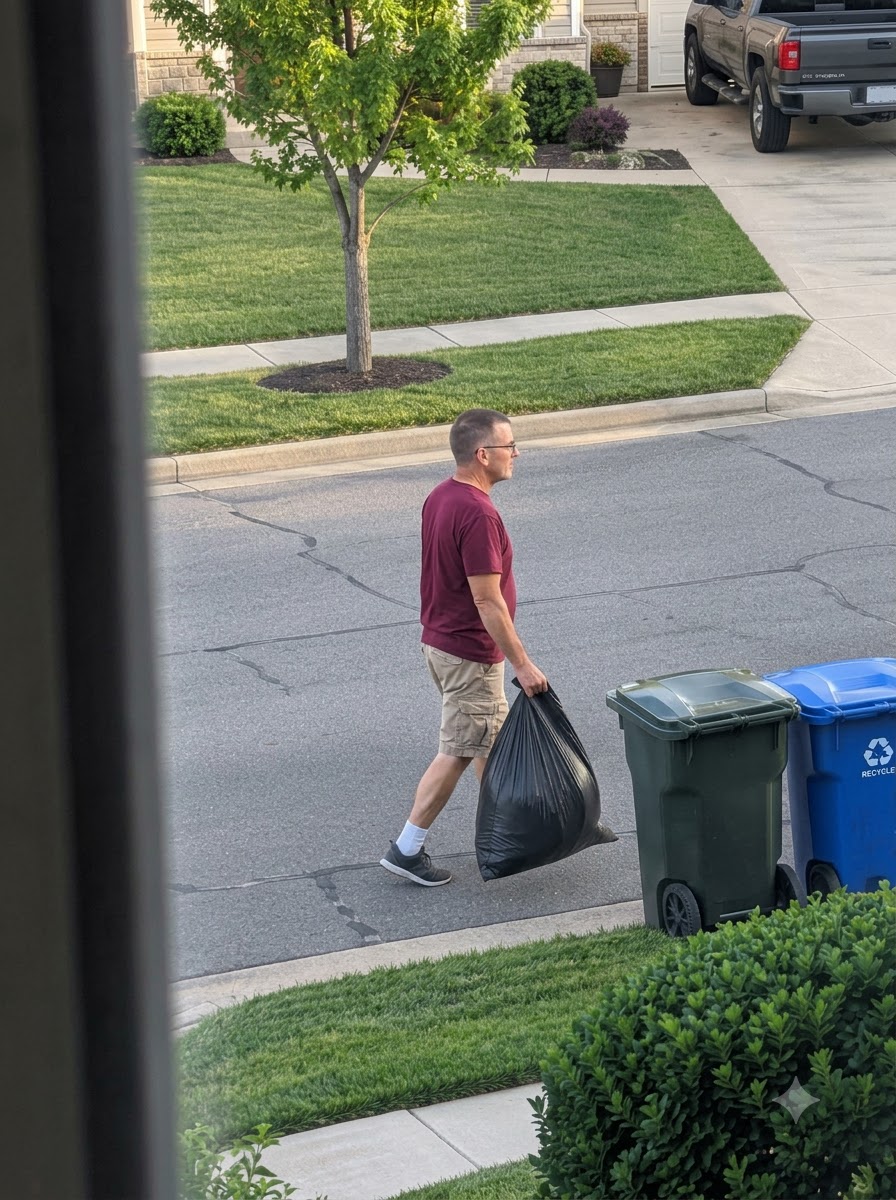
But carrying one plastic bag twenty feet outside?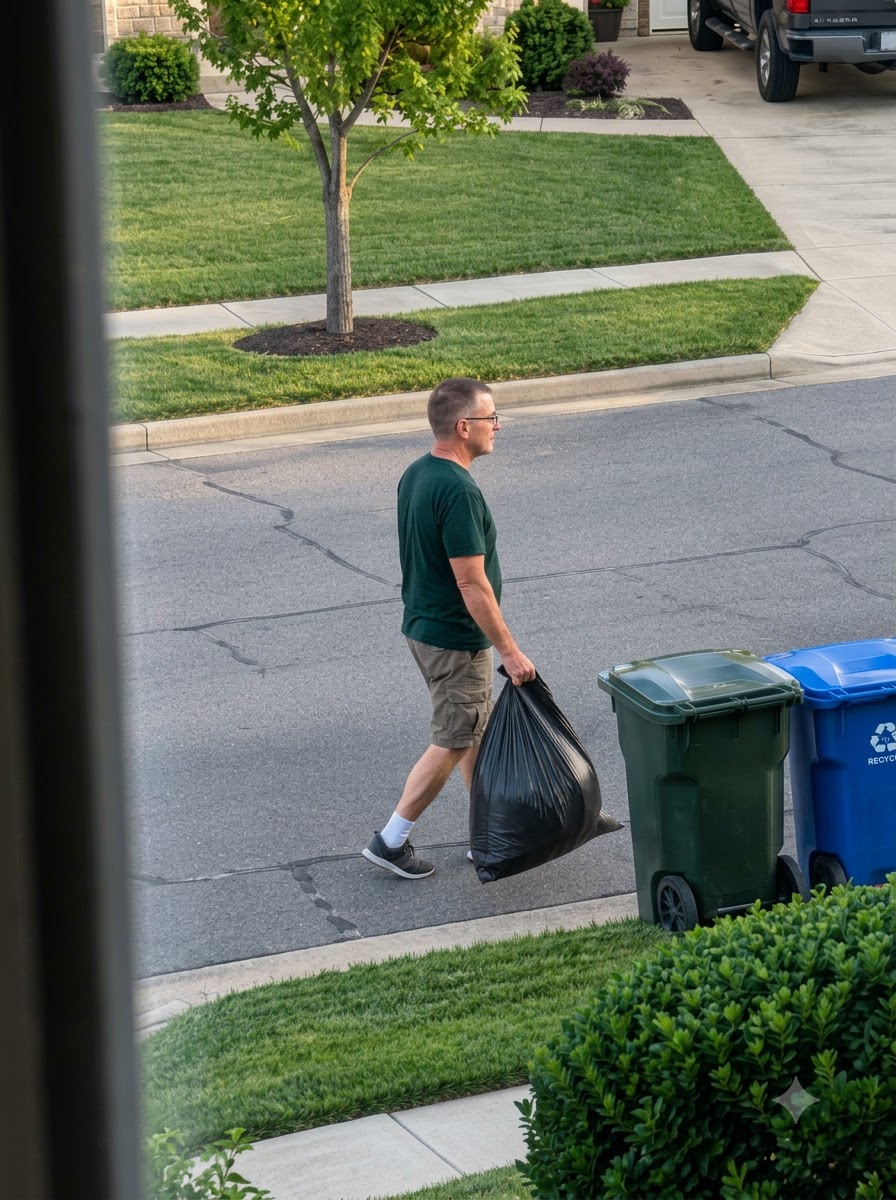
Apparently unbearable.
I had watched him balance empty cartons on top of an overflowing trash can rather than simply tie the bag and take it out.
I used to laugh at him.
“One day that tower is going to collapse on you.”
He would shrug.
“I’ll deal with it when it does.”
So when Robert stood after dinner one Monday evening, walked into the kitchen, tied up the trash bag, and carried it toward the back door without being asked, I laughed.
“Who are you, and what have you done with my husband?”
Normally, he would have made some sarcastic reply.
That night, he didn’t.
“I’ve got it,” he said.
Then he went outside.
I didn’t think much of it.
Maybe at fifty-eight he had finally decided to conquer his greatest enemy: household garbage.
But Tuesday night, it happened again.
At exactly nine thirty, while we were watching television, Robert stood.
“I’ll take the trash.”
I glanced toward the kitchen.
“There’s barely anything in there.”
“I’ll take it anyway.”
He disappeared through the back door.
This time, he was gone for almost fifteen minutes.
Taking out the garbage normally took less than two.
When he returned, I asked what had taken so long.
“The bin lid was stuck.”
Then he sat down and continued watching television.
There was only one problem.
Our trash bin had never had a sticking lid.
Not once.
My name is Diane.
I had been married to Robert for twenty-nine years, and before that week, he had never given me any serious reason to distrust him.
Robert wasn’t mysterious.
He told me almost everything.
If he stopped at the hardware store, I heard about what the cashier said.
If traffic was bad, I got a full description.
He was predictable in the reassuring way that long marriages often become predictable.
That was why his tiny lie bothered me so much.
It wasn’t dramatic.
But Robert wasn’t a man who casually lied.
And when someone who almost never lies suddenly starts doing it, even about something small, you wonder what larger truth the lie is protecting.
So Wednesday night, I watched him.
At exactly nine thirty, he got up.
He pulled a half-full trash bag from the kitchen can.
I told him I was tired and went upstairs.
Instead of getting ready for bed, I stood behind the bedroom curtain and watched the backyard.
Robert came through the back door carrying the bag.
He walked toward our bins.
Then he passed them.
My stomach tightened.
He continued beyond the garage, past the hedge separating our yard from the neighbors’, and into the narrow alley behind the houses.
Nobody usually went back there except on collection day.
I stood gripping the curtain.
Twelve minutes later, Robert returned.
He walked slowly.
His hands were in his pockets.
And the trash bag was gone.
When he came upstairs, I was already in bed pretending to read.
He kissed my forehead.
Said goodnight.
Then fell asleep beside me as though nothing unusual had happened.
I barely slept.
I wish I could say twenty-nine years of trust made me calm and rational.
It didn’t.
My mind immediately went somewhere terrible.
An affair.
What else was I supposed to think?
My husband suddenly had a reason to leave the house at exactly the same time every night.
He was lying about where he went.
He was disappearing into a dark alley and returning without the bag he had supposedly taken outside.
By Thursday, I needed answers.
At nine thirty, Robert stood and grabbed the garbage again.
I waited until the back door shut.
Then I counted to thirty, put on my shoes and coat, and slipped out through the front door.
I circled the house.
Robert walked past our bins exactly as I expected.
He continued down the alley and stopped two houses away beside an old detached garage owned by a couple who spent most of the year in Florida.
Then he opened the garbage bag.
My heart started pounding.
Robert reached inside and removed a small package wrapped in brown paper.
I recognized the wrapping immediately.
We kept that exact brown paper in our hall closet for mailing fragile objects.
Then a woman stepped out from behind the garage.
Young.
Maybe late twenties.
Thirty at most.
She wore a long coat, and her hair was bright blue.
Robert handed her the package.
I stopped breathing.
There I was, hiding in the shadows, watching my husband of almost three decades secretly hand a young woman something wrapped in paper.
Every ugly suspicion I had spent the previous nights trying to dismiss suddenly felt real.
Then the woman spoke.
Her voice carried through the quiet alley.
“She still doesn’t know?”
Robert shook his head.
“Not yet.”
“How much longer are you going to keep doing this?”
“Until Saturday.”
I stepped backward.
My heel landed on an empty plastic bottle.
The crack echoed through the alley.
Robert spun around.
The young woman stared at me.
For one awful second, none of us moved.
Then Robert whispered,
“Diane.”
I stepped into the light.
“What is going on?”
“Please,” Robert said. “Let me explain.”
“That’s usually what people say when they’ve been caught doing something they shouldn’t.”
He took a cautious step toward me.
“Can we go home and talk?”
“No.”
I looked at the woman.
“We can talk right here.”
“Diane—”
“I just watched you walk into a dark alley with a fake trash bag, pull out a hidden package, and give it to a woman I’ve never seen before.”
My voice began trembling.
“And then I heard you discussing how long you could keep something from me.”
“So no, Robert. Nobody is leaving until someone tells me the truth.”
He looked miserable.
The woman looked even worse.
I prepared myself for whatever came next.
Then she said,
“I’m Claire’s daughter.”
Everything inside me stopped.
“What?”
“My mother was Claire.”
The alley seemed to move beneath my feet. Claire.
My younger sister.
My only sibling.
Dead for twenty-three years.
I finally looked closely at the young woman.
Until then, all I had noticed was the blue hair.
Now I could see her face.
The narrow chin.
The slight upward tilt at the corners of her eyes.
A face I had known for almost my entire childhood.
Claire’s face.
Claire’s eyes.
“Oh my God.”
The woman swallowed.
“My name is Amelia.”
Of course.
I knew that name.
The last time I had seen Amelia, she was seven.
She stood in her father’s driveway clutching a stuffed rabbit as I backed my car away.
Claire had died only months earlier.
I waved.
Amelia didn’t wave back.
She simply watched.
At the time, I assumed she was a devastated child trying to understand why her mother was never coming home.
I believed I would see her again soon.
The following weekend.
Maybe the weekend after.
I had no idea that would be the last time I saw her for twenty-three years.
I looked at Robert.
“You found her.”
He nodded.
“I found her.”
“How?”
“I was searching through old records online. I was trying to track down some things connected to Claire, and Amelia’s name appeared. I sent her a message.”
“When?”
Robert hesitated.
My chest tightened.
“When, Robert?”
“About six weeks ago.”
Six weeks.
My husband had known where my sister’s daughter was for six weeks.
A child I had spent twenty-three years wondering about.
And he hadn’t told me.
“You knew?”
My shock turned into anger.
“For six weeks?”
Amelia stepped forward.
“Please don’t blame him for everything. It wasn’t completely his decision.”
I looked at the package.
“What exactly is in there?”
Amelia carefully unfolded the brown paper.
The first thing she pulled out was a photograph.
I recognized it instantly.
Claire and me as teenagers at the lake.
She wore a ridiculous bright yellow swimsuit she loved.
My arm was around her shoulders.
Both of us were laughing in the sunlight.
I had kept that photograph in a box in my closet for decades.
Amelia removed another picture.
Claire sitting on our mother’s porch with baby Amelia in her lap.
Then a birthday card.
An old envelope.
A little silver photo frame.
I turned toward Robert.
“You’ve been taking these from Claire’s box.”
“One group at a time,” he admitted.
“And hiding them in trash bags?”
Robert actually looked embarrassed.
“I needed some way to get them outside without you asking questions. If I walked through the house carrying wrapped packages every night, you would have wanted to know what they were.”
I stared at him.
“So you started volunteering to take out the garbage.”
The one chore he had avoided since the 1990s.
Amelia made a tiny sound that was almost a laugh before covering her mouth.
Under any other circumstances, it would have been funny.
My husband, who considered taking out the trash a form of torture, had suddenly become the household garbage champion because he was smuggling family photographs out of my closet.
But I wasn’t ready to laugh.
“Why?”
Robert looked at me.
“Why would you hide this?”
My voice cracked.
“You know what Amelia means to me. You know what losing contact with her did to me.”
Before Robert could answer, Amelia looked down at the photograph of Claire holding her as a baby.
“Because I didn’t believe him.”
I stared at her.
“Believe what?”
“That my mother’s family wanted me.”
My chest tightened.
“What are you talking about?”
“My dad told me you didn’t.”
She spoke quietly.
“He told me that after Mom died, her family didn’t want contact anymore.”
I couldn’t make sense of the words.
“He told you what?”
“That you thought I should stay with him and that continuing contact would only make things harder.”
She looked away.
“As I got older, the story changed slightly. Sometimes he said there had been arguments. Sometimes he said there was bad blood.”
“But the ending was always the same.”
“My mother’s family didn’t want me.”
“That is not true.”
My voice came out so sharply that Amelia flinched.
I immediately softened.
“No. Amelia, please listen to me.”
“That isn’t remotely what happened.”
She nodded slowly.
“That’s what Robert said too.”
Then twenty-three years of memories came crashing back.
The calls I made to her father that went unanswered.
Birthday cards sent every year.
No reply.
Christmas presents.
Then one package returned because they had moved without leaving a forwarding address.
I remembered driving to their house one afternoon and finding strangers living there.
They had bought the property months earlier.
They didn’t know where the previous owner had gone.
I called relatives.
Friends.
Anyone connected to Claire.
Nobody knew where Amelia and her father had disappeared to.
Eventually, I stopped asking because every “I don’t know” felt like losing her all over again.
But I never stopped wondering.
“I thought your father wanted us gone,” I said.
“I thought maybe he blamed us for something.”
“I spent years wondering whether I had said something wrong after Claire died.”
Amelia’s eyes filled.
“I thought you forgot me.”
That sentence hurt more than everything else combined.
“I never forgot you.”
I stepped closer.
“Not once, Amelia.”
“Not one day.”
Her tears finally fell.
Robert quietly looked away.
I wanted to hug her.
I also wanted to scream at my husband.
And part of me wanted to find Amelia’s father and demand twenty-three years of explanations.
Instead, I said,
“Come home with us.”
Amelia stepped backward.
Only slightly.
But I understood.
We might share blood.
She might have Claire’s eyes.
But to her, I was also almost a stranger.
“I was supposed to come Saturday,” she said.
I turned toward Robert.
“Saturday.”
Then the conversation I had overheard finally made sense.
Until Saturday.
They weren’t discussing the end of an affair.
They were planning a reunion. “She asked me not to tell you,” Robert explained.
“I wanted to. I swear I did. But Amelia wasn’t ready.”
I looked at her.
“Why Saturday?”
“Because I wasn’t sure I could actually come.”
She held the photographs tightly against her chest.
“When Robert first contacted me, I thought he was lying.”
“Everything he told me contradicted what I’d believed my entire life.”
At first, Amelia didn’t even believe Robert was genuinely connected to us.
Then she accepted his identity but still doubted his story.
Robert had told her that I loved Claire.
That I still talked about my sister.
That I had kept boxes filled with photographs, cards, letters, and personal things.
Amelia couldn’t understand.
“If you cared so much, why did you disappear?”
That was the question she couldn’t get past.
“So I started showing her,” Robert said.
“Photographs first.”
“Then cards.”
“Letters.”
“I thought if she could see actual proof before meeting you, she might feel safe enough to walk through our door.”
Amelia nodded.
“Yesterday he brought letters my mom wrote to you when I was a baby.”
I remembered them.
Claire loved writing letters even when we lived close enough to see each other every week.
She wrote about everything.
My terrible cooking.
Her marriage.
Baby Amelia learning to clap.
Ordinary pieces of a life none of us knew would end so soon.
“My dad told me nobody on Mom’s side cared what happened to us,” Amelia said.
“And then I sat in my hotel room reading Mom’s handwriting.”
“She wrote about you constantly.”
“Like you were part of every day.”
She swallowed.
“Like there wasn’t any version of her family where you weren’t right in the middle.”
I couldn’t speak.
Robert looked at me.
“That was the plan.”
“Give her enough evidence to know the truth before she ever had to face you.”
Part of me understood.
Part of me even loved him for what he had tried to do.
But another part of me had spent several nights believing my marriage was falling apart.
I turned toward him.
“So you thought keeping me completely ignorant was a good idea?”
“Amelia asked—”
“I understand why she did.”
I looked toward Amelia.
“You were afraid. You needed time.”
Then I faced Robert again.
“But you knew me.”
“You knew what losing her did to me.”
“You were there during some of those years.”
“You watched me wonder whether I had failed my sister somehow.”
Robert’s expression tightened.
“I know.”
“I spent years believing maybe I had scared her father away.”
“That maybe Amelia grew up thinking I simply abandoned her.”
“And for six weeks you had the answer.”
My voice broke.
“And instead of telling me, you hid it inside garbage bags.”
“I wanted Saturday to be perfect,” Robert said quietly.
“I wanted to give you this incredible reunion.”
“I imagined opening the door and there she would be.”
I stared at him.
“Why would I need it to be perfect?”
“I needed it to be true.”
“Messy, frightening, confusing—but true.”
“I would have wanted it six weeks ago.”
He had no answer.
“And while you were organizing your perfect surprise, I was lying awake believing you were sleeping with someone else.”
Amelia’s eyes widened.
“Oh.”
She turned toward Robert.
“You told me she didn’t suspect anything.”
“I didn’t think she did!”
Despite myself, I laughed.
Just once.
Not because anything was particularly funny.
Because the situation was so completely absurd that something inside me finally broke loose.
Robert sighed.
“That sounded worse when I said it.”
“Everything about this has gone worse than you intended.”
For several moments, the three of us stood in silence.
Then Amelia said,
“I spoke to my father.”
I looked at her.
“When?”
“After Robert found me.”
“I called Dad and asked him directly.”
Her expression changed.
“He was scared.”
“Of what?”
“Losing me.”
And standing there beneath a buzzing streetlight, Amelia finally told me the rest.
Claire had been the center of her childhood.
When Amelia fell, she ran to her mother.
When nightmares woke her, she called for Claire.
Her father loved her, but he traveled constantly for work.
Claire was home.
Claire was safety.
Then Claire died unexpectedly.
Suddenly, her father was alone with a grieving seven-year-old who cried every night for a mother who would never come back.
“He thought I’d choose you,” Amelia said.
I stared at her.
“Choose me over my own father?”
She nodded.
“Apparently, after Mom died, I kept asking for you.”
“When is Aunt Diane coming?”
“When can I go to Aunt Diane’s?”
“You looked like Mom. You sounded like her.”
I remembered those years.
Amelia had spent weekends at my house even before Claire died.
Of course she wanted me.
Her father decided staying close to Claire’s family would prevent Amelia from moving forward.
He convinced himself that cutting contact completely would help her heal.
“I don’t think that was the only reason,” I said.
Amelia nodded.
“Neither do I.”
“He was terrified,” I said. “He had already lost Claire. And then his daughter kept asking for her mother’s family.”
“He thought he might lose you too.”
“He panicked.”
“Yes.”
Amelia wiped her eyes.
“Then he moved us.”
“And one lie required another lie.”
“When I got older and asked questions, he changed details.”
“Eventually the story had existed so long that challenging it felt like betraying him.”
“He isolated me from everyone on Mom’s side because that made the lie easier to maintain.”
I could understand his fear.
Grief can distort people.
It can make them cling so tightly that they damage the very person they are afraid to lose.
But understanding someone’s motives is not the same as forgiving the consequences.
Nothing could restore those twenty-three years.
Nothing could return the seven-year-old holding the stuffed rabbit.
Nothing could give Amelia back her grandmother.
Her cousins.
Her aunt.
All the birthdays and Christmases and ordinary Sunday afternoons stolen by one man’s fear.
But I finally understood something I had spent decades questioning.
Claire’s husband hadn’t removed us from Amelia’s life because we meant nothing to her.
He removed us because we meant too much.
The three of us walked home together.
At our front steps, Amelia hesitated.
I didn’t pressure her.
“You have always had a place here,” I told her.
“Long before tonight.”
“Long before you knew it.”
She looked at me.
“Thank you.”
Then she stepped inside.
Robert wisely stayed behind us.
I took Amelia upstairs.
On the top shelf of the hall closet sat a cardboard box that had followed me through three moves.
Claire’s box.
I could never throw it away.
I could never fully unpack it.
So I had carried it from house to house for more than two decades.
I placed it on the bed.
Some photographs and letters were missing because Robert had already delivered them.
But most of Claire was still there.
Her faded college sweatshirt.
An old recipe book with flour permanently trapped between the pages.
A scarf she once believed made her look sophisticated.
A small wooden jewelry box.
Amelia picked up the scarf.
“I’ve seen this.”
“You have?”
“There’s a photograph of Mom wearing it.”
I smiled.
“She wore it constantly for six months.”
“Then one day she announced it made her look like a fortune teller and never wore it again.” Amelia laughed.
A genuine laugh.
And for the first time that night, I laughed with her.
Something between us finally loosened.
Inside the jewelry box was a delicate silver bracelet.
Claire had once told me over coffee that she wanted Amelia to have it when she was older.
A bracelet for a grown woman.
I had never been able to keep that promise.
Until now.
I held it out to her.
“This belonged to your mother.”
“She wanted you to have it someday.”
“I’ve been keeping it for you all these years.”
“I just didn’t know where you were.”
Amelia stared at the bracelet.
“You’re sure?”
“I’ve been sure for twenty-three years.”
Her face crumpled.
I moved toward her, then stopped because I didn’t want to overwhelm her.
She closed the distance herself.
She wrapped her arms around me.
Holding her was the strangest feeling.
She was my family.
My sister’s daughter.
My own blood.
And she was also a grown woman I had essentially met an hour earlier.
Both truths existed at once.
I cried into her blue hair.
She cried against my shoulder.
And I held her the way I had wanted to hold a seven-year-old girl in a driveway twenty-three years earlier.
We remained at the kitchen table until after midnight.
Amelia had endless questions.
And I had decades of answers that finally had somewhere to go.
“What was Mom like as a teenager?”
“Stubborn.”
“How stubborn?”
“The kind of stubborn that could become an Olympic event.”
“Did she really hate mushrooms?”
“She could find one tiny mushroom inside an entire casserole and hold it up like evidence in a murder investigation.”
“Could she sing?”
“Only if we use the word ‘sing’ very generously.”
Amelia laughed until she cried.
And every question gave something back to me too.
For twenty-three years, my memories of Claire had lived inside me with nowhere to go.
Now someone wanted to hear them.
Every single one.
Robert mostly remained quiet.
For once, he understood that this wasn’t his moment to control.
Amelia returned to her hotel that night.
She wasn’t ready to stay.
I didn’t ask her to.
Saturday came two days later.
The perfect surprise Robert had imagined was no longer possible.
But Amelia came anyway.
This time, she walked to the front door.
She knocked.
And I answered.
Rebuilding what had been taken from us didn’t happen overnight.
There were awkward silences.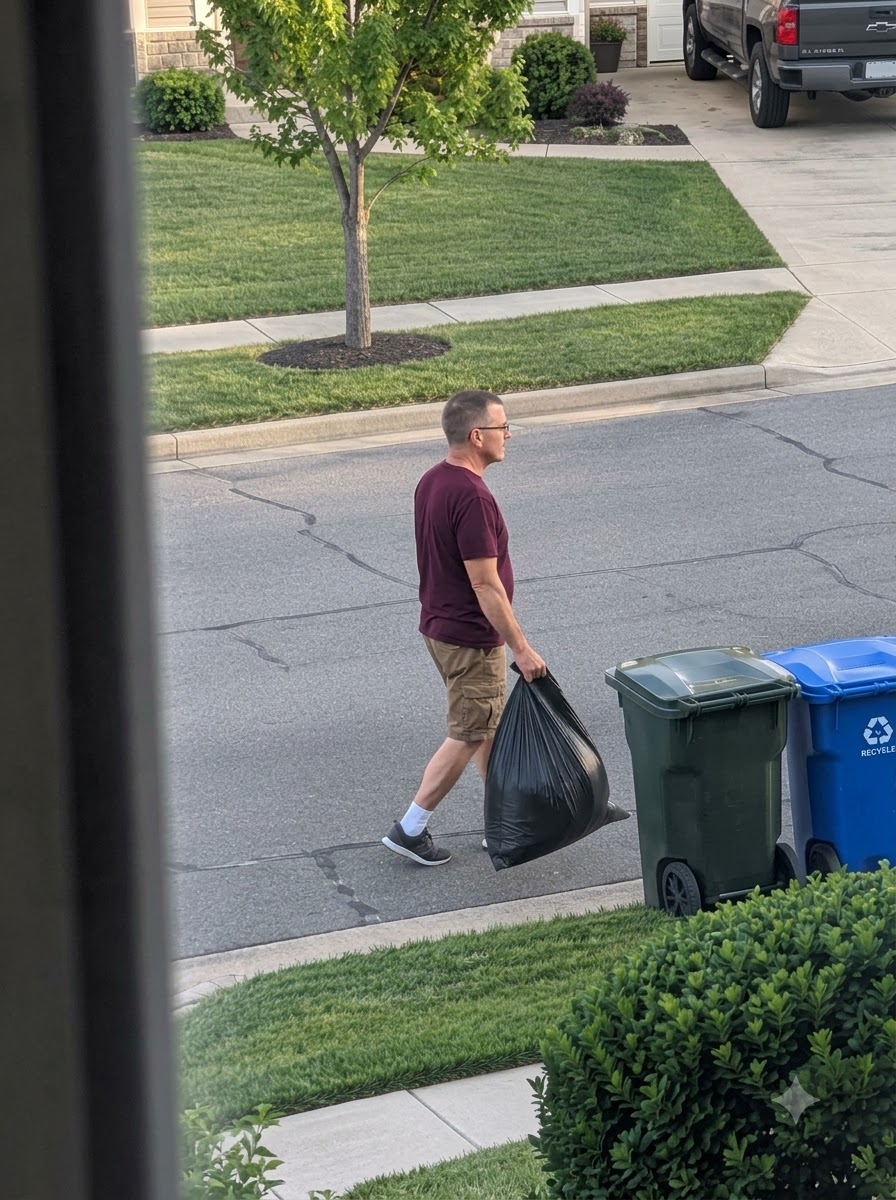
Questions that had no satisfying answers.
Moments when Amelia tilted her head or laughed in a certain way and I saw Claire so clearly that I had to look away.
But Amelia kept coming back.
That mattered more than anything.
A few weeks later, she called simply to ask whether I still had Claire’s pie recipe.
I read it to her over the phone.
Afterward, I sat alone in my kitchen and cried.
Not because anything dramatic had happened.
Because nothing dramatic had happened.
A niece had simply called her aunt for a family recipe.
An ordinary moment.
The kind of moment I had been denied for twenty-three years.
As for Robert, I stayed angry longer than he expected.
He had assumed that because his intentions were good, forgiveness would come quickly.
It didn’t.
One evening, I told him,
“If you ever locate another missing member of my family, you tell me immediately.”
“No more sneaking pictures out in garbage bags.”
He smiled cautiously.
“That seems reasonable.”
I stopped smiling.
“I’m serious.”
“No more secrets like this.”
“Not even when you think you’re protecting me.”
“Especially then.”
Robert nodded.
“You’re right.”
“I promise.”
Eventually, I forgave him.
I still hated what he had done.
I hated those nights when I was afraid.
But I understood his mistake.
He had found a frightened young woman who had spent her entire life believing she was unwanted.
He wanted to give her enough proof to feel safe.
And he wanted to return to me the niece he had watched me mourn for nearly our entire marriage.
His heart was in the right place.
His method wasn’t.
Robert had forgotten something important.
Loving someone doesn’t give you the right to make the biggest decisions of their life for them.
Even a beautiful surprise can become painful when you hide it for too long.
For a few days, I believed Robert’s secrecy meant I had misunderstood the man I had married.
Instead, that secret led me directly to someone I had been missing almost as long as I had known him.
Amelia and I still grieve the years we lost.
For twenty-three years, she believed I had knowingly walked away from her.
For twenty-three years, I believed she had been taken somewhere I wasn’t welcome.
Neither story was true.
Neither of us abandoned the other.
We had simply spent more than two decades standing on opposite sides of the same lie, each believing the other was gone.
Now, whenever Amelia visits, she usually takes something home from Claire’s box.
A photograph.
A letter.
A handwritten copy of the pie recipe.
She took the old scarf too.
She wears it constantly now, draped over everything.
Exactly like Claire did before suddenly deciding she hated it.
The cardboard box on the top shelf of my closet gets emptier every month.
Once, that would have terrified me.
Now it makes me happy.
Those things were never meant to remain hidden in darkness forever, waiting for someone who might never return.
And neither was Amelia.
