

PART 1
“Another one quit, Mr. Castillo.”
Don Ernesto set the keys and a folded sheet of paper on the table. It was resignation number 22 in seven months. I was 46, with businesses in Guadalajara and four six-year-old sons who had spent three years waiting for their mother to come back. Elena had walked out of our house leaving only a note: “I can’t do this anymore.” Since then, Mateo, Lucas, Diego, and Tomás had turned every new caregiver into an enemy before she was allowed to get close.
That morning the kitchen looked like a disaster zone. Cereal was scattered across the floor, milk was spilled on the counter, and a broken glass lay beside the sink. Mateo watched me with his arms crossed.
“She left, didn’t she?”
I nodded.
“They all leave,” Lucas said.
The sentence hurt, because I left every morning too, for the office. Mateo gave orders so he would not have to feel vulnerable. Lucas exploded over anything. Diego hid. Tomás screamed when he could not find the words. I paid for psychologists, activities, and caregivers, but when I came home I found the same rage. I knew how to cover expenses. I did not know how to sit with their pain.
That day Ernesto told me about Susana Herrera. She was 39, had spent years cleaning houses, and had no childcare certificates.
“They recommended her at her parish. She says she wants to try.”
I let out a tired laugh.
“Three days. If she lasts, we’ll talk.”
Susana arrived the next day at 9:00. She wore a plain white blouse and dark pants, and she carried a small bag and a worn Bible. Before she stepped inside, she closed her eyes for a few seconds.
In my study I explained the 22 resignations.
“My sons are out of control,” I admitted.
She looked at me without pity.
“No. They’re trying to find out who is going to leave next.”
When we walked into the playroom we found books thrown down, cushions on the floor, and toys blocking the way. All four of them were waiting for her. Susana knelt so she would be at their height.
“I don’t know everything that happened to you, but I know you are not impossible to love.”
Mateo clenched his jaw. Lucas mocked her. Diego hid, and Tomás drew in a breath, ready to scream. Then Susana began to hum an old song while she picked up a stuffed bear.
To my surprise, Tomás did not scream.
That afternoon, all four of them ended up helping her tidy the room.
The next day I left for work. At 5:20 I came back ready for another resignation. I found Susana soaked from head to foot, and an empty bucket in front of the boys. I felt as if everything was over.
But she burst out laughing.
“Well. Looks like it rained inside the house today.”
That night Mateo knocked on her door with the bucket.
“Are you still going to stay?”
“Tomorrow I’m still going to be here.”
Mateo swallowed and asked her a question he had never asked any of the other caregivers.
“And the day after tomorrow?”
PART 2
Susana did not promise forever.
“The day after tomorrow, when I get here, I’ll show you.”
On the second day there were no miracles, but there were small decisions. Lucas set a toy down instead of throwing it. Diego came out from under the stairs when Susana waited nearby. Tomás cried, and she did not hush him. Mateo kept watching her.
On the third day I had a presentation in downtown Guadalajara. By noon I could no longer concentrate, and I drove home.
The first thing I noticed was the silence.
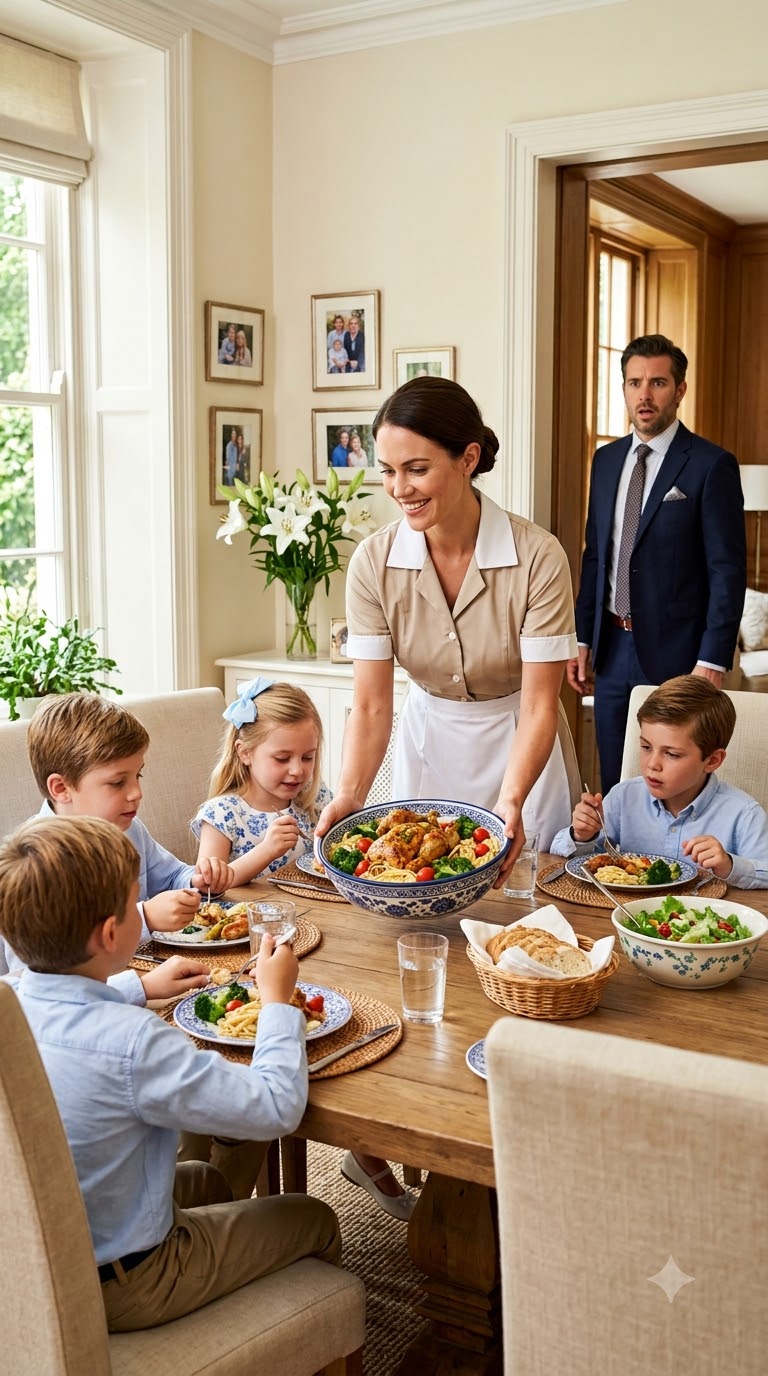
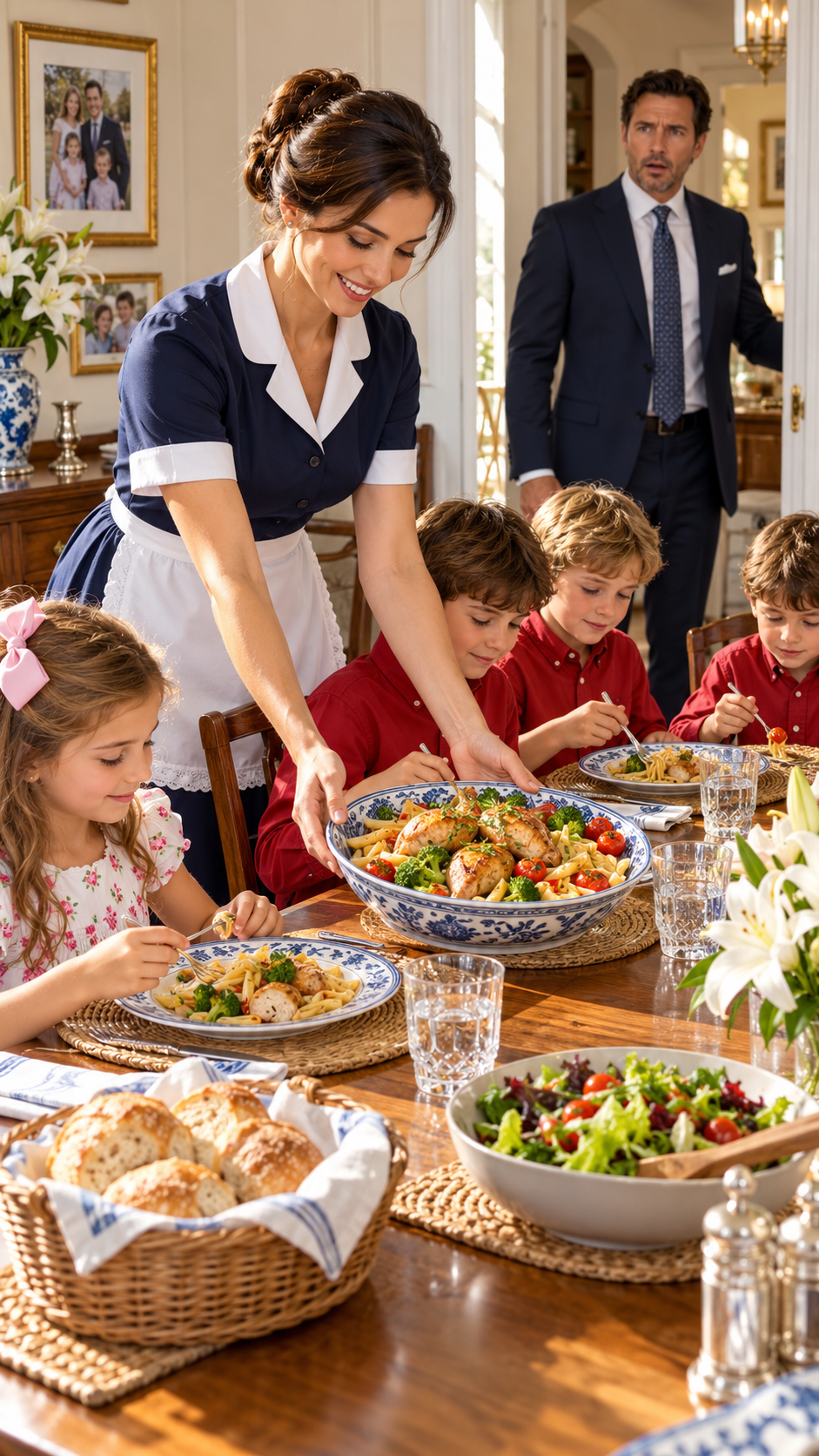
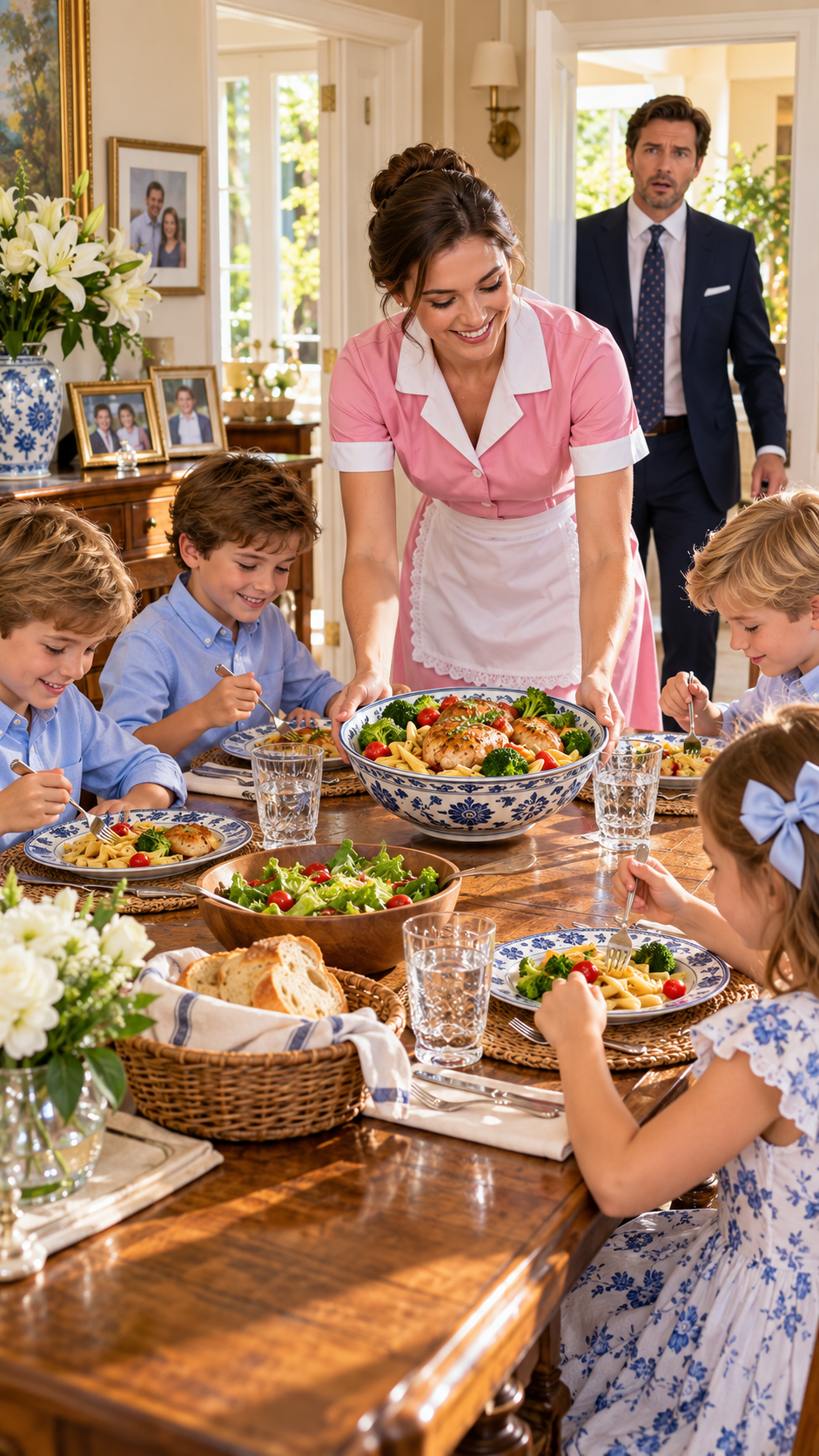
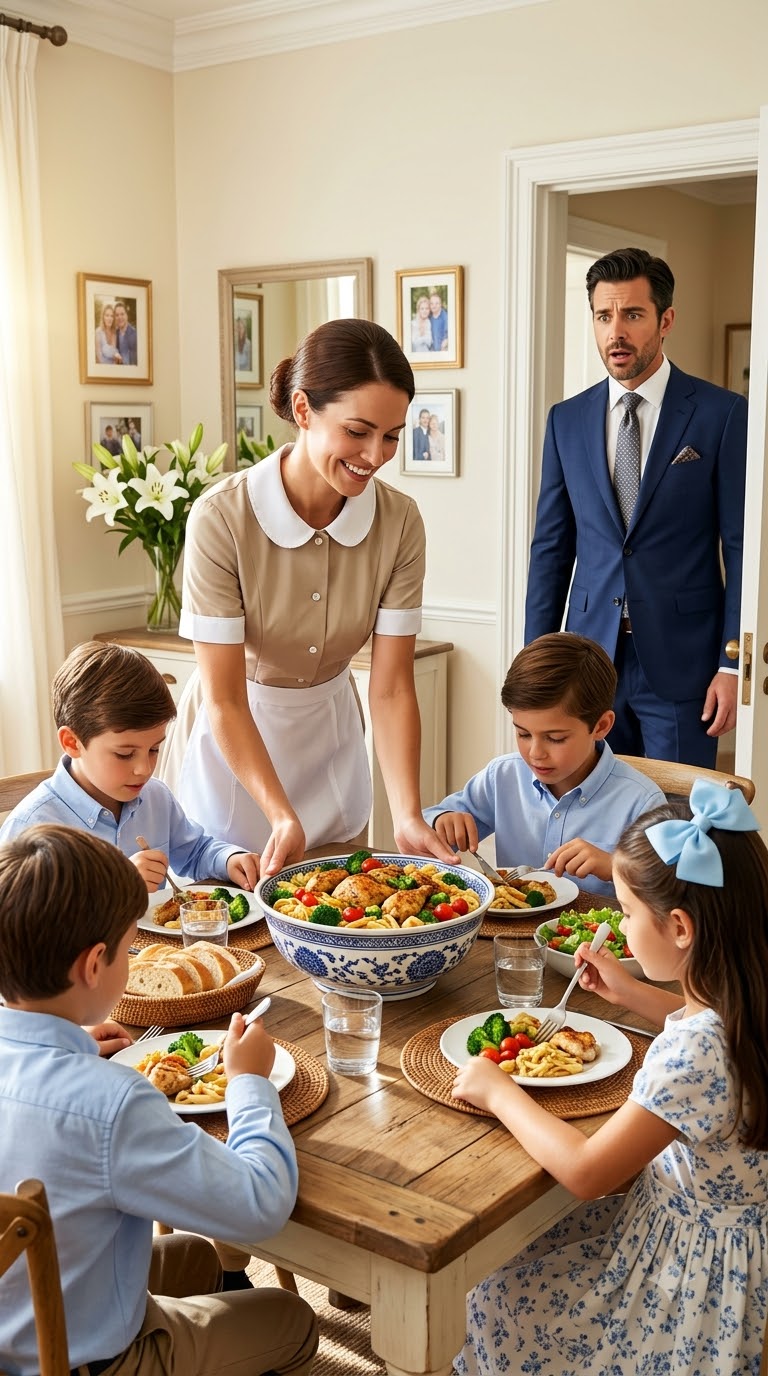
I followed voices to the dining room. My four sons were sitting around the table. There was soup, warm tortillas, and glasses of water. Susana had her hands folded.
“Thank you for this meal, and because we are learning not to be afraid of one another.”
Tomás saw me.
“Dad, come here.”
I sat down. No one fought over the tortillas or shoved a chair. That detail, so small for any other family, put a knot in my throat. Halfway through the meal Tomás spilled his glass. I tensed. Susana only reached for a cloth.
“It’s all right. Accidents get cleaned up.”
Afterward I asked her how she had managed in three days what I had not managed in three years.
“You still think they need someone to fix them. They need to discover that they can make a mistake and still not be abandoned.”
Six weeks later I thought we were coming out of the tunnel.
Then Mother’s Day arrived.
That morning I found Susana’s room torn apart and her Bible on the floor, with several pages ripped out. My four sons were crying around it.
Mateo shouted, “She’s going to leave too when she sees what we’re like!”
Susana, instead of packing her suitcase, sat down on the floor among the torn pages.
PART 3
I stepped forward to separate the boys, but Susana raised a hand.
“Let them.”
Her voice was not harsh. It was firm.
Mateo was crying with rage. Lucas had hit the wall with his open palm. Diego was shaking, and Tomás kept repeating that everyone left. I felt ashamed. For years I had called “bad behavior” what I now saw clearly: every piece of mischief was a question. “Are you going to leave us too?”
Susana picked up one of the torn pages.
“I’m sad about my Bible,” she said, “but I am not disappointed in you.”
Mateo looked at her as if he did not understand.
“We broke it.”
“Yes. And we are going to have to take responsibility. But a broken thing does not turn the people who broke it into bad people.”
Lucas lowered his head.
“Mom left because we were bad.”
That sentence went straight through me. I had heard versions of it many times, but I had never had the courage to answer it head-on.
I sat on the floor with them.
“No,” I said. “Your mom made an adult decision. You were children. It was not your fault.”
Mateo looked at me with red eyes.
“Then why did you never say it to us like that?”
I had no defense.
“Because I was angry too, and because I was afraid to talk about her.”
For the first time I did not try to look like the father who had the answers. I told them that the night Elena left I sat in the kitchen until dawn, reading her note over and over. I told them I had felt that I had not been enough either.
Then something happened that I will not forget. Lucas came closer and rested his head on my shoulder.
Susana let us cry.
Later, all four of them gathered every page of the Bible. Mateo asked whether it could be repaired.
“It isn’t going to be the way it was,” Susana answered. “But we can keep it whole in another way.”
We bought a leather folder made by a bookbinder in Tlaquepaque. Over several days the boys placed the pages in one by one. Some stayed wrinkled. Others had small tears. Susana would not let us replace a single one.
“This Bible already tells another story,” she said.
Mother’s Day did not disappear from our lives, but it stopped being an enemy. That night the boys made a sign for Susana. It did not say “Mom.” It said, “Thank you for staying today.” She put it on the refrigerator.
The next day Susana put a new rule on the refrigerator: “Feeling does not give permission to hurt.” There were no humiliating punishments, but there were consequences. Lucas patched the wall with me. Mateo helped pay, with part of his Sunday money, for the new binding. Diego tidied the room, and Tomás swept up the small pieces with a child’s broom. I canceled two meetings so I could be there. It was the first time I did not hire someone to repair what was happening inside my own house. We also went back to family therapy, but this time I went into the sessions instead of waiting outside. I discovered that my sons did not need a perfect father. They needed one who was present when shame, anger, or fear showed up.
Summer changed our house slowly. Mateo laughed again. Lucas started building wooden boxes instead of breaking toys. Diego stopped hiding, and Tomás began to hum Susana’s song.
But the hardest change was mine.
One night I found her in the kitchen drinking coffee. The house was quiet.
“They’re better because of you,” I told her.
“Because of you too.”
I shook my head.
“I got here late.”
Susana set her cup down.
“Getting here late is not the same as not getting here.”
I stayed quiet. Then I confessed something I had never said out loud. After Elena left, I had decided that my only duty was to keep my sons safe and financially protected. I had turned work into an excuse for not getting too close to their pain.
Susana listened, and then, for the first time, she spoke about herself.
Years earlier she had had a daughter, Lucía. She lost her when the girl was still a child, after a long illness. After that loss, Susana spent a long time living on automatic, working in other people’s houses, avoiding attachment to anyone.
“When I heard at the parish that there were four boys who made everyone run,” she told me, “I understood that rage. I spent years trying to make the world stay away before it could hurt me again.”
Then I understood why she had never treated my sons like a problem she had to solve. She knew the fear of loving someone and losing them.
“And you’re not afraid anymore?” I asked.
“Of course I am. I just stopped obeying the fear.”
That conversation changed the way I was at home. I started coming back earlier. I cooked on Sundays, even though at first I burned the tortillas. I went with Lucas to the workshop. I read with Diego. I listened to Mateo without correcting him right away. When Tomás cried, I stopped looking for a solution and sat down beside him.
Six months after Susana arrived, she was no longer the caregiver. She was part of our decisions, our dinners, and our hard days.
And I had fallen in love with her.
I did not want to act without speaking to my sons first. One morning I made hotcakes and sat them around the table.
“I want to ask Susana to stay with us as family. Not as an employee.”
Mateo smiled before I finished.
“We already know.”
“What do you mean, you already know?”
“Dad, you’re 46, not 14,” Lucas answered, and all four of them laughed.
Then they turned serious.
“If you ask her,” Diego said, “we want to be there.”
The following Saturday we prepared dinner in the garden. Nothing luxurious. Simple lights, geraniums, bread from the neighborhood bakery, and mole that Ernesto had sent over because I did not trust my own skills.
After dinner, Tomás handed Susana a small bouquet of the flowers they had tended for weeks.
I took out a box with a simple ring.
“Months ago you said you couldn’t promise us forever,” I reminded her. “You could only show us one day at a time. That’s what you did. And we want to choose you one day at a time too. Do you want to build a life with us?”
Susana cried. She looked at the boys first.
“Are you sure?”
Mateo pointed at the ring.
“You took a long time to ask.”
She laughed through her tears and said yes.
We did not marry right away. We went slowly. Family therapy, clear agreements, and a great deal of work. I did not want a wedding to become another way of pretending everything was settled. A year later we held a small ceremony in the same garden.
On the day of the family photo, something happened that I still keep as my favorite memory. The photographer wanted to arrange us perfectly. Mateo standing straight, Lucas still, Diego smiling, and Tomás looking at the camera. Susana was beside me with the repaired Bible in her hands.
“Now everyone say ‘family,’” the photographer asked.
Tomás raised his voice.
“No! Let’s say ‘we’re still here.’”
We all laughed just as the shutter clicked.
The photo came out a little blurred because Lucas leaned in, Mateo opened his mouth laughing, and my eyes were wet. It was not perfect.
We hung it in the entryway.
Beneath it, on a small shelf, we left the plastic bucket the boys had used to soak Susana on her second day.
Sometimes someone asks why we keep an old bucket in a house where everything else is looked after. I always give the same answer.
Because that bucket was the first question my sons asked Susana without using words.
“Are you going to leave too?”
And every morning, when I pass the photograph, I remember that the answer was never in some enormous promise.
It was in something much harder.
Still being there the next day.
