

PART 1
Throughout the day, I had done everything possible to appear courageous.
Whenever a nurse entered my hospital room, I greeted them with a smile. When the doctors discussed the operation scheduled for the following morning, I tried to make jokes. I listened to their explanations, nodded at the appropriate moments, and repeated their reassurances as though saying them aloud would make them true.
They spoke with such confidence that I desperately wanted to believe them.
But beneath my practiced composure, I was terrified.
My face remained swollen, my skin hurt, and every breath reminded me that something was seriously wrong inside my body. According to the doctors, surgery offered my best chance of recovery.
They had also warned me about something I could not stop thinking about.
After the operation, my life might never be the same.
Those words followed me through the afternoon and into the evening. No matter how often I tried to distract myself, they returned.
When the hospital finally became quiet, the courage I had displayed all day disappeared.
Alone beneath the soft yellow light, I felt less like a patient preparing for surgery and more like a frightened little boy who had wandered somewhere he did not belong.
I stared at the ceiling, wondering whether I would recognize myself when I woke up.
Would my memories still belong to me?
Would I remember the people I loved?
Would I wake up at all?
Earlier that afternoon, Mom had sat beside my bed, gripping my hand so firmly that her knuckles turned white.
She tried to distract me with childhood memories.
She reminded me of the summer when I was five and insisted on tying my own shoes. I had been so proud of myself until I tripped in the yard.
She laughed while telling the story, and for a moment, I could almost imagine being that little boy again.
Then she turned away to reach for a tissue.
I saw a tear sliding down her cheek.
Mom rarely cried in front of me. Even when I broke my arm as a child, she had remained calm.
Seeing her frightened now made everything feel more dangerous.
Dad stood near the foot of my bed, opening and closing his rough hands.
He had always been the strong one in our family, the man who could carry me on his shoulders and make almost any problem seem manageable.
That afternoon, even he appeared uncertain.
Eventually, he cleared his throat.
“You are strong,” he said quietly to me.
I wanted to believe him.
More than anything, I wanted to be strong enough to reassure both of them.
But I had nothing comforting left to say.
At eight o’clock, a nurse announced that visiting hours were over.
Mom embraced me tightly enough that I could feel her heartbeat. Dad touched my forehead and seemed about to speak, but the words never came.
Then they were gone.
The door closed, leaving me with the low mechanical hum of the equipment beside my bed.
I picked up the notebook on my nightstand.
Writing seemed easier than speaking.
I wrote about everything I was afraid of losing: dinners with my parents, Dad complaining about politics, Mom putting too much food on my plate, and the ridiculous conversations with friends that sometimes left me laughing until my stomach hurt.
Even the ordinary things seemed extraordinary now.
The sound of rain against our kitchen window.
The smell of coffee in the morning.
The comfort of knowing that tomorrow would probably resemble yesterday.
I wrote until my fingers ached.
Then I put the notebook aside and tried to sleep.
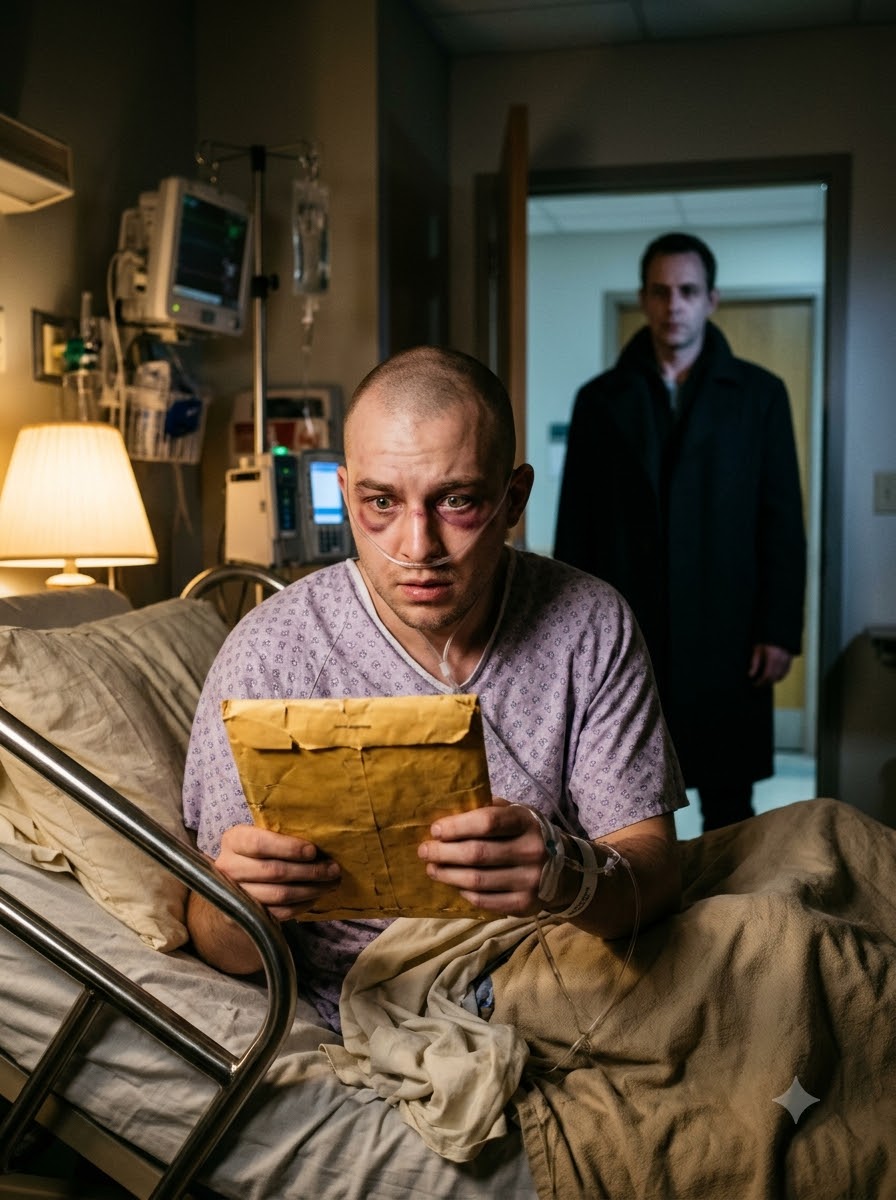
At 11:47 p.m., I heard the last nurse’s footsteps fade down the corridor.
A moment later, my door began opening.
I watched a figure appear against the hallway light.
The person wore no white coat.
In one hand was an old envelope, yellowed with age.
Something about the writing on its front made my blood run cold.
I recognized every uneven letter.
It was my handwriting.
Yet I had never seen that envelope before.
The stranger approached my nightstand, placed the envelope beside me, and leaned close enough to whisper.
“Read it before tomorrow comes, because after the surgery you will not remember who I am anymore.”
Before I could respond, the figure disappeared.
I reached for the envelope with trembling fingers.
For several seconds, I wondered whether exhaustion had caused me to hallucinate.
But the paper felt real.
Its edges were rough, its surface dry and old.
I turned on the bedside lamp.
The handwriting was unmistakable.
Even the unusual shape of my capital E was there.
I opened the envelope carefully.
Inside was a single folded page.
The first sentence contained my name and a warning.
It told me not to trust what happened the following morning.
The doctors would smile, it said. They would describe the operation as routine. They would reassure me that everything was safe.
But before allowing them to take me into surgery, I had to ask one question.
What exactly were they taking from me?
I read the warning repeatedly.
It seemed impossible that such a simple question could matter so much.
Yet the letter insisted that the answer would be more important than anything the doctors had told me.
I thought about Dr. Alden, who had smiled confidently throughout the day.
I had accepted his explanations because I wanted to believe everything would be fine.
Now I wondered what he might have left unsaid.
At the bottom of the page was a date.
Three weeks in the future.
I stared at it.
The letter seemed to have been written by someone who knew what would happen after my surgery.
Someone who knew enough to warn me.
Someone whose handwriting was identical to mine.
When I turned the paper over, I noticed a photograph taped to the back.
It showed me laughing beside another young man.
He had an easy smile, and the way we stood together suggested we had known each other for years.
But I could not remember him.
Not his name.
Not where we had met.
Not why we were laughing.
I turned the photograph over.
Written on the back, again in my handwriting, were the words:
“Do not let them make you forget this face.”
I felt a strange ache in my chest.
I searched my memories of school, childhood summers, and old friendships.
Nothing explained the young man in the photograph.
I knew he should mean something to me.
That certainty frightened me more than the letter itself.
Had the crash already damaged my memory?
Had I forgotten someone important?
And why would anyone want to make that loss permanent?
I decided not to show the letter to anyone yet.
I slipped it beneath my blanket and switched off the lamp when I heard footsteps approaching.
There were two people outside.
One walked quickly, with the light steps of a nurse.
The other moved more heavily.
They stopped directly outside my door.
A moment later, Nurse Clara entered with an orderly I recognized.
She asked why I was still awake.
I pretended I had only just opened my eyes.
“I couldn’t sleep,” I told her.
That was true.
Clara checked my pulse and examined the monitors.
Then she mentioned something that made my heart race.
According to the corridor camera, nobody had entered my room at 11:47.
She said the ward had been quiet and suggested that I must have dreamed the visitor.
The orderly nodded.
But while Clara adjusted my blanket, I noticed him looking toward my nightstand.
He glanced at the exact spot where the envelope had been.
Then he looked again.
I kept my face still.
Clara’s explanation sounded perfectly reasonable, except for the paper hidden beneath my blanket.
I had touched it.
I had read it.
I had seen the photograph.
Whatever the camera showed, someone had entered my room.
After they left, I waited until their footsteps disappeared.
Then I examined the envelope again.
It was still there.
The handwriting was still mine.
The photograph still showed the unfamiliar young man laughing beside me.
I tucked everything beneath my mattress, where I hoped no one would find it.
For a long time, I lay awake considering the possibilities.
Perhaps the camera had malfunctioned.
Perhaps someone had deliberately avoided it.
Or perhaps the hospital knew more about the visitor than it was willing to admit.
Just before leaving, Clara had paused in the doorway.
Without turning around, she said something I could not understand.
“Some doors are not on camera, Ethan.”
Then she walked away.
The following morning, sunlight replaced the dim yellow glow of the previous night.
Mom and Dad arrived early.
Both looked exhausted, though they tried to smile.
Soon afterward, Dr. Alden entered with the surgical team.
His reassuring expression was exactly as the letter had predicted.
He reviewed my chart and described the procedure as routine.
I listened as the younger doctors explained anesthesia and recovery.
Every instinct told me to nod and remain agreeable.
Instead, I took a breath.
“What exactly are you taking from me?”
The room fell silent.
Dr. Alden’s smile tightened.
He glanced at my chart.
Mom looked confused.
Dad’s hands began clenching again.
I repeated the question.
Rather than answer directly, Alden announced that he wanted another scan before proceeding.
He said additional imaging would provide a clearer picture and that careful preparation was always preferable to rushing.
The surgical team immediately began rearranging its schedule.
I watched them, increasingly certain that my question had changed something.
A routine question should not have produced such an uncomfortable reaction.
While we waited, Mom admitted something else.
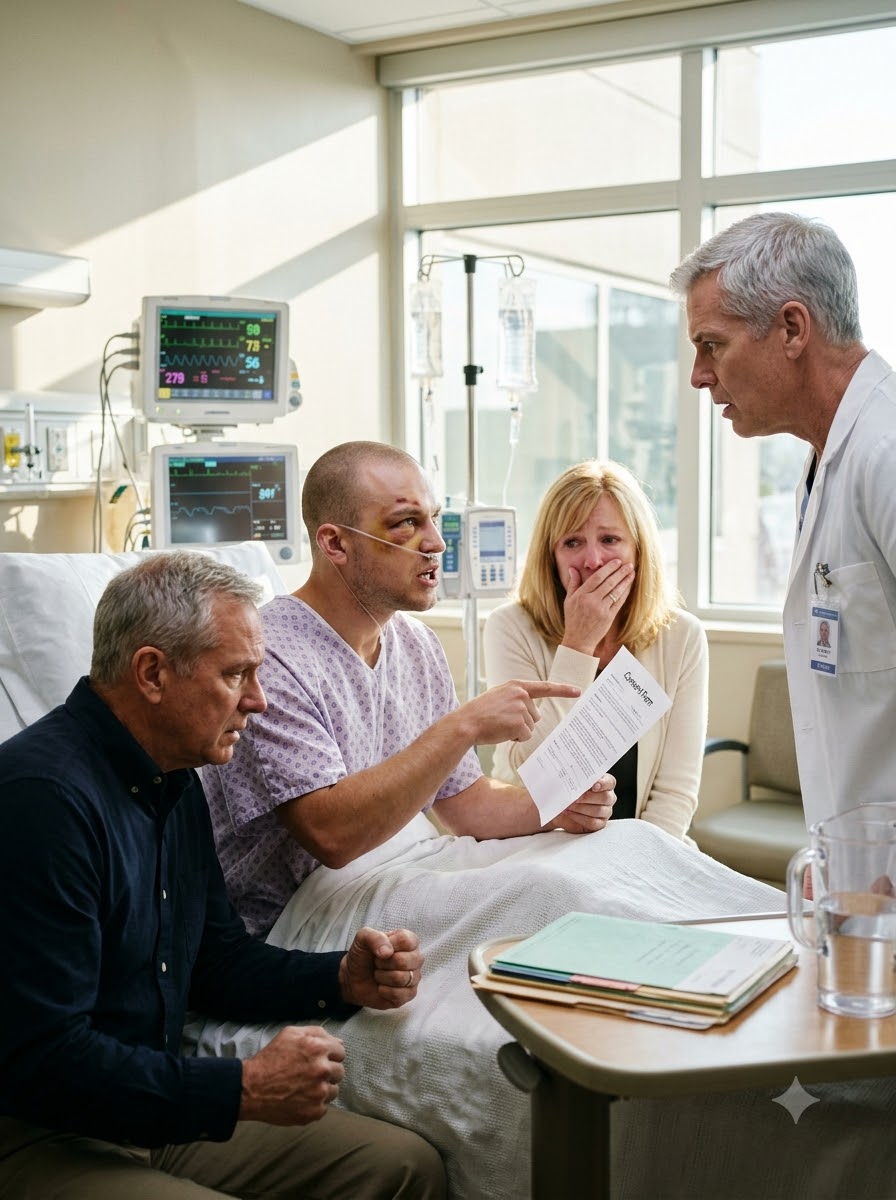
The previous day, a nurse had asked her to sign another document.
She had been told it was standard anesthesia paperwork.
Mom had signed without reading every line.
I asked to see it.
Dr. Alden said it had already been filed and could not be retrieved until after the procedure.
His explanation sounded professional.
It also sounded like another excuse.
When he left, I asked Mom whether she remembered anything written on the document.
She shook her head.
She had trusted the hospital.
She had believed she was helping me.
I could see how frightened she was, and I did not want to blame her.
But I needed to know what she had signed.
While Mom rested in the corridor and the extra scan was being arranged, I noticed her bag beside my bed.
I hesitated before opening it.
Then I found a folded document between a packet of tissues and a bottle of water.
The title made me feel sick.
Elective memory modulation to remove traumatic memories after brain injury.
I read it twice.
The document described a procedure intended to target and remove specific memories.
It presented the treatment as a way to reduce psychological distress and support recovery.
But it was not simply anesthesia paperwork.
It concerned my memories.
My identity.
My life.
At the bottom was a signature.
Mine.
Or at least it looked exactly like mine.
The date beside it was from a day when I had been unconscious after the crash.
I could not remember signing anything.
I could not even remember being awake.
When Mom returned, she saw the paper in my hands.
Her face crumpled.
She began crying and explained that the doctors had warned her my grief might prevent me from recovering.
They had told her removing traumatic memories could help me survive.
She had signed because she was terrified of losing me.
Dad arrived and admitted that he had agreed as well.
He told me that after the crash, I had repeatedly screamed a name.
Daniel.
I had stopped eating.
I had withdrawn from everyone.
My parents had watched me deteriorate and feared that I might die.
They had believed the doctors were offering a way to save me.
I held Mom’s hand while she cried.
I understood their desperation.
But I could not accept that a decision about my mind had been made without my informed consent.
I unfolded the document again.
Near the bottom, in small print, I found a sentence I had missed.
Patient requests removal of all memories of Daniel.
I stared at those words.
Then I reached for the photograph.
The young man beside me was smiling.
And suddenly, I knew the name that belonged to his face.
Daniel.
But remembering his name was only the beginning.
I still had no idea why losing him had nearly destroyed me—or why someone was so determined to make me forget him again.
PART 2
I held the photograph for a long time after discovering Daniel’s name on the consent form.
The picture showed two young men who appeared completely comfortable together.
I recognized myself immediately.
The other man seemed familiar in a way I could not explain.
His hair fell slightly forward as he laughed. His shoulders leaned toward mine, as though the photographer had caught us in the middle of a private joke.
I knew we must have shared countless moments like that.
But when I searched my memory, I found almost nothing.
Then a fragment appeared.
Rain.
Heavy rain striking a windshield.
Windshield wipers struggling to clear the glass.
A voice laughing beside me.
The sharp sound of brakes.
Then darkness.
I gripped the photograph.
The young man had been in a car with me.
I was certain of it.
When Mom returned, I asked her how I had suffered my brain injury.
She said there had been an accident.
A car crash.
I asked who else had been involved.
Her expression changed.
She told me the doctors had advised her not to force painful memories before my brain was ready.
I asked about Daniel.
She looked away.
That was answer enough to tell me she knew him.
But it did not tell me what had happened.
Later, when Clara came to check my condition, I showed her the photograph.
I asked whether Daniel had ever visited the hospital.
She consulted the visitor records.
When she returned, she said no one named Daniel appeared in the log.
She examined the photograph without touching it.
Then she suggested it might simply be a picture from my life before the accident.
I did not challenge her.
But I had begun noticing a pattern.
The hospital records showed no stranger entering my room.
They showed no visit from Daniel.
And yet I possessed a letter and photograph that raised questions nobody seemed willing to answer.
I hid the photograph inside my notebook.
That evening, Dad came to see me.
He stood near the foot of my bed, as usual, repeatedly clenching his hands.
His eyes moved briefly toward the notebook.
I wanted to ask him everything.
Instead, I watched him struggle to speak.
“You are strong,” he reminded me.
His voice sounded rougher than before.
After he left, I tried to sleep.
I dreamed of rain, headlights, and laughter that ended abruptly.
When I woke, my notebook was open.
Across an otherwise blank page was one word.
Remember.
The handwriting was mine.
But I had fallen asleep with my pen on the nightstand.
I could not explain how the word had appeared.
The following evening, I heard a voice in the corridor.
Something about it made me stop moving.
It was familiar, but not in the way a friend’s voice might be familiar.
It sounded like my own voice.
Older.
Tired.
I followed it down the hallway toward a room I had never noticed.
Inside, an older man sat beside a hospital bed.
When he looked up, I froze.
He had my eyes.
My face.
My voice.
But he appeared to have lived through years I had not experienced.
He did not seem surprised to see me.
Instead, he gestured for me to approach.
He told me his name was Ethan.
He was me.
Three weeks after the surgery.
I could barely understand what he was saying.
He explained that he had agreed to memory modulation.
The operation had relieved his grief.
He no longer woke screaming Daniel’s name.
He ate normally.
He slept through the night.
He went to work and carried on with his life.
From the outside, he appeared recovered.
But he described his existence as strangely empty.
He could look at photographs from his past without recognizing why they mattered.
He could smile politely at people he should have loved.
He could remember the practical details of his life while feeling disconnected from the experiences that had shaped him.
The doctors had removed the pain.
But they had also removed something essential.
I asked how he had come back.
He said he had discovered a way to return for one night, though he could not explain the process.
The letter had been his warning to me.
He had written it because he could not bear to watch himself make the same decision again.
I asked whether remembering Daniel would only bring unbearable suffering.
He looked at me sadly.
He said grief was not the same as punishment.
Remembering someone who had died did not mean I had to spend the rest of my life blaming myself.
He told me that the sadness he had lost was inseparable from the love he had once felt.
Without remembering Daniel, he had also lost the friendship that made the grief meaningful.
He spoke about Mom and Dad.
At first, they had been relieved.
Their son no longer cried uncontrollably.
He no longer refused food.
But eventually, they noticed how distant he had become.
He was courteous and calm.
He was also a stranger in ways they could not explain.
I asked what I should do.
He told me the decision had to be mine.
He urged me to write a clear refusal and keep Daniel’s photograph close.
Then the light around him began changing.
His figure seemed less solid.
I reached toward him, but my hand passed through a fading warmth.
Before disappearing, he pointed to the photograph.
“In three weeks, you will not know his name, but you will still feel him missing every time you laugh.”
Then he was gone.
I returned to my room trembling.
I no longer knew what to believe about time, memory, or the hospital.
But I knew one thing.
I did not want to become the man I had just met.
The following day, I confronted Dad.
I asked him to stop protecting me from the truth.
I wanted to know who Daniel was.
Dad remained silent for a long time.
Then he told me.
Daniel had been my best friend.
He was like a brother to me.
And he had died in the car crash that caused my injuries.
We had been driving in heavy rain.
Daniel sat beside me, laughing.
The car had lost control on the wet road.
By the time help arrived, Daniel was dead.
As Dad spoke, the fragments in my mind began fitting together.
The windshield.
The brakes.
Daniel’s laughter.
The terrible silence afterward.
I asked why nobody had told me.
Dad explained that after regaining consciousness, I had blamed myself for Daniel’s death.
I screamed his name.
I cried until I could barely speak.
Eventually, I stopped eating and responding to visitors.
The doctors feared my grief was interfering with my physical recovery.
They proposed memory modulation.
Mom and Dad agreed because they were desperate to save me.
Mom entered while Dad was explaining.
She sat beside me, took my hand, and began crying.
She told me how frightened she had been.
She had listened to me call for Daniel night after night.
She had watched me grow weaker.
When the doctors offered a treatment that might ease my suffering, she had believed it was the only way to keep me alive.
Dad admitted that he had been afraid of burying another young man.
He had already seen Daniel’s family endure one funeral.
He could not bear the possibility of losing his own son.
I understood their fear.
I understood their love.
But I also understood that Daniel had been part of my life long before the crash.
He had shared meals with my family.
He had laughed at our table.
He had been present for ordinary moments that helped shape who I was.
Those memories were not an illness.
They were part of me.
I told my parents I loved them.
But I could not agree to forget someone who had meant so much.
Dad reached into his pocket.
He brought out an old keychain.
The metal was worn, and a small charm hung from it.
He explained that Daniel had carried it everywhere.
It had been recovered from the car after the accident.
Dad had kept it because he did not know when I would be ready to see it.
He placed it in my palm.
“He was like a brother to you, and I am sorry I tried to make you forget your brother to keep you alive.”
I closed my fingers around the keychain.
For the first time since waking in the hospital, I felt that my parents and I were finally speaking honestly.
But I still needed to know whether the treatment was as harmless as the doctors claimed.
Clara eventually agreed to help me investigate.
One evening, when the ward was quiet, she led me to a restricted records wing.
She used her access card to unlock a heavy door.
Inside were rows of filing cabinets.
The room smelled of paper and disinfectant.
Clara showed me several records concerning patients who had undergone memory modulation.
Their medical summaries described successful recoveries.
They ate normally.
They slept peacefully.
They no longer displayed the same distress.
But other notes revealed troubling changes.
One man no longer recognized the home where he had lived for twenty years.
Another woman greeted her husband each morning as though he were an unfamiliar visitor.
A third patient kept a photograph of her daughter beside her bed.
She smiled at the picture but could not explain why looking at it made her chest ache.
The doctors considered her absence of tears an improvement.
I saw something else.
She had lost the ability to understand her own grief.
Clara then showed me a file bearing my name.
Inside was an earlier request for memory modulation.
It had been written after the crash, while I was overwhelmed by guilt.
The handwriting was mine.
The words begged the doctors to remove Daniel from my memory because remembering him hurt too much.
I stared at the page.
I could imagine the frightened, grieving version of myself who had written it.
He had wanted the pain to stop.
I could not blame him for that.
But he had not understood the full consequences of what he was requesting.
Clara explained that the earlier document could still be treated as consent unless I formally replaced it.
I needed to write a refusal.
It had to be signed and witnessed before surgery.
She warned me that documents sometimes disappeared when they interfered with decisions already made.
I remembered the strange envelope.
The orderly watching my nightstand.
The consent form Mom had signed.
And the schedule that already listed me for memory modulation.
Before leaving the records wing, I saw my name printed on the following day’s procedure list.
Beside it was a time circled in red.
The status read confirmed.
I returned to my room knowing I could not wait any longer.
I had to make my choice unmistakable.
I opened my notebook and wrote that I refused all memory modulation.
I specifically refused the removal of any memory involving Daniel.
I consented only to the surgery needed to treat my brain injury.
Then I signed my name.
The familiar loop of my E appeared beneath the words.
Mom begged me to reconsider.
She feared that grief might overwhelm me again.
Dad, however, told her he would support my decision.
He said he would rather help me endure the pain of remembering than watch me become someone who no longer understood his own past.
Eventually, Mom nodded through her tears.
Clara arrived to witness my refusal.
She read the document carefully.
Then she picked up her pen.
But when I looked down at the paper, something impossible had happened.
Every word of my refusal had vanished.
Only my signature remained.
I held up the page.
Clara examined both sides.
Mom touched the blank paper.
None of us could explain what had happened.
Clara warned me that a signature without the accompanying instructions could be misused.
I thought of the earlier form.
I thought of how easily my handwriting had appeared on documents I did not remember signing.
I asked for another sheet.
This time, I wrote in large, unmistakable letters.
I refused elective memory modulation.
I refused the removal of Daniel’s memories.
I agreed only to the operation for my brain injury.
I read every sentence aloud while Mom and Clara listened.
Then I signed again.
I made additional handwritten copies.
Mom placed one inside her coat.
Clara kept another beside her badge.
I hid mine inside the notebook with Daniel’s photograph.
When Dr. Alden returned, I showed him the blank page.
He called it a printing error.
Clara asked how a printing error could remove the writing while leaving the signature.
He did not give a convincing answer.
Instead, he warned me about the risks of surgery without the combined procedure.
He mentioned seizures and possible uncontrolled memory loss.
For a moment, fear almost changed my mind.
Then Dad stepped forward.
“A son who forgot his brother is not the son we raised, and I would rather help you carry grief than visit a stranger who smiles without knowing why.”
I signed the refusal once more in front of everyone.
Dr. Alden read it aloud.
Then he placed it in my chart.
That night, I began writing another letter.
It was addressed to my future self.
I explained that Daniel had died, that I had chosen to remember him, and that grief was not something I wanted erased.
I wanted the person waking after surgery to know what mattered.
While I was writing, the room grew strangely cold.
I looked toward the doorway.
The stranger had returned.
He stood silently in the same place where I had first seen him.
I recognized him now.
The older Ethan.
He told me the choice would not be complete simply because I had signed a refusal.
The real test would come after surgery, when the pain returned.
If I woke frightened and grieving, the doctors might offer me relief again.
I would have to choose Daniel a second time.
He asked me to write a letter for the morning, when my thoughts might be confused.
I wrote that I had refused memory modulation.
I wrote that Daniel had died in the crash.
I wrote that remembering him mattered more than escaping every painful feeling.
I sealed the letter with a copy of our photograph.
Clara entered as I finished.
She took the envelope and promised to leave it beside me in recovery.
The older Ethan began fading.
Before he disappeared, he looked at the photograph.
“Hold on to the laugh in that picture, because laughter is proof that Daniel lived and not only died.”
Then he vanished.
I lay awake for a long time afterward.
The following morning, nurses arrived to prepare me for surgery.
The corridor was busy.
Equipment rattled past my door.
The smell of antiseptic filled the air.
I reached for my chart.
My refusal was missing again.
I searched through the papers.
The signed document had disappeared.
Dr. Alden entered with the surgical team.
I asked where the refusal had gone.
He took the chart without appearing surprised.
Then the bed began moving toward the operating theater.
As the ceiling lights passed overhead, I remembered the copies Mom and Clara still held.
I remembered the letter waiting for me afterward.
And I remembered Daniel.
Dr. Alden looked down at me.
“We will only take what you signed for.”
I wanted to ask which signature he meant.
But the operating-room doors were already opening.
PART 3
Consciousness returned slowly.
At first, there was only darkness and a distant mechanical sound.
Then I became aware of light pressing against my eyelids.
My head ached.
My mouth felt dry.
My arms were heavy, and even the smallest movement seemed to require enormous effort.
I heard someone calling my name.
“Ethan.”
I tried to open my eyes.
The room gradually came into focus.
Machines stood beside my bed.
A blanket covered my body.
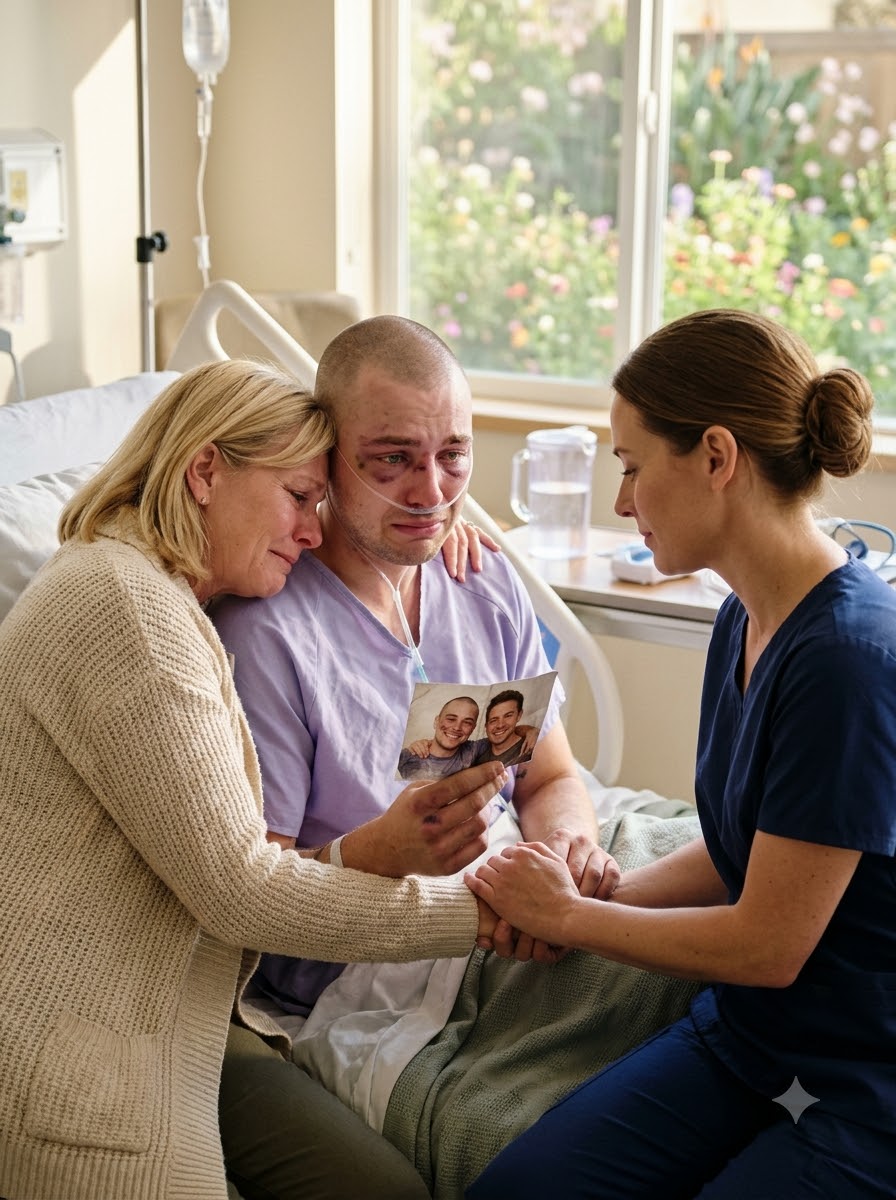
Nurse Clara was leaning toward me.
The surgery was over.
But I could not immediately remember what had frightened me most before it began.
Clara waited until I was fully looking at her.
Then she held up a photograph.
Two young men were laughing together.
I recognized myself.
The other face seemed important.
Terribly important.
But I could not remember his name.
Panic spread through me.
I stared harder at the photograph.
I knew the young man mattered.
I knew I should recognize him.
Yet the memory remained just beyond my reach.
I thought of the missing refusal form.
I thought of Dr. Alden’s final words.
Had they performed the modulation after all?
Had they removed the person I had fought so desperately to remember?
I tried to speak, but my voice caught.
Clara took my hand.
She did not tell me to calm down.
She reached for an envelope on the nightstand.
It was the letter I had written before surgery.
She opened it and began reading.
The words explained that I had refused memory modulation.
They told me Daniel had died in the crash.
They reminded me that grief was not a disease to be removed, but the mark left by love.
As Clara continued reading, something shifted inside my mind.
A name emerged.
Daniel.
Then it came again.
Daniel.
My best friend.
My brother in every way except blood.
I remembered his laugh.
I remembered rain on the windshield.
I remembered the sound of brakes.
And I remembered that he had died.
The grief returned with such force that I began crying.
But this time, I understood what the pain meant.
It meant I remembered him.
Clara kept holding the photograph.
Daniel’s face was no longer unfamiliar.
It belonged to someone I had loved for years.
Mom hurried to my bedside.
She gripped my hand while tears streamed down her cheeks.
Dad stood near the foot of the bed.
His shoulders trembled.
Together, they helped me remember.
Mom spoke about Daniel eating dinner with us.
Dad recalled his jokes and the way he teased him about politics.
I remembered laughter around our table.
I remembered the ordinary happiness of having him there.
Later, Dr. Alden came to examine me.
He explained that the surgery had successfully removed the tumor.
No memory modulation had been performed.
The temporary confusion, he said, was related to anesthesia and pressure on my injured brain.
He warned that memory recovery could remain unpredictable for a while.
I listened carefully.
His explanation matched what Clara had told me.
For the first time, I felt some relief in his presence.
But I also understood that my recovery would not be simple.
Remembering Daniel meant facing the loss I had once begged to escape.
That evening, Mom sat beside me while Dad placed Daniel’s keychain in my palm.
I closed my fingers around it.
The metal felt cool and familiar.
I remembered the photograph, the older Ethan, and the warning that had brought me this far.
Before leaving, Dr. Alden explained that the following forty-eight hours would be especially important for my injured memories.
Some details might return.
Others could remain difficult to access.
I was frightened that Daniel’s name might disappear again.
So the next morning, I reached for my notebook.
I began writing everything I could remember.
The rain.
The windshield.
The brakes.
Daniel laughing in the passenger seat.
The terrible silence after the crash.
I wrote about the days in intensive care, when guilt had overwhelmed me.
I wrote about refusing food.
I wrote about begging the doctors to make the pain stop.
But I also wrote about the friendship itself.
I tried to describe Daniel’s laugh.
The way he leaned back in his seat.
The jokes he told during long drives.
The way being around him had always made ordinary days better.
Sometimes the memories arrived clearly.
Sometimes they were little more than impressions.
I recorded them anyway.
Each sentence felt like another piece of my life being returned to me.
Mom visited with soup and more stories.
She told me that Daniel always chose the chair nearest the window at our dinner table.
She remembered how he teased Dad until Dad laughed despite himself.
She recalled how he thanked her whenever she put more food in his bowl, even when he was already full.
As she spoke, Daniel became more than the young man in a photograph.
He became part of our home again.
Dad arrived later carrying a folded jacket.
It had belonged to Daniel.
The fabric was worn, and it smelled faintly of old leather.
Dad told me he had kept it since the accident.
He had not known what to do with it.
Throwing it away felt wrong.
Looking at it had been painful.
Now he wanted me to have it.
I held the jacket and remembered Daniel wearing it on cold evenings.
I remembered borrowing it when I forgot my own.
For the first time, those memories brought warmth alongside sadness.
I placed the jacket over the chair beside my bed.
It felt right to have something of his nearby.
That evening, Clara appeared at my door with a woman I had not seen since the crash.
She had tired eyes and a gentle expression.
Clara introduced her as Daniel’s mother.
My chest tightened.
I had been driving the car.
Daniel had died beside me.
I did not know what his mother would say when she looked at me.
She approached the bed and took my hand.
There was no anger in her face.
She told me she did not blame me.
The road had been dangerous.
The rain had been heavy.
Another car had approached too quickly.
Neither Daniel nor I could have controlled everything that happened.
She said Daniel had chosen to ride with his best friend.
He had trusted me.
And she did not want his memory to become a punishment I carried for the rest of my life.
Her words did not erase my guilt.
But something inside me loosened.
She began telling stories about Daniel as a child.
She described his stubbornness, his kindness, and the loyalty that had always defined him.
She said he had spoken of me as a brother long before the accident.
At one point, she recalled something funny he had done.
I laughed.
It was a real laugh.
For a moment, I almost felt guilty about it.
Then I remembered what the older Ethan had said.
Laughter was proof that Daniel had lived.
Not only that he had died.
Before leaving, Daniel’s mother handed me an envelope.
My name was written on the front in his handwriting.
She explained that Daniel had written the letter before the crash.
She had kept it until she believed I was ready.
I stared at the envelope.
It was strange how much my life had changed because of letters.
One had arrived from a future version of myself.
Another had protected my memories after surgery.
And now I held a letter written by the friend I had nearly forgotten.
I did not open it immediately.
I wanted to.
But I was frightened of what it might contain.
I kept it beside my bed throughout the night.
Every time I looked at it, I remembered Daniel laughing in the photograph.
I wondered what he had wanted to tell me.
Had he written about our friendship?
Had he made another joke?
Had he somehow known how much I would need his words?
By morning, I could no longer bear waiting.
I carefully broke the seal.
The first sentence made my eyes fill with tears.
“If you are reading this, do not spend your life apologizing for a road neither of us could control.”
I read it several times.
Then I continued.
Daniel’s familiar humor filled the page.
He urged me to live fully.
He wanted me to laugh without guilt.
He wanted me to remember him as a friend rather than as the worst thing that had ever happened to me.
He wrote about the plans we had made and the ordinary days we had shared.
He reminded me that friendship did not become meaningless because one person’s life ended.
It changed.
It became something the surviving friend carried forward.
As I read, I began to understand something I had missed throughout my recovery.
I had believed there were only two choices.
Remember Daniel and suffer forever.
Or forget him and escape the pain.
But Daniel’s letter offered another possibility.
I could remember him and still live.
I could grieve and still laugh.
I could miss him without treating every happy moment as a betrayal.
The guilt did not disappear immediately.
It was too deeply rooted for that.
But it began to change.
It became something I could examine rather than something that controlled every breath.
I folded Daniel’s letter and placed it inside my notebook.
Beside it were my own letters, the photograph, and the copies of my refusal.
They were reminders of what I had chosen.
And why.
Over the following days, my recovery continued.
Some mornings were easier than others.
There were moments when I could recall Daniel’s voice clearly.
At other times, I struggled to remember small details.
Whenever that happened, I opened my notebook.
Mom and Dad helped fill the gaps.
Daniel’s mother shared stories I had never heard.
Slowly, my memories became less frightening.
I learned to let sadness arrive without assuming it would destroy me.
I learned that remembering did not require reliving the crash every minute.
And I learned that accepting comfort was not the same as forgetting.
Three weeks after the night the stranger first appeared, I reached the date written at the bottom of his letter.
I had thought about that date almost constantly.
At first, I feared it represented some terrible deadline.
Perhaps it was the day my memories would vanish.
Perhaps it was the day the older Ethan would return.
But when the morning arrived, nothing extraordinary happened.
I woke up knowing my own name.
I remembered my parents.
I remembered the crash.
And I remembered Daniel.
That day, Mom and Dad accompanied me to his memorial.
The weather was clear.
Soft sunlight fell through the trees.
Flowers surrounded the stone marking his resting place.
Daniel’s mother was there too.
I brought the original photograph.
Its corners were still curled from being carried and handled so often.
I placed it beside the memorial.
Then I stood quietly, looking at the two young men laughing in the picture.
One was me.
The other was my best friend.
For a long time, I said nothing.
I thought about the night before surgery.
The yellow light.
The stranger at the door.
The letter in my handwriting.
The photograph I could not understand.
I remembered how frightened I had been of waking up as someone else.
And I thought about the older Ethan, whose life had become quiet and empty because he had surrendered the memories that hurt.
I had been given the opportunity to make a different choice.
I had made it.
And I had kept making it.
Finally, I spoke Daniel’s name aloud.
“Daniel.”
My voice shook.
But I did not look away.
I did not apologize for remembering him.
I did not ask the pain to disappear.
I simply stood there with the people who loved him.
Mom squeezed my hand.
Dad remained beside me, his shoulders steady.
Daniel’s mother smiled through her tears.
For the first time, the silence around us felt peaceful rather than empty.
I understood that the future had changed.
The older Ethan would not become my reality.
Whatever strange path had allowed him to warn me no longer needed to exist.
The loop had been broken.
Not merely because I had refused a procedure, but because I had chosen to carry my memories even when they were painful.
When we returned home, the familiar sounds of the house welcomed me.
Dishes clattered in the kitchen.
Mom prepared dinner.
Dad complained about something he had seen on the news.
Soon we were sitting around the table together.
Mom put more food into my bowl than I could possibly eat.
Dad continued grumbling about politics.
I laughed.
Then I laughed harder.
For a moment, my stomach actually hurt from laughing.
I remembered writing about that exact experience on the night before surgery.
Back then, I had been terrified that I would never sit at our table again.
Now I was home.
I was recovering.
I had scars, headaches, and difficult memories.
But I was alive.
And I was still myself.
The surgery had helped my body heal.
Remembering Daniel helped me understand what being whole meant.
I no longer believed healing required becoming someone untouched by grief.
I could be wounded and still have a future.
I could carry a loss without allowing it to define every remaining day.
I could remember a friend who had died and still find reasons to be happy.
That evening, after dinner, I opened my notebook one final time.
Inside were the photograph, the letters, and the words I had written when I feared losing my identity.
I thought about Clara, who had protected my decision.
I remembered Mom’s trembling hands and Dad’s quiet determination.
I thought about Daniel’s mother, whose forgiveness had helped me begin forgiving myself.
And I remembered the stranger who had appeared in my hospital room carrying a letter written in my own hand.
For so long, I had thought he was someone trying to frighten me.
Now I understood.
He had been trying to save me.
Not simply from the doctors.
Not even from the surgery.
He had been trying to save me from a future in which I could no longer remember why the people I loved mattered.
I turned to a clean page.
I picked up my pen.
And in the same uneven handwriting that had appeared on the mysterious envelope, I wrote one final sentence.
“I woke up as myself, and I remember him.”
I looked at those words for a long time.
Then I closed the notebook.
From the kitchen, I heard Mom calling me back to the table.
Dad was already complaining about something else.
I could hear the familiar warmth in their voices.
I stood, slipped Daniel’s keychain into my pocket, and went to join them.
The older Ethan never appeared again.
I no longer needed him to.
I knew who I was.
I knew who Daniel had been.
And although I would always miss him, I finally understood that carrying his memory was not the same as carrying a punishment.
It was carrying a friendship.
It was carrying love.
And it was carrying a part of myself that I would never willingly surrender again.
