

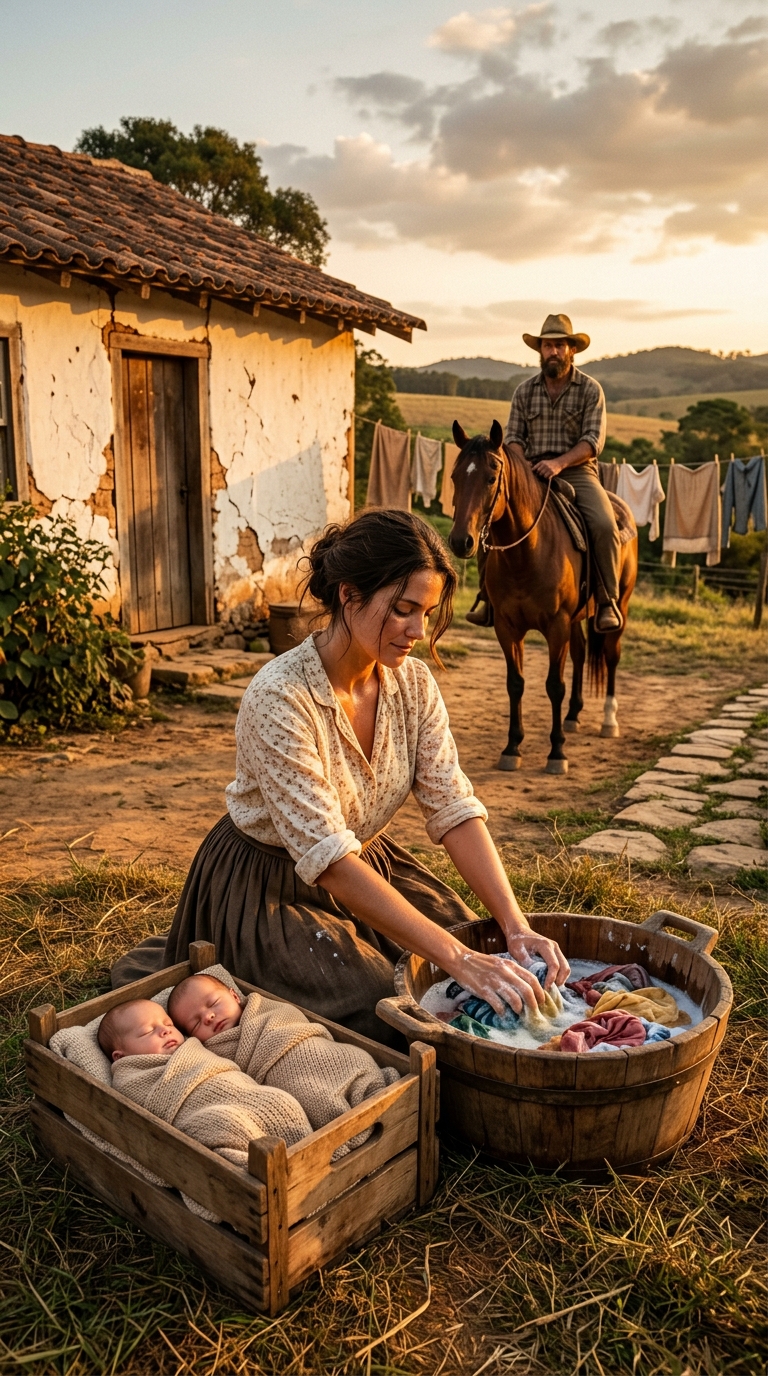
In the year 1898, when the roads of Guanajuato were still measured in dust, church bells, and exhaustion, there stood a humble shack at the end of a lonely path where almost no one ever passed. Its walls were cracked adobe, the old tile roof let in the rain, and in the dry dirt yard a woman washed other people’s clothes from before the rooster crowed.
Her name was Rosaura Mendoza.
She was twenty-six years old, with twin babies only four months old and a widowhood that still hurt like an open wound. Her hands, once soft, were now cracked from lye soap and the cold well water. But Rosaura never stopped. She couldn’t. Because beside the washbasin, inside a wooden box her late husband had built with his own hands, slept Mateo and Lucía — the only two reasons she kept getting up every morning.
Three months earlier, her life still had a man’s name: Tomás Alvarado.
Tomás was a day laborer on the lands of Don Evaristo Salcedo, the most feared landowner in San Jerónimo del Río. He wasn’t rich, but he was honest. He worked from the moment the sky brightened until the shadows stretched long across the maguey plants. When Rosaura became pregnant with twins, he walked around with a smile too big for his face.
“I’m going to buy a little piece of land, Rosa,” he would tell her at night. “Small, even if it’s tiny. But our own. So our children won’t have to ask permission to plant a single corn stalk.”
Rosaura believed him.
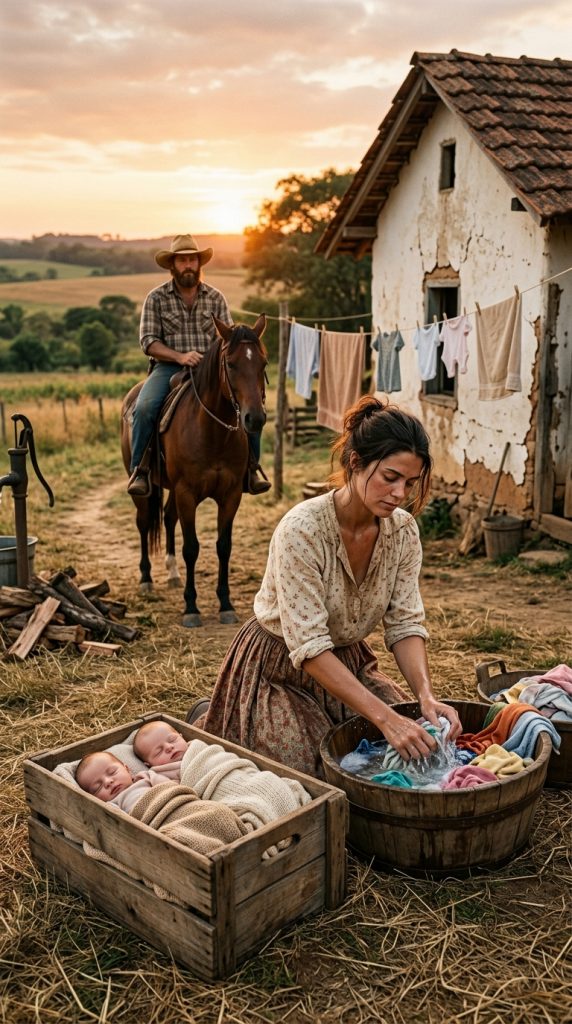
Until one morning Tomás went to clear a plot of land near the stream and never came back. An old tree fell the wrong way. The workers arrived too late. When they brought the news, Rosaura was breastfeeding Mateo while Lucía slept wrapped in a rebozo.
She didn’t scream. She didn’t faint.
She simply stood still, staring at the door, as if her husband might still walk in and say it had all been a scare.
But Tomás never returned.
From then on, Rosaura learned that mourning was a luxury for those with a full pot. She did not have that. She washed clothes, mended sacks, sold tortillas when she had enough corn, and accepted whatever work the women from the village left at her fence. Some helped her quietly. Others looked at her with pity. And pity, Rosaura knew, could hurt worse than hunger.
One heavy sunny afternoon, while she was scrubbing a coarse cotton shirt at the washbasin, she heard hooves.
She straightened up immediately.
No one ever came down that path by accident.
A chestnut horse appeared through the dust. Riding it was a tall man with broad shoulders, a palm-leaf hat, and a light-colored shirt. He didn’t look like a laborer or a foreman. He looked tired from the road, but not lost.
The man stopped the horse a few steps from the yard and took off his hat.
“Good afternoon, ma’am. Forgive the intrusion. I’m coming from Dolores and took the old road by mistake. Would it be too much trouble to ask for a little water?”
Rosaura looked at him with distrust. Since Tomás died, she had learned that a woman alone had to measure every word and every distance.
“Wait there,” she said.
She went into the shack, filled a clay pitcher, and came back. She offered it to him without getting too close. The man drank slowly. Then, without any bad intention, his eyes drifted toward the wooden box where the twins were sleeping.
“Are they yours?”
Rosaura lifted her chin.
“Yes. Mateo and Lucía.”
The man nodded with respect.
“May God keep them.”
He didn’t ask about the father. He didn’t ask if she was alone. He made no comment that would force her to defend herself.
“My name is Julián Arriaga,” he said as he returned the pitcher. “I have a ranch on the other side of the river.”
“Rosaura Mendoza.”
Julián bowed his head.
“Thank you for the water, Doña Rosaura.”
He mounted again and left.
Rosaura went back to washing, but she could no longer concentrate. Not because the man had pleased her — her heart was still in mourning — but because, for the first time in months, someone had looked at her without pity. As if she were still a complete woman, not just a poor widow with two small children.
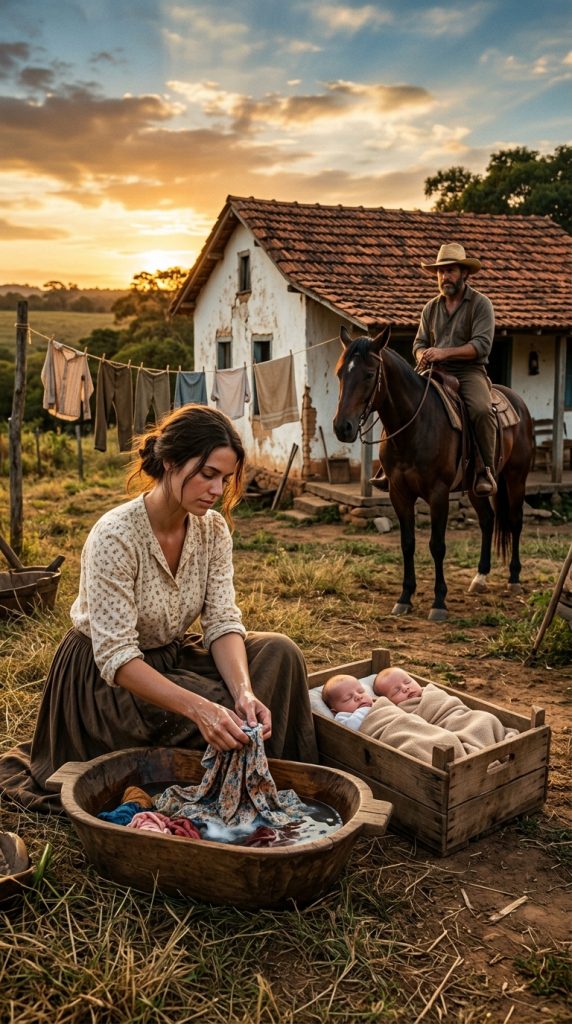
Three days later, Julián returned.
This time he said he had passed nearby and noticed some loose tiles on the roof from the road.
“If it rains hard, the water will come in on top of the children,” he said.
Rosaura stiffened.
“I’ll fix it when I can.”
“I’m not here to offend you. I brought tools. I won’t charge anything. And if you tell me to leave, I’ll leave.”
Rosaura looked at the sky. Dark clouds were coming down from the hill. Then she looked at her children. Her pride burned in her throat, but being a mother won over being proud.
“Fix it then. But only the roof.”
Julián climbed up without another word. He worked under the sun, adjusted tiles, reinforced beams, came down sweaty, and washed his hands in silence. Rosaura offered him a plate of watery beans. He accepted only half a tortilla, as if he understood that the food was more sacrifice than invitation.
From then on, he returned a few times. Once to repair the fence. Another to leave a sack of corn, swearing it was extra from his ranch. Another to bring two wooden rattles he had carved himself for the children.
He never tried to touch her. He never said a single word out of place. He stayed in the yard, helped, greeted the twins, and left before nightfall.
But villages have eyes even in the stones.
Soon, at Don Aniceto’s store, the murmurs began.
“The widow of Tomás is receiving visits.”
“And not just any visits. Don Julián Arriaga.”
“Oh, those women who barely mourn their husbands…”
Rosaura heard the rumors on Sunday after mass. The women lowered their voices when she walked by with Mateo in one arm and Lucía in the other. No one dared say anything to her face, but their eyes spoke.
The rumor also reached Don Evaristo Salcedo.
And Don Evaristo was not a man who tolerated losing control over what he considered his.
One morning he appeared at the shack with his foreman, Macario — a heavy man with a crooked gaze and hands always ready to obey.
Rosaura was hanging clothes when she saw them arrive. A chill ran down her back.
Don Evaristo dismounted with false calm.
“Rosaura, my dear, I’ve come to talk about a delicate matter.”
She did not invite him inside.
“Speak.”
The landowner sighed as if the sorrow of others weighed on him.
“Your late husband left a debt with me.”
Rosaura blinked.
“Tomás owed nothing.”
Don Evaristo took a yellowish paper from his jacket.
“Here is his signature.”
Rosaura saw letters that looked like Tomás’s, but the amount written left her breathless. It was an absurd sum. Not even working ten years could they have paid it.
“That’s a lie,” she whispered.
Don Evaristo’s smile hardened.
“Careful, woman. I’m giving you thirty days out of respect for your husband’s memory. If you don’t pay, I take the house and the land.”
“This house is where my children were born.”
“This house is on my land.”
Macario took a step toward the twins’ box. Rosaura moved in front of them like a wild animal.
Don Evaristo lowered his voice.
“And tell that outsider rancher not to stick his nose in. I give the orders here.”
They left, leaving dust and fear behind.
That night, Rosaura cried for the first time without hiding. She hugged Mateo and Lucía to her chest and felt the whole world wanted to tear away even the ground she stood on.
The next day, Julián arrived and found her with swollen eyes. She told him everything.
He listened in silence. When she finished, his jaw was clenched.
“That’s a trap.”
“I can’t prove it.”
“I can help.”
“I don’t want you to pay for me.”
“I wasn’t talking about paying. I was talking about finding the truth.”
Rosaura hesitated. But she knew she could not face the landowner, the justice of the peace, and half the village that feared him all by herself.
“I trust you,” she said at last.
Julián went that same afternoon with Father Ignacio, the priest who had married Rosaura and Tomás. The priest listened seriously, then searched the parish records and remembered something important: Tomás had come to see him two weeks before he died to ask for advice, because he wanted to save money and legally buy the piece of land where they lived. He never mentioned any debt.
With a letter from the priest, Julián traveled to the municipal seat and spoke with an honest notary. They checked books, seals, and records. There was no debt in Tomás’s name. But they found something worse: two other widows had lost their houses over similar papers signed in favor of Don Evaristo.
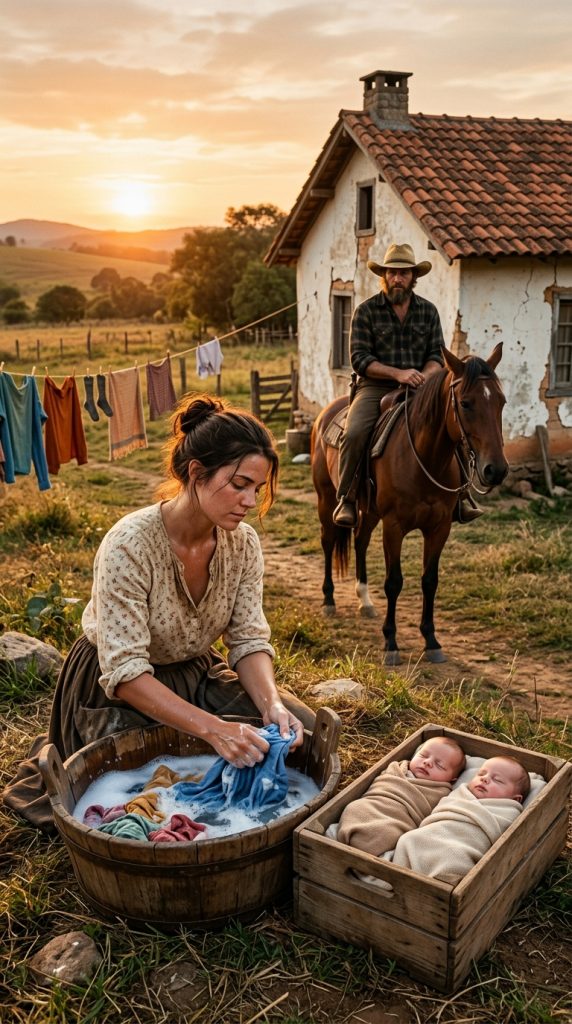
Julián returned with the proof.
But Don Evaristo found out.
Before dawn, Macario and three men arrived at the shack. Rosaura woke to the sound of horses. She grabbed Tomás’s old machete and stepped into the yard with the rebozo over her shoulders.
“Go away,” she said firmly.
Macario laughed.
“We’ve come to empty the house.”
“Over my dead body.”
The men advanced.
At that moment, another horse came galloping down the path. It was Julián. Behind him came Father Ignacio on a mule, and two neighbors who had decided not to stay silent any longer.
“No one touches that house!” Julián shouted.
Macario reached for his knife, but Father Ignacio raised his voice.
“Before God and these witnesses, that debt is false!”
The men stopped.
The scene moved that same morning to the town square. Don Evaristo, furious, tried to deny everything in front of Don Aniceto’s store. But Julián showed the records. The notary from the municipal seat arrived with sealed copies. Father Ignacio declared that Tomás had never acknowledged any debt. And one of the dispossessed widows, Doña Mercedes, dared to speak through tears.
“He did the same to me.”
The whole town fell silent.
For the first time, Don Evaristo found nowhere to hide his power.
Julián then did something unexpected.
“I don’t want a long fight,” he said, looking at the landowner. “If you sign today the legal sale of the land where Rosaura lives, at a fair price, and renounce any claim against her and her children, I won’t take this any further. But if you refuse, tomorrow I will file a formal complaint for fraud.”
Don Evaristo looked around. He saw the priest, the notary, the neighbors, the women who no longer lowered their gaze. He understood that fear was slipping from his hands.
He signed.
That afternoon, Julián delivered to Rosaura a deed in her name.
She held it with trembling fingers. She read slowly: Rosaura Mendoza, legitimate owner. Heirs: Mateo and Lucía Alvarado Mendoza.
The paper blurred with tears.
“This is not a gift,” Julián said. “It is justice.”
Rosaura looked at him. For months she had believed life only knew how to take things from her. But there stood this man, hat in hand, asking for nothing, giving her solid ground.
“You once asked me if you could help me,” she said softly. “Today I tell you yes. But not because I need an owner. Because I want to walk accompanied.”
Julián swallowed hard, moved.
“Rosaura, if one day you accept marrying me, I want it to be by your own will, not out of fear.”
She looked at her children, then the shack, then the deed.
“Then it will be by will.”
They married six weeks later in the church of San Jerónimo del Río. Rosaura wore a light blue dress she had sewn herself and her mother’s medallion around her neck. Mateo slept through the entire ceremony. Lucía, however, watched Father Ignacio with wide eyes, as if she understood that something great was happening.
When Julián kissed Rosaura’s forehead, the whole town applauded.
Years later, the shack was no longer cracked. Julián had it reinforced, but Rosaura asked to keep the washbasin and the old wooden box where her children had slept as babies.
“So we don’t forget,” she would say.
Mateo and Lucía grew up running among cornfields, horses, and rainy afternoons. They called “Papá Julián” the man who never tried to erase Tomás, but instead honored his memory.
And Rosaura, the widow everyone thought would be easy to break, ended up as owner of her land, her house, and her destiny.
Because sometimes God does not send miracles with trumpets or lights in the sky. Sometimes He sends them on a tired horse, with a man asking for water, right when a woman believes no one sees her anymore.
