


Chapter 1: The Hollow Gift
“Give that to Josephine, after all, she is just the filler granddaughter.”
My father delivered the words with a crooked grin, as though he had just told the funniest joke of the night. We stood in the center of the spacious living room while the entire family watched, and my eight-year-old daughter, Josephine, found herself holding a cheap plastic rocking horse with one broken leg, covered in black marker scribbles and wrapped in a wrinkled gift bag that looked as though it had been pulled from a dumpster.
At first, Josephine didn’t understand what was happening. She looked down at the toy, waiting for someone to laugh and admit it was only a prank, or for my mother to reach beneath the sparkling branches of the Christmas tree and hand her the real present. But the silence stretched across the room, and no one corrected the cruelty lingering in the air.
My sister Clara’s twin boys sat surrounded by a towering pile of presents—premium tablets, designer bicycles, costly sneakers, and customized art sets. Even the family golden retriever, Buster, had been given a brand-new orthopedic bed along with a huge bag of gourmet treats.
My daughter was handed a broken toy horse, and my father finished with another cold laugh.
“Good gifts are reserved for the grandchildren who actually matter.”
The room filled with strained, awkward laughter that pierced my skin like tiny needles. Clara covered her mouth, pretending to be uncomfortable, but the unmistakable sparkle of satisfaction in her eyes exposed what she truly felt. My mother made no effort to stop him or scold him. She simply continued passing out expensive gifts as though Josephine didn’t exist, as though the sweet little girl who had spent two full days carefully choosing her nicest dress just to impress her grandparents hadn’t just been humiliated in front of everyone we knew.
I remained perfectly still for several long seconds—not because I lacked the courage to speak, but because something inside me finally clicked into place. It was as though I had finally accepted the complete, ugly truth I had spent years refusing to face.
In our family, everyone had their assigned place. Clara had always been the golden child, and her sons were treated as the unquestioned heirs to the family name and fortune. My brother Silas was accepted only as long as he stayed quiet and never challenged the family order. And I, Bennett, was the one who fixed everything—the one who arrived at the corporate office before sunrise, answered emergency business calls long after midnight, solved every crisis, cleaned up every disaster, and was still expected to be grateful for the opportunity to serve them.
Love, respect, and acknowledgment were never included in my share of the family. And they certainly were never offered to Josephine. To them, my daughter was simply an inconvenience, a quiet little girl who served no purpose for showing off on social media. She wasn’t loud or demanding like Clara’s boys, and she never threw tantrums when things didn’t go her way. Instead, she had large, thoughtful eyes that constantly searched every room, quietly hoping her grandparents would someday truly see her.
That New Year’s celebration, I made the mistake of believing things might finally be different.
“Maybe they will change now that they are getting older, maybe they will finally understand,” I had told myself during the drive to the estate.
Josephine had even brought along a picture frame she made herself from wooden craft sticks and glitter. Inside it was a photograph of her with my father, taken months earlier at a park—the only day he had allowed her to hold a fishing rod and smiled at her with something that almost resembled genuine affection.
“I am going to give this to Grandpa, maybe he will put it on his mahogany desk,” she had told me in the car, her voice filled with pure, unadulterated excitement. After the humiliating “gift” was forced into her hands, my daughter held the broken rocking horse tightly against her chest as though it were something precious. Her lower lip quivered uncontrollably, and she fought with everything she had not to break down, but the moment had already become too heavy for her small heart. She covered her face with both tiny hands and released a quiet, suffocated sob—one of those silent cries that carries no sound because pain has already learned to wait its turn.
Silas suddenly pushed himself up from his chair, his face flushed with rage.
“Are you honestly sitting there and humiliating a little girl like this, what kind of people have we become?” he shouted.
My father slammed his fist down on the table, making the crystal glasses tremble violently.
“Sit down, Silas, do not start with your pathetic drama,” my father growled.
I took Josephine’s hand and led her toward the hallway, away from the glitter and cruelty behind us. She sobbed softly into my shirt, her small body shaking with disappointment.
“Dad, maybe my real gift is hidden in another room?” she whispered faintly.
It felt like my entire world was collapsing inward.
“No, my love,” I said in the calmest voice I could force out, “there is no other gift.”
Her crying deepened, and that was the exact moment the man I used to be finally disappeared. Twenty minutes later, while laughter filled the room again and everyone returned to cake and perfect photos for their online lives, I stepped back into the living room. I walked directly to the Christmas tree, picked up the two velvet gift bags I had brought for my parents, and revealed their presents—a gold watch for my father and a luxury leather handbag for my mother.
Then I placed them back into my coat pocket right in front of everyone, watching confusion spread across their faces.
My father narrowed his eyes.
“What do you think you are doing, Bennett?” he asked.
I looked at all of them—my mother, my sister Clara, my father, and the children who had fallen silent, sensing the shift in the room.
“I also have a New Year gift for you,” I said evenly, my chest steady with a strange, liberating calm, “I resign from the family business, effective immediately.”
A heavy, suffocating silence swallowed the room, yet none of them could possibly imagine what would come next.
Chapter 2: The New Horizon
At first, they believed it was nothing more than a dramatic outburst meant to demand attention or leverage. My father let out a short, dismissive laugh, as though I were a child making threats I would quickly abandon. My mother looked at me with her usual practiced sympathy, the kind she used when trying to guilt me back into obedience. Clara folded her arms, tapping her foot impatiently as she waited for me to retract my words and restore the mood.
“Bennett, stop talking nonsense,” my father said, waving his hand irritably. “You will calm down by tomorrow morning and get to the office early because we have several high value accounts that need attention.”
“I am not going to make it, not tomorrow, not ever,” I replied, my tone firm and controlled.
My mother pressed a hand to her chest in her familiar performance.
“After everything we have done for you, this is how you repay us?” she asked.
A short, humorless laugh escaped me.
“Everything you did for me? I built that company when the two of you couldn’t even manage your own suppliers. I was the one fixing contracts, negotiating with furious clients, handling payroll, and cleaning up your endless mistakes, all while you treated my daughter like she was nothing.”
Clara clicked her tongue and shook her head, as if I were the problem.
“You have always been envious of our success, Bennett,” she said. “It clearly bothers you that my children receive more because they are actually loved by the family.”
“They are just children, Clara, and it is not their fault that they are being raised to be cruel,” I said, holding her gaze, “but it is your fault. You watched Josephine cry, and you were clearly happy about it.” Clara opened her mouth to snap back, but Silas appeared from the hallway with Josephine in his arms. He had given her a warm blanket and a mug of hot cocoa. “I am taking her upstairs, let us play some card games, it honestly smells like rot in here,” Silas said, giving me a look of solidarity before walking away. No one responded, and the air stayed thick enough to feel suffocating. Before going upstairs, Silas paused and glanced back at me.
“It was about time you finally woke up, brother,” he said.
That night, I brought Josephine home. She fell asleep in the car, still holding the broken rocking horse—not because she wanted it, but because children often cling to the things that hurt them most. When I got home, I tucked her into bed with her shoes still on, then opened my laptop and submitted my official resignation through the corporate HR system of our family company, Sterling Logistics. There were no insults, no emotional outbursts, and no arguments—just a single, clear sentence: “As of today, I am leaving my operational and administrative position and I will no longer be available for calls, emergencies, or internal matters.”
But that wasn’t the full story. I had been preparing for this moment for a full year.
While my family used me as their dependable, unpaid labor, I had been taking advanced business courses, building strategic connections, and quietly launching my own company, “Summit Path.” I wasn’t going to compete with them using the same corrupt methods. I was going to surpass them through transparency, without favoritism, under-the-table deals, or humiliation.
The initial funding came from a businesswoman named Patricia Vance from a nearby city, who reviewed my projections and believed in what I was building. Our office was modest, located in a quiet professional district, but it was more than enough to begin properly.
By January, we had signed our first three clients. By February, the number had grown to ten. The most surprising part was that several of those clients came directly from Sterling Logistics without any outreach on my part. They contacted me themselves.
“Bennett, we always knew you were the only one keeping that company alive,” Don, a long-term client, told me during a lunch meeting. “Your father just signed the checks and yelled at the staff, but you were the one doing the real work.”
My parents stayed silent for several weeks, likely believing I would eventually return and beg for my old position. Then, an ornate gold-embossed envelope arrived.
“Family dinner, just the closest ones, we want to talk,” the card read.
They did not mention Josephine. They did not apologize. They simply used the word “family” as if it were a charm capable of erasing years of emotional damage. I went to the dinner, but I did not bring my daughter with me. My mother opened the door dressed as though she were welcoming elite business partners rather than her own son. My father sat in the dining room with a glass of scotch, attempting to project total control over the situation. Clara sat nearby looking uneasy, nervously adjusting her jewelry. After half an hour of hollow, forced conversation about weather and the stock market, my father finally cleared his throat.
“We have thought about it quite a bit,” he began, “we want to offer you a partnership, equal shares in Sterling Logistics, just come back and we will smooth everything over.”
My mother quickly added, “We truly miss Josephine, it was a bad joke, yes, but it is all behind us now.”
“No,” I said firmly, “it is not behind us, and you are only doing this because you are terrified that your customers are all leaving.”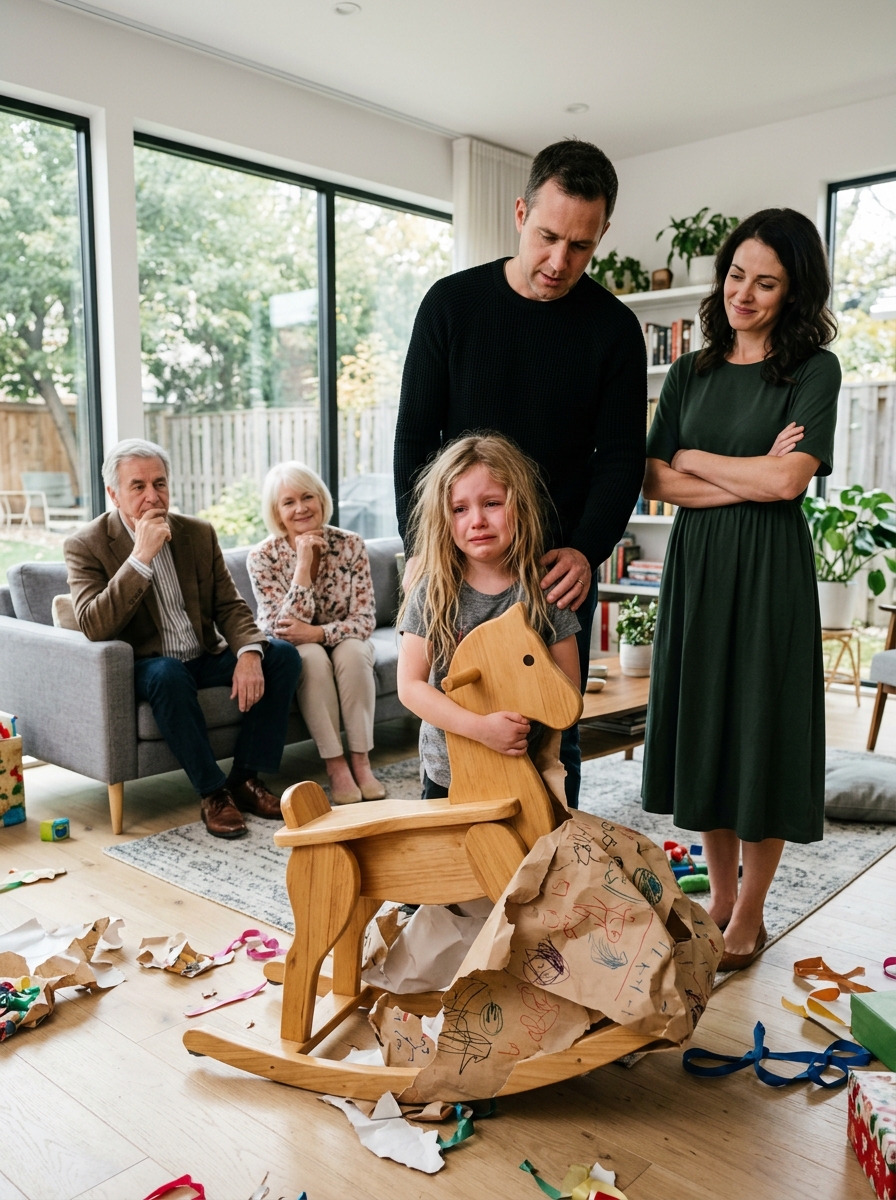
My father’s jaw tightened, his expression hardening. I reached into my coat and placed an envelope on the table identical to his.
“I also have a proposal,” I said.
He opened it, expecting to see my return agreement, but instead found a formal buyout offer for his shares, complete with a realistic market valuation prepared by my legal and financial team. It was a clean exit plan before their approaching collapse became public.
His face turned deep red.
“How dare you come into my home and offer me this?” he snapped.
“I dare speak because I know Sterling from the inside,” I replied. “I know about the illegal cash payments, the altered contract dates, and the falsified accounts. I warned you for years, but you refused to listen.”
My mother went pale, her eyes darting between me and my father. At that exact moment, my father’s phone rang. He glanced at the screen, saw “Accountant Fiona,” and rejected the call. But I saw the name, and I already understood what was unfolding.
Two days later, Fiona called me, her voice shaking.
“Bennett, the tax authorities are planning a full audit, and your father is panicking, he is trying to blame me for everything that went wrong,” she whispered.
A cold chill ran through me. That same week, I received a call from the school with disturbing news. Clara had attempted to pick up Josephine, claiming I had authorized it. School security physically intervened to stop her. That was when I realized they were no longer trying to reclaim the company—they were trying to use my daughter as leverage against me.
Chapter 3: The Price of Dignity
The first thing I did was secure Josephine’s safety. I went to the school with my attorney and submitted strict written instructions: only Silas and I were allowed to pick her up. No one else—not grandparents, not her aunt, not any extended “family” member. The principal looked at me with serious concern.
“You did the right thing by coming here, sir, your sister was extremely insistent and caused quite a scene at the front desk,” the principal noted.
That evening, while Josephine colored at the kitchen table, she asked, “Dad, did Aunt Clara want to see me because they finally love me now?”
The question hurt more than I could explain.
“I do not know, my love, but loving someone does not mean showing up and trying to scare them,” I said.
She lowered her eyes, her small shoulders sinking.
“Then it is probably better if she stays away,” she replied quietly.
April brought the consequence my parents could no longer escape. The tax authorities uncovered severe irregularities—unpaid penalties, unregistered transactions, and contracts that could not be legally justified. Fiona, the accountant who had endured thirty years under my father’s control, resigned before they could scapegoat her. She arrived at my office with a box of files and exhausted eyes.
“I do not want to keep hiding their secrets anymore,” she said. “if you give me a job, even as a junior assistant, I will start today.”
I hired her as our lead accountant, and with Fiona came more trusted clients—people who had never believed in my father but had always trusted her. Soon after, skilled employees from Sterling followed: sales staff, logistics coordinators, and administrative workers. They all shared the same sentiment.
“We no longer want to live in fear of the next verbal explosion,” they said.
Within four months, Summit Path expanded from a small office into two full floors of a professional building. Silas joined as an operating partner, and the company continued to grow rapidly. Patricia supported the expansion, no longer out of sympathy but because the business was now strong, profitable, and respected.
Meanwhile, Sterling Logistics was unraveling. Clara began posting vague, self-pitying messages online—“betrayal always comes from the person you helped the most,” or “some children grow up to destroy their parents out of pure ambition.” Soon after, her husband, Robert, asked to meet me at a local café. He looked completely broken. “I am filing for a divorce,” he said flatly, staring down into his black coffee. “I cannot take it anymore. What happened on New Year’s Eve opened my eyes to the reality of this family. Clara is teaching our children to mock other people’s pain, and she is repeating the exact patterns your parents used on you. I will not let my children grow up like that.”
I did not feel happiness or triumph—only a deep, heavy sadness. Family toxicity is a poison that never remains contained within one generation if no one makes the decision to cut it off at the root.
In mid-April, my father finally reached out.
“We need to talk, no more arguments, just business,” he said.
I agreed to meet him at my office, and he arrived alongside my mother. Both of them looked noticeably older, as though several years had been compressed into a matter of months. My father set a thick, worn folder onto the table.
“We are ready to sell the company,” he muttered.
I went through the documents in silence. Sterling was nearly bankrupt. They had unpaid taxes, had lost their key clients, and no longer had the operational resources to function properly. Their pride had outweighed the company for years, but now even pride could not hold it together.
“I am not buying this to save you,” I said firmly, “I am buying it to save the remaining jobs and to clean up whatever can still be recovered for the market.”
My mother gripped her handkerchief tightly, her hands trembling.
“We understand,” she said quietly.
For the first time in my life, they did not argue, manipulate, or demand special treatment. The purchase agreement was signed in May, and Sterling Logistics ceased to exist as an independent company, its remaining assets absorbed into Summit Path. My parents were left with just enough to clear their debts and retire in a modest home—no luxury, but also no homelessness.
As I walked away from the signing, my father extended his hand toward me. “Thank you,” he murmured, barely meeting my eyes. “I know you did not do this for us.”
“No,” I replied, “I did it in spite of you.”
My mother quietly handed me a small envelope.
“It is for Josephine, a card, if you want to give it to her,” she said.
That evening, I gave it to my daughter. She opened it carefully, as if afraid it might break. Inside was a simple hand-drawn ballerina and a short note: “Happy Birthday, Josephine, I am sorry I haven’t seen you in a long time. Love, Grandma.”
Josephine read it twice, her expression difficult to read.
“Is Grandma good now?” she asked, looking up at me.
I held her close in a gentle embrace.
“I do not know, my love, sometimes people start to change when it is very late,” I said, “that does not erase what they did, but it can be a start if they truly mean it.”
“Do I have to see her?”
“No, only if you want to, one day in the future.”
June arrived with the school spring festival. Josephine stepped onto the stage wearing a clean white dress and read an original poem about the meaning of family. Her voice wavered in the first lines, then grew steady and confident. In the front row, Silas, Fiona, Patricia, and I stood together, applauding as though she had achieved something far greater than a school performance.
Near the exit, I noticed my parents standing against the wall. They did not approach, and they did not interrupt. My mother quietly filmed the moment on her phone, eyes glistening, while my father stood still and silent, watching as though he was only now realizing the quiet child he once dismissed carried a light of her own.
Josephine noticed them too.
“Dad, were those my grandparents?” she asked.
“Yes, they were.”
“Why did they not come to say hello?”
“Maybe they did not want to take away your special moment,” I said.
She considered this for a moment, then smiled brightly.
“That is okay, today was my day anyway,” she said.
That night, as I tucked her into bed, she whispered something I will never forget.
“Our family is small now, Dad, but it feels real, and I much prefer this to a big one where everyone laughs when someone else is crying.”
I kissed her forehead.
“You are absolutely right,” I said softly.
Later that evening, I found a note from Silas on the kitchen table: “As kids, we used to dream of having a company where nobody was afraid to speak their mind. Look around you, brother, we actually made it.”
I stood by the window for a long time, watching the city lights flicker like distant stars. My parents had spent their lives planting pride, favoritism, and cruelty—and in the end, they harvested loneliness. I had spent mine choosing distance, dignity, and honest work, and in return, I found a peace I never thought I would know.
My daughter, once given a broken toy wrapped in humiliation, now understood something no wealth could teach her: her value was never determined by who chose her in a crowded room. Sometimes, stepping away from your own family is not betrayal—it is the first true act of love.
THE END.
