

Part 1: Twenty Bags of Feed and a Forgotten Promise
The frost on my windshield was so stubborn that morning I had to scrape the glass twice before I could see through it.
It was early November in Iowa, when winter hadn’t quite arrived but the cold had already settled deep into everything. The fields were bare, the mornings were dark, and the wind had that sharp edge that wouldn’t disappear until spring.
By the time my truck was warm enough to drive, my mother had already spent ninety minutes working in the barn.
At seventy-four, Ellen Carter still rose at four-thirty every morning.
She pulled on my father’s old brown Carhartt coat, the one with the torn left pocket she refused to have repaired, picked up her flashlight and coffee thermos, and headed outside before sunrise.
She hadn’t missed a feeding in her entire life.
Not when she was sick with the flu in 2019.
Not the morning after we buried Dad.
Not once.
“Jess,” she said when I entered the barn, “we’re about out.”
She stood beside the feed bin, staring into it.
I joined her and looked down.
There was barely enough feed remaining for another day, perhaps two if we were careful.
“I thought Luke picked some up last week,” I said.
“He did. Ten bags. That was all they had.” She snapped the lid shut. “We need twenty more to get through to the next delivery.”
Our family had been raising cattle outside Redfield, Iowa, for three generations.
My great-grandfather purchased the original 160 acres in 1931, during the Depression, when almost everyone believed buying farmland was foolish.
My grandfather eventually acquired another eighty acres.
Dad built the large red barn and expanded the herd to nearly two hundred cattle.
After he died eight years earlier, Mom reduced the herd to ninety-seven.
She insisted that was more than enough to keep her occupied.
And she was right.
My younger brother, Luke, lived down the road in the old farmhouse with his wife and two sons. I’d returned from Des Moines three years earlier after my divorce and moved into the small apartment above Mom’s garage.
Luke and I handled the physically demanding work.
We repaired fences, hauled hay, called the veterinarian, dealt with frozen pipes, and argued with the tractor whenever it refused to start.
But Mom still ran the farm.
Every important decision belonged to her.
“Weather’s turning tonight,” she said, studying the sky through the barn doorway. “Radio says freezing rain starting around four.”
“I heard.”
“Roads’ll be glass by dark. I want that feed in the barn before then.”
“I’ll run into town after breakfast.”
“I’ll come with you.”
I almost told her to stay home.
Her knees had been bothering her, and she had already spent enough time outside in the cold.
But I’d learned long ago that telling Ellen Carter what she could or couldn’t do was a waste of breath.
“Okay,” I said. “After breakfast.”
She nodded and reached over the gate to stroke Rosie’s nose.
Rosie was our oldest cow, and Mom had always been especially fond of her.
“Don’t you worry, girl,” she said softly. “We’ll get you fed. We always do.”
Redfield was the kind of Iowa town you could drive through without realizing you’d entered it.
One stoplight.
A gas station.
A Casey’s.
Two churches.
A bar called The Rusty Spur.
And Dawson Farm Supply, standing at the edge of town where Main Street became a county road.
The store had opened in 1962.
Hank Dawson’s father built it, Hank managed it for almost forty years, and now Hank’s son Travis ran the business.
I’d known Travis since childhood.
He was two grades ahead of me, and his family lived three farms down from ours, near the old farmhouse with the leaning silo.
During summer afternoons, he’d ride his bicycle over to our place.
Mom would make him a peanut butter sandwich and pour him lemonade.
Then he’d help Dad stack hay bales for a dollar an hour.
Hank died two years earlier.
A heart attack took him behind the store counter while he was ringing up a bag of dog food for Mrs. Ostrander.
Half the county attended his funeral.
Afterward, Travis began changing the business.
He installed a computerized checkout system, removed the coffee pot where farmers had gathered for decades, and hung a sign near the register:
“NO CREDIT — ALL ACCOUNTS PAYABLE AT TIME OF PURCHASE.”
He stocked expensive boots and fancy dog treats while gradually reducing the ordinary supplies local farmers depended on.
People complained.
But the nearest alternative was a chain store in Perry, nearly forty miles away.
Most customers continued shopping at Dawson’s because they didn’t have much choice.
Mom said very little during our drive.
She sat beside me in Dad’s 1998 Ford, which had more than 260,000 miles on it.
Occasionally, she touched the dashboard almost affectionately.
She’d never agreed to sell that truck.
“You okay, Mom?” I asked.
“Fine.”
“You’re quiet.”
“I’m always quiet.”
“You’re quieter than usual.”
She kept looking through the window.
We passed the Dawson farmhouse, with its leaning silo and empty pasture.
The porch light was still burning, even though it was morning.
Travis had moved to a newer house in Adel with a three-car garage and enormous windows.
His childhood home had been vacant for almost two years.
We arrived at Dawson Farm Supply shortly after eight.
Only two other trucks were parked outside.
Inside, the familiar smells of grain dust, leather, and motor oil greeted us.
Country music played somewhere behind the storeroom.
A young employee with red hair stepped out from behind the counter.
His name tag read CALEB.
He looked no older than nineteen.
“Morning, ma’am. Help you find something?”
“Cattle feed,” Mom said. “The fourteen percent. Twenty bags.”
“Yes, ma’am. Got some right over here.”
He led us toward the loading door.
A pallet of fifty-pound bags stood against the wall.
Mom checked the label, as she always did.
Same brand.
Same mixture.
Same weight.
Then she counted.
Exactly twenty bags remained.
“That’s the last of it?” she asked.
“Yes, ma’am,” Caleb said. “Truck’s not due back till next Thursday. Everybody’s been stocking up because of the weather.”
“Well, then, we’ll take all twenty.”
“Sure thing.”
Caleb fetched a flatbed cart and began stacking the bags.
I helped him lift them.
We’d loaded eight when a voice interrupted us.
“Hold up.”
Caleb stopped.
Travis Dawson emerged from his office, phone in hand.
At forty-six, he had his father’s broad shoulders and his mother’s narrow face. He wore a pressed shirt beneath a fleece vest bearing the store logo.
He walked toward us without acknowledging me.
“Sorry, Mrs. Carter,” he said. “Those are reserved.”
Mom frowned.
“Since when?” she asked.
“Since about five minutes ago.”
Caleb looked bewildered.
“Nobody told me, Travis.”
“I’m telling you now. Put them back on the pallet.”
I stepped forward.
“Wait a minute,” I said. “What do you mean, reserved? They were sitting right here. Nobody said anything about them being reserved.”
Travis finally looked at me.
“Hey, Jess.”
“Hey, Travis. What’s going on?”
He sighed impatiently.
“A commercial customer called a few minutes ago,” he said. “They want every bag of feed I’ve got left. All of it. And they offered to pay extra for it.”
“How much extra?” I asked.
“That’s between me and the customer.”
Mom glanced at the cart.
“But we were here first,” she said.
Her voice was perfectly calm.
She wasn’t arguing.
She was simply stating what had happened.
Travis shrugged.
“Business is business, Mrs. Carter.”
I felt my jaw tighten.
We had ninety-seven cattle and barely enough feed for another day.
Freezing rain was expected that afternoon.
The roads could become impassable before nightfall.
And the next supplier was almost forty miles away.
Travis knew our situation.
He also knew my mother had shopped at Dawson’s for more than fifty years.
She’d bought her first work gloves there in 1972.
She’d fed Travis when he was a child, bandaged his scraped knee after a bicycle accident, and delivered casseroles to his family every week for three months after his mother died in 1993.
I wanted to remind him of every one of those things.
But before I could speak, Mom lightly touched my arm.
I stopped.
She studied Travis for several seconds.
“Well,” she said, “I understand. You’ve got to make a living.”
Relief crossed his face.
“Glad you see it that way, Mrs. Carter. I knew you would.”
He turned to Caleb.
“Put them back.”
The young employee hesitated.
Then he began returning the bags to the pallet.
Each heavy thud made my anger worse.
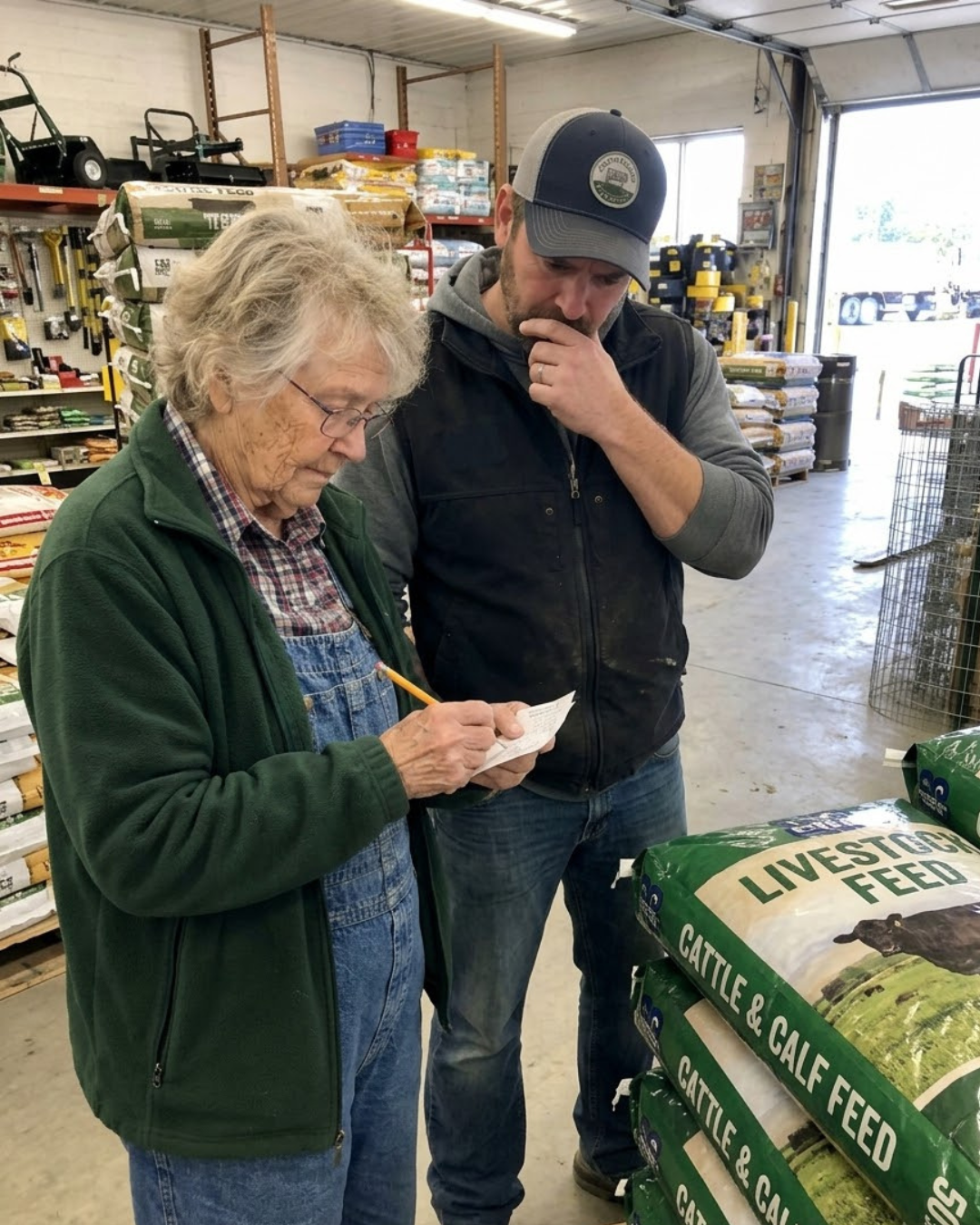
Mom walked quietly to the counter.
I followed, struggling to understand why she was allowing this.
My mother had once chased a dishonest cattle buyer off our property with a broom handle over two hundred dollars.
Yet now she stood calmly while a man she’d known since childhood refused to sell her feed our cattle desperately needed.
Travis returned to the register.
He started working at the computer as though nothing unusual had happened.
A receipt printer buzzed beside him.
Mom watched.
After a long silence, she spoke.
“Travis,” she said. “Could I borrow your pencil?”
He looked surprised.
“Sure, Mrs. Carter.”
He handed her a yellow pencil printed with the store’s name.
Mom tore the receipt from the printer and turned it over.
For a moment, she held the pencil without writing.
Then she bent over the counter.
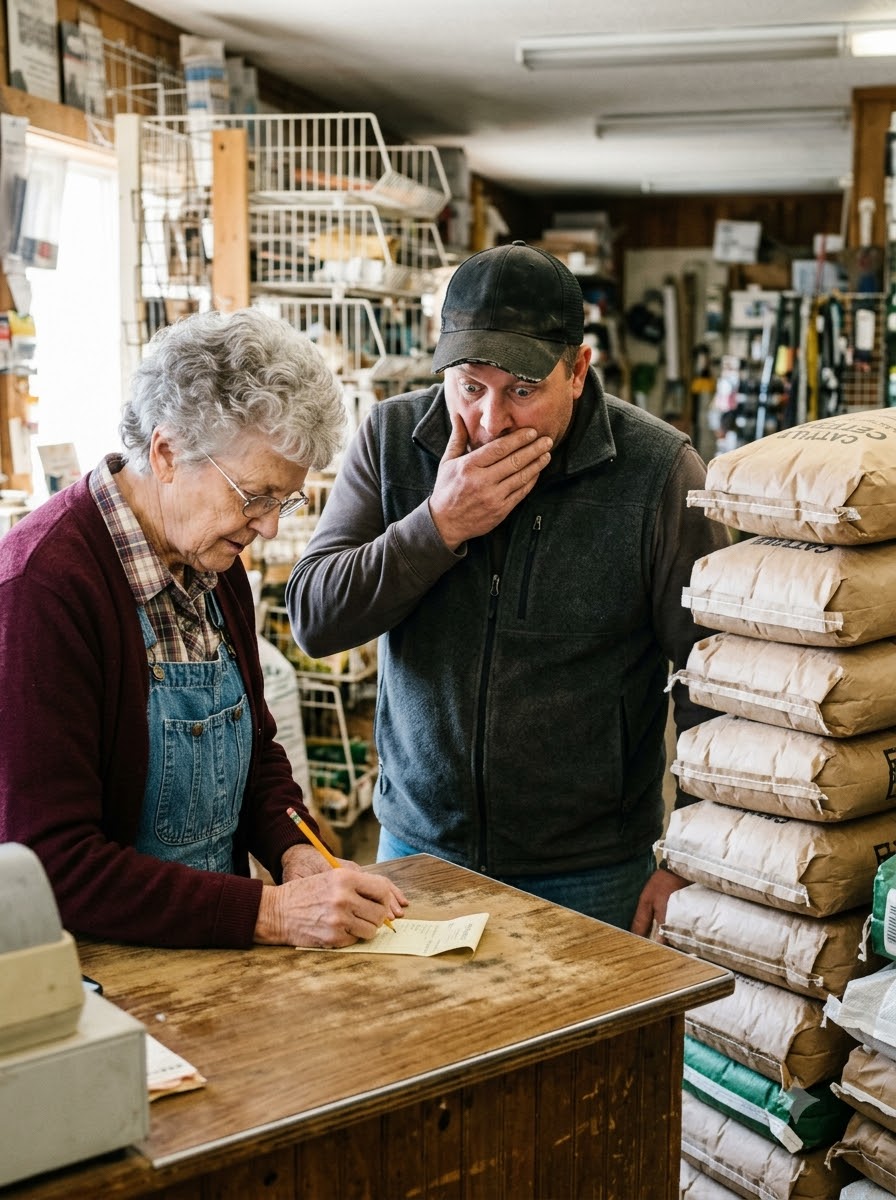
Slowly, carefully, with the unsteady handwriting arthritis had given her, she wrote six numbers.
She placed the pencil down and slid the paper toward Travis.
“Would you mind checking these against your old ledger?” she asked.
At first, he barely looked.
Then his eyes returned to the numbers.
He lifted the receipt.
Read them again.
And suddenly, the color disappeared from his face.
“Where did you get those numbers?” he asked.
His voice had become strangely quiet.
Mom met his gaze.
“Your father gave them to me.”
Travis stared.
“My father?”
She nodded.
“Thirty-two years ago.”
He stood motionless for another moment.
Then he hurried into his office without another word.
I heard drawers opening and boxes scraping across the floor.
I turned to Mom.
“Mom. What numbers?”
She picked up the pencil, turned it between her fingers, and carefully aligned it with the counter’s edge.
“Something your dad and I agreed never to use,” she said, “unless we had to.”
“What does that mean?”
She didn’t answer.
“Mom. What does that mean?”
“Hush, Jessie,” she said gently. “Just wait.”
Five minutes passed.
Then ten.
Caleb returned to stocking shelves, although he kept glancing toward us.
Mr. Lindgren, an elderly man from church, entered to buy rock salt.
“Morning, Ellen.”
Mom nodded.
He paid and left.
Inside the office, Travis continued searching.
I heard another drawer slam.
Then a muffled curse.
“Mom, please just tell me what’s going on.”
“In a minute.”
“What did Hank Dawson give you? What are those numbers?”
“In a minute, Jessie.”
Before I could question her again, the bell above the entrance rang.
A tall, tanned man entered wearing an expensive black jacket and boots that looked far too clean for farm work.
Outside, a white pickup with an empty flatbed trailer waited in the gravel lot.
Its door displayed a green-and-gold logo.
PRAIRIE RIDGE CATTLE COMPANY.
My stomach tightened.
Prairie Ridge was a Nebraska corporation that had spent years buying small farms across our county.
They’d purchased the Hoffmann property, the Pettersen farm, and the Kowalski dairy.
Old barns disappeared.
Large commercial feedlots replaced them.
And they’d repeatedly offered to buy our land.
Mom had received four letters in the previous year.
She’d burned every one.
The man approached Caleb.
“Brent Hollis, Prairie Ridge,” he said. “I called a little while ago about the feed. Travis said he’d have it ready.”
Caleb glanced toward the office.
“Uh. Travis is in the back. He’ll be right out.”
Brent smiled.
“Great. I’ll pull my trailer around to the loading door.”
Then he noticed us.
Recognition flashed across his face.
“Mrs. Carter,” he said, smiling even wider. “What a surprise.”
“Mr. Hollis.”
I looked between them.
“You know each other?” I asked.
“Mr. Hollis has been writing me letters,” Mom said.
“I have indeed,” Brent said cheerfully. “Did you get my last one? The offer’s still good. Better than good, actually. I could probably go even higher, now that the weather’s turning.”
He glanced toward the feed pallet.
“Hard winter coming. Tough time to be short on feed.”
Suddenly, I understood.
He knew exactly whose feed he’d taken.
And he knew what losing those twenty bags could mean for our farm.
I stepped toward him.
Mom touched my arm again.
“Jessie,” she said quietly.
“Mom, he’s…”
“I know what he is.”
Brent raised both hands.
“Whoa, now. No need to get upset. I’m just a businessman buying feed for my company’s cattle. Same as anybody else.”
“You’ve got a feedlot in Guthrie County with three thousand head,” I said. “You’ve got suppliers in Omaha who deliver by the semi-load. You don’t need twenty bags from a little store in Redfield.”
“Every little bit helps,” he said.
Before I could respond, Travis’s office door opened.
He emerged carrying an enormous, dust-covered green binder.
He placed it on the counter.
Written across its cracked spine were the words:
“ACCOUNTS — 1990–1995. H.D.”
Hank Dawson’s old ledger.
Travis ignored Brent completely.
He opened the binder and began turning yellowed pages covered in handwriting, dates, names, and dollar amounts.
Some were stained with coffee.
Others carried fingerprints of grease and dirt.
His fingers moved down the columns.
Then stopped.
He stared at a page near the bottom of the binder.
His face went white.
“Travis?” Brent said impatiently. “I’m ready to load whenever you are.”
Travis didn’t respond.
“What is this?” he whispered.
Mom leaned over the counter.
“That’s what I came here to find out,” she said.
I moved closer.
At the top of the page were the same six numbers Mom had written on the receipt.
Beneath them was an account name.
“ACCOUNT: TOM AND ELLEN CARTER.”
And farther down, a single amount.
$38,500.00.
I stared at it.
Thirty-eight thousand five hundred dollars.
In 1993.
“I don’t understand,” I said. “You owed Hank Dawson thirty-eight thousand dollars?”
Mom shook her head.
“No, honey,” Mom said softly. “Read it again.”
I looked more carefully.
The column wasn’t labeled as money my parents owed.
It was labeled “Owed To.”
Hank Dawson had owed my parents $38,500.
For thirty-two years, my mother had carried six numbers that proved it.
But I still didn’t understand why she’d waited until that morning to reveal them.
Or why Travis looked as though his entire understanding of his father had just been shattered.
Part 2: The Debt That Saved a Family
“I don’t understand,” Travis said. His voice was shaking. “My dad never owed anybody money. He was the most careful man with a dollar I ever knew. He never borrowed a penny in his life.”
Mom rested her hand on the counter.
“He borrowed it once,” Mom said.
She unzipped Dad’s old coat.
“Do you remember the summer of 1993, Travis?” she asked.
He nodded.
“The flood,” he said.
Anyone who lived in Iowa that year remembered the flooding.
Rain fell for weeks.
Rivers overflowed.
Farms disappeared beneath water.
The Raccoon River flooded large parts of Dallas County.
In Des Moines, the water treatment plant was overwhelmed, leaving approximately 250,000 people without clean drinking water for nearly three weeks.
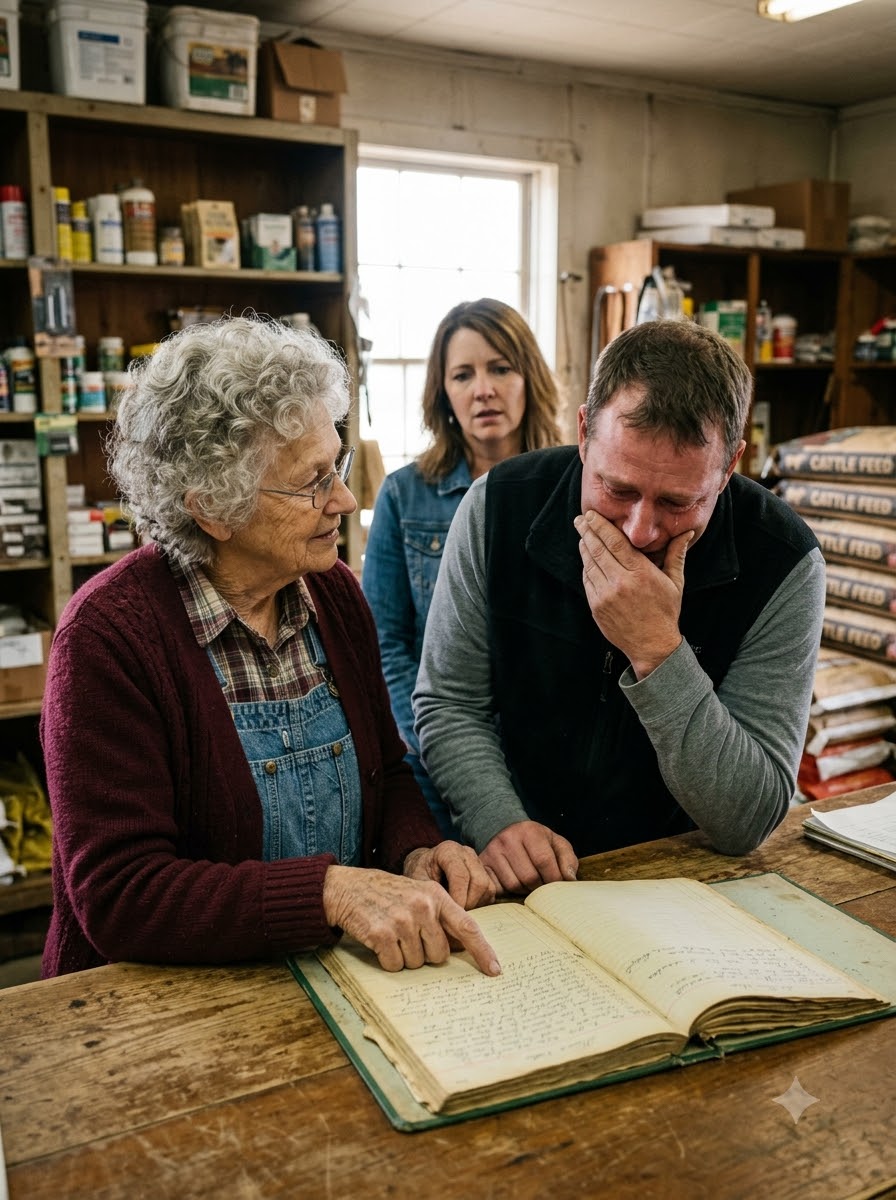
Travis looked at the ledger.
“I was twelve,” Travis said quietly. “The water came up through the floor of this store. I remember Dad standing in it up to his knees, trying to carry bags of seed up onto the shelves. I remember he wouldn’t stop. Even when it was up to his waist. Mom had to make him come home.”
My mother nodded.
“Your mother,” Mom said gently. “Your mother was sick that summer.”
Travis’s expression tightened.
“She died in September,” he said.
“I know, honey. I remember.”
Brent shifted impatiently beside us.
“Look, I’m sorry to interrupt,” he said. “But I’ve got a long drive back and a storm coming in. Can we load the feed?”
Travis barely looked up.
“In a minute,” he said.
“Travis…”
“I said in a minute.”
Brent’s smile faded.
Mom continued.
“The flood ruined everything in this store,” she said. “Every bag of feed. Every bag of seed. Every piece of machinery in the back. The building was standing, but everything inside it was gone. And Hank didn’t have flood insurance. Nobody around here had flood insurance back then. Nobody ever thought the Raccoon would come up that far.”
Travis closed his eyes.
“And the hospital bills,” Mom said. “For your mother. They were piling up on his kitchen table. I saw them. Stacks of them. He had them held down with a coffee can so they wouldn’t blow away.”
“He never told me,” Travis whispered.
“Of course he didn’t. You were twelve years old, and your mother was dying. What was he going to tell you?”
Mom touched the old binder.
“He went to the bank in Adel,” she said. “He went to the bank in Perry. He went to the bank in Des Moines. Every one of them turned him down. Half the county was underwater, and the banks weren’t lending money to anybody whose business had just been ruined. They told him to declare bankruptcy and sell the building.”
“I never knew any of this,” Travis said. “Not one word.”
“No,” Mom said. “You weren’t supposed to.”
She turned the yellow pencil between her fingers.
“One night in August,” she said, “your father came out to our farm. It was almost midnight. Tom and I were sitting on the porch because it was too hot to sleep. We saw headlights coming up the driveway, and we thought somebody’s cows had gotten out.”
A small smile crossed her face.
“It was Hank. He got out of his truck and walked up to our porch, and he just stood there at the bottom of the steps. He didn’t say anything. Tom asked him if he wanted a beer. He said no. Tom asked him if everything was all right. He said no.”
Her voice softened.
“And then that big, tough, proud man sat down on our bottom step and cried like a baby,” she said. “He said he was going to lose the store. He said his father built it with his own two hands. He said he was going to lose his wife. And then he was going to lose the store. And then he’d have nothing left to give his boy.”
Travis covered his mouth.
“Tom sat down next to him,” Mom said. “And I went inside and got the coffee pot. And we sat there on those porch steps until the sun came up.”
I knew those steps.
I’d spent my childhood sitting there.
I’d shared my first kiss there.
And after Dad died, I’d sat on those same boards beneath the stars, unable to understand how life could continue without him.
But I’d never known Hank Dawson had once sat there crying.
“In the morning,” Mom said, “Tom went out to the barn. He was out there for a long time. When he came back in, he told me what he wanted to do.”
Something stirred in my memory.
A summer afternoon.
An empty stall.
My father sitting alone on an overturned bucket.
“Big Jim,” I whispered.
Mom looked at me.
“You remember.”
Of course I remembered.
Big Jim was Dad’s prized black Angus bull, enormous and powerful, with a white star on his forehead.
He’d won best in show at the Iowa State Fair two consecutive years.
People traveled from several states to purchase his calves.
Dad adored that animal.
In late August 1993, a silver livestock trailer came up our driveway.
Dad led Big Jim out of the barn and loaded him himself.
Then he watched the trailer disappear down the road.
Later that afternoon, I found him crying in the empty stall.
I was thirteen.
I’d never seen my father cry before.
When I asked what was wrong, he wiped his face.
“Nothing, Jessie-girl. Sometimes you just have to let go of something you love.”
He never explained anything else.
Until that morning at Dawson Farm Supply, I hadn’t understood why.
“We sold Big Jim,” Mom said to Travis. “And forty of our best cows. And we took out the money we’d been saving for six years to buy a new combine. Altogether, it came to thirty-eight thousand five hundred dollars.”
She touched the ledger.
“We gave it to your father. All of it. In cash. In a coffee can.”
Travis made a broken sound.
Mom continued.
“He paid off the store’s debts,” Mom said. “He paid off some of the hospital bills. He restocked the shelves. And Dawson Farm Supply opened its doors again on October first, 1993.”
Brent no longer looked amused.
“Hank didn’t want to take it,” Mom said. “He fought us on it. He was so proud. He said he’d never taken charity in his life and he wasn’t going to start now. He tried to give it back three times.”
She shook her head.
“Finally, Tom told him it wasn’t charity. It was a loan. And Hank said, fine, then it’s going in the book. Because if it’s not in the book, it’s not real.”
She turned the ledger toward Travis.
“He wrote it down right there, right in front of us, in the back office of this store. Then he tore a little corner off a feed sack and wrote those six numbers on it and handed it to Tom. And he said, ‘That’s your account. Whenever you need it, for anything, for as long as you live, you bring me those numbers. And if I’m not here anymore, you bring them to my boy.’”
Travis’s hands trembled.
Mom looked at the page.
“Is there more?” Mom asked him softly. “On the page? He wrote something else after we left. He told Tom he did. But we never saw it.”
Travis found a faded note in the margin.
He began reading.
“‘August 30, 1993. Tom and Ellen Carter sold their best bull to save this store. They won’t let me pay them back with interest. They won’t sign any papers. They won’t even shake on it. Tom says a gift you brag about stops being a gift.’”
He paused.
His voice grew rougher.
“‘So I’m writing it here instead. This debt doesn’t get paid off in money. It gets paid off in whatever they need, whenever they need it, for as long as there’s a Dawson behind this counter. No questions. No arguments. No excuses.’”
He couldn’t continue.
Mom placed her hand over his.
“Go on, honey.”
He swallowed.
“‘If I’m gone and my son is reading this,’” he read, “‘then listen to me, Travis. This store belongs to the people who walk through that door. Business isn’t business. Business is people. It always was. If you ever forget that, you come back to this page. And if you ever turn a Carter away, then I raised you wrong. And that’s on me. Not on you.’”
Tears rolled down Travis’s face.
The store was silent.
Caleb stood beside the feed pallet.
Mr. Lindgren had returned and was watching from near the entrance.
“I didn’t know,” Travis said. His voice was barely a whisper. “Mrs. Carter, I swear to God, I didn’t know.”
“I know you didn’t,” Mom said.
“Why didn’t you ever tell me? Why didn’t Dad tell me?”
“Because Hank was proud. And because Tom made him promise. And because Tom and I made a promise to each other too.” She looked at me. “We agreed we would never, ever use those numbers. Not for anything. Unless we absolutely had to.”
“And today you had to,” Travis said.
Mom considered that.
“No,” she said finally. “Not really. I could have driven to Perry. Jessie would have driven me. We’d have made it before the ice. Probably.”
Travis frowned.
“Then why?”
Mom met his eyes.
“Because I didn’t come here today for twenty bags of feed,” she said. “I came here to find out if Hank Dawson’s boy was still Hank Dawson’s boy.”
Brent loudly cleared his throat.
“Well,” he said. “That’s a very touching story.”
He opened an expensive leather checkbook on the counter.
“But I still have a business to run,” he said. “And so do you, Travis. I made you an offer on the phone this morning. Double your retail price on every bag. And I’ll make it triple, right now, just to make this simple.”
He clicked his silver pen.
“Sixty bags of feed by the end of the month. I’ll be buying all of it from you. Every bag that comes in on that truck.”
Travis looked at him.
“Why?” he asked.
“Because my company’s growing. We need feed.”
“No.” Travis shook his head slowly. “You’ve got a supplier in Omaha. Big Valley Grain. They deliver to your Guthrie County lot by the semi-load every week. Everybody knows that. You don’t need twenty bags of feed from me. You never did.”
Brent’s jaw tightened.
“I don’t see how that’s any of your business.”
Travis looked increasingly troubled.
“You called me this morning,” Travis said. His voice was getting stronger. “You asked me if I had any feed left. I said I had twenty bags. And you asked me—”
He stopped.
“You asked me if anybody else was asking for it. You asked me specifically if the Carters had been in yet.”
Mom’s hands tightened slightly on the counter.
“I told you Mrs. Carter usually comes in on Tuesdays,” Travis said slowly. “And you said, ‘Then I’ll pay double. Just make sure she doesn’t get it.’”
My heart pounded.
“You son of a…”
“Jessie,” Mom said quietly.
I stopped speaking.
Brent raised his hands.
“That’s a misunderstanding,” he said. “I was just making conversation.”
A voice came from behind us.
“You’ve been doing this all over the county,” said a voice behind us.
Mr. Lindgren stepped forward, still holding his rock salt.
“Buying up the feed at every little store before a storm,” Mr. Lindgren said. “I heard it from Gary Pettersen before he sold. Same thing happened to him two winters ago. Ice storm coming, and every store in three counties was cleaned out of feed. All bought up by a big outfit from Nebraska. Gary’s cows went three days without enough to eat. Lost eleven head. Three weeks later, a man from Prairie Ridge showed up at his door with a checkbook.”
Brent’s face reddened.
“That’s a lie.”
“Is it?” Mr. Lindgren said. “Gary’s got a long memory. And so do I.”
Brent looked around.
Then he turned toward Travis.
“Let me tell you how this goes, Travis,” he said quietly. “Prairie Ridge spends eighty thousand dollars a year in this store. Fencing. Medicine. Tools. Tires. We’re your biggest account by a mile. Without us, you’re out of business by spring. You know it, and I know it. I’ve seen your books.”
Travis remained silent.
“So you can sell twenty bags of feed to an old lady because your daddy wrote a sad note in a notebook thirty years ago,” Brent said. “Or you can keep your store open. Your choice.”
Travis looked down at his father’s ledger.
I could almost see the numbers running through his mind.
His mortgage.
The new computer system.
The expensive inventory that wasn’t selling.
The store’s declining revenue.
Eighty thousand dollars a year was a tremendous amount for a small-town business.
For several seconds, nobody spoke.
Then Travis ran his finger along the faded handwriting.
“Business is people,” he said quietly.
He lifted his head.
“Load the Carters’ feed into their truck,” he said. “All twenty bags.”
Caleb straightened.
“Yes, sir,” Caleb said.
He said it with such enthusiasm that I nearly laughed.
Brent’s face darkened.
“You’re making a very big mistake.”
“Probably,” Travis said. “Wouldn’t be my first one. My dad would tell you I’ve made a lot of them. Especially the last couple of years.”
He carefully closed the binder.
“Mr. Hollis, I’m closing the Prairie Ridge account,” he said. “Effective today. If you have any outstanding orders, you can pick them up by Friday. After that, I’d appreciate it if you did your business in Perry.”
Brent snatched his checkbook away.
“You’ll regret this,” he said. “Every farmer in this county is going to sell eventually. Every one of them. And when they do, they’re going to sell to us. And there won’t be anybody left to buy your feed.”
He pointed at Mom.
“Including you, Mrs. Carter. You’re seventy-four years old. How many more winters do you think you’ve got?”
She didn’t flinch.
“As many as the good Lord gives me,” she said. “And not one of them will be spent cashing your checks.”
Brent stormed out.
His empty trailer rattled behind his truck as he sped away.
Mr. Lindgren chuckled.
“Well,” he said. “I’d say Hank would’ve enjoyed that.”
“He’d have enjoyed it more if I’d thrown him out on his ear,” Travis said.
“He’d have tried,” Mom said. “Hank was all bark.”
Travis came around the counter.
He stood before my mother, struggling to compose himself.
“Mrs. Carter,” he said. His voice cracked. “I’m so sorry. I’m so sorry for how I treated you. For what I said. For all of it. I didn’t know what kind of man I was becoming until you put that pencil in my hand.”
Mom reached up and patted his cheek.
“You know what kind of man you are now,” she said. “That’s what matters.”
“The account,” Travis said. “Dad’s ledger. Thirty-eight thousand five hundred dollars. That’s got to be worth more than eighty thousand today. I don’t know how I’m going to pay that back. But I will. Somehow. I’ll start this week. Whatever you need.”
Mom shook her head.
“I don’t want your money, Travis.”
“But Dad said…”
“I know what your dad said. I was there.” She smiled a little. “I’ve got twenty bags of feed. That’s all I came for. That and the answer to my question.”
“What answer?”
She looked toward the window.
Caleb was loading the final bags into Dad’s old Ford.
Beyond the parking lot, the sky had darkened.
“That Hank raised you right,” she said. “You just forgot for a little while. That’s all. Everybody forgets sometimes.”
We made it home before the storm.
But by that evening, as ice covered the county and our electricity failed, I would discover that Travis Dawson hadn’t finished honoring his father’s promise.
Part 3: The Six Numbers That Kept a Community Together
Freezing rain began at three-thirty that afternoon, thirty minutes earlier than forecast.
Fortunately, we’d already reached home.
All twenty bags were safely stored in the barn.
Luke came over to help unload, and I told him everything that had happened at Dawson’s.
He stood frozen with a fifty-pound bag on his shoulder.
“Big Jim?” he said. “Mom sold Big Jim for Hank Dawson?”
Luke had been only eight when Dad sold the bull.
He remembered little about that summer, but he remembered Dad’s stories.
Big Jim breaking through three fences to reach a heifer at the Ostrander farm.
Big Jim following Dad around the barn like a dog.
Big Jim winning a blue ribbon at the State Fair and then trying to eat it.
Dad had told those stories every Thanksgiving.
But never the story of Big Jim’s final day on our farm.
“Why didn’t they ever tell us?” Luke asked me, when Mom had gone back up to the house.
“Dad said a gift you brag about stops being a gift.”
Luke lowered the feed bag.
He looked toward the farmhouse, where Mom was preparing supper.
“That sounds exactly like Dad,” he said quietly.
By five, ice coated everything.
Tree branches.
Fence posts.
Power lines.
The entire countryside glittered beneath a dangerous layer of frozen rain.
Branches cracked in the darkness.
At six-fifteen, the electricity failed.
Mom lit the kerosene lamps she’d kept ready for years.
I started the wood stove.
Luke’s wife, Megan, brought their boys over, and we gathered around the kitchen table for chili and cornbread.
The children thought eating by lamplight was a wonderful adventure.
At eight, Mom reached for Dad’s coat.
“Mom, where are you going?”
“Check the water tanks. Heaters’ll be out with the power. They’ll freeze over.”
“I’ll go,” Luke said.
“We’ll both go,” Mom said.
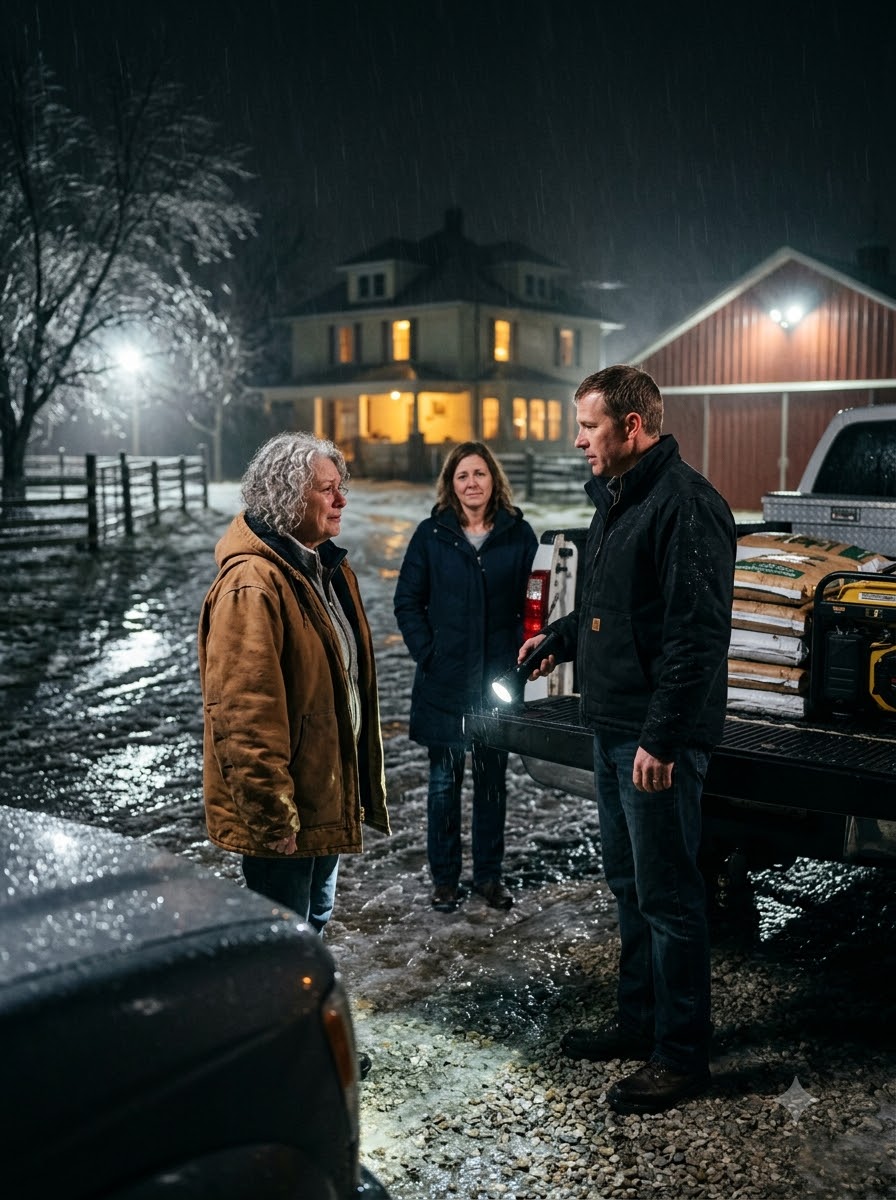
Then headlights appeared on our driveway.
A vehicle was creeping toward the barn, sliding slightly across the ice.
“Who in the world is out driving in this?” Megan said.
We crowded around the window.
The vehicle finally stopped.
It was a Dawson Farm Supply delivery truck.
The driver’s door opened.
A large figure climbed down and nearly fell before grabbing the side mirror.
It was Travis.
He carefully made his way to the rear doors.
Mom was already putting on her coat.
We followed her outside, gripping one another to keep from slipping.
Travis opened the truck.
Inside sat a gas-powered generator and another dozen bags of cattle feed.
“Travis Dawson,” Mom said. “What on earth are you doing out here?”
“Power’s out all over the county,” he said. He was out of breath. His face was red from the cold. “Your water tank heaters’ll freeze. Figured you’d need a generator.”
“You drove all the way out here on this ice to bring us a generator?”
“And some more feed. I had a little extra in the back room. I didn’t even know it was there. Caleb found it.” He grinned sheepishly. “Turns out I don’t know where half the stuff in my own store is.”
“Travis,” Mom said. “You could have killed yourself.”
“I went about eight miles an hour,” he said. “It took me forty-five minutes to get here from town. I passed three cars in the ditch.”
Luke stepped forward.
“Thanks, Travis.”
Travis shook his hand.
“Don’t thank me. It’s not a gift.” He glanced at Mom. “It’s on account.”
Mom laughed.
A real, joyful laugh.
It was the first time I’d heard that sound from her in months.
We spent nearly an hour connecting the generator to the water tank heaters.
Our hands were numb by the time we finished.
Afterward, everyone crowded into the warm kitchen.
Mom brewed coffee on the wood stove.
Travis sat at the same table where he’d eaten countless sandwiches as a child.
Mom placed a plate in front of him.
Peanut butter on white bread.
Cut diagonally.
Exactly the way he’d liked it when he was nine.
He stared at the sandwich.
“You remember,” he said.
“I remember everything,” Mom said.
He ate it in four bites.
Then he wiped his mouth.
“Mrs. Carter,” he said, wiping his mouth. “Can I ask you something?”
“Of course.”
“Why’d you wait? All those years. You could have used those numbers a hundred times. When Mr. Carter got sick. When feed prices went through the roof in 2012. When the hailstorm took your roof off. Why didn’t you ever use them?”
Mom sat across from him.
“Because we didn’t need to,” she said. “We were all right. We got by. And Tom always said that number wasn’t for us. It was for your dad. As long as Hank knew it was there, he could hold his head up. He didn’t owe the bank. He didn’t owe anybody but friends. And friends don’t come to collect.”
“But today you did.”
Mom studied her coffee.
“Today,” she said, “I watched you put my feed back on that pallet for a man from Nebraska. And I thought about your daddy, crying on my porch steps. And I thought, if Hank could see this, it would break his heart.”
Travis looked away.
“I didn’t come to collect a debt,” Mom said. “I came to give you a reminder. That’s all those numbers ever were. A reminder of who you belong to.”
He sat quietly.
“He’d be ashamed of me,” he said finally. “The way I’ve been running that store. No credit. No coffee pot. Fancy boots nobody can afford. Kicking old-timers out because they stand around talking too long.”
“Then change it back,” Mom said simply.
“It’s not that easy. Hollis was right. That Prairie Ridge account was keeping the lights on. Without it…” He shook his head. “I don’t know if I can make it to spring.”
Mom placed her cup down.
“Well,” she said. “Then I guess we’d better make sure you do.”
The storm continued for two days.
When it finally passed, much of Dallas County was covered in broken branches and fallen power lines.
Some homes remained without electricity for nearly a week.
But news traveled quickly, even when the roads were covered in ice.
Mr. Lindgren told his wife what had happened.
She told her sister.
Her sister told the quilting circle at church.
By Sunday, nearly everyone in Redfield knew about Brent Hollis and the twenty bags of feed.
Mom refused to discuss Big Jim.
When Mrs. Ostrander called asking about the bull, Mom replied, “I don’t know what you’re talking about, Doris,” and hung up the phone.
But people heard about Prairie Ridge allegedly buying up feed before storms and pressuring struggling farmers.
They also heard that Travis Dawson had sacrificed an eighty-thousand-dollar account rather than abandon a seventy-four-year-old widow.
On Monday morning, pickup trucks lined the gravel parking lot at Dawson Farm Supply.
Gary Pettersen drove from Panora to buy oats for the horses he kept at his brother’s property.
Mr. Lindgren bought fencing supplies.
The Ostranders arrived.
The Kowalskis’ oldest son drove from Des Moines on his day off to purchase work gloves.
A young family who’d recently moved to the Henderson place stopped by after hearing the story at church.
Some customers bought supplies they needed.
Others purchased things they could have done without.
Several bought nothing.
They simply shook Travis’s hand.
By noon, he called Mom.
“Mrs. Carter,” he said, and his voice was shaking. “I’ve done more business this morning than I did all of last month.”
“Good,” Mom said. “Now go put the coffee pot back by the register.”
He did.
The following week, Travis removed the no-credit sign.
He replaced it with one that read:
“ASK ABOUT AN ACCOUNT.”
The expensive boots and fancy dog treats gradually disappeared.
Practical farm supplies returned.
He began opening an hour earlier on Saturdays.
And the farmers who’d once gathered around the coffee pot came back.
They discussed rainfall, corn prices, and everything else that had always mattered to them.
Travis also brought his father’s ledger out of storage.
He placed the old green binder on a shelf behind the counter.
The Carter account remained private.
But customers were allowed to look through the other pages.
Soon, people began recognizing names.
Their own.
Their parents’.
Their grandparents’.
“Look at this,” Mr. Lindgren said one morning, pointing at a page from 1991. “Hank let my daddy buy a whole year of seed on credit after his heart attack. Never charged him a dime of interest. I never knew that.”
Becky Ostrander found her mother’s name.
“My mom’s in here too,” said Becky Ostrander, flipping through another page. “1994. Her name’s in here every month for a whole year. And then at the bottom, it says, ‘Paid in full. Don’t ever bring it up.’ What does that mean?”
Nobody could say for certain.
But they understood enough.
For decades, Hank Dawson had quietly helped people survive difficult times.
He’d extended credit, forgiven debts, and offered assistance without announcing it.
And he’d written it all down.
His ledger wasn’t merely a record of transactions.
It was a history of people helping one another.
Brent Hollis returned once.
In early December, his white pickup pulled into our driveway.
This time, he came directly to the farmhouse.
Mom answered the door.
“Mrs. Carter,” he said. He wasn’t smiling this time. He looked tired. “I’ll get right to the point. My company’s prepared to make you a final offer for this property.”
He handed her an envelope.
She left it sealed.
“It’s a very generous number,” he said. “More than this land is worth, frankly. And I’ll be honest with you. After what happened at Dawson’s, my bosses aren’t too happy with me. A lot of folks around here have stopped returning our calls. Two farmers who were about to sign with us backed out last week.”
“I’m sorry to hear that,” Mom said.
Her tone suggested otherwise.
“So this is your last chance,” Brent said. “After this, there won’t be another offer.”
Mom turned the envelope over.
Then handed it back.
“Mr. Hollis,” she said. “My husband’s grandfather bought this land in 1931. Everybody told him he was crazy. The banks were failing. People were standing in soup lines. And he bought a hundred and sixty acres of Iowa dirt with every penny he had.”
“I’m aware of the history, ma’am.”
“No,” Mom said. “I don’t think you are.”
She stepped onto the porch.
Across the fields stood the old Dawson farmhouse.
“Do you see that house over there? With the leaning silo?”
Brent looked.
“That’s the Dawson place,” Mom said. “Three farms down. In 1931, when my husband’s grandfather bought this land, he didn’t have enough money left over to buy seed. You know who gave it to him? Hank Dawson’s grandfather. On credit. No interest. No papers. Just a handshake.”
She turned back toward him.
“And when the Dawsons needed help in 1993, we were there. And when we needed help this year, they were there. That’s how it works out here, Mr. Hollis. We carry each other. It’s been going on for almost a hundred years. And there’s no amount of money in that envelope that can buy it.”
Brent remained silent.
Finally, he slipped the envelope into his pocket.
“You know,” he said quietly, “my grandfather had a farm. In Nebraska. Outside of Kearney. He lost it in the farm crisis in ‘85. The bank took it.”
Mom looked at him.
“Nobody helped him,” Brent said. “Nobody had any coffee cans full of money for him. He moved to Omaha and worked in a meatpacking plant until he died.”
He stared toward the fields.
“I guess I always figured that’s just how it goes,” he said. “The big fish eat the little fish. Business is business.”
“It doesn’t have to be,” Mom said.
He considered her words.
Then he walked down the porch steps.
Before leaving, he turned around.
“For what it’s worth, Mrs. Carter,” he said, “I’m sorry. About the feed.”
He drove away.
We never saw him again.
The following spring, we heard he’d left Prairie Ridge and returned to Nebraska.
Someone claimed he was working at a farm cooperative near Kearney.
I never learned whether that was true.
But I hoped it was.
Travis survived the winter.
By April, Dawson Farm Supply was doing better than it had in ten years.
He hired another employee, Gary Pettersen’s grandson, who’d lost his job when Prairie Ridge reduced its workforce.
One warm Saturday that April, Travis drove out to our farm.
He carried the green binder.
Mom was sitting on the porch steps, shelling peas into a bowl.
I sat beside her.
Luke and his boys were checking the newborn calves in the pasture.
Travis settled onto the bottom step.
“Mrs. Carter,” he said. “I’ve been thinking about Dad’s ledger. About your account.”
“Mm-hmm,” Mom said.
She continued shelling peas.
“I can pay some of it back now. Not all of it. Not yet. But I’ve been putting a little aside every week since November. It’s almost six thousand dollars.”
“Travis.”
“I know you said you don’t want it. But it’s not right. Dad would want…”
“Travis,” Mom said again. Gently. “Open the binder.”
He opened it to the Carter account.
Mom set her bowl aside.
She wiped her hands on her apron.
Then she reached into Dad’s brown coat and pulled out the yellow pencil Travis had given her in November.
She’d kept it all winter.
Taking the binder, she found the original $38,500 entry.
Beneath it, she wrote:
“Paid in full. April 12. One bag of feed at a time, and one good man come home. — Ellen Carter.”
Travis read the words.
Then he covered his face and cried.
Mom returned the binder.
“Don’t you ever bring it up again,” she said.
He laughed through his tears.
“That’s exactly what Dad wrote on Becky Ostrander’s mom’s page.”
“Well,” Mom said, “your father stole it from Tom. Tom was saying that before Hank was out of diapers.”
We sat together in the spring sunshine.
Beyond the porch, a newborn calf struggled to balance on its long legs while its mother licked its coat.
Luke’s boys shouted excitedly.
After a while, Travis spoke.
“I want to start a new page,” he said.
“What kind of page?” I asked.
He turned to the back of the ledger.
One blank page remained.
“For whoever needs it,” he said. “Not one family. Anybody. Anybody who’s in trouble and can’t ask. Anybody who’s too proud to walk into a bank. Anybody whose cattle are going hungry before a storm.”
He looked at Mom.
“I’ll put a little aside every month. Some from the store. Some of that six thousand. And whoever needs it can just come in and ask.”
“How will they know?” I asked.
“I’ll give them a number,” Travis said. “Just like Dad did.”
He took the pencil.
At the top of the blank page, he wrote six numbers representing that day.
April 12, 2025.
“I’ll tell the people who need to know,” he said. “Quietly. And they can tell other people. Quietly. And anybody who brings me those six numbers gets help. No questions. No paperwork. No interest.”
“And no bragging,” Mom said.
“And no bragging,” Travis agreed.
That was a year and a half ago.
Mom is seventy-six now.
She still wakes at four-thirty every morning.
She still wears Dad’s old brown coat.
She still carries her flashlight and coffee thermos into the barn before sunrise.
And she still hasn’t missed a feeding.
Dawson Farm Supply remains open.
The coffee pot stands beside the register.
On Saturday mornings, the old farmers gather around it, arguing about the weather, corn prices, and whose grandfather caused the most trouble.
Travis pretends to be annoyed.
But he never asks them to leave.
Last spring, he moved back into the old Dawson farmhouse.
He repaired the porch, painted the barn, and began leaving the porch light on all night, just as Hank used to.
He said he wanted anyone driving down the county road after dark to know someone was home.
I once asked how many people had brought him the new six-number account.
He smiled.
“A few.”
He never told me more.
But I’ve noticed things.
The young family at the Henderson farm lost their first crop to hail last summer.
Somehow, they had enough seed to plant again in spring.
When Mr. Lindgren’s wife was hospitalized in February, someone fed his cattle for six weeks.
He never received a bill.
Caleb, the red-haired employee who’d been ordered to put our feed back on the pallet, is preparing to study agriculture at Iowa State.
His parents couldn’t afford the tuition.
Somebody helped.
And I know that somewhere, each of those families has a little piece of paper.
Perhaps tucked into a wallet.
Or a coat pocket.
Or between the pages of a Bible.
Six numbers written in pencil.
Last month, Mom gave me something I’d never expected to hold.
We were sitting at the kitchen table after supper.
The dishes were finished.
The wood stove crackled.
Mom reached into the pocket of Dad’s coat and pulled out a tiny folded scrap of yellowed paper.
It was a corner torn from an old feed sack.
Thin and fragile after more than thirty years.
On it were six numbers in Hank Dawson’s faded, slanted handwriting.
The original account number.
The one Hank had given Dad in 1993.
“Your dad kept it in his wallet for twenty-four years,” Mom said. “After he died, I kept it in his coat.”
She placed it in my hand.
“I want you to have it now.”
I looked at her.
“Mom, the account is closed. You wrote ‘paid in full.’”
“The account is closed,” she said. “That’s not what it’s for anymore.”
“Then what’s it for?”
She folded my fingers around the paper.
Her hands were warm, rough, and trembling slightly with age.
“Someday,” she said, “somebody’s going to stand in front of you and tell you ‘business is business.’ Somebody’s going to put your feed back on the pallet. Somebody’s going to forget who they belong to.”
She smiled.
“And when that happens, Jessie, you’re not going to yell. You’re not going to argue. You’re going to thank them. And you’re going to ask to borrow a pencil.”
I stared at the faded numbers.
“And then what?” I asked.
Mom stood.
She pulled on Dad’s old brown coat, picked up her flashlight, and headed toward the door.
It was almost time to check the cattle.
Before stepping outside, she turned back.
“And then you remind them,” she said. “That’s all. Most people aren’t bad, honey. They just forget. All anybody ever needs is somebody who loves them enough to remind them.”
Then she opened the door and walked into the cold Iowa night.
Across the yard, the barn lights glowed.
Ninety-seven cattle were waiting for her.
And just as she’d done every morning and evening for decades, Ellen Carter went to make sure they were fed.
She never missed a feeding.
Not once.
Not ever.
