

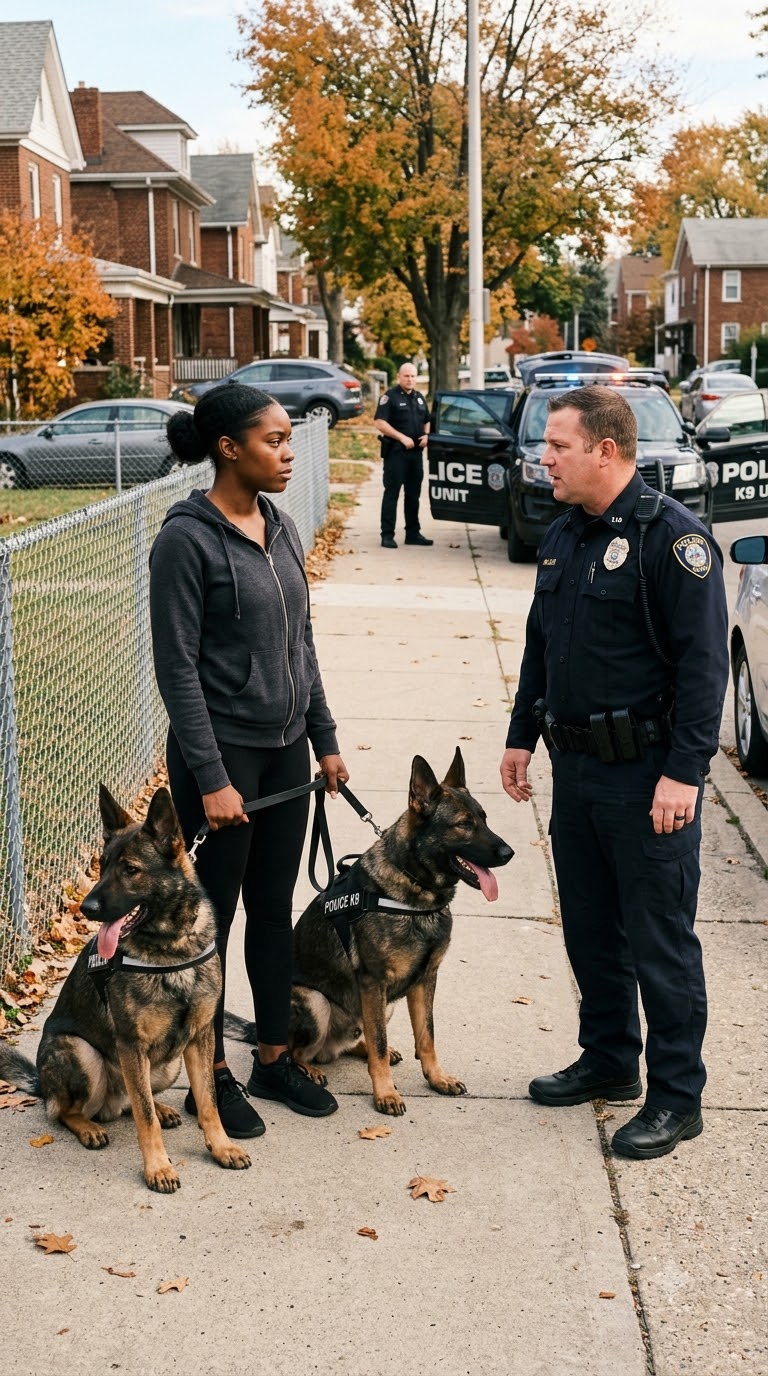
“Let go of those leashes and move away from the dogs.”
Captain Raymond Pike said it as though the decision had already been made somewhere before he arrived. His right hand hovered near the radio clipped to his vest while his eyes traveled from Simone Carter’s running clothes to the two German Shepherds sitting calmly beside her. Simone tightened her grip on the braided tactical leads but did not take a single step.
What Pike could not have known from looking at her was that Simone had spent nearly fifteen years handling military working dogs for the United States Army. He could not have known that the two animals at her feet had crossed oceans with her, worked around explosives and gunfire, and learned to read the smallest movement of her shoulders before most people could read a shouted command. Most importantly, he did not know that neither dog had been given permission to do anything except sit.
That morning had started with cereal.
Nine-year-old Noah Carter was responsible for feeding the dogs, and he treated the job with the seriousness other children reserved for video games or baseball practice. When Simone and Noah first moved into their small brick house in Brookhaven Glen outside Savannah, he announced that breakfast for Ranger and Atlas would be his responsibility. Simone had agreed because after the year they had survived, she was grateful whenever her son wanted responsibility instead of another reason to be afraid.
At six-thirty, Noah carried two stainless steel bowls onto the back porch. Ranger was eight, broad-chested and dark along the saddle, with amber eyes that made strangers nervous until he decided they were acceptable. Atlas was six, leaner and faster, with one ear that tilted slightly whenever Noah spoke to him.
“Sit.”
Both dogs sat.
Noah poured the food.
“Wait.”
Neither moved.
He looked toward the kitchen window to make sure his mother was watching. Simone was tying her running shoes and pretending not to.
“Okay.”
Two heads dropped into two bowls.
Noah grinned.
Simone smiled too.
At thirty-seven, Simone Carter had already lived several versions of a life. At eighteen she joined the Army because college money was scarce and staying in the small Alabama town where she grew up felt like a future someone else had chosen. By twenty-two she was working with military dogs, and by twenty-nine she had served on deployments she rarely described outside rooms where everyone else had been there too.
She eventually became a senior handler and trainer. Between assignments, she finished an undergraduate degree, then a master’s in animal behavior, studying late at night because she had decided that when the uniform finally came off, she wanted to know who she would be next. A blast during her final deployment damaged her left knee and gave her a scar along the outside of her thigh, but it did not end her career immediately.
Grief did.
Her husband, Andrew Carter, had been an Army medic. He was killed in a vehicle accident during a stateside training exercise three years before she retired. Noah was six.
There were losses that arrived loudly and others that simply reorganized the furniture inside your mind. Andrew’s death did both. Simone continued working because stopping felt impossible, then eventually stopped because continuing felt worse.
Brookhaven Glen was supposed to be quiet.
The neighborhood had tree-lined streets, decent schools, a small park, and enough distance from downtown Savannah that mornings still sounded like sprinklers and birds instead of traffic. Simone had signed a civilian contract consulting with a regional federal K9 training center about forty minutes away. The work paid well, kept her connected to the animals she understood, and allowed her to be home before Noah finished homework most evenings.
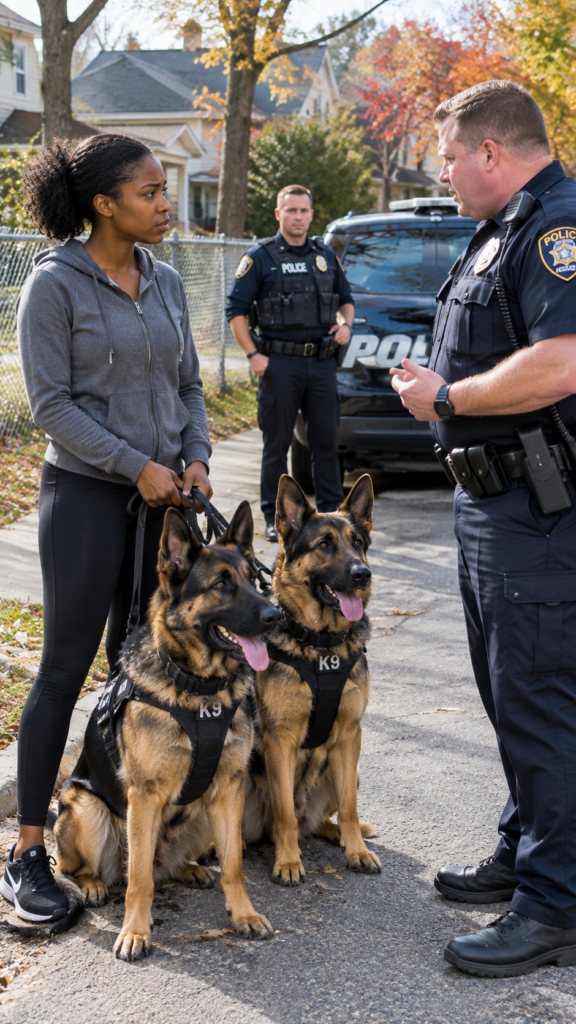
Ranger and Atlas had retired with her through approved handler placement. They were no longer working military assets, but neither had forgotten training built over thousands of hours. At home they slept beside Noah’s bed, stole socks when bored, and stared shamelessly at anyone eating chicken.
At dawn, they became different dogs.
Simone clipped their leashes and checked each fastener once.
“Ready?”
Ranger stood.
Atlas stretched.
Then the three of them stepped into the Georgia morning.
Simone ran the same route most weekdays. Maple Crest Drive to Grayson Avenue, through Crescent Park, behind the community tennis courts, then through a narrow service lot connecting the park to her subdivision. The route was a little over three miles.
She liked repetition.
After years when roads changed because somebody found an explosive device or a checkpoint closed without warning, knowing exactly where the sidewalk cracked felt luxurious. She knew where the sprinkler overshot one lawn, where the terrier behind a wooden fence barked every morning, and where an old pecan tree pushed its roots through concrete.
Ranger ran to her left.
Atlas ran to her right.
Neither pulled.
That precision was why the two patrol cars ahead looked wrong immediately.
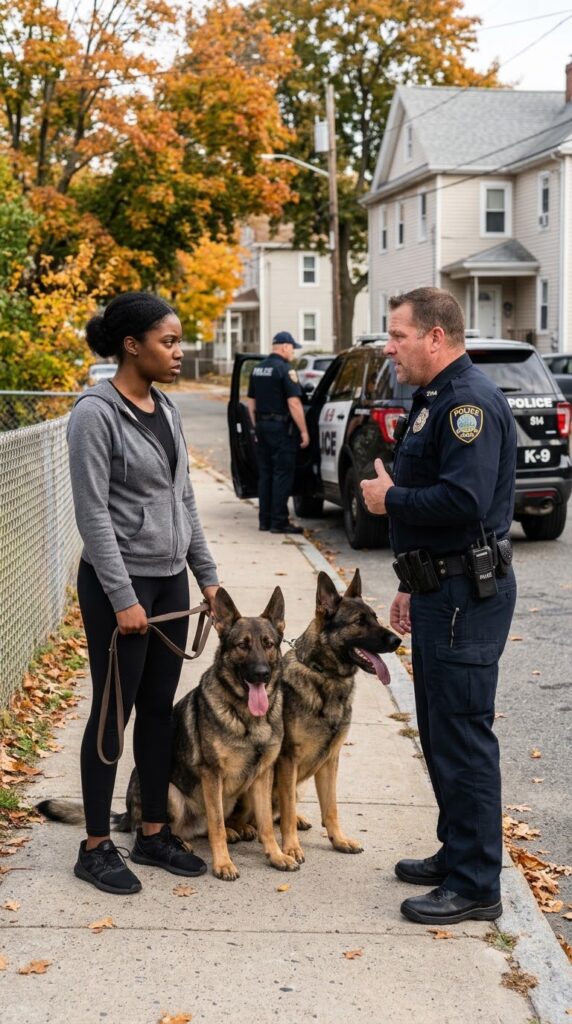
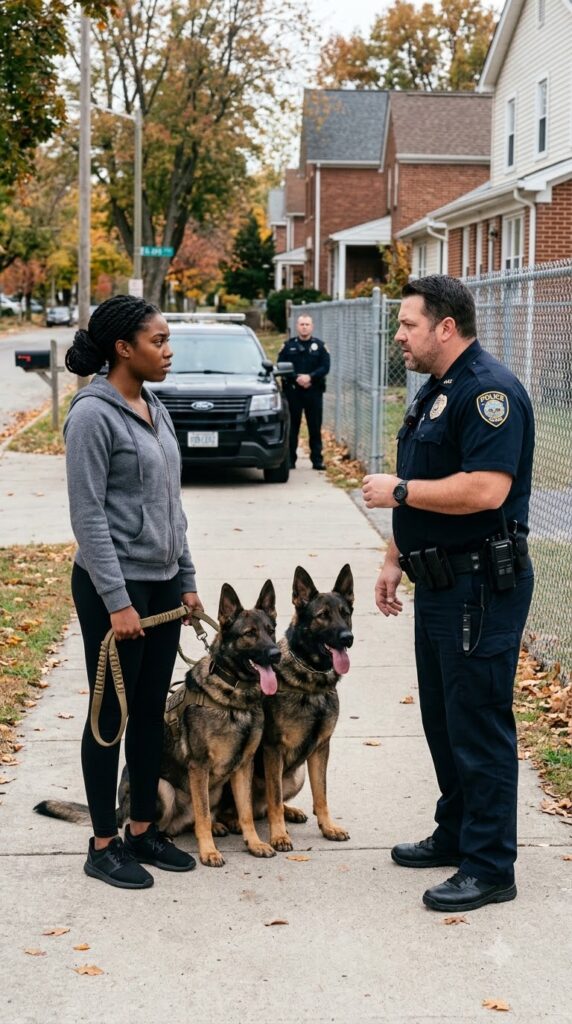
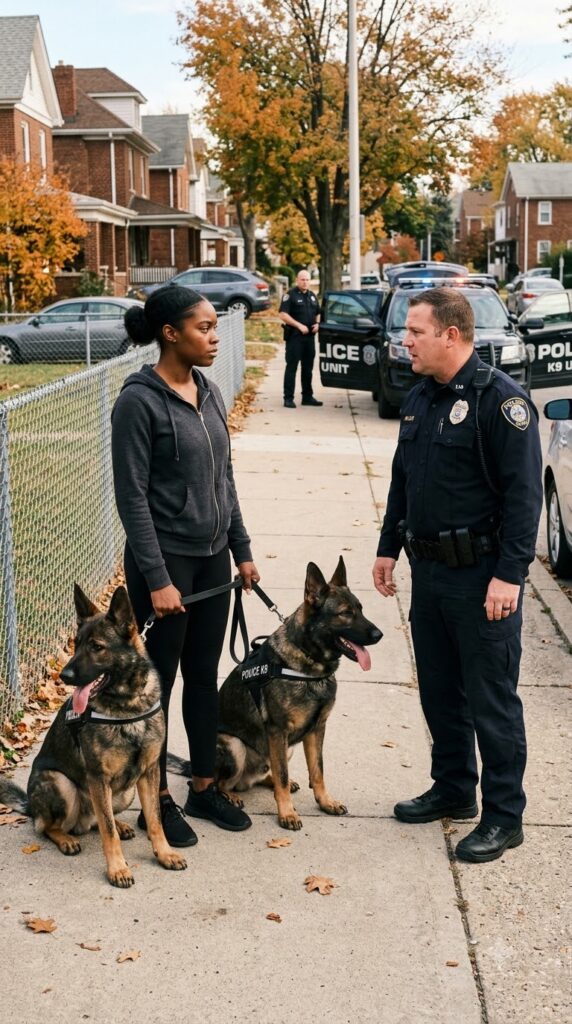
They were parked nose-to-nose across the entrance to the service lot, leaving no clean way through. Simone slowed from a run to a walk before the officers even opened their doors.
The first officer was heavyset, perhaps fifty-three, with close-cropped gray hair and the stiff posture of someone accustomed to controlling conversations through volume. His nameplate read PIKE. The younger officer remained a few feet behind him and slightly to the right.
Pike looked at Simone.
Then the dogs.
“We got a call about dangerous dogs running loose.”
Simone glanced down.
Both German Shepherds were attached to visible leashes and standing in heel position.
“These two?”
Pike’s expression barely changed.
“I said we got a report.”
“They aren’t loose.”
“Ma’am, step away from them.”
Simone felt something old awaken behind her ribs.
Recognition.
Not fear exactly.
The awareness that a situation had stopped being about the words being spoken.
“My dogs are leashed and under control.”
Pike stepped closer.
“I need you to listen carefully.”
“I am listening.”
“Then release the leashes.”
“No.”
The younger officer, whose badge read MILLS, shifted several feet to Simone’s right.
She noticed immediately.
A fence stood behind her.
A cruiser blocked the left side.
Pike stood ahead.
Mills was moving toward the right.
They were narrowing her space.
Simone’s breathing stayed even.
“Captain Pike, my name is Simone Carter. I am a retired Army military working-dog handler and currently hold a federal K9 training contract. Ranger and Atlas are documented retired military working dogs placed legally in my care.”
Pike gave a short smile.
“Everybody has a story when police show up.”
Simone stared at him.
“That isn’t a story.”
“I don’t need your résumé.”
“No, but you may need their records before you decide to confiscate them.”
Something changed in his face.
Simone had guessed correctly.
Pike lifted his radio.
“Animal control is already on the way.”
“For what?”
“The animals have been reported as aggressive.”
“By whom?”
“That isn’t your concern.”
“It becomes my concern when you are threatening to take animals standing peacefully on leashes.”
Pike’s jaw tightened.
“You people always want to argue everything.”
The words sat between them.
Mills looked toward his captain.
Simone noticed.
She had heard enough variations of that sentence in enough places to know exactly where it came from. She did not reward it with anger.
“Show me the complaint.”
Pike stepped closer.
“I do not need to show you anything right now.”
“Then we can wait for animal control.”
“I said drop the leashes.”
“And I said no.”
For the first time, Pike’s composure cracked.
He reached toward Simone’s left hand.
Ranger moved before Simone did.
The dog surged one step forward, enough to place his body between Pike and Simone. Atlas mirrored him instantly, hitting the limit of the short lead and planting his feet beside Ranger.
Neither dog bit.
Neither made contact.
Neither ignored Simone’s control.
But Ranger’s growl came from somewhere so deep in his chest that Mills stopped moving. Atlas raised his lips just enough to reveal teeth.
Pike jumped backward.
His hip struck the cruiser.
His radio banged against the hood.
Mills stumbled toward the fence.
For one brief second, both officers looked exactly like men who had forgotten that an animal trained to notice threats had been watching every inch of them.
Simone’s voice remained calm.
“Ranger.”
The dog’s ears shifted.
“Atlas.”
Both focused on her.
“Down.”
Immediately, both dogs dropped beside her boots.
No barking.
No lunging.
No chaos.
Just silence.
Pike stared.
Simone let the moment sit.
Then she said, “That is control.”
Mills looked down.
Pike recovered more slowly.
“You think this is funny?”
“No.”
“You just threatened law enforcement with attack dogs.”
“I gave no attack command.”
“They came at me.”
“They moved between you and me when you reached for my hand.”
Pike’s face reddened.
“I can have those animals destroyed.”
That was the first time Simone felt actual anger.
Not visible anger.
The dangerous kind that became colder instead of hotter.
She looked directly at him.
“You should be very careful about what you say next.”
Pike took another breath.
Then he pointed toward her street.
“Get out of here.”
Simone shortened both leads.
“Gladly.”
She stepped around the cruiser.
Pike called after her.
“This isn’t finished.”
She did not turn.
“It should have been before it started.”
Simone walked home.
She did not run.
Her shoulders remained straight until she reached her own porch.
Then her hands began shaking.
Noah stood behind the railing holding his tablet.
She stopped.
He looked pale.
“Mom.”
Simone climbed the steps.
“You okay?”
He nodded too quickly.
“You?”
“I’m fine.”
His eyes moved toward the dogs.
“They didn’t do anything.”
“I know.”
“I recorded it.”
Simone looked at him.
“What?”
“Everything.”
Noah held up the tablet.
“I saw the police cars from the porch.”
For several seconds, Simone did not speak.
Andrew had given Noah those same brown eyes. When the boy became serious, the resemblance was almost painful.
“You recorded the whole thing?”
“Yes.”
“Did you go into the street?”
“No.”
“Did you speak to anybody?”
“No.”
She exhaled.
“Good.”
Then another voice came from next door.
“I recorded it too.”
Mrs. Lorraine Bishop stood behind her screen door.
Lorraine was seventy-two, widowed, and had lived on Maple Crest Drive since half the subdivision was still pine trees. She held her phone up in one hand.
“I got most of it from my window.”
Simone looked between her son and neighbor.
Two recordings.
Two angles.
She understood immediately what that meant.
Inside, she gave Ranger and Atlas water, then sat at the kitchen table. Ranger leaned his shoulder against her leg.
Her hands still shook.
She called Malcolm Reid.
Malcolm had been Andrew’s closest friend before becoming the attorney Simone trusted with everything from her home closing to her federal consulting paperwork. He had spent twelve years practicing civil and administrative law. More importantly, he knew when to let Simone finish talking.
She described the event in order.
Time.
Location.
Officer names.
Exact statements.
Dog behavior.
Commands.
Witnesses.
When she stopped, Malcolm asked one question.
“Where is the footage?”
“Two devices.”
“Make three copies of each before anybody posts anything.”
Simone stood.
“I’m doing it now.”
“No edits.”
“Obviously.”
“No social-media captions.”
“Malcolm.”
“I know you know.”
“Then stop talking to me like I’m nineteen.”
He laughed once.
“Good. You sound like yourself.”
They preserved everything.
One copy went to encrypted cloud storage.
One to Malcolm.
One stayed offline on a hard drive.
Then Lorraine knocked on Simone’s door carrying banana bread and her phone.
“I figured if the police come back, nobody should be hungry.”
Simone almost smiled.
By afternoon, Malcolm contacted the Brookhaven Police Department requesting the incident report and preservation of body-camera, dispatch, and vehicle-camera records.
The department responded with a short statement.
They were reviewing the encounter.
Then someone posted Noah’s footage.
Not Simone.
Not Malcolm.
Lorraine’s grandson obtained permission from his grandmother and uploaded her angle alongside the clip Noah had already sent to a neighborhood accountability group. Within hours, thousands of people had watched Pike tell a Black woman to surrender two visibly leashed dogs.
By evening, the number crossed fifty thousand.
Local television picked it up.
One headline read:
RETIRED ARMY K9 HANDLER CONFRONTED OVER LEASHED SERVICE DOGS
Simone hated the word hero that began appearing beneath it.
She had not done anything heroic.
She had simply refused an unreasonable order.
Noah sat beside her on the couch watching comments multiply.
“They believe you.”
Simone turned off the tablet screen.
“Some do.”
“A lot do.”
“Yes.”
“Is that good?”
She thought.
“It’s useful.”
That answer confused him.
She pulled him closer.
“Being popular is not the same as being right.”
Noah nodded.
“But sometimes people looking at the same evidence helps.”
That he understood.
The next morning, Police Chief Angela Monroe appeared before cameras.
Captain Raymond Pike had been placed on paid administrative leave pending an internal review. The department asked the public not to rush to conclusions while investigators examined the complete circumstances.
Simone watched from the kitchen.
Then turned off the television.
For several hours, she believed perhaps the worst had passed.
Then the messages started.
Not national messages.
Neighborhood ones.
A Black father named Terrence Wade said Pike had stopped him outside his own subdivision three times in two years. A nurse named Patrice Monroe said Pike followed her teenage son through the neighborhood after a convenience-store clerk falsely reported shoplifting.
Another woman described Pike demanding proof that she lived in her own house.
A retired teacher said she had filed a complaint after watching Pike search two Black teenagers without explaining why.
Simone created a spreadsheet.
Names.
Dates.
Incident descriptions.
Complaint numbers where available.
Witnesses.
Fourteen stories by the end of the day.
Noah saw the spreadsheet after dinner.
“That’s all him?”
“Most of them.”
“How long?”
“Years.”
Noah looked disturbed.
“Why didn’t anybody stop him?”
Simone paused.
“That’s an important question.”
She did not give him an easy answer.
Because she did not have one.
That evening they ate baked chicken, rice, and green beans. Ranger slept beneath Noah’s chair while Atlas stared hopefully at every forkful of food.
For one hour, Simone turned off her phone.
No news.
No comments.
No lawyers.
Just dinner.
Noah asked about his science project.
Simone helped him spell photosynthesis.
Normality felt fragile.
She held onto it anyway.
Two mornings later, Malcolm called.
His voice told her immediately that the situation had changed.
“Pike filed suit.”
Simone stopped pouring coffee.
“For what?”
“Civil damages.”
She set the pot down.
“How much?”
“Seven hundred fifty thousand.”
She almost laughed because the number sounded ridiculous.
Malcolm continued.
“He alleges emotional trauma, physical injury, professional harm, and deliberate use of dangerous animals to intimidate police.”
Simone’s smile disappeared.
“What does he want involving the dogs?”
Silence.
That was enough.
“Tell me.”
“He is asking the court to classify Ranger and Atlas as dangerous animals.”
“And?”
“Permanent removal from your custody.”
Simone closed her eyes.
“And?”
Malcolm’s voice softened.
“If the court determines they present an ongoing threat, his petition requests euthanasia.”
The kitchen disappeared for a second.
Not literally.
The refrigerator still hummed.
Morning light still entered through the window.
But Simone heard only the word.
Euthanasia.
She put her palm flat against the table.
“Who is representing him?”
“David Sloane.”
That name she knew.
One of the most expensive civil litigators in coastal Georgia.
“Pike cannot afford Sloane.”
“No.”
“Who is paying?”
“We’re looking.”
Simone stared out the window.
Ranger and Atlas patrolled the fence beside Noah.
“Find out.”
“We will.”
“No, Malcolm.”
Her voice hardened.
“Find out who is paying for this.”
He was quiet.
“I already am.”
That afternoon, Simone told Noah.
She did not tell him everything.
She did not say euthanasia.
Not yet.
She explained that Pike was asking a court to take Ranger and Atlas because he claimed they were dangerous.
Noah’s face changed immediately.
“They’re not.”
“I know.”
“He knows they’re not.”
“I think so.”
“Then why?”
Simone answered honestly.
“I don’t know yet.”
Noah sat on the floor beside Ranger.
The Shepherd placed his chin across the boy’s knee.
“Can they really take them?”
“Someone can ask a judge for almost anything.”
“That’s not what I asked.”
Simone looked at him.
Andrew would have smiled at that.
“No.”
She corrected herself.
“I don’t know whether they can.”
Noah stared.
“But we fight?”
“Yes.”
“Okay.”
That was all.
Ten years old and terrified.
Still, he trusted the word we.
The lawsuit was only the beginning.
An emergency animal-control petition followed.
A municipal judge named Warren Cole denied Malcolm’s first request to block temporary impoundment. He did so from written filings without holding oral argument.
Simone read the order twice.
Then placed it on the table.
“How long?”
“Could be forty-eight hours.”
Malcolm’s voice came through speakerphone.
“We’re filing with the state appellate court.”
“What about their military status?”
“That is our strongest argument.”
“Use everything.”
“We are.”
Simone looked toward the dogs.
Ranger was asleep.
Atlas chewed a rubber ball.
Neither understood that strangers were discussing whether they should remain alive.
For the first time since Andrew died, Simone entered the garage and closed the door simply so Noah would not hear her cry.
She gave herself five minutes.
Then she washed her face.
Opened the door.
And returned to the kitchen.
By the next morning, Brookhaven residents had gathered outside the municipal building.
Simone had organized nothing.
Lorraine apparently had.
The seventy-two-year-old stood near the front wearing a yellow blouse and holding a sign that read:
LEASHED IS NOT LOOSE.
Simone almost laughed when she saw it from the car.
Other signs were less polite.
She did not stop.
Malcolm had warned her that every statement now mattered.
The case had become legal before it became symbolic.
Then Councilman Preston Vale entered it.
Vale chaired Brookhaven’s Public Safety Committee. He was sixty-one, silver-haired, polished, and possessed the smooth voice of someone who could make a threat sound like reasonable governance.
He appeared on television that evening.
“This should never have become a racial issue.”
Simone watched from the kitchen.
Nobody had asked him whether it was.
Vale continued.
“The city has a responsibility to protect officers and residents from highly trained attack animals.”
Simone’s jaw tightened.
“Military service is honorable.”
He folded his hands.
“But military service does not place anyone above public-safety laws.”
Simone turned off the television.
Noah looked up from homework.
“Why?”
“Because I’ve heard enough.”
“Is he lying?”
Simone considered.
“He’s choosing words carefully.”
“That means yes?”
“Sometimes.”
Noah went back to math.
Her phone buzzed continuously.
Supporters remained.
But the conversation changed.
People who previously saw two calm dogs now saw “combat-trained animals.”
The phrase spread.
Then Pike’s attorney released an old military record.
It concerned Ranger.
The excerpt described an overseas incident where a civilian contractor had been injured during a restricted-area breach. The document omitted the investigation results, the command review, the finding that Ranger had responded appropriately, and the commendation Simone later received.
Local headlines did not wait.
DOG AT CENTER OF POLICE LAWSUIT PREVIOUSLY INJURED CIVILIAN
Simone stared at the headline.
Then closed the browser.
Malcolm called.
“We have the full report.”
“I know.”
“We’ll file it.”
“I know.”
“You were cleared.”
“I know.”
He paused.
“You okay?”
“No.”
That answer surprised him.
Simone leaned against the counter.
“But I will be.”
Ranger’s overseas incident had happened during Simone’s final deployment. A civilian contractor entered a restricted zone after repeated warnings and moved toward an area where soldiers were exposed during a security incident. Ranger intercepted because that was exactly what he had been trained to do.
The investigation lasted weeks.
Simone was cleared completely.
Ranger returned to duty.
That context vanished when one paragraph became a headline.
Noah heard about it.
Children at school had heard.
He came home unusually quiet.
At dinner he finally asked, “Did Ranger hurt somebody?”
Simone placed down her fork.
“Yes.”
His eyes widened.
“Because he was bad?”
“No.”
She explained in language a nine-year-old could hold.
“He was working.”
“Was the man bad?”
“I don’t know.”
“Then why?”
“Because sometimes a dog does not need to know whether somebody is good or bad.”
Noah waited.
“He needs to know whether the person is crossing a boundary he was trained to protect.”
“Did Ranger make a mistake?”
“No.”
“Did you?”
“The investigation said no.”
Noah looked under the table.
Ranger’s head rested beside his shoe.
“So why are they saying it like that?”
Simone took a breath.
“Because a piece of a true story can be used to make people believe something that isn’t true.”
Noah thought about it.
“That’s lying.”
“Sometimes it’s worse.”
“How?”
“You can prove every sentence you said.”
She looked at him.
“And still mislead people.”
He went silent.
The following morning Lorraine Bishop arrived carrying a casserole and a flash drive.
Simone opened the door.
Lorraine entered without waiting for an invitation.
“You need this.”
She placed the drive on the table.
“What is it?”
“Raymond Pike.”
Simone stared.
Lorraine sat.
“I’ve been here thirty-three years.”
Her hands folded.
“I have watched that man for a long time.”
She described two incidents.
One occurred eighteen months earlier, when Pike stopped a Black homeowner named Calvin Moore outside his own house, insisted the moving boxes in his SUV looked suspicious, and detained him until neighbors confirmed where he lived. Lorraine had filmed most of it from her porch.
The second happened nearly four years earlier.
Pike confronted two Black college students visiting their grandmother across the street.
One was placed against a patrol car.
The other repeatedly explained whose house they were visiting.
No charges followed.
Lorraine had filed complaints after both events.
Nothing happened.
“You kept the videos?”
“I am old.”
Lorraine shrugged.
“We keep things.”
Simone almost smiled.
“Why didn’t you bring them sooner?”
Lorraine looked ashamed.
“I thought filing the complaint was enough.”
She stared at the table.
“When nothing happened, I decided maybe there was more I didn’t understand.”
“And now?”
Lorraine looked at her.
“Now I understand I was giving the system more benefit of the doubt than the people inside those videos.”
Simone picked up the drive.
“Thank you.”
“Don’t thank me.”
Lorraine stood.
“Use it.”
Malcolm had the footage within an hour.
His reaction came quickly.
“This changes the case.”
“Pattern?”
“Clear pattern.”
“Enough?”
“For the civil suit, absolutely.”
He paused.
“I want another lawyer.”
Simone leaned back.
“That usually means expensive.”
“Not for you.”
He gave her the name.
Danielle Mercer.
Civil-rights attorney.
Federal litigation.
Police misconduct.
Simone agreed.
Danielle entered the case that afternoon.
She asked sharper questions than anyone had yet.
“Who called in the original loose-dog complaint?”
The answer was buried inside dispatch records nobody had seriously challenged.
Danielle filed for them.
The records arrived the next day.
There had been one call.
Anonymous.
No caller identification.
No recorded name.
No follow-up contact.
But the timing mattered.
The call came four minutes before Simone left her house.
It described two aggressive German Shepherds expected to enter the rear service lot from the park path.
Danielle called Simone.
“This was not random.”
Simone stood at the kitchen window.
“Say that again.”
“The caller did not report dogs they saw.”
Danielle’s voice sharpened.
“They predicted where you and the dogs would be.”
Simone felt cold.
“Someone knew my route.”
“Yes.”
“And Pike was already there.”
“Yes.”
Simone looked toward Ranger.
Then Atlas.
“This was arranged.”
“That is now my working theory.”
The case changed shape.
Pike stopped looking like an impulsive officer reacting badly to a false complaint.
He looked like part of something.
Danielle asked who had access to Simone’s schedule.
The neighborhood knew she ran early.
The specific route was less obvious.
Her federal training contract included arrival and departure schedules.
City administrators had recently received copies during bidding discussions about expanding Brookhaven’s canine program.
That connection seemed thin.
Until Danielle asked who paid Pike’s attorney.
The answer came from campaign records.
A legal-defense nonprofit had retained David Sloane.
The nonprofit’s largest recent donor was a political-action committee closely connected to Councilman Preston Vale.
Simone wrote his name on a legal pad.
Then circled it.
Vale.
The state appellate court granted the emergency injunction two days later.
Ranger and Atlas could not be seized while the classification dispute remained unresolved.
Danielle called while Simone was walking the dogs.
“The injunction is granted.”
Simone stopped.
She stood on Maple Crest Drive in running shoes and did not move.
“Both dogs stay home?”
“Yes.”
“Until?”
“Until the underlying issue is litigated.”
Simone looked down.
Ranger stared back.
Atlas sniffed a mailbox.
“Thank you.”
Then her voice broke.
Danielle became quiet.
“Go home, Simone.”
Simone sat on the curb before she reached it.
She cried into both hands.
Ranger leaned against her side.
Atlas placed his chin across her knee.
She had spent days refusing to imagine animal-control officers entering her house.
Now, temporarily, they would not.
That evening neighbors gathered in front of Simone’s home.
Nobody planned it officially.
People brought folding chairs.
Lemonade.
Cookies.
Music.
Children ran between yards while Ranger and Atlas stayed on the porch beside Noah.
Noah looked toward his mother.
“They can stay?”
“Yes.”
“For good?”
Simone could not lie.
“For now.”
He nodded.
Then hugged Ranger.
Peace lasted forty-eight hours.
On Monday morning, the Brookhaven Police Department announced its internal review was complete.
Captain Raymond Pike would return to duty.
Simone heard the announcement on the radio.
She turned it off.
Then made eggs.
Malcolm called twenty minutes later.
“There’s more.”
“Of course there is.”
“A rider was added to the Georgia Municipal Animal Safety Act.”
Simone stopped moving.
“What rider?”
“It would allow cities to classify retired government working dogs with prior bite histories as enhanced-risk animals.”
She understood.
“That includes Ranger.”
“Yes.”
“And overrides the injunction argument.”
“Potentially.”
“When is the vote?”
“This week.”
Simone wrote it down.
Then Malcolm continued.
“And Pike filed a criminal complaint.”
Her pen stopped.
“For what?”
“Obstruction and interference with a police investigation.”
She laughed once.
Not because anything was funny.
“He’s claiming you prevented officers from investigating the loose-dog report.”
“They were my dogs.”
“I know.”
“They weren’t loose.”
“I know.”
“There wasn’t a real complaint.”
“We now have evidence suggesting exactly that.”
“What happens if they charge me?”
Malcolm hesitated.
“Your federal contractor credential could be suspended pending review.”
There it was.
Dogs.
Career.
Freedom.
Three directions.
One morning.
Simone wrote each one separately.
DOGS
LICENSE
CRIMINAL CASE
Then beneath them:
WHO BENEFITS?
She stared at those words for a long time.
Noah entered carrying a cereal bowl.
He sat at the opposite end of the kitchen table.
He did not ask questions.
Children learned atmosphere faster than adults wanted to believe.
Simone kept reading.
After several minutes Noah said, “Mom?”
“Yes?”
“You always figure stuff out.”
She looked up.
He ate another spoonful of cereal.
“So figure it out.”
Simone smiled despite herself.
“That easy?”
“No.”
He shrugged.
“But you still do it.”
Andrew’s face appeared in Noah’s expression so clearly that Simone looked away.
“Finish breakfast.”
Noah nodded.
She returned to the legal pad.
The question remained.
Who benefited?
That night, Simone did not sleep.
She spread every document across the kitchen table.
The original complaint.
Pike’s lawsuit.
Animal-control petition.
Vale’s public statements.
Campaign filings.
The legislative rider.
Her federal K9 contract.
The criminal complaint.
Everything.
Then she removed emotion.
That was how military planning worked.
Not because emotion was weakness.
Because emotion could hide structure.
Pike wanted the dogs.
Vale supported Pike.
The rider targeted retired working animals.
The criminal complaint threatened Simone’s federal contract.
Her contract.
Simone stopped.
Brookhaven had been discussing expansion of its municipal canine-training program.
Her company had been the lead outside consultant.
If she lost federal eligibility, the city would need another provider.
She called Danielle at 5:42 in the morning.
The attorney answered awake.
“Tell me.”
Simone did.
For twenty minutes she walked through the timeline.
Danielle asked only three questions.
Then she said, “We need Vale’s financial disclosures.”
Malcolm joined the call.
By seven, both lawyers were searching public filings and discovery material.
Simone made coffee.
Noah slept upstairs.
The dogs rested near the table.
At 7:38 Danielle called back.
“We found something.”
Simone put down the cup.
“What?”
“Northline Protective Services.”
The name meant nothing.
Danielle continued.
“Private security and K9 contractor.”
Simone’s breathing slowed.
“They have been lobbying Brookhaven for the expanded canine program.”
“Yes.”
“And?”
“Preston Vale has received consulting payments from a Northline subsidiary for twenty-two months.”
Simone closed her eyes.
“How much?”
“Enough to matter.”
“Be specific.”
“Nearly two hundred thousand dollars.”
Silence.
Danielle continued.
“If your contract gets disqualified, Brookhaven reopens the municipal K9 award.”
“Northline bids.”
“Yes.”
“If the rider reclassifies Ranger and Atlas, my federal credential gets complicated.”
“Yes.”
“If the criminal complaint produces even temporary suspension—”
“Your contract may be terminated for compliance reasons.”
Simone opened her eyes.
“And Pike?”
“That is what we still need.”
They found it before noon.
Pike’s brother-in-law ran a regional subcontractor used by Northline.
Payments had increased shortly before the confrontation.
Not proof alone.
But enough to justify scrutiny.
Simone called someone she had not spoken to in months.
Major Tessa Grant worked county internal affairs.
They met during a K9 training symposium and developed the kind of immediate professional respect that did not require friendship.
When Tessa answered, she said, “I wondered when you would call.”
“You’ve been watching?”
“Everybody has.”
Simone explained the money.
Tessa became quiet.
Then she said, “Send everything.”
“Why?”
“Because I’ve been looking at Pike for nine months.”
Simone stopped.
“What for?”
“Complaint suppression.”
“Who’s suppressing them?”
“That’s what I couldn’t prove.”
“Vale.”
“Maybe.”
Simone corrected herself.
“Follow the money.”
Tessa exhaled.
“Now you sound like an investigator.”
“I sound angry.”
“Good investigators usually are.”
By afternoon, county internal affairs contacted the state attorney general.
A preservation notice froze relevant city emails, campaign records, financial disclosures, and contractor communications.
Vale learned about it within hours.
He resigned from the Public Safety Committee the next morning.
His statement cited family priorities.
Simone read four sentences.
Then put the phone down.
Malcolm texted:
He’s running.
She answered:
Running still leaves tracks.
The criminal complaint collapsed first.
The county prosecutor reviewed Pike’s filing and declined charges.
Malcolm called.
“She called it legally unsupported.”
Simone drew a line through CRIMINAL CASE.
One.
The legislative rider fell next.
A federal veterans’ advocacy organization and retired-working-animal coalition sent formal notice to lawmakers challenging the proposed classification. The legislator who introduced the rider withdrew it before the final vote, saying the language required additional review.
Simone crossed through DOGS — LEGISLATIVE RIDER.
Two.
Then the police chief reversed Pike’s reinstatement.
He returned to unpaid administrative leave pending state investigation.
Three.
Simone stared at the page.
For the first time in weeks, every immediate weapon pointed at her had been stopped.
Not resolved.
Stopped.
There was a difference.
The deeper case continued.
Tessa’s investigators recovered emails between Vale’s office and Northline executives discussing the city contract.
One message contained language about “clearing current contractor obstacles.”
Another referenced “the Carter issue.”
Simone read that one twice.
Not her name.
Her issue.
A problem to be removed.
Investigators also recovered communications between Pike and a political aide the night before Simone was stopped.
One text contained her running route.
Another said:
Back lot is cleanest. No audience.
There had been an audience.
A nine-year-old boy on a porch.
A seventy-two-year-old woman behind a curtain.
That changed everything.
Pike’s younger partner, Officer Aaron Mills, eventually cooperated.
He admitted Pike told him they were performing “a compliance stop” involving a problematic K9 contractor.
There had been no legitimate dog complaint presented during briefing.
Mills assumed supervisors had handled it.
By the time he realized otherwise, the confrontation was already happening.
Danielle asked Simone whether she hated him.
“No.”
“Why?”
“He had a choice.”
“And?”
“He made the wrong one at first.”
Danielle waited.
“He made a different one later.”
That distinction mattered to Simone.
Accountability did not require pretending every failure was identical.
The federal civil-rights complaint followed.
Simone sued Pike, Vale, and Brookhaven.
The filing alleged coordinated abuse of authority, discriminatory policing, retaliation, and interference with protected property and employment interests. Lorraine’s videos supported the pattern.
Resident affidavits expanded it.
The false complaint supported planning.
Financial records provided motive.
The case became impossible to describe as one woman arguing with one officer.
That was exactly what certain people had tried to keep it.
Brookhaven Police Chief Renee Caldwell called Simone personally.
The chief was a Black woman in her late forties who had spent twenty-three years climbing through a department that rarely made advancement easy. Simone respected that history.
It did not excuse what happened.
“I owe you an apology.”
Simone sat at the kitchen table.
“You owe the neighborhood more than me.”
The chief became quiet.
“I know.”
“Your review reinstated him despite complaints.”
“Yes.”
“Why?”
Pressure.
Politics.
Fear of losing council support.
Concern over department funding.
Simone listened.
When Caldwell finished, she said, “You made a decision because power made the wrong answer easier.”
The chief sighed.
“Yes.”
“I know that feeling.”
Another pause.
“But when you wear authority, easier answers cost other people more.”
Caldwell accepted that.
Weeks later, she publicly acknowledged failures in the department’s complaint-review process.
It did not repair everything.
It created a record.
Simone had learned to value records.
People could rewrite memories.
Documents were harder.
The civil case did not settle.
Pike refused.
His lawyer approached Danielle repeatedly with financial offers.
Simone rejected them.
Once, Danielle asked, “What would make you consider settlement?”
“His certification.”
“You want his badge.”
“I want him unable to do this to somebody else.”
“Money?”
“Secondary.”
Danielle smiled.
“That makes negotiations annoying.”
“Good.”
The case went before a jury months later.
Simone wore a navy suit instead of her Army uniform.
She wanted the case decided on what happened in Brookhaven, not on whether jurors admired her military past.
Noah attended only one morning.
Most days Simone kept him in school.
He had already lost enough childhood to adult problems.
Lorraine testified.
So did Calvin Moore.
Patrice Monroe.
Other residents.
Aaron Mills.
Then the videos played.
Pike ordering Simone to release two leashes.
The dogs sitting calmly.
His movement forward.
Ranger and Atlas stepping between them.
Simone’s single command bringing both animals down instantly.
The jury watched twice.
The defense argued officer safety.
Danielle asked why a legitimate safety stop had been planned before the supposed complaint existed.
Silence answered better than Pike did.
The jury returned a verdict for Simone.
The damages exceeded one million dollars across several defendants and claims.
Simone did not celebrate in the courthouse.
She sat beside Malcolm and stared at her hands.
Andrew should have been there.
That thought came unexpectedly.
She felt grateful.
Then sad.
Then tired.
All three were allowed.
Half of Simone’s personal award funded legal support for Brookhaven residents challenging misconduct.
Another portion created the Andrew Carter Working Dog Foundation, helping veterans train for civilian K9 careers and supporting retired working animals whose handlers struggled with medical or legal costs.
Noah designed the first logo.
It was terrible.
Simone used it anyway.
“It looks like Ranger has six legs.”
“He’s running.”
“He’s mutating.”
“You don’t understand art.”
Apparently she did not.
The state revoked Pike’s law-enforcement certification after the misconduct proceedings concluded.
Additional criminal charges followed from falsified reporting, conspiracy, retaliation, and official misconduct.
Federal civil-rights prosecutors also reviewed the conduct.
Pike eventually stood before a judge without a uniform.
Simone did not attend sentencing.
She was sitting inside Noah’s fourth-grade classroom watching him present a project on Georgia history.
Her phone buzzed once.
Malcolm.
Sentenced. Badge permanently gone.
Simone read it.
Locked the phone.
Looked back toward her son.
Noah pointed at a poster board.
Something about James Oglethorpe.
Simone smiled.
That was where she wanted to be.
Vale’s investigation took longer.
Financial cases always did.
Money left trails, but rich people hired professionals whose entire careers existed to make trails look like scenery.
The attorney general followed the consulting payments.
Contract forecasts.
Lobbying communications.
Northline’s projected takeover.
The staged complaint.
Pike’s involvement.
Then investigators uncovered similar arrangements around two previous municipal contracts.
Vale had been doing versions of the same thing for years.
Brookhaven was simply the first time one target refused to disappear quietly.
Former aides cooperated.
Northline executives turned over documents.
One recorded conversation captured Vale complaining that “the Carter woman” had made a simple transition unnecessarily public.
Simone listened once.
Then refused to hear it again.
She had no interest in living inside his voice.
Vale was indicted on bribery, conspiracy, abuse of office, obstruction, and financial misconduct charges.
He resigned from council entirely.
The courthouse steps where he once spoke about public safety filled with cameras when he entered for trial.
His lawyer tried to separate the K9 controversy from the money.
The documents refused.
The jury convicted him on most major counts.
He received prison time and a permanent prohibition on holding state public office.
Northline lost the contract opportunity.
The company itself came under investigation.
The city restructured its procurement rules.
None of it felt cinematic to Simone.
Real accountability involved too much paperwork.
One evening, Noah watched footage of Vale leaving court.
“Is he going to prison?”
“Yes.”
“Because of us?”
Simone turned down the television.
“No.”
Noah looked confused.
“He is going because of what he chose to do.”
“But if you didn’t fight—”
“Then maybe nobody would have found it yet.”
She looked at him.
“That doesn’t make his choices ours.”
Noah thought.
“So we just uncovered it.”
“Yes.”
He liked that answer.
“So like detectives.”
“Do your homework.”
That ended the conversation.
Months later, Brookhaven County held a public hearing on protections for retired military and government working animals.
Simone almost declined the invitation.
Then she thought about Ranger and Atlas.
She took her Army dress uniform from the back of the closet.
Fourteen years lived on the fabric.
Ribbons.
Insignia.
Buttons polished before deployments.
A life before Brookhaven.
She dressed slowly.
Noah stood in his room wrestling with a collar.
“Hold still.”
“I am.”
“You’re moving.”
“That’s because you’re choking me.”
“I’m fixing one button.”
Ranger watched from the floor.
Noah looked at Simone’s uniform.
His expression changed.
“You look different.”
“I look old.”
“No.”
He shook his head.
“You look like all the stories you never tell me.”
Simone stopped.
Children occasionally said things adults spent years trying to find language for.
“One day.”
Noah nodded.
He accepted that.
At the county chamber, Ranger and Atlas wore retired-working-dog harnesses.
Simone walked between them.
Noah sat beside Lorraine in the front row.
Malcolm and Danielle stood near the attorneys’ table.
The room was full.
Simone spoke without notes.
She did not describe herself as brave.
She described procedure.
A false complaint.
Officers waiting before the reported event.
Two controlled animals.
A child recording from a porch.
A neighborhood full of earlier complaints.
A political official with money waiting behind the conflict.
Then she spoke about service.
“People like simple versions of working dogs.”
She looked toward Ranger.
“They call them heroes when the uniform is visible.”
Then toward Atlas.
“They call them dangerous when their training becomes inconvenient.”
The room stayed quiet.
“These animals do not understand politics.”
She paused.
“They understand work.”
“They understand commands.”
“They understand trust.”
Simone looked toward the commissioners.
“And the people entrusted with authority should be expected to understand those things too.”
She spoke about Noah last.
“My son held a tablet steady because he saw adults behaving in a way that felt wrong.”
Her voice softened.
“I do not want the lesson of this story to be that everybody needs a camera.”
She let that sit.
“I want the lesson to be that authority should still behave correctly when there is no camera.”
Noah looked down.
Then back up.
The county adopted a resolution requiring higher review before retired military working animals could be classified as dangerous based solely on documented service incidents. It also required preservation and independent review when an animal seizure request involved a retired government K9.
The resolution did not fix America.
Simone knew that.
It fixed one door.
Sometimes one door mattered.
The foundation grew slowly.
Veterans called.
Some needed jobs.
Others needed help covering veterinary surgery for retired dogs.
One former handler said he had been sleeping in his truck with his dog because the apartment he found would not allow the animal.
Simone helped place both.
Andrew Carter’s name appeared on every grant form.
At first, writing it hurt.
Eventually it felt like introducing him.
Ranger aged.
His hips stiffened.
He stopped running the full three miles with Simone.
Atlas continued.
Noah complained that Ranger was becoming lazy.
“He’s retired.”
“He’s been retired forever.”
“Exactly. He’s good at it.”
Ranger sighed from the rug.
Everyone agreed that meant he had won the argument.
Two years after the original confrontation, Lorraine moved to Florida to live near her daughter.
Before leaving, she came to Simone’s house with another casserole.
“You people are going to starve without me.”
“We know how to cook.”
“I’ve seen you cook.”
Simone laughed.
Lorraine hugged Noah.
Then Simone.
At the door, she looked toward Ranger and Atlas.
“You know, I almost didn’t record that morning.”
Simone became still.
“Why?”
Lorraine shrugged.
“I thought maybe I was making trouble where there wasn’t any.”
She looked embarrassed.
“Then I remembered how many times I’d thought that before.”
Simone nodded.
“What changed?”
“You.”
Lorraine answered immediately.
“You weren’t doing anything.”
“That simple?”
“It should have been.”
Simone carried that sentence for years.
It should have been.
The neighborhood changed too.
Not dramatically.
There were still arguments about trash pickup.
People still parked badly.
Teenagers still drove too fast.
But residents knew one another differently.
Complaint-review meetings became public.
The department installed an independent civilian oversight panel.
Chief Caldwell remained in office but changed her procedures substantially.
Some people distrusted her permanently.
That too was allowed.
Accountability did not require universal forgiveness.
Simone saw Aaron Mills once at a grocery store.
He noticed her near the produce section.
For several seconds, neither spoke.
Then he approached.
“Dr. Carter.”
“Officer Mills.”
He was no longer with Brookhaven.
State investigators had suspended him temporarily, but his cooperation prevented permanent decertification. He eventually joined a smaller department two counties away after retraining.
“I owe you an apology.”
Simone looked at him.
“Yes.”
He blinked.
Apparently he expected her to make the moment easier.
She did not.
“I should have said something that morning.”
“Yes.”
“I knew the setup felt wrong.”
“Yes.”
“I told myself Pike knew more than I did.”
Simone waited.
Mills looked ashamed.
“That was cowardly.”
“Yes.”
He nodded.
“Okay.”
Simone softened slightly.
“You told the truth later.”
“I should’ve done it sooner.”
“Both can be true.”
He looked at her.
“Thank you.”
“Don’t waste it.”
He understood.
They went separate directions.
One autumn morning, years after everything began, Simone woke before dawn.
She tied her shoes.
Atlas waited by the door.
Ranger remained asleep beside Noah’s room.
At ten, the boy was no longer really a boy.
He had grown taller.
His voice cracked unexpectedly.
He pretended Ranger still slept in his room because the dog wanted to, although everyone knew the arrangement went both ways.
Simone clipped Atlas’s leash.
Then heard nails against the floor.
Ranger appeared slowly.
“You sure?”
The old Shepherd stared.
Simone smiled.
“Fine.”
She clipped him too.
They walked instead of running.
Maple Crest was quiet.
A cooler wind moved through the trees.
The same route still lived in Simone’s body.
Down Maple Crest.
Left at Grayson.
Through Crescent Park.
Then the service lot.
Years earlier, she avoided thinking about the asphalt before reaching it.
Later, she deliberately ran through without slowing.
That morning she stopped.
Not because she was afraid.
Because she wanted to remember correctly.
The fence remained.
The cracked pavement remained.
The world had not placed a monument there.
Good.
She did not want one.
Ranger sniffed the edge of the grass.
Atlas watched a squirrel.
Simone looked at the place where two cruisers once blocked her path.
Pike’s voice came back faintly.
Drop those leashes.
Then another memory replaced it.
Noah’s small hands holding a tablet.
Lorraine behind a curtain.
Ranger and Atlas responding to one quiet command.
Malcolm saying preserve everything.
Danielle saying follow the money.
Andrew’s voice existing only in Simone’s memory.
Handle what is in front of you.
She breathed.
Then walked forward.
No cruisers waited.
No officer stepped into her path.
Nothing happened.
That was exactly what she wanted.
When Simone came home, the kitchen light was on.
Noah sat at the table eating cereal.
He was older now, but apparently still incapable of putting cereal boxes back into the pantry.
Ranger and Atlas immediately stationed themselves beside him.
Noah glanced down.
“You already ate.”
Neither dog appeared persuaded.
Simone sat across from him.
“Good walk?” he asked.
She looked through the window.
Morning light spread across the table.
Andrew’s photograph sat on the windowsill.
The old legal pad from the case remained inside a kitchen drawer, every crossed-out threat still visible if she opened it.
She rarely did.
“Good walk.”
Noah nodded.
He returned to cereal.
Simone watched him.
For years, people told her the confrontation made her famous.
She never thought of it that way.
The parking lot had merely exposed things already there.
Pike’s conduct.
Vale’s corruption.
The department’s failures.
The neighborhood’s buried stories.
Her son’s courage.
Her own instinct to document before reacting.
Even Ranger and Atlas had not suddenly become remarkable that morning.
They had been trained long before anybody pointed a camera at them.
The viral video showed only seconds.
It showed two dogs stepping forward.
Two officers backing away.
A Black woman refusing to surrender control.
People loved that part.
But the real story came afterward.
It was legal pads at two in the morning.
Neighbors handing over old videos.
A child asking whether his dogs would be taken.
Attorneys tracing money.
People signing affidavits after years of silence.
An officer deciding eventually to tell the truth about his own failure.
A police chief admitting political pressure had shaped a bad decision.
A jury watching the entire sequence instead of one edited version.
A community deciding some procedures should become harder to abuse.
That was never as dramatic as Ranger’s growl.
It mattered more.
Simone poured coffee.
Noah looked toward her.
“You’re doing that thing.”
“What thing?”
“Staring into space.”
“I’m thinking.”
“About the case?”
She smiled.
“How’d you know?”
“You always get the same face.”
Simone took a drink.
“It’s weird.”
“What?”
“The whole thing started because somebody thought two dogs were the easiest way to take something from me.”
Noah looked down at Ranger.
“What did they want?”
Simone thought about how to answer.
At first, she believed Pike wanted control.
Then she believed Vale wanted money.
Both were true.
But the conspiracy required something else.
It required everyone involved to believe Simone would eventually become tired enough, frightened enough, or financially pressured enough to step aside.
“They wanted me to quit.”
Noah shrugged.
“That was dumb.”
Simone laughed.
“Apparently.”
He finished cereal.
Then carried the bowl to the sink.
Ranger followed.
Atlas followed Ranger.
Simone watched them.
The house was warm.
The porch light was off because morning had arrived.
School books sat beside Noah’s backpack.
A federal K9 training manual rested near Simone’s laptop.
Everything looked ordinary.
Once, ordinary felt temporary to her.
The Army taught her to expect movement.
Andrew’s death taught her that anything could disappear.
The case taught her that even a quiet suburban street could become contested ground.
Over time, Simone learned another truth.
Ordinary was not fragile simply because people could threaten it.
Ordinary could be defended.
Not with constant fear.
Not by treating every stranger like an enemy.
By building systems strong enough that one powerful person could not erase what happened.
By keeping records.
By believing witnesses.
By refusing to let status turn a complaint into nothing.
By teaching children that authority could be questioned without teaching them that everyone in authority was the enemy.
By making the truth expensive to bury.
Simone looked toward Andrew’s photograph.
He was laughing.
She could no longer remember what had been funny when the picture was taken.
For years that bothered her.
Then it stopped.
Not every memory needed a full report.
Some moments were allowed to remain incomplete.
She touched the edge of the frame.
Then she stood.
“Shoes.”
Noah groaned.
“I know.”
“Backpack.”
“I know.”
“Lunch.”
He froze.
Then ran toward the refrigerator.
Simone laughed.
Some battles remained universal.
Outside, Ranger lay in a patch of sunlight near the porch.
Atlas stood at the fence.
No police cars waited at the end of Maple Crest.
No cameras were recording.
No lawyers were calling.
No councilman was calculating.
The neighborhood simply woke up around them.
And after everything Simone Carter had fought to protect, that was the ending she valued most.
Not the verdict.
Not the money.
Not Pike losing his badge.
Not Vale entering a courtroom.
Not applause in a county chamber.
A boy getting ready for school.
Two old working dogs waiting for crumbs.
Coffee cooling on a kitchen table.
A Black woman walking the same streets without asking anyone’s permission to belong there.
For years people told Simone that Ranger and Atlas had protected her that morning.
They had.
But that was not the whole story.
Noah protected the truth by recording.
Lorraine protected it by refusing to delete what she had seen.
Residents protected it by finally attaching their names to stories they once thought nobody wanted.
Malcolm and Danielle protected it by turning outrage into evidence.
Tessa Grant protected it by following the pattern past the officer and into the money.
Even Mills, late though he was, protected part of it by deciding his career mattered less than continuing a lie.
That was what Simone eventually taught at every K9 training seminar she led afterward.
A working dog could protect a handler.
A lawyer could protect a right.
A camera could preserve a moment.
But institutions only changed when enough ordinary people decided the truth was also their responsibility.
Then she always ended with Ranger and Atlas.
Not the famous footage.
A photograph Noah had taken years later.
Ranger sleeping on his back in the living room with all four legs in the air.
Atlas sitting beside him wearing one of Noah’s old baseball caps.
The audience usually laughed.
Simone did too.
“These are the dangerous animals everybody argued about.”
Then she would pause.
“The uniform was never what made them worth protecting.”
She looked around the room.
“Their service record wasn’t either.”
Another pause.
“They were worth protecting because laws and power are supposed to mean something even when the person using them has no famous résumé, no viral video, and nobody important standing nearby.”
That was the lesson she cared about.
Because on the morning Captain Raymond Pike blocked her route, he thought he saw a woman alone with two dogs.
He did not see fifteen years of training.
He did not see a son holding a tablet from a porch.
He did not see an elderly neighbor behind a curtain.
He did not see the complaints people had saved.
He did not see attorneys, investigators, federal records, financial trails, or a community that had finally become tired of staying quiet.
Mostly, he failed to see one simple thing.
Simone Carter was not required to be extraordinary before she deserved to be treated lawfully.
Neither was anyone else.
And years later, when she walked through that empty parking lot with Ranger and Atlas beside her, she no longer thought about whether Pike had picked the wrong woman.
That would have been the wrong lesson.
He had made the wrong decision.
The difference mattered.
Simone shortened the leashes as they crossed the street.
“Come on, boys.”
Ranger moved slowly.
Atlas matched him.
The morning opened ahead.
And the three of them went home.
