

Part 1
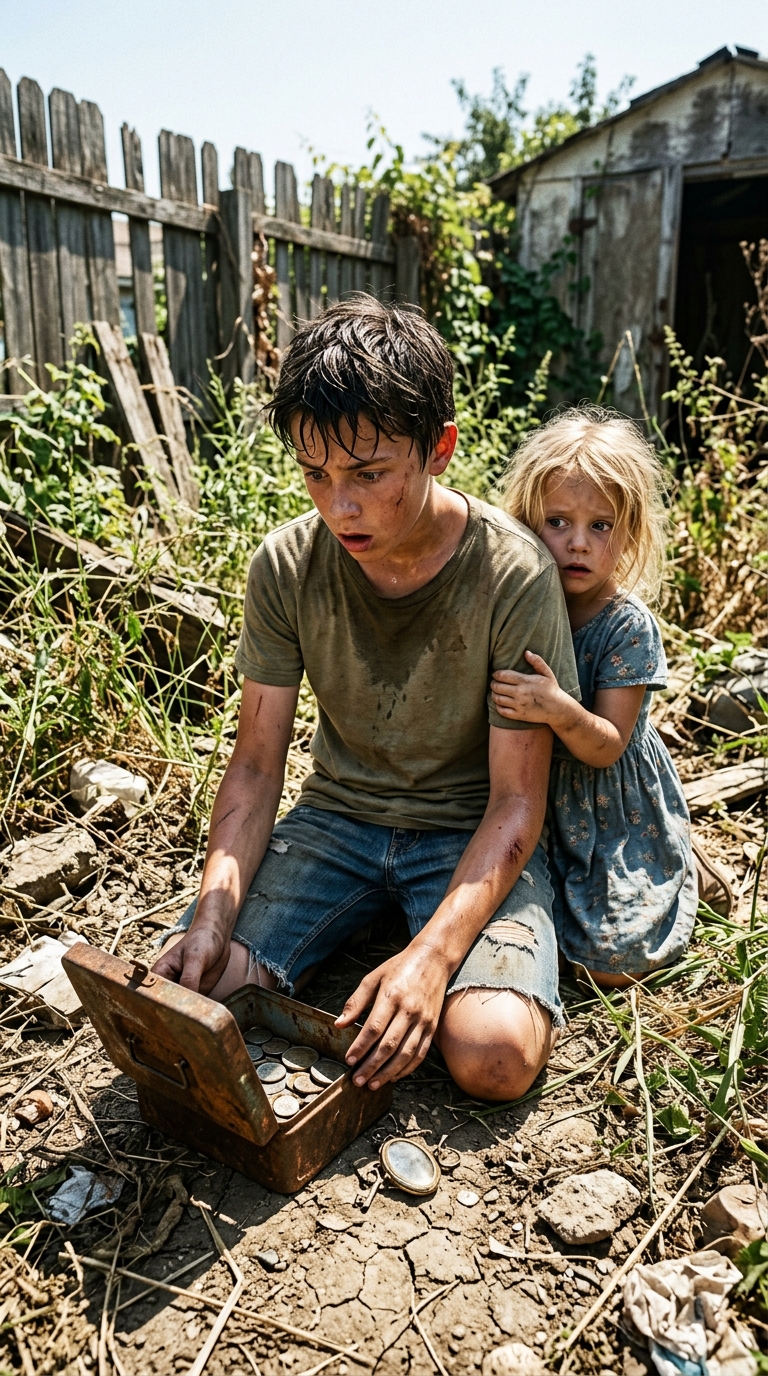
They walked beneath a punishing sun that scorched the dry earth—lost, hungry, and with nowhere to call home. Mateo, thirteen years old, tightly held the trembling hand of his little sister Sofía, only five. They had been walking for two days along the arid dirt roads of northern Mexico. Their sandals were worn down, their faces coated in a thin layer of dust, but in Mateo’s eyes burned a determination far beyond his years. He had to protect her. She was all he had left in the world after their mother’s sudden death and the cruel eviction from their home at the hands of their stepfather—a ruthless man who had taken everything from them.
The silence of the desert was broken only by the hot wind stirring the dry bushes. Sofía, her voice cracked from thirst, tugged at her brother’s shirt. She was hungry, and fear was beginning to overpower her innocence. Mateo forced a smile, promising they would find shelter soon, even as his heart pounded with the desperation of someone cornered by fate.
That was when the outline of old adobe walls appeared on the horizon. As they drew closer, Mateo’s heart skipped a beat. The wooden fences were rotting, and the red-tiled roof looked ready to collapse—but he recognized the place instantly. It was his grandmother Elena’s old ranch. The only place where they had ever known the warmth of family, the smell of freshly made tortillas, and endless laughter. Now, it lay buried under abandonment and overgrown weeds.
Sofía squeezed his hand, looking up at him with wide, hopeful eyes. Mateo knew it wasn’t just coincidence—it was their last chance to survive. He pushed open the old wooden gate, which creaked like a mournful cry in the middle of nowhere. Inside the main house, the smell of dampness and dust surrounded them. In one corner, an old wood stove still stood, and the furniture, though covered in cobwebs, remained in place. Mateo sat his sister down and promised her everything would be okay.
Determined to find something useful, Mateo stepped into the backyard. Among the tall grass, he spotted an old leaning chicken coop. To his surprise, four thin, frightened chickens were still alive, scratching at the dry ground. A spark of hope ignited in his chest. If they could survive, so could they. Searching for something to clear the land, his hands found an old rusted hoe, half-buried beneath a cactus.
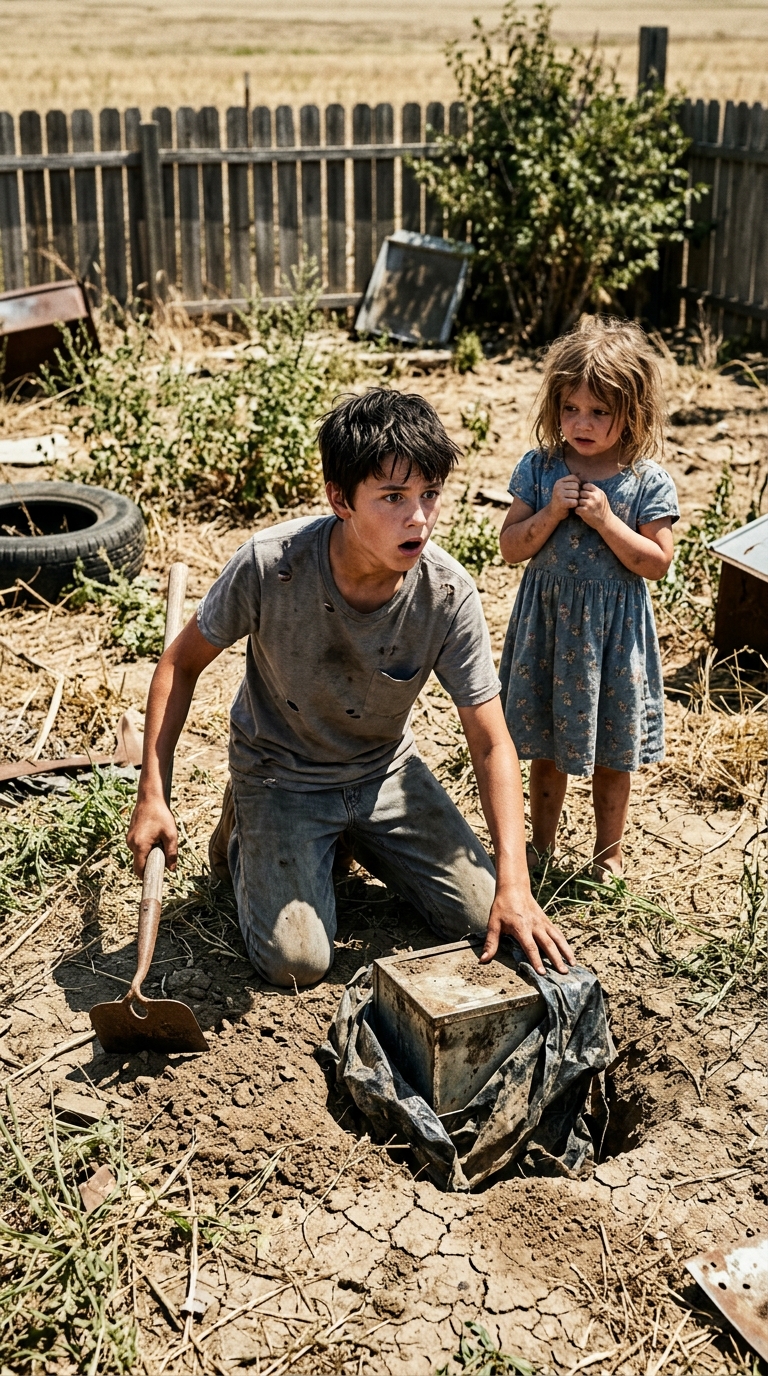
With the last strength he had, Mateo began striking the hard earth, trying to clear the area so the chickens could find food. Sweat dripped down his forehead, mixing with the dirt. Suddenly, the metal of the hoe hit something solid, producing a dull sound—unlike that of a rock.
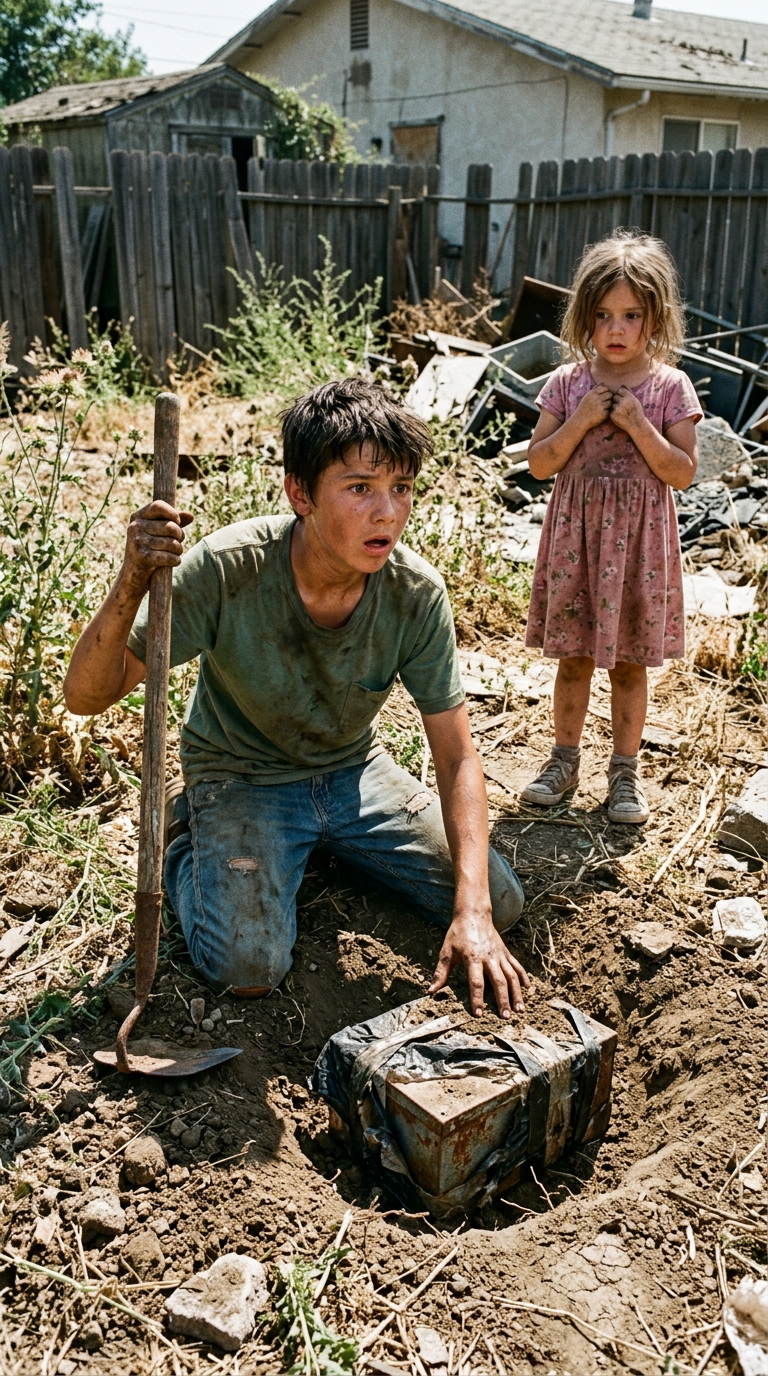
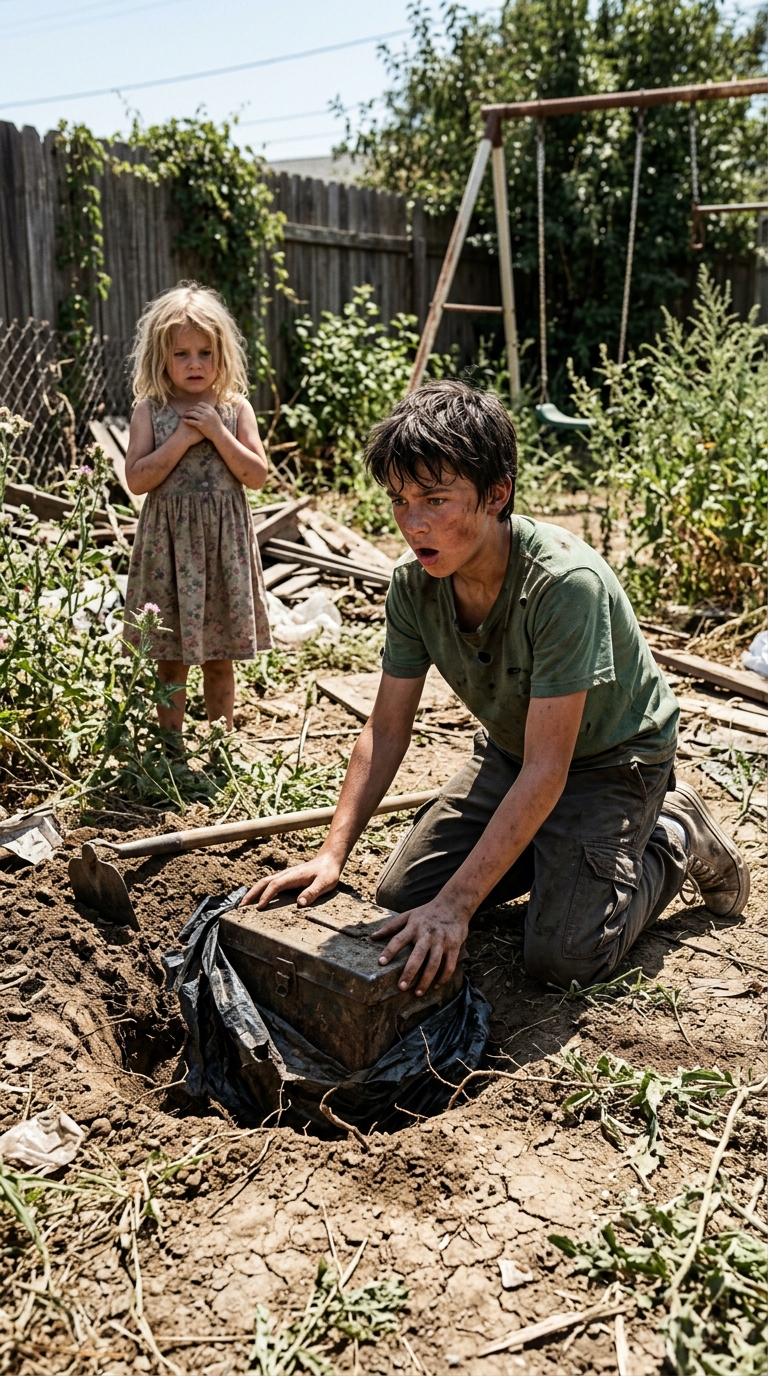
Intrigued, Mateo dropped to his knees and began digging frantically with his bare hands. About one meter deep, he unearthed a heavy metal box wrapped in rotting black rubber. The lock was rusted, but a well-aimed strike with the hoe was enough to break it. When he lifted the lid, what he saw inside made his blood run cold. There was no money—only a bundle of legal documents and a letter written in his grandmother’s unmistakable handwriting. As he read the first lines, Mateo’s world completely collapsed. The truth was so disturbing and dark that the air left his lungs. It was impossible to believe what was about to happen…
Part 2
Mateo’s hands trembled as he held the yellowed paper under the reddish glow of the sunset. His grandmother Elena’s letter revealed the secret that had condemned their family. The ranch had not been seized or lost to debts, as their stepfather, Don Ramiro, had made them believe. The original property deeds were there, in Mateo and Sofía’s names, carefully protected. But what truly shattered him was the final paragraph, written with urgency: Don Ramiro was not just an opportunist. He had tampered with the brakes of his mother’s old truck to take control of the land surrounding the ranch—a property a foreign company wanted to buy for millions to build a dam. His mother had not died in a tragic accident. She had been murdered.
A single tear carved a clean path through the dirt on Mateo’s cheek, but as it fell onto the letter, the sadness evaporated, replaced by a burning fire. The innocence of the thirteen-year-old boy died in that moment, giving way to a relentless protector demanding justice. He tucked the documents against his chest, silently vowing that the man responsible would pay for every tear his little sister had shed.
The following days became a test of pure survival. Mateo knew they couldn’t run—the ranch was their refuge and their rightful home. He used the hoe with renewed fury, clearing the land and reinforcing the rotting fences with rusted wire and mesquite branches. He found an old clay pot, which he filled with water from a nearly dry well, rationing every drop. Life seemed to struggle to push through the tragedy. One morning, while checking the chicken coop, he found three fresh eggs hidden in the dry straw.
He ran inside, where Sofía played on the dusty floor, unaware of the storm gathering around them. Mateo lit the old wood stove with dry branches and cooked the eggs. Watching his sister eat, her smile slowly returning color to her cheeks, strengthened his spirit. They were no longer two abandoned children waiting for death—they were the rightful owners of that land, reclaiming it with every breath.
Time began to blur, but Mateo calculated that they had been there for fourteen days when the rough sound of an engine shattered the sacred silence of the desert. A thick cloud of dust rose along the dirt road. Mateo ran to the broken window and peeked through the cracks. A black, luxurious truck stopped at the gate. Don Ramiro stepped out, wearing expensive boots and a cowboy hat, accompanied by two large men with dark, cold expressions.
Mateo’s heart pounded like a war drum. He knew exactly why they had come. Ramiro wasn’t there to look for them—he was there to dig up the metal box and destroy the only evidence of his crimes before finalizing the land deal.
“Sofía, hide in the old wardrobe and don’t come out no matter what you hear,” Mateo whispered, his voice so firm it left no room for argument. The terrified little girl obeyed instantly, shutting the wooden door behind her.
Mateo grabbed the hoe, gripping the wooden handle until his knuckles turned white. He walked to the front door, flung it open, and stepped onto the wooden porch, which creaked under his weight. The surprise on Don Ramiro’s face was genuine—but it quickly twisted into a crooked, malicious smile.
“Well, well… look what the wind dragged in,” Ramiro said, removing his hat and pretending pity. “I thought the coyotes had already taken care of you. Move aside, kid—this place doesn’t belong to you anymore.”
“This ranch is ours,” Mateo replied, his voice strong and clear, cutting through the midday heat. “And I know exactly why you’re here.”
Ramiro’s eyes narrowed, studying the boy’s face. He stepped forward, signaling his bodyguards to move in.
“You don’t know anything, brat. Get out of here now if you want your little sister to keep breathing.”
Mateo didn’t move an inch. He slightly raised the hoe, holding a defensive stance.
“You’re looking for the black box under the big cactus,” Mateo said firmly, locking his gaze on his mother’s killer. “But you’re too late.”
Ramiro’s confidence shattered in an instant. His face turned pale, and fury overtook his features. He pulled a revolver from his belt and pointed it straight at the boy’s chest.
“Where are the papers, you worthless orphan? Give them to me, or I’ll finish the job right here!” he shouted, completely losing control.
“I gave them to Don Chema, the head of the communal council, two nights ago,” Mateo revealed, his voice cold enough to freeze the air. “I walked ten kilometers under the moon while you slept in my mother’s bed. He read everything—the letter, the evidence… all of it.”
Ramiro let out a nervous laugh, refusing to believe that a thirteen-year-old boy had outsmarted him like that. He cocked the gun, ready to fire.
“You’re lying!” he roared, pulling the trigger—
But before the shot could ring out, a louder thunder shook the place. The sound of multiple engines and horses approaching at full speed made Ramiro’s men turn in panic. From the agave fields surrounding the property, dozens of men from the village emerged. They carried machetes, hunting rifles, and farming tools. At the front rode Don Chema, holding the documents Mateo had given him high above his head.
“Put down the weapon, murderer!” Don Chema’s voice thundered, backed by the force of an entire village that had loved Mateo’s grandmother and mother.
The two bodyguards, seeing they were completely outnumbered and surrounded by men ready to deliver justice with their own hands, dropped their weapons and raised their hands, betraying their boss without hesitation.
Ramiro, sweating cold and trembling with fear, looked around. He was trapped. The impunity his money once bought him meant nothing on this land of honorable men. Slowly, he lowered the revolver and fell to his knees in the dust—defeated by the very boy he had tried to destroy.
The villagers secured Ramiro and his accomplices, tying them with thick ropes to hand them over to the authorities. Don Chema dismounted, walked up to the porch, and placed a heavy, reassuring hand on Mateo’s shoulder.
“Your mother and your grandmother would be very proud of you, son. You are a brave man. No one will ever touch a single inch of this land again. It belongs to you.”
Mateo felt his legs give out. The hoe slipped from his hands, striking the wooden porch with a dull sound. The full weight of the past few days—the suppressed terror and physical exhaustion—hit him all at once. But he didn’t fall. Sofía ran out of the house and wrapped her arms around his waist, sobbing uncontrollably. Mateo dropped to his knees, pulling his little sister into a desperate embrace, burying his face in her hair as the tears he had held back for weeks finally broke free. He cried for his mother, he cried for the pain—but above all, he cried with relief. The nightmare was over.
Months later, the ranch was no longer the bleak, abandoned place they had found. With the help of the community and the money authorities recovered from Ramiro’s frozen accounts, the adobe walls were restored and painted a bright white. The roof now bore new tiles that shone under the Mexican sun. The small chicken coop had become a lively corral, and the once dry fields were now planted with strong, green corn.
Mateo, his face more weathered by the sun but his eyes filled with peace, watched Sofía run through the backyard chasing chickens, laughing freely. Justice did not bring their mother back, and the pain of her absence would always leave a scar in their hearts. Yet as he looked at his grandmother’s old house, Mateo knew they had achieved something extraordinary. When the world tried to bury them under cruelty and neglect, they chose to take root instead. And like seeds in arid soil, they proved that even after the harshest drought, life—and love—always find a way to bloom again.
