

That afternoon in Greenville is still frozen in my memory.
It was the day I finally understood what it really meant to be “the daughter-in-law.”
For a long time, I kept this story to myself. I thought staying silent would make it disappear. But some memories don’t fade—they linger, circling quietly, reminding you who you used to be… and the exact moment everything changed.
It began with a call from my mother-in-law, Dorothy Simmons.
“Angela, come early tomorrow. There’s a lot to do.”
It wasn’t a request.
It was a command.
When I hung up, my husband, Kevin Simmons, was stretched out on the couch, scrolling through his phone like nothing had happened.
“What does your mom want?” I asked.
“Grandpa’s anniversary,” he replied without looking up. “You know how she is.”
And I did.
Dorothy was a proud woman. She thrived on admiration—lived for it, really. She wanted neighbors talking about her, praising her home, her generosity, her ability to host.
“Dorothy’s house is always full of food.”
“She really knows how to take care of her guests.”
To hear that, she would invite half the neighborhood without a second thought.
And someone else would quietly carry the burden.
The next morning, we arrived early.
The patio was already alive with activity. Kevin and a couple of neighbors were setting up a canopy, while long wooden tables were draped in white cloth. Glasses clinked. Chairs scraped. The kind of noise that feels cheerful… until you realize how much work is hiding underneath it.
“About twenty people are coming,” Kevin said casually.
Twenty.
The word hit harder than it should have.
“Twenty?” I repeated.
“Family, neighbors, friends… you know how it is.”
Yes.
I knew.
What I didn’t know was what would happen next.
Inside the kitchen, Dorothy moved from dish to dish, giving instructions like a conductor directing an orchestra.
“Angela, come here.”
I stepped closer.
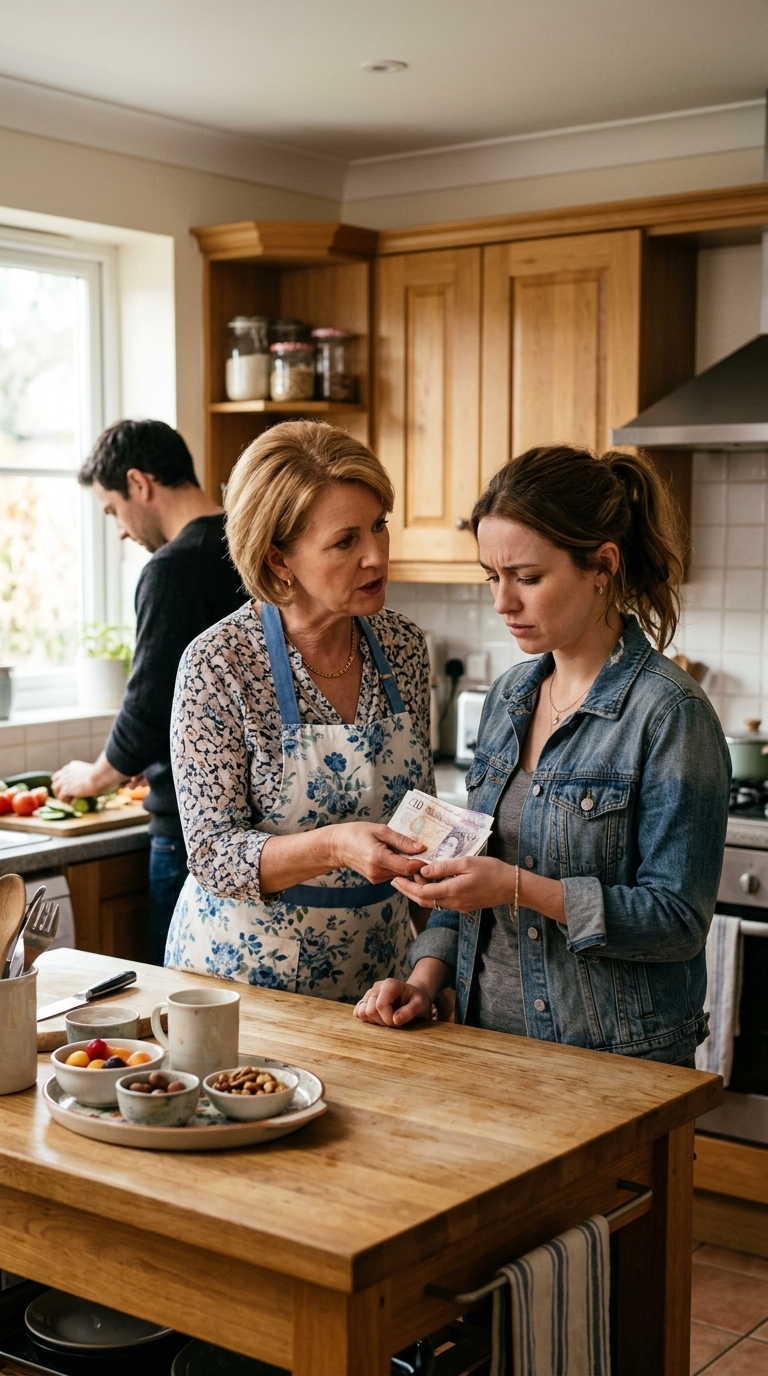
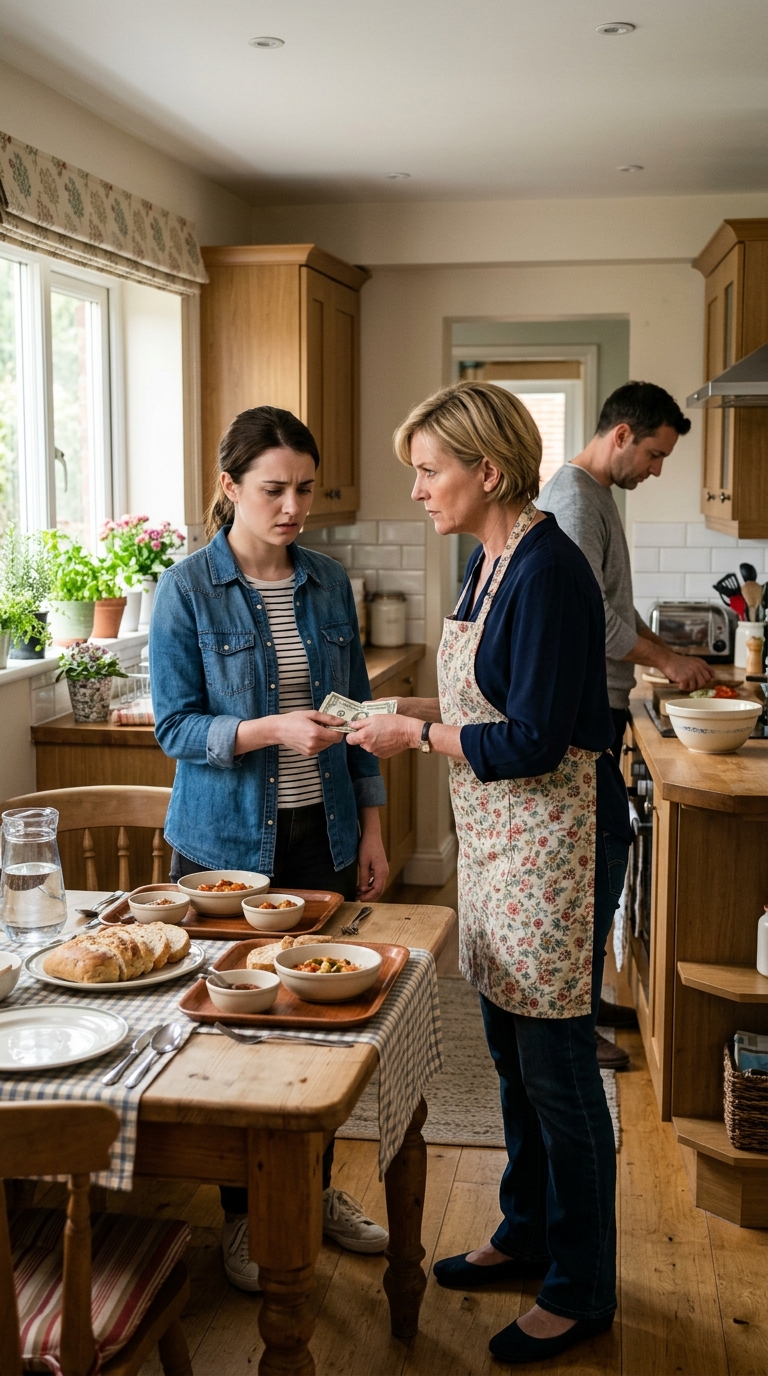
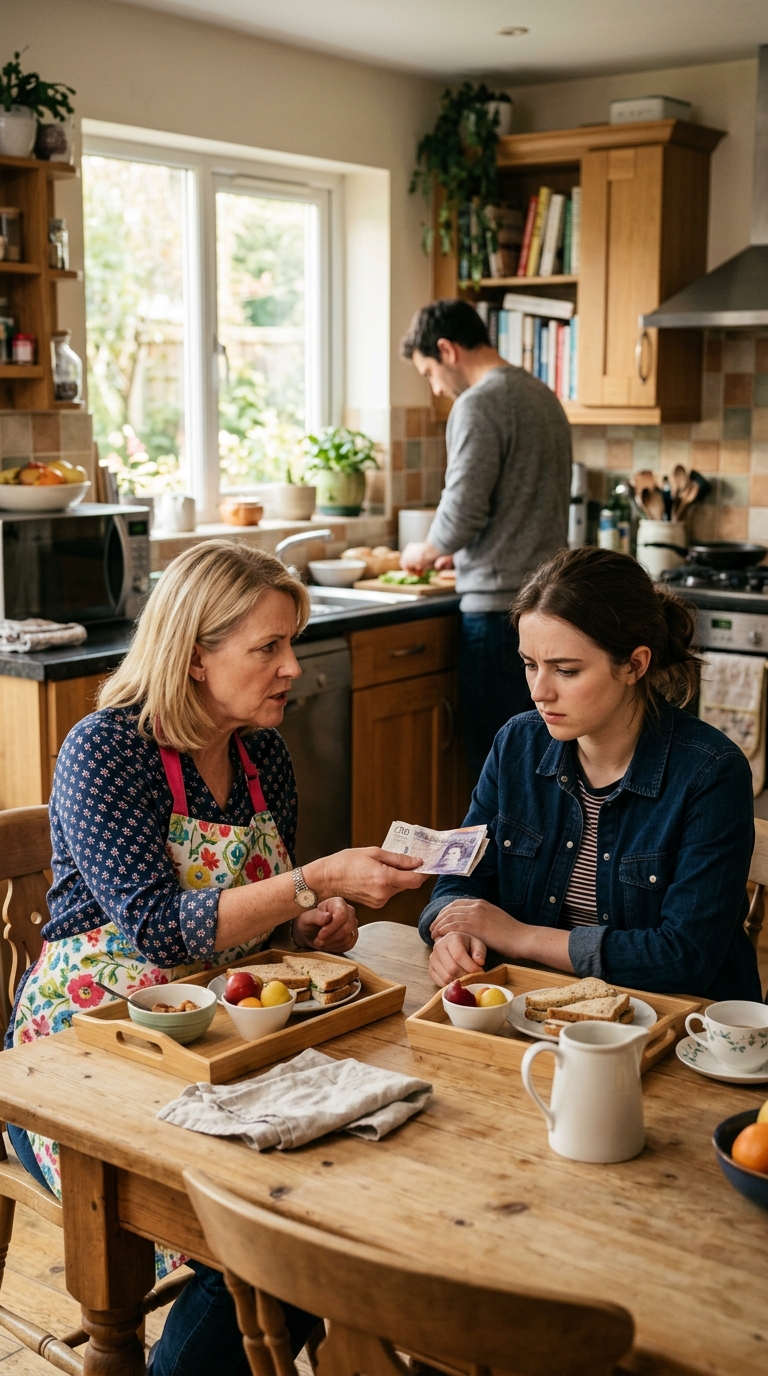
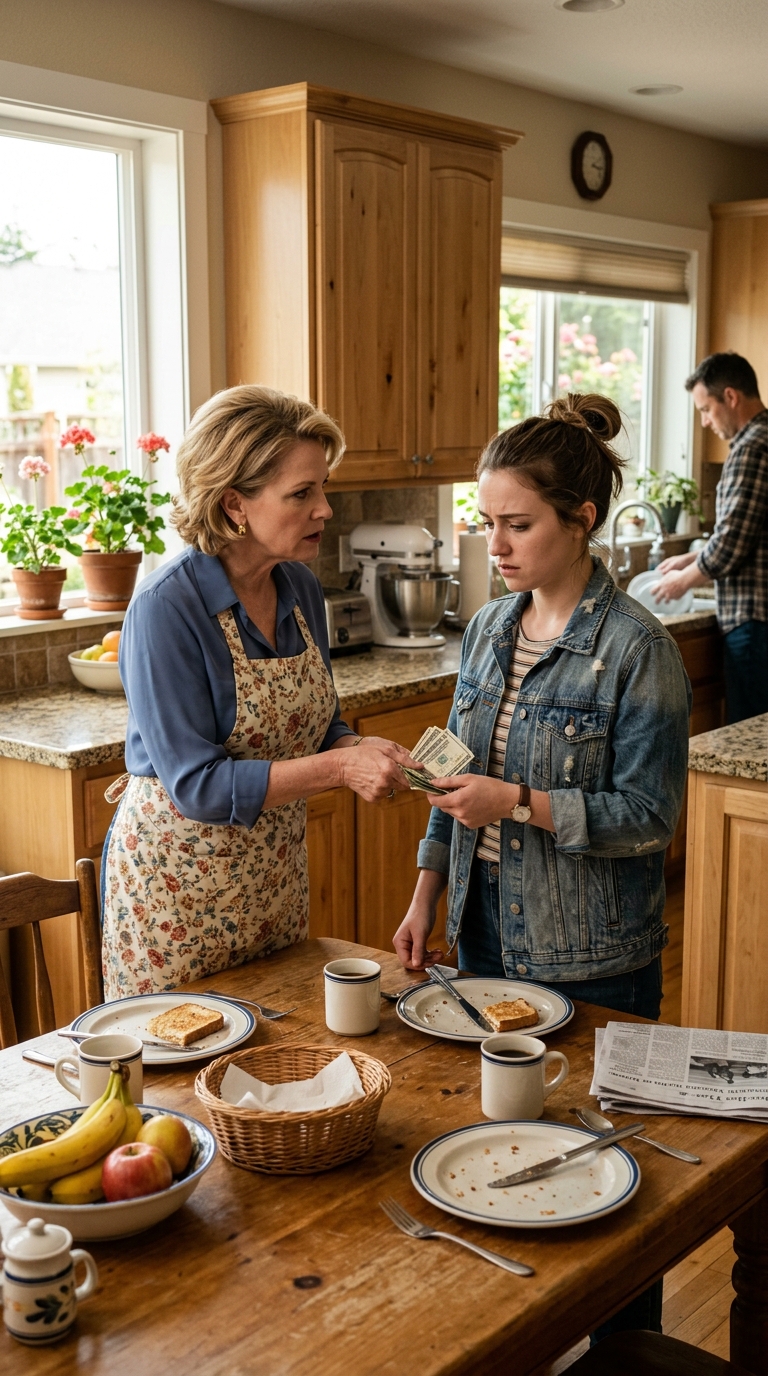
She reached into her apron pocket, pulled out a small stack of wrinkled bills, and pressed them into my hand.
“Go to the market and buy everything for lunch.”
I looked down.
Something didn’t feel right.
I counted it.
One hundred dollars.
My fingers tightened slightly.
“That’s all?” I asked, careful with my tone.
Her expression hardened instantly.
“Is that not enough for you?”
My throat went dry.
“Mom… there are twenty people coming.”
She let out a short, sharp laugh.
“In my day, I could make a full feast with half that,” she said, leaning in closer. “A good daughter-in-law knows how to manage.”
Her words didn’t just sting.
They settled somewhere deeper.
Outside, Kevin’s voice drifted in.
“Just do your best, Angela. Don’t upset my mom.”
He didn’t even step inside.
Didn’t even look at me.
Just… said it.
Like always.
At the market, everything felt louder than usual.
Vendors calling out prices. Plastic bags crinkling. The smell of grilled food drifting through the air.
I stood there, holding the money.
One hundred dollars.
I walked past the meat section. Too expensive.
Chicken? Maybe—but not enough for twenty.
Vegetables? Yes, but even those had gone up.
I paused near a shelf and opened my wallet.
I had my own money.
More than enough to fix this.
I could buy meat, fresh vegetables, dessert, drinks—everything.
No one would know.
Dorothy would be praised.
Kevin would be satisfied.
And I… would stay exactly who I had always been.
The quiet solution.
The invisible support.
The “good daughter-in-law.”
But then a question surfaced.
Clear.
Sharp.
Impossible to ignore.
Why was it always my job to fix things I didn’t create?
Why could she invite twenty people… and expect me to perform a miracle?
Why was silence always my responsibility?
I stood there for a long moment.
Then I closed my wallet.
And for the first time since I married into that family…
I made a different choice.
I bought exactly what one hundred dollars could cover.
Not a dollar more.
When I got back, the patio was already full.
Laughter filled the air. Conversations overlapped. Glasses clinked.
Dorothy moved among her guests like a queen in her court.
“My daughter-in-law prepared everything today,” she announced proudly.
I smiled.
Of course she said that.
She always did.
I went into the kitchen and started cooking.
Calmly.
Carefully.
Every ingredient measured. Every portion stretched. Every decision deliberate.
There was no rush.
No panic.
Just quiet focus.
When the food was ready, I carried the dishes outside.
Twenty people were already seated.
“The food is ready,” I said.
The conversations softened.
I set the dishes down, one by one.
Dorothy watched.
Satisfied.
Expecting.
Certain.
Until the moment came.
I lifted the lid of the first pot.
And the second they saw inside…
Everything changed.
A thin vegetable stew.
Carrots.
Potatoes.
Cabbage.
Floating in a light broth.
No meat.
The second dish—plain white rice.
The third—a small plate of fried eggs, cut in halves.
That was all.
For twenty people.
The silence that followed wasn’t normal.
It wasn’t polite.
It was stunned.
Someone shifted in their chair.
Another guest looked down at their plate.
A quiet murmur passed across the table.
Dorothy’s smile froze.
Then slowly… disappeared.
“Angela…” she said, her voice tightening. “What is this?”
I stood still.
“This is lunch,” I said calmly.
Her eyes sharpened.
“For twenty people?”
“Yes.”
A pause.
Then I added:
“I used the one hundred dollars you gave me.”
The words dropped like a stone into still water.
Ripples spread immediately.
People exchanged looks.
Someone coughed awkwardly.
And just like that… the truth entered the room.
Dorothy’s face lost its color.
Kevin stepped forward, forcing a laugh.
“Angela, come on… you didn’t have to—”
“I followed the instructions,” I said gently.
My voice wasn’t loud.
But it didn’t need to be.
“I was given one hundred dollars. So I prepared lunch with one hundred dollars.”
No accusation.
No anger.
Just truth.
And somehow… that made it heavier.
Dorothy straightened.
“In this family, we take care of our guests properly,” she said, her tone sharp.
I met her gaze.
“And in a family,” I replied softly, “we take care of each other properly too.”
That was the moment.
The exact moment something shifted.
No one applauded.
No one raised their voice.
But something in the air changed.
An older woman at the end of the table reached for the rice spoon.
“Well,” she said gently, “food is food.”
She served herself.
One by one, others followed.
Quietly.
Carefully.
Not because the meal impressed them.
But because the illusion had already broken.
Lunch ended early.
Guests left with polite smiles and quick goodbyes.
The patio, once filled with noise, now felt strangely empty.
Dorothy stood by the table, avoiding everyone’s gaze.
Kevin shut the door behind the last guest and turned toward me.
“You embarrassed her,” he said.
I shook my head.
“No.”
He frowned.
“You could have just used your own money.”
There it was.
Simple.
Predictable.
Normal.
I took a slow breath.
“That’s exactly the problem,” I said quietly. “I always do.”
He didn’t reply.
Maybe he didn’t know how.
From the kitchen doorway, Dorothy spoke.
“You could have told me.”
I turned to face her.
“I did,” I said. “When I asked if it was enough.”
She fell silent.
Because she remembered.
She just hadn’t listened.
That evening, on the drive home, Kevin finally spoke.
“I don’t know how to fix this.”
I looked out the window for a moment, then back at him.
“You don’t have to fix it,” I said.
He glanced at me.
“You just have to understand it.”
That afternoon didn’t destroy anything.
It revealed everything.
It showed me who I had been.
And who I was no longer willing to be.
Because that was the day I stopped being just “the daughter-in-law.”
And became someone who could finally say:
Enough
