

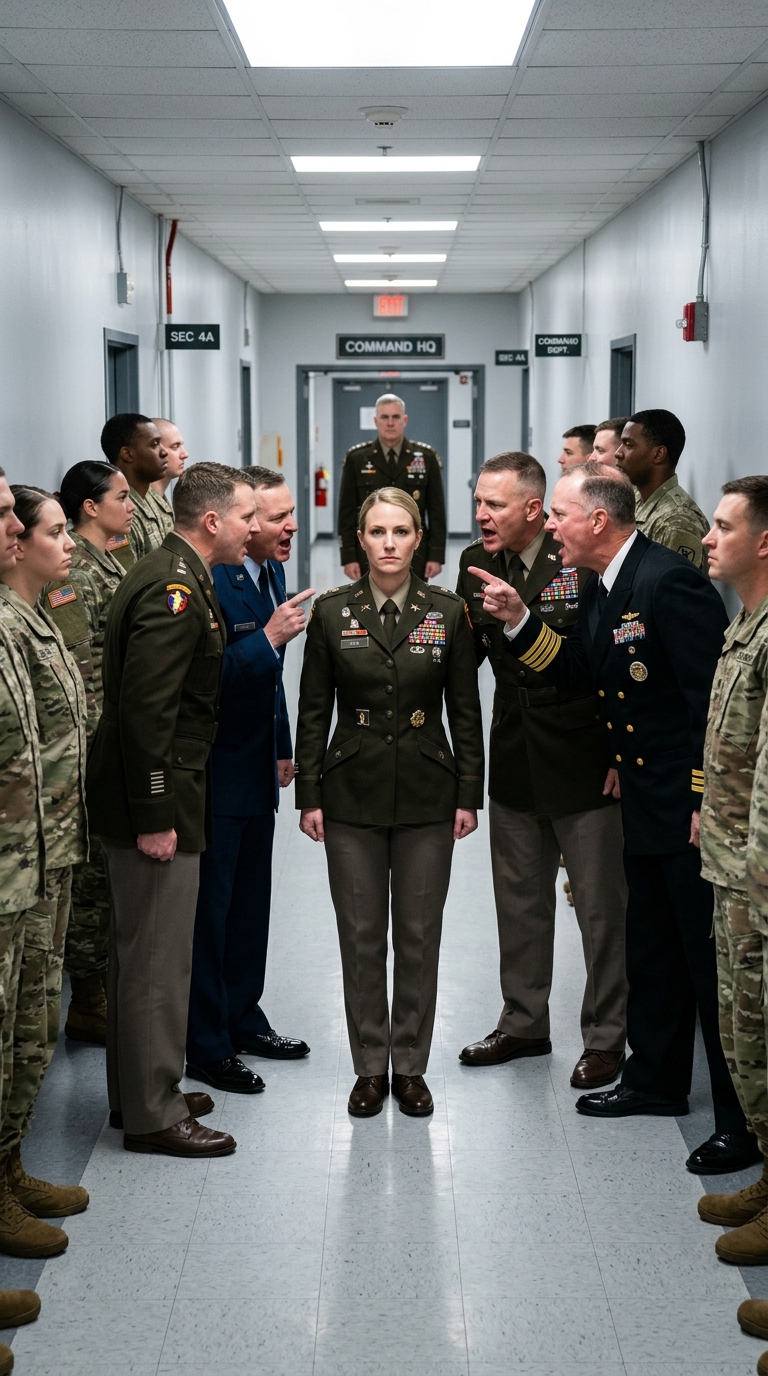
The evaluation chamber at Redstone Joint Training Center was designed to make people uncomfortable on purpose.
There were no windows, no clocks, and no sense of time beyond the constant hum of fluorescent lights overhead. The concrete walls threw every sound back too sharply—boots shifting, papers sliding, someone clearing a throat. The air carried a faint mix of dust, metal, and stale conditioning. It was the kind of place meant to strip confidence before the real test even began.
Staff Sergeant Elena Ward stood at attention in the center of the room.
She was one of only two Army non-commissioned officers selected for the joint leadership assessment, a high-pressure screening tied to future command-track opportunities. Navy observers lined one wall, Marines the other, and Army evaluators stood near the rear tables with clipboards ready. Everyone in that room understood what was at stake. Careers could shift here. Reputations could rise—or end—before the day was over.
At first glance, Elena seemed easy to overlook. Her uniform was precise, boots polished, hair secured with exact discipline. No dramatic war stories followed her across base. No crowd of admirers. No swagger. Her file—at least the part everyone could see—looked thinner than most in the program.
That was exactly why Senior Instructor Colonel Victor Harlan called her forward first.
He circled her slowly, hands clasped behind his back, speaking with the controlled contempt of someone who believed pressure revealed truth faster than instruction ever could.
“Staff Sergeant Ward,” he said, glancing at her file, “your record is… unimpressive.”
A few observers shifted slightly.
“No major public commendations. No celebrated field command. No defining evaluations anyone here would recognize.” He lifted his gaze to meet her stillness. “So tell us—why are you standing in a room reserved for exceptional candidates?”
Elena didn’t respond.
Her eyes stayed forward. Her breathing remained steady. Her posture did not move even a fraction.
Harlan paused, almost amused.
“You understand silence can be mistaken for fear?”
Nothing.
He stepped closer. “Or confusion.”
Still nothing.
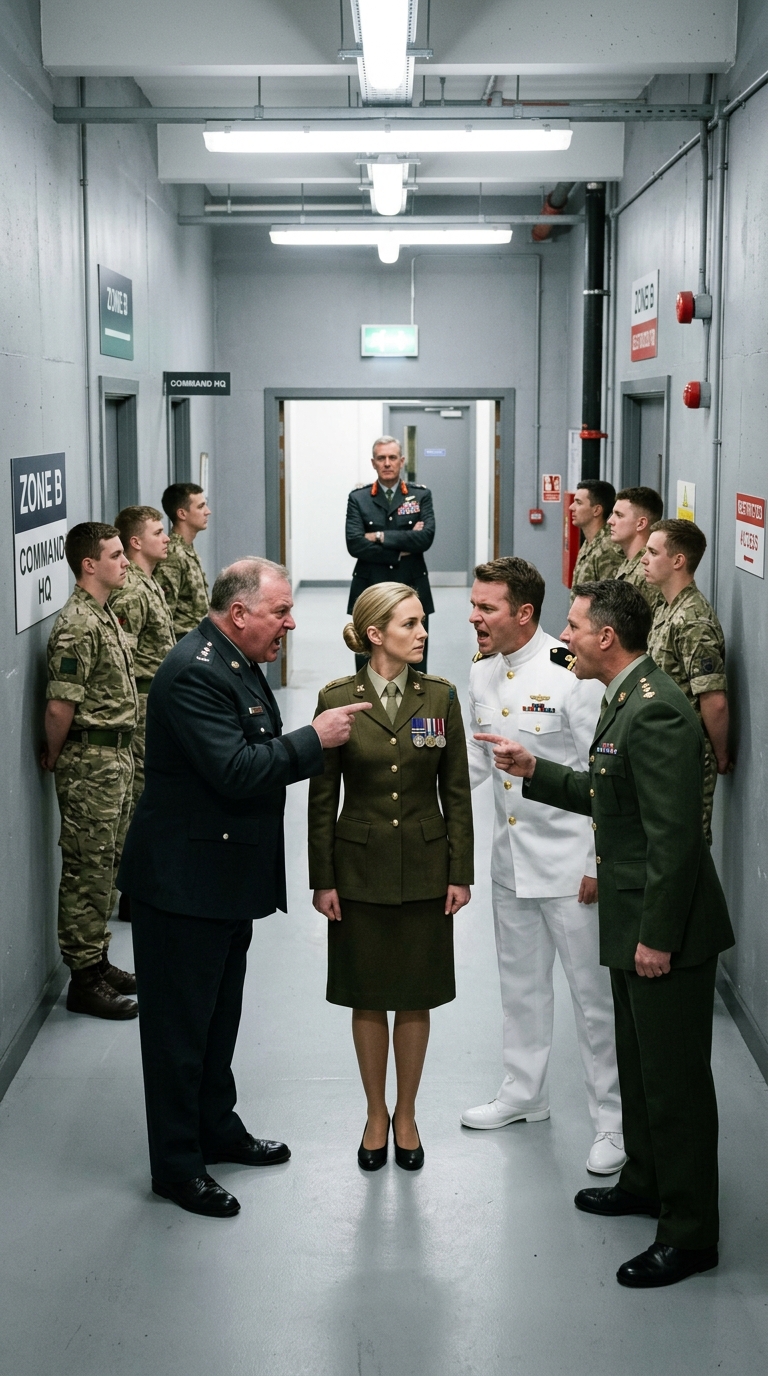
A faint, uneasy laugh came from the Marine side of the room, then disappeared just as quickly when no one else joined it. Harlan straightened, turning to address the room like an instructor making an example.
“This,” he said, gesturing toward Elena, “is what happens when discipline is mistaken for leadership. Quiet obedience. Polished compliance. An empty file in a perfect uniform.”
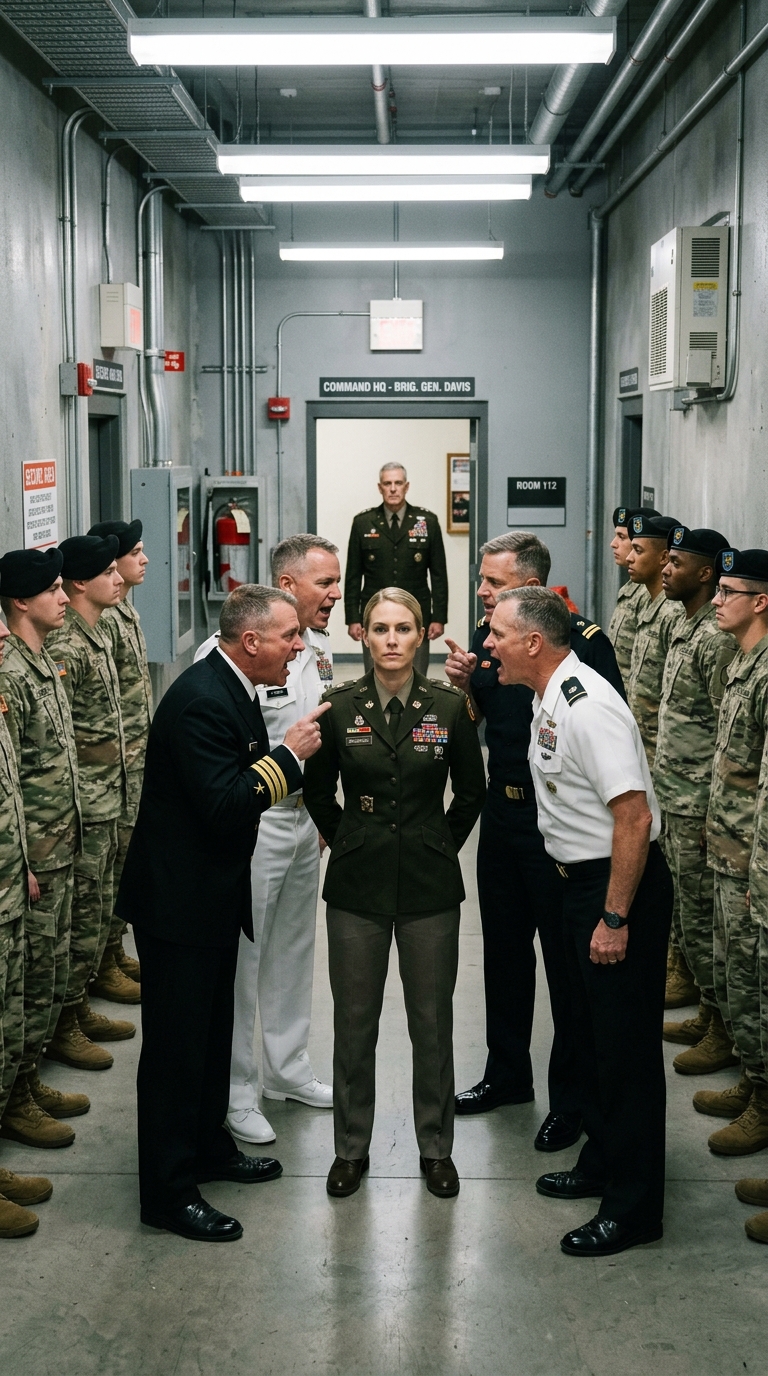
The words were intentional. Measured. Built to force a reaction.
Elena didn’t move.
If anything, her silence became heavier with every passing second.
Captain Noah Briggs, one of the Army assessors, noticed it first. This wasn’t the silence of someone breaking. It was the silence of someone choosing not to engage in the wrong battle.
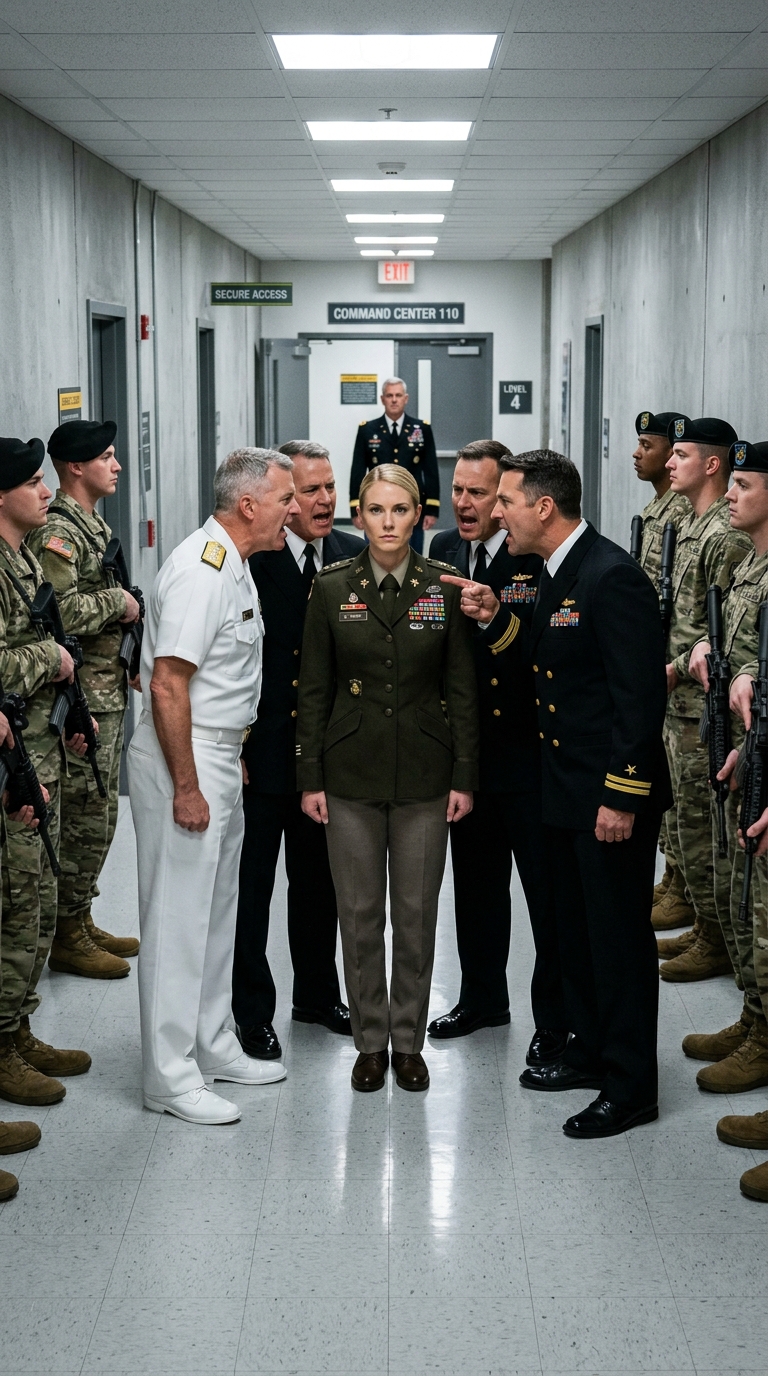
Harlan’s voice sharpened. “Either this sergeant has nothing to say, or she believes she’s above explanation.”
Then the steel door at the rear of the chamber opened with a low hydraulic hiss.
Every head turned.
A tall officer in a dark Navy uniform stepped inside without announcement. No entourage. No noise. No formal introduction. But the insignia on his chest and shoulders shifted the entire atmosphere in the room. People straightened instinctively before realizing it.
Rear Admiral Thomas Vale, Naval Special Warfare.
Harlan frowned. “Sir, this is a controlled evaluation—”
The admiral raised one hand, and Harlan fell silent.
Vale looked directly at Elena.
Then he spoke—calm, controlled, and sharper than any raised voice:
“Why has Staff Sergeant Elena Ward been standing in this room for twenty minutes without anyone acknowledging the operational rank she earned?”
The room went completely still.
Colonel Harlan’s expression shifted first. Then Briggs glanced down at Elena’s file as if it had suddenly become something risky to hold.
Because Elena Ward was not simply a quiet Army staff sergeant with an unremarkable record.
So who had she been before Redstone—and why had someone powerful enough to halt the entire evaluation just revealed the first fracture in a truth no one in that room was cleared to know?
Part 2
No one answered the admiral right away.
That alone told Elena everything. The room was filled with officers who had spent years believing silence in others meant weakness. Now their own silence came from uncertainty—and uncertainty looked far worse on those used to authority.
Rear Admiral Thomas Vale stepped further into the chamber, the door sealing behind him with a soft mechanical hiss. He wasn’t imposing in a theatrical way. He didn’t need to be. His presence carried the weight of a reputation that arrived before introductions. Several Navy observers had already gone rigid. A Marine major lowered his clipboard without noticing.
Colonel Victor Harlan recovered first. “Sir, with respect, the candidate is being evaluated under standard inter-service protocol.”
Vale kept his focus on Elena. “Then your protocol is incomplete.”
The words landed sharply.
Captain Noah Briggs reopened the folder in his hands, flipping through pages faster now. “Sir, her official personnel file lists her as Army Staff Sergeant Elena Ward, logistics leadership track, prior joint attachment—”
“Sanitized,” Vale said.
Briggs stopped mid-sentence.
The admiral finally looked around the room. “Since you’re all realizing this at once, I’ll simplify it. The version of Staff Sergeant Ward’s file available to you was reduced for placement protection and assignment neutrality. That does not justify public judgment based on missing information.”
Harlan’s jaw tightened. “If there are undisclosed qualifications, they were not provided to lead evaluators.”
Vale’s expression remained unchanged. “Then lead evaluators should understand the difference between testing resilience and confusing confidentiality with lack of merit.”
A few people shifted where they stood.
Elena remained at attention, but internally, the old awareness had already returned—the instinct that tracked exits, power shifts, and consequences before emotion had time to surface. She hadn’t wanted this. For fourteen months at Redstone, she had allowed herself to look ordinary on paper. Predictable. Replaceable. Unremarkable. That had been the objective.
And now that cover had cracked.
Harlan turned toward her, his tone no longer dominant, just strained. “If your record includes operational distinctions relevant to this evaluation, why did you not disclose them?”
Elena answered for the first time.
“Because I was not asked in a secure setting, sir.”
Her voice was steady, low, and completely controlled.
The response moved through the room like a current.
Vale gave a slight nod, as if confirming exactly what he expected. “Staff Sergeant Ward has spent most of her career in roles where discussing prior work openly would have been a violation, not a credential.”
Captain Briggs spoke again, more cautiously now. “Sir, what kind of roles?”
Vale held his gaze for a moment. “The kind that required her to operate above her rank, outside her branch, and without recognition.”
That was all he said.
But it was enough.
The implications shifted the entire room. Harlan was no longer facing a quiet candidate with a thin file—he was facing a soldier whose record had been deliberately flattened despite experience significant enough to draw intervention from a Naval Special Warfare admiral.
One of the Marine observers, Lieutenant Colonel Pierce, finally voiced what others had avoided. “Are we to understand Staff Sergeant Ward was attached to a special mission element?”
Vale’s response was precise. “You are to understand that if she had answered Colonel Harlan the way he intended, half this room still wouldn’t have the clearance to assess the truth.”
That ended it.
The chamber remained still for several long seconds.
For the first time, Elena noticed something different on the faces around her—embarrassment where confidence had been moments before. Not everyone. Some were curious. Some cautious. But Harlan now looked like a man who had built a trap and only realized too late he was standing inside it.
Vale stepped forward and stopped a few feet from Elena. “At ease, Sergeant Major–equivalent authority acknowledged under prior joint operational designation.”
Several heads lifted at once.
It wasn’t a promotion. In practice, it was something more unusual—a public acknowledgment that in past assignments, Elena had carried responsibility far beyond the rank on her uniform.
Harlan said nothing.
Vale turned toward the room. “This candidate did not remain silent because she lacked substance. She remained silent because professionals with real operational discipline understand that not every challenge deserves a public response.”
No one reacted this time.
Captain Briggs closed the file slowly. “Sir, should the evaluation continue?”
Elena almost answered before Vale did. She understood the weight behind the question. Ending it now would protect her—but also define her. Continuing would change how every answer was judged.
Vale looked at her. “Staff Sergeant Ward?”
He was giving the decision back to her.
“Yes, sir,” she said. “Continue the evaluation.”
Harlan looked caught off guard.
Elena turned her head toward him for the first time. “Unless the colonel believes his earlier concerns can’t hold under a fair assessment.”
A few observers looked away to hide their reactions.
Harlan straightened. “Proceed.”
What followed was no longer performance.
Scenario assessments began—written decisions, field command hypotheticals, resource triage under conflicting orders, leadership ethics under compromised chains of command. Elena responded with precision. No theatrics. No excess. Just clarity. She spoke rarely, but when she did, every word landed. During one scenario involving casualty evacuation versus mission risk, even Lieutenant Colonel Pierce muttered, “That’s the right call,” before stopping himself.
By the end, the outcome was clear.
She hadn’t just passed the evaluation—she had surpassed it.
But the real shift came afterward.
Elena stepped into the corridor outside. Captain Briggs followed.
“I owe you an apology,” he said.
Elena looked at him. “For what?”
“For assuming your silence needed interpretation.”
She paused for a moment. “Most people do.”
Before he could respond, the secure door at the end of the hallway opened. A civilian courier entered carrying a sealed pouch and asked for Admiral Vale by name.
Vale took it, opened it, and read a single page. His expression barely changed—but Elena noticed.
That was enough.
The evaluation had never been the only reason he came.
He folded the paper once and looked at her. “Staff Sergeant Ward, I need ten minutes of your time. Alone.”
The hallway went quiet again.
Because whatever was inside that pouch mattered more than the evaluation, more than Harlan’s mistake—maybe even more than the past Elena had kept hidden.
And if Admiral Vale had come to Redstone not just to protect her but to find her, then the truth was far more dangerous than anyone in that building had assumed.
Part 3
Admiral Vale did not speak until the secure office door shut behind them.
The room was small, functional, and without windows. A steel table was bolted to the floor, and a digital clock on the wall ticked loudly in the silence. Elena remained standing until Vale motioned to the chair across from him. She sat, but not at ease. Experience had taught her that difficult news delivered in private often came quietly—thin documents, steady voices, no warning.
Vale placed the paper from the courier on the table.
“A team went missing forty-one hours ago,” he said.
Elena didn’t reach for it immediately.
“Joint surveillance support operation,” he continued. “Low-visibility tracking, eastern Mediterranean transfer route, suspected weapons network with state-backed protection. One signal returned. Two didn’t.”
Elena lowered her gaze and read. The details were stripped down—names removed, locations reduced—but one codename stood out instantly. Then another.
Her pulse shifted.
The second codename belonged to Commander Isaac Rainer, the naval liaison officer she had once worked with during a classified hostage-interdiction support mission years earlier. He had been disciplined, precise, and not easily impressed. If he was part of the missing team, the situation had been serious long before it went silent.
Vale watched her carefully. “You know him.”
“Yes, sir.”
“We expected that.”
That answered the real question.
Not the evaluation. Not Harlan. Those were secondary. Vale had come because Elena Ward had been buried inside a standard Army leadership track with a reduced file—and somewhere higher up, someone realized too late that they needed the person behind that file back in play.
Elena placed the paper down. “You want me for recovery?”
“We want you for reconstruction first,” Vale replied. “Timeline analysis, behavioral gaps, likely fallback decisions, signal silence patterns, cross-branch assumptions. If your reconstruction suggests survivability, it transitions into recovery support.”
Elena processed that.
There was always a certain weight to requests like this. They began as analysis—structured, detached—but everyone involved understood where they led. If you could rebuild the last known truth, eventually you were asked to move toward it.
“I was supposed to be done,” Elena said quietly.
Vale didn’t dismiss it. “I know.”
Redstone had been her pause. Not retirement, but distance. After years of assignments where recognition disappeared into classified systems and outcomes—good or bad—were buried the same way, she had accepted something quieter. Leadership training. Predictable routines. A chance to exist in a world where decisions were debated, not executed under pressure.
For a while, it had almost worked.
Then Harlan mistook silence for weakness. Then Vale walked into the room. And now the life she had stepped away from reached back—not dramatically, not forcefully, just inevitably.
“What are my options?” Elena asked.
Vale answered without hesitation. “You can refuse. It will be recorded as voluntary non-participation under prior service limitations.”
Elena held his gaze. “And unofficially?”
“Unofficially, they asked for the person most likely to understand what Rainer would do if communication collapsed and chain-of-command improvisation became necessary. Your name came first.”
Elena looked back at the page.
That was the cost of being good at something. When things went wrong, the world remembered exactly who to call.
By nightfall, her answer was yes.
The next forty-eight hours moved quickly. Elena was detached from Redstone under temporary joint authority and flown to a secure analysis site outside Norfolk. There, she worked alongside signals intelligence teams, mission planners, and an exhausted NSA liaison who kept bringing her fragments—burst transmissions, fuel irregularities, vessel movement gaps, pieces of metadata that meant nothing until Elena started mapping decisions instead of data.
She reconstructed the missing team’s final movements hour by hour.
Rainer, she concluded, had likely broken from standard fallback—not because the mission failed, but because an asset had improvised under pressure and he chose to protect mission integrity over clean extraction timing. That meant reduced signatures, avoidance of official channels, and movement toward a commercially deniable maritime corridor instead of a military retrieval point.
Vale listened without interrupting.
“Which means?” he finally asked.
“They’re not where you’ve been searching,” Elena said. “And if one signal came back, it wasn’t random. It was intentional. A breadcrumb from someone who assumed only people familiar with his deviation patterns would recognize it.”
That changed everything.
Search assets shifted. A civilian-flagged vessel under quiet observation became the new focus. Twenty-six hours later, one operative was recovered alive from a coastal warehouse transfer zone. Seven hours after that, Commander Isaac Rainer was located—wounded, but conscious—aboard a seized supply vessel under allied control. The third man did not survive.
Outcomes like that never came clean.
When Vale told her, Elena nodded once and asked for the name of the one who was lost. Only after hearing it did she allow herself a slow breath. In their world, relief and grief always arrived together.
Three weeks later, she returned briefly to Redstone to complete her detachment paperwork.
The base felt different. Not dramatically—but enough. Word had spread, though not in detail. People didn’t know the story, but they knew enough to stop mistaking quiet for weakness. Captain Briggs met her outside admin processing and handed her a folder.
“Final evaluation results,” he said. “Highest composite score in the cycle.”
Elena accepted it. “That won’t make Colonel Harlan happy.”
Briggs almost smiled. “He’s adjusting his approach.”
That mattered more than an apology.
Later that afternoon, Harlan approached her near the empty drill pad. His posture was rigid, but there was no edge of authority in his voice this time.
“I misjudged you,” he said.
Elena waited.
“I believed pressure revealed substance. In your case, it revealed my assumptions first.” He paused. “That was my failure, not yours.”
It wasn’t warm. It wasn’t polished. But it was honest.
Elena gave a single nod. “Then maybe the evaluation worked after all, sir.”
Harlan exhaled quietly, something close to reluctant respect in the gesture.
By the end of the month, Elena was offered a permanent strategic role bridging leadership assessment and joint operational talent identification—an assignment that finally aligned both sides of her experience: the visible soldier and the unseen professional she had been for years. She accepted with one condition: no more reduced files used as justification for careless judgment. If secrecy was required, dignity had to remain standard.
The policy was implemented without announcement.
And that, more than recognition, was enough.
Because in the end, Elena Ward didn’t need a room full of observers to validate what she had earned. She didn’t need to raise her voice over those who mistook stillness for weakness. She had already operated in harder environments, under heavier decisions, where the stakes were far greater than reputation.
She stayed silent because she understood something they didn’t:
real authority doesn’t shake when it’s challenged, and real strength doesn’t always announce itself before it shifts the entire room.
At Redstone, they thought they were evaluating a quiet sergeant.
Instead, they revealed their own inability to recognize a leader shaped in places most of them would never be cleared to enter.
