

He Came Home Too Soon to Prepare for What He Was About to See
Graham Holloway had not intended to be home before sunset. For nearly two years, his life had followed a rigid, lifeless pattern. He left before his sons fully woke, spent long hours inside a glass tower in downtown Raleigh, and returned after dark to a house that was quiet in all the wrong ways. His staff kept everything spotless. His schedules stayed precise. Every room looked immaculate.
Nothing in that house felt alive.
On that Thursday, an investor meeting ended early after a contract delay pushed everything forward. Graham should have stayed in the city and buried himself in work, but something inside him refused the routine. He dismissed his driver at the gate of his Wake Forest estate in North Carolina and walked in through the side entrance alone.
He remembered how his late wife used to surprise him like that. She would hear the door open, laugh from somewhere down the hall, and call out that dinner was almost ready. Sometimes their twin boys would run toward him before he even set down his briefcase.
Those memories had become dangerous things.
As Graham stepped inside, he loosened his tie and expected silence. Instead, he heard something that made him stop mid-step.
Children laughing.
Not from a screen. Not from a device. Real laughter—bright, breathless, unguarded.
For a moment, Graham thought his mind was deceiving him.
Then he followed the sound.
The Room That Took the Air Out of His Chest
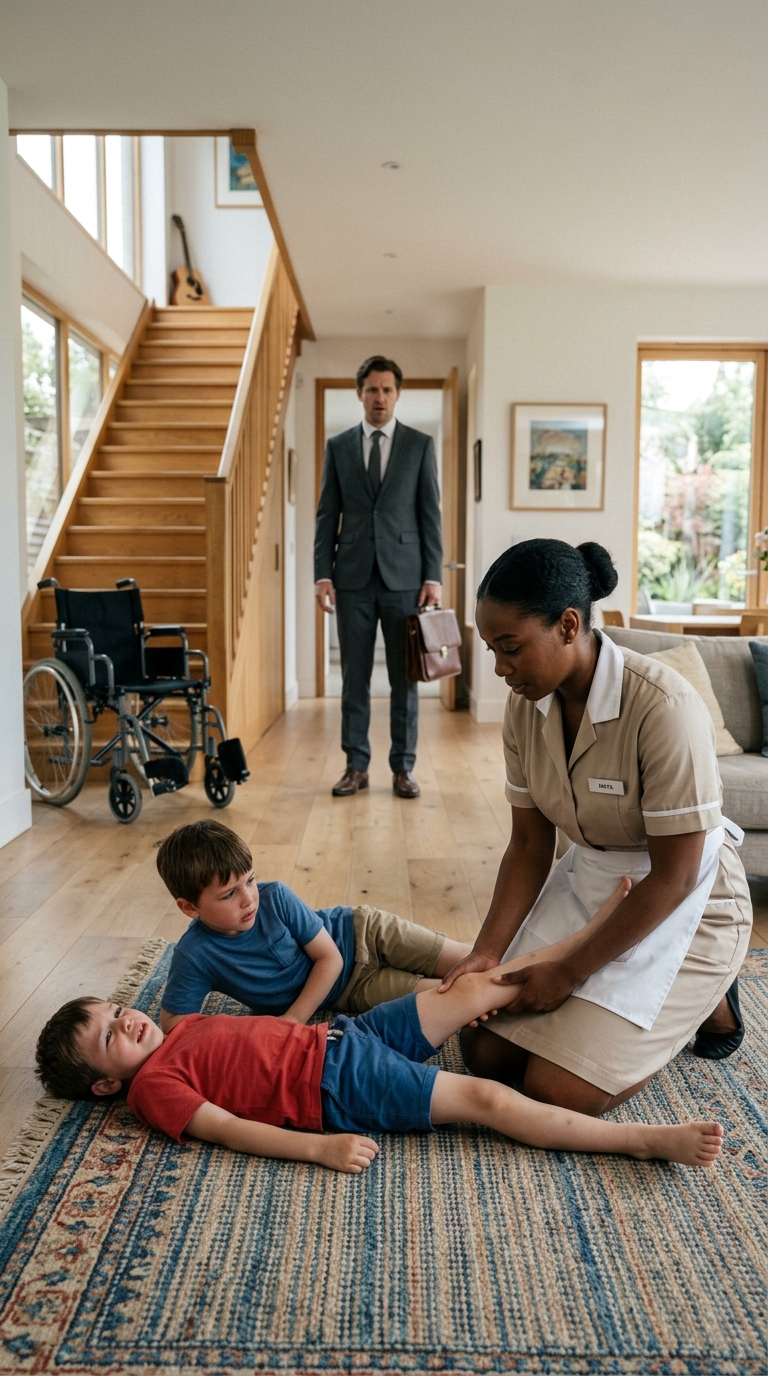
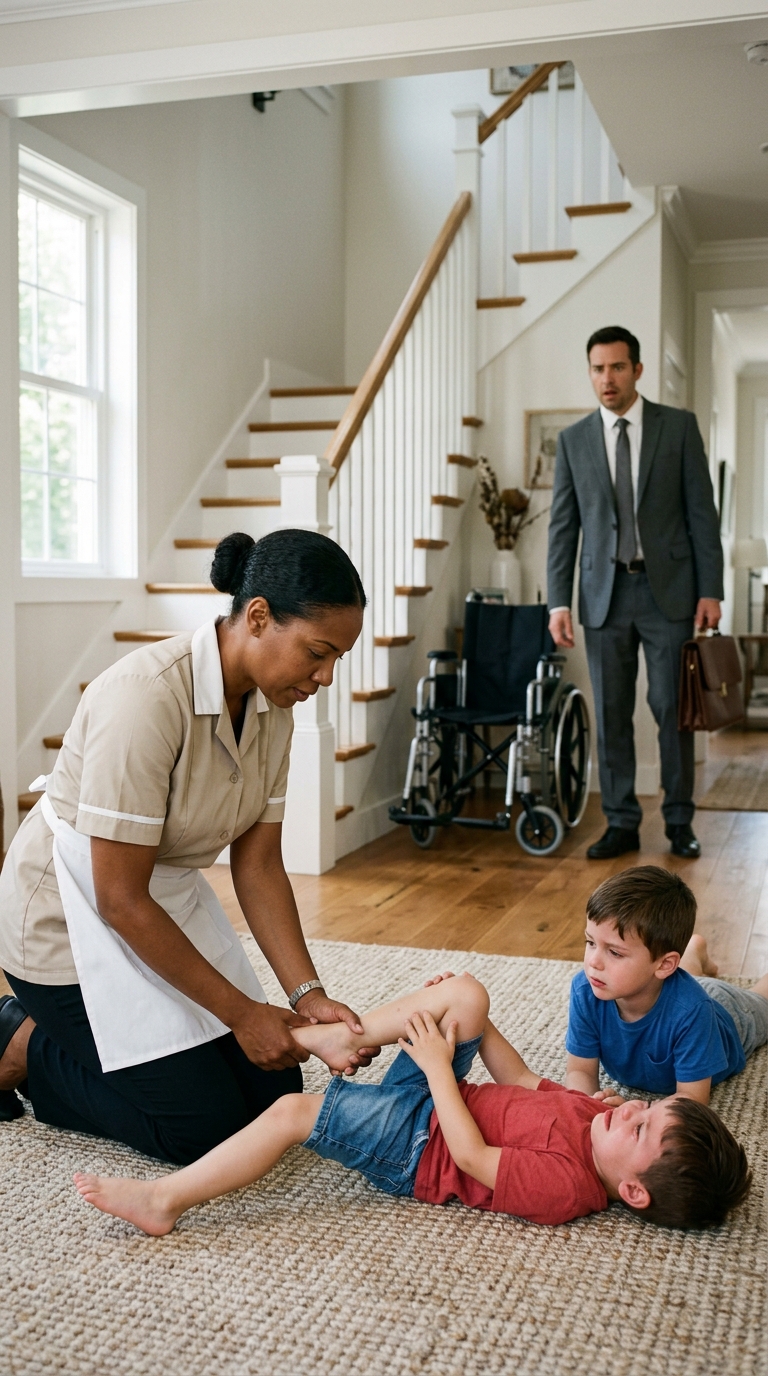
The laughter led him down the east corridor to the rehabilitation room he had built after the accident. He pushed the door open—and froze so sharply his shoulder struck the frame.
Both wheelchairs were empty.
His chest slammed tight.
On the padded floor were his sons, Declan and Wesley Mercer, eight years old, identical except for a faint mark above Wesley’s eyebrow from an old childhood fall before everything changed. They were lying on their backs, knees bent, bare feet pressing against foam wedges and small wooden blocks.
Beside them was Naomi Bell, the housekeeper he had hired three months earlier.
She was not panicked. Not rushed. Not careless.
She was steady.
One hand supported Declan’s hips while the other rested lightly at Wesley’s knee. Her movements were slow and measured, almost rhythmic. Under her breath, she hummed a quiet tune Graham had never heard before—something about rivers, sunlight, and moving one inch at a time.
The boys were not afraid.
They were smiling.
Graham’s throat went dry.
Every specialist he had ever hired warned him about alignment, positioning, pressure, risk. He had been trained to treat every movement as a potential emergency. What he saw now made fear surge through him instantly.
“What are you doing?” he said, sharper than intended.
Naomi looked up calmly.
She did not flinch. She did not rush to justify herself.
“Helping them feel their bodies again,” she said.
Graham stepped forward, and that was when something inside him shifted into deeper confusion.
Declan’s toes curled toward Naomi’s fingers.
Not randomly. Not involuntarily.
Deliberately.
Wesley pressed his foot against a block with a trembling effort, then laughed—like he had surprised himself.
Graham stared, as if the room itself had tilted.
“No,” he whispered. “That’s not possible.”
Naomi held his gaze.
“It is,” she said softly. “It’s just been ignored.”
Before the Silence, There Had Been a Family
Before grief entered the house like winter, Graham Holloway had been the kind of man people described with admiration and distance. Wealthy, disciplined, precise—the founder of a security software company that had made him powerful. He solved problems. He controlled systems. He imposed order on chaos.
At home, Lena had been the warmth behind everything.
She filled the kitchen with music while cooking. She grew herbs along the patio. She made mornings feel alive, turning two noisy boys into laughter, teeth brushed, pajamas on, all within minutes.
When she laughed, the entire house felt human.
Then, one rainy afternoon near Durham, their SUV was struck by a speeding pickup that ran a red light.
Graham was still in his office when the hospital called.
He remembered almost nothing about the drive. Only fragments—red lights, antiseptic corridors, a nurse speaking too gently.
Lena did not survive.
The boys did.
But survival came with a truth no parent is prepared to carry.
Spinal trauma. Emergency procedures. Long-term uncertainty. Words like incomplete injury, interrupted pathways, guarded prognosis. Then the sentence that changed everything: they might never walk again.
Graham heard it—and became obsessed with control.
The House Turned Into a System
Money opened every door, and he forced every one of them open.
He brought in specialists, therapists, consultants. He bought advanced equipment, adaptive systems, stimulation devices, custom supports he barely understood but trusted because doing more felt like safety. He converted an entire wing into a recovery unit.
Soon, the twins lived inside a schedule that resembled a corporate program more than childhood.
Morning evaluations. Guided movement. Digital tracking. Hydro sessions. Strength exercises. Rest blocks. Medication. Therapy. Sleep.
Everything was structured. Everything was recorded. Everything looked correct.
And yet, the boys grew quieter.
They stopped asking to go outside.
They stopped playing.
They stopped calling out just to share something small.
They became careful in a way children should never become careful.
Graham told himself it was protection. That discipline meant love. That hope required control.
But what filled the house was not hope.
It was caution.
And caution slowly erased everything alive.
The Woman He Barely Noticed at First
Naomi Bell had arrived quietly.
Twenty-nine, from Asheville, soft-spoken, observant. Her references called her dependable, patient, and unusually good with children. Graham hired her because she seemed competent without being disruptive. He wanted support, not questions.
At first, Naomi did exactly what he expected. She kept the kitchen warm with real meals instead of reheated trays. She folded linens, polished surfaces, and moved through the house with a quiet, steady efficiency that seemed to calm others without ever drawing attention to herself. She never disturbed Lena’s framed photographs, never repositioned them, never treated the memory of Graham’s wife as something inconvenient.
The boys noticed her before Graham did. Declan watched her every time she passed through a room. Wesley smiled when she hummed while folding laundry. She spoke to them without pity, without exaggeration, and without the clipped, clinical tone they had grown used to hearing.
One afternoon, Graham overheard her kneeling beside the twins’ chairs near the sunroom.
“If you could be anywhere tomorrow, where would you go?” she asked.
Declan answered first, very softly. “A lake.”
Naomi smiled. “What would you do there?”
“Skip rocks,” Wesley said.
It had been months since Graham had heard them answer a question that wasn’t about pain, medication, or care routines.
Something about that should have told him he was missing something important.
The Day the Truth Could No Longer Stay Hidden
Now, standing in the doorway of the rehab room, Graham looked from his sons to Naomi as though she had crossed an invisible boundary he could not yet name.
“You had no right,” he said, though his voice carried less force than he intended.
Naomi’s hands stayed steady on the boys.
“I had every reason to be careful,” she replied. “And I was.”
“You are not a therapist.”
“No,” she said. “I’m not.”
Declan looked up at his father, uncertain. Wesley’s smile faded slightly. Graham saw it and immediately felt a sharp sting of regret.
Naomi shifted her attention calmly.
“I’m not forcing anything. I’m supporting what they already try to do on their own.”
Graham swallowed. “The specialists said movements like that could be reflex. Random. Meaningless.”
Naomi picked up a small block and gently set it near Wesley’s foot again.
“Wes,” she said softly, “can you press for me one more time?”
Wesley focused, his face tightening with effort. His foot trembled, then pressed down.
Small. Uneven. Real.
Naomi looked back at Graham.
“That’s not random.”
Then she reached for Declan’s hand and touched two fingers lightly to his foot’s arch.
“Your turn, sweetheart.”
Declan exhaled, concentrated, and curled his toes again.
Graham felt his eyes sting.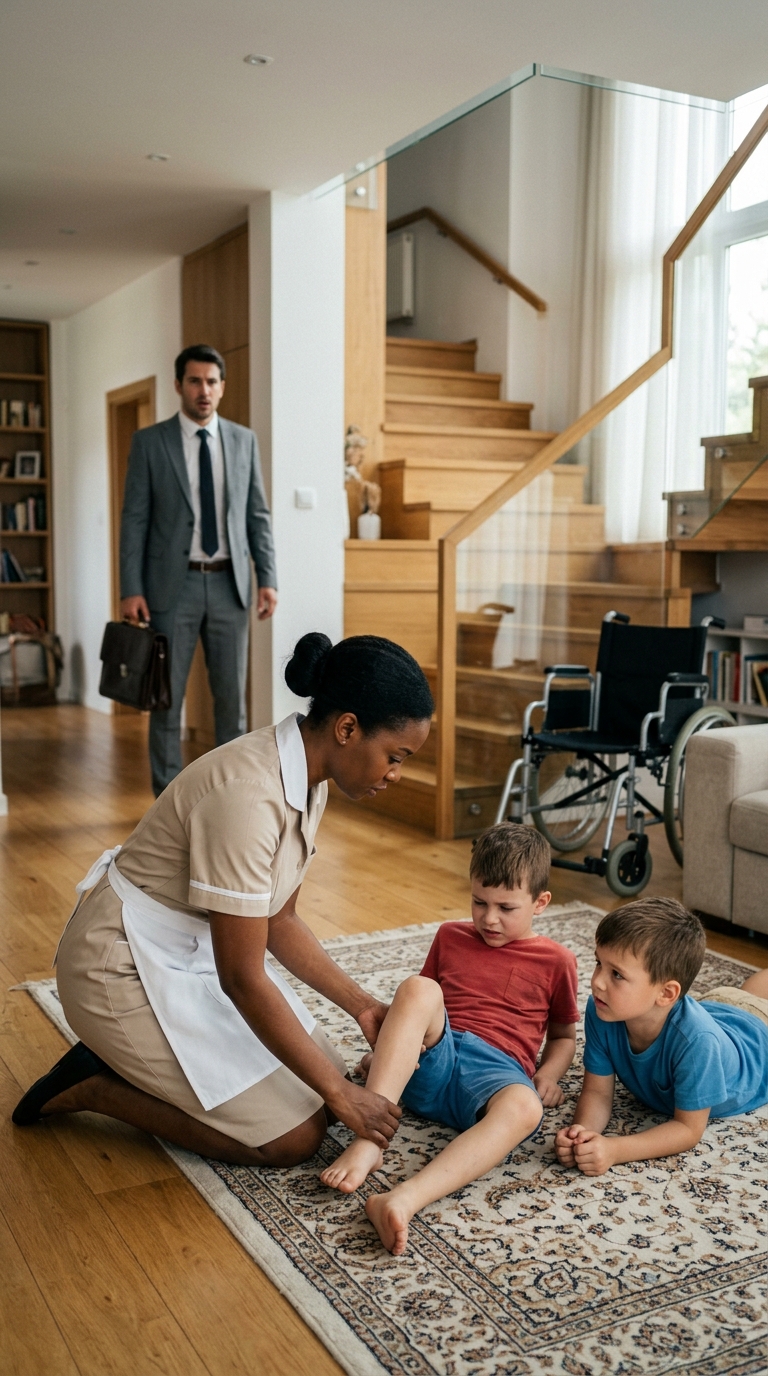
He had spent eighteen months listening to experts define his sons through percentages, risks, and limitations. Yet here on the floor, under the care of a woman he had barely considered important, his boys were responding like children who had simply been waiting to be invited back into themselves.
“How long?” he asked.
Naomi hesitated only briefly.
“A few weeks,” she said. “Small things. Carefully. Slowly.”
“Without telling me?”
Her expression neither hardened nor softened.
“You never asked what they did when they felt hopeful,” she said quietly. “You only asked whether they followed the program.”
The truth landed harder than blame ever could.
The Story Naomi Had Carried Into His House
Graham lowered himself into a chair near the wall, as if his legs no longer trusted him.
Naomi helped the boys settle, gently covering their legs with a blanket as she spoke.
Her younger brother, Micah, had suffered a severe spinal injury at thirteen after a farm accident in western North Carolina. Their family had no wealth, no dedicated therapy wing, no advanced equipment. What they had was a mother who refused to let her son be reduced to a diagnosis.
Naomi described evenings spent on the floor of a small living room, guiding movement with pillows, towels, songs, and patience. She spoke about learning to value effort over outcome, patterns over assumptions, and joy over performance.
“My brother didn’t get a miracle,” she said. “But he got more life than anyone expected. He learned to move in ways doctors overlooked because they didn’t fit the version of the story they had already decided on.”
Graham listened without interruption.
“When I started here,” Naomi continued, “I saw your boys trying. Not constantly. Not on demand. But sometimes, when they laughed or reached or got excited, their bodies responded in small ways. Early records mentioned incomplete pathways, but that part was treated like it didn’t matter anymore.”
Graham looked up. “You read their files?”
“Only to understand what had already been written about them,” she said. “And what had been ignored.”
His shame deepened because he understood exactly what she meant. Early records held uncertainty and possibility. Later ones became narrower, more final. He had clung to certainty because it felt like control.
Naomi lowered her voice.
“Your sons don’t only need treatment. They need space to believe they still belong to themselves.”
The Experts Did Not Like Being Questioned
That evening, Graham called Dr. Warren Pike, the physician overseeing the twins’ program, and demanded a full reassessment.
Dr. Pike arrived the next morning in a pressed navy blazer, carrying the calm certainty of authority. He listened with a neutral expression that bordered on indifference.
After a brief examination, he stepped back and folded his arms.
“These responses are limited,” he said. “They don’t necessarily indicate meaningful recovery.”
Naomi stood quietly near the bookshelf, but Graham could feel her attention sharpen.
“They are deliberate,” Graham said. “They respond on request.”
Dr. Pike glanced at Naomi, then back at Graham. “Household staff often misread hopeful signals. Families do as well. It’s understandable.”
Graham felt the dismissal land—and something inside him shift with it.
For months, he had mistaken authority for truth.
“Show him,” Graham said to the boys.
Naomi knelt and spoke softly. Both twins responded again—small effort, clear intention.
Dr. Pike’s jaw tightened slightly.
“Even if there is some preserved function,” he said, “expectations must remain realistic.”
Naomi spoke, calm but firm.
“Realistic should not mean lifeless.”
Dr. Pike frowned. “And you are?”
“The person who listened when they stopped speaking,” she said.
Silence filled the room. Graham had built companies by recognizing when systems protected themselves instead of serving people. Now he realized he had failed to apply that clarity at home.
“I want a new team,” he said.
Dr. Pike blinked. “Excuse me?”
“A new evaluation. A new rehabilitation plan. And copies of every report since the accident.”
The doctor tried to respond, but Graham cut him off.
“My sons are not a finished story just because someone got comfortable with the first chapter.”
The First Night He Sat on the Floor With Them Again
After the doctor left, the house felt altered.
Not lighter. Just less trapped.
That night, Graham entered the rehab room without his phone or laptop, without trying to manage anything. Naomi was already there, arranging cushions as the boys watched him with cautious curiosity.
He rolled up his sleeves and lowered himself awkwardly onto the mat.
Declan stared. Wesley blinked twice.
“Dad,” Wesley said lightly, “you’re not very good at sitting like that.”
Graham laughed before he could stop himself—rough, uneven, but real.
“Apparently not,” he said.
Naomi guided his hands, showing him how to support without controlling, how to wait instead of rush. Every instinct told him to fix, correct, take over.
Instead, he listened.
“Let him lead,” she whispered.
Graham nodded. “Okay.”
He looked at his son—truly looked.
“I’m here,” he said quietly. “We go at your pace.”
Declan’s expression softened slightly.
They worked through small movements: shifts of weight, presses of heel, curled toes. Wesley laughed when his brother concentrated so hard he stuck out his tongue. Then Wesley tried and smiled with pride Graham could barely process.
At one point, tears blurred his vision.
“Did you see that?” he whispered.
“Yeah,” Wesley said with a grin. “We did.”
Naomi turned slightly away, giving him space to feel it without being watched too closely.
What Changed Was More Than Their Therapy
Within two weeks, Graham brought the twins to a pediatric spinal recovery center in Chapel Hill specializing in incomplete injuries and family-centered rehabilitation.
The staff did not promise miracles. They did something better.
They paid attention.
After full evaluation, they confirmed preserved pathways that allowed real potential for improved strength, responsiveness, and adaptive mobility. Progress would be slow. Walking could not be guaranteed. But the previous approach had been too rigid, too narrow, too disconnected from the children themselves.
Graham acted immediately.
He ended all prior contracts. Removed the rigid schedule system. Replaced mechanical repetition with therapy, play, outdoor time, music, rest, and movement designed around the boys instead of charts.
Then he did something unexpected.
He invited Naomi into his study and offered her a role coordinating their daily care alongside the medical team.
She froze slightly.
“I’m not a clinician,” she said.
Graham shook his head.
“You were the first person here who saw them as still becoming themselves,” he said. “That matters more than any title.”
Naomi’s eyes filled.
“Then I’ll do everything I can,” she said.
“I know,” he replied.
For the first time since Lena’s death, he said it without desperation—only certainty.
The Sound That Finally Returned to the House
Spring arrived slowly.
The herb boxes Lena planted began to grow again. Windows stayed open longer. Light reached deeper into the hallways. And laughter returned—first faint, then steady.
Sometimes from therapy sessions turned into games.
Sometimes from the backyard and improvised obstacle courses.
Sometimes from Graham himself, rediscovering what his home sounded like without fear in it.
The boys still struggled. There were setbacks, frustration, and exhaustion.
But the story no longer felt finished.
One evening, Graham watched from the doorway as Naomi helped the twins build a crooked cardboard city. Wesley explained absurd traffic rules. Declan laughed so hard he struggled to tape anything straight.
Grief rose—but this time, not alone.
Hope stood beside it.
Lena was gone. That would never change.
But their sons were still here.
Still trying. Still growing. Still responding when life reached for them with patience instead of fear.
Graham had come home early expecting routine.
He found truth instead.
Not the kind written in reports. A deeper one.
Healing does not always arrive loudly. Sometimes it begins when someone kneels down and listens closely enough to realize the story is still unfolding.
And sometimes the person who changes everything is the one no one thought to ask.
