

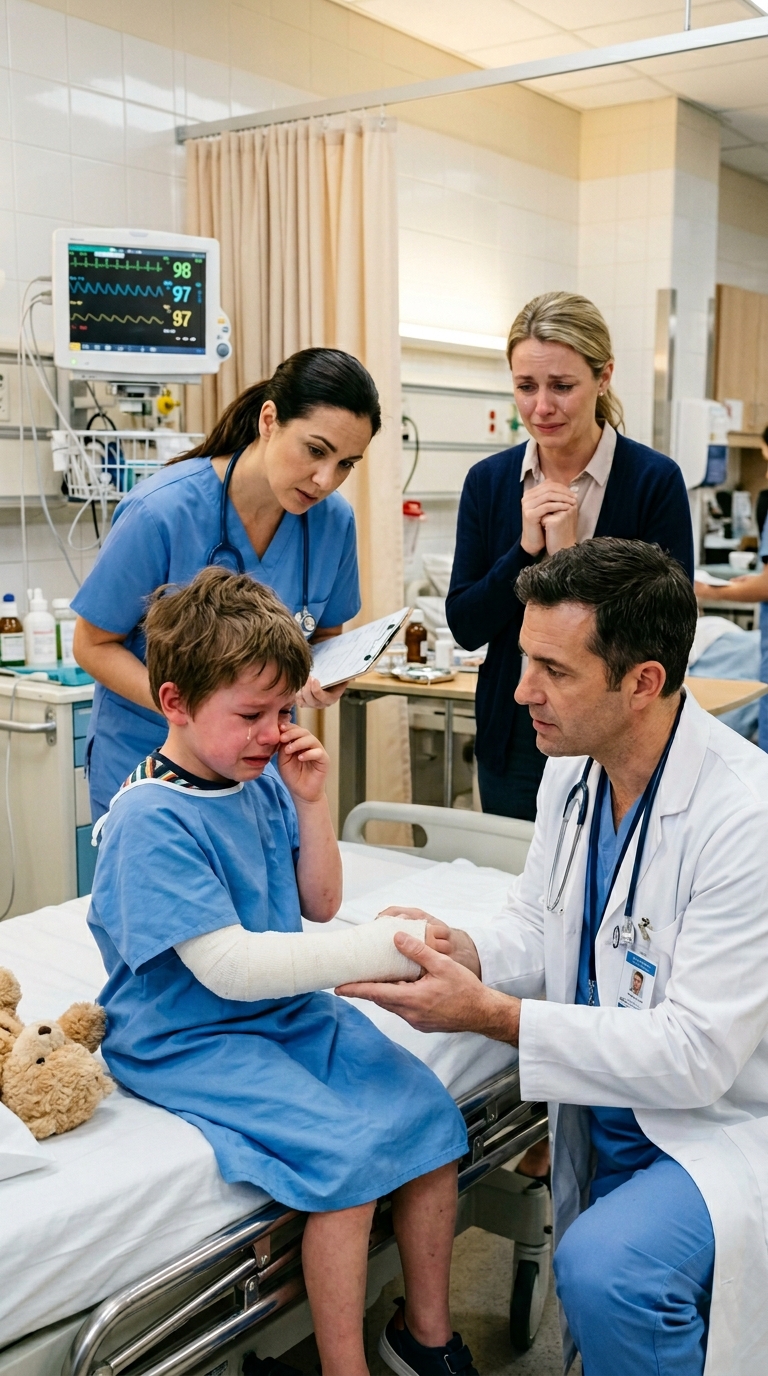
I had worked as a pediatric emergency nurse in a mid-sized hospital outside Chicago for nearly thirteen years, and while that time had taught me to recognize the many ways fear can show itself in a child, there are still moments that slip past experience and settle somewhere deeper, somewhere harder to explain.
That evening had already stretched longer than it should have. The waiting room had been full since late afternoon, and the steady rhythm of intake, assessment, and treatment had started to blur into something mechanical. The kind of pace where your hands keep moving even when your mind begins to drift.
When the chart landed in my hands, it looked simple enough.
A five-year-old boy. Recent arm injury. Low-grade fever. Mild discomfort that had worsened overnight.
Usually, that meant a routine check. Maybe an adjustment. Maybe antibiotics. Nothing that would stay with you after your shift ended.
His name, according to the file, was Mason Hale.
But the moment I stepped into Room 6, something in the air felt off in a way I couldn’t explain.
He lay small against the oversized hospital bed, his pale face turned slightly toward the ceiling. His breathing was uneven—not fast enough to signal panic, but not steady enough to suggest comfort. His left arm rested stiffly on a pillow, wrapped in a thick white cast that immediately drew my attention for reasons I couldn’t yet define.
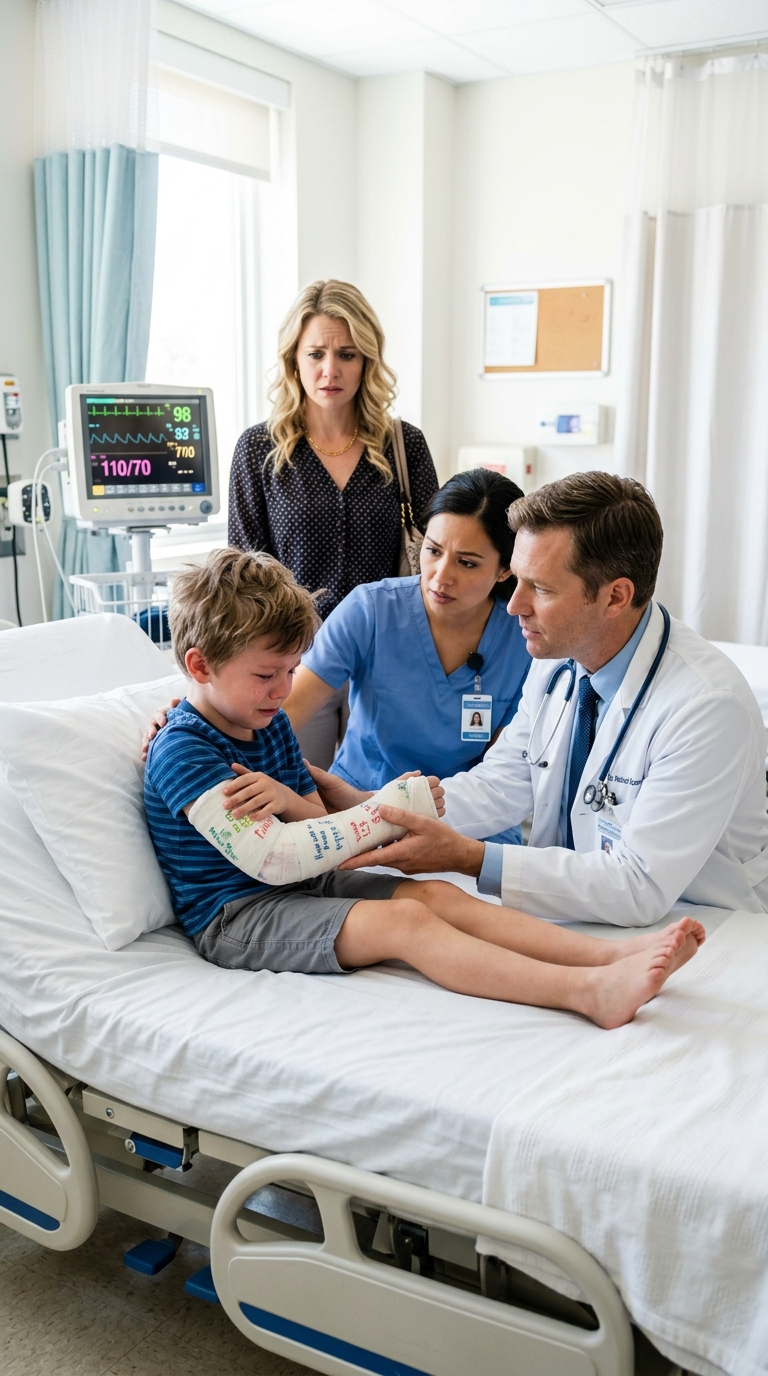
His mother stood near the far wall.
Not beside him.
Not close enough to comfort him.
Just far enough to feel distant.
Her posture was rigid, her fingers tightening again and again around the strap of her handbag, as if she were holding herself together by force.
I offered a gentle smile as I stepped closer. Children often read tone before they understand words.
“Hey there, Mason. I’m Nurse Emily. I’m just going to take a quick look at your arm, okay?”
He didn’t respond.
His eyes stayed fixed upward, wide and unblinking. And there was something in them that didn’t match the usual fear of pain or hospitals.
It wasn’t confusion.
It wasn’t resistance.
It was something quieter.
Heavier.
Like he understood something the rest of us hadn’t noticed yet.
As I reached toward the edge of the cast, planning only to check circulation and swelling, everything changed in a single instant.
Before my fingers even touched it, Mason recoiled violently.
He yanked his arm back with a force far beyond his size, twisting away as his voice broke through the room in a desperate plea.
“No… please, don’t touch it!”
Tears came immediately, streaming down his cheeks as his small body curled inward protectively, as if the cast wasn’t helping him—but something he needed to defend.
The reaction didn’t match the situation.
And that was the moment instinct took over.
The door opened quickly behind me as two staff members rushed in, drawn by the distress.
“Hey, hey, it’s okay, buddy, you’re safe, we’ve got you,” one of them said softly, moving carefully to steady him without making things worse.
His mother stepped forward then—but not with comfort.
Not with warmth.
With tension.
“He’s just scared,” she said quickly, her voice tight. “Please, just give him something for the fever and let us go home.”
But by then, I wasn’t looking at Mason anymore.
I was looking at the cast.
Because something about it wasn’t right.
Even before I could explain why.
The surface wasn’t smooth like it should have been. It looked uneven in places, thicker than necessary, almost layered. And there was a faint chemical smell in the air that didn’t belong in any proper clinical setting.
That was when Dr. Rowan Pierce stepped into the room.
Quiet.
Focused.
The kind of doctor who didn’t rush—unless something truly demanded it.
He didn’t speak at first. He crouched slightly, examining the cast from different angles, then tapped it gently with the back of his pen, listening carefully.
The sound was wrong.
Too dense.
Too solid.
He stood slowly, scanning the room before speaking, his voice firm but controlled.
“Everyone, take a step back for a moment.”
The shift was immediate.
When someone like Dr. Pierce spoke that way, people didn’t question it.
They listened.
He turned to the mother, holding her gaze just long enough to make the question heavier than it sounded.
“You said this was done at a clinic?”
There was a pause.
Short—but noticeable.
“Yes,” she said.
But the word lacked conviction.
He shook his head slowly.
“No,” he said quietly. “It wasn’t.”
Then he looked at me.
And in that look, something changed.
This wasn’t routine anymore.
“Emily, I need you to call security.”
The room fell silent.
Nothing about that request fit the situation we were supposed to be in.
He didn’t raise his voice, but his next words carried enough weight to remove any doubt.
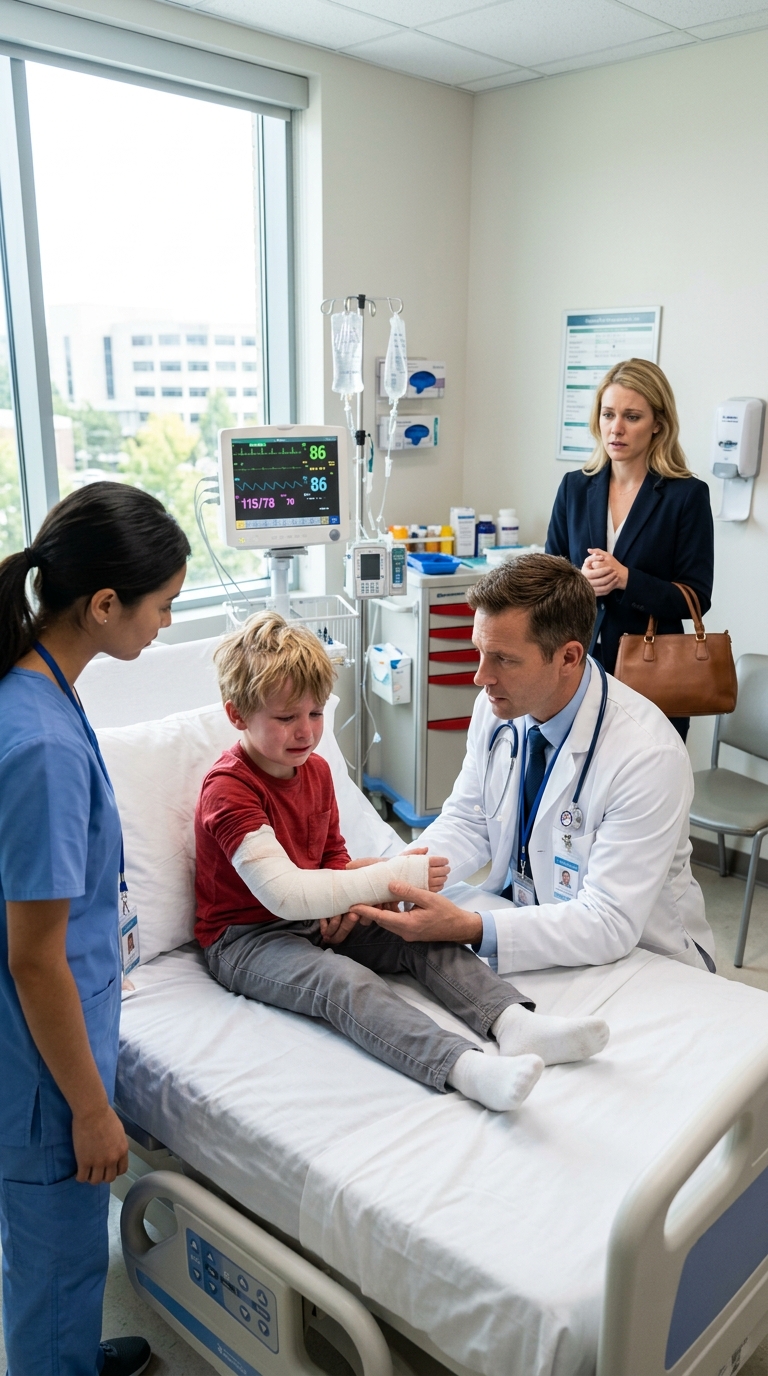
“This isn’t standard medical material,” he said, his eyes returning to the cast. “And whatever is inside it… wasn’t placed there for treatment.”
Security arrived faster than usual, filling the doorway as the tension in the room thickened into something almost tangible.
Mason had quieted slightly, though his breathing was still uneven. His eyes moved between us and his mother, as if he were trying to understand something we hadn’t yet figured out.
She had stepped closer to the wall now, her composure beginning to crack in subtle ways. The stiffness in her shoulders had shifted into something closer to unease.
“You don’t understand,” she said, her voice lower now. Less controlled. “You shouldn’t open it here.”
Dr. Pierce didn’t respond.
Not because he ignored her.
Because he had already decided.
And once he reached that point, there was no hesitation left.
He prepared the removal tool, choosing something heavier than usual, something meant for resistance rather than routine.
And that was the moment I realized—
Whatever we were about to find…
was never supposed to be found at all.
As the blade touched the surface of the cast, the resistance was immediate, and the faint chemical smell in the room sharpened into something stronger, something that confirmed what we had all begun to suspect.
Mason whimpered softly, his fingers tightening around the edge of the blanket as if trying to anchor himself to something real.
I leaned closer, lowering my voice to keep him grounded.
“It’s okay, Mason. We’re right here with you, and we’re not going anywhere.”
Layer by layer, the outer shell began to break apart, but instead of revealing the soft lining we expected, more hardened material appeared beneath it, dense and deliberate, as if the entire cast had been constructed for a purpose far different from healing.
Then, midway through the process, something shifted.
A faint sound.
Subtle, but unmistakable.
Like something small adjusting under pressure.
Dr. Pierce paused, meeting my eyes briefly before continuing more carefully, widening the opening with precision rather than force.
And then we saw it.
Not bone.
Not padding.
But objects.
Small.
Tightly packed.
Wrapped in a thin protective layer and pressed against the child’s skin in a way that made my chest tighten as the realization settled in.
A compact data drive.
A heavy ring, worn but engraved.
And a sealed sample container that had no place anywhere near a child’s arm.
No one spoke.
Because there are moments when words fail, and this was one of them.
Mason looked down at his arm slowly, his gaze steady, then lifted his eyes toward his mother.
And what I saw in his expression wasn’t confusion.
It wasn’t fear.
It was recognition.
As if he had known all along.
Security moved closer, their radios crackling quietly as calls were made, and the energy in the room shifted from concern into something far more serious, something that extended beyond medicine into territory we rarely crossed.
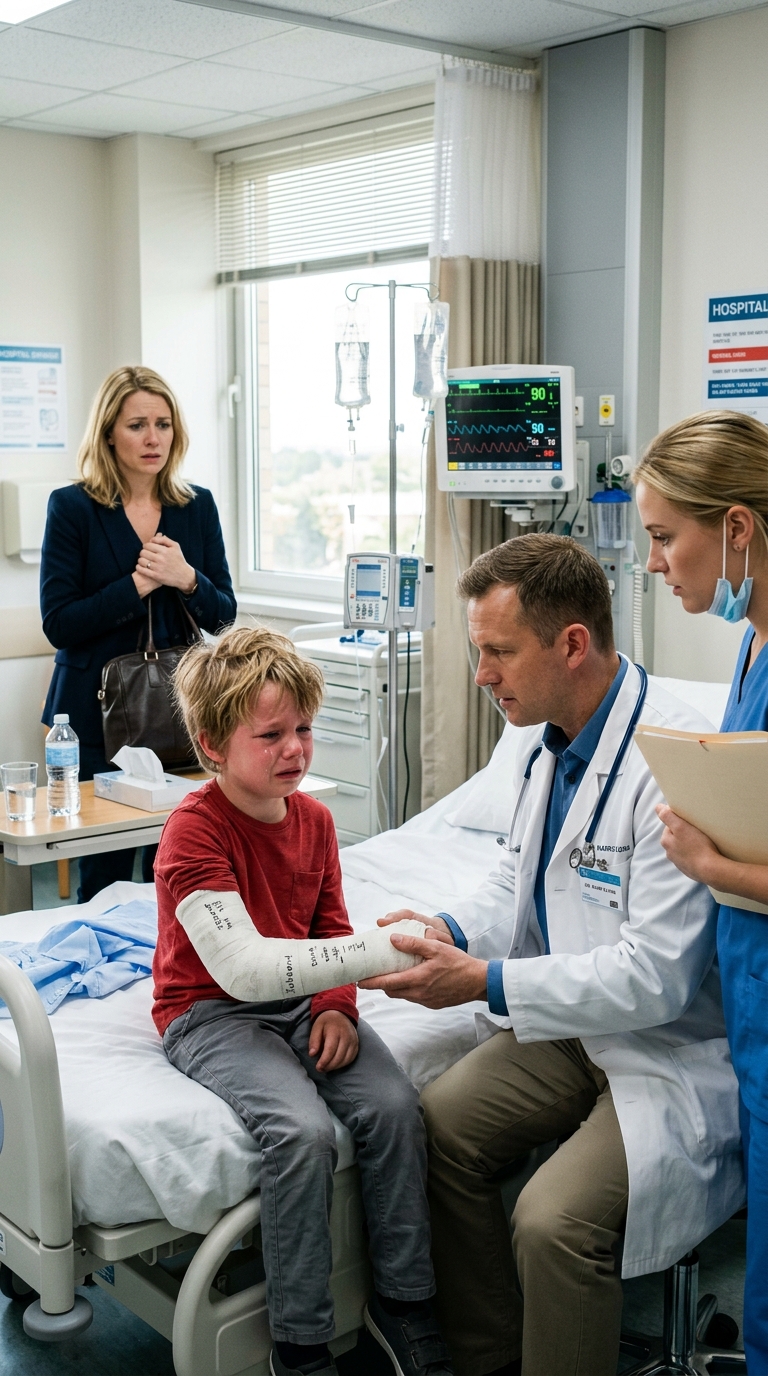
His mother spoke again, but this time the sharp edge in her voice had softened into something more desperate.
“You think you helped him,” she said, her voice breaking as her composure slipped. “But you just took away the only thing that was keeping him safe.”
The words didn’t land cleanly.
They carried more weight than explanation.
And nothing about the situation felt simple anymore.
I glanced at Mason’s arm, at the faint impressions left on his skin where the materials had pressed too tightly for too long, then back at his face, where exhaustion now seemed to settle over him.
He reached out slowly, his small hand finding mine with surprising steadiness.
“Is it out?” he asked quietly.
I swallowed before answering, because the simplicity of the question felt heavier than anything else in that room.
“Yes,” I said gently. “It’s out now.”
His shoulders dropped slightly, as though an invisible weight had lifted.
But the room itself didn’t feel any lighter.
Because whatever had been hidden there was never meant to stay hidden forever.
By the time my shift ended, the hospital had already returned to its usual rhythm. Emergencies don’t pause long enough for reflection, and the next patient always arrives whether you’re ready or not.
Mason had been moved to observation, resting more peacefully than before, though a quiet sense of vigilance lingered in the room.
His mother was no longer there.
And whatever came next had already moved beyond us, handled by people whose work extended far past the walls of our department.
But as I stood by the window outside his room, watching his small chest rise and fall with steady breaths, I couldn’t shake the feeling that had settled inside me.
Because things like that don’t happen by accident.
They are planned.
Placed.
Protected for reasons that are never simple.
And even though we had uncovered what was hidden, even though we had removed it piece by piece and brought it into the open, it didn’t feel like an ending.
It felt like the beginning of something that had been waiting for the right moment to surface.
I rested my hand lightly against the glass, my reflection faint beside his.
And the thought that stayed with me, long after I walked away, wasn’t about what we had found.
It was about what it meant.
Because whatever came next…
wasn’t going to stay hidden for long.
