

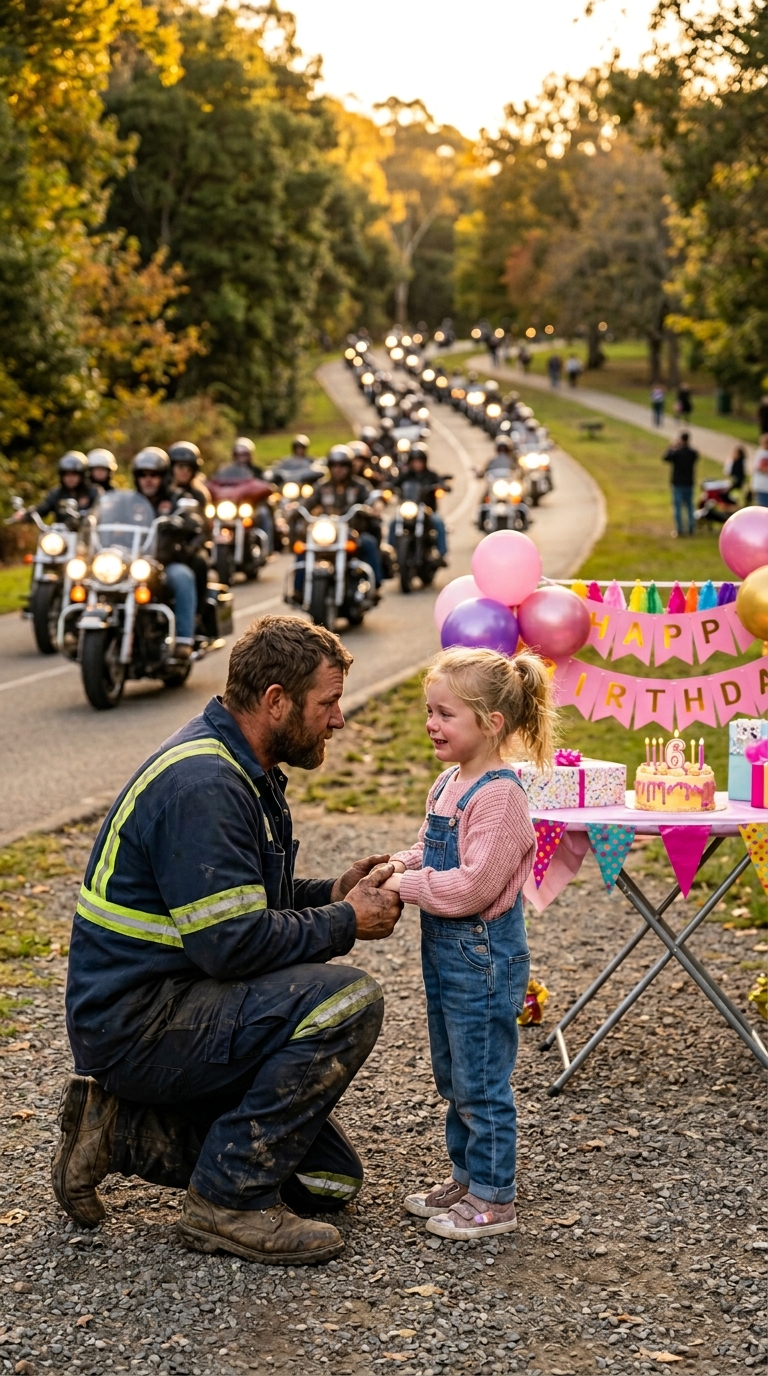
There were seventy-three bikers when we showed up uninvited to a little girl’s sixth birthday party after learning that not a single classmate had come—simply because her dad was “just a trash collector who rides a motorcycle.”
Her name was Lily Harper.
She had been waiting for nearly three hours at the lakeside pavilion her father had rented, sitting beside a homemade cake shaped like a pink motorcycle with a tiny sugar crown on top. Every time headlights passed near the park entrance, her eyes lit up—only to dim again moments later, hope rising and falling like a tide that refused to give in.
The invitations had read: “Lily’s 6th Birthday!” with crowns and motorcycles drawn in crayon across every corner. Twenty-five cards, each one carefully colored by Lily herself. Some had faint dents where she pressed too hard with her pink marker. She didn’t want anything fancy—just friends.
But in the private parent messaging group at Brookstone Academy, the tone had been different. Colder. Dismissive.
A screenshot made its way to me later.
“No one’s actually going to the garbage guy’s kid’s party, right?” one mother wrote.
“I mean… what kind of crowd do you think will be there?” another replied.
“Better not,” someone else added.
I found Lily crying behind the pavilion, her small shoulders trembling beneath the pink leather jacket her father had given her that morning. It was a tiny version of his own riding jacket, with “Daddy’s Little Rider” stitched across the back in white thread, a small embroidered crown above it.
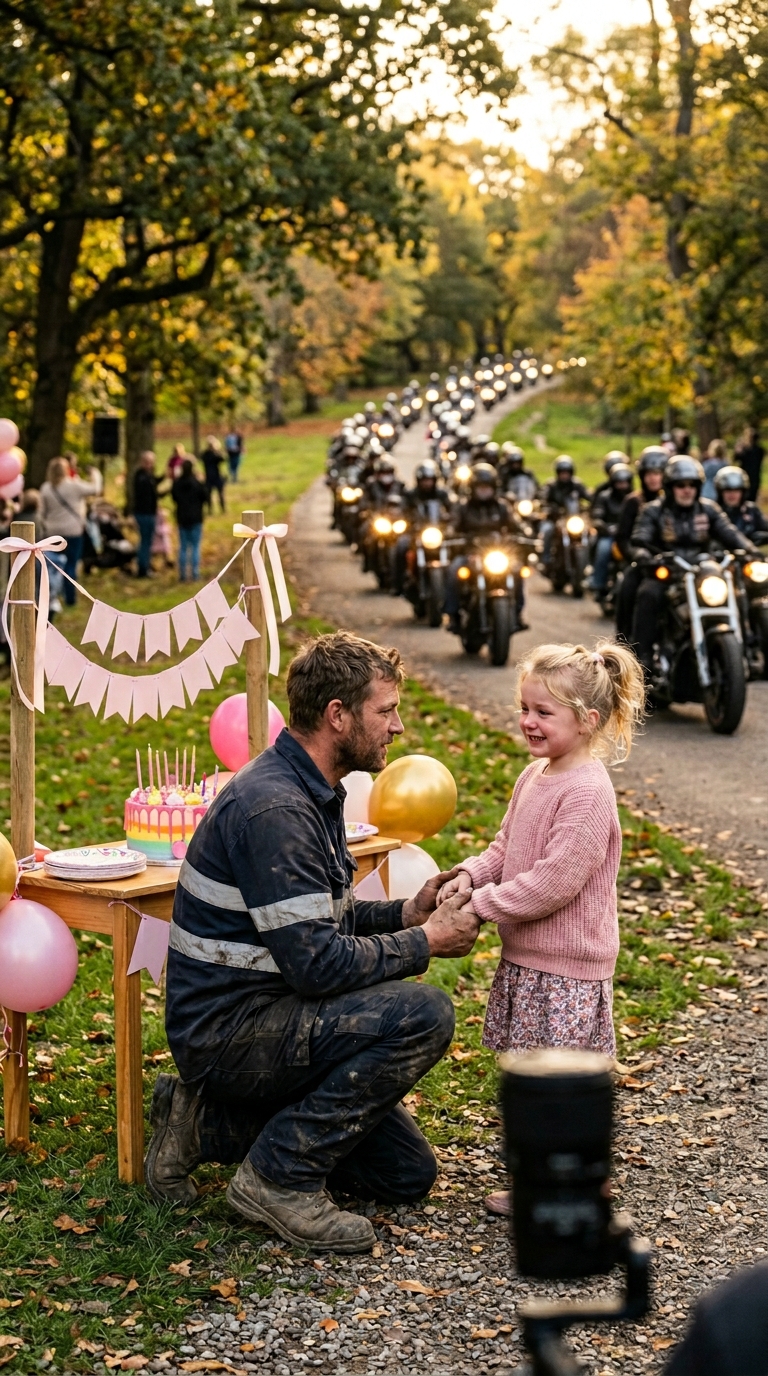
What those parents didn’t know was that Lily’s father, Daniel Harper, had spent six months saving to rent that pavilion in the nicer part of town.
He worked sanitation in the early mornings, stocked shelves at a grocery warehouse in the afternoons, and fixed motorcycles in his garage on weekends.
Every dollar he saved went toward tuition at Brookstone Academy because he believed his daughter deserved every opportunity—even if it meant sacrificing sleep.
I was there running my food truck, selling barbecue sandwiches and lemonade, when I saw it all unfold. Daniel, still wearing his neon-striped sanitation uniform, boots dusty, sat at a long picnic table decorated with pink balloons and unicorn streamers tangled together with black-and-silver motorcycle pennants. A pile of bright goodie bags sat untouched.
“Maybe traffic’s bad, peanut,” he said gently, checking his phone. “I’ll call a couple of the parents.”
But Lily already knew. Kids always do.
“They’re not coming, Dad,” she whispered. “Yesterday, Ava’s mom looked at my invitation and made a face. She said something about trash trucks.”
Daniel’s expression broke in a way that tightened something in my chest. This was a man who handled other people’s waste before sunrise just so his daughter could sit in classrooms beside their children—and in that moment, he looked completely helpless.
Lily reached for his rough hand and squeezed it. “It’s okay. We can eat all the cake. It’s my favorite anyway.”
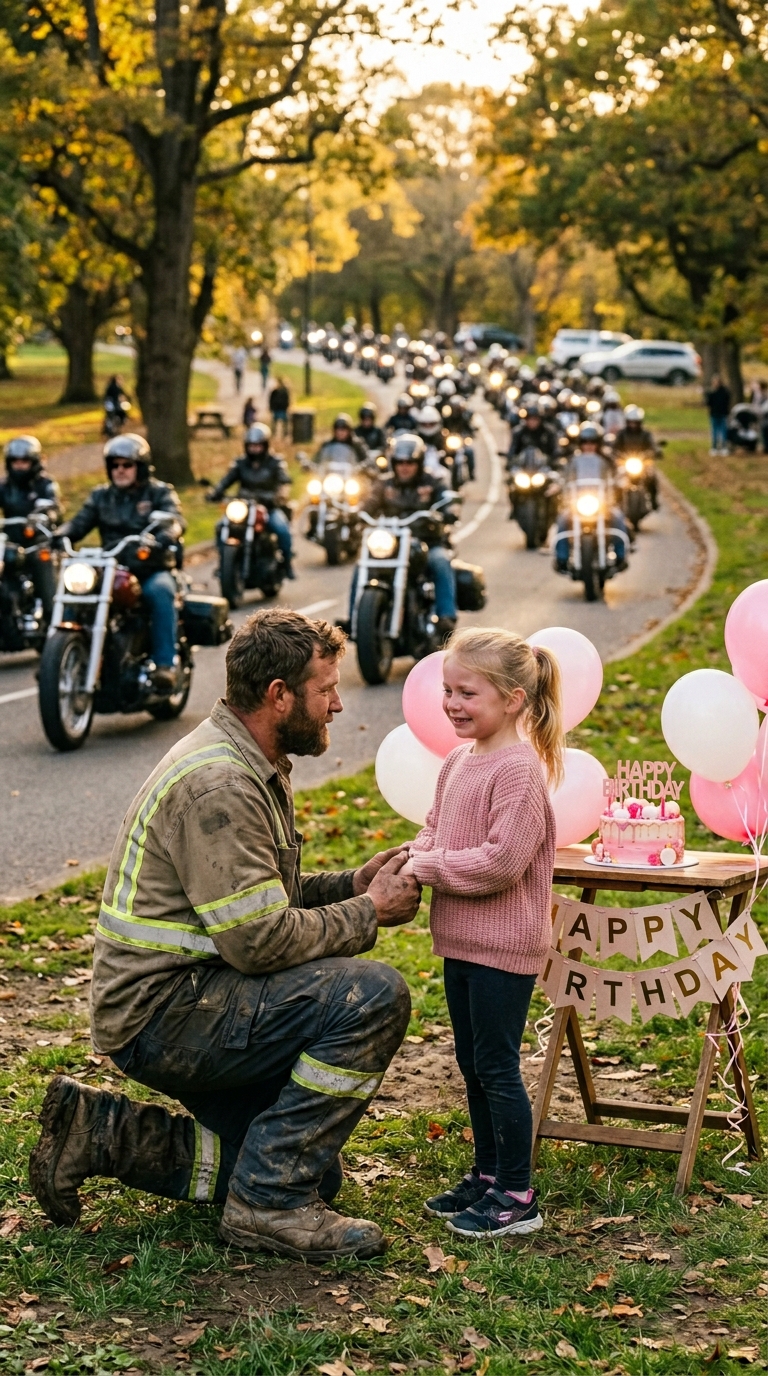
That was when I acted without thinking. I took a photo—the empty tables, the sagging balloons, the little girl in her pink jacket trying to smile—and posted it in a local riders’ group.
“Six-year-old’s birthday. No one showed because her dad collects trash and rides a bike. Anyone nearby?”
The first engine thundered into the parking lot fifteen minutes later.
It was “Captain Ray,” real name Raymond Collins, a retired paramedic who now owned a small auto shop. He removed his helmet, walked straight to Lily, and dropped to one knee like he was greeting royalty.
“Happy birthday, Princess,” he said warmly. “Heard there was supposed to be a biker party. Thought you might need some bikes.”
Her tear-streaked face lifted. “You came? For me?”
“Wouldn’t miss it.”
Then came three more bikes. Then eight. Then a steady roar of engines rolling in like a storm that refused to be ignored.
Daniel stood up, confused and overwhelmed. “I don’t… what’s happening?”
I showed him my phone. The post had been shared dozens of times.
“Riders take care of their own,” I told him.
Within an hour, the entire pavilion transformed. Leather vests, chrome reflecting sunlight, laughter replacing silence. A women’s riding group called “Iron Angels” arrived carrying a second cake—this one shaped like a glittering unicorn riding a motorcycle. A veterans’ club brought a child-sized helmet painted bubblegum pink with “Lily” written in silver glitter along the side. Another group stopped at a toy store and bought every pink, wheel-themed toy they could find.
But the moment that changed everything… was when Big Mike showed up.
Michael “Big Mike” Turner was exactly the kind of man those parents imagined and feared—six foot eight, arms wrapped in tattoos, a beard thick as winter, riding a Harley that rumbled like distant thunder. He worked in the same sanitation department as Daniel, though their routes rarely crossed.
He approached Lily slowly, then lowered himself to the grass so they were eye to eye.
“Your dad told me you love princesses and bikes,” he said gently. “My little girl did too.”
He placed a carefully wrapped box in her hands. Inside was a handmade leather journal titled The Road Adventures of Princess Lily. Every page was filled with drawings of a small girl riding a motorcycle through castles, forests, and mountains.
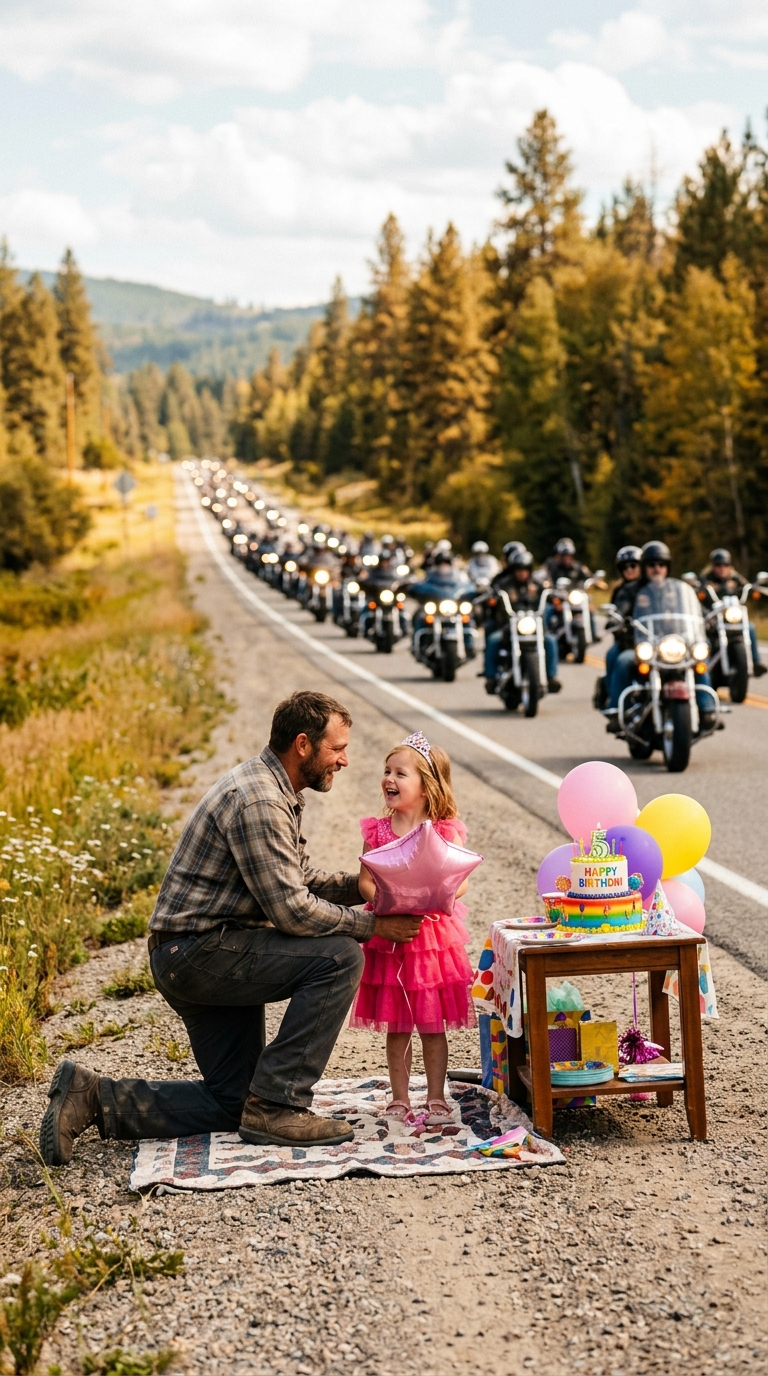
Lily didn’t hesitate. She threw her arms around his neck.
Big Mike closed his eyes as he held her, tears slipping quietly down his face.
“My daughter would’ve been twenty-five,” he said softly to Daniel. “We lost her when she was eight. Seeing your girl smile… that’s everything.”
Daniel pulled him into a tight embrace, two grown men holding on like family.
The party came alive in a way no one could have planned. Riders took slow laps around the parking lot, Lily sitting safely in front while they moved at a walking pace. Someone set up a speaker, playing a mix that jumped from classic rock to Disney songs without apology. The women painted Lily’s nails in bright colors and braided ribbons into her hair.
She glowed. She laughed. She forgot the empty chairs.
Then the tennis crowd arrived.
Mrs. Karen Whitmore, president of the Brookstone Academy Parents’ Association, approached stiffly with a group of well-dressed parents.
“What exactly is going on here?” she asked sharply. “This is a public family park, not a biker rally.”
Daniel started to respond, but Lily ran forward first, beaming.
“It’s my birthday!” she said, lifting her glittering helmet. “And they all came!”
Karen blinked. “Lily Harper? But I thought—” She stopped herself.
“The party nobody planned to attend?” Big Mike rose to his full height, towering above her. “The one your kids skipped because her dad hauls your garbage?”
More parents gathered, drawn in by the noise and curiosity. Their children stared wide-eyed at the motorcycles.
“Mom, that’s Lily!” one little girl shouted from a car window. “Look at the bikes! Can we go?”
“Absolutely not,” her mother answered loudly. “Those aren’t our people.”
Then a woman stepped forward from the group of riders.
“Hi, Melissa,” she said calmly.
It was Dr. Rebecca Lawson—a pediatric neurosurgeon many of those same parents trusted with their children’s lives. Today, she wore jeans and a leather vest marked with her riding club’s patch.
Melissa’s face drained of color. “Dr. Lawson? You ride… with them?”
“I ride with my friends,” Rebecca replied. “And today, we’re celebrating a little girl who deserved better.”
Recognition spread quickly. The accountant who managed their taxes stood beside a chrome bike. The owner of a high-end restaurant leaned against another. A respected contractor, a retired Marine, a school bus driver, a nurse.
All of them—“those people.”
At that moment, Ava—the same girl whose mother had mocked the invitation—broke free and ran straight to Lily.
“Happy birthday!” she called out. “Your party is awesome!”
And just like that, the invisible line between “us” and “them” began to crack.
What started as quiet cruelty turned into something the entire neighborhood would remember for years. Not because of the engines or the leather jackets—but because a group of strangers refused to let a child believe that her father’s honest work made her any less worthy of love.
