

It was still dark when he lit the stove. The chill of dawn slipped through the cracks of the old wooden house, but he no longer felt it; a much deeper cold had settled in his chest for months. He took two clay mugs from the cupboard, worn by time and use. Into the first, he poured black coffee—thick and bitter. Into the second, he prepared chamomile tea. He did it with almost religious devotion: the exact same measure, the same boiling time, the same temperature as always. When his coffee was ready, he took the steaming mug of tea, walked slowly to the back door, looked out at the gray horizon, and poured the liquid onto the dry earth.
The dust absorbed the chamomile in a single breath. He had done that every dawn since his wife had closed her eyes forever. He knew perfectly well she was no longer there to drink it, but his hands—stubborn and full of memory—refused to learn how to prepare just one cup. Grief is a habit that is hard to break. After washing both mugs and putting them away, he grabbed his hoe and went out to work the land before the sun began to burn.
Miles away, the afternoon brought relentless rain that showed no mercy. In a house that knew nothing of warmth, a young woman—barely twenty—burned with fever. Shivering uncontrollably beneath a thin, worn blanket, she had gone more than a day without food. The door to her room creaked open. Her father stood in the doorway, his silhouette outlined by the gray light of the hallway. There was no “How are you feeling?” no hand on her forehead. His eyes, as cold as the storm outside, judged her with contempt.
“Who’s going to do your work in the field tomorrow?” he asked, his voice stripped of any trace of humanity.
She forced herself to sit up. Her hands pressed into the mattress, but her legs—weak and trembling—gave out instantly, sending her crashing onto the dirt floor. Her father did not react. He did not offer a hand, did not even pretend to help. He simply turned, left the room, and returned moments later carrying her few belongings: a couple of worn changes of clothes, a pair of old shoes, and finally, her mother’s shawl. He held the garment between two fingers, lifting it as if it were contaminated.
“You’re still carrying this sick woman’s rag,” he spat.
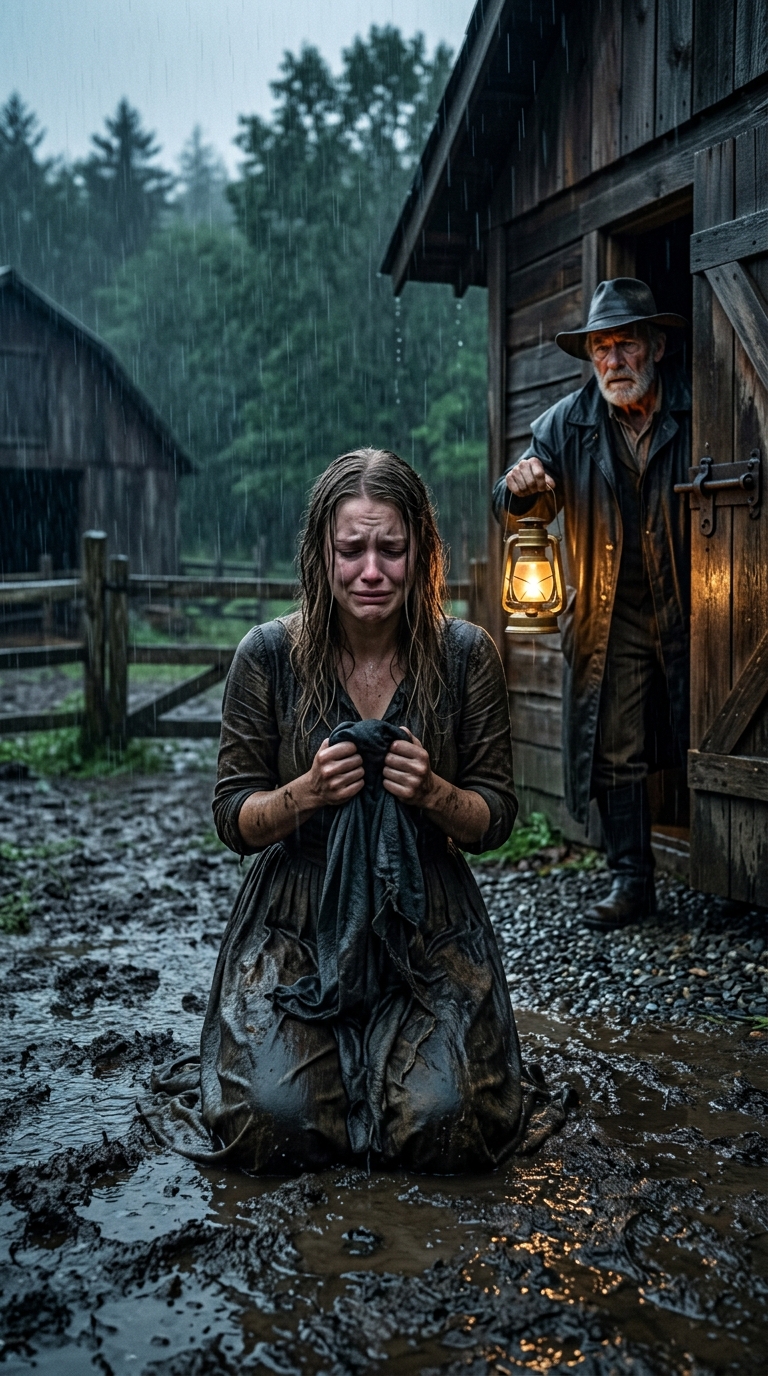
He walked to the front door and threw it wide open. The icy wind pushed the rain inside. Without hesitation, he hurled her belongings into the mud of the yard. Then he turned back to her, still struggling to stand.
“Get out of here. I don’t want any more useless weight in this house.”
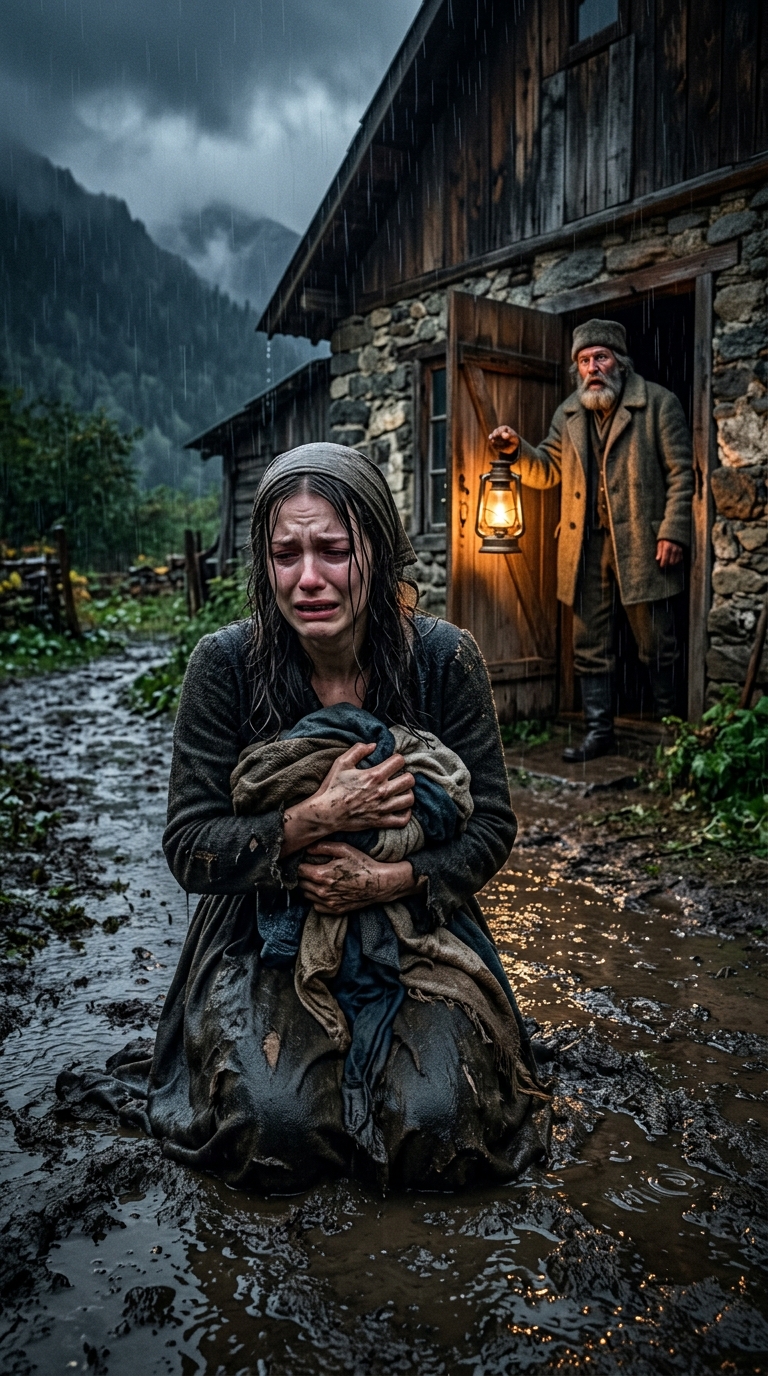
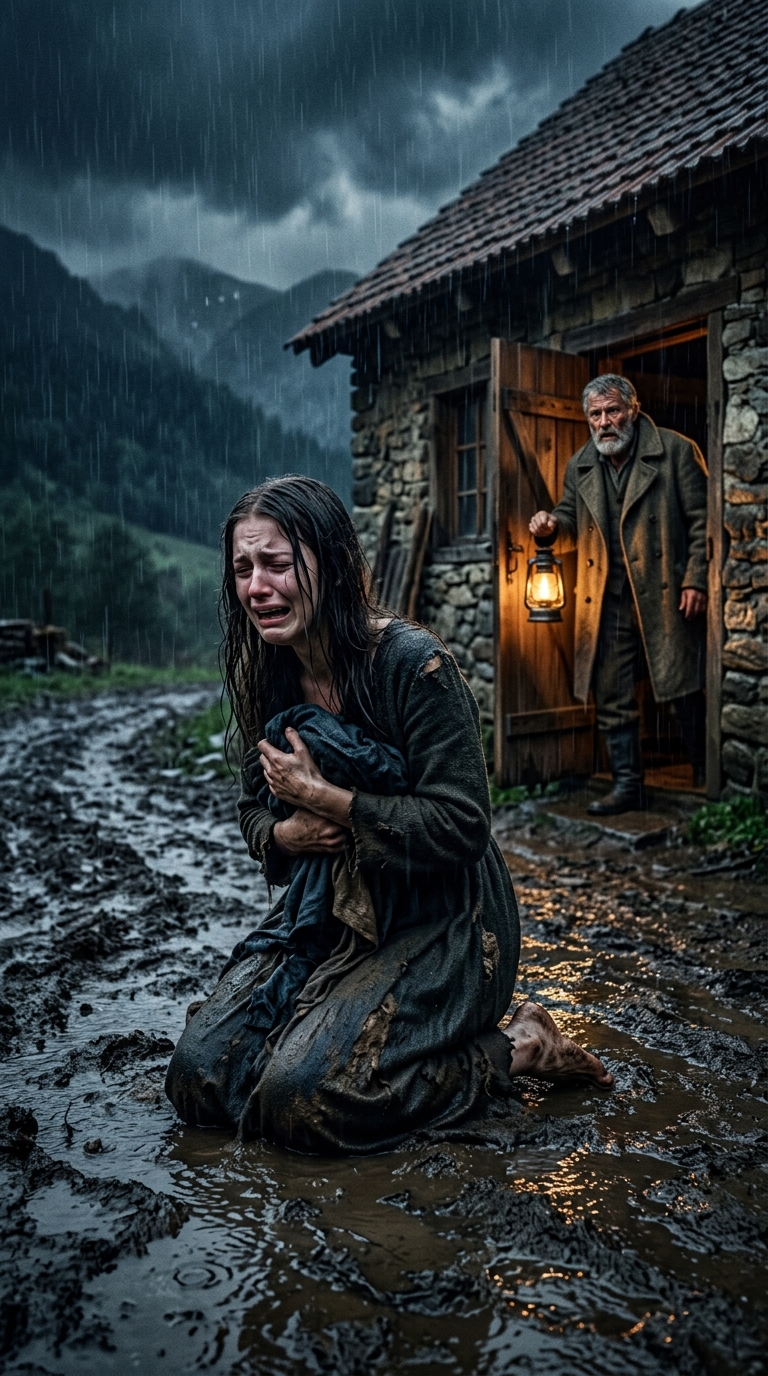
He shoved her mercilessly outside. She stumbled and fell to her knees in the freezing mud. The sound of the door slamming behind her was final. The sharp click of the lock echoed like a death sentence. Desperate, she crawled through the mud, grabbed her mother’s shawl, and clutched it to her chest, searching for warmth that no longer existed. She returned to the door, pounding weakly against the wood, begging, promising that the next day she would work twice as hard—that she would do whatever he wanted.
From inside, her father’s voice cut through the wood like a blade:
“I’d rather say I have no daughter than have one who’s useless—just like her mother.”
She tried to cry, but her body was so exhausted it could not even grant her that relief. Barely able to stand, she began walking down the dirt path without direction, driven only by instinct. The rain beat down on her mercilessly, the cold seeping into her bones—until her body gave in. She collapsed at the side of the road, face down, protecting the shawl beneath her chest as if it were the last heartbeat she had left.
Hours later, the widower was returning home along that same path. The night was pitch-dark, and the rain had softened into a steady drizzle. The yellow beam of his lantern swept across the ground and stopped on a strange shape. It looked like a pile of discarded clothes in the mud. He was about to walk around it when the light revealed a pale arm. He froze. The last time he had held a fragile body, life had slipped through his fingers. His hand trembled, but instinct was stronger than fear.
He knelt in the mud, gently turned the body over, and saw the face of a young woman consumed by fever, her breathing uneven, clutching a mud-soaked shawl. He knew exactly what that breathing meant. He knew one more night in the open would extinguish that life forever. Without hesitation, he lifted her into his arms and carried her home.
He laid her on his own bed, lit the stove, and prepared chamomile tea. He dampened a cloth and placed it on her burning forehead. Sitting in the same wooden chair, he repeated the same gestures, the same painful vigil he had lived through months before with his wife. While the young woman slept, the widower took the dirty shawl to dry it near the fire. As his fingers pressed against the damp fabric, he felt something unusual. Something rigid—a perfect square—carefully sewn into the hem.
With great care, he opened the stitches and pulled out a yellowed piece of paper, folded in four, the ink faded but still legible. It was a legal document—a land purchase contract, with signatures, dates, and sums of money he did not fully understand.
He looked at the paper, then at the young woman fighting to breathe, and realized that fate had not placed her in his path by chance. That hidden piece of paper was the key to a buried truth—a secret about to unleash a storm far more dangerous than the rain that night, one that threatened to shake the very foundations of the entire village.
The widower did not leave his chair all night. Each time the young woman coughed or stirred, he replaced the damp cloth and lifted the mug to her lips so she could take small sips. His hands moved on instinct, guided by painful memory. That endless night brought back the ghosts of his own loss—but this time, the story would not end in death.
On the fifth day, the fever finally broke. The young woman woke in a strange place, frightened, expecting at any moment to hear her father’s voice. But she found only silence, a plate of warm food, and a man with sad eyes who asked nothing of her. Her legs still trembling, she stood and, seeing the widower’s torn shirt hanging from a nail, took needle and thread and mended it with the same fine, steady stitches her mother had taught her. When the widower returned from the fields and saw his shirt repaired, he said nothing. Two broken souls were beginning to recognize each other.
But in small villages, secrets do not exist. The young woman’s father, leaning against the counter of the general store, began to spread his poison. With calculated coldness, he told anyone who would listen that his daughter was useless—a disgrace who had run away and taken refuge in the house of a lonely widower. His words fell like seeds in fertile soil. Soon, the neighbors’ gazes changed. The shopkeeper refused the widower credit, old friends crossed the street to avoid greeting him, and women whispered behind his back. The widower noticed, felt the weight of their contempt—but when he returned home and saw the girl alive, slowly regaining her strength, he knew he was doing the right thing.
One night, as they ate beans and drank tea by the firelight, the heavy silence finally broke. She kept her eyes on the table as she confessed her pain. She told him how her father had thrown her out, how he had always blamed her for her mother’s death.
“He told me that if I had worked harder, there would have been enough money to save her,” her voice cracked as tears rolled down her cheeks. “I was fifteen… and I believed him.”
The widower froze, his spoon suspended in the air. His knuckles turned white against the table. Anger rose in his throat, but when he spoke, his voice was calm and steady.
“I sold everything I had to pay doctors for my wife. Every hectare, every animal… I did everything a man can do, and she still died. The fault is not with the one who tries—it belongs to the one who doesn’t even make the effort. That man who left you outside is the one who should carry that guilt, not you.”
The widower’s words struck the young woman’s chest like a revelation. A stone that had been crushing her soul for fifteen years finally began to shift.
Days later, the widower could no longer remain silent. He opened a drawer, took out the yellowed document he had found in the shawl, and placed it in front of her.
“I found this sewn into your mother’s shawl the night I brought you home.”
She took the paper. Her eyes traced the faded lines. It was a contract—the sale of land that had belonged to her mother, signed by her before she died, in exchange for a considerable sum of money. The young woman’s world stopped. Her father had always claimed they were poor, that there had been no money for a doctor. But the money had existed. Her mother had given everything to save herself.
“There was never a doctor… there was never any medicine,” she whispered, her gaze distant, her heart pounding. “My mother gave the money… what did he do with it?”
That night, she did not cry. She read the document over and over again. Every lie her father had told collapsed, exposing a monster beneath. And with each lie that fell apart, a new strength—fierce and unyielding—rose within her. She was no longer the frightened girl in the rain.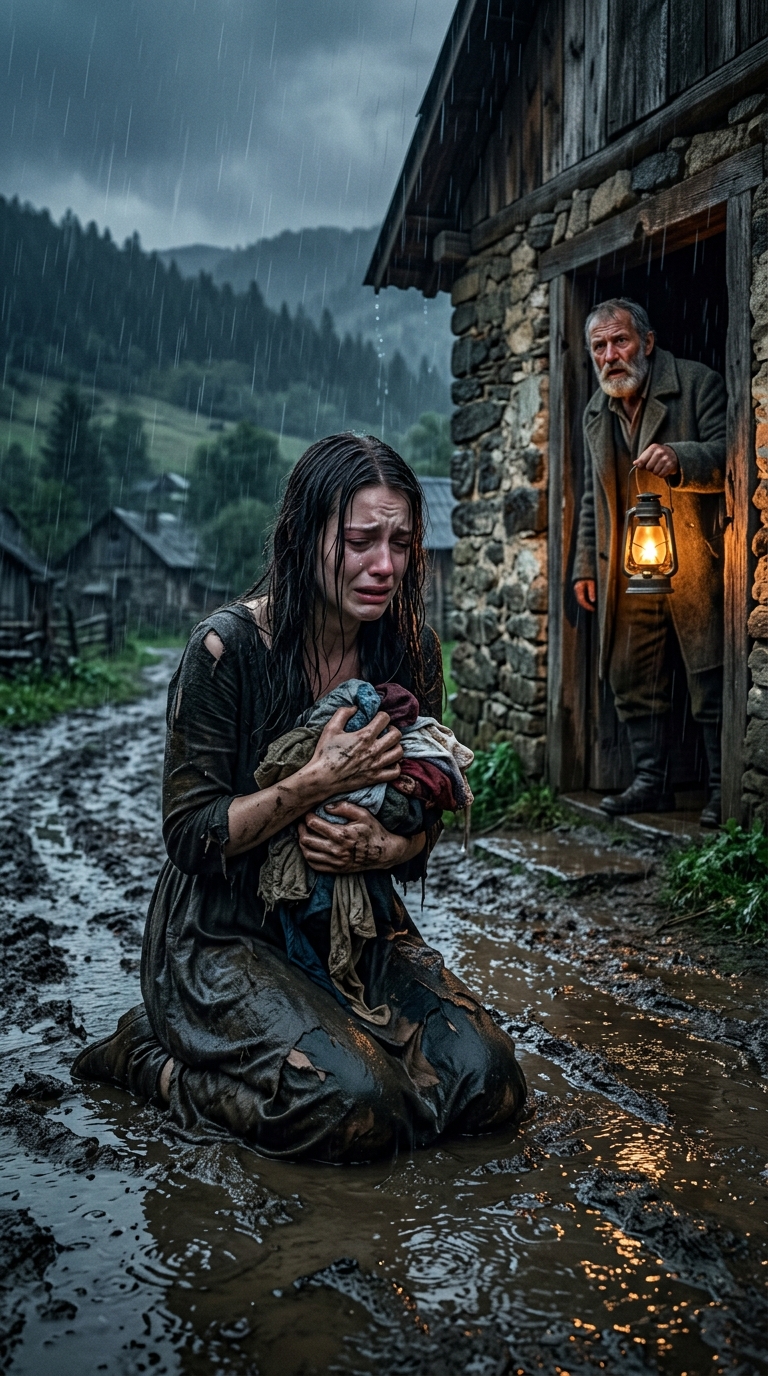
But the calm would not last. Realizing that his rumors had failed to break the widower or force his daughter to return begging for forgiveness, her father decided to play his final card. He summoned the entire village to the cooperative hall. He would restore his “honor” in public and demand that his daughter be returned to him, accusing the widower of taking advantage of her and even claiming he had sold his late wife’s land out of greed.
On the morning of the meeting, the sky was unusually clear. The widower wore his mended shirt. The young woman took her mother’s shawl, hid the document within its hem, and draped it over her shoulders. Together, they walked toward the cooperative, heads held high.
The place was packed. People stood against the walls, watching intently. Her father stood at the front, immaculate, carrying himself like a man in control. When he saw them enter, he smiled smugly and began his speech. He spoke of his suffering, of how he had raised his daughter alone, working from dawn to dusk. Then he pointed an accusing finger at the widower, calling him an opportunist, a man without morals who had taken in a young, unmarried woman. Murmurs filled the room. The father tasted his victory.
The widower remained silent, steady as an oak. He did not need to defend himself. Then the young woman stepped forward. Her father frowned and ordered her to sit down under his breath, but she ignored him. She walked to the center of the room, locked her gaze on him, and then turned to the crowd.
Her voice rang out—clear and firm. She told them about the night of the storm. How she burned with fever, how her father refused her help, threw her belongings into the mud, and locked her out.
“If this man hadn’t found me lying in the dirt, I would be dead. He sold everything to try to save his wife—he has every medical receipt to prove it. But since we’re talking about selling land…” she paused, and the room held its breath.
She removed the shawl, opened the stitching with her fingers, and pulled out the yellowed paper. Her father’s face drained of color.
“This document was sewn here by my own mother. It’s the sale of her land. She signed it to pay for her treatment. For fifteen years, my father told me there wasn’t a single cent—that my mother died because of me, because I didn’t work hard enough. But the money existed.”
She turned toward her father, her eyes blazing with truth.
“I’m asking you in front of everyone, Father: Where is that money? What did you spend it on while you let my mother die?”
The silence in the hall was absolute—deafening. Her father opened his mouth, but no words came out. His mask of respectability shattered. From the back of the room, an older man with weathered hands stood up.
“I’ll tell you where it is,” he said calmly. “I’ve seen him in San Jacinto, at the gambling tables behind the cantina. Betting big, losing everything, owing half the town.”
Her father tried to stammer out a defense, to invent excuses about uncontrollable debts, but no one was listening anymore. There were no shouts, no violence. There was something worse: complete indifference. One by one, the villagers—the neighbors, the shopkeeper, the old friends—stood up and walked out. They turned their backs on him, leaving him alone in the center of the room with his shame and the echo of his lies.
The young woman looked at him one last time. There was no hatred left in her eyes—only the peace of someone who is finally free. She adjusted the shawl, turned around, and walked toward the door, where the widower stood waiting, hat in hand. They left together, leaving the past behind.
The days that followed brought a quiet kind of healing. The village, in its own way, apologized. Bags of corn began to appear again at the widower’s fence. Credit at the store was restored without a word. Greetings along the road became sincere once more. As for her father, he became a ghost in his own house—no one bought from him, no one spoke to him; he was a stone in the path that everyone avoided.
One morning, the widower came down to the kitchen before heading to the fields. On the table, a mug of chamomile tea was already prepared. It was warm, sweetened with piloncillo and touched with cinnamon—exactly how his late wife had liked it, and how the young woman’s mother had liked it too. She stood in the doorway, watching him with a soft, peaceful smile.
He sat down, took the mug in both hands, and felt the warmth seep through the clay. He took a sip. It was perfect. This time, the tea would not be poured onto dry earth. This time, the tea was meant to celebrate life.
Sometimes, life breaks us in the cruelest ways—stripping away what we love most and leaving us exposed in the middle of the storm. But it is precisely in that vulnerability that we find those who carry the missing pieces we need. Love—true care—is not demanded or owed; it is born from shared pain and grows through the quiet kindness of simple acts. We are not defined by what we lose, but by what we choose to rebuild with those who decide to stay. And in that house, with an old hoe and a mended shawl, two souls had finally built a true home.
