

The king had long since mastered the art of appearing untouched by memory.
It was one of the first things power had forced him to learn.
Years before, when he was still a prince, he had fallen in love with a woman the court deemed unworthy. She was not born into nobility. She brought no army, no land, no alliance valuable enough for men who measured marriage in power and lineage. She was the daughter of a royal astronomer, raised among books, ancient charts, and the quiet patience of those who studied the sky more than they sought favor in court.
Her name was Elara.
She did not fear him the way others did—and that was what drew him to her first. When he spoke, she listened without lowering herself too far. When he argued, she answered honestly. When he shared his dreams of the kind of king he hoped to become, she never praised him for them. She simply asked whether he would still recognize himself once the crown demanded its price.
He used to laugh at words like that.
He was young then. He believed love could survive anything the throne demanded.
For a time, it seemed he was right.
They met in the old western garden, beneath a broken stone arch the court had long forgotten. They exchanged letters neither of them dared sign. He gave her a ring—not formally, not as an engagement—but one taken from his mother’s collection, simple and old, engraved inside with a single line: To the one I chose before the world chose for me.
Elara wore it on a cord around her neck, hidden beneath her dress.
Then his father found out.
The old king was not cruel in the way stories simplify cruelty. He was something worse. He was practical. He believed kingdoms fell when rulers confused desire with duty. He told his son plainly: princes did not belong to themselves. Their love was not private. Their promises were not theirs to keep.
When the young prince refused to give Elara up, his father stopped arguing.
He acted.
One morning, Elara was gone.
No goodbye. No letter. No warning.
The prince demanded answers. His father told him she had been sent away for the good of the realm—and that if he truly cared for her, he would let her disappear rather than force the kingdom to make an example of her. At first, the prince searched—recklessly, desperately. But every path ended in silence. Every servant knew nothing. Every guard had seen nothing.
In time, grief hardened into obedience.
His father died. The prince became king.
The years passed.
War, treaties, famine, and the slow, brutal weight of ruling filled the space where love had once lived. Eventually, the memory of Elara stopped feeling like an open wound and became something else—a sealed chamber he visited only in rare moments of quiet.
No one in the palace remembered her name.
Or so he believed.
That night, the royal dining hall was full.
Torches flickered along the walls. Tables gleamed with gold cups and carved platters. Nobles spoke carefully, trained never to be too free in the king’s presence. Musicians played softly near the far arch. Servants moved like shadows between the benches.
The king sat at the head of the hall, listening to a lord speak at length about southern grain shipments, though in truth, he heard very little. He had been tired for weeks, and lately the noise of court life seemed to pass around him instead of through him.
Then the doors opened.
At first, no one noticed.
Children did not enter the royal hall during supper. Poor children least of all.
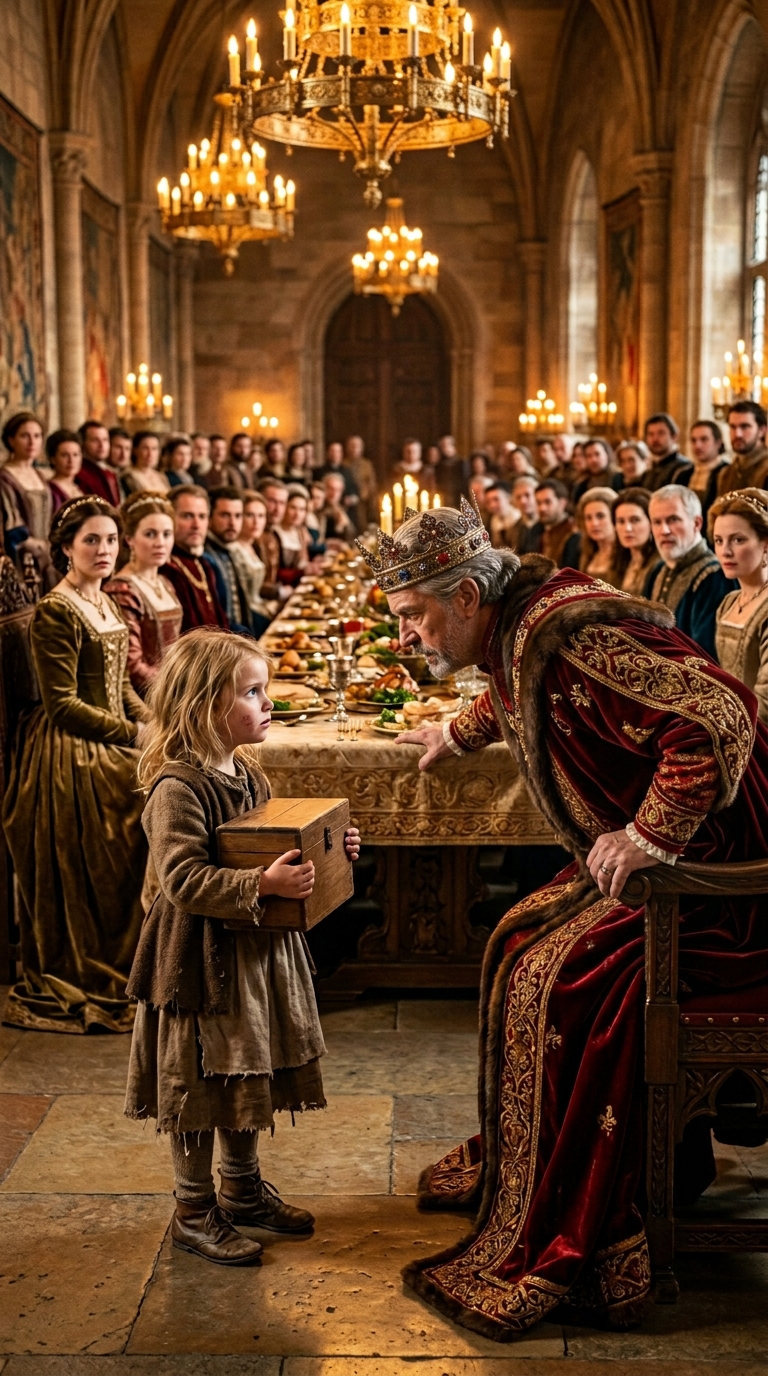
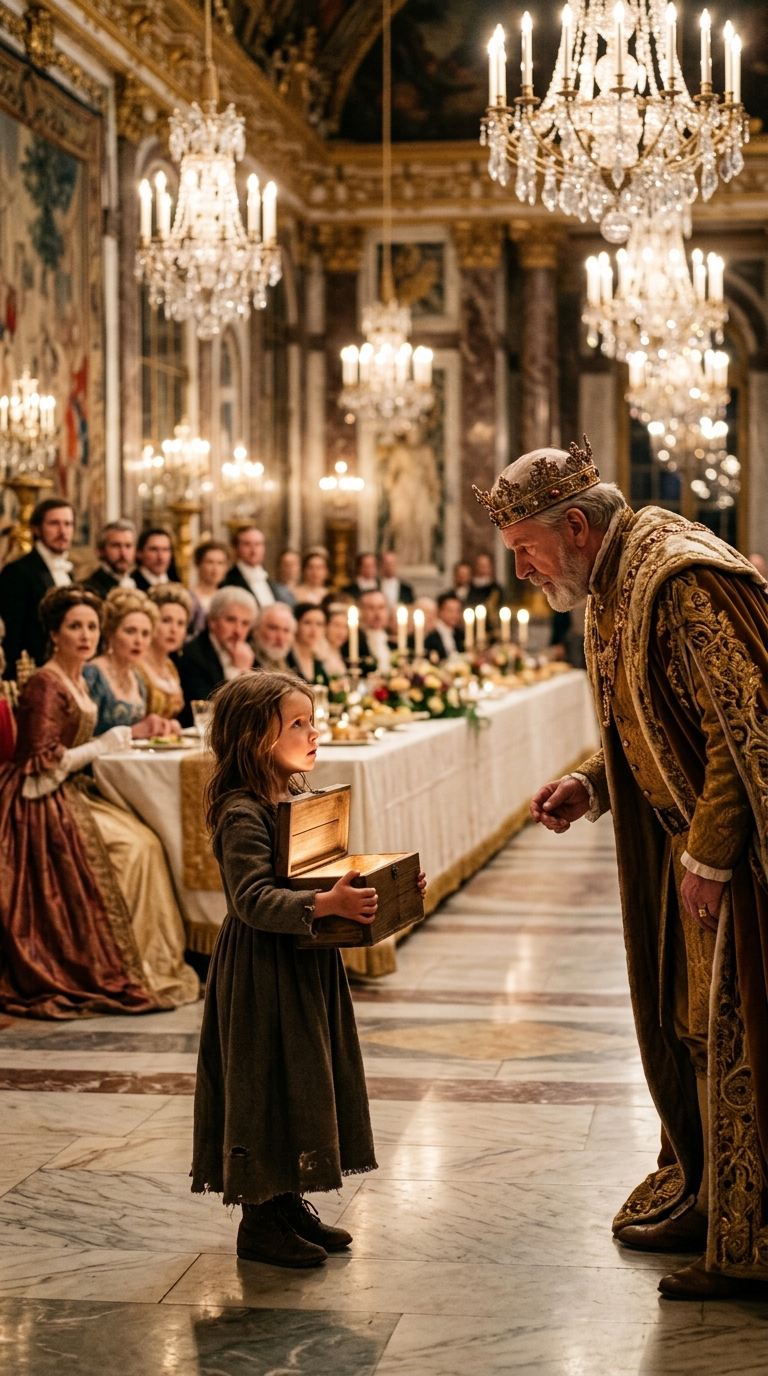
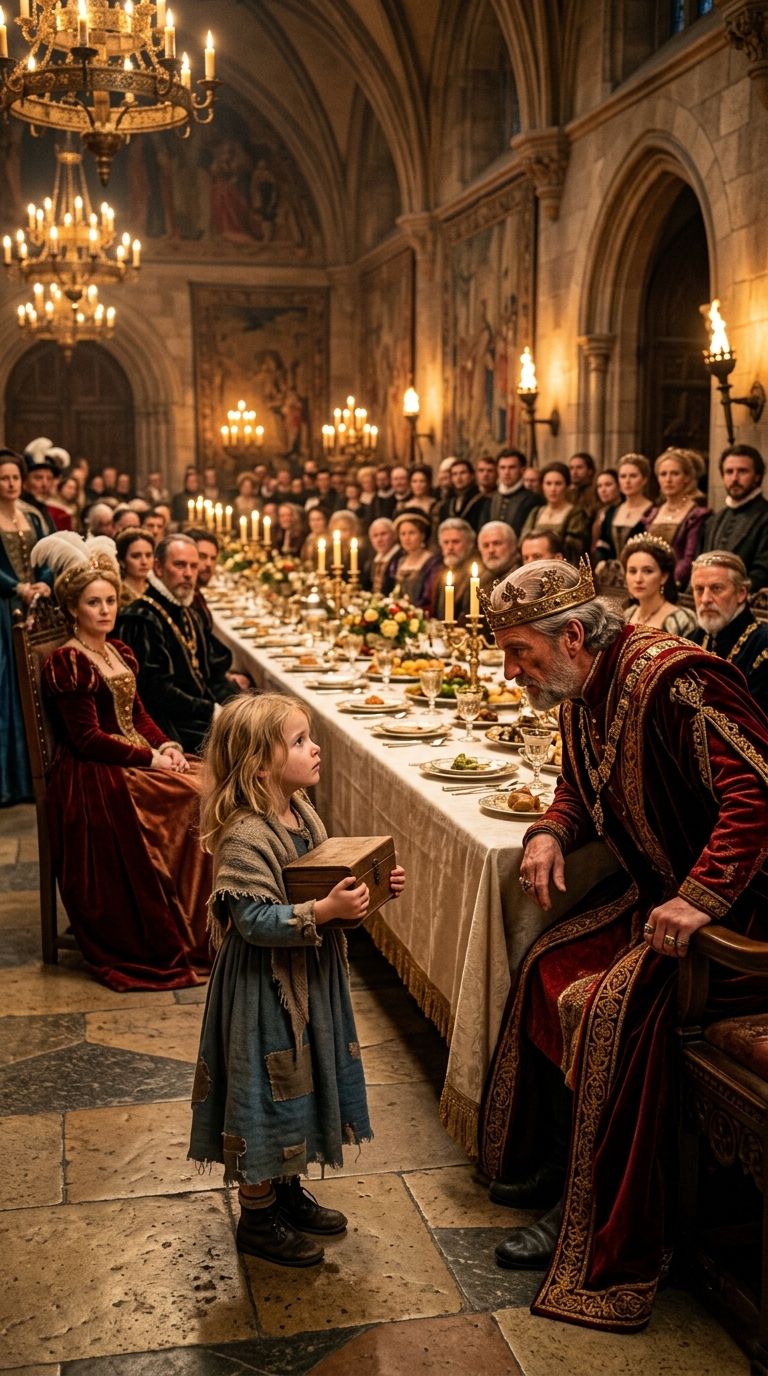
But when a small girl walked across the stone floor carrying a wooden box in both hands, something in the room shifted. Voices lowered. A servant froze mid-step. A noble near the center frowned in disbelief.
She could not have been older than nine.
Her dress was worn, too thin for the season. Her hair had been tied back that morning, but poorly, with loose strands falling across her face. She did not walk like someone brave. She walked like someone repeating instructions she could not afford to forget.
She stopped in the center of the hall and looked directly at the king.
“My mother said this belongs to the king.”
Silence fell instantly.
The king stared at her.
First came irritation—at the interruption, at the broken order. Then confusion. Then something deeper, harder to name.
He stood slowly.
“Who is your mother?” he asked.
The girl tightened her grip on the wooden box.
For a moment, it seemed her courage might falter.
Then she spoke.
“The woman you loved… but your father took from you.”
The words did not echo.
They didn’t need to.
Everyone in that room felt them land.
The king went pale so quickly that the lord beside him stepped back without thinking, as if something unseen had passed between them.
The girl opened the box with trembling hands.
Inside, resting on faded cloth, lay an old ring.
Simple.
Worn.
Silver.
The king recognized it immediately.
He had not seen it in nearly twenty years.
But he knew the small scratch along one side—where it had once struck a stone bench in the western garden. He knew the engraving inside. He remembered her fingers closing around it the night he gave it to her, telling her—young, foolish, certain—that no crown in the world could force him to choose against his own heart.
The hall blurred.
“Clear the room,” he said.
No one moved.
His voice hardened like steel.
“Now.”
Chairs scraped. Nobles stood at once. Servants lowered their eyes and hurried out. The musicians abandoned their instruments. Within moments, the vast hall stood empty—except for the king, two guards at the doors, and the small girl holding the box.
The king stepped down from the high table.
His pace was slower than it should have been.
When he stopped in front of her, he did not reach for the ring immediately.
Instead, he studied her face.
Her eyes were dark and watchful. Not noble. Not fearful. There was something familiar in the curve of her mouth—but memory can deceive, and he did not trust what he wanted to see.
“Where is your mother?” he asked.
The girl swallowed.
“She died three days ago.”
The king shut his eyes.
For a brief, unbearable moment, the hall seemed to tilt beneath him.
“When?” he whispered, though it wasn’t truly the question he meant to ask.
The girl misunderstood—or perhaps she understood exactly what he meant.
“She told me to wait until after sunset,” she said. “She said if I came in daylight, they might stop me before I reached you.”
He opened his eyes again.
“She knew I would see you.”
“She said you would recognize the ring.”
At last, he took it from the box.
His hand trembled.
The engraving inside was still there.
To the one I chose before the world chose for me.
The king clenched the ring tightly in his palm until it hurt.
“What was her name?” he asked, though he already knew the answer.
The girl spoke softly.
“Elara.”
He turned away.
Not from the child.
But from the memory.
He had spent years teaching himself not to hope that name would ever reach him again in a living voice.
“Did she say anything else?”
The girl nodded.
“She said if you looked at me for too long, you would understand before I had to explain.”
Slowly, the king looked back at her.
And this time, he truly saw her.
Not the worn dress.
Not the fear.
But the shape of her face.
The curve of her hair near her temple.
And in her eyes—
Elara.
Not entirely.
But enough.
His breath faltered.
“How old are you?”
“Nine.”
The number struck him like a blow.
Too young, if measured against the years he remembered.
Too old to be dismissed as coincidence.
The king sank into the nearest chair, as if his body had decided before his mind could catch up.
The girl watched him carefully.
“My mother said you would ask me that.”
“What else did she say?”
“She said you never knew.”
The king looked up sharply.
“Knew what?”
The girl hesitated.
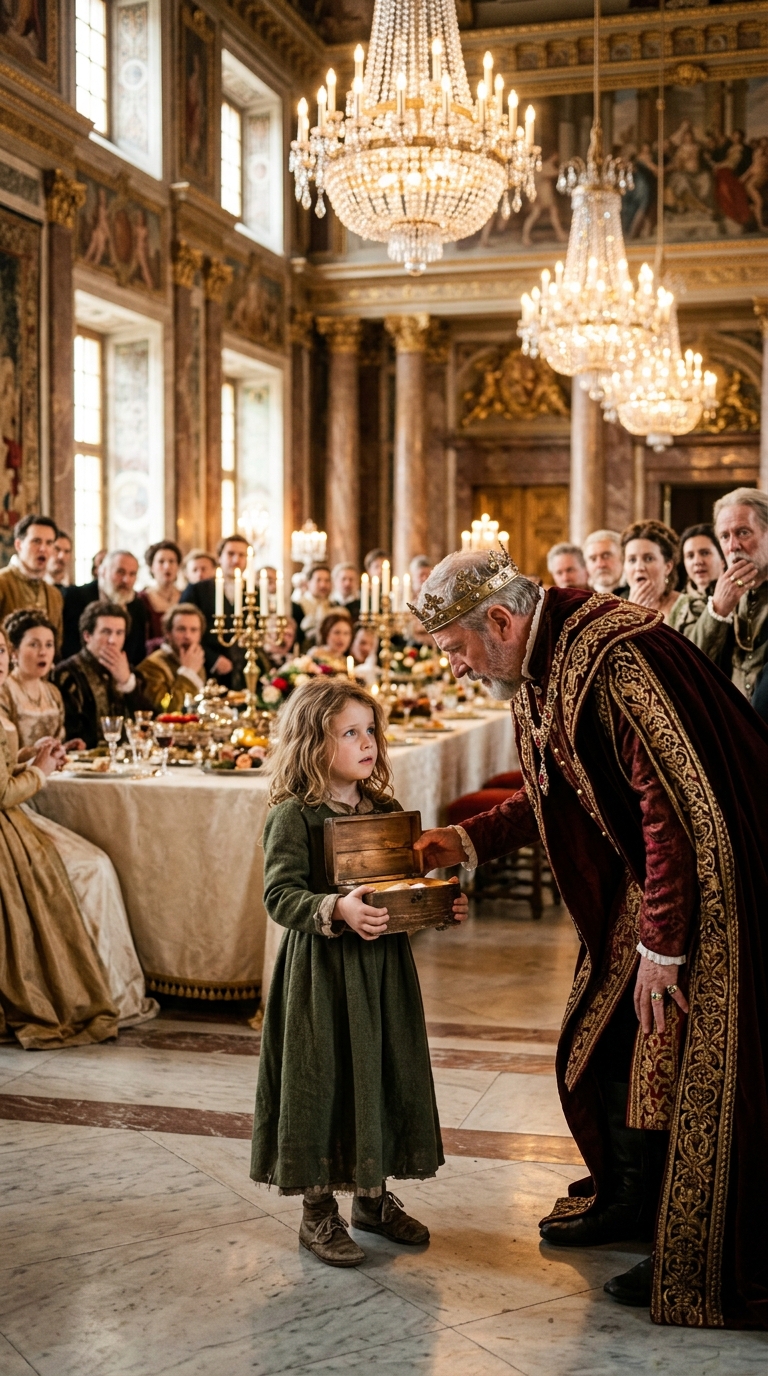
Then, with the quiet weight only truth can carry, she said, “That I was yours.”
The silence that followed was larger than the hall itself.
The king stared at her.
There are moments when a life does not shatter loudly. It opens—quietly, and without return.
His mind moved backward without control.
The last winter before his father sent Elara away. The final days in the western garden. The last letter she had written—filled with tenderness, fear, and sentences that had always felt unfinished.
He had thought she was already grieving.
He had not understood.
“Why didn’t she tell me?” he whispered.
The girl lowered her gaze to the box.
“She tried.”
The king’s expression darkened.
“My father.”
She nodded once.
“He found the letter before it reached you.”
The king rose too quickly, grief and anger crashing through him at once. One of the guards shifted at the door, but the king raised a hand without turning, and the man froze instantly.
The child did not move.
That, more than anything, told him whose daughter she was.
“Elara never married?” he asked.
“No.”
“She raised you alone?”
The girl paused.
“Not alone. There was an old healer in the hills. She helped us for a long time. But my mother never let me come near the capital. She said the palace was beautiful from far away and dangerous from near.”
A broken laugh escaped him.
Because yes—Elara would have said exactly that.
He looked at the girl again.
His daughter.
The thought came slowly, as if even it were afraid to reach him—afraid it might be taken away as everything else had been.
“My name is Livia,” she said softly, as though offering him a kindness before he could ask for it.
He repeated it under his breath.
It sounded both unfamiliar and stolen at once.
Livia.
A daughter.
His daughter.
Alive.
At the far edges of the hall, the torches crackled. Somewhere deep within the palace, bells marked the passing hour. The king stood in the ruins of the life he thought he understood and realized that nothing in his treasury, his armies, or his bloodline had prepared him for this—for a child standing before him, carrying both his past and his reckoning inside a wooden box.
A thousand questions pressed against him at once.
Where had they lived?
How had Elara died?
Had she hated him in the end?
Had Livia eaten enough?
Had she been cold through the winters?
Had she ever laughed the way her mother once did—carefree, unguarded, before the world demanded silence?
But only one question came first.
“Why did she send you now?”
Livia met his gaze without hesitation.
“She said you were finally alone enough to hear the truth.”
A slight frown touched his face.
“What does that mean?”
“She said when kings are surrounded, they only hear what protects the throne. But when they begin to lose what they love, they can finally hear what protects the soul.”
It was far too wise for a child.
Which meant Elara had given it to her exactly as it was.
The king closed his hand tightly around the ring.
For years, he had blamed his father. Circumstance. Duty. The machinery of power that grinds private happiness into something unrecognizable.
Now, standing before the living proof of what had been taken from him, he understood something worse.
He had also blamed time.
But time had not stolen these years.
A man had.
And that man had once sat on the throne—and died with his secrets buried.
Or so the king had believed.
“Did your mother leave anything else?” he asked.
Livia’s expression shifted.
Not into sorrow.
But into hesitation.
“Yes.”
She reached into the inner fold of her dress and drew out a second object.
A sealed letter.
The wax had cracked slightly from the journey, but the imprint pressed into it was unmistakable.
Not Elara’s.
The old king’s.
For a moment, the room felt frozen.
“She found it after he died,” Livia said quietly. “Hidden among papers a priest kept for him at the abbey.”
The king took the letter carefully.
He had not seen his father’s private seal in years.
“Did she read it?”
“No. She said some truths are meant to wound the right person.”
He broke the seal.
Inside was a single sheet.
The handwriting was unmistakably his father’s—precise, controlled, unyielding even in ink.
If this reaches my son, then either chance or weakness has undone what necessity required. You will hate me for what I chose. In time, perhaps you will hate yourself more for forcing me to choose it.
The king kept reading, his vision narrowing around each word.
The woman was with child. I confirmed it before she did. Had I allowed her to remain, you would have broken the kingdom for her. You would have married beneath your station, divided the court, and handed your enemies a living claim stronger than law and weaker than peace. I removed her because I chose the crown over your happiness. One day, you will understand that a ruler is defined not only by what he keeps—but by what he agrees to lose.
The king’s hand trembled so violently that the paper crackled between his fingers.
The final line cut deeper than anything before it.
If the child lived, I pray she never comes here. For if she does, it will mean you failed to become hard enough.
The king lowered the letter.
For a long moment, he said nothing.
Livia stood in front of him, still and waiting.
Then she asked the question Elara herself had likely carried for years.
“Did you know?”
He looked at her.
At his daughter.
At the child he had never protected, because he had never known she needed protecting.
“No,” he said, his voice breaking beneath the truth. “But I should have known enough.”
Tears filled Livia’s eyes then—whether for herself, for her mother, or for the man before her, he could not tell.
“What happens now?” she asked.
He could have answered as a king.
You stay. You are recognized. You are safe. The court will kneel. The bloodline is restored.
But he had learned—too late—that crowns promise far more than hearts can carry.
So he answered as a father might have, if one had been allowed to exist within him all these years.
“What do you want to happen?”
Livia blinked, startled.
No one had ever asked her that inside a palace.
After a long pause, she whispered, “I don’t know.”
It was the truest answer she could give.
The king nodded slowly.
“Then no one will decide for you tonight.”
He ordered rooms prepared—not in the royal wing, but in the queen mother’s old chambers, where the light was softer and the corridors quieter. He had food brought. He dismissed every lord who demanded explanations. And he locked his father’s letter inside his private chest.
Near midnight, when the palace had finally fallen silent, he walked alone into the western garden—beneath the broken stone arch where he had once believed love could stand against power.
In one hand, he held Elara’s ring.
In the other, his father’s letter.
And for the first time in many years, he allowed himself to hate the dead.
Not because they were gone.
But because they had arranged the lives of the living so cruelly before they left.
By dawn, the kingdom itself had not changed.
No proclamations had been made. No bells had rung.
But something inside the palace already had.
A child slept beneath the royal roof, carrying his eyes and Elara’s courage.
And the king realized—with the painful clarity that only comes too late—that the greatest inheritance ever brought into his hall had not come in gold, or titles, or conquest—
but in a small wooden box, held by the daughter he was never meant to meet.
Yet the strangest moment came at sunrise.
A servant entered quietly, reporting that the girl’s chamber was empty.
The bed had not been touched.
The food remained exactly as it had been left.
And on the pillow, there were only two things:
The wooden box.
And the ring.
No note.
No goodbye.
Nothing.
The king went there himself, refusing escort, refusing explanation.
The room was exactly as described.
She was gone.
Only the box and the ring remained.
For one suspended, unbearable instant, he thought history had repeated itself—that he had been allowed to find her only to lose her again.
Then he opened the box.
Inside lay a folded scrap of parchment, written in Livia’s small, careful hand.
I wanted to see if you would keep me because I am your daughter… or because I am a secret the court would fear. If you come for me, come alone. Not as king. As the man my mother loved.
Beneath the note rested a pressed white flower from the western garden—
the one place in the kingdom Elara had once called theirs.
And in that moment, even through the rising panic, the king understood the final gift Elara had left him:
Not proof.
Not blame.
A choice.
The daughter he had never known had not come only to be found—
but to decide whether he was worthy of finding her.
