

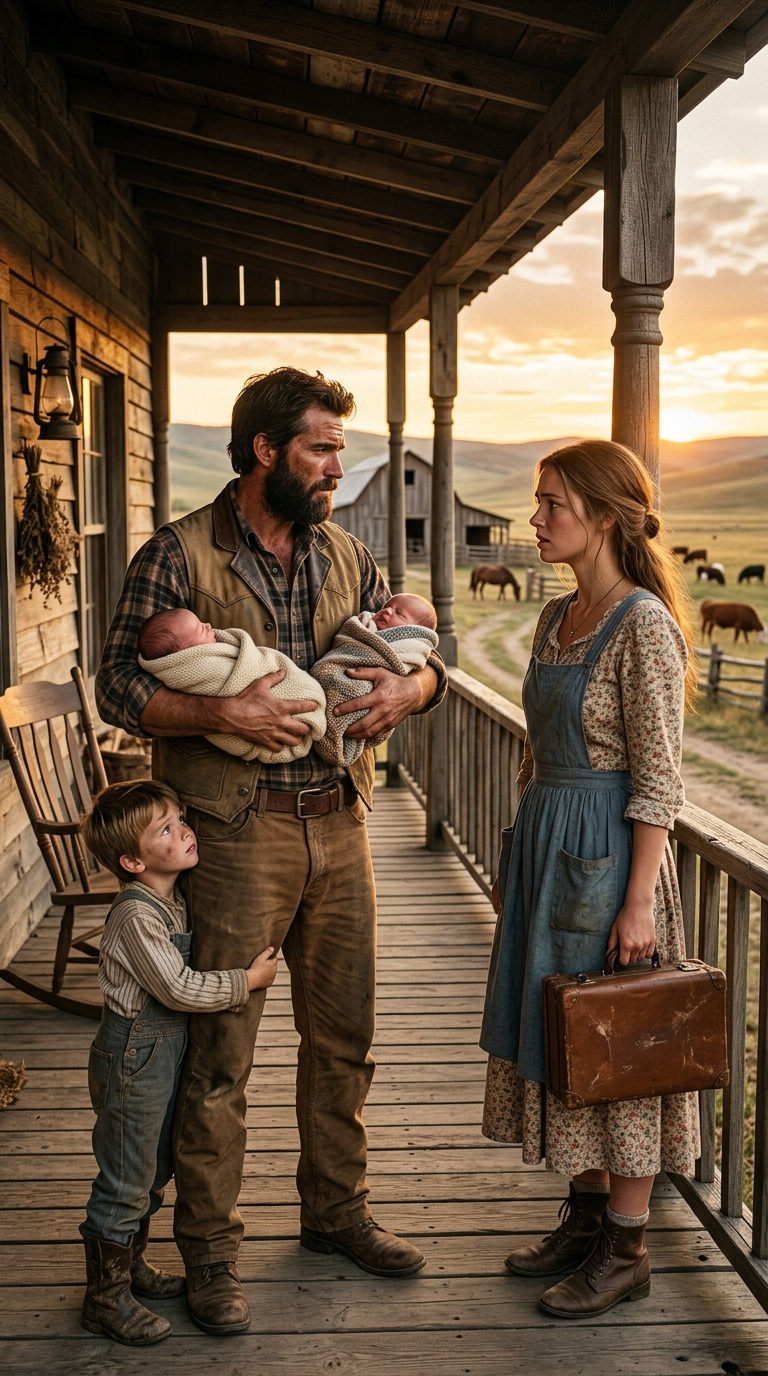
When the wagon stopped in front of the hacienda, Jacinta thought that all that awaited her was hard labor, sharp commands, and silent nights. She stepped down with a small suitcase, a wooden rosary clutched in her fingers, and fear hidden beneath her skirt. She was twenty-three, yet sometimes she felt as though life had placed more years upon her than could possibly fit inside such a young body. She had come from a forgotten village in the Bajío, one of those places where everyone knows each other, and yet no one knows what to do with someone else’s pain.
The hacienda was bathed in the orange glow of the late afternoon. From a distance, it was beautiful. Up close, it felt like a house that had been breathing sorrow for far too long.
As soon as she climbed the steps of the corridor, she saw him.
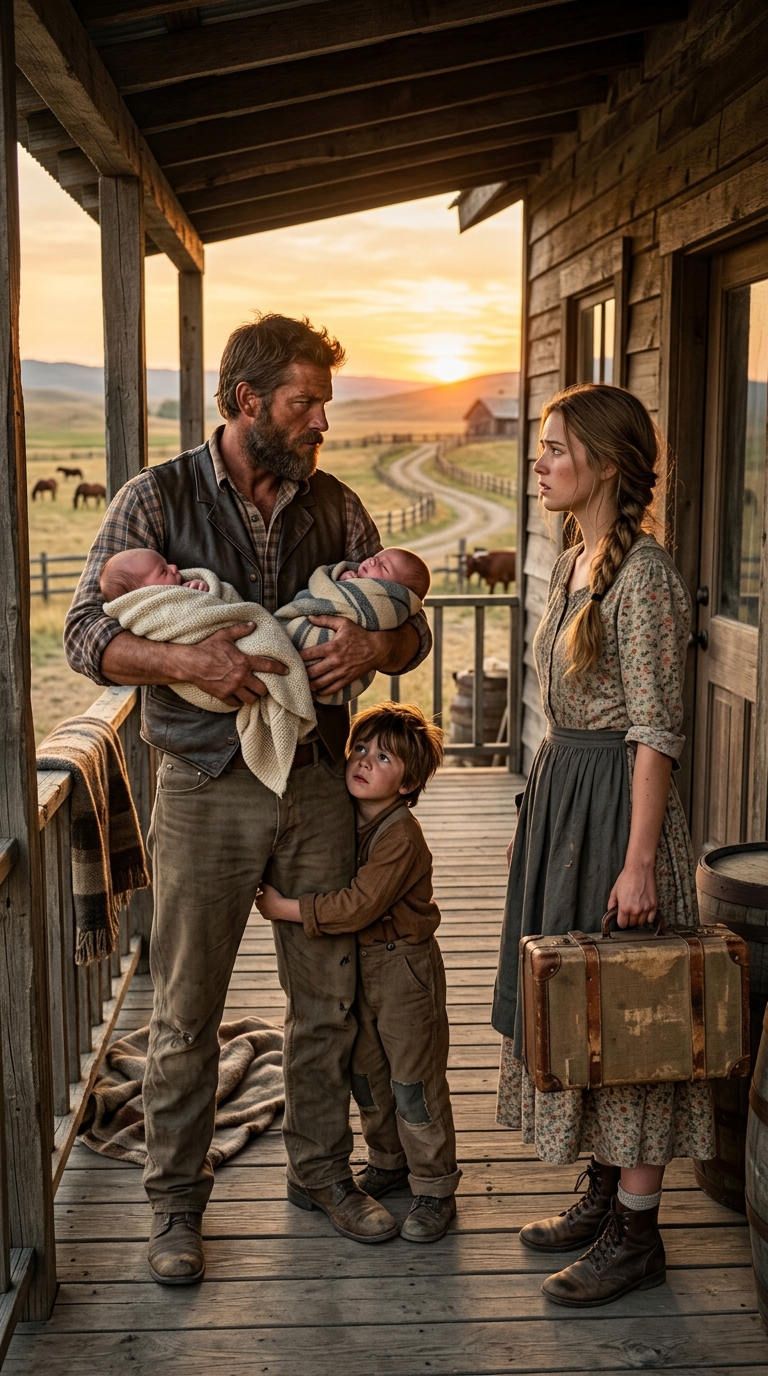
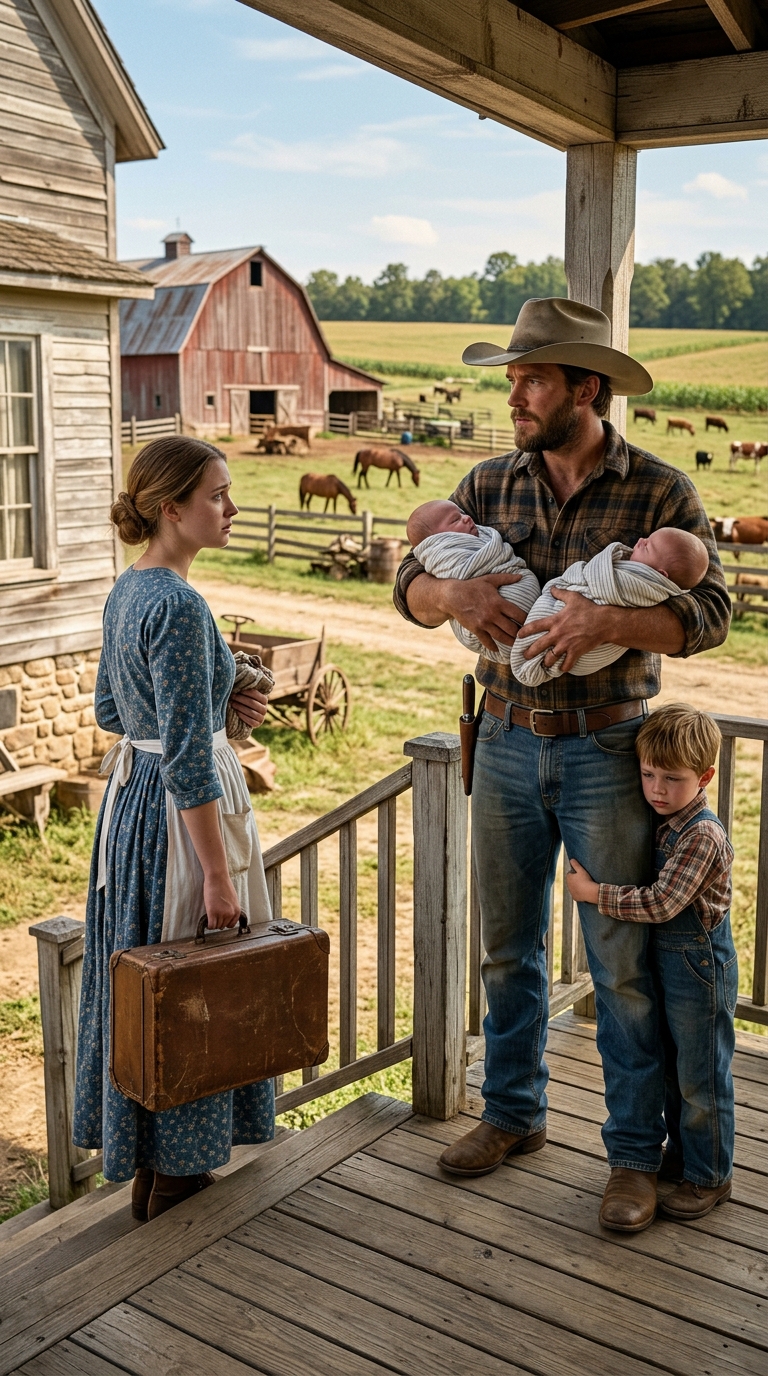
Don Esteban de la Vega stood leaning against the doorway, a baby in each arm. Both were crying with that exhausted cry of children who no longer have the strength, and yet cannot stop. At his feet, sitting against the wall, was a boy of about five. Thin, his knees covered in dust, with eyes so serious they seemed borrowed from an old man.
Esteban did not welcome her. He did not smile. He simply said:
“The work clothes are in the back room. The kitchen has needed hands since yesterday.”
Jacinta lowered her gaze and nodded. She passed beside him, catching the scent of sour milk, damp clothes, and exhaustion. The house was large, but inside it felt empty. There were fine pieces of furniture covered in dust, yellowed curtains, and a strange silence, as if the walls themselves were in mourning.
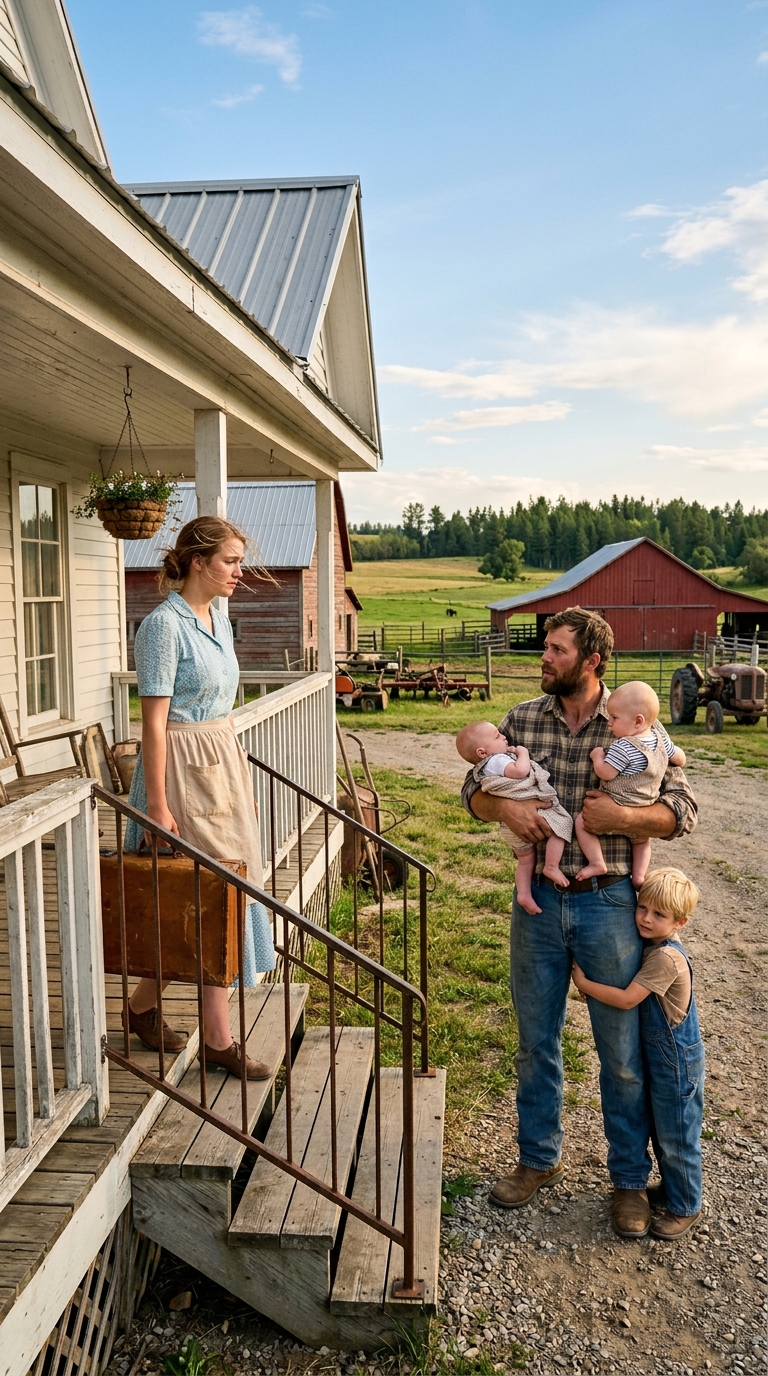
In the kitchen, she was greeted by Doña Cata, an old, thin, hunched woman with a cough that seemed to tear at her chest. It was she who told her the story. Esteban’s wife, Elena, had died eight months earlier after falling from a horse into a ravine. The twins, Tomás and Julián, had been only a few weeks old when they were left without a mother. The eldest boy, Mateo, had watched his mother ride out that foggy morning, wave goodbye, and disappear, never to return. From that day on, he had not spoken a single word.
“Other girls have come before you,” Doña Cata murmured. “None of them lasted. This house is heavy. But the children… the children need someone.”
Jacinta wanted to say that she would not grow attached, that she had come only to work, that serving in a hacienda was one thing and stepping into the pain of a broken family was something entirely different. But she said nothing. She put on the dark uniform, tied her hair with a faded blue ribbon that had once belonged to her mother, and began with what was most urgent.
She lit the stove. Washed pots coated in old grease. Threw away spoiled milk. Swept flour from the floor. She prepared beans, a simple broth, warm tortillas, and coffee. She worked without lifting her head until the kitchen once again smelled like real food instead of abandonment.
That night, she served dinner. Esteban ate in silence. Mateo sat beside him, quiet, without looking at anyone. Jacinta noticed something strange: he was not a restless child, nor spoiled, nor absent. It was as if he had hidden behind an invisible door and was watching the world from there, unwilling to return.
At two in the morning, the twins woke crying. Jacinta heard heavy footsteps in the corridor and then Esteban’s deep voice trying to calm them without success. She turned over in bed. She told herself it was not her responsibility. That her hours were over. That she had no reason to get up. But within seconds, she was already barefoot in the hallway.
She found Esteban sitting on the floor between two improvised crates used as cribs, holding a baby in each arm, his face completely defeated.
Without asking, Jacinta took Julián, the more restless one, and held him close against her chest. Then, without thinking, she began to sing an old lullaby, one her mother used to hum while sewing at night. It spoke of a river, of the moon, and of a small boat carrying sleep to the shore.
First Julián calmed. Then Tomás.
The silence that followed was so deep that Jacinta felt a knot rise in her throat. She avoided looking at Esteban, because she sensed that if she saw his eyes in that moment, with all that fragile truth exposed, something inside her would begin to break.
Doña Cata left three days later. Before she went, she cupped Jacinta’s face with her bony hands and said:
“This house is sick, child. Not the walls. The inside. Take care of it as if it were a person.”
And she did.
In the weeks that followed, Jacinta became the invisible thread that held the entire hacienda together. She woke before dawn, boiled water, prepared bottles, bathed the twins in a tin basin, hung laundry, organized the pantry, cooked for the household and the workers. Little by little, the estate began to feel alive again. The courtyard filled with clean sheets drying under the sun. The front garden, which had died with Elena, began to turn green again because Jacinta pulled weeds in her spare time and watered the plants with the patience of someone trying to save more than just flowers.
But the most important change happened in the corridor.
Every afternoon, when the heaviest work was done, Jacinta would sit at a distance from Mateo and take out a piece of cloth and a blunt needle. She embroidered in silence. She did not speak to him. She did not force him into anything. She was simply there.
On the third day, Mateo moved a little closer.
On the fifth, he sat beside her.
On the seventh, he reached out and touched the yellow flower she was embroidering.
Jacinta understood the question without hearing it. She gave him another piece of cloth and showed him how to pass the thread from one side to the other. Mateo made three crooked stitches and lifted the cloth to look at it as if he had created a miracle. He did not smile, but something in his eyes lit up. Jacinta had to turn her face away so the boy would not see her cry.
From that moment on, Mateo began to follow her around the house like a quiet shadow. He sat in the kitchen while she kneaded dough. Watched her hang clothes. Leaned against the doorway when she rocked the twins. He said nothing, but his silence had changed—it was no longer the silence of someone hiding, but of someone who had found company.
Esteban noticed it before admitting anything else. One afternoon, he returned early from the fields and stopped at the kitchen doorway. Jacinta was sitting there feeding Tomás, while Julián slept in a basket and Mateo, completely focused, embroidered beside her with his tongue slightly between his lips. The scene was simple, domestic, almost sacred.
And it hurt him.
It hurt because it looked like a family.
And a family was exactly what he had lost.
From that moment on, he began to see her differently. He noticed how Jacinta bit her lip when she concentrated, how her hands were rough from labor and yet incredibly gentle with the children, how the smell of coffee at dawn now felt like home because it came from her hands, how the lullaby had settled so deeply in his chest that sometimes he found himself humming it without realizing while checking the cattle.
Then Doña Mercedes appeared.
She was a well-established widow, owner of neighboring lands, elegant, composed, respected throughout the region. Since Elena’s death, she had begun visiting the hacienda frequently: a doctor for the children, fabric for clothing, advice on accounts and harvests. Everyone knew what she intended. Marrying Esteban would have been, in the eyes of the town, the proper thing. The sensible thing. The advantageous thing.
When she met Jacinta, she looked her up and down and smiled with icy politeness.
Then the whispers began.
That the maid was becoming too involved in the household. That the children sought her more than their father. That a single woman sleeping under the same roof as a widowed man could bring nothing good. Even Father Anselmo came to speak with Esteban about the “scandal” and suggested he should consider a proper solution—a wife of his own class, a woman of standing.
Jacinta learned what was being said, and that night she made a decision. Not out of pride, but out of fear. Fear of ruining Esteban’s reputation, of becoming a stain on his children’s name, of staying where she did not belong.
She pulled her suitcase from beneath the bed. Packed her rosary, the blue ribbon, the piece of lace she had never finished embroidering. And also a letter from her mother—the same one she had carried for years without ever being able to read to the end. That night, at last, she did.
In the final lines, her mother had written: Do not live in fear of what others will say. In the end, one regrets more the happiness that was allowed to slip away than the mistakes made in trying to find it.
Jacinta cried in silence. Then she closed the suitcase.
She would leave before dawn.
She waited until the house fell asleep. She walked quietly through the kitchen and placed her hand on the latch of the back door. Then she heard small footsteps behind her.
She turned.
Mateo stood in the middle of the kitchen, barefoot, clutching the embroidered cloth tightly against his chest. He saw the suitcase. He saw the door. He understood everything.
His lower lip began to tremble.
And then it happened.
The boy who had not spoken in eight months opened his mouth and said, in a voice broken from disuse:
“No.”
Jacinta dropped the suitcase.
Mateo stepped toward her, his eyes full of tears, and this time he said it louder, clearer, with a desperation that shattered her heart:
“Mom, stay.”
Those two words pierced straight through her.
She fell to her knees and embraced him as the boy clung to her neck with desperate strength, as if the world were slipping from his hands again. Jacinta cried without holding back—for Mateo, for herself, for the little girl who could not save her own mother, for the fear she had disguised as prudence.
The crying woke Esteban. He appeared in the kitchen doorway, his hair disheveled, his face pale. He saw the suitcase on the floor, saw Mateo clinging to Jacinta, saw the door slightly open to the night—and he understood.
For a few seconds, no one spoke.
Then Mateo, still holding on to Jacinta, looked at his father and said:
“She was leaving.”
It was the second full sentence he had spoken.
Esteban knelt in front of them. His eyes were bright with emotion, but his voice remained steady.
“Don’t go,” he finally said, looking at Jacinta. “Not as a servant. Not out of pity. Stay because this house needs you… and because I do too.”
She looked at him and knew that leaving would not be courage. It would be cowardice.
With trembling hands, she opened the suitcase, took out her mother’s rosary, and hung it on a nail beside the stove.
Mateo understood immediately. He gave the faintest smile—a small but real spark, the first since Elena’s death.
The next morning, the house felt different.
Not because the pain had disappeared, but because, for the first time, love had been given permission to stay.
The whispers did not stop. Doña Mercedes confronted Esteban and accused him of confusing gratitude with love. Father Anselmo refused to marry a maid to a landowner. But Esteban, for the first time in a long while, stopped living for the judgment of others. He sought out another priest, a simple man named Father Tomás, who, upon seeing Jacinta holding the twins while Mateo clung to her skirt, said:
“There are homes that are already blessed before a priest ever arrives.”
They were married in the garden Jacinta had brought back to life. She wore a simple white dress sewn by her own hands and her mother’s blue ribbon in her hair. Mateo stood between them, holding their hands as if he himself were binding together what sorrow had tried to break. Tomás and Julián laughed in the arms of an old farmhand who cried more than anyone during the ceremony.
Over time, the hacienda began to prosper. Jacinta did not just bring warmth into the house; she also helped organize the accounts, the harvests, and the provisions. The twins grew strong and happy. Mateo found his voice again—first in small words, then more and more—until he became a boy with a gentle voice and attentive eyes, able to embroider flowers and run after calves with the same joy.
Years later, on a golden afternoon, Jacinta sat on the corridor embroidering while the twins played in the yard and Mateo, now older, read beside her. Esteban returned from the fields, placed his hands on her shoulders, and asked what she was thinking about.
She smiled without lifting her needle.
“That I arrived at this hacienda with a suitcase so small it could fit under a bed,” she said. “And now, if I were to leave, I would need an entire wagon to carry everything I have.”
Esteban lowered his head and kissed her hair.
In the yard, Tomás shouted that he had won the race. Julián protested that it was not true. Mateo looked up from his book and laughed. And that sound—that silly argument, that pure laughter, that ordinary and beautiful life—filled the air like a song.
Jacinta closed her eyes for a moment and let the sound settle into her chest.
Because in the end, she understood something that had taken her years to learn: family does not always arrive through blood. Sometimes it arrives wounded, tired, crying in the arms of a man who does not know what to do with two babies and a broken child. Sometimes it arrives when a young woman steps down from a wagon believing she has only come to work.
And sometimes, when one thinks she has come only to sweep away the sorrow of others, she discovers that she has actually come to stay—and to turn a house into a home.
