

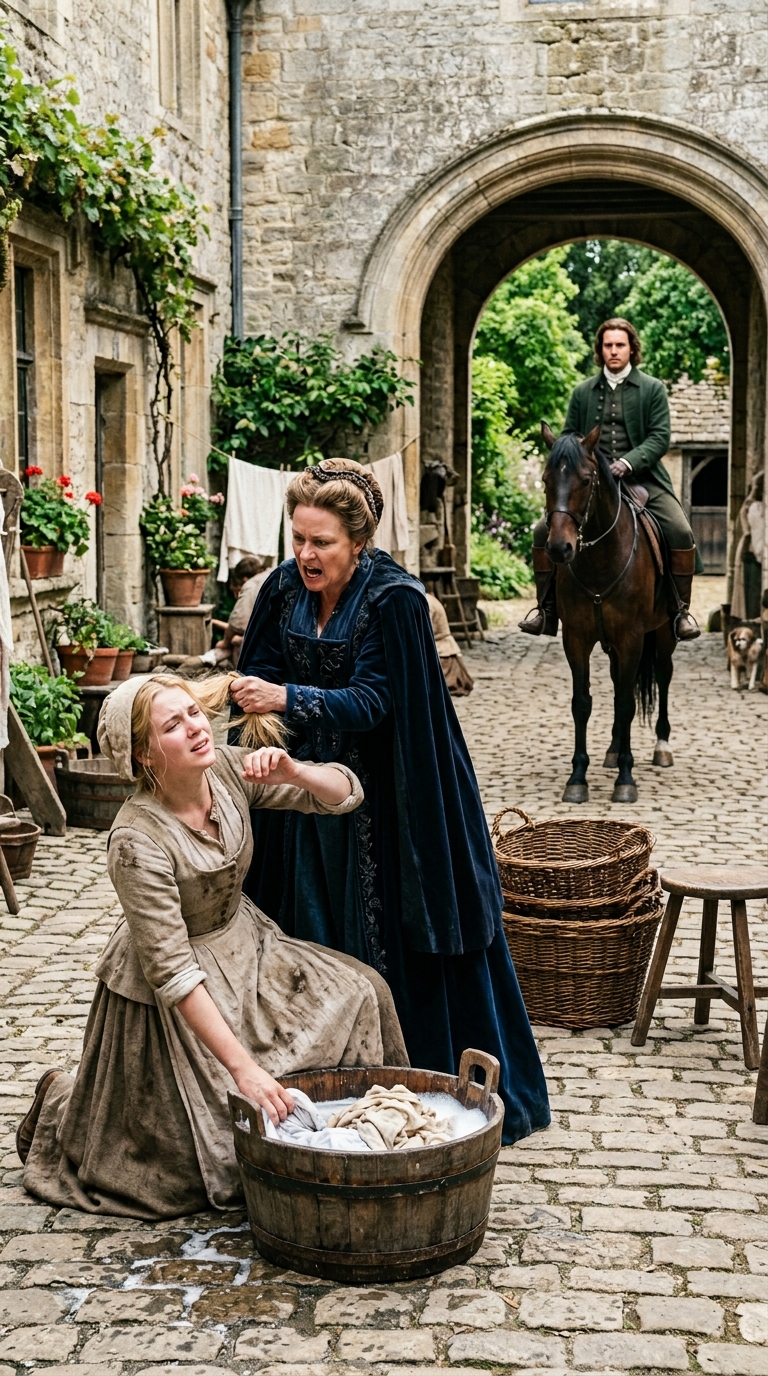
They say a mother’s love knows no conditions. That it is born pure, fierce, ready to protect even when the whole world turns against you. But Paloma Alvarado learned far too early that not all mothers love that way. Some smile in front of others and, in private, deliver poison drop by drop, until the daughter stops feeling like a person and begins to feel like a punishment.
In the summer of 1843, the old Alvarado mansion stood on the outskirts of San Jerónimo like a corpse dressed for a gala. From a distance, it still appeared elegant, with its wrought-iron balconies and white columns covered in withered bougainvillea. But inside, everything smelled of dampness, of debt, of stale pride. The garden was dry, the fountains empty, and the marble floors, once gleaming, now seemed to reflect a ruin no one dared to name.
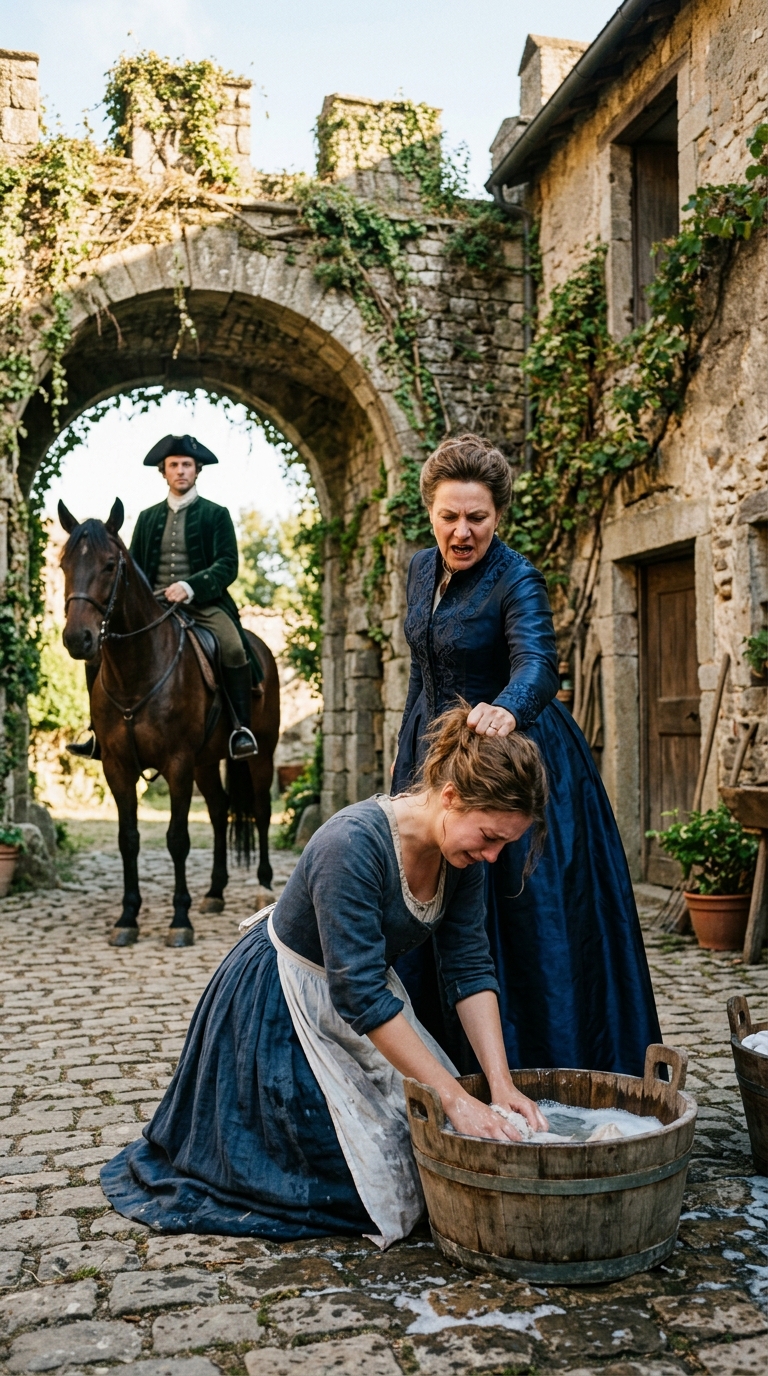
Paloma, nineteen years old, knew every crack in that house because she lived bent over them. That morning, she was on her knees scrubbing the floor of the main hall with harsh soap and nearly freezing water. Her knuckles were split, the skin on her hands cracked, and her entire body ached from the blows of the night before, when a cup had slipped from her fingers and shattered into pieces.
She did not look up when she heard the sound she feared most.
Tac. Tac. Tac.
Her mother’s heels.
“You missed that corner,” said a cold, impeccable voice, sharp as a freshly honed blade.
Paloma swallowed.
“I’ll fix it right away, Mother.”
Doña Carolina Alvarado was beautiful in a way that intimidated. Always dressed in dark silks, her hair arranged with almost cruel perfection, her back straight, her chin raised. She looked like a woman born to be admired. Only those who lived under her roof knew that such elegance concealed a heart hardened by ambition and resentment.
Without warning, Carolina kicked the bucket. Dirty water spilled across the freshly cleaned marble and soaked Paloma’s simple skirt.
“Look what you’ve done,” she spat. “Clumsy. Useless. Just like your father before he died and left me buried in debt.”
Paloma lowered her head even further.
“I’m sorry.”
“Your apologies are worthless. Get up.”
She grabbed her by the hair and forced her to stand. Paloma closed her eyes for a moment. She had learned that screaming only prolonged the punishment.
“You’re going to Don Carlos Robles, to the loan office. You’ll tell him I need another extension. And you will come back with his signature. If you return empty-handed, I swear this time you will learn.”
Minutes later, Paloma left the mansion with her dress still damp against her legs. The afternoon sun was harsh, but outside, at least, she could breathe. She walked toward the town along the edges of the streets, trying to make herself invisible. She always walked like that: small, silent, as if existing as little as possible were a way to survive.
In San Jerónimo, life went on as if nothing were wrong. Vendors called out, selling fruit. Carriages stirred up dust. Women with parasols crossed the plaza. No one paid attention to a pale girl with a bruised cheek and wounded hands. And if someone did, they pretended not to see. In small towns, fear of influential families often looks a lot like indifference.
The loan office stood between the pharmacy and a fabric shop. Paloma took a deep breath before entering.
The bell above the door rang with an absurd cheerfulness.
Don Carlos looked up from his desk. He was a plump man, with a graying mustache and round glasses. As soon as he saw her, he frowned with a mixture of compassion and fatigue.
“Miss Alvarado… I had a feeling you would come.”
“My mother needs an extension on the loan, Don Carlos. Just one more month.”
The man removed his glasses and rubbed the bridge of his nose.
“Paloma, this cannot go on. It’s four months overdue. The bank is already asking too many questions.”
She tightened her fingers against the fabric of her dress.
“Please. Just once more. I will find work. I will do something. I will pay.”
Don Carlos glanced at the bruise near her cheekbone. His jaw tightened, but in the end, he looked away. The kindness of some men extends only as far as the danger of confronting someone like Carolina Alvarado.
“I’ll sign,” he said at last. “But this is the last time. Tell your mother I mean it.”
The relief lasted barely a second. She knew it would not be enough. It never was.
Don Carlos picked up the pen and signed the document. At that moment, the door opened.
The air changed.
It was not imagination. Paloma felt it on her skin, as if a cloud had covered the sun. She turned slowly.
In the doorway stood a tall man dressed in black, with a presence so commanding he did not need to announce his name to dominate the room. He wore riding boots covered in road dust, dark leather gloves, and a simple, well-tailored jacket without adornment. His black hair was slicked back, and he had a full beard. His eyes, gray and deep, looked like a storm.
It was Don Benedicto de la Vega, owner of the Monteoscuro estate to the north of the state.
All kinds of rumors surrounded him. That he had challenged a colonel to a duel. That he never forgave betrayal. That his wife and daughter had died under dark circumstances, and since then, he had become quieter than a mausoleum. Some said he was a dangerous man. Others said he was simply too powerful for people to like him.
Don Carlos stood abruptly.
“Don Benedicto. I was not expecting you until next week.”
“My plans changed,” he replied, his voice low, calm, impossible to ignore.
Paloma tried to leave without drawing attention. But as she passed him, the worn heel of her shoe caught in the carpet. She stumbled forward and collided with his arm.
It was like hitting a wall of stone.
She stepped back immediately, mortified.
“I’m sorry, sir. I…”
She expected contempt. Humiliation. Perhaps a cold order never to touch him again.
But Benedicto said nothing at first. He observed her.
Not casually. Not with a quick glance. He saw her entirely: the bruised cheek, the injured hands, the hunched posture, that silent trembling that belongs only to those who have lived in fear for far too long.
“What is your name?” he asked.
“Pa… Paloma Alvarado.”
Something shifted, just slightly, in his expression.
He extended a gloved hand, palm upward.
She froze.
It was not a command. Nor a caress. It was an invitation.
With hesitation, she placed her hand in his. Benedicto held it with careful firmness and helped her regain her balance, as if he knew exactly how much strength to use without breaking what little remained standing inside her.
“You may go,” Don Carlos murmured nervously.
Paloma took the signed document and left almost running.
She returned to the mansion before nightfall. Her mother was waiting in the hall with a glass of wine.
“Well?”
Paloma handed him the paper. Carolina read it and let out a bitter laugh.
“Another extension. Do you know what this turns us into? Beggars. Trash.”
“I only did what you asked.”
The slap made her stagger.
“Do not speak unless I ask you to.”
Paloma clenched her teeth and stepped back. When she finally managed to lock herself in her room—a tiny space with a narrow bed and a broken mirror—she pressed her forehead against the door and breathed as if trying not to drown.
She did not hear the carriage arrive.
She did not hear the gate open.
The first thing she heard clearly was her mother’s scream.
Paloma moved closer to the door and pressed her ear against the wood.
“You have no right!” Carolina shrieked. “You cannot enter my house and demand anything from me!”
Benedicto’s voice answered, even lower, but sharp as iron.
“I am not here to demand. I am here to inform. Your daughter will leave this house tonight. I have the authorization of the local magistrate and the records of your debts, your abuse, and your incapacity to be her guardian.”
Paloma’s heart pounded so hard it hurt.
“She is my daughter!”
“No. A mother protects. You manage suffering.”
A heavy silence followed.
Then Carolina spoke again, her voice so cold and calculating it sent a chill through Paloma’s blood:
“How much will you pay me for her?”
This time, the answer came in a second.
“Nothing. Because I am not buying. I am preventing a crime.”
Then came Carolina’s furious whisper, a threat—and immediately after, Benedicto’s voice, more dangerous than a shout:
“Sign, Doña Carolina. Or tomorrow you will wake up to magistrates, witnesses, creditors, and half of San Jerónimo learning why that girl lives marked.”

Paloma heard the scratch of a pen on paper.
Then footsteps.
The door opened, and Benedicto appeared in the doorway.
“Pack what you need. You are leaving with me.”
“I don’t understand,” she whispered.
“You do not need to understand everything tonight. Only to leave.”
“Why would you do this for me?”
He looked at her for a moment.
“Because no one did it for the people I loved. And I will not repeat that mistake.”
Paloma placed into a cloth bag a dress, a shawl, and a small wooden box that had belonged to her father. That was everything she owned. As she crossed the hall, she felt her mother’s poisonous gaze burning into her back.
“You will come back crawling,” Carolina spat.
Paloma did not answer.
She climbed into the carriage and did not look back until the house had become a distorted shadow swallowed by the night.
The Monteoscuro estate appeared three hours later, outlined against the sky like a fortress of volcanic stone. Its high walls, narrow windows, and iron gate would have frightened anyone. They frightened Paloma too. But when she crossed the threshold, a woman in her fifties, with sharp eyes and strong hands, came forward to greet them.
“I am Doña Inés,” she said. “I run this house. And you need to eat, bathe, and sleep before you collapse.”
The room they gave her had clean sheets, a small fireplace, and a window overlooking orange trees. It took Paloma several minutes to believe she could truly close the door—and that no one would open it to hurt her.
That night, she cried as she had not cried in years.
Life in Monteoscuro followed strict rules, but there was no cruelty. No one raised their voice. No one watched her with the eyes of an executioner. Benedicto rarely appeared during the day. He spent hours in his study, rode out on horseback, or received sealed letters that Inés kept locked away.
Little by little, Paloma pieced together the story through silence and murmurs. Benedicto had lost his wife, Mariana, and his young daughter, Rosita, five years earlier. Officially, they had died from a sudden fever. But the servants spoke of something more. Of a man named Esteban Figueroa, an operator for corrupt politicians and landowners, skilled at making tragedies look like accidents.
One night, unable to sleep after a nightmare, Paloma woke screaming. Minutes later, Benedicto was at her door, dressed only in a night shirt, his face tense with concern.
“Are you hurt?”
“No. I just… dreamed about her.”
He lit the lamp and sat in the chair by the window.
“Bruises leave the body before they leave the memory,” he said.
Paloma looked at him in silence.
“How do you know that?”
Benedicto held her gaze.
“Because I live with ghosts too.”
It was the first time they truly spoke. Not as savior and rescued, but as two broken people recognizing each other’s fractures. He told her about Mariana, about Rosita, about the suspicion that had followed him for years, about the evidence he was gathering against Figueroa. Paloma told him about her mother, about the sleepless nights, about fear turning into habit.
“Pain does not make anyone noble,” Benedicto said. “It only destroys—unless someone helps you escape it.”
Those words stayed with her.
The danger arrived at the beginning of autumn.
Doña Inés burst into the library, paler than usual.
“He is here,” she said.
Paloma looked out the window.
In the courtyard, beside a black carriage, stood a man of ordinary appearance—almost forgettable—except for his eyes: cold, calculating, patient like a predator. Esteban Figueroa.
Benedicto went out to meet him. They spoke for ten minutes. When he returned, his face was hardened.
“He wants to open an investigation,” he said. “Improper rumors. A young woman living under my roof. Kidnapping. Manipulation. The truth does not matter to him. He only needs an excuse.”
That night, while the house slept, Paloma passed by the study and noticed a light still on. She pushed the door open. Benedicto was asleep over scattered papers on the desk. She had no intention of intruding, but a sealed document, half hidden among the others, caught her attention.
She opened it.
She felt the blood drain from her hands.
It was not a simple summons. It was a sentence disguised as one. Figueroa was not coming to discredit him. He was coming to eliminate him under the appearance of legality.
The next morning, Paloma confronted him in the stables.
“You intend to turn yourself in.”
Benedicto looked up.
“You should not have seen that document.”
“Answer me.”
He clenched his jaw.
“If I resist, they will drag you down with me. They will say you are an accomplice, that you were seduced, that you lied. I will not allow that.”
Paloma stepped closer to him.
“You took me out of a house where they believed they could decide my life through fear. I will not let another man do the same to yours.”
“Paloma…”
“You taught me that pain breaks you if no one pulls you out of it. Now it is my turn.”
Three days later, Figueroa returned with a magistrate and two bailiffs.
What he did not expect was to find Paloma in the main hall, dressed with sober elegance, her hair tied back, her posture straight, and a folder of documents in her hands.

“Gentlemen,” she said in a clear voice, “before you proceed, there is something you must review.”
Figueroa smiled with contempt.
“This does not concern you, miss.”
“It concerns me more than anyone.”
She opened the folder. Inside were testimonies from neighbors, merchants, and former servants of the Alvarado household; medical records of her injuries; the fraudulent loan extensions obtained by Carolina; and, most importantly, a signed statement from Don Carlos detailing coercion, abuse, and threats. Doña Inés had also provided old letters from Mariana and pharmacy receipts proving that the “fever” years ago had coincided with the presence of a supposed doctor sent by Figueroa.
The magistrate frowned.
Paloma did not tremble.
“Don Benedicto legally removed me from a house where I was abused. You, Mr. Figueroa, are using my presence here to conceal another intention: to execute a man who has spent years gathering evidence against you and against the deaths of Doña Mariana de la Vega and the child Rosita.”
“You have no proof!” Figueroa roared.
“Check your sealed orders,” Paloma replied, turning to the magistrate. “You will see they contradict the official reason for your visit.”
The magistrate extended his hand.
For the first time, Figueroa hesitated.
And in that hesitation, everyone understood.
Benedicto stepped beside Paloma. Not in front of her. Beside her.
“If you attempt to proceed,” he said with deadly calm, “all this documentation will be sent to the capital today. And your name will no longer be useful to those you serve.”
The magistrate cleared his throat, uneasy.
“This requires formal review. No one will be detained today.”
Figueroa left Monteoscuro with a rigid jaw and shattered authority.
What followed was slow, but decisive. Carolina Alvarado was socially exposed. Creditors closed in on her. Many doors that once opened to her no longer did. Figueroa lost protection when the investigation escalated and certain powerful men chose to sacrifice him to protect themselves.
For the first time, fear changed hands.
The months restored calm to Monteoscuro. Paloma learned to read the estate’s account books, to ride a horse, to walk through the corridors without flinching at footsteps behind her. She learned to laugh again—at first timidly, then with genuine joy. She discovered that she had a voice, that she could say “no,” and that sometimes saying “yes” could also be an act of freedom.
One winter afternoon, as the sun set over the orange trees, Benedicto found her in the library.
“You are free to leave whenever you wish,” he said. “You are of age, you have resources, and you will have my help if you choose to build a life away from here.”
Paloma closed her book and offered a faint smile.
“And if I don’t want to leave?”
Benedicto remained silent.
“Not as a ward,” she added. “Not as someone who was saved. But as someone who chooses to stay.”
A rare softness appeared on his face, precious because it was so rare.
“Then I would consider myself the most fortunate man in this country.”
A year later, on a cold night, with the fireplace lit and the wind gently tapping against the windows, Benedicto handed her a small velvet box.
Inside was a simple, elegant ring.
“I am not asking you to forget anything,” he said. “Only to allow me to build with you something stronger than everything that tried to destroy us.”
Paloma looked up. She saw the man who had not turned away when everyone else chose not to see. The man who gave her shelter without demanding blind obedience. The man she, in her own way, had also saved.
“Yes,” she whispered.
Benedicto slipped the ring onto her finger, and she kissed him with a tenderness that was steady, calm, and free of fear.
Outside, the night remained cold. The past still existed. The scars did not disappear as if by magic. But inside that library, beside the fire, two people who had known hell finally understood that salvation does not always arrive as a miracle.
Sometimes it comes as a door someone opens.
Sometimes it comes as an outstretched hand.
And sometimes, when you accept it and then learn to extend your own, it stops being called rescue.
And begins to be called home.
