

Alejandro Montalvo was not a man accustomed to surprises. In his world, everything came with advance notice: meetings were scheduled weeks ahead, decisions were signed with lawyers’ ink, and even smiles seemed rehearsed. That’s why, that afternoon, as the watch on his wrist marked an “impossible” hour for him to be home, he felt a strange, almost childlike joy at the thought of Valeria. He imagined her face when she saw him walk in early, the scent of the living room blending with hers, the sound of her heels approaching as she came to embrace him. He had left his office with the familiar knot of stress in his chest, but in the car, for the first time in months, that knot began to loosen.
The mansion, however, greeted him with a stillness that wasn’t peace. It was something else. A silence too polished, as if someone had wiped the air clean of any trace of life. The hallway lights were still on, and that detail—something that should have seemed normal—brushed against his skin like a warning. Alejandro closed the door carefully, not out of discretion, but because the place seemed to demand it, as if the marble itself could betray him.
He hadn’t even taken off his coat when he heard hurried footsteps. They weren’t Valeria’s light steps. These were heavier, more urgent. And then Rosaura appeared.
The maid had been in that house for years—so long that Alejandro could no longer remember the first time he had seen her. Rosaura was one of those presences that becomes part of the background: always punctual, always quiet, always fixing what no one noticed. But that night, she was not the same woman. Her face was pale, her eyes wide as if she had witnessed an accident, and her hands trembled as though the cold had seeped into her bones.

“Sir… please… don’t say anything,” she whispered, and before he could ask, she grabbed his arm with a strength he didn’t know she had. “Trust me. Follow me.”
Alejandro frowned. No one grabbed him like that. No one spoke to him in that tone. His first instinct was the same as always—control. He was about to demand an explanation, to call out Valeria’s name, to order everything clarified on the spot. But Rosaura tightened her grip again, leaned closer, and with an urgency that froze his blood, whispered:
“Stay quiet… please!”
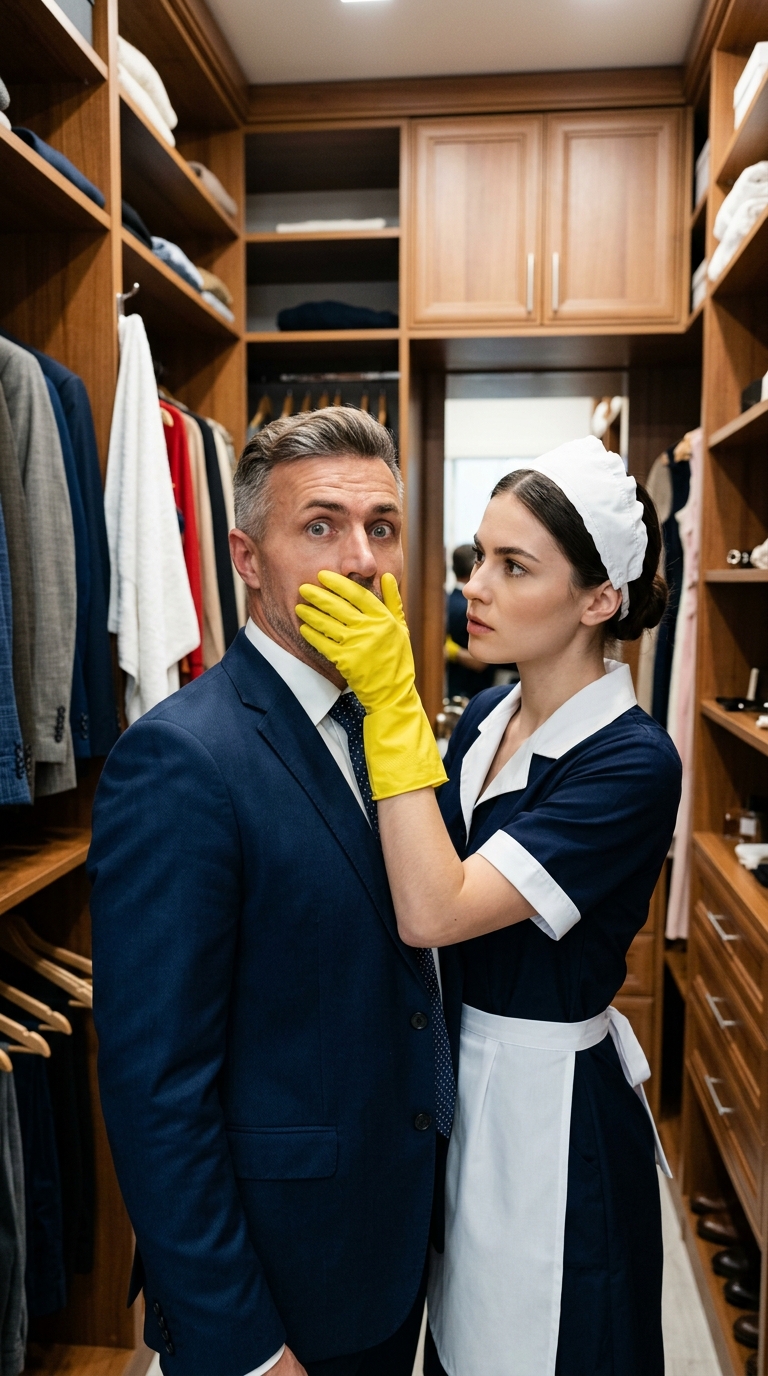
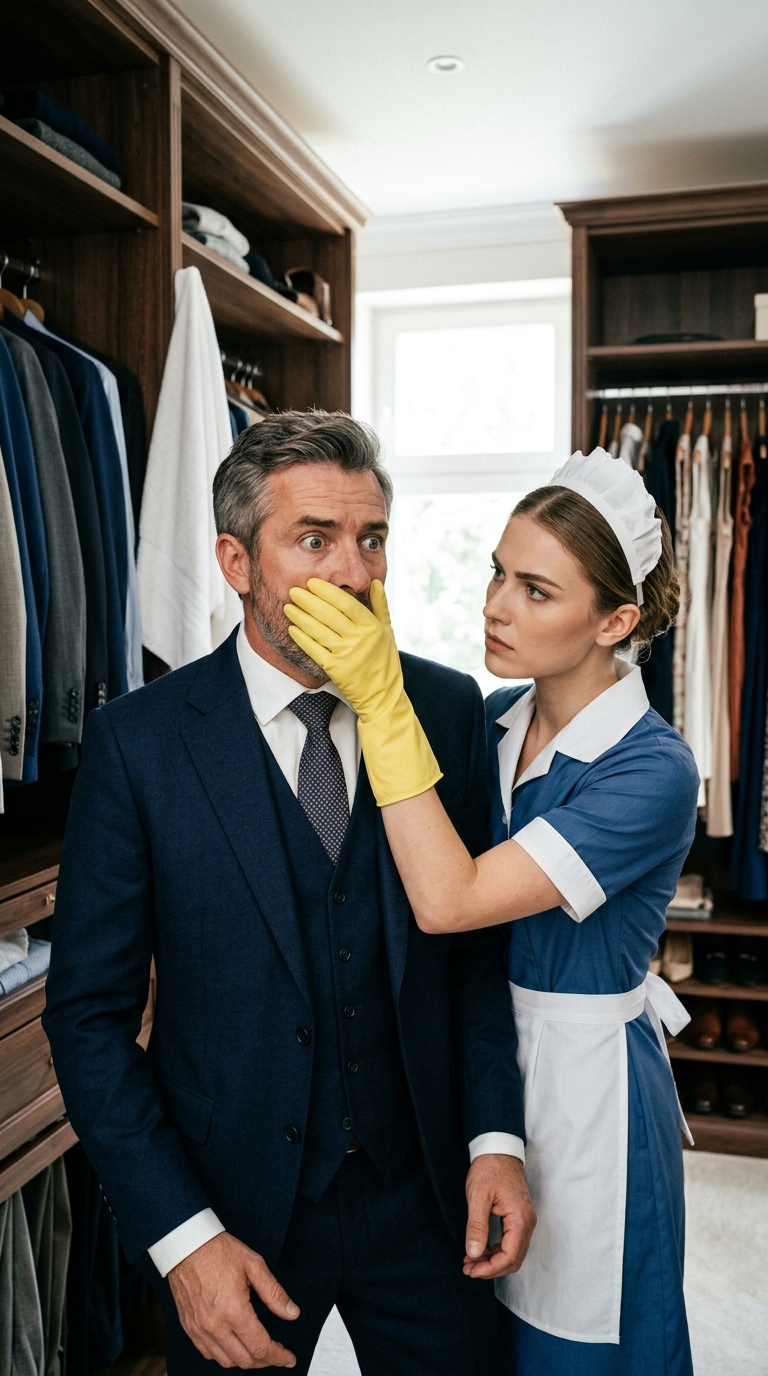
She pushed him toward a large wardrobe—an old wooden closet in the hallway where Valeria kept expensive coats she rarely wore. Inside, it smelled of dust, leather, and perfume—a mixture of trapped luxury. Rosaura closed the door almost completely, leaving only a narrow crack. Alejandro wanted to protest, but her hand covered his mouth—gentle, yet firm—as if she were saving his life with a single gesture.
From the other side came a sound that froze him in place: laughter. A familiar, warm laugh, like one shared over a glass of wine. Valeria’s voice.
And then, like a shadow that should not have been there, a man’s voice responded—confident, assured, far too comfortable inside his home. Alejandro felt his heart pounding in his temples. Something inside him told him this was not just a conversation—it was a breaking point, the kind that splits a life in two. And through that narrow crack, that thin thread of light, the truth was beginning to reveal itself.
—
From the darkness of the closet, Alejandro saw the living room lit with flawless elegance. The fireplace was burning—not out of necessity, but for appearance. On the table, two glasses gleamed. Valeria sat on the sofa, relaxed, as if that world belonged to her by natural right. Her hair was tied back, her dress simple yet expensive, and she wore that smile Alejandro had mistaken for love so many times.
Across from her stood Julián.
Julián—his brother. His blood. His childhood partner, the one who had once sworn they would always stand on the same side.
The blow didn’t come as a shout or a dramatic scene. It was silent, intimate—like a blade sliding in without a sound. Alejandro felt something inside him tear loose. For a second, he wanted to throw open the closet door and demand answers. He wanted to see them tremble. He wanted to hear the words, “It’s not what it looks like.” But Rosaura, pressed against him in the shadows, held his wrist and slowly shook her head, her eyes filled with fear.
Valeria spoke about numbers and decisions as if Alejandro no longer existed. She mentioned properties, shares, changes within the company he had never authorized. Julián nodded with an obscene calm, taking slow sips from his glass.
“It’s only a matter of time,” he said. “We just have to do it right. No scandals.”
Valeria set her glass down on the table with a composure so perfect it was infuriating.
“Soon he’ll stop being an inconvenience,” she said—and she said it without guilt, without hesitation, as casually as someone commenting on the weather.
Alejandro felt the air leave his lungs. Rosaura pressed her lips together, and in her eyes was an I knew it that hurt more than any words.
Julián lowered his voice, as if sharing something sweet.
“Small doses,” he explained. “Consistent. Fatigue, dizziness—symptoms easy to justify. No one suspects when a body slowly fades away.”
Alejandro’s world shrank. He remembered the past few months—the exhaustion that overtook him in meetings, the dizziness when he stood up, the constant feeling of being one step away from fainting. He had gone to the doctor. He had taken tests. “Stress,” they told him. “Too much pressure.” And he had believed them, because it was easier to blame himself than to look around.
Now, in that closet, he heard his name like a sentence.
“Once everything is signed, once control is ours…” Valeria murmured, “no one will be able to challenge it. Not even him.”
The word inheritance rose like a monster. Contracts. Control. Total control. Each term pressed against his chest like a stone.
And as if the truth carried physical weight, Alejandro suddenly felt his body turn strange. A wave of dizziness blurred his vision. Cold sweat formed on his forehead. His heart raced, yet his strength drained away like water through an invisible crack. He opened his mouth to breathe, but Rosaura covered it again, pleading silently.
“Sir… hold on,” she whispered near his ear. “Don’t move. Please.”
Alejandro tried to nod. Tried to tell her he understood. But his throat burned, and for a moment, he feared he would collapse inside that closet—and that everything would end there, without justice, without explanation, without one last glimpse of daylight.
The room fell into sudden silence when something inside the closet—his elbow, perhaps—brushed against a shelf. A decorative figure fell to the floor with a sharp, brutal sound.
The laughter stopped.
Valeria froze. Julián frowned.
“Did you hear that?” he asked.
Panic clenched Alejandro’s stomach. If they opened that door, there would be no turning back. Rosaura closed her eyes for a brief second, as if praying without words, and acted before fear could paralyze her. She opened the closet just enough to slip out, her body blocking the narrow gap.
“Rosaura?” Valeria called, her voice dripping with false sweetness.
Rosaura walked toward the opposite hallway with forced calm. From inside, Alejandro could hear her breathing fast, her footsteps trying not to betray urgency. Then, with a calculated motion, she shoved a stack of boxes near the staircase.

The crash was deafening—cardboard, glass, metal. A noise that rippled through the house like lightning.
“God!” Valeria exclaimed.
Footsteps rushed toward the sound. Julián muttered something irritated. Rosaura returned quickly, almost silently, and opened the closet.
Alejandro was still standing out of sheer pride, but his legs were already failing him. The poison—because he could no longer call it anything else—was shutting him down from within.
“We can’t stay here,” Rosaura whispered, slipping an arm around his back. “If you stay… you won’t make it out.”
The hallway seemed longer than ever. The lights were dim, and every shadow felt like a potential witness. Rosaura guided him along the wall, avoiding any corner where there might be a camera. Alejandro tried to walk straight, but his vision flickered in and out, like a lamp about to go dark.
“No… my car…” he managed to murmur.
“No, sir,” Rosaura cut him off. “They’ll track it. Trust me.”
That phrase—trust me—pierced Alejandro like an act of faith. His entire life had been built on trusting contracts, signatures, guards, systems. That night, the only solid thing was the hand of a humble woman holding him up so he wouldn’t fall.
They reached the service exit—a discreet door rarely used, at the end of a corridor that smelled of cleaning supplies and kitchen air. Rosaura opened it slowly, like someone opening a crack toward freedom. The night air rushed in, cold and real. Outside, the back garden lay in darkness—no music, no luxury. Only earth, shadows, and silence.
Rosaura led him along a narrow path, avoiding the main lights. The mansion faded behind them, like a beautiful but rotten castle. Alejandro felt something close to an old sorrow. That place had been his pride, his shield. Now it was a cage.
Rosaura’s car was old and inconspicuous, parked far away on a street no one would associate with a millionaire’s life. The engine hesitated, coughing like an old man, but finally turned over. As the car began to move, Alejandro looked back through the window at the fading lights of his home—and he couldn’t tell whether what he felt was relief… or grief.
Rosaura drove while avoiding the main avenues. She didn’t head to a hospital, didn’t call the police, didn’t ask anyone for help. Every turn seemed premeditated, as if she had rehearsed that route in her mind for weeks.
“How…?” Alejandro tried to ask, his voice broken.
Rosaura tightened her grip on the steering wheel.
“Because I heard them, sir,” she said. “Several times. And because I saw things in your food… in your drinks. And because you started getting sick, and no one—no one was asking the right questions.”
Alejandro swallowed, feeling humiliation burn his throat. He—the man who believed he saw everything—had missed what mattered most.
“I recorded it…” Rosaura continued, her voice trembling. “I didn’t know if anyone would believe me. But I needed proof.”
Alejandro closed his eyes, fighting the pull of unconsciousness. The city shifted from elegant neighborhoods to humbler streets, with dim lights and worn walls. The car finally stopped in front of a small house in a narrow alley. There were no cameras, no gate, no guards. Just a simple door and the silence of the night.
Inside, it smelled of coffee and real life—of hanging laundry, stored soup, and family. Rosaura helped him in and laid him down on an old but clean sofa. Alejandro felt his body give in. It wasn’t the comfort of luxury—it was something else: safety.
The following days blurred together. There were hands that gave him water, a neighbor who lent a phone, a doctor who came without unnecessary questions. There were tests. There was a name for what had been killing him. There was confirmation, cold and undeniable: poison—small doses, accumulated over time.
When sirens echoed in the distance, Alejandro was still weak, but for the first time in a long while, his mind was clear. Rosaura handed over the recordings. Clear audio. Distinct words. “Small doses.” “Inheritance.” “Stop being an inconvenience.” The truth left no room for excuses.
Valeria and Julián were arrested. There was no glamour in their downfall. No applause. Just cameras, pale faces, and a public silence heavier than any headline. Their accounts were frozen. The company was placed under intervention. The Montalvo name—once a key that opened doors—became a burden, a stain no one wanted to carry.
Alejandro watched it all without joy. He felt no sense of revenge. What he felt instead was a deep exhaustion, as if his body finally understood that it had survived. In Rosaura’s modest home, he sat one afternoon staring at his hands—hands that had signed thousands of documents, yet had failed to hold on to what truly mattered.
“Why did you do it?” he finally asked, when his voice had regained some strength. “You could have left. You could have stayed silent.”
Rosaura looked at him as if the question itself was sad.
“Because you… were hard sometimes, sir,” she said honestly. “But you were also fair. Because I saw how early you got up, how you worked, how you carried the weight of everything. And because… even if they ignored me in that house, I knew one thing: no one deserves to die like that—betrayed at their own table.”
Alejandro lowered his gaze. For the first time, pride offered him no protection.
That day, he understood something no business or wealth had ever taught him: power can buy silence, but it cannot buy loyalty. Loyalty is born in places where people look each other in the eye, where bread is shared without calculation, where a word is worth more than a contract.
When he was finally able to walk without support, Alejandro did not return to the mansion as a man reclaiming a throne. He returned like someone stepping into a place that no longer belonged to him. He walked through the halls, saw the glasses, the fireplace, the expensive paintings—and realized that all of it was fragile, decorative, replaceable.
What had held him up the night he nearly died was a trembling, courageous hand that told him to “stay quiet”—not to silence him, but to save him.
Alejandro began again—not only with lawyers and reforms, but with a deeply personal decision: to learn to listen before life forced him into silence. In his world, betrayal had been born from luxury and pride. Loyalty, from humility. And from that moment on, whenever someone asked what he had learned, he answered without embellishment:
“There are silences that destroy you… and silences that save you. And when everything collapses, only one truth remains: it’s not what you have that saves you—it’s who stays by your side when you lose your footing.”
