

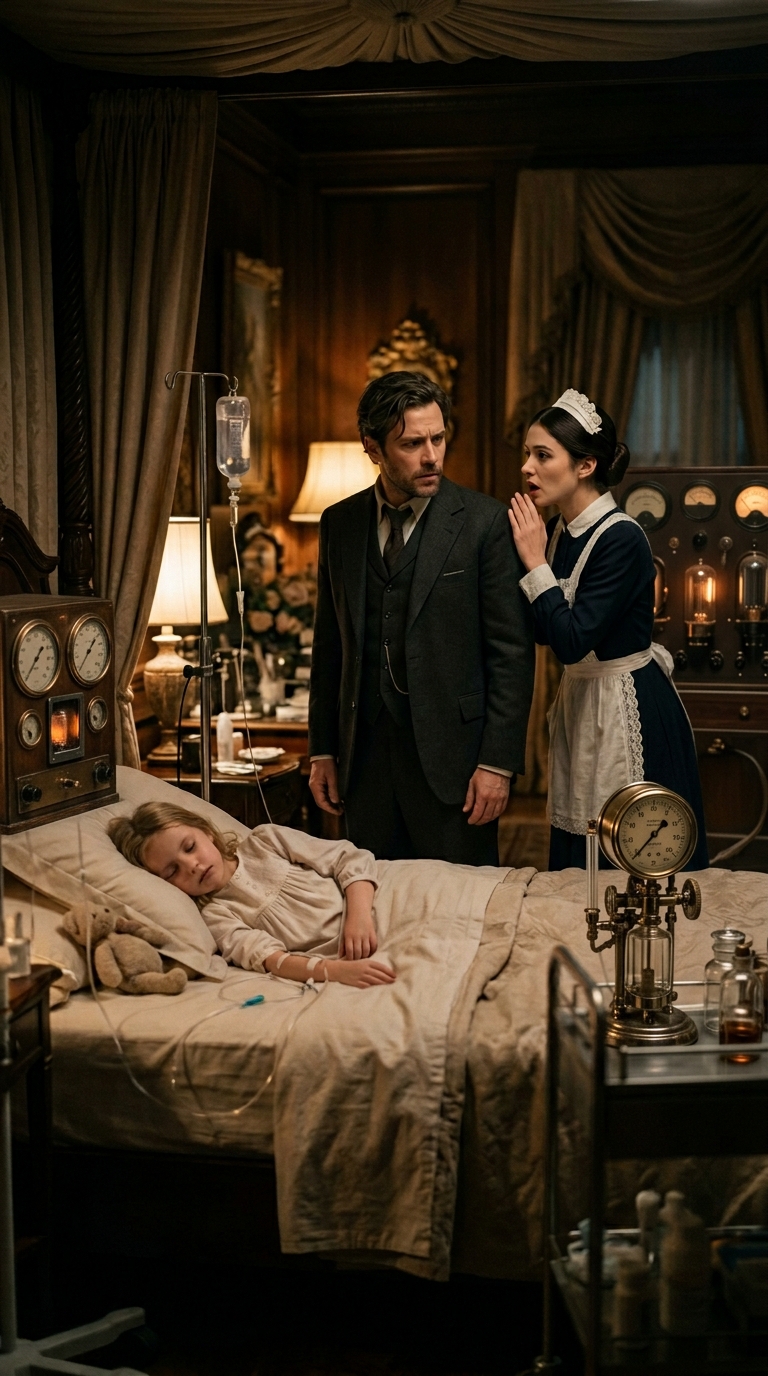
The mansion felt unnaturally hollow that night. Crystal chandeliers cast soft light over marble floors, priceless paintings lined the walls, and the massive desk in Victor Langford’s study gleamed with polished perfection, yet none of it held any meaning anymore.
Victor sat alone, elbows pressed into the desk, his fingers intertwined so tightly they had begun to ache. He wasn’t aware of the pain. The only thing he could feel was the echo of the doctor’s voice repeating in his mind.
“Mr. Langford… your daughter may have three months. Perhaps less.”
He had heard difficult news before in his life. Business collapses, betrayals, risks worth millions. None of it had ever shaken him like this.
“Her kidneys are failing,” the doctor had continued carefully. “And what troubles us most is that we cannot identify the cause. Her condition does not match any known pattern.”
Victor had stood there, frozen for only a second before something inside him snapped.
Money, resources, power—none of it mattered anymore unless it could keep Sophia alive.
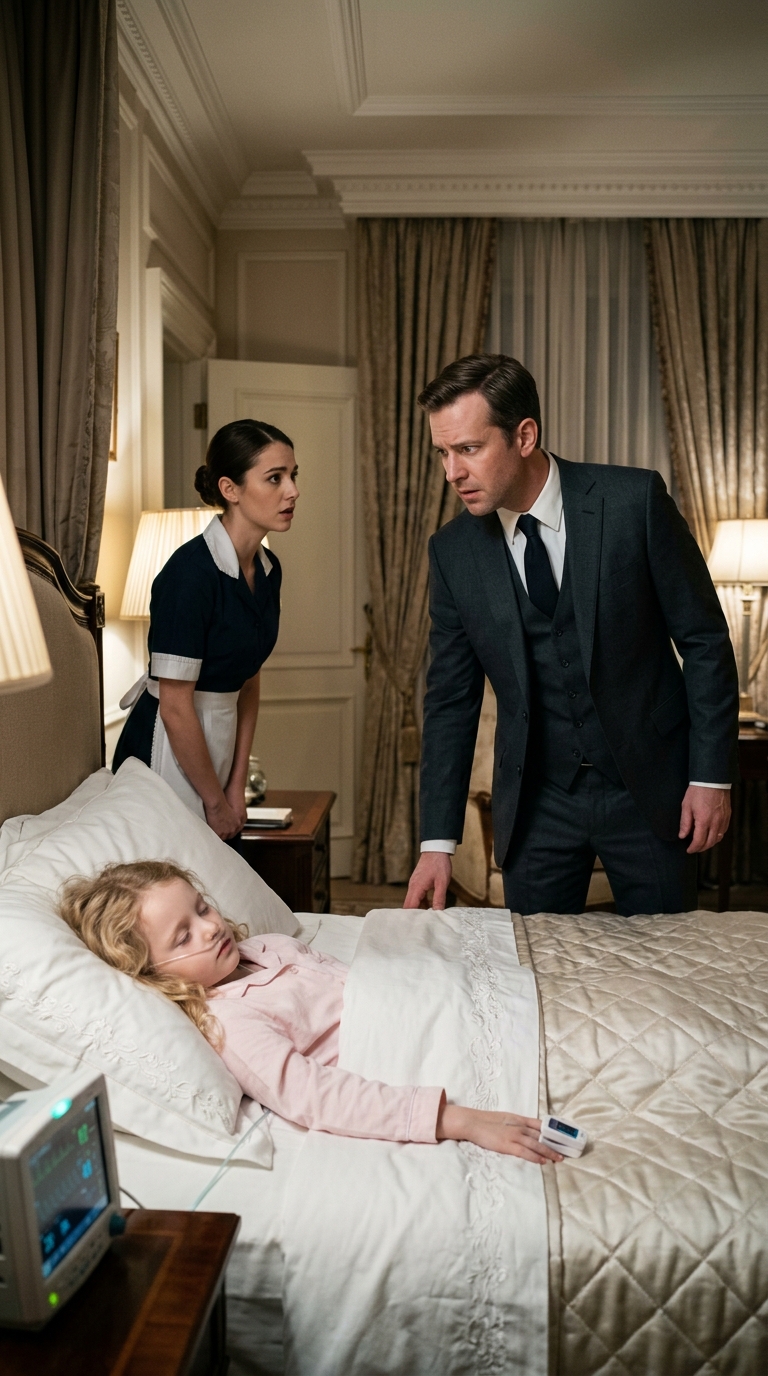
Within hours, he mobilized everything he had built over decades. Calls were made across continents. Specialists were flown in without hesitation. Laboratories were funded overnight. Entire teams were assembled inside the mansion, transforming it from a home into something closer to a private medical center.
Experts walked through the halls with quiet urgency. Charts filled the study walls. Complex discussions stretched late into the night, voices low but intense.
And yet, every conclusion ended the same way.
Uncertainty.
No clear diagnosis.
No real solution.
Time passed, but answers did not come.
Meanwhile, Sophia faded.
She was only fifteen, but the brightness that once defined her seemed to dim with each passing day. Her laughter disappeared first, replaced by silence. Then her strength began to leave her. Tasks that once felt effortless became impossible.
Some evenings, she would sit at the dining table, staring at her plate, her hand trembling slightly as she tried to lift a fork. More than once, she fell asleep right there, her body too exhausted to continue.
Victor watched it happen. He stayed close, attended every update, approved every treatment. But for the first time in his life, he could not fix what was breaking in front of him.
The doctors adjusted medications constantly. New combinations, new dosages, new theories. Each change came with cautious hope, and each time, that hope quietly disappeared.
Except for one thing that never changed.
Every day, without fail, Maria Delgado entered Sophia’s room.
Maria was not part of the medical team. She had no formal training in medicine. She had simply worked in the Langford household for over five years, long enough to understand the rhythm of the home and the people inside it.
She brought meals, even when Sophia barely touched them. She sat beside her when the nights stretched long and uncomfortable. She spoke softly, even when there was no response. And when the pain came, she stayed, holding Sophia’s hand until it passed.
It was not something anyone had asked her to do. It was simply something she chose.
And because she was always there, she began to notice things others overlooked.
At first, it was subtle. A bottle that wasn’t exactly where it should be. A label that looked identical but somehow felt different. A shift in Sophia’s condition that didn’t match what the doctors expected.
Maria didn’t say anything immediately. She questioned herself first. In a house filled with experts, what right did she have to doubt what she was seeing?
But the pattern didn’t disappear.
If anything, it became clearer.
One evening, as Maria helped Sophia sip a small amount of water, the girl’s voice, weak and barely audible, broke the silence.
“Why do I feel worse… after they help me?”
Maria didn’t answer right away.
Because in that moment, she realized she had already known the answer.
She had just been afraid to say it.
That night, long after the house had fallen quiet, Maria stood outside Victor’s study. The hallway felt colder than usual. Her hand hovered near the door, hesitating.
Speaking up could cost her everything. Her job. Her stability. Her place in a house where she had spent years building trust.
But inside that room was a father who was losing his child.
She knocked.
Victor’s voice came from inside, tired and distant. “Come in.”
Maria stepped in slowly, her hands clasped together.
“I’m sorry to disturb you, sir,” she said. “But I can’t stay silent anymore.”
Victor rubbed his temples, exhaustion weighing heavily on him. “What is it?”
She hesitated for only a moment.
“I think I know how to save Sophia.”
The words settled into the room, heavy and unexpected.
Victor looked up sharply. For a brief second, hope flickered—but it was quickly replaced by doubt.
“If this is a misunderstanding,” he said quietly, “you should leave.”
Maria didn’t step back.
“Your daughter isn’t dying from an unknown illness,” she said, her voice steady despite the tension in the air. “She’s getting worse because she’s being given the wrong medication.”
Victor stood up abruptly, the chair scraping sharply against the floor.
“What are you saying?”
“I’ve seen the pills change,” Maria continued. “Not during the day. Not when the doctors are here. But after they leave. Someone comes in and replaces them. And after that, Sophia always declines.”
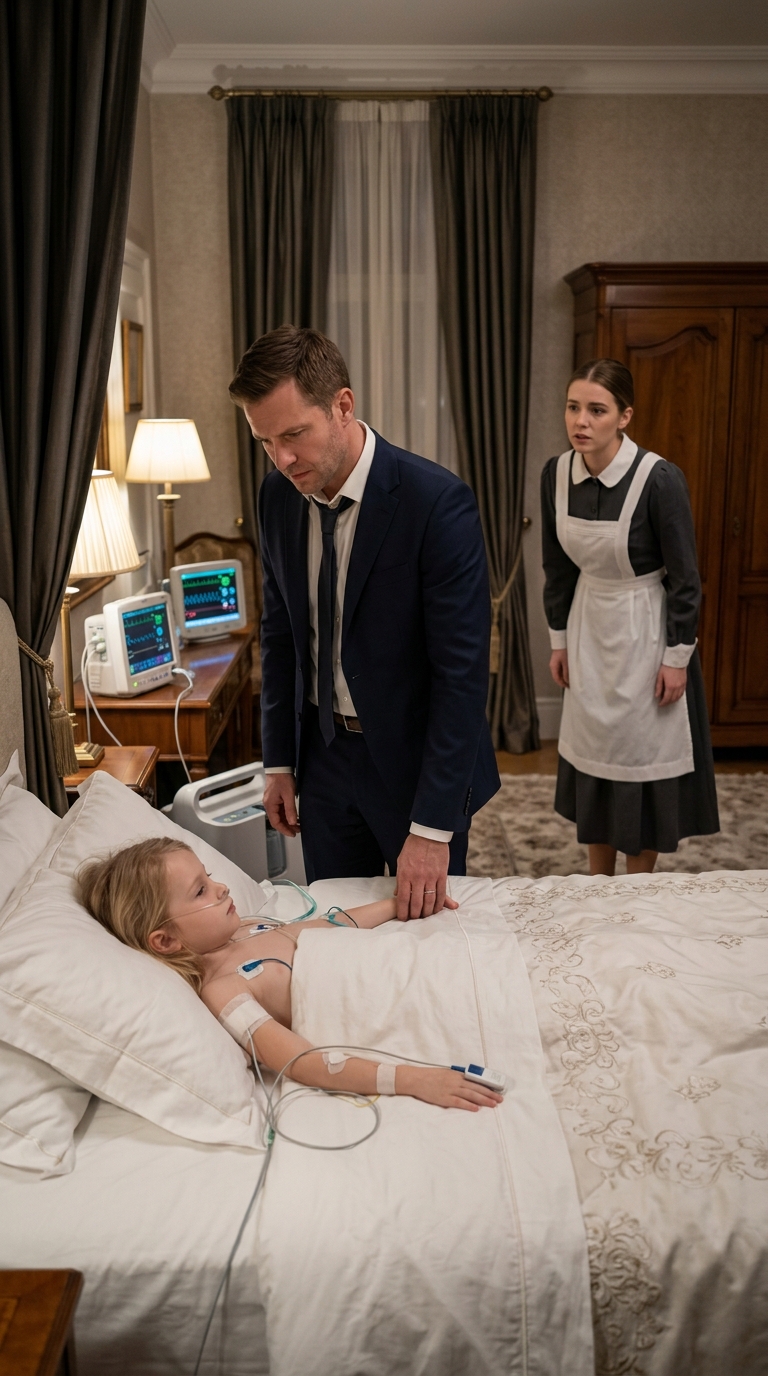
The room went still.
“Are you accusing my doctors?” Victor asked, his voice low, controlled.
Maria shook her head.
“No. I’m saying the problem isn’t the doctors.”
She lifted her eyes to meet his.
“It’s someone inside this house.”
Victor felt something cold settle in his chest.
“That’s impossible,” he said, though the certainty in his voice was already weakening. “My wife oversees everything.”
Maria’s gaze softened, but she didn’t retreat.
“That’s why I was afraid to speak,” she admitted. “But if nothing changes… your daughter may not survive.”
That night, Victor didn’t try to convince himself she was wrong.
He didn’t argue.
He investigated.
Security footage from inside the mansion—cameras that had been largely ignored—was pulled and reviewed in detail.
And what they revealed was something Victor could not immediately process.
Lydia.
His wife.
Entering Sophia’s room when no medical staff were present.
Again.
And again.
Each time, moving calmly. Precisely.
Each time, replacing the medication.
The bottles looked identical. But they weren’t.
Laboratory tests confirmed it. The substituted pills contained compounds that slowly damaged kidney function. Not enough to raise immediate suspicion. But enough to ensure steady deterioration.
The truth landed with devastating clarity.
Lydia was Sophia’s stepmother.
And if Sophia didn’t survive, a substantial trust fund would transfer entirely to her.
Victor didn’t shout. He didn’t break anything.
He simply sat there, watching the footage over and over, as if repetition might somehow change what he was seeing.
The medications were stopped immediately. A new treatment plan was built from scratch, this time under strict supervision.
And then, slowly, something changed.
Within three days, Sophia’s condition stabilized.
Within a week, she asked for food—real food—for the first time in months.
Doctors were stunned. New test results showed improvement where there had only been decline before.
The mystery that had confused specialists from around the world suddenly made sense.
There had never been an unknown disease.
Only a hidden cause.
Poison.
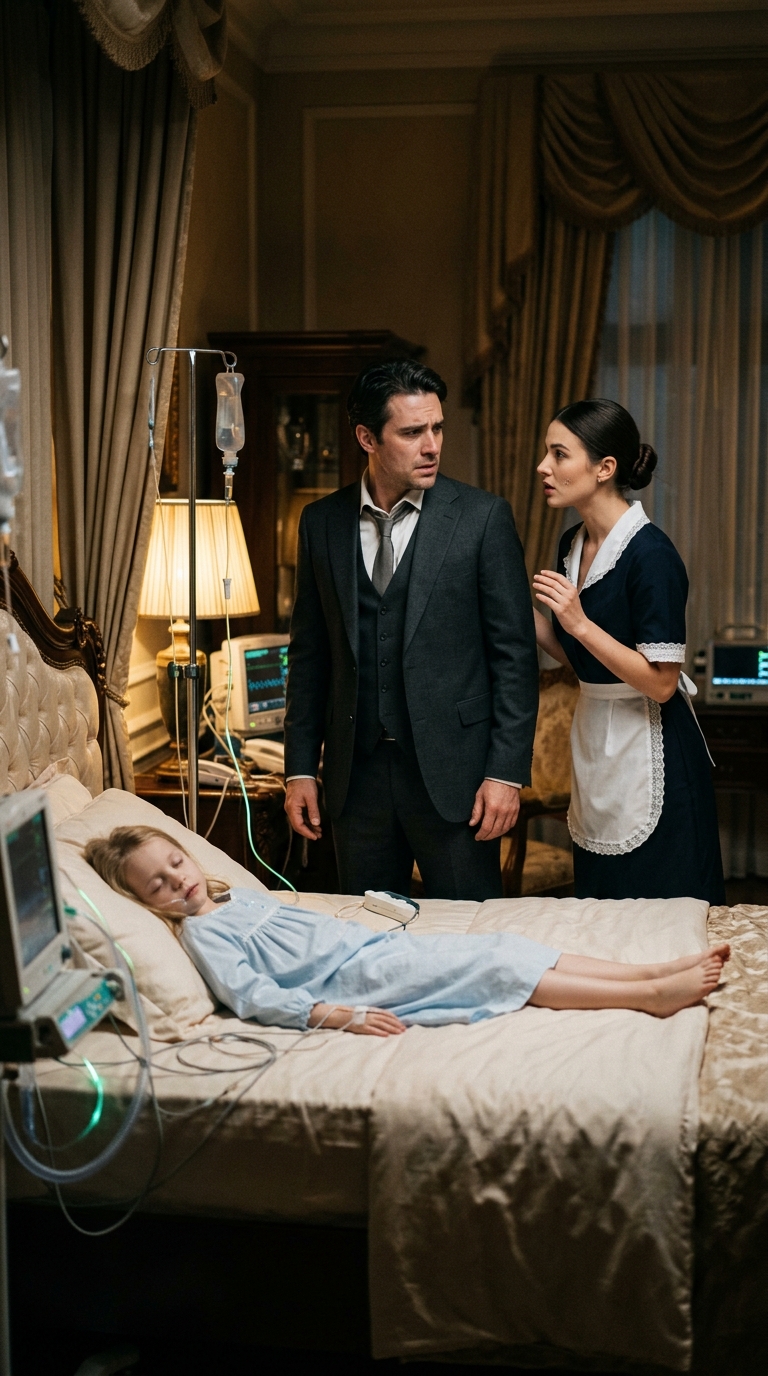
While experts had been searching for rare diagnoses and complex explanations, the truth had been simple—and close.
A few days later, Victor stood quietly at the doorway of Sophia’s room.
She was resting peacefully, her breathing steady.
Maria adjusted the blanket gently, making sure she was comfortable.
“Maria,” Victor said softly.
She turned.
“Thank you for saving my daughter.”
Maria smiled, a quiet, humble expression.
“I didn’t save her, sir,” she said.
“I just refused to ignore what I saw.”
Victor stood there for a long moment, letting those words settle into something deeper than gratitude.
All his life, he had believed that power came from wealth, knowledge, and control.
But in that moment, he understood something far more important.
Sometimes, what saves a life isn’t expertise.
It isn’t status.
It isn’t even access to the best resources in the world.
Sometimes, it’s simply the courage to pay attention.
And the heart to speak up—
even when it would be easier to stay silent.
