

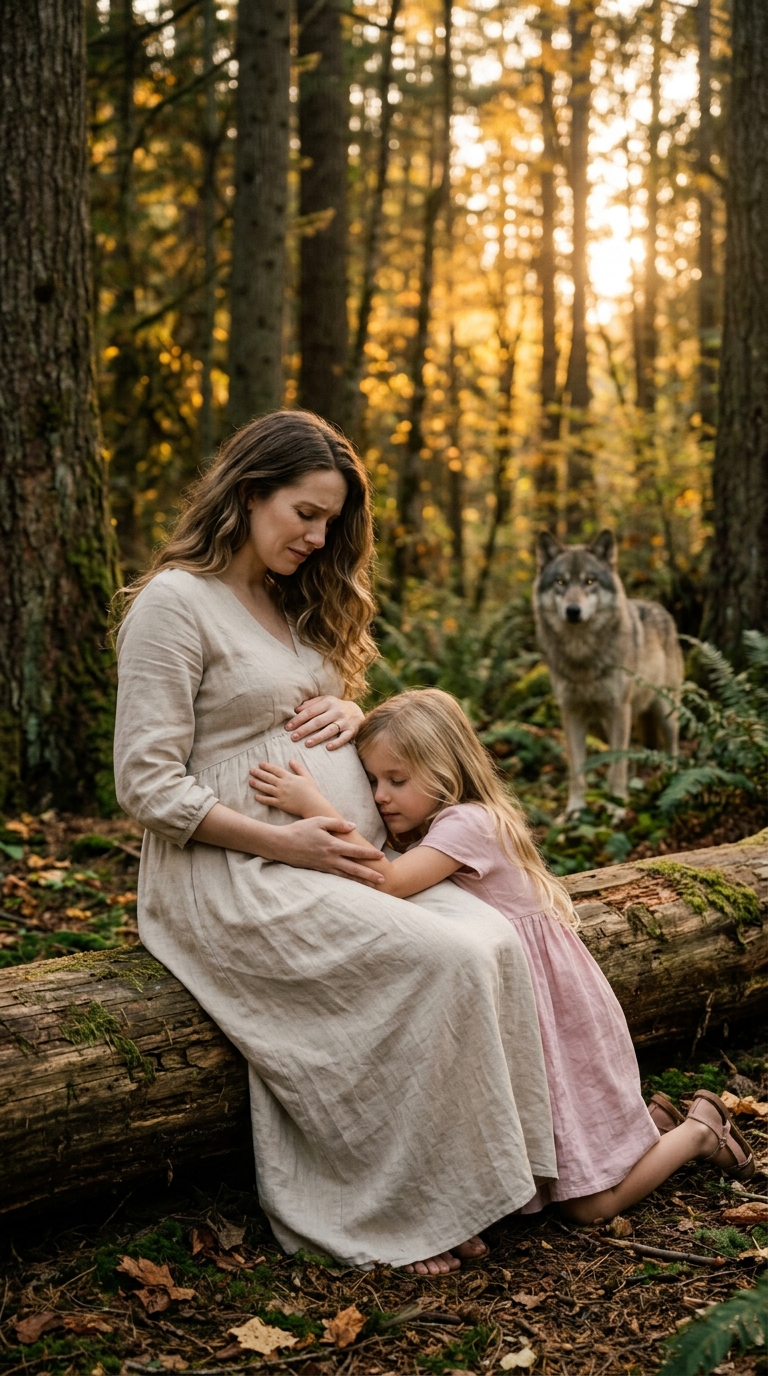
No one would later be able to explain how they had gotten so far.
That was the question the rescuers would ask themselves for weeks—sitting in emergency rooms, in hospital corridors, at kitchen tables where people try to process things that cannot be processed anywhere else. How a thirty-one-year-old woman, thirty-six weeks pregnant, had ended up four kilometers off the marked trail, in a clearing that didn’t appear on any recent map, with her six-year-old daughter, no phone signal, and the sun already setting.
The answer was simple—and explained nothing:
They had gotten lost.
They had set out for a walk on a trail they knew, in a forest they had visited dozens of times, on an October day that was exactly the kind that invites you to walk—cool, golden, with sunlight filtering through the trees at an angle that made everything feel more meaningful than it was.
Sofía had packed the small backpack with water and snacks. Lucía had insisted on carrying her own bottle—the red one with the little bear on it—even though it was too heavy for her six-year-old arms.
They had taken a detour.
Just to see where it led.
And that detour had led to another, and the light had shifted before Sofía realized it had shifted, and when she checked her phone, the map app was spinning on the screen with that loading animation that means the GPS is trying to find you—and still can’t.
That had been two hours ago.
Part I: What Sofía Knew
Before the pregnancy, Sofía Reyes had been the kind of woman who didn’t panic.
An emergency room nurse for eight years—the kind of job that calibrates your response to stress in ways most people never experience. The kind that teaches you to read situations quickly, to make decisions with incomplete information, to keep your voice calm while someone else’s body is failing under your hands.
She knew panic.
She had seen it in hundreds of eyes.
She knew that panic turns good decisions into bad ones, that it narrows your vision at the exact moment you need it wide, that it speeds up your body when what you need is to be slow and deliberate.
She knew all of this.
And still—sitting on a fallen log in the clearing, contractions coming in waves that could no longer be ignored, with Lucía beside her, eyes too wide and fingers gripping her arm too tightly—the panic was there.
Not the loud kind.
The worst kind.
The quiet one—the one that exists in the space between what you know and what you can’t do with what you know.
She knew the contractions were eight minutes apart.
She knew thirty-six weeks wasn’t too early—but it was early.
She knew they were miles from any road, with no signal, and maybe an hour—an hour and a half—of daylight left.
She knew no one knew exactly where they were.
Her husband, Daniel, was at a conference in Madrid. He knew she had gone for a walk—but not which trail. She hadn’t sent her location before losing signal because she hadn’t thought she needed to.
It was just a walk.
Just to see where the detour led.
Everything she knew converged into a single conclusion—one her nurse’s mind formed with clinical precision.
And in that moment, it was the most terrifying thing she had ever felt.
If the contractions sped up—
If labor began here, in this clearing, in this forest, without equipment, without help, with hours of cold ahead—
She didn’t finish the thought.
Instead, she looked at Lucía.
Lucía was watching her with that particular expression children have when they are too perceptive to be lied to—but still need someone to tell them everything will be okay, even when it might not be.
“Mama?”
Her voice was small.
Not small with fear.
Small like someone measuring how much space there is for fear before deciding whether to fill it.
“I’m here,” Sofía said.
It was all she had.
It was enough.
Barely.
Part II: The Contraction
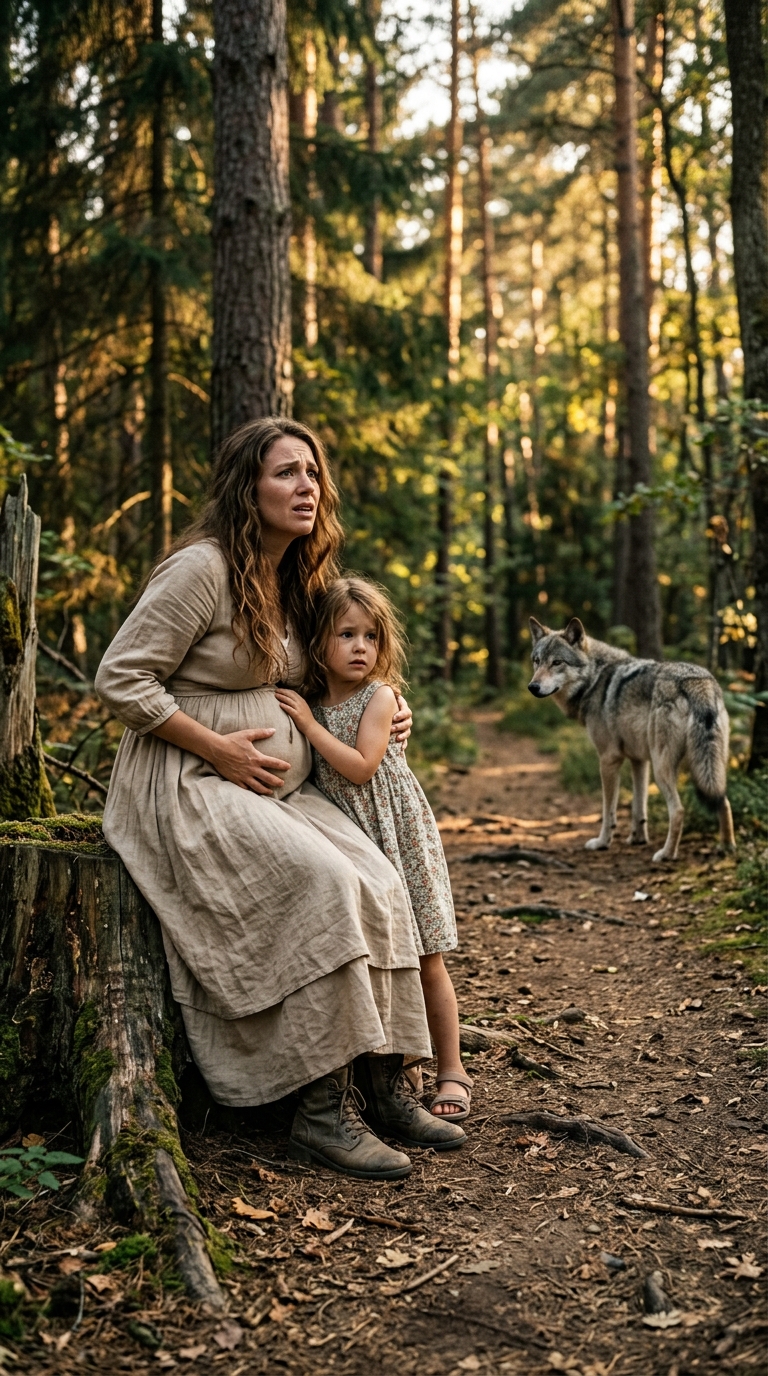
The next one came four minutes after the last.
Sofía knew because she had been counting—the kind of counting nurses do automatically, something that runs outside of emotion, continuing even when the rest of the mind is busy with other things.
Four minutes.
She bent forward over the log, pressing her fists against her knees, breathing the way she had taught other women in the maternity ward—slow in, slower out, treating breath like the one thing she could still control.
Lucía pressed close beside her.
“Mama, you’re crying.”
“I know, sweetheart.”
“Does it hurt a lot?”
“A little.”
A pause. Another breath.
“A lot.”
Lucía didn’t speak for a moment.
Then she placed her hand on her mother’s back—a small hand, nails that needed trimming, a bandage on her index finger from when she had fallen three days earlier—and left it there.
Without rubbing. Without patting. Just there.
The specific gesture of someone who has somehow learned that sometimes presence is all you can offer—and that it is enough.
Sofía covered that small hand with her own.
The contraction passed.
The forest was quiet in the way forests are quiet when the wind stops—not the absence of sound, but the particular quality of sound when everything that makes noise has, at the same moment, chosen to pause.
And in that silence, Sofía looked up.
Part III: The Wolf
It stood at the edge of the clearing.
She hadn’t heard it arrive. No branch had snapped, no leaves had shifted. It was simply… there, the way things sometimes are when you lift your eyes from the ground.
Large. Gray. With the particular stillness of animals that don’t rush because they have nothing to prove.
It was watching her.
Sofía’s first instinct was the correct one—not to move, not to scream, not to make any sudden motion that every piece of guidance about encountering wildlife warns against with hard-earned urgency.
But beneath that correct instinct, there was something else.
Something she couldn’t name.
The wolf wasn’t in a threatening stance.
That was what her brain registered—with the speed of someone trained to read bodies, human or otherwise. It wasn’t the posture of a predator calculating.
It was something harder to define.
Attentive.
Present.
Watching with the specific focus of something that has arrived somewhere and is assessing what it finds there.
Lucía pressed fully against her mother, her face buried in her arm.
Sofía didn’t look away.
The wolf didn’t look away.
And in that space between them—four meters of clearing, silence, and fading light—something happened that Sofía would never be able to describe afterward with the words she had.
She could describe the facts: the wolf there, her here, the contractions, the fear, the desperation that had been building for two hours and that now had found a way out.
But she couldn’t describe what she felt when she opened her mouth.
“Please…”
The word came out broken. She hadn’t decided to speak. The words came on their own—from the part of her that had moved beyond logic, beyond training, beyond everything except the most basic need any living being has in any situation.
“Help me.”
The forest did not answer.
The wolf did not answer.
But it did not leave.
It stayed there—completely still, eyes fixed on her—for two seconds that felt like the longest two seconds of Sofía’s life.
And then something shifted in its posture.
She couldn’t have named it.
It wasn’t aggression.
It wasn’t retreat.
It was… decision.
The subtle change in the body of an animal that has completed its assessment, reached a conclusion, and is now acting on it.
The wolf turned.
And ran.
Part IV: Alone
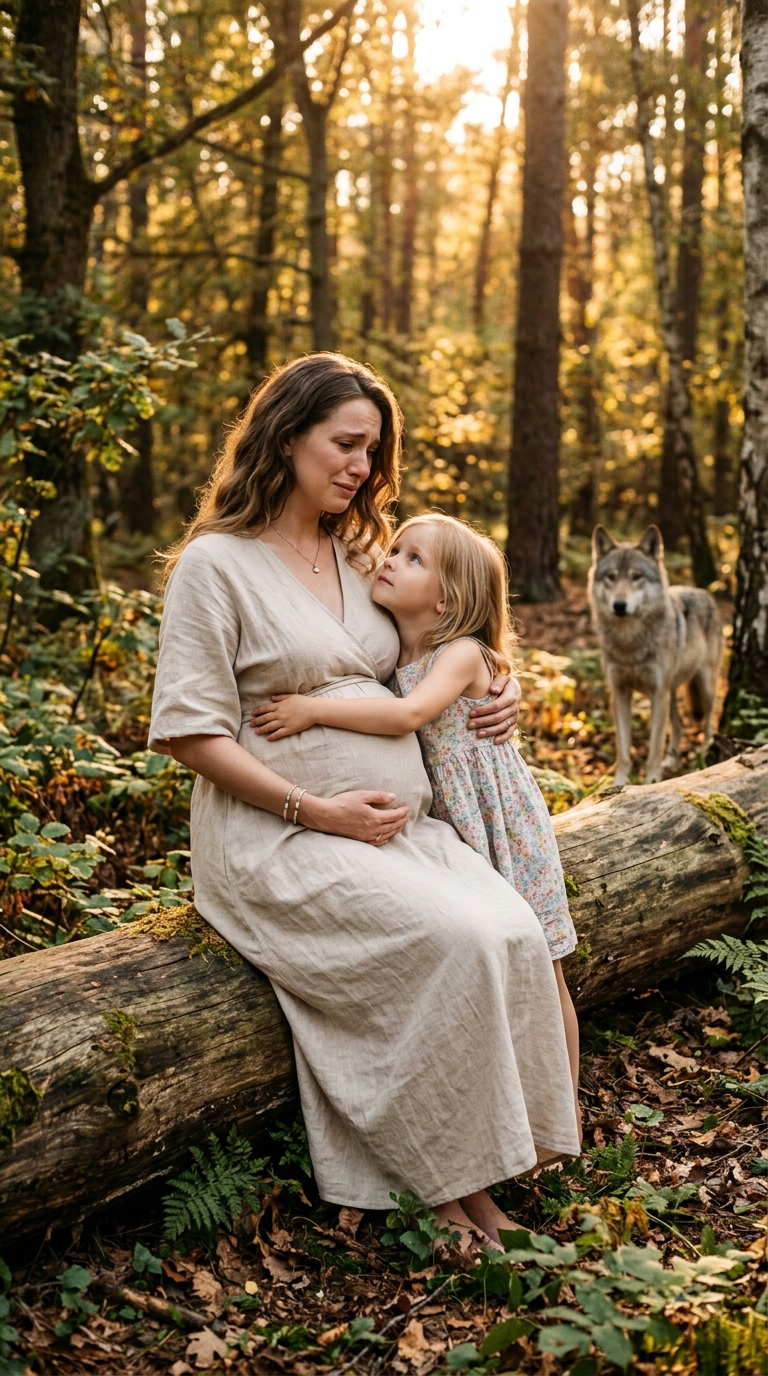
Sofía reached out toward the space where the wolf had been.
The gesture made no sense.
She knew that even as she did it.
But the body sometimes acts without permission from the mind—expressing something that has no other way out.
“Please!” she called, louder now—too loud—desperation breaking through the control she had held onto for two hours. “Don’t leave me!”
The forest swallowed her words.
The wolf did not return.
Lucía lifted her face from her mother’s arm.
“Mama.”
Not a question.
The way children say their mother’s name when they need it to mean everything.
Sofía lowered her hand.
Breathed.
The next contraction came three minutes later.
What happened over the next hour would remain in fragments in Sofía’s memory for the rest of her life—not as a continuous story, but as flashes separated by the darkness that comes when pain is strong enough to interrupt memory.
Lucía singing—not a song Sofía recognized, but something the child seemed to be inventing as she went, with the peculiar logic of six-year-olds who don’t know they’re doing something extraordinary.
Her own hands—acting without conscious thought. Eight years of training operating beneath awareness, doing what it knew how to do while the rest of her mind was occupied elsewhere.
The wind.
The forest.
The light shifting.
And then—at some point she could never precisely place—
another sound.
Part V: What the Wolf Brought
She heard them before she saw them.
Voices.
More than one.
The distinct sound of people moving quickly through dense vegetation, the crackle of emergency radios, the beams of flashlights—even though there was still enough daylight not to need them.
The first person to enter the clearing was a man in an orange vest.
He stopped when he saw her.
Then crossed the clearing in ten quick steps and dropped to his knees in front of her.
“We found your trail,” he said, his voice carrying the weight of someone holding many things at once. “There’s a medical team twelve minutes out.”
He glanced at her stomach. At her face.
“How far apart are the contractions?”
“Three minutes,” Sofía said.
Her voice came out strangely calm.
The training—again.
The man nodded and spoke into his radio.
Lucía stayed beside her mother, her hand still resting on her back.
“How did you find us?” Sofía asked.
The man in the orange vest looked at her.
“A hunter,” he said. “At the northern edge of the forest. He says a wolf came out of the trees and ran straight toward him.”
He paused.
“Wolves don’t do that. They don’t run toward people. He followed it because…”
He stopped, looking at her in a way that wasn’t entirely professional—something softer, like someone trying to understand something that didn’t fit into any category.
“Because something told him he should.”
Sofía said nothing.
She looked toward the edge of the clearing where the wolf had stood.
It was gone.
Part VI: The Birth
The medical team arrived in eleven minutes.
Not twelve.
Eleven.
What happened next was fast and organized in the way things become fast and organized when the right people arrive exactly where they are needed.
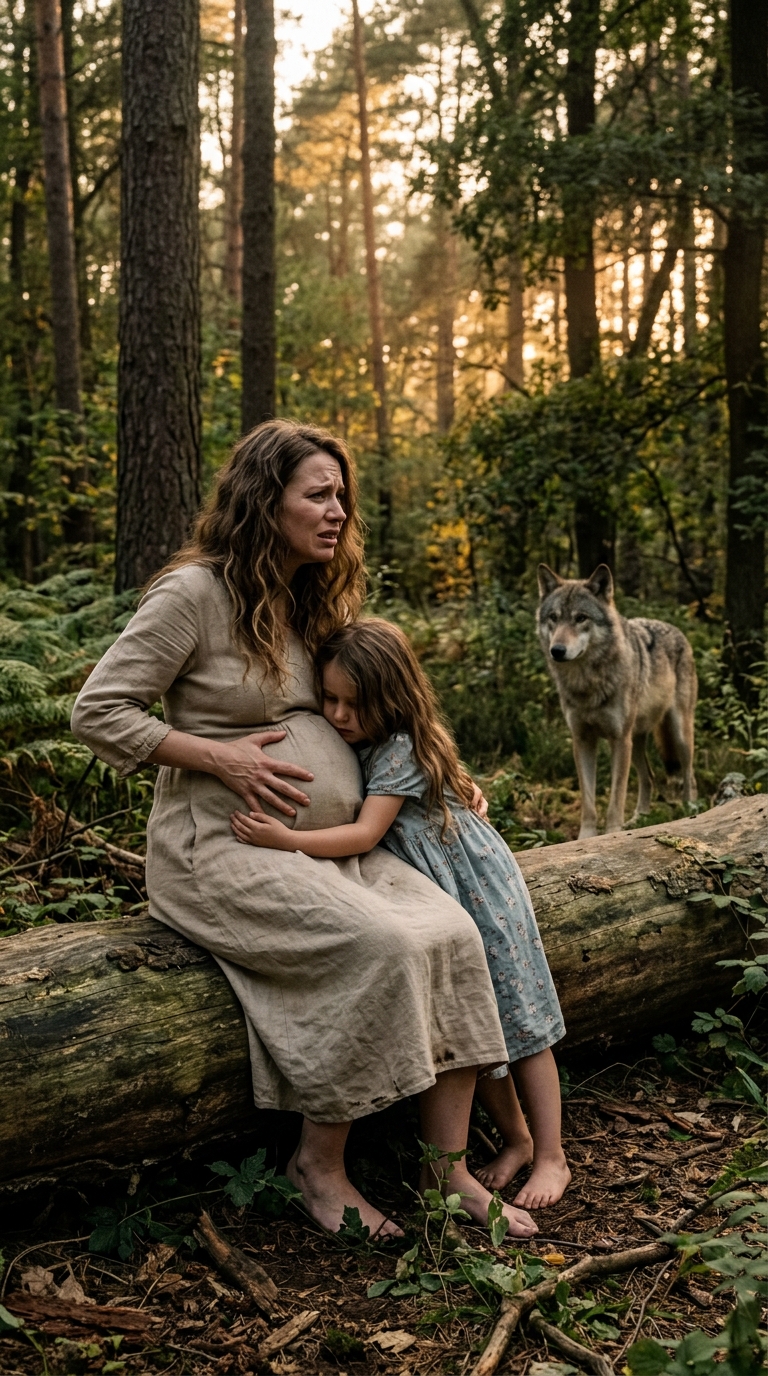
The baby was born in the clearing.
Not in the hospital they had carefully chosen.
Not with the doctor they knew.
Not with the music they had prepared, nor the hospital bag waiting by the door for weeks.
In the clearing.
With the scent of the forest.
With the glow of flashlights.
With the wind moving through the trees.
A boy.
Thirty-six weeks and four days.
Small—but with lungs that immediately declared, with the urgent voice of something newly arrived in the world, that he was alive.
Sofía held him for the first few minutes before they carried him to the helicopter—those minutes that exist outside of time, like certain moments that don’t belong to the normal flow of things.
Lucía was beside her.
Her hand still on her mother’s arm.
“What’s his name?” she asked.
Sofía looked at him. Looked at the forest. Looked at the edge of the clearing.
“I don’t know yet,” she said.
Lucía thought for a moment.
“He should be called Wolf,” she said.
Sofía looked at her.
And something in her face—something that had been only fear and pain and a kind of wordless desperation for hours—shifted.
Not quite a smile.
Something deeper. Quieter.
“Yes,” she said. “He should.”
Epilogue
They named him Mateo.
Not Wolf—though Lucía insisted for several days, with a persistence her father would later describe as “completely reasonable, given the circumstances.” Mateo, which had been Sofía’s grandfather’s name, one they had been considering for months but had never quite chosen.
But Lucía called him “Wolf” during his first year of life, when no one else was listening—her voice carrying the quiet tone of someone sharing a secret with someone who didn’t yet understand, but one day would.
Mateo grew up healthy.
Thirty-six weeks had been enough—early enough to make the birth in the forest dangerous, but not so early as to leave lasting complications. He spent ten days in the neonatal unit. He came home with everything working exactly as it should.
And nothing to remember.
Except—and this was something Sofía would think about for years—the forest.
She thought it because, from the moment Mateo had enough words to express it, he had a relationship with forests that neither parent could fully explain.
A particular calm among trees.
A kind of attention—a complete presence—that was unusual in small children.
“The forest knows him,” Lucía would say, with the absolute certainty of someone who had seen something adults wouldn’t know how to see.
The hunter’s name was Félix Torres.
Seventy-three years old. Forty of those spent walking that forest, knowing its edges, its seasons, and the behavior of its animals with the fluency of someone who had learned a language without words.
He had never seen a wolf run directly toward a human.
He told the story many times afterward—to journalists who called in the first weeks, to friends at the town bar, to his daughter in the city who began calling more often after that.
He always told the same facts.
The wolf emerging from the trees.
The straight, unwavering path.
The brief moment of eye contact before it kept running.
What he never told—
what he kept for himself, for the quiet nights when the forest outside his window spoke in ways it couldn’t during the day—
was what he had felt.
Not fear.
Something older than fear.
The certainty that what stood before him was not a threat, but a message.
That the animal running toward him was not coming from somewhere—
but going toward something.
That what was being asked of him in that moment—him, Félix Torres, seventy-three years old, forty years in the forest—was simple:
To listen.
To follow.
Not to question.
To trust that the forest knew what it was doing.
Sofía returned to the clearing once.
Lucía was eight. Mateo was nearly two and stayed home with Daniel.
They went on an October Saturday—the same light, the same angle, the same golden tone filtering through the trees. Sofía had spent months unsure if she wanted to return, and then months certain that she needed to.
The clearing was smaller than she remembered.
It always happened that way—the places that had once felt immense seemed to shrink when you returned, as if their size had partly belonged to what you were carrying inside when you lived them.
She sat on the fallen log.
Lucía explored the edge of the clearing with the careful seriousness of an eight-year-old taking a place seriously.
Sofía watched the tree line.
Not expecting anything.
Just watching.
“Mama,” Lucía called from across the clearing.
“Yes?”
“I think it’s still here.”
Sofía looked at her.
Lucía was staring into the trees—that exact place where the clearing ended and the forest began, where the light changed and shadows gathered.
“Why do you think that?” Sofía asked.
Lucía thought for a moment.
“Because some places remember you,” she said.
Sofía looked at her a moment longer.
Then she turned her gaze back to the forest.
The wind moved through the trees.
The light fell the way October light does—golden, horizontal, carrying that quiet sense of endings that are also beginnings.
Sofía didn’t see anything.
But somewhere deep in her chest—in that place without a name that everyone somehow knows—she felt something she recognized.
Not safety, exactly.
But the memory of safety.
The certainty that in the darkest moment of her life, in a clearing that appeared on no map, something had listened.
Something had understood.
Something had run toward the only person who could help—with the urgency of a creature that knows time matters, even if it cannot explain how it knows.
“Yes,” Sofía said at last, softly—to the forest, to the memory, to everything that had no words.
“I think it’s still here.”
The wind passed through the trees.
The forest exhaled.
And in the silence that followed—the kind of silence that belongs to places that have witnessed something that changes the people who live through it—Sofía Reyes remained seated on the fallen log, letting the October sun fall over her.
And she thought about a wolf—
running toward a stranger with purpose, with speed, and with something that, if she had to name it, she would call exactly what it was.
Compassion.
In the only language available.
In the only body available.
At the only moment when there was still time.
