

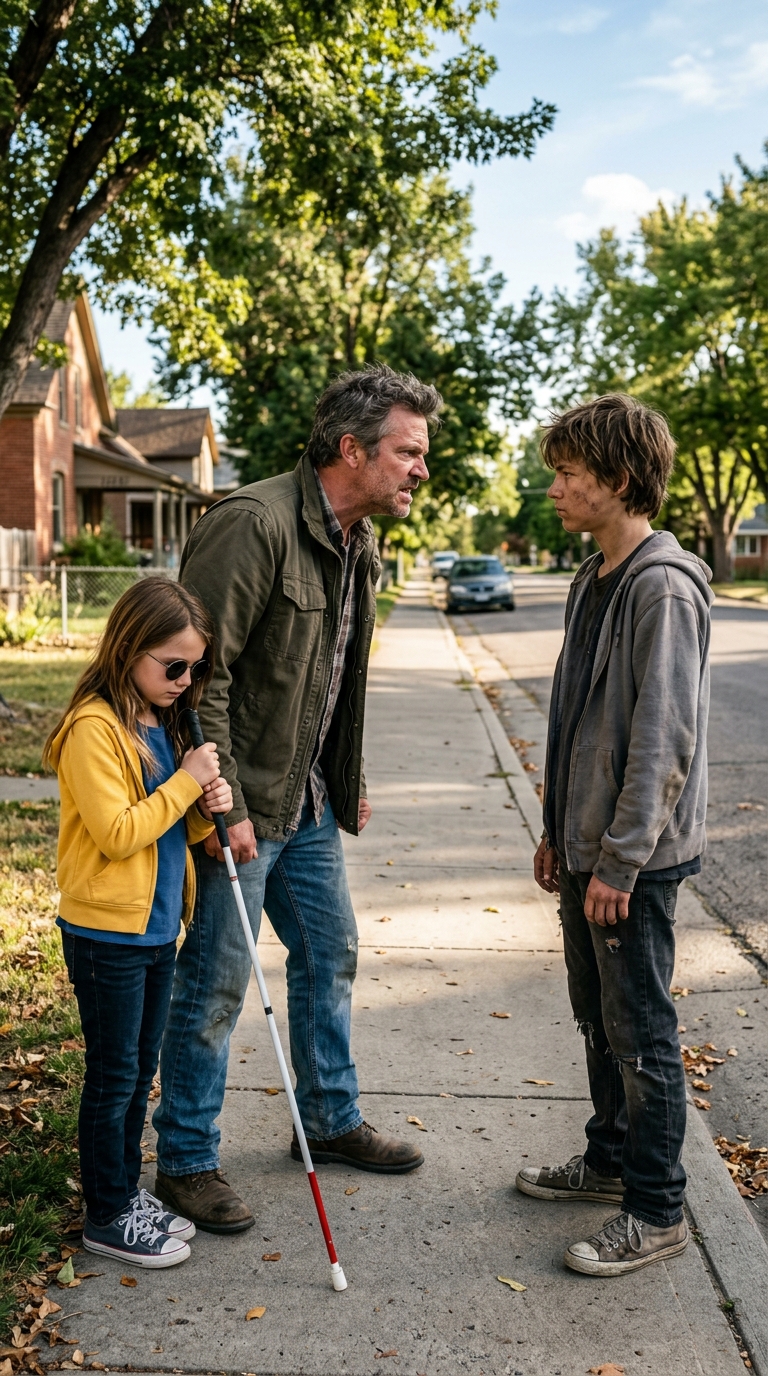
I nearly grabbed him by the collar.
That’s how fast the anger surged through me.
But if I’m being honest… it wasn’t just anger.
It was fear.
Because something in the way he said it—calm, certain, almost tired—didn’t sound like a guess.
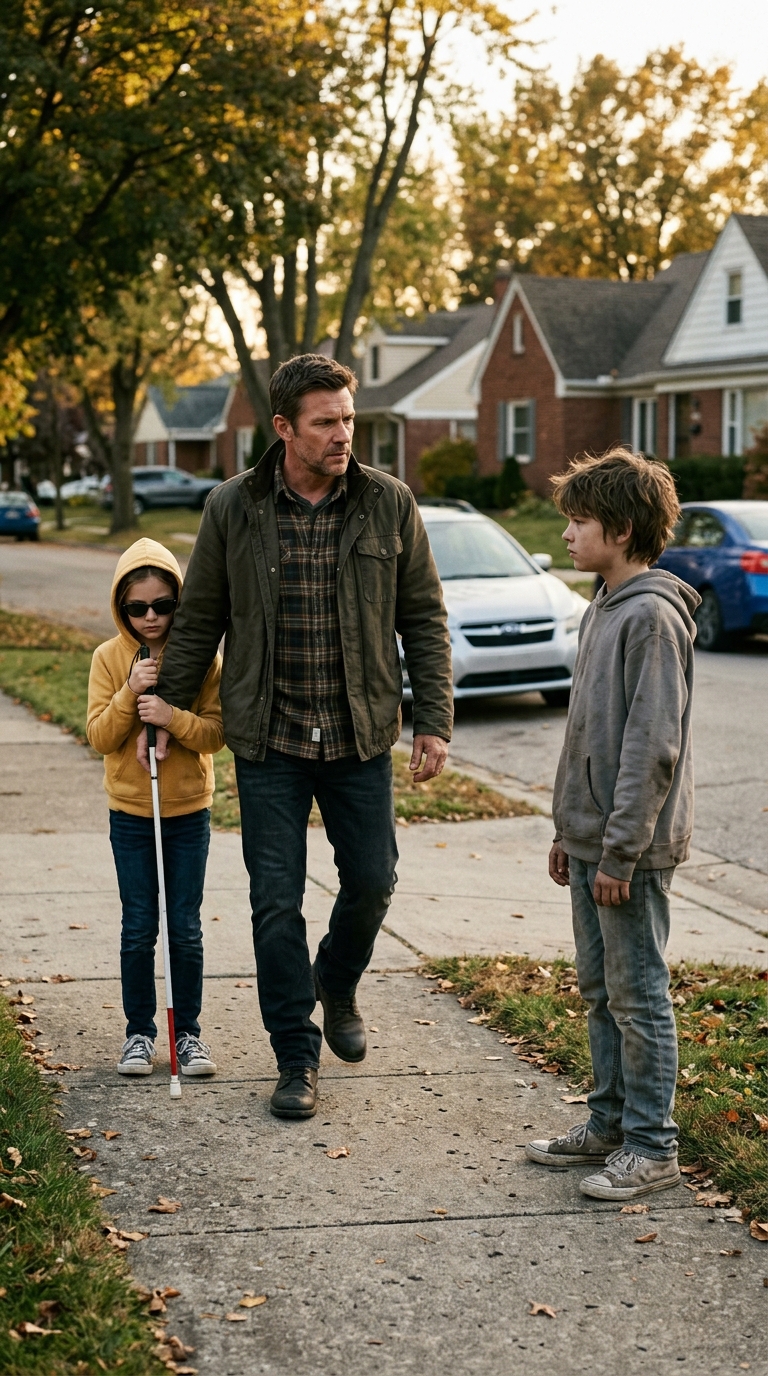
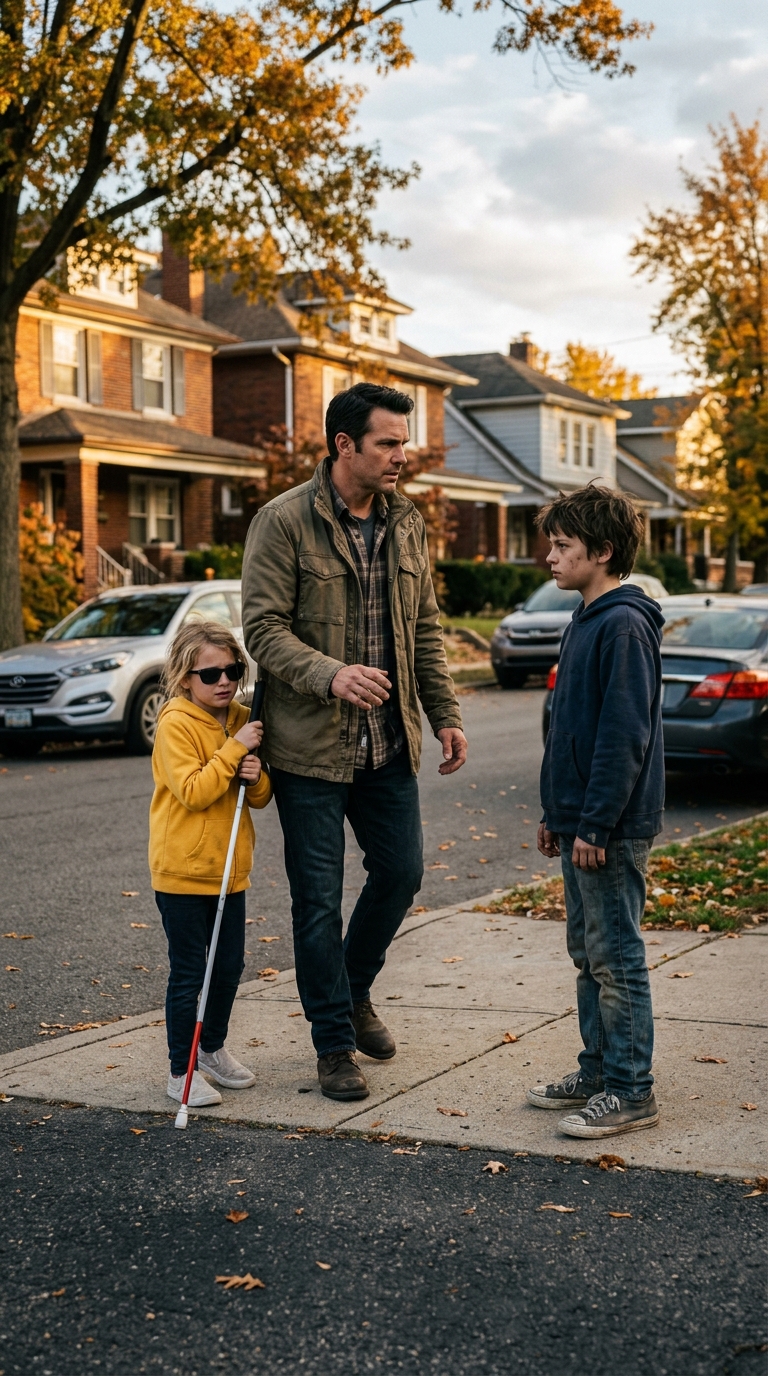
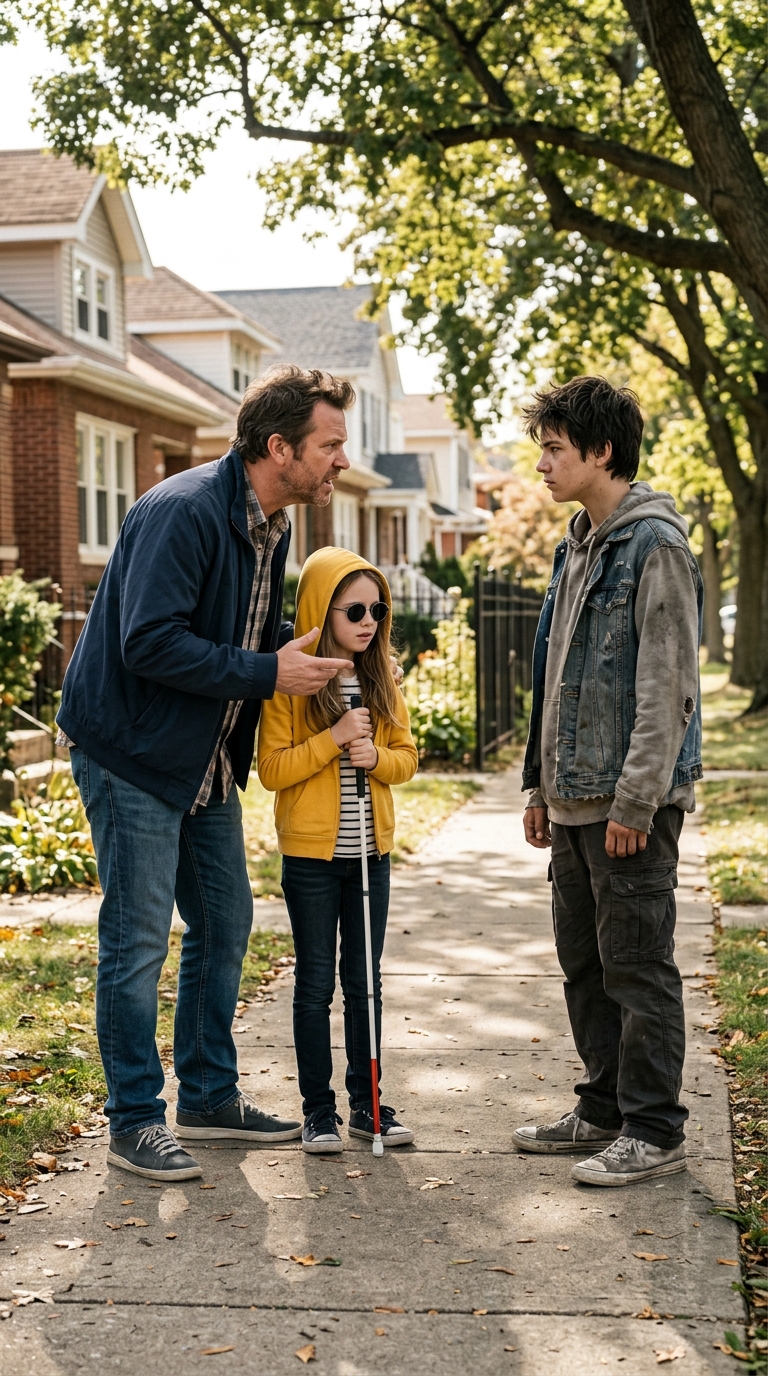
My daughter Lily stood beside me in her yellow hoodie, both hands wrapped tightly around her white cane. Her dark sunglasses hid the eyes that hadn’t met mine in almost a year.
Doctors called it trauma-induced blindness.
Specialists said it sometimes followed severe shock.
My wife repeated it so often it became truth in our home.
“She can’t see. Not anymore.”
And I believed her.
I needed to believe her.
Because the alternative meant that my daughter had been living in darkness… while I stood right beside her and never truly saw her.
I built my entire life around protecting that fragile version of reality.
Then this filthy little boy stepped into our path on that quiet suburban sidewalk—and looked at Lily like she wasn’t broken at all.
Like she was hiding.
“Your daughter is not blind,” he said calmly.
I stared at him. “What did you say?”
He didn’t flinch. Didn’t step back.
“She just doesn’t want to see you.”
The words didn’t hit me all at once.
They spread—slow, cold—like something sinking under my skin.
Lily’s fingers tightened around her cane.
Too tight.
“How do you know that?” I demanded.
The boy’s face didn’t change.
“Ask your wife.”
That was the first moment something cracked.
Not loudly.
Not dramatically.
Just a small shift—like a picture on the wall tilting slightly out of place.
“Who are you?” I snapped.
But he ignored me.
Instead, he turned to Lily, his voice soft now—gentler than anything he had said to me.
“You can stop pretending now,” he told her.
“He wasn’t the one driving.”
The world seemed to pause.
Lily made a sound—small, fragile—like something inside her had just been touched after being locked away too long.
“Lily?” I said, turning to her so fast I almost lost my balance.
She didn’t answer.
Didn’t move.
Didn’t breathe.
The boy stepped closer. Dirt smudged across his face. Scratches along his knees. But his eyes…
His eyes carried something heavy.
“She saw everything,” he said quietly.
“That’s why your wife covered her eyes before the police came.”
The accident.
It rushed back all at once.
The twisted metal.
The flashing lights.
My brother’s body.
The official version had always been clean. Simple.
My brother was driving.
He lost control.
He died instantly.
My wife—passenger. Minor injuries.
Lily—traumatized. Blind.
That was the story.
It had always been the story.
“No…” I whispered. “That’s not possible.”
But even as I said it… something inside me resisted.
Because there had always been things that didn’t fit.
The way my wife avoided every conversation about that night.
The way Lily screamed in her sleep—but never explained why.
The way she turned her face away every time I gently asked, “Do you remember anything?”
Not confusion.
Avoidance.
The boy reached into his pocket and pulled out something small.
A pink plastic hair clip.
Lily’s.
The one she had been wearing that day.
The one my wife said had been lost in the crash.
Lily’s breath caught.
The boy held it out to me.
“She dropped it under the seat,” he said softly.
“When she saw your wife switch places.”
The word switch didn’t make sense at first.
“What do you mean?” I asked, my voice unsteady.
The boy met my eyes.
“Before people came,” he said.
“Your wife climbed over. Into the passenger seat. Your brother was still alive when she dragged him.”
Everything inside me went hollow.
I grabbed the mailbox beside me just to stay upright.
Because now… the pieces weren’t just shifting.
They were locking into place.
My wife had been driving.
Drunk.
My brother tried to stop her.
They argued.
The car swerved.
And when it all ended… she made a choice.
Not to tell the truth.
But to survive it.
At any cost.
Even if it meant rewriting reality.
Even if it meant turning her own daughter into a witness who had to disappear.
I dropped to my knees in front of Lily.
My voice broke. “Sweetheart… can you see me?”
For a moment, nothing happened.
Then her lower lip trembled.
Slowly… painfully… she lifted her head.
And looked at me.
Not past me.
Not through me.
At me.
Eleven months.
Eleven months… and this was the first time.
My chest collapsed under the weight of it.
“I didn’t want Mom to go to jail,” she whispered.
“She told me Uncle Ben was going to take you away from us.”
That was the real prison.
Not blindness.
Fear.
A child forced to choose between truth… and losing her family.
So she chose silence.
She chose to “not see.”
Because not seeing was safer than speaking.
I turned back to the boy. “How do you know all this?”
For the first time, his expression faltered.
He swallowed. Pointed across the street.
“I was there,” he said. “Sleeping in their garage.”
A runaway.
A kid no one noticed.
No one asked about.
But he saw everything.
Not because he was meant to.
But because he had nowhere else to go.
My phone was already in my hand when I heard footsteps behind us.
My wife.
Barefoot. Still holding her keys.
She didn’t look at me.
Didn’t look at the boy.
She looked at Lily.
Only Lily.
And in that moment… I knew.
“Lily,” she said softly, her voice tight, controlled.
“Come inside.”
Lily stepped back.
Behind me.
That one movement said everything no words could.
That was the moment my marriage ended.
Not with shouting.
Not with accusations.
With a child choosing truth… over fear.
When the police arrived, my wife tried to control the narrative again—talking fast, interrupting, redirecting.
But Lily… Lily took off her sunglasses.
Her hands were shaking.
But her voice wasn’t.
She pointed to the curb—the one still marked from where the car had mounted it.
And she said:
“Mom was driving. Uncle Ben kept saying stop.”
Silence.
The kind that changes everything.
The boy stood beside us the whole time.
Quiet now.
Invisible again.
When an officer asked his name, he shrugged.
“Doesn’t matter.”
Maybe to them.
But not to us.
Before they took him away for the night, Lily ran to him.
Hugged him tightly.
Like she was holding onto something solid for the first time in months.
“Thank you for making me look,” she whispered.
He froze—like no one had ever thanked him before.
And that stayed with me.
Not the betrayal.
Not the lie.
But that moment.
Because my daughter was never blind.
She was just a child who loved too deeply… and was taught that truth could destroy everything.
So she closed her eyes.
And waited…
Until someone brave enough—someone with nothing to lose—stood in front of her and showed her that the truth, no matter how painful…
is still safer than a lie you have to live inside forever.
