

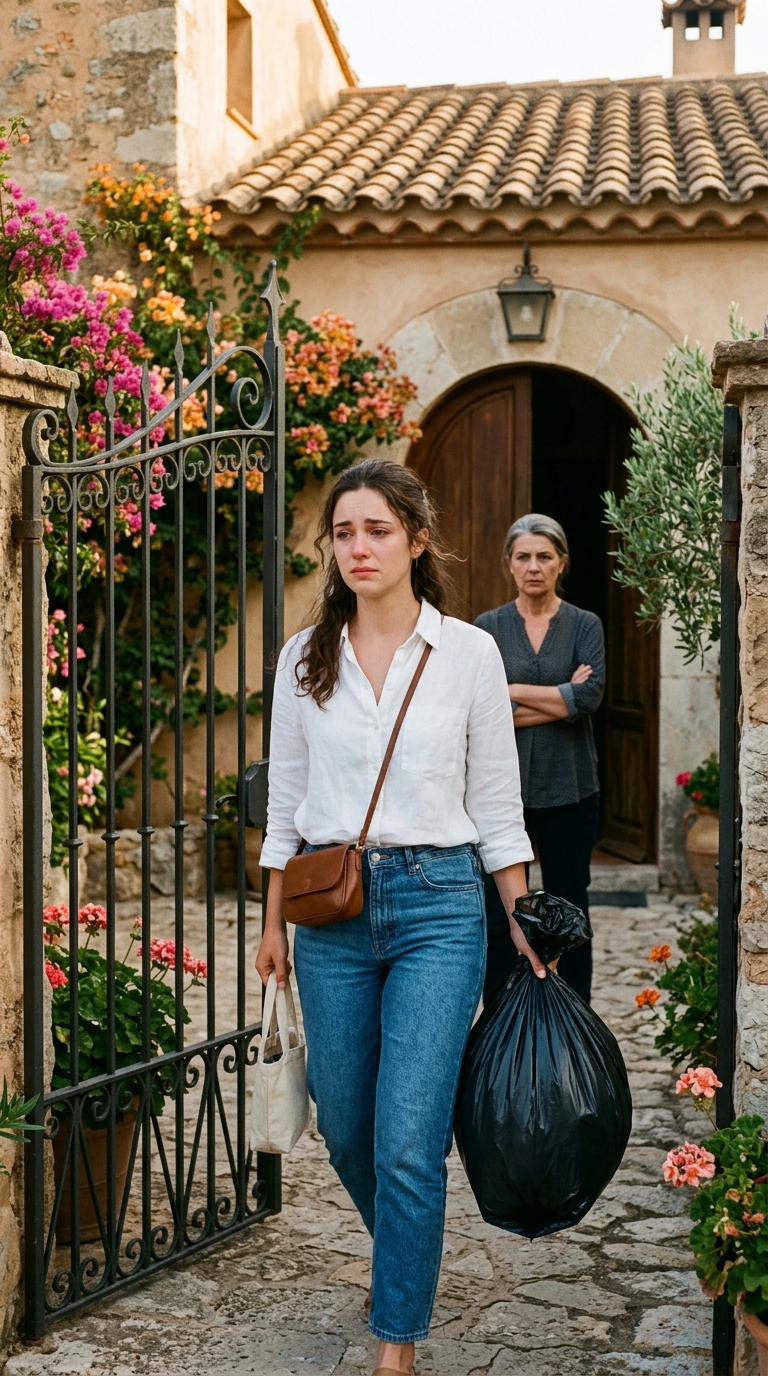
Valeria’s marriage ended in the cruelest way possible after five long years.
There were no children. No assets in her name. Not even a single word from her husband asking her to stay—or trying to save what they had once promised to build together.
The imposing house she had once tried to call home stood silently on an elegant street in Guadalajara. She had left her entire life behind in Puebla—her friends, her comfort zone—to move to Jalisco and build a family with Mateo.
But that day, the sun beat down mercilessly on the red brick patio, burning not only her skin… but the last pieces of hope she had left.
Inside, Valeria felt nothing but a paralyzing cold.
The scene in the courtyard was humiliating.
Her mother-in-law, Doña Carmen Rivera, stood with her arms crossed, blocking the front door. On her face was a look of absolute satisfaction—the predatory gaze of someone who had finally gotten rid of prey she had never accepted.
Beside her, Lucía, Valeria’s sister-in-law, smiled with that twisted, venomous expression she always wore when she knew Valeria was suffering.
“Just leave already,” Lucía muttered, kicking one of the small cardboard boxes that held Valeria’s few belongings. “You’ve stayed in this house long enough, living off us for free.”
Mateo—the man who once promised her eternal love—didn’t even come out to say goodbye.
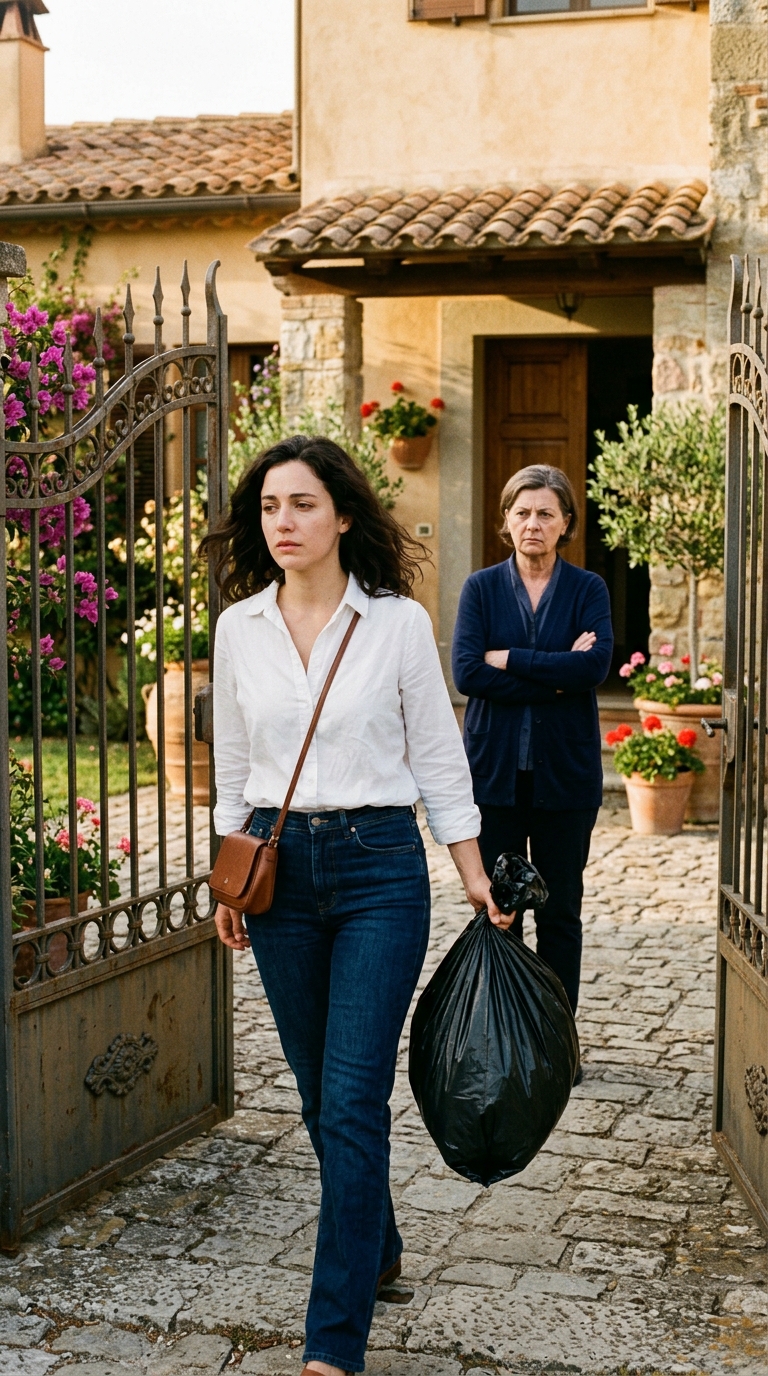
He didn’t have the courage.
He had locked himself in an upstairs room… or maybe he had already left early to avoid facing her.
Rumor had it he was already expecting a child with another woman—someone Doña Carmen actually approved of.
But Valeria didn’t care anymore.
The pain had dried her tears.
She didn’t ask for anything. Not a single peso. No explanations.
She wore only the clothes on her back… and carried a small suitcase with three changes.
She lowered her head slightly, holding onto the dignity they were trying to crush.
“I’m leaving,” Valeria said, her voice steady.
No one responded.
Doña Carmen simply scoffed.
Valeria turned and walked toward the heavy black iron gate. Just as her hand touched the sun-scorched metal, a deep, raspy voice called from behind.
“Valeria.”
It was her father-in-law.
Don Ernesto Rivera.
During the five years of marriage, he had barely spoken to her. He had always been a silent shadow in the house—distant, sitting alone in a corner with his newspaper, or tending to his cacti and agaves, as if the poison and tension his wife and daughter spread had nothing to do with him.
Valeria turned slowly.
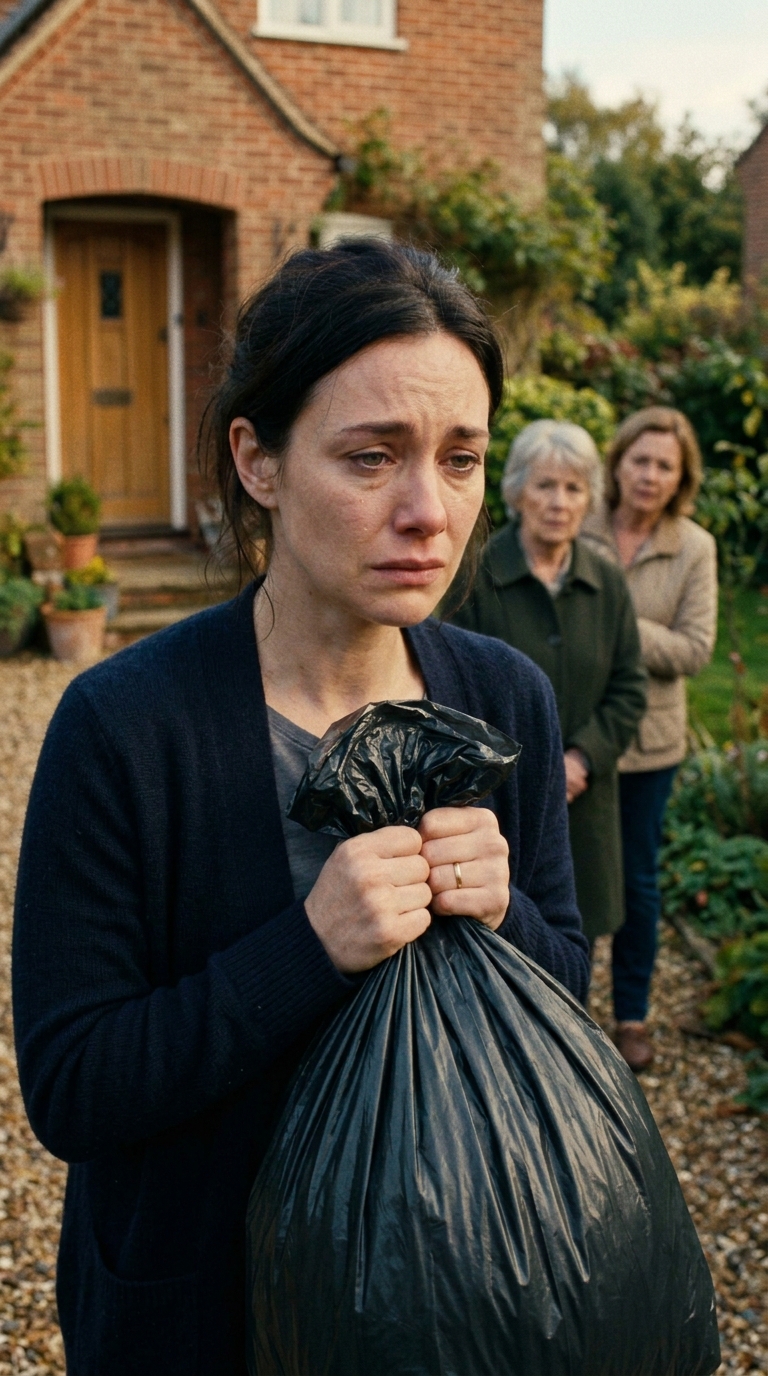
Don Ernesto stood beside the large trash bin in the garage, holding a black plastic bag.
“If you’re leaving,” the old man said slowly, his wrinkled face unreadable, “take this out for me.”
He lifted the bag slightly toward her.
“It’s trash,” he added, in a strangely flat tone.
Valeria hesitated for a second—surprised by such a cold request in the middle of her personal collapse—but, used to obeying in that house, she nodded.
“Of course.”
She took the bag.
Immediately, something felt wrong.
It was too light.
Far too light to be household trash.
She gave one final nod of goodbye. Don Ernesto returned it—but his eyes locked onto hers with unusual intensity before he turned away without another word.
Valeria stepped out onto the street.
The heavy gate slammed shut behind her, the metallic sound marking the definitive end of everything she had endured for five years.
She walked along the cobblestone sidewalk, passing colorful houses, hearing distant mariachi music drifting from a nearby cantina.
A gust of wind blew—purple jacaranda petals falling onto her shoulders.
She told herself not to look back.
But after twenty steps, curiosity—and that strange feeling in her hands—forced her to stop.
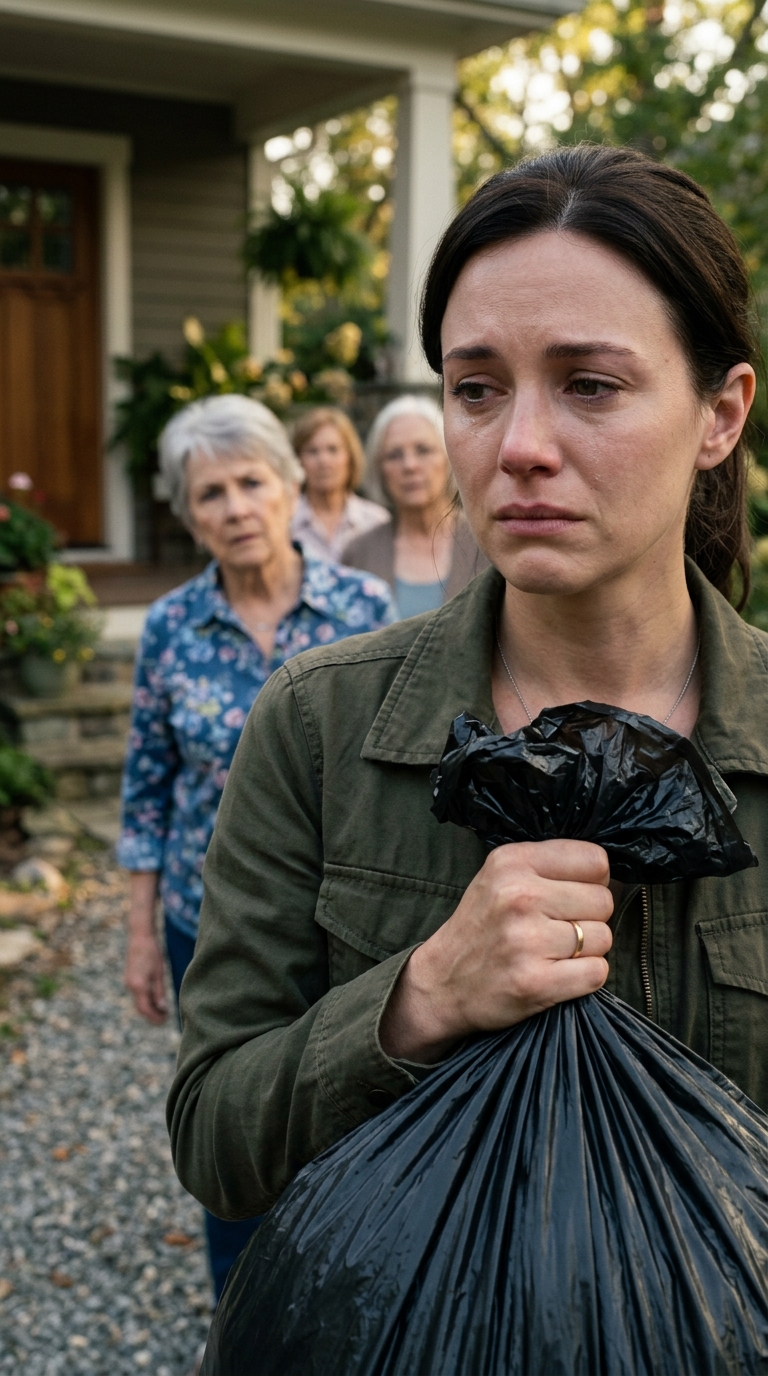
She looked at the black bag.
The weight still didn’t make sense.
No food scraps. No dust. No empty bottles.
Her hands trembled slightly as she tore open the plastic.
There was no trash.
What she saw inside that bag was about to destroy everything the Rivera family believed they had taken from her.
No one—absolutely no one—could have imagined what was about to happen next.
PART 2
Inside the black bag, there was only an old brown envelope—carefully wrapped in multiple layers of clear plastic to protect it from moisture.
Valeria’s heart began to pound in her chest.
With trembling hands, she tore through the plastic and opened the envelope.
The world around her seemed to stop.
The noise of cars, the distant music, the heat of the sun… all faded away.
Inside was a bank savings book in her name.
When she opened it, the printed balance stole her breath:
More than 2.5 million pesos.
It couldn’t be real.
Valeria blinked several times, thinking the stress and pain were making her hallucinate.
But the numbers didn’t change.
Beneath the bank book, she found a stack of legal documents stamped and notarized.
Property deeds.
A small but elegant apartment in one of the quietest, safest areas of Zapopan.
As she read further, she realized the property had been secretly purchased and placed in her name three years ago.
Finally, at the bottom of the envelope, she found a small silver key… and a handwritten note.
The handwriting was firm. Old-fashioned.
“Dignity is not lost when others try to take it from you. It is lost when you abandon it yourself. A new life is waiting for you. Don’t look back. —E.R.”
Valeria pressed the note against her chest.
The air left her lungs.
And for the first time in years… she dropped to her knees on the sidewalk and cried.
But these were not tears of defeat.
Not tears of humiliation.
She cried from a relief so deep it washed her soul clean.
The man who had remained silent for five years—the man she had believed to be a cowardly accomplice—had actually been planning her escape all along.
He had seen every tear.
He had heard every insult from Doña Carmen.
He had noticed every betrayal from Mateo.
And instead of shouting empty words… he used his power in silence to secure her an unbreakable future.
That very afternoon, Valeria didn’t look for a cheap hotel.
She took a taxi straight to Zapopan.
When she inserted the key into the lock and opened the door, the scent of fresh wood and cleanliness welcomed her like an embrace.
The apartment was beautiful—filled with natural light, cream-colored walls, and a balcony overlooking a quiet, tree-lined street.
On the kitchen table, there was a spare key.
That night, Valeria slept on the floor, wrapped in blankets.
But it was the most peaceful night she had had in five years.
She learned what it felt like to wake up without the anxiety of hearing her mother-in-law’s angry footsteps.
To eat without feeling judged.
To breathe… without the weight of a husband who despised her.
Eight months passed.
With the capital of 2.5 million pesos, Valeria chose not to hide.
She rented a beautiful space in the heart of Guadalajara and opened a small café she named “The Second Light.”
At first, the place had only three rustic wooden tables, an espresso machine, and a mountain of fear.
Valeria arrived at 5 a.m. every day—baking sweet bread, preparing traditional café de olla, and cleaning every corner. But her kindness, the calm atmosphere, and the quality of her work turned the café into a success in less than six months.
Three tables became fifteen.
Students, office workers, and couples filled the place daily.
Valeria hired four employees.
Her face—once pale and worn—now shone with confidence.
She was alive again.
But in Mexico, secrets don’t stay buried forever.
And karma… has a very particular way of collecting its debts.
One Tuesday afternoon, the bell at “The Second Light” rang sharply.
Valeria was behind the counter, drying a cup, when she looked up.
Her blood froze—for a split second.
Then she straightened her posture.
It was them.
Mateo.
Doña Carmen.
Lucía.
All three looked worn down—poorly dressed, their faces twisted with a mix of rage and desperation.
The woman Mateo had chosen over her had drained their bank accounts and abandoned him. The Rivera family business had collapsed under debt.
Someone had told them that the “useless” Valeria now owned one of the most popular cafés in the city.
Doña Carmen stormed forward, pushing past customers, slamming her hand against a table.
“So this is where you’ve been hiding, thief!” she shouted, spitting venom. “You stole from us! You must’ve taken money from my son during the marriage to build this pathetic place!”
The café fell silent.
Lucía pulled out her phone, ready to record.
“By law, half of this belongs to me,” Mateo said, stepping forward, trying to reclaim his old intimidating tone. “We were married. You have to hand over the deeds—or I’ll bury you in lawsuits.”
Valeria didn’t move an inch.
She held their gaze—those three ghosts from her past.
She was about to speak, to throw them out with her head held high—
when a deep, commanding voice cut through the air from the entrance.
“She doesn’t owe you a single cent, you useless fool.”
Everyone turned.
Don Ernesto.
He stood there in an elegant suit, his face hardened—the look of a patriarch who had finally decided to cleanse his house.
He walked slowly to the center of the café, stopping in front of Valeria, placing himself between her and them like an unbreakable shield.
“Ernesto?” Doña Carmen stammered, turning pale. “What are you doing here? You knew about this?”
“I didn’t just know, Carmen,” he said, his voice like thunder in the silent room. “I financed it.”
Mateo’s face drained of color.
“For five years,” Don Ernesto continued, “I watched you and your children destroy a good woman. I saw Mateo waste the family’s money on mistresses. I saw you humiliate her out of pure envy.”
“So I made a decision.”
“I liquidated my shares before this idiot ran the company into the ground. I bought properties. I created funds.”
“Everything you think Valeria stole from you… I gave to her. From my own inheritance.”
Mateo grabbed his head in disbelief.
“Dad, that’s fraud! That’s family money!”
“It’s my money!” Ernesto roared, silencing him instantly. “And it’s protected by three separate law firms. You, your mother, and your sister won’t touch a single peso of hers.”
“And for the record,” he added coldly, “the divorce papers I gave you yesterday, Carmen… are final. I’m done living with snakes.”
The moment shattered the Riveras.
Doña Carmen tried to speak—but humiliation and fear choked her voice.
Lucía lowered her phone, trembling.
Mateo, realizing he had lost everything—the only woman who ever truly loved him and his entire future—turned and ran out like the coward he had always been.
The two women followed minutes later, dragging themselves out under the silent gaze of thirty customers.
Silence lingered in “The Second Light.”
Then slowly, conversations resumed—soft smiles spreading among the customers who understood the justice of what they had just witnessed.
Don Ernesto turned to Valeria.
He looked older now. More tired. More gray in his hair.
But his eyes were the same.
Calm.
Deep.
Peaceful.
They said nothing for a long moment.
Finally, she spoke, her voice tight with emotion.
“Don Ernesto… thank you. You saved my life.”
The old man looked around—the warm café, the aroma of coffee, the life pulsing through every corner, built by a woman who refused to break.
“I only gave you a tool, hija,” he said softly, with the first genuine smile she had ever seen from him. “The courage to build this… that was all yours. I knew you would succeed.”
“Someone had to do the right thing. And I saw in you what they—blinded by arrogance—refused to see.”
That was the last time Don Ernesto needed to intervene.
From that day on, he became a regular customer—sitting quietly at a table in the back, reading his newspaper and enjoying a good cup of coffee.
No longer a distant father-in-law.
But the father Valeria had always deserved.
Months later, on a quiet Sunday afternoon, Valeria leaned against the counter of her café, smiling for no particular reason as the last rays of the Jalisco sun filled the room.
And in that moment, she understood the greatest lesson of her life:
Losing everything… had been the price of finding herself.
Whether it was fate—or the quiet justice of a silent old man—she had learned that the end of a story of abuse doesn’t always end in tragedy.
Sometimes…
what others throw away as “trash”…
becomes someone else’s ticket to freedom.
And for the first time in a long time—
her life was no longer defined by abandonment or pain…
but by a future that finally, completely, belonged to her.
