

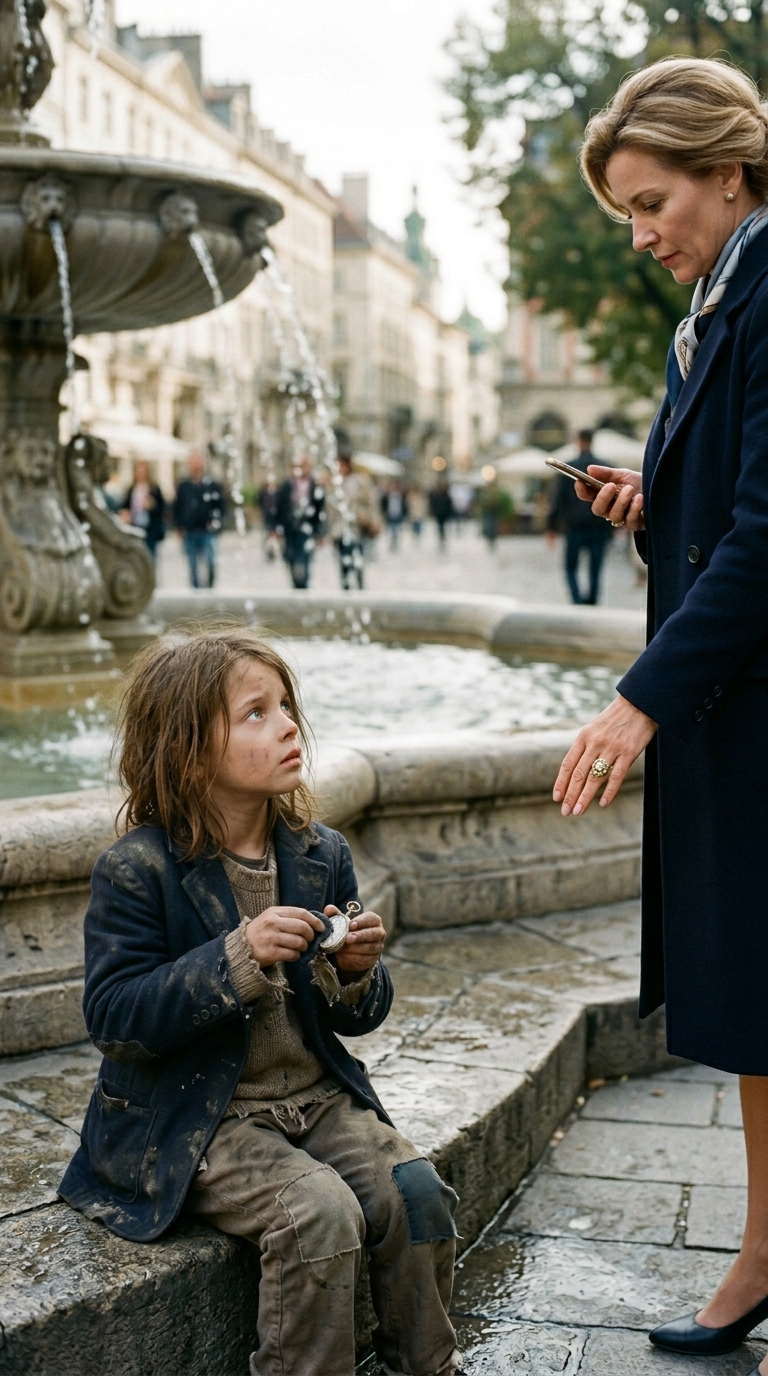
The groundskeeper would later say the little girl looked like she had been carrying the locket longer than she had been carrying her own childhood.
She knelt beside the fountain in torn, dust-stained clothes, her small fingers trembling in the cold water as she tried to clean the metal surface with the edge of her sleeve. She cried quietly—not like a child hoping to be noticed, but like one who had learned that crying too loudly only made people turn away faster.
A few feet away, an elderly woman sat alone on a bench beside the fountain, elegant and composed, one hand resting near a ring bright enough to catch even the pale daylight.
Then the little girl looked up.
Saw the ring.
And stopped moving.
For one long second, the water kept running, the birds kept calling, the city kept breathing in the distance—but the child herself went still, as if something inside her had frozen.
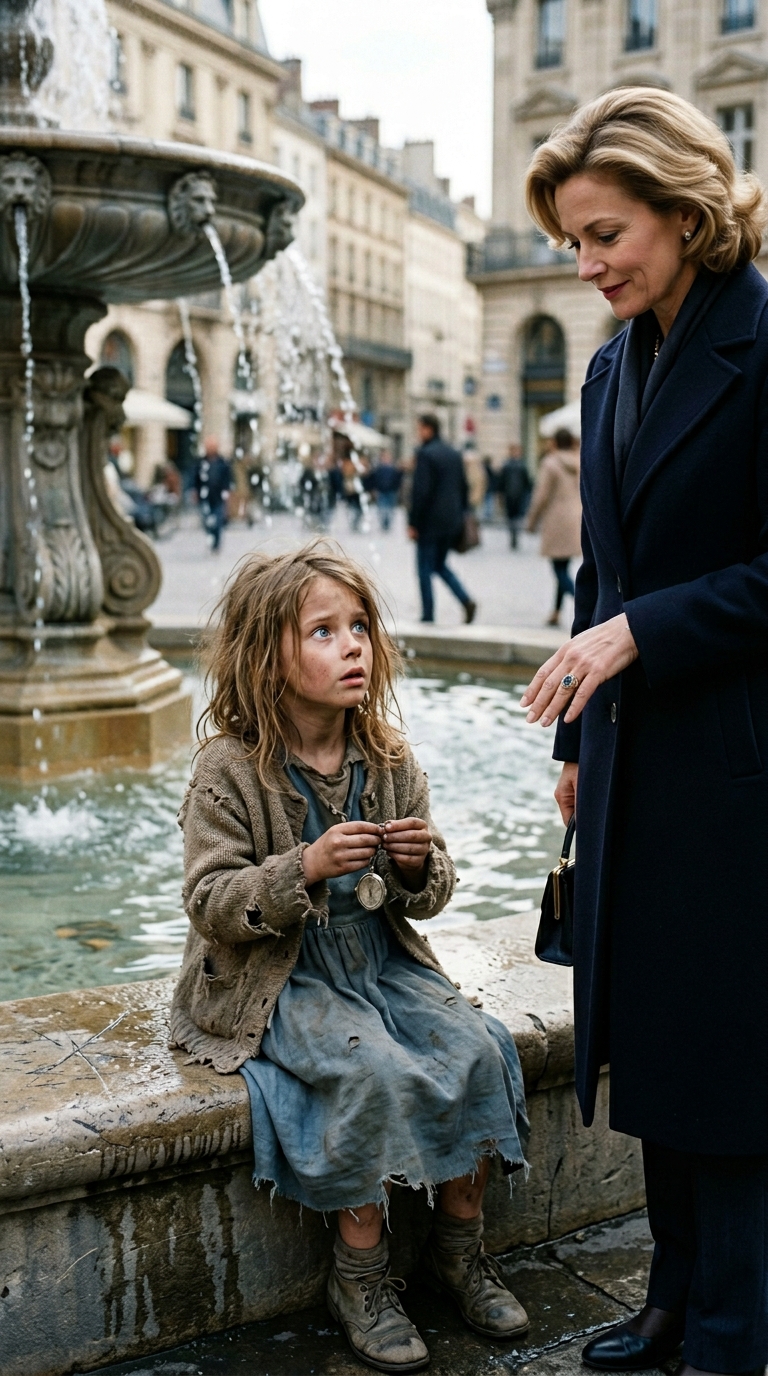
She stood slowly and walked toward the bench.
“My mom…” she whispered.
The woman turned, confused at first, expecting a request—a plea—a beggar’s voice.
Instead, the girl raised the locket.
Then pointed at the ring.
The woman’s face broke open in shock.
Not pity.
Not confusion.
Recognition.
The groundskeeper heard the child’s voice and turned from the path. He was already uneasy by the look on the woman’s face before he even reached them.
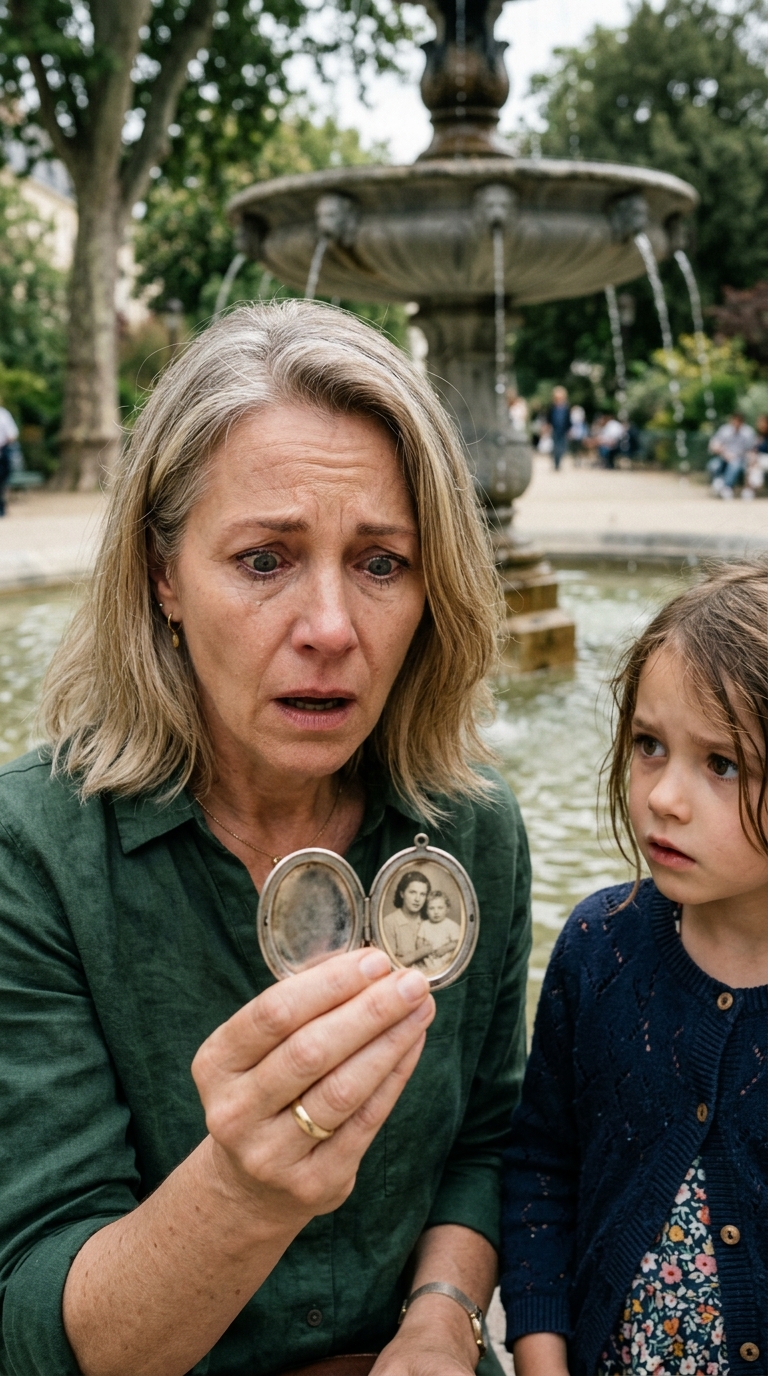
The girl opened the locket.
Inside was a tiny, faded photograph—and tucked behind it, folded into the metal frame, a scrap of paper so small it looked almost impossible that words could fit on it.
The groundskeeper stepped closer.
Then he saw what was inside.
And froze.
The little girl looked up through tears and whispered:
“She said hide.”
The elderly woman’s hand began to tremble violently.
She stared at the paper like it held something she had spent years praying would never return.
Then she said, before she could stop herself:
“She kept the second instruction.”
The groundskeeper didn’t understand everything—but he understood enough.
This wasn’t a lost-family moment.
This was a message that had arrived too late.
He crouched carefully, not wanting to scare the child. “What does the paper say?”
The old woman closed her eyes.
The girl held the locket tighter. “My mom said only the lady with the ring could read it.”
The groundskeeper glanced at the trembling hand, the ring, the fear. “Then she knows.”
The woman opened her eyes slowly.
For a moment, she looked less like someone untouchable… and more like someone watching the past come back to life.
“She shouldn’t have sent you alone,” the woman whispered.
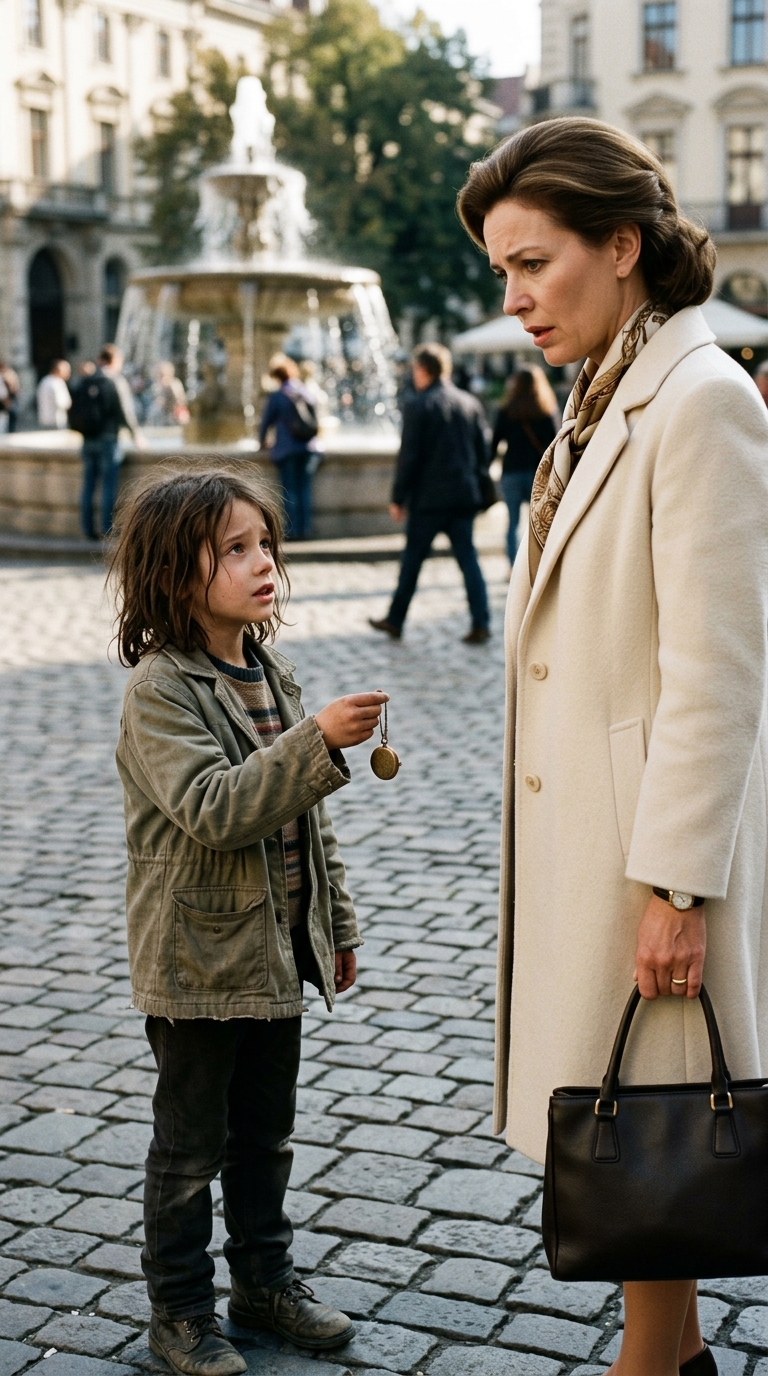
The child’s lips quivered. “She said if I saw the ring, I had to come fast.”
The groundskeeper extended his hand gently. “May I?”
After a pause, the girl let him take the locket.
He unfolded the tiny paper.
The handwriting was cramped and faded, but still readable:
If she is wearing the ring, they never stopped looking.
The groundskeeper’s expression changed instantly.
He looked from the note to the elderly woman. “Who is ‘they’?”
The woman didn’t answer right away.
Instead, she studied the girl’s face—really studied it—as if searching for someone she had once known in fear.
Then she asked, softly, “What was your mother’s name?”
The child swallowed. “Mira.”
The name hollowed the woman out.
The groundskeeper saw it.
“You knew her.”
The woman nodded once.
“She worked for my family,” she said. “Years ago.”
The little girl stepped closer. “She said my mom had this ring too.”
The woman looked down at her own hand.
“No,” she whispered. “She never had it.”
The child blinked.
“She stole it,” the woman said, her voice shaking. “The night she ran.”
The groundskeeper went still.
Now the note, the fear, the hidden paper—everything started to form something darker.
The little girl clutched her coat. “Then why did she tell me to find you?”
The old woman answered, her eyes filling with tears.
“Because she didn’t steal it for herself.”
Silence settled around the fountain.
The water kept running.
The birds kept calling.
And then the woman spoke the sentence that made both the child and the groundskeeper go cold:
“She stole it because it opened the room where they kept your real name.”
