

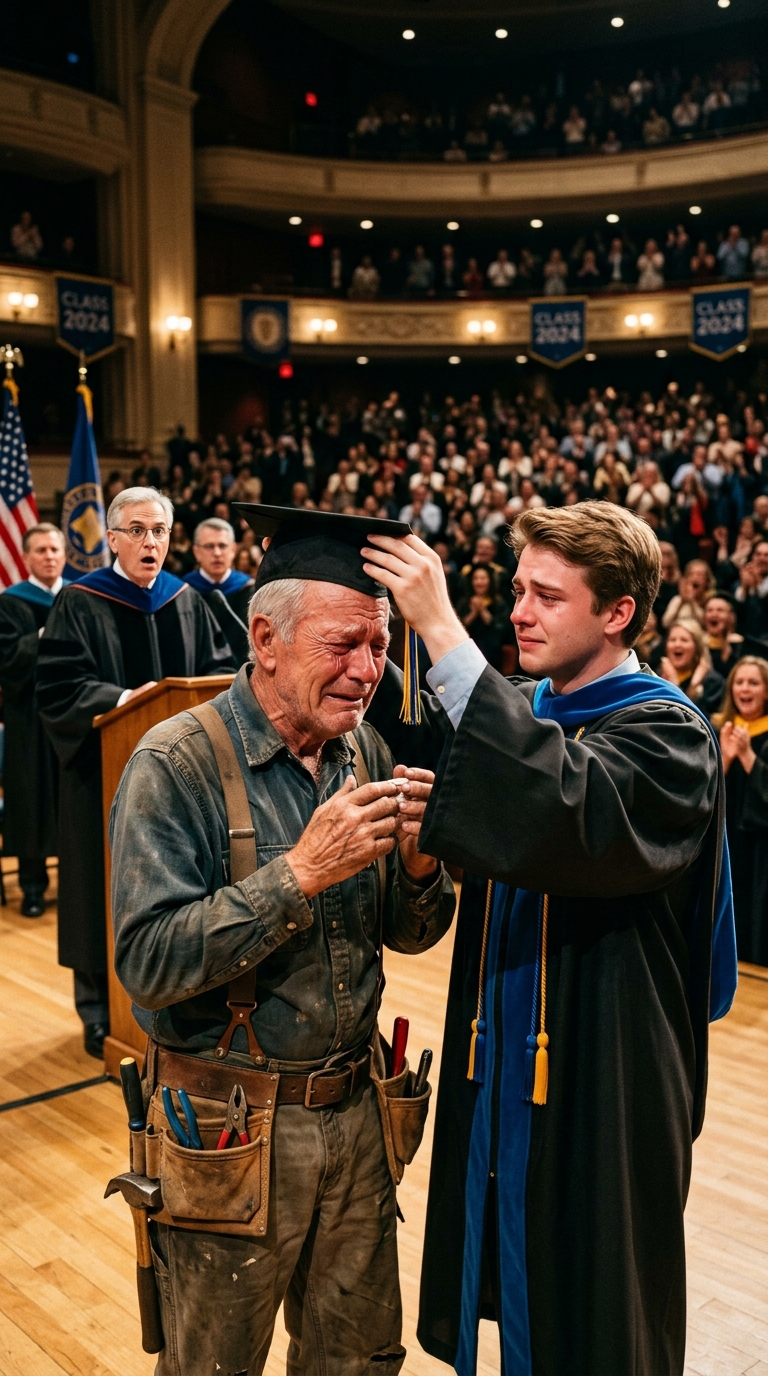
The Man Who Truly Built My Future
My stepfather spent twenty-five years working in construction, and he was the one who pushed me to keep studying until I earned a doctorate. Still, no one imagined he would show up at my graduation ceremony—least of all my professor.
The auditorium was filled with the scent of polished wood and freshly printed books. I had dreamed of that moment for years. But when the applause faded, it wasn’t my diploma that captured everyone’s attention. It was a quiet man seated in the last row, leaning forward, watching me with pride. It was Héctor Álvarez, my stepfather—the man who had laid the foundation of my life long before I ever thought about earning a PhD.
My childhood was far from perfect. My mother, Elena, separated from my biological father when I was very young. Over time, his image faded, replaced by memories of empty rooms and unanswered questions. I grew up in the small town of Santiago Vale, surrounded by rice fields and dusty roads. Life there was simple and harsh. Affection wasn’t expressed through words, but through food on the table or the certainty that someone would come home at the end of the day.

When I was four years old, my mother remarried. Héctor brought neither money nor status—only an old toolbox, hands hardened by years of labor, and a back worn down by effort. At first, I struggled to accept him. His boots left dust throughout the house, and his stories always revolved around construction sites and scaffolding I couldn’t even imagine. But over time, I began to understand his quiet way of showing love. He fixed my broken bicycle, stitched my worn-out sandals, and rode miles on his old bike whenever someone bullied me after school. He never shouted or gave long lectures. Once, he calmly told me something I would never forget:
“You don’t have to call me father. But I want you to know you can always count on me.”
After that, calling him “Dad” came naturally.
Our life was modest, but it was full of meaning. Every night, he came home covered in dust, exhausted from work, and asked me the same question:
“How was school today?”
He couldn’t help me with advanced math or literature, but he insisted that I study. He repeated a phrase that stayed with me:
“Knowledge is something no one can take away from you. It can open doors that money never will.”
We didn’t have much, but his consistency gave me strength. When I was accepted into Metro City University, my mother cried with pride. Héctor, on the other hand, stood silently on the porch, smoking a cheap cigarette. The next day, he sold his only motorcycle, added my mother’s savings, and prepared everything for me to move to the city. Before I left, he handed me a box of food—rice, dried fish, and roasted peanuts—and said:
“Study hard, son. Make the most of every opportunity.”

Inside the box, I found a folded note:
“I may not understand your books, but I believe in you. Whatever you learn, I will always support you.”
During my university and graduate years, Héctor never changed. He kept working tirelessly—climbing scaffolding, carrying bricks, bending his back a little more each day. Every time I returned home, I saw him at the construction site, wiping sweat from his brow, as if he were building my future with every block he carried.
On the day of my doctoral defense at Nueva Vista University, I asked him to attend. A bit shyly, he borrowed a suit, polished a pair of shoes that didn’t quite fit, and sat in the last row, trying to keep his back straight despite the pain.
When I finished my presentation, Professor Alaric Mendes approached the guests. When he reached Héctor, he suddenly stopped, as if something had just come back to him.
“You are Héctor Álvarez, aren’t you?” he asked in surprise. “I grew up near a construction site in Quezon District. I remember a worker who climbed down the scaffolding carrying an injured colleague—even though he himself was hurt. That man was you.”
Héctor remained silent, as humble as ever. Then the professor added, visibly moved:
“I never imagined I would meet you again… and now I see you here, as the father of a new doctor. It is an honor.”

I looked toward the last row and saw Héctor smiling, his eyes shining. In that moment, I understood something profound: he had never sought recognition. Everything he had done through years of silent sacrifice had borne fruit—not for himself, but through me.
Today, I am a professor at Metro City University. I have my own family. Héctor has retired from construction. He grows vegetables, raises chickens, reads the newspaper every morning, and rides his bicycle around the neighborhood. Sometimes he calls me just to proudly show me his tomato plants or to offer eggs to my children.
Once, I asked him:
“Do you regret working so many years for me?”
He let out a quiet laugh and replied:
“Not at all. I built many buildings in my life… but what I’m most proud of is building you.”
And that’s when I truly understood: even though I hold a doctorate, the real builder will always be Héctor Álvarez. He didn’t just raise walls—he built an entire life, lesson by lesson, through quiet acts of love.
