

When I married Daniel, I believed I had found the kind of love people spend years searching for.
He was calm, patient, and quietly kind—the kind of man who never raised his voice and never forgot the small things that mattered. We moved into a modest home in Vermont, where his widowed mother, Margaret, lived with us. At first, I saw it as something beautiful: a man who honored the woman who had raised him.
But a few weeks after the wedding, I began noticing something that didn’t sit right.
Every night, after I fell asleep, Daniel would leave our bed.
I didn’t catch on immediately. The first few times, I thought I had imagined the empty space beside me. But eventually, I started waking up in the middle of the night and finding the bed cold where he should have been.
One night, I heard the soft click of the door opening and closing.
The next morning, I asked him gently, trying not to sound suspicious.

“Did you get up last night?”
He smiled in that same calm way. “Mom gets a little anxious at night. I just stay with her until she falls asleep.”
It sounded reasonable, and I didn’t want to seem selfish. Still, the nights kept passing—and he never came back to our room.
Weeks turned into months. Months quietly turned into years.
No matter how exhausted he was, no matter how early he had to wake up, Daniel would always leave once the house went quiet. Outside, the seasons changed—winter snow, spring rain, heavy summer heat—but his routine never did.
To everyone else, we looked like a happy family. A devoted son, a gentle mother, and a grateful wife. But inside, something in me was slowly breaking.
Sometimes Margaret would say things that made it worse.
“A man who loves his mother deeply will always be a good husband,” she would say with a soft smile.
I would smile politely, but inside I felt invisible.
I tried to push away the thoughts that kept creeping in—the feeling that maybe Daniel loved his mother more than me, or that there was something I didn’t understand. The hardest part was not knowing the truth.
Three years passed like that.
One night, I couldn’t sleep at all. Around two in the morning, I heard the familiar sound again: the bed shifting, quiet footsteps, the door closing softly.

This time, I didn’t stay still.
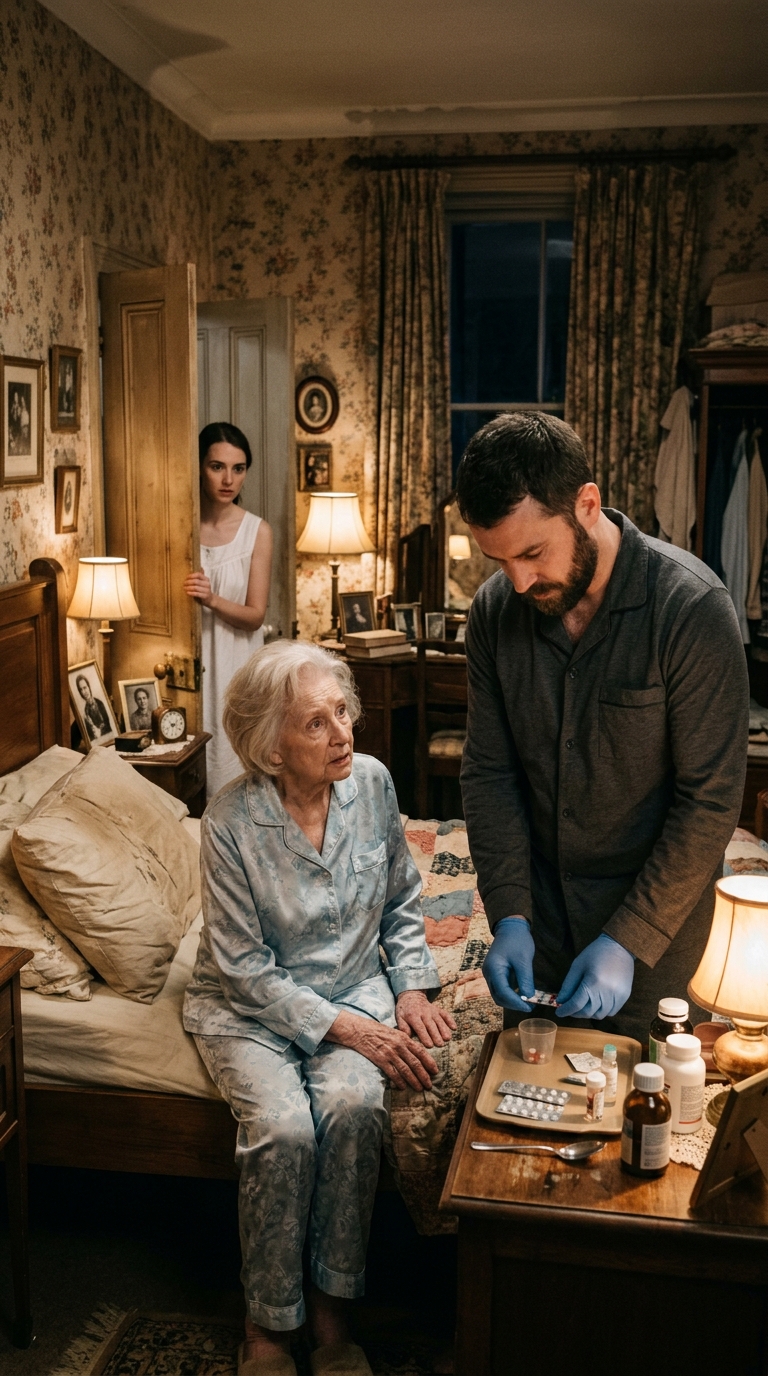
I got up slowly and followed him down the hallway, my heart racing with every step. The light in his mother’s room was dim, the door nearly closed.
For a moment, I just stood there, listening.
Then I heard Margaret’s voice, weak and tired.
“Daniel… could you help me again? It’s burning tonight.”
His voice was soft and steady. “Of course, Mom. Don’t move. I’ll take care of it.”
Something inside me tightened.
I pushed the door open just a little.
What I saw made me freeze.
Daniel was wearing disposable gloves, carefully applying medicated cream to his mother’s back. Under the soft light, her skin looked red and inflamed, covered in patches that must have been incredibly painful. She winced slightly but still tried to smile.
“I’m sorry you have to do this every night,” she whispered.
Daniel shook his head right away. “You took care of me my whole life. Let me do this for you now.”
I covered my mouth, suddenly unable to breathe.
For three years, I had imagined things that hurt him without him ever knowing. I had thought about jealousy, about resentment, about things that were never true. What I was seeing wasn’t strange or wrong.
It was love—quiet, patient, and completely selfless.
Margaret had been living with a painful skin condition that became unbearable at night. During the day, she hid it well. Long sleeves, gentle smiles, no complaints. But when the pain came, it was Daniel who stayed with her—every night, without telling anyone, without asking for recognition.
I went back to our room and didn’t sleep at all. I just lay there, thinking about everything I had misunderstood.
The next morning, after Daniel left for work, I went to the pharmacy. I bought gentle lotion, clean cloths, soft bandages—anything that might ease her pain.

When I returned home, I knocked softly on Margaret’s door.
“Mom,” I said quietly, “would you let me help you tonight?”
She looked surprised at first. Then her eyes filled with tears.
“You don’t have to do that,” she said.
“I want to,” I answered. “It’s time I understand what you’ve both been carrying on your own.”
That night, for the first time in years, Daniel stayed beside me.
He held my hand gently and whispered, “Thank you for not misunderstanding me anymore.”
Tears slipped down my cheeks, but for the first time, they didn’t feel heavy.
“I’m sorry it took me so long to see the truth,” I said softly.
From that night on, we carried the responsibility together. I helped Margaret with her treatments, and little by little, her condition improved. The house began to feel warmer, lighter, more peaceful than it had in years.
And every night, when Daniel lay beside me instead of quietly slipping away, I finally understood something I had never fully seen before.
Love isn’t always loud. It isn’t always romantic. Sometimes it’s simply the choice to care for someone when no one else is watching.
If I had never followed him that night, I might have spent the rest of my life resenting the kindest man I had ever known—never realizing that what I thought was distance was actually devotion.
