


“Sir, please don’t get on that boat!”
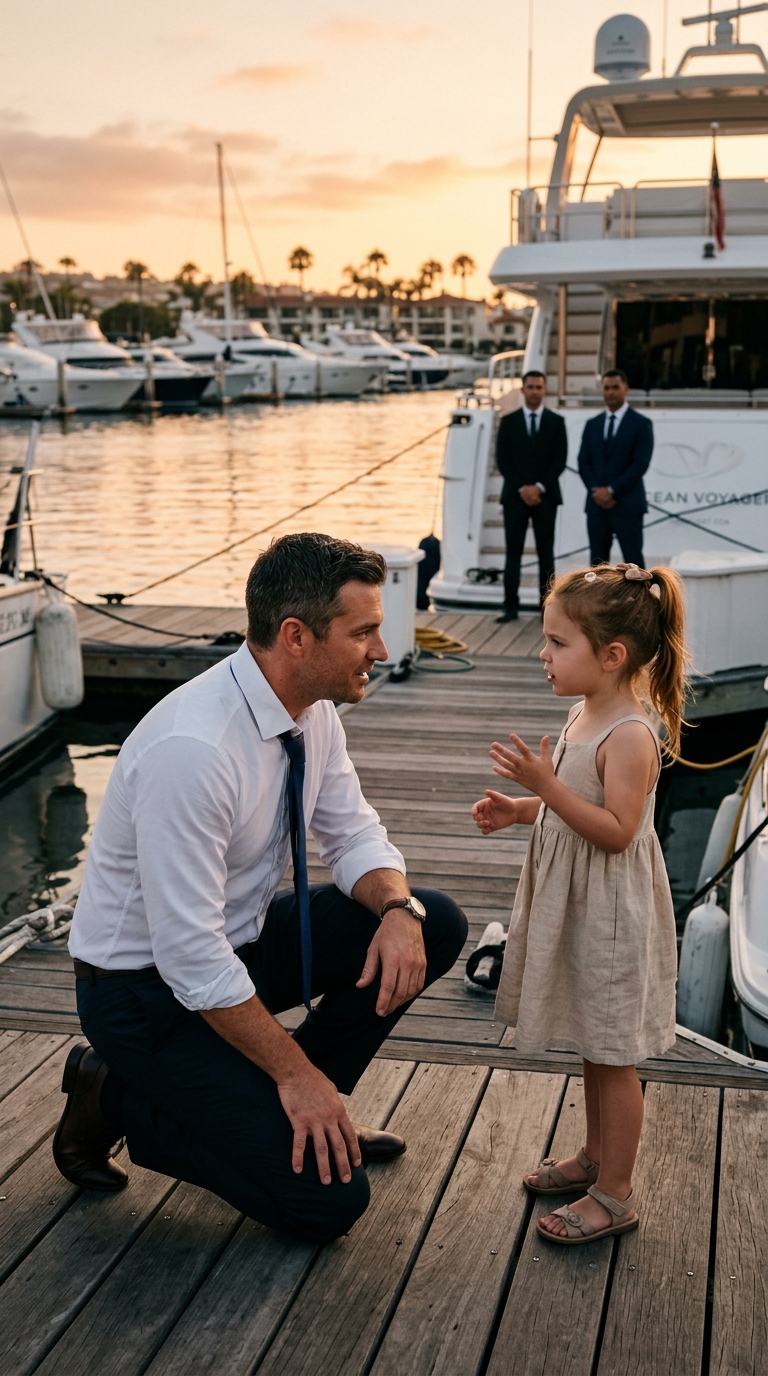
The small, trembling voice cut through the bright buzz of the marina just as Jonathan Pierce stepped onto the polished dock leading to his yacht.
Minutes later, a sound from the vessel would freeze his blood.
That morning, Jonathan had woken with a sharp sense of triumph pulsing through him. After years of ruthless deals, sleepless nights, and risks that would have broken most men, he had closed the biggest acquisition of his career. The headlines would call him visionary. Investors called him unstoppable.
To celebrate, he chose the most visible symbol of his success: a day at sea aboard his brand-new yacht, The Sovereign—sleek, white, and gleaming under the Florida sun at Crescent Bay Marina. It was the largest, most luxurious vessel in sight, fitted with marble countertops, imported leather seating, and engines powerful enough to cut through open water like silk.
The sky was clear. The breeze carried salt and fuel. Other boat owners glanced his way—some admiring, others envious. Jonathan accepted the attention with calm confidence. He had earned it.
Then he saw her.

She stood directly in front of the boarding ramp, small and still, as if placed there by something beyond chance. Barefoot. Her dress worn and frayed at the edges. Tangled strands of brown hair framed a face far too serious for a child no older than nine.
Security guards were already moving toward her.
“Clear the dock,” one of them muttered.
Before they could reach her, she lifted her chin and looked straight at Jonathan.
There was something in that gaze—something that unsettled him more than any rival ever had.
“Sir,” she said, her voice shaking but firm, “please don’t get on. You can’t go today.”
A few onlookers chuckled. Jonathan forced a polite smile.
“And why is that?” he asked, humoring her.
“I saw it,” she whispered. “In my dream. The boat… the water… and you. It was loud and dark and you couldn’t get out.”
Her small hands tightened at her sides, knuckles pale. There was no playfulness in her face. Only fear.
Jonathan almost dismissed her. He didn’t believe in dreams or warnings. His world was built on logic and numbers.
Yet something in her eyes—raw, urgent sincerity—pulled at him unexpectedly.
“Remove her,” one of the guards said quietly.
Jonathan raised a hand. “Wait.”
The dock went still.
“What’s your name?” he asked.
“Grace,” she said softly.
“And Grace,” he replied gently, “boats don’t sink because of dreams.”
She swallowed. “My dad used to say they talk before something bad happens. You just have to listen.”
For a split second, something stirred in Jonathan’s mind—a memory of a report long ago, warnings dismissed, an engineer called overly cautious.
He pushed the thought away.
But then—
Crack.
The sound came from the yacht’s lower deck. Sharp. Splintering. Like metal under pressure.
Jonathan froze.
Another sound followed—louder. A dull pop echoed through the hull. Crew members exchanged confused looks.
“What was that?” someone called out.
Then shouting broke out. A deckhand ran toward the dock, panic replacing professionalism.
“Sir! There’s water coming in from the aft compartment!”
The words hit like a blow.
Within seconds, chaos erupted. Water rushed through a ruptured pipe beneath the engine housing—one that had not been properly secured during a rushed installation. Electrical sparks snapped near exposed wiring. A mechanic shouted to cut power before the engines ignited.
Had the yacht left just minutes earlier, the vibration from acceleration would have worsened the rupture. A short circuit near the fuel line could have triggered an explosion at sea.
Jonathan stood still, his heart hammering. The champagne bottle still rested in a silver bucket by the ramp. The ribbon he had planned to cut fluttered in the wind.
Slowly, he turned to where the girl had been.
Grace was gone.
Hours later, after emergency crews secured the yacht and the marina settled into uneasy quiet, Jonathan sat in his car, staring at the steering wheel, his hands slightly shaking.
He had been minutes away from dying.
“Find her,” he told his head of security. “The little girl.”
They found her at Harbor Light Shelter, a modest building a few blocks from the marina.
When Jonathan stepped into its narrow hallway that evening, the smell of disinfectant and worn paint replaced the polished scent of luxury. Grace sat at a small table, drawing boats with a blue crayon.
She looked up when he entered.
“You didn’t go,” she said quietly.
“No,” he replied. “I didn’t.”
A counselor stepped closer, speaking gently. “Her name is Grace Mitchell,” she said. “Her father passed away three years ago.”
The name hit him harder than the cracking hull ever had.
Mitchell.
Ethan Mitchell.
Jonathan remembered. A naval engineer at Pierce Maritime Innovations nearly a decade earlier. A man who had filed report after report about structural weaknesses in a line of high-performance yachts—reports Jonathan had dismissed as excessive caution that would slow production and cut into profits.
Ethan had been fired for “obstructing efficiency.”
Within two years, the pressure had broken him. A heart attack, the counselor said. Grace had been eight.
Jonathan’s throat tightened.
“She talks about him often,” the counselor added softly. “He used to bring her to the docks. Said boats speak if you know how to listen.”
Jonathan slowly knelt in front of Grace.
“Your father worked for me,” he said.
She nodded. “He said one day you’d understand.”
The quiet certainty in her voice cracked something inside him.
“I didn’t listen,” Jonathan admitted. “But you did.”
Grace’s eyes filled with tears she refused to let fall. “He said if something feels wrong, you don’t ignore it. Even if no one believes you.”
Jonathan lowered his head. For years, he had built his empire by pushing past doubt, dismissing caution, and moving forward no matter the cost. The profits had grown. So had the quiet compromises.
Now he saw how many warnings he had ignored—not just from engineers, but from his own conscience.
The next morning, Crescent Bay Marina buzzed with talk of the near-disaster. By afternoon, Jonathan Pierce made a public statement.
Production of the compromised yacht line would be halted. Independent safety audits would be commissioned. Compensation funds would be established for families affected by past negligence.
And a new foundation would be created in Ethan Mitchell’s name—dedicated to maritime safety research and scholarships for young engineers.
When reporters asked what had led to such a sudden change, Jonathan paused.
“A child reminded me to listen,” he said simply.
Later that week, he returned to Harbor Light Shelter—not with cameras, but alone.
Grace met him outside.
“I sold the yacht,” he told her gently.
Her eyes widened. “All of them?”
“I kept one thing,” he said, holding out a small silver compass engraved with her father’s initials, recovered from company archives. “Your dad once gave this to a trainee. Said every captain needs direction.”

Grace held it carefully, like something fragile.
“You saved my life,” Jonathan continued, his voice unsteady. “But more than that—you saved the part of me I forgot existed.”
She studied him for a long moment.
“Then listen next time,” she said.
He nodded.
Because in the end, real wealth isn’t measured by yachts resting in shining marinas, or contracts signed in glass offices. It’s measured by the courage to admit mistakes, to change direction, and to respect the quiet warnings we once ignored.
And sometimes, salvation doesn’t come from power or success—but from a barefoot child brave enough to say, “Don’t get on.”
