

My life reads like a carefully executed coup, though for years I was the only one unaware the battle had already begun. They say in Seattle the rain doesn’t just fall—it erases, washing away the city’s edges into the gray of Puget Sound. But on the night everything shattered, the rain revealed instead of erased. It brought a cold clarity that finally exposed the monsters living in my own home.
I am Julian Thorne, founder of Visionary Systems. To the world, I’m the tech prodigy who turned neural interfaces into a billion-dollar empire. But to the woman idly swirling a glass of expensive Chardonnay in my kitchen, I was nothing more than a golden goose—a convenient fortune with a “pathetic” attachment to his past.
“Honestly, Julian,” Tiffany said, her tone laced with polished indifference. She didn’t even glance at me, too busy admiring her reflection in the dark glass. “She has a nurse for a reason. You’re a CEO, not a caretaker. Don’t you have a jet to catch? The Tokyo board won’t wait forever.”
I turned toward my mother, Margaret. She sat at the breakfast nook, her hands—worn from years of cleaning offices to fund my MIT education—searching for a glass of water. Her eyes were clouded, a milky veil from an untreated infection she’d hidden long ago. She had spent her surgery money on my future. She had given up her sight for my vision.
“I’ll be back soon, Ma,” I murmured, pressing a kiss to her forehead. She smelled faintly of lavender and medicine.
“Safe travels, Julian,” she said softly. “Don’t work too hard. The world can wait.”
Tiffany exhaled sharply and checked her watch. “The car is waiting. Move.”
A faint unease lingered as I left, the heavy doors closing behind me like a vault. But fate intervened. Three hours later, my flight was grounded by a violent storm. The sky turned bruised purple, wind screaming across the coast.
When I returned to the estate far earlier than expected, something felt wrong. The west wing lights were off. I checked the security app—terrace cameras manually disabled.
My pulse slowed into something heavy and deliberate.
I entered through the service door, moving silently through my own house.
The interior was unnaturally quiet, broken only by rain striking the glass walls. As I neared the terrace, I saw a shape through the mist.
My blood froze.
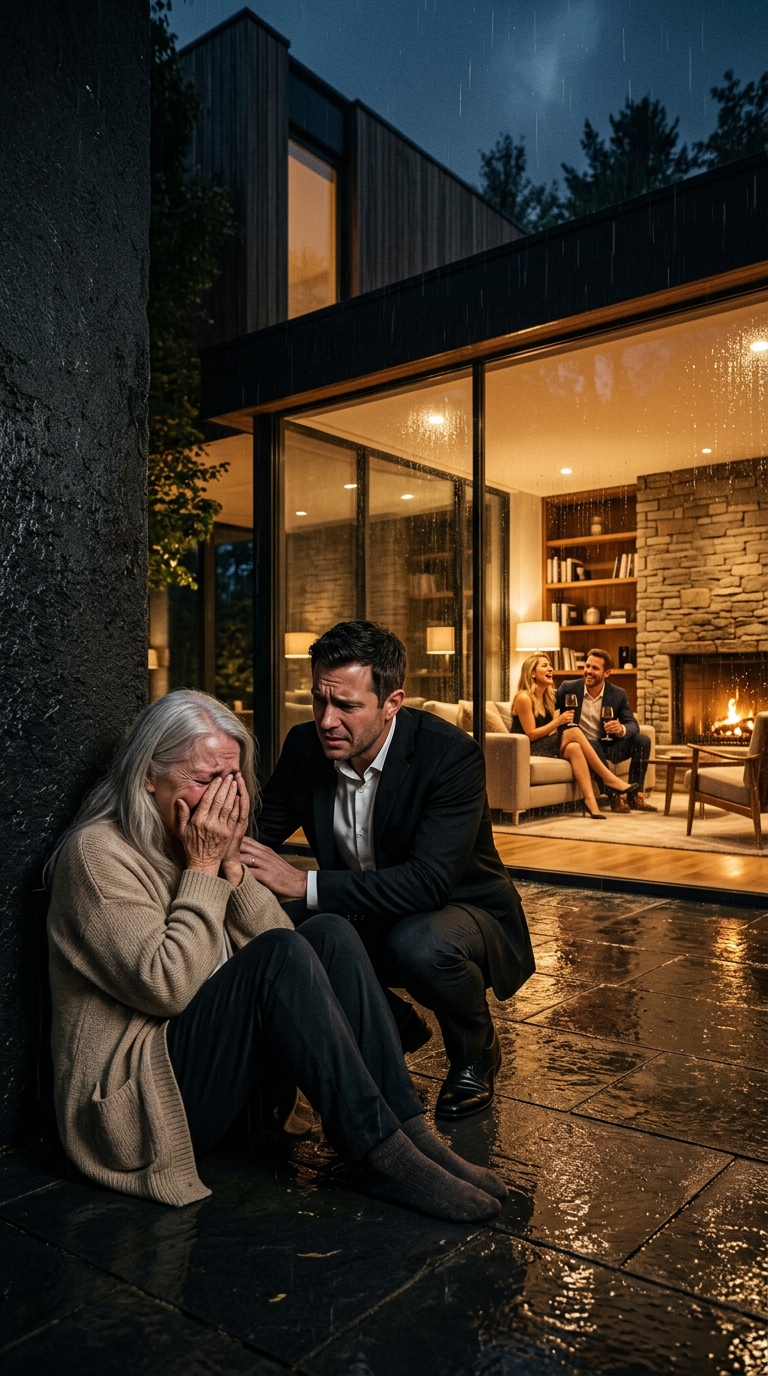
On the narrow stone balcony stood my mother, curled into herself, shivering in a thin nightgown. Her fingers scraped weakly against the glass, searching for a handle locked from the inside.
Inside, the fireplace blazed warmly. Tiffany reclined against Chad Vance—my COO and closest friend of fifteen years. They shared a bottle of champagne, laughter light and careless.
“Did you hear her scratching again?” Chad chuckled. “Like a giant, blind moth on the patio.”
Tiffany sneered, leaning into him. “Let her stay. The old hag smells like poverty and stale medicine. It’s better for the house if she stays out there. Julian’s halfway to Japan—he won’t notice anything until Monday. By then we’ll convince him she needs to be put away.”
“To the ‘aesthetic,’” Chad toasted. “And to the shell company. By the time he figures it out, we’ll be gone.”
Something inside me shifted—quiet, final.
I didn’t storm in. I unlocked the door remotely, stepped into the freezing rain, and pulled my mother into my arms.
“Julian?” she whispered, shaking. “I couldn’t get back in.”
“I’ve got you, Ma,” I said.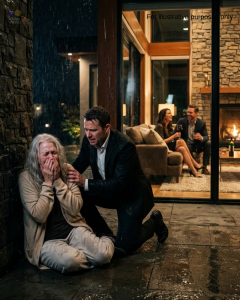
I carried her to safety, called her doctor, wrapped her in warmth—then returned.
I placed my phone on the table.
Still recording.
Silence filled the room.
Tiffany’s face went pale. Chad’s hand trembled.
“Julian! You’re back!” Tiffany rushed forward, her concern perfectly staged.
“Is that so?” I said calmly. “You seem very concerned.”
Chad straightened. “It’s not what it looks like.”
“And the cameras?” I asked. “Did the storm disable those too?”
Tiffany’s voice cracked. “It was a joke—”
“The door was locked,” I said.
Chad’s tone hardened. “She’s a liability. You need people who fit your image.”
I looked at him. “You’re right.”
I dismissed them for the night.
Then I went to work.
By morning, everything had changed.
Accounts frozen. Access revoked. Evidence sent.
When they stood in the foyer, demanding control, I handed Tiffany a single document.
The house belonged to my mother.
They were trespassers.
Security waited. The law was already moving.
Within minutes, they were gone.
The aftermath was swift. Public disgrace. Criminal charges. Silence where betrayal once lived.
But inside the house, something new grew.
Peace.
I spent my days beside my mother, describing sunsets she could no longer see.
“It’s violet tonight,” I told her once.
She smiled. “I can feel it.”
And I finally understood—I had built everything to protect her, yet nearly lost her to the very world I created.
A year later, I gave her something back.
Sight.
As she looked at me for the first time in decades, she whispered, “You look just like your father.”
And for the first time in years, everything felt whole.
The past didn’t disappear.
But it no longer owned me.
If you want more stories like this, feel free to share your thoughts below.
