


PART 1 — An Afternoon Borrowed from Time
I believed that pretending to be a dying young woman’s boyfriend for three hours would amount to a modest kindness. I had no idea that a wooden box, and the secret she had kept inside it, would change everything I understood about my late wife. It began with a declaration that almost made me lose my grip on my coffee. "Daniel, you’re going to be my boyfriend for the next three hours." Beside me, a 24-year-old woman smiled while her hands shook under a hospital blanket. "I’m sorry, what?" I asked. "I’ve never had a real date and I’m running out of time. Pretty please?" Her name was Sophie, and she was a patient at the hospice where I volunteered. She was young enough to be my daughter. At 56, and two years into widowhood, I certainly hadn’t expected anyone to ask me on a date.
My wife, Claire, had died of cancer after twelve years of marriage. Without her, our home seemed impossibly large. Its quiet was difficult to endure, and the most ordinary habits brought fresh reminders that she would never return. Before her death, Claire had encouraged me to volunteer at a hospice. She believed that being present for people facing painful moments might help me find purpose again. That suggestion eventually brought Sophie into my life. Her treatments were no longer helping, and her doctors had explained that there was little more they could offer. Yet every morning she wanted her curtains opened so she could watch the sun rise. "Can’t waste a perfectly good sunrise," she would say. I respected the way she refused to make her illness the center of every conversation.
"Sophie, you’re joking, right?" I asked. "Nope. Come on, Daniel. It’s only three hours. One date. You can handle that, can’t you?" I tried to explain my lack of qualifications. "You’re asking the wrong person. I haven’t been on a date in years." "Perfect. Neither have I." That made me laugh. "Besides, you’re old enough to be my father," she added. "That’s exactly what I was thinking." "Then we’re already off to a great start." She wasn’t proposing a relationship. All she wanted was a few hours that felt different from the rest of her days. "I want to go outside, eat something sweet, and pretend I’m just another girl having a normal day," she explained. "I’ve never had someone take me on a proper date." Her smile faltered. "Please, Daniel. It would mean the world to me."
I thought of Claire and the everyday moments I had learned, too late, never to dismiss as unimportant. "Alright," I told Sophie. "Three hours." Her expression brightened immediately. I checked with the nurse responsible for her care. After assessing Sophie, she agreed that we could spend some time in the hospice garden, provided I brought her inside if she became tired. Soon I was guiding her wheelchair toward the courtyard. At the little café near the entrance, I bought her strawberry ice cream and chose chocolate for myself. After tasting hers, she reached across and helped herself to mine. "Hey! Get your own." "Yours tastes better." "They’re both ice cream." "That’s what someone with bad taste would say."
We settled beside the pond and fed the ducks, talking about films, music, and the absurd things we might do with an ordinary day free from worry. Sophie wanted to see New York, buy pizza from a street vendor, and attend a Broadway show. "I’d probably fall asleep halfway through," I admitted. "Then you’re not invited." For a little while, I nearly forgot the circumstances that had brought us together. My thoughts weren’t occupied by hospital rooms or medication times. I was simply sharing ice cream with a young woman who laughed at my dreadful jokes. Eventually, she asked about Claire. "How long were you married?" "Twelve years." "What was she like?" I rested against the bench. "Stubborn. Terrible at singing. Absolutely convinced she could cook, despite burning toast at least twice a week."
Sophie laughed. "She sounds wonderful." "She was. She also had this little thing she did whenever she wanted to tell me she loved me. She’d squeeze my hand three times. It was our little thing." I showed her by pressing my fingers into my palm. Something shifted in her face. Her smile slipped away as she turned toward the pond. "That’s sweet," she whispered. "She would’ve liked you," I said. "Really?" "Absolutely. She would’ve thought you were funny." "Good. I like her already." Later, tiredness began to show. Sophie drew several measured breaths and leaned her head against her wheelchair. "Are you okay?" "I’m fine. Just having a wonderful date." I gave her water, and we moved beneath a tree, beside a quieter bench.
There, she returned to the subject of my wife. "Did she ever talk about her life before she met you?" "Of course. She grew up in another state, went to college, and worked in publishing. Why?" Sophie’s next question took me completely by surprise. "Did she ever mention having a baby?" "No. Why would you ask that?" Her gaze dropped to the ground. "Just curious." "Is there something you’re trying to tell me?" "Not yet." I wanted an explanation, but her discomfort stopped me from pressing. Even so, I couldn’t put the question aside. I had believed that Claire and I had shared our lives openly. Until that afternoon, I had never found a reason to doubt it.
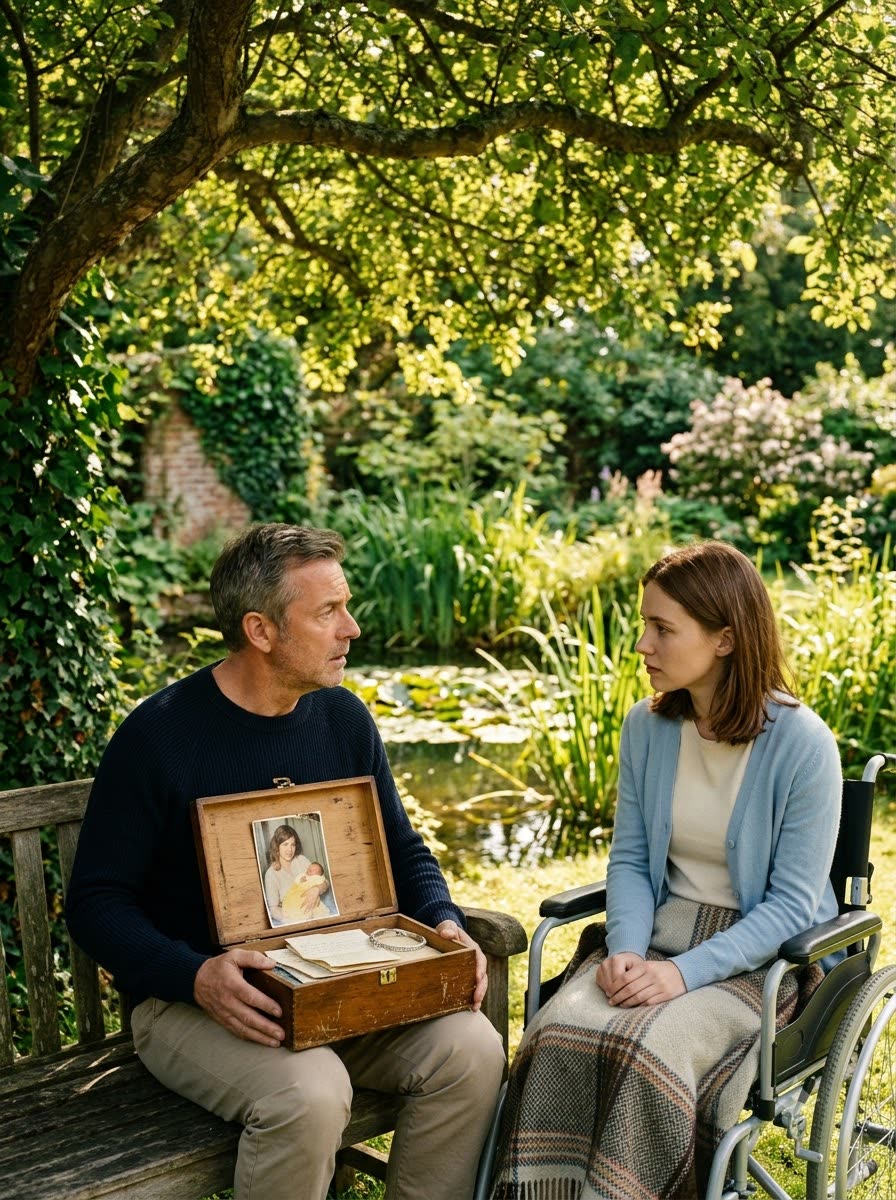
When I glanced at my watch, our allotted three hours were nearly finished. "Well, Miss Sophie, I believe your boyfriend has fulfilled his contractual obligations." She checked her own watch. "Not quite." From the small bag attached to her wheelchair, she brought out a wooden box roughly the size of a paperback. Its edges were scratched, and a little brass clasp held it shut. "What’s that?" "Something I’ve been keeping for a long time." "Is it a present?" "In a way." She cradled it with care. "Daniel, I need you to understand something. I didn’t choose you by accident." My smile vanished. "What do you mean?"
"There’s something about Claire you never knew. I promised her I’d tell you when the time was right." My heart started hammering. "Please don’t be angry with her," Sophie said. "She had her reasons." "Why would I be angry? What did she do?" "Just open it." I struggled with the clasp, my fingers suddenly clumsy. Sophie laid her hand over mine. "Whatever happens, Daniel, I need you to know that she loved you." "Why are you saying goodbye like that?" Her smile was sorrowful. "Because our three hours are over." At last, with shaking hands, I raised the lid. What lay inside made the entire afternoon seem different.
The first thing I saw was a photograph of Claire standing outside a hospital, a newborn gathered in her arms beneath a pale yellow blanket. She appeared to be in her early twenties. I knew her face immediately, but the baby was not mine. Beneath the picture lay papers, a folded letter, a little silver bracelet, and an envelope bearing my name. "Where did you get this?" I asked. "From my mother," Sophie answered. "Your mother?" Her reply left me staring between her and the photograph, unable to understand how the woman I had loved and the young patient beside me could belong to the same hidden story. "Claire was my biological mother, Daniel."
PART 2 — The Family She Never Told Me About
"No." It was the only response I could manage. "Yes." "But Claire never had children." "She had me." Among the papers was a birth certificate naming Claire under "Mother." Its date was twenty-four years earlier—the year Sophie had been born. Looking at her now, I could recognize my wife in her eyes and in the small crease near her mouth. Those familiar features had been there all along. I simply hadn’t understood what they meant. "How?" I whispered. "She was 20 when she had me. She wasn’t married, and the man who got her pregnant wasn’t someone she could depend on. Her parents were strict, and she was terrified of what would happen if they found out."
"She gave you up for adoption?" "Yes. It was a closed adoption. She thought it would give me a better life." I lifted the silver bracelet. Its inscription read, "For my little girl. Always loved." "Did she ever see you again?" "Yes, when I was older." I opened a letter written in Claire’s hand seven years before. "To my daughter, I was young and frightened when I gave you up. I convinced myself it was the only way to protect you." The words continued: "But I never stopped thinking about you. I wondered whether you liked strawberries, whether you laughed loudly, and whether you had someone to hold your hand when you were afraid." She had written that she hoped her daughter would someday find her and understand that giving her away had been the hardest choice of her life.
I held the letter against my forehead. "How did you find each other?" "When I turned 18, I started looking for my biological parents. Eventually, I found a way to contact her." "How long did you know each other?" "Six years." Sophie nodded. "She was scared you’d find out. She didn’t want to hurt you, but she also didn’t want to lose me again." Anger rose through the shock. It wasn’t anger that Sophie existed or that she was Claire’s daughter. It came from realizing that my wife had lived with this enormous secret while I believed we had told each other everything. "Did she meet you?" "Several times, mostly in a café near her old office. She remembered everything I told her."
"Why didn’t she tell me?" "She was afraid." I asked what had made Claire wait. "She knew you wanted children, Daniel." Nothing Sophie had said struck me harder. Claire and I had tried to become parents. There had been medical appointments and tests before we finally stopped trying. We told ourselves that we were happy, and we were. Still, there were times when Claire cried because she believed she had let me down. I had always assured her that she was enough. Now, sitting with her daughter, I thought about those conversations differently. The pain we had shared had also concealed something I had never known to ask about.
"She was afraid you’d think she’d hidden something unforgivable," Sophie explained. "She knew having a daughter might bring back all those memories about the children you couldn’t have together." I lowered my eyes to the letter. "She could’ve told me." "I know, Daniel." Sophie took my hand. "She was afraid you’d see her differently. She didn’t want you to feel you had to choose between us. She didn’t want me to become a responsibility you inherited. She wanted you to meet me because you wanted to." The envelope addressed to me was still in the box. My hands trembled as I opened it and unfolded the words Claire had been unable to say.
"Daniel, I am sorry. There is something I have wanted to tell you for years. I have a daughter. Her name is Sophie." Seeing my own name at the beginning made the letter feel painfully immediate. "I met her again when she was 18, and I have loved every moment of knowing her. I wanted to introduce you to her and watch the two of you become part of each other’s lives." I kept reading. "But I was afraid you’d wonder what else I had kept from you. I was afraid you would see me differently. Most of all, I was afraid I would lose the family I had built with you."
Tears blurred the page until I could scarcely make out her handwriting. "You gave me a life I never thought I would have. You loved me without asking me to be anyone other than myself. Please don’t let my silence make you question my love. I loved you every single day. And I hope that one day, you can love Sophie, too." Beside me, Sophie reached for my hand again. "She loved you so much, Daniel." "Why didn’t she tell me before she died?" "She wanted to. She found out her cancer had returned, and we were talking about it when she was going through another round of tests."
I remembered Claire’s exhaustion and fear during that time. Near the end, I had asked whether there was anything more she needed to tell me. She had answered by squeezing my hand three times and whispering, "I love you." I had thought that was everything she meant to say. Now there was another meaning beside that memory, another conversation she had never managed to begin. Sophie told me that Claire had asked her to promise she would find me if anything happened. She had entrusted Sophie with the box and told her to wait until she felt ready. The explanation didn’t undo my hurt, but it showed me how long both of them had carried what I was only now learning.
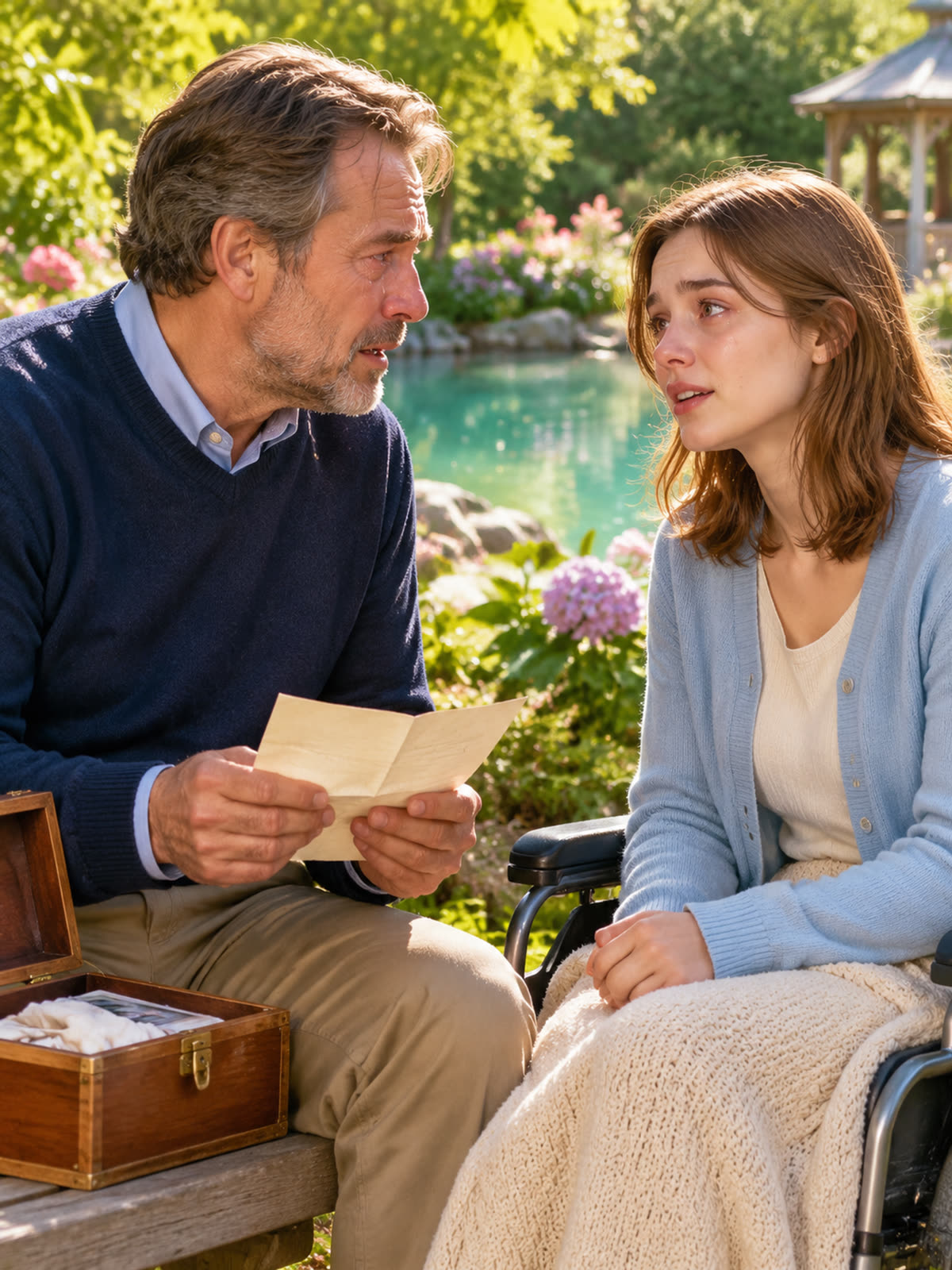
"How did you know where I was?" I asked. "She told me you were thinking about volunteering at a hospice." "Then you came here because of her?" Sophie nodded. She had wanted to meet me, but wanting it had not made the introduction easy. "I wanted to meet you, but I didn’t know how to walk up and say, ‘Hello, I’m your dead wife’s daughter.’" In spite of everything, a fractured laugh escaped me. "That would’ve been quite an introduction." The young woman who had asked for ice cream and teased me beside the pond had been trying to find a way into a conversation neither of us could have approached lightly.
"I watched you for a while," she said. "You never made people feel like they were dying. You made them feel like they were still living. Then you opened my curtains one morning and told me it was a beautiful day. I knew why Mom had loved you." Mom. Until that moment, I had never heard Sophie call Claire by that name. It was such a small word, yet it revealed an entire part of my wife’s life that had existed beyond my knowledge. I had believed Claire’s greatest fear was leaving me alone. With Sophie beside me and the open box between us, I understood that she had also feared leaving her daughter behind a second time.
PART 3 — Three Squeezes, and Everything They Meant
"Why did you ask me to be your boyfriend?" I asked. Sophie had already explained why she had sought me out, but I still wanted to understand why she had chosen that particular way of reaching me. "Because I wanted one normal afternoon with you. Mom said you’d complain about the ice cream, make terrible jokes, and quietly make sure I had everything I needed." I laughed. "That sounds about right." "She was right about you." What had begun as an unexpected favor had brought me to someone Claire had loved, someone she had hoped I might one day love as well.
I looked down at Sophie’s shaking hands. "How much time do you have?" I asked. "Nobody knows exactly." I wanted to insist that there must be another opinion, another possibility, something more someone could try. But I had already watched a person I loved endure that struggle. Instead of giving voice to those demands, I held her hand and pressed it three times. One. Two. Three. Her eyes widened. "That’s what she used to do," I whispered. "I know," she replied. "I’d like you to do it, too."
Eventually, a nurse came to find us. Sophie was exhausted, and she needed to return to her room. The afternoon we had borrowed was finished, but I wasn’t ready to let our connection end with it. "Can I visit you tomorrow?" I asked. "You’re asking me out again?" "Only if you’ll have me." She smiled. "You’re a little old for me, but I suppose I can make an exception." Her teasing was familiar now, even after everything that had changed between the first ice cream and the opening of the box.
Back at her bedside, Sophie asked me to set the wooden box on the table. "Thank you for opening it," she whispered. "Thank you for finding me," I answered, and kissed the top of her head. I had agreed to give her three hours without knowing what she would place in my hands. By the time I left her room, those hours had become part of a family story I had thought was already complete. There was pain in what Claire had withheld, but there was also Sophie, no longer a stranger I happened to know through the hospice.
After that, I came every day. When she was well enough to enjoy it, I brought strawberry ice cream. We watched old movies together and talked about Claire. The conversations moved between the wife I had known and the mother Sophie had discovered when she was eighteen. Neither of us possessed every story. I could tell her things she had never heard, and she could give me memories from a part of Claire’s life I had never been allowed to see.
We exchanged those memories a little at a time. Claire had been a dreadful dancer, had loved horror films, and had once attempted to teach Sophie how to make her favorite pasta sauce. "She burned it," Sophie told me. "Of course she did," I said, laughing. The woman in those stories was unmistakably the woman I had married. Even in the life she had hidden from me, there were the same familiar habits and the same failed attempts in the kitchen.
What developed between Sophie and me was something new. It was not a substitute for Claire or an attempt to recover the years that had already passed. We were getting to know each other through what we shared and through the stories only one of us could tell. The visits gave us room to laugh, remember, and sit together without pretending that our circumstances were different. I had not known her as a child, but she was here now, and I wanted to be there with her.
A few weeks later, Sophie’s condition began to deteriorate. Sitting upright became something she could no longer manage without assistance. The visits continued, but the things she wanted grew simpler as her strength diminished. She stopped asking me to bring ice cream. Instead, she wanted the curtains opened. The request brought me back to what I had admired about her from the beginning: even now, she still wanted to see the morning.
"Can’t waste a perfectly good sunrise," she whispered one day. I went to the curtains and opened them for her. The words were the same ones I had heard before our afternoon in the garden, before the box, before I had understood why she had come looking for me. Now I knew whose daughter she was and how much it had taken for her to place that knowledge in my hands.
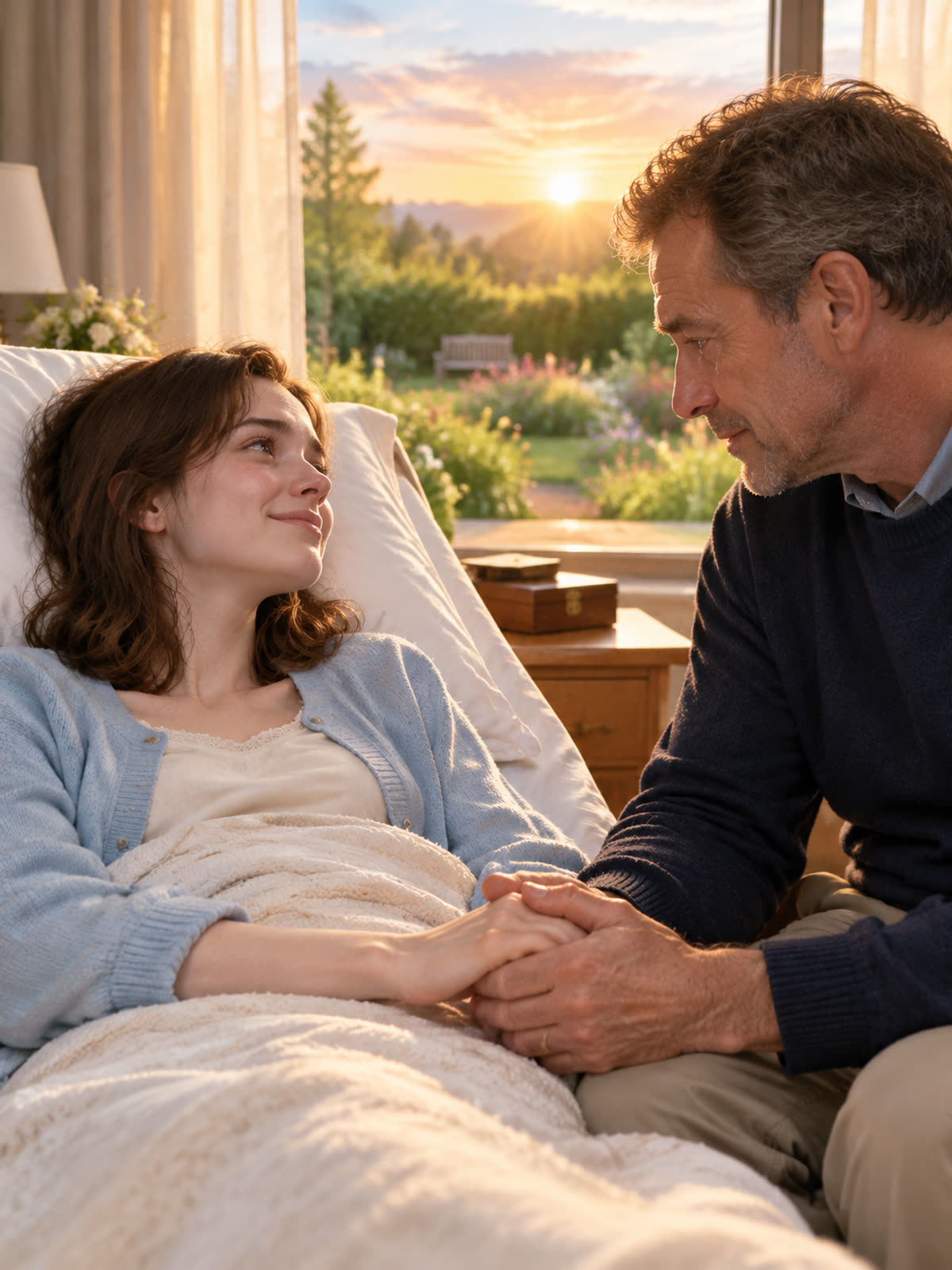
Sunlight spread through the room, and Sophie smiled. Then she reached toward me. I took her hand, and she squeezed mine three times. I answered with three squeezes of my own. There was no need to explain what they meant. Claire had once used that small gesture to tell me she loved me. Now Sophie and I shared it, too. A few days later, she died.
Losing her reopened the grief I had felt after Claire’s death. This time, though, I was grieving someone I had only just begun to know. So much of her life had happened before I entered it, and our time together had been so brief. At her bedside, I found a folded note. Inside was a single sentence. "Now you have someone else who remembers her, Daniel. Please don’t stop telling her stories."
I keep the wooden box beside Claire’s photograph. Occasionally, someone asks whether I ever had children, and my first answer is still no. Then I stop and correct it. "I have a daughter. Her name is Sophie." We were not related by blood, and I never knew her during childhood. What I did have was an afternoon of strawberry ice cream, awful jokes, and a first date I will always remember. I also came to know another part of the woman who had shared twelve years of my life.
For a long time, I believed Claire’s death meant that my family was gone. I was mistaken. There was someone I had not met yet. But the question remains: if a person you loved kept a secret large enough to change your life because they were afraid, would you call it betrayal, or could you understand their wish to protect the family you had built? And if an unexpected bond returned a part of that person to you, would you be brave enough to welcome it?
If this story moved you, there is another about a hairstylist who shaved her head to comfort a wealthy client losing her hair during chemotherapy. The next morning, the woman’s furious husband arrived at the salon with two intimidating men. The hairstylist expected a confrontation and was terrified. Then he spoke—and his next words made her question everything she had worked so hard to build.
Disclaimer: This story is a work of fiction inspired by real-life themes. Names, characters, places and events are fictionalized, and any resemblance to real persons is purely coincidental. It does not represent any person or organization and does not encourage inappropriate behavior. Images are for illustration purposes only.
